Don Herron

The Photography of Don Herron

Born in Brenham, Texas in 1941, Don Herron was an American photographer. Upon graduating from high school in 1959, he served four years in the United States Air Force. Herron received his Bachelor of Arts, and later in 1972, his Master of Fine Arts from the University of Texas at Austin, where he taught studio classes. He moved to San Francisco in the latter part of 1972. 

Inspired by medieval sculptures set in niches and largely self-taught, he began a series of portraits of people posed in bathtubs, which became known as the “Tub Shots”. Herron collaborated with his subjects and allowed them to stage the images. Some of his subjects simply sat in their empty bathtubs, while others wore costumes and created tableaux. The tubs were sometimes filled with water or styrofoam peanuts used for packing. Many of the subjects posed nude; others concealed themselves with bubbles or the limbs of mannequins. 

In 1978, Don Herron relocated to New York City where he became part of the East Village art scene. He continued his series of black and white images by photographing the members of its underground, bohemian community of artists. The “Tub Shots” series contains such personalities as painter Keith Haring, photographers Peter Hujar and Robert Mapplethorpe, filmmaker Peter Berlin, playwrights and drag performers Charles Busch and Ethyl Eichelberger, and actress and Warhol superstar Holly Woodlawn, among others. Through this work, Herron captured both the glamour and camp, as well as the joy and tragedy, that the community experienced in the 1970s.

Herron relocated in the middle of the 1980s to Newburgh, New York, where he became an active member of the Historical Society of Newburgh Bay and the Highlands. He settled in a historical 1836 Federal townhouse which had been designed by Thornton McNess Niven, a Scottish-American architect and master stonecutter who gained fame for his Gothic Revival and Italianate styles. Herron created accurate drawings of his and other historical buildings in the Newburgh area for publication in tour booklets. He also provided artwork for non-profit groups including Habitat for Humanity.

Don Herron also wrote newsprint articles for the Times Herald Record and the Mid-Hudson Times; his writings drew on his personal experiences, including his childhood in Texas and his confrontation with cancer. Don Lee Herron died on December 25th of 2012 at the Castle Point Veterans Administration Hospital surrounded by his many friends.

Herron’s  “Tub Shots” series has been published in New York’s Village Voice, the New York Magazine and in the art journal, Art Forum.  In 2018, the Daniel Cooney Gallery in the Chelsea district of Manhattan held a two month exhibition of Herron’s series which displayed sixty-five black and white photographs dated from 1978 to 1993.  Herron’s work is in the collections of the Chrysler Museum of Art in Norfolk, Virginia; Connecticut’s Aldrich Contemporary Art Museum; New York’s Tang Teaching Art Museum in Saratoga Springs; and the museums of the Universities of Texas, Louisiana, and Toronto. 

Note: Three articles on “Tub Shots” and Don Herron can be found at New York essayist and television producer Brian Ferrari’s informative blog site located at: https://brianferrarinyc.com

Top Insert Image: Don Herron, “Performer Winston Fong, San Francisco”, circa 1972-78, Tub Shots Series, Gelatin Silver Print

Middle Insert Image: Don Herron, Self Portrait, 1993, Gelatin Silver Print

Bottom Insert Image: Don Herron, “Actor Ethyl Sichelberger, NYC”, 1982, Tub Shot Series, Gelatin Silver Print

John Minton, “Portrait of Kevin Maybury”

John Minton, “Portrait of Kevin Maybury”, 1956, Oil on Canvas, 129.4 x 98.8 cm, Tate Museum, London

In April of 1956,  painter John Minton took a one-year hiatus without pay from his position as head of the Painting Department of London’s Royal College of Art. This was at a period in his career when his figurative style of painting was being overtaken by the new movement of Abstract Expressionism. Minton was having profound doubts about the relevance of painting in the modern world and doubts about his own ability as a teacher and a painter.

Shortly after leaving the Royal College, Minton accepted a commission to design stage sets for two productions at London’s Royal Court Theater, “Don Juan” and “The Death of Satan”. These two plays, to be presented by the English Stage Company, were written by playwright Ronald Duncan and had been previously performed, “Don Juan” in 1953 and “The Death of Satan”, a comedy performed in 1954.

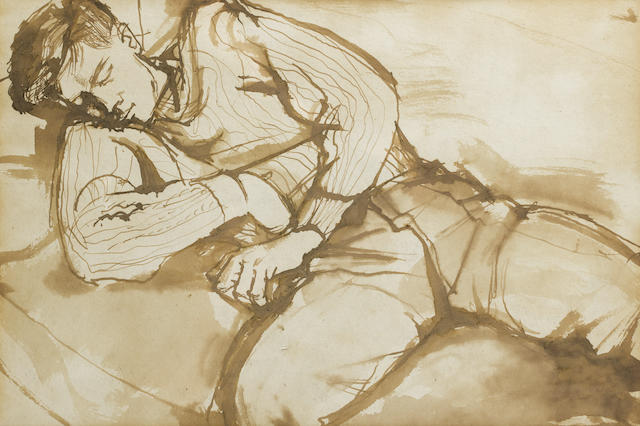
While working at the theater, John Minton met Kevin Maybury, an Australian carpenter working in the scenery department. A relationship developed and by the winter of 1956 Maybury had moved into Minton’s Chelsea house at 9 Apollo Place. Although Minton made several portrait drawings of Maybury, the”Portrait of Kevin Maybury”, shown above, is the only painting of Maybury known to be done by Minton. 

Finding himself out of sync with the new abstract expressionist movement, John Minton found himself left by the wayside in the painting world. He suffered psychological problems and turned to self-medicating with alcohol. In January of 1957, John Minton died, at the age of thirty-nine, from an overdose of sleeping pills in what was ruled a suicide.

After Minton’s death, Kevin Maybury subsequently had a distinguished career as a stage manager in South Africa and was the first person to earn a lifetime achievement award for services to South African theatre. Kevin Maybury died. at the age of eighty-four, in July of 2013 at his home in Johannesburg.

The “Portrait of Kevin Maybury”, most likely painted at the workshop in The Royal Court Theater during the summer of 1956, shows Kevin Maybury, posed and informally dressed,  holding a collapsible ruler and surrounded by the tools of his trade. The surface of the canvas is composed of geometric forms upon which tools lie at angles. The right side of the canvas is dominated by the easel which seems to lie flat on the plane of the canvas surface. This combined with the tilted up floor shortens the depth of the image.

Top Insert Image: Michael Ayrton, “John Minton”, October 1941, Oil on Panel, 41 x 33.5 cm, Private Collection

Middle Insert Image: John Minton, “Kevin Maybury Having a Nap”, 1956-1957, Ink and Wash on Paper, 25.2 x 37 cm, Private Collection

Bottom Insert Image: John Minton, “Kevin Maybury and Spanish Boy”, Pen, Ink, Gouache and Crayon on Paper, 37.3 x 27.3 cm, Private Collection


Wayne Howarth

The Artwork of Wayne Howarth

Based in North West England, Wayne Howarth is a British artist, the son of illustrator Walt Howarth who was known for his interior and cover art of such British serial comics as Doctor Who, The Avengers, and Tarzan .After graduating from Liverpool Polytechnic in 1979, Wayne Howarth became a successful interior designer for many high profile clients throughout Great Britain. In 2009, Howarth changed the focus of his career to drawing, a passion he has had since childhood.

Howarth’s portraiture work is most often done in a combination of mediums. Harris’s figurative images, mainly done in pencil, are combined with surface pattern designs taken from textiles and wall coverings, which are then rendered by Howarth in acrylics and watercolors. Gold and copper leaf are also occasionally applied to the background patterns for embellishment.

Wayne Howarth’s work and contacts, including image purchases and  commissions for portraits, can be found at the artist’s site located at: https://www.waynehowarthillustration.com

Gaston-Marie Martin

Photography and Sculptural Work by Gaston-Marie Martin

Following a lineage of artistic personalities, Gaston-Marie Martin is a French photographer and sculptor who currently lives and works in Paris. His photographic work of male figures  are either in black and white format or tinted with colors.  

Revisiting classical references in his sculptural work, Martin creates reliquaries which, hidden away in their interiors, contain secret, almost ceremonial photographs of male figures. These instruments of memory blend the history of painting and the epic of photography with an archaeology of erotism. The reliquaries raise, in a very personal way, the art medium of nudity to a fascinating form of symbolism.

Gaston-Marie Martin’s works can be found at the artist’s sites located at: 

https://ofleadandlight.tumblr.com

http://gastonmariemartin.blogspot.com


Eliot Elisofon

Eliot Elisofon,“Marcel Duchamp Descending a Staircase”, 1952, Gelatin Silver Print, Image Size 33.5 x 26.8 cm, Mead Art Museum, Amherst College

Born in New York City in April of 1911 to immigrant parents, Eliot Elisofon, born Meyer Eliot Elicofon, was a photojournalist and a documentary photographer. His humble upbringing and childhood struggles inspired his career as a photographer; the human condition with all its struggles became the central focus of his work. 

Elisofon graduated from Fordham University in 1933 and first produced advertising photographs for Vogue and Mademoiselle magazines. By 1937, he was regularly contributing work to Life magazine on a variety of subjects, including theater, military exercises, coal miners, and elite society events. In 1936, Elisofon became a founding member of the Photo League, a cooperative of New York photographers who covered creative and social causes. One of its more active members, he gave lectures, collaborated with sociologist and photographer Lewis Hine on the “Men at Work” project, and taught courses on flash photography and photojournalism. 

In 1937, Eliot Elisofon became associated with filmmaker Willard Van Dyke, Harper’s Bazaar art director Alexey Brodovitch, Beaumont Newhall, the photography curator at the Museum of Modern Art, and Tom Maloney, the editior of U.S. Camera magazine. His first exhibition of his New York street photography was shown at the Pennsylvania Museum of Art and New York’s avant-garde Julien Levy Gallery, In 1938, Elisofon’s “Playgrounds of Manhattan” was shown at the New School, a progressive arts college in New York City. 

Elisofon was hired in 1939 as a photographer in the Federal Writers’ Project, a WPA New Deal Program, for its series “These Are Our Lives”, which contained thirty-seven life histories of both black and white farm laborers, factory and mill workers, and workers in service occupations or on relief. Beginning in 1942, Elisofon was a war correspondent and a photographer for Life magazine; he was the only photographer to accompany General Patton throughout the North African Campaign. These photographs taken during the campaign became part of the exhibition “The Tunisian Triumph”, which opened in June of 1943 at MOMA and later traveled to twenty cities. Elisofon continued to be associated with Life and other magazines until 1972. 

Over the years, Eliot Elisofon traveled to six continents and nineteen books of his work were published during his lifetime. During his photographic journeys around the African continent, Elisofon assembled a collection of African art and took over eighty thousand images; the art and photographs are now part of the collection of the National Museum of African Art in Washington, DC. 

Eliot Elisofon’s photograph “Marcel Duchamp Descending a Staircase” was shot for a ten-page article written by Winthrop Sargeant on Marcel Duchamp, a key member of the Dada movement, for the April 28, 1952, issue of Life magazine. One of Duchamp’s most significant works was his early 1912 painting “Nude Descending a Staircase”, a cubist image in the manner of the chronophotography work of Eadweard Muybridge, who was a pioneer in the study of movement and measurement through multiple image photography. Elison’s 1952 time-lapse photograph of Duchamp descending a flight of stairs was done as a tribute to Duchamp’s famous painting; the image above is one of the two staged shots that Elisofon produced in the photo shoot.

Top Insert Image: Eliot Elisofon, “Self Portrait with Speed Graphic Camera, New York City”, 1936, Gelatin Silver Print

Bottom Insert Image: Marcel Duchamp, “Nude Descending a Staircase (No. 2)”, 1912, Oil on Canvas, 151.8 x 93.3 cm, Philadelphia Museum of Art

Kris Knight

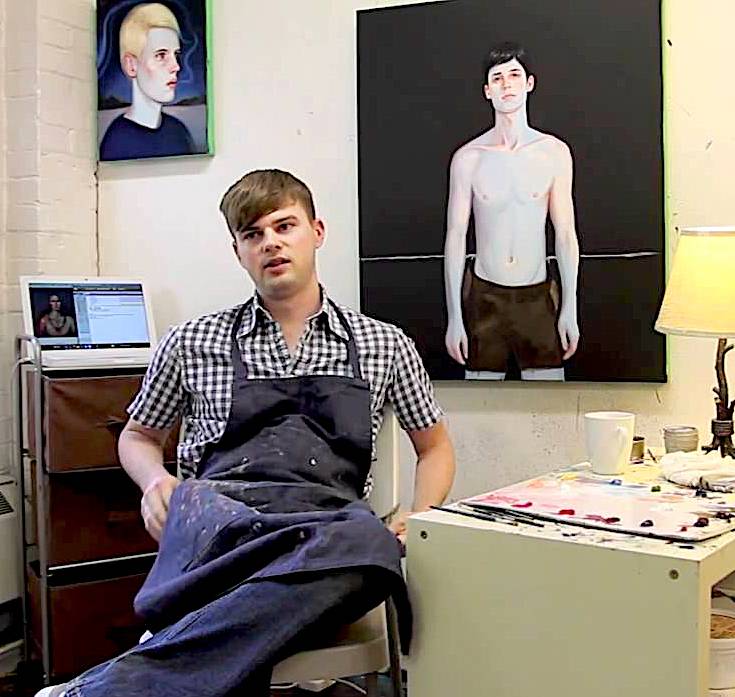
Paintings by Kris Knight

Born in 1980 in Windsor, Kris Knight is a Canadian painter who has been interested in art since a young age. He moved to Toronto at the age of nineteen and studied at the Ontario College of Art and Design, where he majored in Painting and Drawing, with minors in Curating and Criticism.

The majority of Knight’s work, often painted in series, has been portraits based on real people, mostly close friends and family members. He has also produced self-portraits, collaged images taken from mass media, and works on the themes of loss, bonding and secrets. The subjects of Knight’s work have mostly been either young or androgynous-appearing men, who are portrayed in mute color tones effecting a powdered or translucent appearance. His pastels and tonal oil paintings, set in both theatrical and ordinary settings, combine nostalgia and romanticism in their exploration of life’s experiences.

Inspired by an eighteenth-century style of painting, Knight’s work draws from the movements of Romanticism, Symbolism and artwork of the Rococo period. Having had an interest in the era of the French Revolution since a child, he was also inspired by the portraiture work of French painters Louise Élisabeth Vigée Le Brun and Baron Joseph Ducreux. Additional influences came from the works of portrait painter Thomas Lawrence, Baroque painter Nicolas Poussin, and John Singer Sargent, considered the leading portrait painter of his day.

Kris Knight painted his “Lost and Found” series in 2012. This series of portraits dealt with disenchanted youths who subtly play the roles of hunter and the hunted. Often shown wearing furs and masks, the paintings explored the emotional state of being lost and the process of recovery. His 2013 series “Secrets Are Things We Grow” explored secrets that people keep and the bond that forms once a secret is revealed to those held close. The use of patterns and symbols of nature are used to represent the growth of secrets over time.

In 2014, Knight painted his “Smell the Magic” series, which had its premiere, sponsored by Gucci, at the Spinello Project’s pop-up gallery in Wynwood, Florida. The paintings in this series were done with brighter color tones; an influence of surrealism can be seen in the use of Ouija board pointers for eyes and overlaid flower blossoms on faces. In 2017, Knight had a solo exhibition at Art Toronto which contained work in a smaller scale with a more theatrical approach. These works focused on the subject of performance in everyday life and the roles portrayed to others.

Kris Knight began involved in the fashion industry early in his career. His paintings were used for four 2012 covers for Fashion for Men magazine and, in 2014, his paintings’ pastel color palette was credited for Gucci’s men’s ready-to-wear fall and winter collection. Collaborating with Gucci, Knight created several botanical floral prints, based on a previous work in 1966, which were incorporated into creative director Frida Giannini’s designs for Gucci’s Cruise 2015 seasonal wear. Knight’s work was later shown at the group exhibition, “Carte Blanche a Christin Lacroix”, at Paris’s Musée Cognacq-Jay in November of 2014.

Kris Knight’s work is represented by the Spinello Gallery in Miami, Florida, and at Paris’s Galerie Alain Gutharc. His website, which includes upcoming exhibitions, can be found at: https://krisknight.com/home.html .

Middle Insert Image: Kris Knight, “Let’s Not Speak So Heavy”, 2020, Oil on Canvas, 35.6 x 27.9 cm

Emilio Baz Vlaud

The Artwork of Emilio Baz Vlaud

Born in Mexico City in 1918, Emilio Baz Vlaud was a painter whose work mostly included portraiture and scenes in the style of  Costumbrismo, images of local Hispanic life, customs, and mannerisms executed in  both artistic Realism and Romanticism.  Influenced by the Magical Realism movement that spread through the art and literary worlds after the first World War, Vlaud was known for his meticulous brushwork and his trompe-d’oeil technique. 

Emilio Baz Vlaud, at a very early age, had great skill in the arts. He would often watch his older gay brother, Ben-Hur Baz Vlaud, a 1926 graduate of the Academy de San Carlos and twelve years his senior, working on his own precisionist drawings and paintings. At the age of seventeen, Emilio Vlaud executed his first self-portrait, the 1935 “Self Portrait as a Teenager”, a highly refined work that is closely related to a self-portrait painted by his brother in the same year. In his self-portrait, Emilio shows himself with perfectly combed hair and dressed in a white shirt. He is  holding a green pencil at an angle, a position which visually divides the canvas in two,  and is shown gripping his elbow with his left hand. 

Emilio Baz Vlaud entered the Academia de San Carlos in 1938 where he initially studied architecture before changing his vocation to painting. He later took courses at the Escuela Nacional de Artes Plásticas, where he studied under the strict training of painter Manuel Rodríguez Lozano, an openly gay artist whose work is often linked to the works of metaphysical painter Giorgio de Chirico. Vlaud made several visits over the years to his older brother who had moved to New York City and was working as a successful commercial illustrator for magazines, such as Newsweek and Time. 

In 1950, Emilio Vlaud relocated to San Miguel Allende, situated in the far eastern part of Guanajuato. He exhibited his work in several collective exhibitions, where he showed his work alongside such prominent artists as painters and muralists Diego Rivera and David Alfaro Siqueiros. In 1951, Vlaud had his first solo exhibition; his flamenco-inspired technique of applying dry oil paints to surfaces by means of small strokes of a short brush were praised by critics and his fellow artists. During his eight year stay in San Miguel Allende, he received a gold medal for artistic merit from the University of Guanajuato. 

In 1962, Emilio Baz Vlaud entered the Monastery of Santa María de la Resurrecion for the purpose of studying psychoanalysis. After several years, he abandoned these studies to return to his vocation as a painter. Although Vlaud is mostly know for his portraiture and scenes done before 1955, he also went through an intense period of abstraction during the 1970s. In 1984, his work was presented at a collective exhibition entitled “Siete Pintores (Seven Painters)” at the Palacio de Bellas Artes in Mexico City. Emilio Baz Vlaud died in 1991. 

Notes: Vlaud’s 1952 “Portrait of Nazario Chimez Barlet”, the last image in the header collection, sold at Sotheby’s in November of 2024 for $204,o00. This bid was was over the estimated value by a great amount. When the bid was hammered and finalized, applause broke out among the bidders.

Insert Images: Emilio Baz Viaud, “Self Portrait as a Teenager”, 1925, Watercolor, Pencil and Dry Brush on Board, 60 x 39.7 cm, Private Collection

Emilio Baz Vlaud, “El Coco”, circa 1955, Oil on Masonite, 50 x 40 cm, Blaisten Collection

Emilio Baz Vlaud, “Self Portrait in Blue Shirt”, 1941, Watercolor, Pencil and Dry Brush on Board, 100 x 65.5 cm, Blaisten Collection, Mexico City


Robert Rauschenberg

Robert Rauschenberg, “Self Portrait, Black Mountain (1)”, 1952, Gelatin Silver Print, 14.3 x 8.3 cm, Robert Rauschenberg Foundation

While studying at Black Mountain College in North Carolina between 1948 and 1952, Robert Rauschenberg focused his attention on mid-century experimental and abstract photography. His exploration of this medium was influenced by the works of photographer Aaron Siskind, whose detailed images created an innovation in abstract photography; Harry Callahan, a prolific photographer who rigorously curated his work; and educator and photographer Hazel Larson Archer, whose work captured life at Black Mountain.

Rauschenberg used a bold mixture of abstraction, double exposures, experiments with light and shadow, and used blueprint paper to produce photographs with a camera. Many of his earliest photographic experiments were portraits of close companions and people he met in conversations; these include artists such as choreographer and dancer Merce Cunningham and painter Cy Twombly.

A recurring subject of his experimental work was the self portrait, of which the double-exposure image above, “Self Portrait, Black Mountain (1)”, is an example. Shot in 1952, it features Rauschenberg seated on a wooden chair with his hands folded. Ghostly images of weeds and chairs are superimposed over his body.This photograph is a singular work in a portfolio edition of seven related photographs taken during the summer of 1952 at Black Mountain College near Asheville, North Carolina.

Denis Dailleux

Photography by Denis Dailleux

Born in Angers, France in 1958, Denis Dailleux is a portraiture photographer who has been documenting life in Egypt for the past thirty years. His works, done in classical black and white as well as in subtle colors, equally capture Egypt’s famous residents and the anonymous subjects in the slums of Cairo with the same passion and the same distinctive sensitivity.

Dailleux has published a series of photographic books, all of which  portray the settings and people of Egypt, the city of Cairo, and his impressions of the 2011 January Revolution in Egypt. After the publishing of his 2008 “Fils de Roi: Portraits of Egypt”, Dailleux took an exploratory trip to Sub-Saharan Africa in search of new sources of inspiration. This expedition led to a portrait series on the village residents in the country of Ghana.

Denis Dailleux has been awarded several international prizes, including the 1997 Monographies Award, the 2000 World Press Photo Award in the portraits category, the 2000 City of Vevey Hasselblad Award in Switzerland, and the 2001 Fuji Film Award given at Biarritz’s Festival Terre d’Images. Dailleux’s series “Egypt, Mother and Son”, portraits of Egyptian bodybuilders with their mothers, won second prize at the 2014 World Press Photo Awards in the staged portraits category. 

A member of Agence VU, Denis Dailleux currently lives in Cairo, Egypt, where he works as a portrait photographer. His website is located at: https://www.denisdailleux.com/index.php?/

The images above contain photographs from several of Dailleux’s series: “Ghana” and “Egypt“; “Egypt, Mother and Son”,  and “Les Conducteurs de Tuk-Tuk du Cairo”.

Peder Severin Krøyer

Peder Severin Krøyer, “Hunters of Skagen”, 1898, Oil on Canvas, 85 x 139 cm, Private Collection

Peder Severin Krøyer, “Italian Field Laborers, Abruzzo”, 1880, Oil on Canvas, 124.3 x 186 cm, Funen’s Art Museum, Odense, Denmark

Born in July of 1851 in Stavanger, Peder Severin Krøyer was one of the foremost Impressionist painters from Denmark. After moving to Copenhagen at a young age, he began studying painting at the Royal Danish Academy, under realist portrait painter Frederik Vermehren. Kreyer completed his studies in 1870. 

Krøyer had his first exhibition in 1871 at the Charlottenborg Palace, where he presented a portrait of his friend, painter Frans Schwartz. In 1873, he was awarded a gold medal for his work and also received a scholarship. Establishing a long-standing patronage, Danish art collector Heinrich Hirschsprung bought in 1874 the first of many paintings by Krøyer.

From 1877 to 1881, Peder Krøyer traveled throughout Europe where he studied, met artists and developed his skills at painting. Staying in Paris under the patronage of Hirschsprung, he studied under portrait and religious painter Léon Bonnat and exhibited his work in Denmark. Krøyer, during his stay in Paris, became acquainted with the works of the impressionists such as Edouard Manet, Camille Pissarro, Paul Cezanne, and Georges Seurat. Impressed with their work, he kept his palette light in tones and loosened his brushstroke. 

Returning to Denmark in 1882, Krøyer became associated with the Skagen artist colony, a group influenced by the French Impressionists. The colony’s artists placed an emphasis on the effects of light and open-air scenes of local life. Krøyer divided his time between Copenhagen, where he continued his portraiture work, and Skagan, where he painted the artist colony and local landscape.

Peder Krøyer encountered painter Marie Martha Triepcke on a trip to Paris in 1888. They married in July of 1889 at her parents’ residence in Germany. Settled with his wife in the Skagen colony, Krøyer executed his first major oil painting, the 1888 “Hip Hip Hurrah! Artists Party at Skagen”. Inspired by a gathering at painter Michael Ancher’s residence, the painting depicts men and women toasting with champagne amid lush trees; gentle sunlight is seen being cast upon the participants and their table.

A champion of plein air painting, Krøyer is best known for his carefree images of life in Skagen. He was fascinated with the depiction of light; his main study was the depiction of the “blue hour”, that point as the day becomes evening when the sky and sea merge in the same tone of blue. Examples of this light depiction are the 1892 “Summer Evening at Skagen” and the 1893 “Summer Evening on Skagen’s South Beach with Anna Ancher ad Marie Krøyer”. 

Over the last ten years of his life, Krøyer’s  eyesight gradually failed him until he was totally blind. He painted almost to the end, even executing masterpieces while half-blind. One of his last important large-scale works was the 1906 “Midsummer’s Eve Bonfire on Skagen Beach”, now in the Skagens Museum. After many visits to the hospital suffering from bouts of mental illness, Peder Severin Krøyer passed away in Skagen at the age of fifty-eight in November of 1909.

Peder Krøyer achieved many prestigious awards during his lifetime, including induction into the Legion of Honor in 1888. The largest collection of Krøyer’s work can be found in the Skagens Museum; other museum collections include the Danish National Gallery, the Frederiksborg Museum, the Musée d’Orsey in Paris, the Philadelphia Museum, and the Royal Danish Academy in Copenhagen.

Insert Images: Peder Severin Krøyer, “Self Portrait”, 1897, Oil on Panel, 40.9 x 31.6 cm, Hirschsprung Collection, Copenhagen, Denmark

Peder Severin Krøyer,, “The Artist’s House”, Date Unknown, Oil on Canvas

Photographer Unknown, “Peder Severin Krøyer:, Date Unknown

Imre Szobotka

Imre Szobotka, “Fiatalkori Onarckép (Self Portrait as a Young Man)”, 1912-14, Oil on Canvas, 45.5 x 38.2 cm, Hungarian National Gallery, Budapest

Born in Zalaegerszeg, Hungary, in September of 1890, Imre Szobotka was a painter and engraver. Between 1905 and 1910, he studied at Budapest’s School of Design under painter Ignác Újváry. Szobotka traveled to Venice in 1908 for a study trip and traveled to Rome in 1909, this time accompanied by his friend Ervin Bossámyl. He relocated to Paris in 1911, where he lived at the residence of avant-garde sculptor and graphic artist József Csáky, one of the first Parisian sculptors to apply pictorial Cubism to his art.

Szobotka attended the 1911 Independent Salon in Paris, where he viewed the works of the Cubist painters. Inspired by their work and with the encouragement of his friend, the Cubist painter József Csáky, he enrolled at the La Palette School of Art in 1912, where he studied under Cubist painters Jean Metzinger and Henri Le Fauconnier. By the spring of 1913, Szobotka’s works, exhibited in the Independent Salon, were already noticed by the French critics, including writer and critic Guillaume Apollinaire. 

During World War I, Imre Szobotka was interned as a prisoner of war, starting in 1914 in Bretagne and later, at Saint Brieuc, France, until his release in 1919. The landscapes, still lifes, and portraits made in the internment period were experiments in cubism, symbolism, and orphism, a cubist offshoot that focused on abstraction and bright colors. These works, rare examples of Hungarian Cubism,  included his 1914 “Pipe Smoker”, the 1916 “Sailor”, and watercolor illustrations he produced for poet Paul Claude’s “Revelation”.

After his return to Paris in 1919, Szobotka’s paintings contained a more naturalistic expression. He exhibited this new work first in 1921 in Belvedere, a commune in the Vesubie Valley north of Nice, and, between 1929 and 1944, in shows at the Tamás Gallery, the Fränkel Salon, and the Mária Valéria Street gallery. The solid, defined construction of these landscape works by Szobotka insured him a place among the Nagybánya artists, whose work was focused on plain-air painting.

Imre Szobotka was a founding member of Képzőművészek Új Társasága, the New Society of Fine Artists, and presented his work in its exhibitions. For his 1929 “Mill in Nagybánya”, he won the landscape award presented by the Szinyei Society, an artistic association founded after painter and educator Pál Szinyei Merse’s death to promote new artists. Szobotka would later enter the “Mill in Nagybánya” at the 1938 Venice Biennial. In 1941, he won the Szinyei Society’s grand award for his exhibited work. 

From 1945 onward, Szobotka produced some graphic work; however, his main concentration was on his landscapes. He spent his last summers in the countryside near the village of Zsemmye where he painted pastoral landscapes. Szobotka became president of the painting division of the Fine and Applied Arts Alliance in 1952. For the body of his work, he received the Munkácsy Award in 1954 and the Socialis Work Order of Merit in 1960. Imre Szobotka died in March of 1961, at the age of seventy, in the city of Budapest.

Imre Szobotka’s “Self Portrait as a Young Man” is one of the key creations of his Parisian years. It shows his embrace of the elements of cubism, particularly the coloring and abstraction of its orphism branch. The main emphasis of the work is not the formal structure with its conventionally postured figure, but rather the way the light breaks its components into prisms of color. Szobotka emphasized his sense of light value and his translucent colorization to form a refined play of reflections, which cut the painting’s solid forms into colored shards.

Insert Images:

Imre Szobotka, “Sailor”, 1916, Oil on Canvas, 35 x 29 cm, Janus Pannonius Museum, Péca

Imre Szobotka, “Gathering Apples”, 1930, Oil on Canvas, 55 x 76 cm, Henman ottó Museum, Miskolc

Imre Sobotka, “Self Portrait”, 1912, Oil on Cardboard, 53 x 45 cm, Private Collection

Felice Casorati

The Paintings of Felice Casorati

Born in December of 1883 in Novara, Felice Casorati was an Italian artist known for his sculptures and paintings, which were rendered from unusual perspectives and often featured obscure symbols. He spent his formative years in the northeastern city of Padua where he developed an interest in literature and music. Casorati studied law at the University of Padua, graduating in 1906, and frequented the atelier of  painter and sculptor Giovanni Viannello.  

Casorati began painting in 1902; his earliest paintings were influenced by the symbolism of the Vienna Secession, a movement, closely related to Art Nouveau, which sought to unite all the disciplines of art into one movement. These early works of Casorati were exhibited at the 1907 Venice Biennale. Casorati’s adherence to symbolist ideals was reinforced after meeting and seeing the work of Austrian painter Gustav Klimt, one of the founders of the Vienna Secession, at the 1910 Vienna Biennale. 

Felice Casorati spent the years between 1908 and 1911 in Naples, where he often visited the Museo di Capodimonte and viewed the work of Pieter Bruegel the Elder, the Dutch Renaissance painter whom he particularly admired. Casorati relocated to Verona in 1911, where, along with poet and engraver Umberto Zerbinati and painter and graphic artist Pino Tedeschi, he founded the periodical “La Via Lattea (The Milky Way)”, for which he executed several symbolist woodcuts. For a brief period between 1914 and 1915, he abandoned his secessionist style and made expressionist woodcuts in the manner of Tuscan artists, such as Lorenzo Viani and Moses Levy.

Casorati’s first solo exhibition of his symbolist-influenced work was at the 1915 Secession III show held in Rome. Before being drafted into the Italian Army in 1915, he also executed his first sculptures in varnished terra cotta, a medium also favored by his friend, the sculptor Arturo Martini. After the end of World War I, Casorati settled at Turin in 1918 and became a prominent figure in the intellectual and artistic circles, including the conservative Return to Order movement which called for the rejection of the avant-garde in favor of a more traditionalist approach. 

In Turin, Felice Casorati established friendships with composer and pianist Alfredo Casella and with the anti-fascist, political activist Piero Gobetti, who founded in February of 1922 the weekly magazine “De Rivoluzione Liberale”. Casorati supported the magazine and Gobetti , in return, championed Casorati’s work in Marxist writer and journalist Antonio Gramsci’s weekly newspaper, the “Ordine Nuovo”. Due to his radical associations, Casorati was arrested with an anti-Fascist group by the authorities for a brief period in 1923 and, subsequently, avoided antagonizing the regime.

The work Casorati produced in the 1920s was radically different from his pre-war work, which he now considered to be immature. The figures in his new work were solidly constructed and set securely in spaces organized by linear perspective theories established in the Italian Renaissance period of the fifteenth-century. Casorati was also influenced by Italian painter Andrea Mantegna’s work with its dramatically foreshortened figures, and the work of painter Piero della Francesca, known for his mathematical treatises and geometrically-composed paintings. 

In 1922, Felice Casorati painted what is considered his most famous work “Silvana Cenni”, a portrait inspired by the work of Piero della Francesca, which features a stern woman in a seated, symmetrical,  frontal view positioned in front of an open window. This tempera work on canvas, composed of carefully rendered volumes, became an iconic portrait of the traditional and period art of Italy which is now known as Magical Realism. 

Beginning in 1923, Casotati opened his atelier to young art students in Turin, many of who would form Torino’s Group of Six, and emerging artists such as self-taught artist and writer Quinto Martini. He was also the co-founder of the Antonio Fontanesi Fine Arts Society, which organized exhibitions of both nineteenth-century and contemporary Italian and foreign art. Casorati was appointed a Professor of Interior Design in 1928 at Turin’s Accademia Albertina, a post he held until appointed as its Chair of Painting in 1941.  

Felice Casorati was commissioned by his patron, Turin industrialist Ricardo Gualino, to work with architect Alberto Sartoris on the Piccolo Teatro in Milan and other decorative works. Casorati also designed costumes and sets for Milan’s Teatro alla Scala and the Maggio Musicale, the annual arts festival in Florence. Once again working with Sartoris, he  designed a building for part of the Piedmontese Pavilion at the 1927 International Biennale in the city of Monza. Casorati  exhibited his work widely throughout Italy and won the First Prize at the 1939 Venice Biennale.

The majority of Casorati’s later paintings were done in a softer palette with  a more gentle perspective. He produced over one hundred-fifty prints in his lifetime, in which he experimented with a variety of techniques that incorporated slate, papyrus and terra cotta matrixes. The simplified mannequin-like figures, which featured in Casorati’s prints of the late 1920s, remained in his etchings, linocuts, and lithographs for the length of his career.

Felice Casorati passed away on March 1, 1963. Most of his important works are in Italian private and public collections, including Trieste’s Modern Art Revoltella Museum and  Rome’s National Gallery of Modern Art. Museums holding Casorati’s art in their collections include the British Museum, the Metropolitan Museum of Art in New York, and the Musrum of Fine Arts in Boston, among others.


Enrique Toribio

Enrique Toribio, Red Series, Limited Edition Series, Model Unknown

Enrique Toribio is a Spanish photographer who currently lives and works in Madrid. He studied Design at Madrid’s School of Arts and Crafts and later earned a degree in Industrial Pattern Design. Since the mid-1980s, Toribio has been involved in couture costume design for theatrical productions of work by Chekhov, Ibsen, and Tennessee Williams. He has also designed costumes for cabaret and dance productions, both Spanish and classical. 

Beginning in 2003, Toribio has concentrated on his photography with an emphasis in figurative and portraiture work. Particularly interested in the aesthetic treatment of body and facial expressions and textures, he endeavors to recreate the appearance of mid-twentieth century photography with the use of digital technology.

Enrique Toribio has participated in several international photography exhibitions, including the Second Great LGBT Photo Show at Leslie & Lohman in New York City, and multiple exhibitions in Spain, including “ABRAZOS” at the Museum of Contemporary Art Conde Duque in Madrid. He has received recognition for his work at Argentina’s FotoRevista competitions in both 2017 and 2018, and received Third Prize at FotoRevista in February of 2018. Toribio’s work has also appeared in several digital photographic magazines and has been included in Joris Buiks’ 2011 phtotographic anthology “Turnon: Tattos”, published by Bruno Gmunder.

Enrique Toribio’s photographic work is available through Saatchi Art: https://www.saatchiart.com/etoribio

The artist’s website is located at:  https://etoribio.com


Gabriel Morcillo Raya

The Paintings of Gabriel Morcillo Raya

Born in Granada, Spain, in February of 1887, Gabriel Morcillo Raya was a painter and teacher. His oeuvre is composed mainly of figurative works and landscapes influenced by Orientalism, a movement which was particularly influential in Spain, due to Spain’s exceedingly dense and complex  relations with Islamic culture.

Gabriel Raya initially studied painting under the tutorage of his aunt Paquita Raya. He later attended Granada’s School of Fine Arts, where he studied under landscape and genre painters Miguel Vico Hernández and José de Larrocha González. In 1907, Raya relocated in Madrid to continue his studies under Valencian painter and illustrator Cecilio Plá y Gallardo: however, due to financial reasons, he was impelled to return to his hometown of Granada. In 1910, Raya received a grant from the Granada Provincial Council which enabled him to travel back to Madrid for further studies. 

Raya exhibited his work during his years in Madrid and earned in 1912 an honorable mention for the work he presented at National Exhibition of Fine Arts. In the same year, he was appointed director of the Residence of Painters of the Alhambra. Two years later, Raya returned to Granada and, in 1918, was awarded a scholarship to the Academy of Painting in Rome, which he did not accept. His work began to challenge the pictorial content of the time with its more concrete detail and use of movement and color.

In 1925, Gabriel Raya became an academician of the Royal Academy of Fine Arts of San Fernando, Granada’s Royal Academy of Fine Arts, and the Royal Academy of Fine Arts at San Telmo. He accepted the position as Professor of Decorative Painting and Natural Figure in 1927 at Granada’s School of Arts and Crafts, where he influenced several generations of local artists, among whom was the painter José Guerrero whose later work  became known for its chromatic masses of color, and Miguel Pérez Aguilera, whose development of his own pictorial language played an important role in contemporary Spanish art.

Raya had his first exhibition of his orientalist works in 1944 in Granada and achieved great success at exhibitions held in Buenos Aires, New York City, and Venice, Italy. During the period from  1955 to 1960,  he traveled to Madrid to paint portraits of Francisco Franco and his wife, and Admiral Carrero Blanco and other members of Madrid’s high bourgeoisie. Raya received the Silver Medal of the Red Cross, a decoration for those people whose voluntary actions supported the Spanish Red Cross, and, in 1951, the Grand Cross of the Order of Alfonso X the Wise for merit in the field of culture. 

Gabriel Morcillo Raya passed away in Granada in December of 1973, at the age of eighty-five. Several of his works, including the 1916 “Dwarf El Puerto Real”, can be seen in the collection of Granada’s Museum of Fine Arts. 

Note: An interesting article on the orientalist movement is “Editorial: Spain and Orientalism” by Anna McSweeney and Claudia Hopkins which is located at Taylor & Francis Online:  https://doi.org/10.1080/17561310.2017.1316039

Insert Images: 

Gabriel Morcillo Raya, “Muchachos”, Initial Stucy, Date Unknown, Watercolor on Paper, 57 x 47 cm, Private Collection

Gabriel Morcillo Raya, “Self Portrait”, Date Unkonw, Oil on Canvas, Private Collection

Herbert List

Photography by Herbert List

Herbert List was a classically educated artist who combined his fascination with  Surrealism and Classicism with his love for photography. His austere, classically posed black and white compositions, particularly his Greek and Italian homoerotic nudes, became a prominent influence on both fashion and contemporary photography. 

Born in Hamburg, Germany, in October of 1903 to a wealthy business family, Herbert List  studied art and literature between 1921 and 1923 at the University of Heidelberg. In 1923, he began to travel for the family’s coffee business, Kaffee-Import Firma List & Heineken. List made contacts and visited plantations in Costa Rica, Guatemala, Brazil and El Salvador; during this four year period, he began to record his travels photographically.  

Through his connections to the European avant-garde, List became associated with  American photographer Andreas Bernhard, known for his dynamic black and white city scenes and natural structures. Bernhard  introduced him to the Rolleiflex camera which allowed for more sophisticated compositions. Beginning in 1930, influenced by the Bauhaus artists and  the emerging surrealist movement, List began photographing still life and portraits of friends, often employing draped fabrics, masks, and double exposures. 

Once the National Socialist Party was in control of Germany, the Gestapo began to pay attention to Herbert List’s openly gay lifestyle and Jewish heritage. In 1936, he left Germany for Paris and decided to begin a professional career as a photographer. During 1937 List maintained a studio in London and held his first solo show at Galerie du Chasseur d’Images, the first Paris gallery dedicated to photography.  Starting in 1936 with a reference from fashion photographer George Hoyningen-Huene to Harper’s Bazaar magazine, List began a three year period working as a fashion photographer for various magazines, including Verve, Vogue, and Life.

Dissatisfied  with fashion photography, List returned to his still life and portraiture  work. He traveled throughout Greece from 1937 to 1939 where he took photographs of ancient temples, sculptures and landscapes; two hundred of these photographs would be published in his 1953 “Licht Über Hellas: Eine Symphonie in Bildern”. During this time, List supported himself with work for magazines and the press, and by doing portraiture work. 

Working in Athens, Herbert List hoped to escape World War II; however, when troops invaded Greece, he was forced in 1941 to return to Germany, where, due to a grandparent’s Jewish heritage, he was denied the ability to work or publish professionally. Near the end of the war in 1944, despite his Jewish heritage, he was drafted into the German military and served in Norway as a map designer. A trip to Paris during his military service allowed him the opportunity to photograph images of Jean Cocteau, Pablo Picasso, Georges Braque, Jean Arp, Joan Miró, and other artists.

After the war, List continued to live in Munich until 1960, where he photographed its ruins and produced freelance photo essays for newspapers and magazines such as Look, Picture Post, Heute, and Harper’s Bazaar. List was made art editor in 1948 for the Swiss-German language, daily free newspaper Heute, which was published by the Allied Forces. In 1951 through an invitation by photojournalist Robert Capa, he started contributing photographs to Magnum, an international photographic cooperative. 

Through the next decade Herbert List focused his interest on photographing life in Italy. where he shot photo essays, street scenes, architectural views, and portraits using a 35 mm camera and a telephoto lens. His work became more spontaneous and was influenced by the Italian neorealist film movement and the work of his Magnum colleague Henri Cartier-Bresson. List ’s travels for his photographic work was extensive, including trips to Spain, France, Mexico, and the Caribbean. 

List’s publications include “Rom”, a collection of his work in Rome, published in Munich in 1950:“Caribia”, his Caribbean Island series published in 1958: “Nigeria”, published in 1963; and “Napoli”,  a 1962  collaboration with Italian director Vittorio de Sica. List is best known for his  1988 book “Junge Männer”, a collection of seventy images of young men lounging in the sun, wrestling, or gazing at the camera. The introduction of the book was written by English novelist Stephen Spender, who fictionalized List as Joachim Lenz in his novel “The Temple”. 

Herbert List passed away in Munich on the 4th of April in 1975. His archive of photographs, originally part of the Ratjen Collection, is now housed in the National Gallery in Washington DC. His work is held in many private and public collections, including New York’s Metropolitan Museum of Art, Boston’s Museum of Fine Art, Kunsthaus Zürich, Cologne’s Museum Ludwig, Munich;s Stadtmaueum, and the Musée Picasso in Paris.

Insert Images:

Herbert List, “Self Portrait, Herrsching”, 1947, Silver Gelatin Print

Herbert List, “Man and Dog”, 1939, Gelatin Silver Print

Photographer Unknown, “Herbert List and Max Scheler, Venice”, 1952, Silver Gelatin Print, Mas Scheler Estate

Herbert List, “Young Man Under Reed Roof, Torremolinos”, 1951, Gelatin Silver Print