Marsden Hartley

Paintings by Marsden Hartley

Born in Lewiston, Maine on January 4th of 1877, Marsden Edmund Hartley was an American Modernist painter, poet, essayist and author.  The youngest of eight children, he remained, at the age of fourteen, with his father in Maine after the death of his mother, his siblings having moved to Ohio after the death. A year later in 1892, he joined his family in Cleveland, Ohio, where he began formal art training at Cleveland’s School of Art under a scholarship.

In 1898, Hartley relocated to New York City to study painting under Impressionist William Merritt Chase at the New York School of Art; he also associated with member artists from  the National Academy of Design. Hartley became a close friend and admirer of allegorical and seascape painter Albert Pinkham Ryder, whom he often visited at his Greenwich Village studio. He also read the writings of Walt Whitman and the American  transcendentalists such as Emerson and Thoreau.

Between 1900 and 1910, Marsden Hartley spent his summers in the city of Lewiston, located in southern Maine, and the region of western Maine near the village of Lovell. During these summers, he painted what are considered his first mature works, images of Kezar Lake located near the town of Lovell, and Maine’s hillsides and mountains. In 1909, Hartley exhibited these paintings at his first solo exhibition in art promoter Alfred Stieglitz’s internationally-known Gallery 291, located in Manhattan. Impressed by Hartley’s work, Stieglitz introduced him to the work of the European Modernist artists, such as Picasso, Kandinsky and Matisse.

Hartley traveled to Europe in April of 1912, the first of many visits, and in Paris became acquainted with Gertrude Stein and her circle of  writers and artists. He was encouraged by Stein, along with poet Hart Crane and novelist Sherwood Anderson, to write as well as paint. Disenchanted after living in Paris for a year, Hartley relocated to Berlin in April of 1913 where he became friends with Wassily Kandinsky and Franz Marc, and continued his painting. Of his work done in Berlin, two of his still life paintings, inspired by the work of Cézanne, and six charcoal drawings were included in the historic 1913 Armory Show in New York.

Marsden Hartley’s work during this period in Berlin was a combination of German Expressionism and abstraction; his work was also inspired by the pageantry of the German military, though his view of the military changed with the outbreak of war in 1914. In Berlin, Hartley developed a close relationship with a lieutenant in the Prussian Armed Forces, Karl von Freyburg, who was a cousin of Hartley’s friend Arnold Ronnebeck. Infatuated with Freyburg, Hartley would use him as a recurring motif in his works. Although Freyburg survived the Battle of the Marne, for which he was awarded the Iron Cross, he died on October 7th in 1914, at the age of twenty-four, during the Battle of Arras. Hartley was devastated at the announcement of Freyburg’s death.

The works Hartley produced shortly after Freyburg’s death were variations on his post-war themes. However, along with the regimental plumes in his paintings, there were now numbers and letters which had deep significance to Hartley. They included the “K.v.F.” of Freyburg’s initials, coded references to the Iron Cross, Freyburg’s age and regiment numbers, and black and white checkered patterns which referenced Freyburg’s favorite game, chess. Two examples of these memorial pieces are “Portrait of a German Officer” and “Portrait No. 47”, both painted in Berlin and seen in the images above.

Marsden Hartley returned to the United States in early 1916. He traveled and painted from 1916 to 1921 in Provincetown, New York, New Mexico, and Bermuda. Although his works still contained some German iconography, he also painted other subjects, often with homoerotic undertones. After an auction of one hundred of his works at New York’s Anderson Gallery in 1921, Hartley returned to Europe and created still lifes and landscapes using the drawing medium of silverpoint. 

Throughout the 1930s, Hartley spent summers and autumns in New Hampshire painting scenes of its mountains. Awarded a Guggenheim Fellowship, he spent time painting in Mexico which was followed by a year in the Bavarian Alps. After a few months in Bermuda in 1935, Hartley traveled by ship to Blue Rocks, Nova Scotia, where he lived for two summers with the Mason family, who earned their living as fishermen. The deaths of the two Mason brothers, drowned in a hurricane, greatly affected Hartley and inspired a series of portrait paintings and seascapes. Hartley returned to Maine in 1937 where he remained for the rest of his life. He died in Ellsworth, Maine, at the age of sixty-six, on September 2nd of 1943.

Marsden Hartley was not overt about his homosexuality and often diverted attention to other aspects of his work. Most of his works, such as “Portrait of a German Officer”, a homage to Freyburg, and his 1916 “Handsome Drinks”, one of the first paintings Hartley did after his reluctant 1916 return to the United States, are coded in their reference to his sexuality. When he reached his sixties, he no longer felt unease and his works became more intimate, such as his two 1940 paintings “Flaming American (Swim Champ)” and the  “Madawaska-Acadian Light-Heavy”, seen in one of the above inserts. 

Top Inset Image: Marsden Hartley, “Green Landscape with Rocks, No. 2”, 1935-1936, Oil on Board, 33 x 45.4 cm, Brooklun Museum, New York

Second Insert Image: Richard Tweedy, “Marsden Hartley”, 1898, Oil on Canvas, 66 x 45.7 cm, National Portrait Gallery, Washington DC

Third Insert Image: Marsden Hartley, “Abstraction”, 1912-1913, Oil on Canvas, 118 x 101 cm, Private Collection

Bottom Insert Image: Marsden Hartley, “Madawaska-Acadian Light-Heavy”, 1940, 101.6 x 76.2 cm, Chicago Art Institute

Simkha Simkhovitch

Simkha Simkhovitch,”Fishermen”, 1948, Pencil, Watercolor and Gouache on Paper on Board, 73.3 x 45.7 cm, Private Collection 

Born in the city of Novozybkov in June of 1885, Simka Faibusovich Simkhovitch was a Russian artist. He began drawing at the age of seven when confined to his room with a severe case of measles. In 1905, Simkhovitch started studying at the Grekov Odessa Art School, one of the oldest art schools in the Ukraine. Upon his graduation in 1911, he received a recommendation for admittance to the Imperial Academy of Arts in Saint Petersburg, which was considered a notable honor at that time. 

Though he began courses in architecture, sculpture and painting, Simkhovitch was dismissed from the Imperial Academy in December of 1911 due to the quota on Jewish students and was drafted into the army. During the first World War, he served as a private until his demobilization in 1912, at which time he reenrolled at the Imperial Academy. Like many others, Simkhovitch was caught in the chaos of the Russian Revolution in 1917; however, he survived and continued his work under the new Soviet government. 

In 1918, Simka Simkhovitch exhibited paintings and sculptures in an exhibition of Russian Jewish artists and, in 1919, placed first in “The Great Russian Revolution” competition with his painting “Russian Revolution”. This painting was added to Saint Petersburg’s historical State Museum of Revolution’s collection. Simkhovitch exhibited his work at the 1922 International Book Fair held in Florence, Italy. Two years later, he traveled to the United States for the purpose of illustrating Soviet textbooks; however, once in the country, he made the decision to immigrate and remain in New York City.

Initially supporting himself by portrait commissions and commercial art, Simkhovitch was hired to paint a theatrical screen for the play “The Command to Love” which was playing at Broadway’s Longacre Theater. This started his career as a screen painter for the theater and brought him to the attention of screenwriter Ernest Pascal, known for his screenplay of “The Hound of the Baskervilles”, who gave him work as an illustrator. Pascal, in turn, introduced Simkhovitch to gallery owner Marie Sterner who purchased two paintings and held solo exhibitions of his work at her gallery in 1927 and 1928. These shows were followed by a solo exhibition of his circus paintings, also at the Marie Sterner Gallery, in 1929.

Simka Simkhovitch moved in the early 1930s with his wife, Elsa, and his three daughters to Conneticutt where he established a studio in his house. There he continued to produce works by commission during the Great Depression years. After a solo exhibition at New York City’s  Helen Hackett Gallery in 1931, Simka Simkhovitch became one of the featured artists at the 1931 exhibition held at San Fransisco’s California Palace of the Legion of Honor located in Lincoln Park. Coordinated by Marie Sterner, the exhibition featured four of Simkhovitch’s watercolors, including his “Nudes”, now in a private collection. 

Beginning in 1936, Simkhovitch began working with the Works Progress Administration, WPA, painting murals for public buildings in the United States. His first work was a 1938 mural for the Jackson, Mississippi, post office and courthouse. Painted on the wall behind the judge’s bench, “Pursuits of Life in Mississippi”, a depiction of black workers engaged in manual labor amid scenes of white professionals and socialites, was eventually covered over in later years during renovations due to its stereotypical imagery. 

In 1936 after winning a competition for the work, Simkhovitch received a commission for four murals at the Beaufort, North Carolina, post office. Upon his return to Conneticutt, he painted the four mural panels depicting the 1886 tragedy of the schooner Crissie Wright, driven onto rocks off the coast of Beaufort, North Carolina, during a winter storm, which resulted in the deaths of all six sailors, four frozen to death. These panels were installed in the Beaufort post office in 1938. The completed mural was  later restored in the 1990s by Elisabeth Speight, the daughter of two muralist who had worked with the WPA.

In February of 1949, Simka Simkhovitch purchased a home in Milford, Conneticutt for his family; the property included a barn which was to be his studio. While in the process of moving, he developed pneumonia and died two weeks later on the 25th of February, at the age of fifty-six. Simkhovitch’s work is in private collections and in numerous museums, including the Polish National Museum in Krakow, the Dallas Museum of Art, the National Museum of American Art in Washington DC,  and the Whitney Museum in New York City. A collection of his papers is housed in the Archives of American Art at the Smithsonian Institution.

Top Insert Image: Simka Simkovitch, Title and Date Unknown, (Picnic), Oil on Canvas, Private Collection

Middle Insert Image: Simkha Simkhovitch, “Self Portrait with Family”, Date Unknown, Private Collection 

Bottom Insert Image: Simka Simkovitch “Boxers”, 1932. Oil on Canvas, Private Collection 

J. Carino

The Artwork of J. Carino

Based in Riverside, California, J. Carino is a figurative artist whose work illustrates the interconnection between man with his sense of self-awareness and the natural world, both literal and symbolic. A  2011 graduate of the Parsons School of Design in New York City, he works in a variety of mixed-media techniques and often uses distortion and abstraction in the construction of his work’s figures.

Carino’s images depict nude, queer figures, often monumental in size, who are set in landscapes both idyllic and suffused with danger. Applying ideas from his study of the decorative arts, he explores the concepts of queerness, self-identity, queer intimacy, sensuality, and man’s relationship with the natural world through images of richly colored and patterned, layered figures and flora. During the evolution of his work’s creation, Carino often adds and removes the layers of landscape and figures to achieve the desired result.

J. Carino’s work has appeared in multiple exhibitions both in the United States and overseas. These include both the Act 1 and Act 2 Summer Stage exhibitions at Auxier/Kline in New York, the 2021 online “Eye Candy” exhibition by the WB Gallery,  the 2020 Art Pride International, and, in the United Kingdom, the 2022 collective “Come Out & Play” at London’s BEERS gallery and the 2019 exhibition at Rye’s McCully & Crane Gallery, among others. 

“Like many queer people, there is a dichotomy of wanting to be seen as a whole person, sexuality included, but also the fear of people seeing too much. My figures, often self portraits, inhabit landscapes of abundance and fertility, lush with ferns and fruit, like an eden where these fears dissipate. Through my work, I explore the complicated influence of intimacy, sexuality, and being seen, especially as it relates to gay relationships and our ability to connect with one another and ourselves.” —J. Carino

J. Carino’s work can be found at the artist’s site located at https://www.jcarinoart.com  and  also at the following gallery locations  https://linktr.ee/j.carino.art

Bottom Insert Image: J. Carino, “Self Portrait”, Date Unknown, Mixed Media on Paper

Piero Fornasetti

The Artwork of Piero Fornasetti

Born in Milan, Italy in November of 1913, Piero Fornasetti was an eclectic artist who was an important figure in the Italian design scene. A prolific creator of designs, he was involved in many aesthetic disciplines including painting, drawing, graphic design, and product design. In the course of his career, Fornasetti created over ten thousand works and was responsible for one of the largest outputs of diverse objects and furniture of the twentieth-century. 

The first child of a wealthy family, Fornasetti was already at the age of ten drawing and displaying an innate inclination towards art. In 1932, he enrolled at the Academia di Brera, Milan’s public academy of fine arts; however, two years later he was expelled for insubordination. Although he applied to Milan’s Superior School of Arts Applied to Industry, Fornasetti was unable to adhere to the schools dogma due to his rebellious nature. 

Beginning in the early 1930s, Piero Fornasetti began a individual and comprehensive study of  engraving and printing techniques. With this knowledge and his developed technical skill, he began to print artist books and lithographs for many of the great artists of the time, including composer and playwright Alberto Savinio, painter Fabrizio Clerici, and painter and writer Giorgio de Chirico. The Fornasetti Art Printshop became the source of quality printing for many artists of his generation. Fornasetti, through his constant experimentation, later developed a printing method for graphic effects on silk; this innovation brought him  to the attention of designer and publisher Gio Ponti, with whom Fornasetti would develop a close creative partnership. 

From the early 1940s and onward, Fornasetti produced a vast series of limited edition graphic works, which included calendars, holiday gifts, and images for advertising, theater, posters, and publications. He produced sketches and drawings for the Esino Lario School of Tapestry, whose fine silk tapestries were produced by local village girls. In 1940 Fornasetti began to publish his own work in the architectural design magazine Domus, and for two years designed a series of almanacs for Gio Ponti. Taking refuge in Switzerland in 1943 during the war, he continued his graphic work, expanding into watercolors, oil portraits, drawings in ink, and the creation of theatrical sets for Albert Camus’s 1938 “Caligula”.

Upon his return to Milan, Piero Fornasetti and Gio Ponti began a close creative partnership which centered on architectural concepts in design and decoration. With the beginning of the 1950s, they put their theories into practice developing new simple and functional designs for the interiors of homes, apartments, cinemas and even ship cabins. Their initial project, the “Architettura” trumeau, a furniture design concept seen in an image above, was exhibited at the 1951 Triennale IX in Milan. This piece of furniture became an icon of Italian design in the interwar years of economic growth. 

Fornasetti is best known for his designs using fanciful motifs such as the moon, sun, playing cards, animals, and other surrealist imagery; most of which were executed in black and white. In 1952, he began work on his iconic and best known series, “Tema a Variazioni (Theme and Variations)”, a facial portrait of opera singer Lina Cavalieri, who was renowned at the time as a true archetype of a classical beauty. This image continues to appear today on a series of everyday objects from porcelain and fabrics to furniture and wall coverings. This portrait series entered into the world of theater as set designs in  Fornasetti’s production of Mozart’s two-act opera, “Don Giovanni”. These designs were used in the December 2016 performances at Milan’s Teatro dell’ Arte and in the  January 2017 performances at Florence’s Teatro della Pergola.

In 1970, Piero Fornasetti, along with a group of friends, operated the Galleria dei Bibliofili, where he exhibited his own work and the work of other contemporary artists. His paintings at this time contained both layered abstractions, with interacting colors done in various techniques, and figurative works done in a new pictorial style, where bodies and faces were composed of fruits and bottles. After the death of Gio Ponti in 1979 and the opening of London’s “Themes and Variations” design gallery in 1980, Fornasetti’s work and his idealogical concepts of form/function gained new interest both at home and abroad. 

Piero Fornasetti died in October of 1988 during a minor operation in hospital. In 2013, Silvana Annicchiarico, the director of the Triennale Design Museum, dedicated a first retrospective of Fornasetti’s work at the museum; this exhibition later went on tour to Paris’s Musée des Arts Décoratifs and Seoul’s Dongdaemun Design Plaza. A 1987 collaboration between Fornasetti and fashion writer and publisher Patrick Mauriés, which became a monograph entitled “Fornasetti: Designer of Dreams”, was published posthumously in 2015 with an introduction by Italian architect and designer Ettore Sottsass. Piero Fornasetti’s work can be seen in the collections of New York’s Metropolitan Museum of Art and London’s Victoria and Albert Museum. 

Note” An example of the range of Piero Fornasetti’s oeuvre can be found at the online Fornasetti website located at: https://www.fornasetti.com/bd/en/

Soufiane Ababri

Drawings by Soufiane Ababri

Born in Rabat, Morocco in 1985, Soufiane Ababri is a multi-media artist who works in the fields of drawing, sculpture, film, and performance art. He graduated from the École Supérieure des Beaux-Arts in 2010 and earned his Masters of Arts at Paris’s École Supérieure des Arts Décoratifs in 2014. Ababri divides his life and work between the cities of Paris, France, and Tangier, Morocco. 

Although he works in many medias, Soufiane Ababri is best known for his homoerotic drawings of men portrayed in settings which depict a flourishing queer subculture. His scenes, either  humorous or infused with emotion, are drawn from his life as a gay Moroccan immigrant in Europe. Ababri’s most acclaimed series, “Bed Works”, was initiated in 2016 and is still continuing today. These pencil portraits of men, drawn while lying down in bed, are conveyed in bold, energetic colors and explore Ababri’s interest in the nuances of masculinity and male intimacy. 

Having a strong interest in sociology, Ababri’s oeuvre also deals with the idea of visual experience as an exercise in introspection, that is the artist sees the world as the world sees him. Ababri’s work, built from layers of personal and intimate events, also uses literary works, such as Antoine de Saint-Exupéry’s 1943 “Little Prince” and poet Frank O’Hara’s “A True Account of Talking to the Sun”, to examine the tensions, stigmas,  and ambivalences in present day  society. 

Soufiane Ababri’s 2020 “Tanned But Still Angry” series consisted of seventeen colored pencil on paper drawings that Ababri developed over several years in reaction to police violence. These drawings depicted real scenes and situations experienced by Ababri himself and fellow members of the LGBT and POC communities. Fueled by the deaths of Adama Traoré in 2016 and George Floyd in May, the series not only powerfully displays injustice, but also, often poetically, emphasizes the need for equality.

Soufiane Ababri’s most recent solo show, the 2021 “Bunch of Queequeg”, named after the “Moby Dick” character, included all works from the continuing “Bed Work” series and was held at Praz-Delavallade in Los Angeles.The triptych drawing from that exhibition, seen in the above images, shows Ababri as Queequeg in the middle panel, with Ishmael in tight-fitting shorts on the right panel and three skewered severed heads on the left panel. In this work, Ababri considers not only the literature of colonialism and its lasting effects on daily life and culture, but also its presence in our most intimate relationships.

Ababri’s installation / performance pieces include the 2017 “Moving Frontiers: Do and Undo” at the Espace Doual’Art in Doula, CM; the 2018 “Humes l’Ordeur des Fleurs Pendant Qu’il en est Encore Temps” held at the Marathon des Mots in Toulouse, France; the 2018 “Here is a Strange and Bitter Crop” at Space in London; the 2019 “Tropical Concrete Gym Park” at the Glassbox in Paris; the 2019 “Memories of a Solitary Cruise” held at The Pill in Istanbul; and the 2020 “Something New Under the Little Prince’s Body” at the Dittrich & Schlechtriem in Berlin.

Soufiane Ababri has exhibited in Berlin, Brussels, and Istanbul. His work is in the collections of Fonds Régional d’Art Contemporain Pointou-Charente and Musée d’Art Contemporain du Val-de-Marne, and Fonds Régional d’Art Contemporain, Pays de la Loire. In 2021 Ababri’s work was included in the Glasgow International Festival for Contemporary Art. 

Note: Photos of Soufiane Ababri’s performance and artwork, as well as  contact information, can be found at: https://soufianeababri.com

An interesting article, written by Joey Levenson, on Soufiane Ababri’s newest book and his use of intimacy as a means of social construct analysis can be found at: https://www.itsnicethat.com/articles/soufiane-ababri-art-100821

Jesús Carrillio

Paintings by Jesús Carrillio

Born in the Andalusian town of Córdoba, Jesús Carrillio is a Spanish multi-media artist who also uses the name Eltío Esse. He works in the fields of painting, photography, computer graphics and film making, Interested in drawing and color from an early age, Jesús Carrillio received his initial lessons in art from his older brother, the painter José Maria Carrillio. 

At the age of sixteen,  Jesús Carrillio attended the Priego Landscape School where he did landscape painting influenced by the school’s impressionistic style. His formal art training began at Granada’s Padre Suárez Institute where he studied art history, art theory, and aesthetics. In 1990, Carrillio attended the Faculty of Fine Arts at the University of Granada, where he majored in painting.

After graduating from the Faculty of Fine Arts, Jesús Carrillio moved in 1995 to the seaside city of Brighton, England, where he painted and worked as a postman. Three years later, he moved to Salamanca, Spain, where he enrolled in its University to study design and both audiovisual and multimedia techniques. Influences on Carrillio’s expressionistic work are the Italian and Flemish paintings of the sixteenth and seventeenth centuries , and his attraction to African culture and art.

Carrillio often uses computer software to enhance his painted images. Both his film and video art, as well as his unique animated and static GIFs,  are designed to be viewed as projections at performances and installation projects. Carrillio’s photographic work and digital paintings are printed on brushed aluminum panels, a process in which, while darker areas of the image appear matte, the lighter areas of the image have a unique shimmer.

More information on Jesús Carrillio’s work, including commissioned pieces and contact information, can be found at his Artfinder site located at: https://www.artfinder.com/artist/eltioesse/

Nebojša Zdravković

Paintings by Nebojša Zdravković

Born in Belgrade in 1959, Nebojša Zdravković is a Serbian artist known for his precise drawing and dynamic color palette. He graduated with a Masters Degree in the Arts and was granted a scholarship by the Spanish government for his post-graduate studies in Madrid. 

Zdravković’s images of male eroticism are executed using a highly expressive color range in a classic impressionistic style. He paints primarily from life, using models for reference, with a particular focus on the effect of light upon his subjects and the posed surroundings.

Nebojša Zdravković, who lives and works in Belgrade, is a member of theAssociation of Fine Artists of Serbia, ULUS. His work has been exhibited at many group shows and at solo exhibitions in Paris, London, Belgrade, Athens, and Cyprus. Zdravković had solo exhibitions at London’s Adonis Art Gallery in 2002 and 2003.  

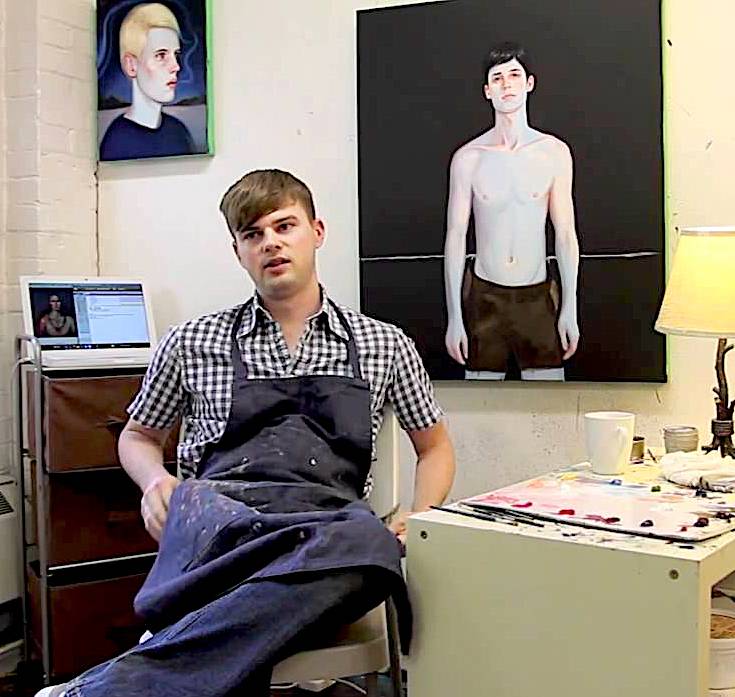
Kris Knight

Paintings by Kris Knight

Born in 1980 in Windsor, Kris Knight is a Canadian painter who has been interested in art since a young age. He moved to Toronto at the age of nineteen and studied at the Ontario College of Art and Design, where he majored in Painting and Drawing, with minors in Curating and Criticism.

The majority of Knight’s work, often painted in series, has been portraits based on real people, mostly close friends and family members. He has also produced self-portraits, collaged images taken from mass media, and works on the themes of loss, bonding and secrets. The subjects of Knight’s work have mostly been either young or androgynous-appearing men, who are portrayed in mute color tones effecting a powdered or translucent appearance. His pastels and tonal oil paintings, set in both theatrical and ordinary settings, combine nostalgia and romanticism in their exploration of life’s experiences.

Inspired by an eighteenth-century style of painting, Knight’s work draws from the movements of Romanticism, Symbolism and artwork of the Rococo period. Having had an interest in the era of the French Revolution since a child, he was also inspired by the portraiture work of French painters Louise Élisabeth Vigée Le Brun and Baron Joseph Ducreux. Additional influences came from the works of portrait painter Thomas Lawrence, Baroque painter Nicolas Poussin, and John Singer Sargent, considered the leading portrait painter of his day.

Kris Knight painted his “Lost and Found” series in 2012. This series of portraits dealt with disenchanted youths who subtly play the roles of hunter and the hunted. Often shown wearing furs and masks, the paintings explored the emotional state of being lost and the process of recovery. His 2013 series “Secrets Are Things We Grow” explored secrets that people keep and the bond that forms once a secret is revealed to those held close. The use of patterns and symbols of nature are used to represent the growth of secrets over time.

In 2014, Knight painted his “Smell the Magic” series, which had its premiere, sponsored by Gucci, at the Spinello Project’s pop-up gallery in Wynwood, Florida. The paintings in this series were done with brighter color tones; an influence of surrealism can be seen in the use of Ouija board pointers for eyes and overlaid flower blossoms on faces. In 2017, Knight had a solo exhibition at Art Toronto which contained work in a smaller scale with a more theatrical approach. These works focused on the subject of performance in everyday life and the roles portrayed to others.

Kris Knight began involved in the fashion industry early in his career. His paintings were used for four 2012 covers for Fashion for Men magazine and, in 2014, his paintings’ pastel color palette was credited for Gucci’s men’s ready-to-wear fall and winter collection. Collaborating with Gucci, Knight created several botanical floral prints, based on a previous work in 1966, which were incorporated into creative director Frida Giannini’s designs for Gucci’s Cruise 2015 seasonal wear. Knight’s work was later shown at the group exhibition, “Carte Blanche a Christin Lacroix”, at Paris’s Musée Cognacq-Jay in November of 2014.

Kris Knight’s work is represented by the Spinello Gallery in Miami, Florida, and at Paris’s Galerie Alain Gutharc. His website, which includes upcoming exhibitions, can be found at: https://krisknight.com/home.html .

Middle Insert Image: Kris Knight, “Let’s Not Speak So Heavy”, 2020, Oil on Canvas, 35.6 x 27.9 cm

Andrés Miró Quesada

Paintings by Andrés Miró Quesada

Born in Lima, Andrés Miró Quesada is a Peruvian painter whose narrative works depicting male figures generate a sense of playful eroticism and sensuality. He studied at Lima’s Alexander von Humboldt College, a German international, school from kindergarten to bachelor degrees. Miró Quesada graduated in 2009 with a degree in Visual Arts from Lima’s  Corriente Alterna School in Miraflores, where he received a silver medal for his work.

Miró Quesada’s work is very cinematographic in nature; the narrative scenes he creates appear as frozen frames from a film. Starting with an initial idea, he takes photographs of the scene until he is satisfied with its composition.After this  composition is passed onto a canvas, Miró Quesada begins the fluid process of painting, in which the final idea is personalized by his addition of a broader range of colors and tones, and  alterations in scale.

Andrés Miró Quesada has exhibited in various collective exhibitions including “Set/Action” at the Vértice Gallery in San Isidro, Peru; the “Play” exhibition at the Luis Miró Quesada Garland Room, a non-profit contemporary art center; and the October 2014 collective exhibition “Homo Ludens/Urbe Ludens”, directed by the Vértice Gallery, at the El Olivar Cultural Center in Lima. Miró Quesada also presented his work in a 2015 solo exhibition, entitled “Amateur” in the Ricardo Palma Cultural Center in Miraflores, Peru.

Emilio Baz Vlaud

The Artwork of Emilio Baz Vlaud

Born in Mexico City in 1918, Emilio Baz Vlaud was a painter whose work mostly included portraiture and scenes in the style of  Costumbrismo, images of local Hispanic life, customs, and mannerisms executed in  both artistic Realism and Romanticism.  Influenced by the Magical Realism movement that spread through the art and literary worlds after the first World War, Vlaud was known for his meticulous brushwork and his trompe-d’oeil technique. 

Emilio Baz Vlaud, at a very early age, had great skill in the arts. He would often watch his older gay brother, Ben-Hur Baz Vlaud, a 1926 graduate of the Academy de San Carlos and twelve years his senior, working on his own precisionist drawings and paintings. At the age of seventeen, Emilio Vlaud executed his first self-portrait, the 1935 “Self Portrait as a Teenager”, a highly refined work that is closely related to a self-portrait painted by his brother in the same year. In his self-portrait, Emilio shows himself with perfectly combed hair and dressed in a white shirt. He is  holding a green pencil at an angle, a position which visually divides the canvas in two,  and is shown gripping his elbow with his left hand. 

Emilio Baz Vlaud entered the Academia de San Carlos in 1938 where he initially studied architecture before changing his vocation to painting. He later took courses at the Escuela Nacional de Artes Plásticas, where he studied under the strict training of painter Manuel Rodríguez Lozano, an openly gay artist whose work is often linked to the works of metaphysical painter Giorgio de Chirico. Vlaud made several visits over the years to his older brother who had moved to New York City and was working as a successful commercial illustrator for magazines, such as Newsweek and Time. 

In 1950, Emilio Vlaud relocated to San Miguel Allende, situated in the far eastern part of Guanajuato. He exhibited his work in several collective exhibitions, where he showed his work alongside such prominent artists as painters and muralists Diego Rivera and David Alfaro Siqueiros. In 1951, Vlaud had his first solo exhibition; his flamenco-inspired technique of applying dry oil paints to surfaces by means of small strokes of a short brush were praised by critics and his fellow artists. During his eight year stay in San Miguel Allende, he received a gold medal for artistic merit from the University of Guanajuato. 

In 1962, Emilio Baz Vlaud entered the Monastery of Santa María de la Resurrecion for the purpose of studying psychoanalysis. After several years, he abandoned these studies to return to his vocation as a painter. Although Vlaud is mostly know for his portraiture and scenes done before 1955, he also went through an intense period of abstraction during the 1970s. In 1984, his work was presented at a collective exhibition entitled “Siete Pintores (Seven Painters)” at the Palacio de Bellas Artes in Mexico City. Emilio Baz Vlaud died in 1991. 

Notes: Vlaud’s 1952 “Portrait of Nazario Chimez Barlet”, the last image in the header collection, sold at Sotheby’s in November of 2024 for $204,o00. This bid was was over the estimated value by a great amount. When the bid was hammered and finalized, applause broke out among the bidders.

Insert Images: Emilio Baz Viaud, “Self Portrait as a Teenager”, 1925, Watercolor, Pencil and Dry Brush on Board, 60 x 39.7 cm, Private Collection

Emilio Baz Vlaud, “El Coco”, circa 1955, Oil on Masonite, 50 x 40 cm, Blaisten Collection

Emilio Baz Vlaud, “Self Portrait in Blue Shirt”, 1941, Watercolor, Pencil and Dry Brush on Board, 100 x 65.5 cm, Blaisten Collection, Mexico City


Amadeo de Souza Cardoso

The Artwork of Amadeo de Souza Cardoso

Born in November of 1887 in the town of Manhule, Amadeo de Souza Cardoso was one of the first generation of Portuguese modernist painters. Known for the exceptional quality of his work, his short career covered all the historical avant-garde movements of the early twentieth=century. 

The son of a wealthy landowner and vintner, Amadeo, at the age of eighteen, traveled to Lisbon and entered the Superior School of Fine Arts where he developed his skills as a designer and caricaturist. In November of 1906, he traveled to Paris with his friend and painter Francisco Smith and lived in an apartment on the Boulevard de Montparnasse. After a caricature he had drawn during a dinner was published  in Portugal’s “O Primerro de Jameiro” newspaper, Amadeo decided to devote himself to painting. 

In 1908, Amadeo de Souza Cardoso established himself at a studio located at 14 Cité Falguière , which became a social gathering place for Portuguese artists including Manuel Bentes, Eduardo Viana, and Domingos Rebelo, among others. At this time, Amadeo began to attend the ateliers of the Académie des Beaux-Arts and the Académie Viti, where he studied under the Spanish painter Angalada Camarasa, whose use of intense coloring presaged the arrival of Fauvism. 

In 1911, Amadeo exhibited his work in the Salon des Indépendents and soon became close friends with writers and artists such as Gertrude Stein, Amedeo Modigliani, Alexander Archipenko, Robert Delaunay, and the Italian Futurists Umberto Boccioni and Gino Severini.  In 1912, Amadeo published his album, “XX Dessuab”, containing twenty drawings with a forward written by author Jerome Doucet, and republished Gustave Flaubert’s “La Légende de Saint Julien to l’Hospitalier” in a calligraphic manuscript with illustrations. Amadeo de Souza Cardoso participated in two important exhibitions in 1913: the Armory Show in the United States that traveled to New York City, Boston and Chicago, and the Erste Deutsche Herbstsalon held at the Galerie Der Strum in Berlin. These two exhibitions were the first to present the new wave of modern art to the public. Seven of the eight works Amadeo displayed at the Armory show sold; three of these were purchased by lawyer and art critic Arthur Jerome Eddy, a prominent member of the first generation of American modern art collectors.

Returning to Portugal in 1914, Amadeo began experimentation in all the new forms of artistic expression, and married Lucia Pecetto, whom he had previously met during his 1908 stay in Paris. In April of 1914, he sent three new works for an exhibition at the London Salon; however, due to the outbreak of World War I, the show was canceled. During the war years, Amadeo maintained contact with other Portuguese artists and poets and reunited with Robert and Sonia Delaunay who had relocated to Portugal. In 1916, he published his “Twelve Reproductions” through Tipografia Santos in Porto and exhibited a collection of one hundred-fourteen works at a solo exhibition in Oporto and later in Lisbon, entitled “Abstraccionism”. 

At this time, the Cubist movement had  expanded throughout Europe and was an important influence to Amadeo de Souza Cardoso’s  style of analytical cubism. He continued to explore expressionism and, in his last works, experimented with many new techniques. In 1918, Amadeo was stricken with a skin disease which impeded his painting. On the 25th of October in 1918, Amadeo de Souza Cardoso died, at the age of thirty, in Espinho, Portugal, of the Spanish influenza, a pandemic which savaged the world at the end of World War I. 

After his death, Amadeo de Souza Cardoso’s work was shown in a 1925 retrospective in France which was well received by both critics and the public. Ten years later, the Souza-Cardoso Prize was established in Portugal to distinguish modern painters. Amadeo’s work remained relatively unknown until 1952, when a exhibition of his work in Portugal regained the public’s attention. Since then, only two retrospectives have been held, one in 1958 and one in 2016, both at the Grand Palais in Paris.

Tope Insert Image: Amadeo de Souza Cardoso, “The Hawks”, 1912, India Ink on Paper, 27 x 24.3 cm, Calouste Gulbenkian Museum

Bottom Insert Image: Amadeo de Souza Cordoso, “Self Portrait”, 1913, Graphite on Paper, Calouste Gulbenkian Museum

Oscar Santasusagna

The Artwork of Oscar Santasusagna

Born in Barcelona in 1973, Oscar Santasusagna is a self-taught Spanish artist who began drawing and painting at an early age. The style and techniques of his work have been influenced by the many artists he has studied, including illustrators and painters Andrew and Newell Conners Wyeth; narrative painter Hernan Bas, best known for his scenes of dandies and waifs; painter and draftsman David Hockney; and printmaker and landscape painter Winslow Homer, among others.

Santasusagna believes that a well-executed painting must make a connection with the viewer and produce an emotional response. His work is narrative in style, with each painting accompanied by  a poem or text that relays a personal message to the viewer. The source of these messages are derived from either a song heard, an image seen, or a personal  experience he has had. The subjects most often presented in Santasusagna’s work are the issues of loneliness, friendship, freedom and equality, homosexuality, and man’s relationship to the natural world.

Since 2015, Oscar Santasusagna has exhibited his paintings at many solo exhibitions throughout Spain. These include his 2015 exhibition “Desperta de la Realitat” and his 2016 “Apunts Dispersos” , both of which were held at Barcelona’s Galeria Moraima. In 2018, Santasusagna had a solo exhibition, entitled “Wanderlust”, at the Galeria Departure located in Barcelona and, in 2021, an exhibition in the United States,  entitled “Fables Keeper”, at the Contemporanco Art Gallery in Asheville, North Carolina.

Santasusagna has exhibited in several collective exhibitions, including  the 2015 Seleccio d’Artistes held at Galeria Escolà in Barcelona, the 2021 Una Mirada LGBTI+ exhibition held at the Taller Balam Gallery in Barcelona, and the 2021 Fundació Barcelona Olimpica, where he won third prize for his painting “Sempre hay un Comienso para cada Historia”. He  has also been finalist at the Sanvicens Painting Contest in Sitges, the Concurs FMPC held in Tarragona, and the annual Premium Painting Contest held in the city of Centelles.

Oscar Santasusagna collaborated with theater playwright Bill Lattanzi on his musical comedy production “Jenny Must Die”, which was premiered at the Providence, Rhode Island, Fringe Festival in 2020. He also painted the book cover illustration for “Projecto Wemen”, published by Madrid’s Editorial Silex in 2018. Santasusagna’s paintings on in many private collections in Spain, Belgium, Canada and the United States.

Top Insert Image: Oscar Santasusagna, “Ode for Tenderness”, 2015, Acrylic on Paper 

Oscar Santasusagna’s work can be found at his website located at https://www.santasusagna.com and at https://www.flickr.com/photos/santasusagna .

Hector de Gregorio

Paintings by Hector de Gregorio

Born in Valencia, Hector de Gregorio is a Spanish painter and digital artist. He had his foundational fine art taining at Camberwell Art College in London. Between 2004 and 2007, De Gregorio studied Fine Art at London’s Central Saint Martin’s, where he earned his BA in 2007. He later earned his MFA in Printmaking at the Royal College of Art in London in 2009. 

Hector de Gregorio was influenced in his formative years by his Catholic upbringing, which furthered his interests in devotional art from different religions, and by his mother, a dressmaker who taught him the skills of design and tailoring. He was also interested in European art: the sensuality of Filippo Lippi’s figures, the realism and dramatic lighting of Caravaggio’s work, the religious narrative works of Hieronymus Bosch, and the surrealist work of  Salvador Dali. All these elements combine to give de Gregorio’s work, although contemporary in appearance,  a familiar medieval atmosphere with overtones of a mythological or religious nature.

De Gregorio’s work is both meticulous and labor intensive. Each image entails extensive costume design research, photographic shoots, digital imaging, and hand finishing of the final image. De Gregorio begins by photographing his friends, dressed in personally made elaborate costumes, at his studio. Taking a number of photos from the shoot, he fashions a collage that distorts the perspective of the image. To these images, de Gregorio digitally adds elements such as colored backdrops, Latin phrases, and other motifs with either mythical or religious references. This finished product is printed on either canvas or fine art paper, and overlaid with waxes, oil paints, gold leaf and varnish.

Hector de Gregorio has exhibited widely, with exhibitions in London, Berlin, Milan, New York, Miami and Chicago.  In November 2009, he won the prestigious annual Young Masters Art Prize for his inspiring contemporary portraiture. In 2012 Hector de Gregorio exhibited his “Absinthes” in  “The Perfect Place to Grow”, an exhibition of work by the alumni of the Royal College of Art to celebrate its 175th anniversary.

Bottom Insert Image: Hector de Gregorio, “Self Portrait”, Date Unknown, Mexed Media on Paper

Imre Szobotka

Imre Szobotka, “Fiatalkori Onarckép (Self Portrait as a Young Man)”, 1912-14, Oil on Canvas, 45.5 x 38.2 cm, Hungarian National Gallery, Budapest

Born in Zalaegerszeg, Hungary, in September of 1890, Imre Szobotka was a painter and engraver. Between 1905 and 1910, he studied at Budapest’s School of Design under painter Ignác Újváry. Szobotka traveled to Venice in 1908 for a study trip and traveled to Rome in 1909, this time accompanied by his friend Ervin Bossámyl. He relocated to Paris in 1911, where he lived at the residence of avant-garde sculptor and graphic artist József Csáky, one of the first Parisian sculptors to apply pictorial Cubism to his art.

Szobotka attended the 1911 Independent Salon in Paris, where he viewed the works of the Cubist painters. Inspired by their work and with the encouragement of his friend, the Cubist painter József Csáky, he enrolled at the La Palette School of Art in 1912, where he studied under Cubist painters Jean Metzinger and Henri Le Fauconnier. By the spring of 1913, Szobotka’s works, exhibited in the Independent Salon, were already noticed by the French critics, including writer and critic Guillaume Apollinaire. 

During World War I, Imre Szobotka was interned as a prisoner of war, starting in 1914 in Bretagne and later, at Saint Brieuc, France, until his release in 1919. The landscapes, still lifes, and portraits made in the internment period were experiments in cubism, symbolism, and orphism, a cubist offshoot that focused on abstraction and bright colors. These works, rare examples of Hungarian Cubism,  included his 1914 “Pipe Smoker”, the 1916 “Sailor”, and watercolor illustrations he produced for poet Paul Claude’s “Revelation”.

After his return to Paris in 1919, Szobotka’s paintings contained a more naturalistic expression. He exhibited this new work first in 1921 in Belvedere, a commune in the Vesubie Valley north of Nice, and, between 1929 and 1944, in shows at the Tamás Gallery, the Fränkel Salon, and the Mária Valéria Street gallery. The solid, defined construction of these landscape works by Szobotka insured him a place among the Nagybánya artists, whose work was focused on plain-air painting.

Imre Szobotka was a founding member of Képzőművészek Új Társasága, the New Society of Fine Artists, and presented his work in its exhibitions. For his 1929 “Mill in Nagybánya”, he won the landscape award presented by the Szinyei Society, an artistic association founded after painter and educator Pál Szinyei Merse’s death to promote new artists. Szobotka would later enter the “Mill in Nagybánya” at the 1938 Venice Biennial. In 1941, he won the Szinyei Society’s grand award for his exhibited work. 

From 1945 onward, Szobotka produced some graphic work; however, his main concentration was on his landscapes. He spent his last summers in the countryside near the village of Zsemmye where he painted pastoral landscapes. Szobotka became president of the painting division of the Fine and Applied Arts Alliance in 1952. For the body of his work, he received the Munkácsy Award in 1954 and the Socialis Work Order of Merit in 1960. Imre Szobotka died in March of 1961, at the age of seventy, in the city of Budapest.

Imre Szobotka’s “Self Portrait as a Young Man” is one of the key creations of his Parisian years. It shows his embrace of the elements of cubism, particularly the coloring and abstraction of its orphism branch. The main emphasis of the work is not the formal structure with its conventionally postured figure, but rather the way the light breaks its components into prisms of color. Szobotka emphasized his sense of light value and his translucent colorization to form a refined play of reflections, which cut the painting’s solid forms into colored shards.

Insert Images:

Imre Szobotka, “Sailor”, 1916, Oil on Canvas, 35 x 29 cm, Janus Pannonius Museum, Péca

Imre Szobotka, “Gathering Apples”, 1930, Oil on Canvas, 55 x 76 cm, Henman ottó Museum, Miskolc

Imre Sobotka, “Self Portrait”, 1912, Oil on Cardboard, 53 x 45 cm, Private Collection

Felice Casorati

The Paintings of Felice Casorati

Born in December of 1883 in Novara, Felice Casorati was an Italian artist known for his sculptures and paintings, which were rendered from unusual perspectives and often featured obscure symbols. He spent his formative years in the northeastern city of Padua where he developed an interest in literature and music. Casorati studied law at the University of Padua, graduating in 1906, and frequented the atelier of  painter and sculptor Giovanni Viannello.  

Casorati began painting in 1902; his earliest paintings were influenced by the symbolism of the Vienna Secession, a movement, closely related to Art Nouveau, which sought to unite all the disciplines of art into one movement. These early works of Casorati were exhibited at the 1907 Venice Biennale. Casorati’s adherence to symbolist ideals was reinforced after meeting and seeing the work of Austrian painter Gustav Klimt, one of the founders of the Vienna Secession, at the 1910 Vienna Biennale. 

Felice Casorati spent the years between 1908 and 1911 in Naples, where he often visited the Museo di Capodimonte and viewed the work of Pieter Bruegel the Elder, the Dutch Renaissance painter whom he particularly admired. Casorati relocated to Verona in 1911, where, along with poet and engraver Umberto Zerbinati and painter and graphic artist Pino Tedeschi, he founded the periodical “La Via Lattea (The Milky Way)”, for which he executed several symbolist woodcuts. For a brief period between 1914 and 1915, he abandoned his secessionist style and made expressionist woodcuts in the manner of Tuscan artists, such as Lorenzo Viani and Moses Levy.

Casorati’s first solo exhibition of his symbolist-influenced work was at the 1915 Secession III show held in Rome. Before being drafted into the Italian Army in 1915, he also executed his first sculptures in varnished terra cotta, a medium also favored by his friend, the sculptor Arturo Martini. After the end of World War I, Casorati settled at Turin in 1918 and became a prominent figure in the intellectual and artistic circles, including the conservative Return to Order movement which called for the rejection of the avant-garde in favor of a more traditionalist approach. 

In Turin, Felice Casorati established friendships with composer and pianist Alfredo Casella and with the anti-fascist, political activist Piero Gobetti, who founded in February of 1922 the weekly magazine “De Rivoluzione Liberale”. Casorati supported the magazine and Gobetti , in return, championed Casorati’s work in Marxist writer and journalist Antonio Gramsci’s weekly newspaper, the “Ordine Nuovo”. Due to his radical associations, Casorati was arrested with an anti-Fascist group by the authorities for a brief period in 1923 and, subsequently, avoided antagonizing the regime.

The work Casorati produced in the 1920s was radically different from his pre-war work, which he now considered to be immature. The figures in his new work were solidly constructed and set securely in spaces organized by linear perspective theories established in the Italian Renaissance period of the fifteenth-century. Casorati was also influenced by Italian painter Andrea Mantegna’s work with its dramatically foreshortened figures, and the work of painter Piero della Francesca, known for his mathematical treatises and geometrically-composed paintings. 

In 1922, Felice Casorati painted what is considered his most famous work “Silvana Cenni”, a portrait inspired by the work of Piero della Francesca, which features a stern woman in a seated, symmetrical,  frontal view positioned in front of an open window. This tempera work on canvas, composed of carefully rendered volumes, became an iconic portrait of the traditional and period art of Italy which is now known as Magical Realism. 

Beginning in 1923, Casotati opened his atelier to young art students in Turin, many of who would form Torino’s Group of Six, and emerging artists such as self-taught artist and writer Quinto Martini. He was also the co-founder of the Antonio Fontanesi Fine Arts Society, which organized exhibitions of both nineteenth-century and contemporary Italian and foreign art. Casorati was appointed a Professor of Interior Design in 1928 at Turin’s Accademia Albertina, a post he held until appointed as its Chair of Painting in 1941.  

Felice Casorati was commissioned by his patron, Turin industrialist Ricardo Gualino, to work with architect Alberto Sartoris on the Piccolo Teatro in Milan and other decorative works. Casorati also designed costumes and sets for Milan’s Teatro alla Scala and the Maggio Musicale, the annual arts festival in Florence. Once again working with Sartoris, he  designed a building for part of the Piedmontese Pavilion at the 1927 International Biennale in the city of Monza. Casorati  exhibited his work widely throughout Italy and won the First Prize at the 1939 Venice Biennale.

The majority of Casorati’s later paintings were done in a softer palette with  a more gentle perspective. He produced over one hundred-fifty prints in his lifetime, in which he experimented with a variety of techniques that incorporated slate, papyrus and terra cotta matrixes. The simplified mannequin-like figures, which featured in Casorati’s prints of the late 1920s, remained in his etchings, linocuts, and lithographs for the length of his career.

Felice Casorati passed away on March 1, 1963. Most of his important works are in Italian private and public collections, including Trieste’s Modern Art Revoltella Museum and  Rome’s National Gallery of Modern Art. Museums holding Casorati’s art in their collections include the British Museum, the Metropolitan Museum of Art in New York, and the Musrum of Fine Arts in Boston, among others.