Denis Forkas

The Paintings of Denis Forkas

Born in 1977 in Kamyshin, a town on the Volga river, Denis Forkas Kostromitin is a Russian painter whose work explores religious and mythological symbolism in the tradition of ancient Mediterranean art. The son of a military officer, his childhood years were spent in various remote regions of the Soviet states. Forkas’s early nomadic existence with its isolation and lack of comforts led to self-education in artistic training and numerous sensory deprivation experiences, which later had a major impact on his artwork.

With little stimulus from the austere Soviet environment, Forkas eagerly consumed literature on the esoteric worlds of Egyptian and Greek mysticism and mythology. After the iron curtain’s collapse in 1991, new translations of literary works, including the esoteric writings of English occultist Aleister Crowley and French author Eliphas Levi, entered the Soviet states. Forkas studied these new volumes and the literature written by Western philosophers, which became available in the mid-1990s.

After the economic boom in the new century, Denis Forkas frequently visited China as a journalist, interpreter, and commercial representative. After meeting several painting masters in China, he was able to receive formal training for three years in traditional Eastern painting techniques, including those of the Xieyl and Gongbi art forms. 

Xieyl is a genre of Chinese traditional painting worked on xuan paper that uses either ink or layers of watercolor. This genre includes works of calligraphy, poem, painting and seal, of which freehand painting is the most influential and popular. Gongbi is a careful, realistic technique of Chinese painting, often highly-colored, that is worked  on xuan paper. This method uses highly-detailed brushstrokes that delineate details very precisely without interpretation or free expression on the part of the artist.

After leaving China, Forkas settled in Moscow to concentrate on his career path as a professional artist. His early work was inspired by German Expressionism and the late nineteenth-century Symbolist movement, which emphasized the reality of the created paint surface itself. These paintings by Forkas were influenced by the early abstract, experimental works of Wassily Kandinsky that, in an immediate way, were an expression of Kandinsky’s inner feelings.

Denis Forkas’s new work, still in the artistic traditions of ancient Near East civilizations, draw their inspiration from early Renaissance and  seventeenth-century Dutch paintings. Drifting away from the earlier predominant symbolist style, Forkas’s paintings became influenced by the works of Belgian painter Fernand Khnopff, who carried symbolism’s recurring themes into his portraits, and Russian painter Mikhail Vrubel, whose paintings in the latter portion of his life displayed a glowing, otherworldly mosaic effect that fit within the Byzantine tradition.

Since 2007, Forkas has privately taught the techniques of painting and drawing to students and has participated in various local and international exhibitions, including the October 2014 Image Show in London. Forkas has produced many drawings and paintings that have been featured as album covers for international music releases. Currently living and working in Moscow, he has contributed both work and an interview for the esoteric publisher Fulgur Press.

Contact information and a small gallery of work by Forkas can be found at his website located at: www.denisforkas.com

For those interested, a list of album cover art by Denis Forkas can be found at the Encyclopaedia Mettalum site located at: https://www.metal-archives.com/artists/Denis_Forkas_Kostromitin/436114

Second Insert Image: Denis Forkas, “The Hanged Man / Gift of Prometheus”, 2017, Acrylics and Gilding on Paper, 41.5 x 29.5 cm

Third Insert Image: Denis Forkas, “Saglokratlok II”, 2017, Ink and Gouache on Paper, 24.1 x 18.5 cm

Bottom Insert Image: Denis Forkas, “Between Two Worlds (Study for a Recurring Dream of Ichor Baptism Fashioned as a Portico Fresco Cartoon)”, 2016, Acrylics on Paper on Hardboard, 23.7 x 22.5 cm

Luchita Hurtado

The Artwork of Luchita Hurtado

Born in Maiquetia, Venezuela in November of 1920, Luchita Hurtado was a painter whose work, with its strong feminist and environmental themes, crossed many different cultures and art movements. Although her career spanned over eight decades, she only received wide recognition for her art towards the end of her life.

In her early years, Luchita Hurtado lived in New York City with her mother, older sister and aunts. She studied Fine Art at the Art Student League and volunteered at “La Prensa”, the largest and oldest daily Spanish-language newspaper in the United States, where she met her first husband, Chilean journalist Daniel de Solar. In 1938 at the age of eighteen, Hurtado married Daniel de Solar and had two children together. The family relocated to Santo Domingo in the Dominican Republic after an invitation with a request to start a newspaper arrived from Rafael Trujillo, dictator of the Dominican Republic.

Returning to the United States, Hurtado and her family settled back in New York City where they associated with many artists and journalists, among whom were Mexican painter Rufino Tamayo, artist and landscape designer Isamu Noguchi, surrealist artist and collector Wolfgang Paalen, and Japanese-American dancer Ailes Gilmour, who was Noguchi’s half-sister. In 1942, Hurtado divorced de Solar and subsequently married Wolfgang Paalen. Beginning  in 1944, Luchita Hurtado produced window displays and painted murals for Bloomingdale’s, a luxury department store in New York City. She also did freelance work as an illustrator for the mass media company Condé Nast and worked as a muralist for the Lord and Taylor department store in the city. 

In 1946, Luchita Hurtado and husband Wolfgang Paalen traveled to Mexico to research pre-Columbian art. A research article by Paaalen, with photographs taken by Hurtado, was published in the 1952 edition of the French literary and artistic journal “Cahiers d’Art”. After her divorce from Wolfgang Paalen, Hurtado moved to Los Angeles in 1951 with fellow painter Lee Mullican, whom she married in the late 1950s. Lee Mullican would remain with her until his death in 1998.

In 1970, Hurtado founded the feminist group, Los Angeles Council of Women Artists. She participated in their first exhibition at the Long Beach Museum of Art, “Invisible/Visible”, which was organized by multi-media artist Judy Chicago and sculptress Dextra Frankel. In 1974, Hurtado had a solo exhibition at the Woman’s Building, a non-profit arts and education center which focused the women’s movement and feminist art.

Except for her two exhibitions and work produced for Bloomingdale’s and Conde Nast, Luchita Hurtado’s artwork was largely unknown until 2015. Ryan Good, who was cataloguing the estate of Hurtado’s deceased husband Lee Mullican, found paintings signed “LH” among others in the collection. He showed these paintings to Paul Soto, founder of Los Angeles’s Park View Gallery, who gave Hurtado her second ever solo exhibition, “Luchita Hurtado: Selected Works, 1942-1952”, a two-month show which opened in November of 2016. Hurtado was ninety-six years old at the opening of the show.

With the recognition generated by the solo exhibition, Luchita Hurtado’s career erupted. Her work was included in the Hammer Museum’s 2018  “Made in L. A.” exhibition and received a good review from the L.A. Times and favorable critical reception. Hurtado’s paintings caught the attention of Hans Ulrich Obrich, a Swiss art curator and the artistic director of the Serpentine Galleries, two prestigious galleries located in central London. He gave Hurtado her first international solo exhibition entitled “Luchita Hurtado: I Live I Die I Will Be Reborn”. 

Luchita Hurtado’s work contain elements from the avant-garde and modernist movements of the twentieth-century, including magical realism, abstraction, and surrealism. She used womb imagery in her works long before it appeared in the feminist art movement of the late 1970s. One of Hurtado’s  best known series of works is the “I Am” images of the 1960s, self-portraits painted by her looking down at her own body. Taking up the issue of climate change, Hurtado painted more specific environmental themes, some of which contained block-lettered texts such as “Mother Earth” and “We Are Just a Species”. 

Hurtado’s artwork depicting nude women contain loosely surrealistic forms that draw inspiration from pre-Columbian art, cave paintings, and abstraction in sculpture and paintings. Through her work, she focused attention on the edges of the body and the language used to bridge the gap between ourselves and others. Hurtado expressed this connection through images that coupled the intimate gestures of the body with the vastness of the sky and earth. 

In February of 2020, the Los Angeles County Museum of Art held a retrospective of Luchita Hurtado’s work. She remained active in the arts until her death, at the age of ninety-nine, in August of 2020. Hurtado was named as one of ‘Time” magazine’s 100 Most Influential People of 2019. Her work is in many private collections and public collections, including the Los Angeles County Museum of Art and New York’s Museum of Modern Art. 

Note: An interesting article on the life of Luchita Hurtado, which includes early photographs and video of Hurtado discussing her life , can be found at the Whipple Russell Architects site located at: https://whipplerussell.com/blog/critically-acclaimed-in-her-90s-modernist-luchita-hurtado

Second Inser Image: Luchita Hurtado, “Birth”, 2019, Acrylic on Linen, Private Collection

Third Insert Image: Luchita Hurtado, “Encounter”, 1971, Detail, Oil on Canvas, 12 x 243 cm, Hauser and Wirth Collection

Bottom Insert Image: Oresti Tsonopoulos, “Luchita Hurtado”,  2018

Sergio Cerchi

Paintings by Sergio Cerchi

Born in Florence in 1957, Sergio Cerchi is an Italian painter and musician. Beginning in his teenage years, he started to study in his two passions, the visual arts and music, by attending workshops held by Florence’s artists and playing in musical groups. Cerchi received his Bachelor of Arts from Florence’s Istituto D’Arte of Porta Romana and attended courses at the prestigious Luigi Cherubini Conservatory of Music.

Sergio Cerchi worked through a process of experimentation with various art techniques to develop his own personal style. His influences range from primitive art to the masters of the Italian Renaissance. Cerchi’s figurative and still life works are set in flattened and realist tableaux, similar to theater sets, within which are contained references to popular culture, art history and personal experience.

In Cerchi’s paintings, the pictorial surface as a whole is fractured into multiple quadrants whose portion of the image is rendered with different coloring and lighting. Through this technique, figures and objects are segmented and reconstructed in collages composed from their angled fragments. The resulting canvas, with its shifting, peeling surface and fading horizon planes, presents a unique version of cubist art.

Sergio Cerchi’s paintings are mostly executed in different shades of a dominant hue. Depending on the angle of each fragmented quadrant, the tone of that part of the image may appear softer or bolder. The palette of Cerchi’s oil paints range from warm undertones of red carmine, mixed with shades of green, ocher and blues, to tones of brown and gray. A prominent feature of his work is the use of bold, dramatic shading in the compositions.

Since 2011, Sergio Cerchi has been represented by Galleria Gagliardi located in San Gimignano, Siena, Italy. He presented his work at a 2013 curated exhibition, entitled “Art in Therapy”, held at the Chiesa di Sant’Agala, a national archeological site in Spoleto, Italy.

Note: Images of Sergio Cerchi’s work and information on exhibitions can be found through Galleria Gagliardi’s website located at: https://www.galleriagagliardi.com/en/artist-works/cerchi-sergio

Bottom Insert Image: Sergio Cerchi, “Supereroe”, 2017, Oil on Canvas, 100 x 100 cm, Private Collection

Justin Liam O’Brien

Paintings by Justin Liam O’Brien

Born in Flushing, New York in 1991, Justin Liam O’Brien is a painter and digital artist. In his early years, he was interested in drawing concept art, graphic novels, and modeling video games, whose construction became a serious occupation until his early twenties. After attending Long Island’s Suffolk County Community College, O’Brien earned a Bachelor of Fine Arts in Digital Arts and 3D Animation from the Pratt Institute in 2016.

In 2017, O’Brien started producing paintings with figurative elements and gradually developed a style which combined his skills at animation with his identity as a queer person. Impressed by the works of Diego Rivera and Leger, O’Brien strived to achieve their simplicity in his early figurative paintings; his focus gradually changed to more complex, narrative works which expressed his personal life and relationships. With his technical painting skill, O’Brien is able to express an exploration of issues centered on a very clear, delineated community of people.

Justin Liam O’Brien’s figurative paintings emerge from his experiences of queer affection, tenderness, longing, and loneliness. The male figures are archetypal, fashioned with soft edges and placed in carefully crafted tableaux, which reflect his technical training in the digital arts. While drawing on personal experiences, O’Brien portrays universal, relatable narratives, often tinged with tension or poignancy, that speak to our feelings of self-doubt and powerlessness. Through these visual communications, he hopes to clarify to its viewers our shared experiences and feelings, and in this way strengthen the communal bond.

In November of 2019, O’Brien had his debut solo exhibition, entitled “Losing in the Form of Darkness”, at New York’s Monya Rowe Gallery on West 30th Street. The figurative compositions in this show depicted unidentified male characters, with blurred features, engaged solitarily or entangled in moments of leisure and passion, as well as, boredom and loneliness. In conjunction with the exhibition, O’Brien developed a book of sketches, executed in the previous year, which contained a more personal side of his work. 

In May of 2020, Justin Liam O’Brien left his position as a 3D modeler for a real estate company and began to concentrate full time on his studio painting. He exhibited his paintings in two shows that year. The first was entitled “Damned by the Rainbow” and was held in July at the GNYP Gallery in Berlin; the title of this show was suggested by a verse from French poet Arthur Rimbaud. The exhibited work reflected O’Brien’s exploration of intimacy and the emotions that emerge in shared personal space. 

In November of 2020, O’Brien’s solo show “When Acting as a Wave” opened at Los Angeles’s Richard Heller Gallery. His paintings frequently examine the effects of being close to people, which can be wonderful or terrible depending on circumstances. O’Brien’s paintings in this show, executed during the period of covid quarantine and isolation,  showed these opposing feelings at their balance point. His 2020 “Bread on a Seder Plate” shows a gathering of friends with a lone figure almost blending into the wall.  Another painting in the show, “I’m Afraid of How This Ends”, shows a room, suggestive of a prison cell, with two figures together, each alone except for the other, with seemingly no means of escape.

In September of 2021, Justin Liam O’Brien returned to the Monya Rowe Gallery for an exhibition entitled “Dreams”, the centerpiece of which was a large canvas, “NYC Inferno”, an ode to a sex party in Brooklyn, New York. Other works in the exhibition derived from references in queer cinema and literature, and the religious art of Italian Early-Renaissance painter Piero della Francesca. O’Brien’s other 2021 shows at the gallery included “Me, Myself and I” and “Equal Affections”.

O’Brien’s works have been exhibited in many group exhibitions including presentations at Galerie LJ in Paris; Chart Gallery and the High Line Nine, both galleries in New York City; the contemporary Kapp Kapp Gallery in Philadelphia; and Galerie Tanja Wagner in Berlin, among others.

“I had been damned by the rainbow. Happiness was my fatality, my remorse, my worm: my life would forever be too immense to be devoted to strength and beauty.”

– Arthur Rimbaud, Une Saison en Enfer (A Season in Hell), 1873

Notes: More images and information on Justin Liam O’Brien’s work can be found at the artist’s site located at: http://justinliamobrien.com

Justin Liam O’Brien’s sketchbook “Losing in the Form of Darkness”, which was published in conjunction of his exhibition of the same name, can be found at the online Raw Meat Collective located at: https://rawmeatcollective.com/shop/losing-in-the-form-of-darkness-by-justin-liam-obrien

Top Insert Image: Laura June Kirsch, “Justin Liam O’Brien”, 2020, Juxtapoz Magazine

Second Insert Image: James Liam O’Brien, “Fais Comme Si J’Avais Pris La Mer”, 2021, Oil on Linen, 175 x 139.7 cm, Private Collection

Third Insert Image: Justin Liam O’Brien, “Stay in My Arms, If You Dare?, 2018, Oil on Canvas, Monya Rowe Gallery

Bottom Insert Image: Justin Liam O’Brien, “Each Man Kills the Thing He Loves”, 2021, Oil on Linen, 152.4 x 152.4 cm, Monya Rowe Gallery

Corrado Cagli

The Artwork of Corrado Cagli

Born in the city of Ancona in February of 1910, Corrado Cagli was an Italian painter of Jewish heritage. Little information on his formative years is available; however, it is known that, at the age of five, his family relocated to Rome. Cagli grew up in a largely assimilated secular family, who had come to terms with its Jewish religion as antisemitism became more aggressive in Fascist Italy. His ties to his Italian heritage were always strong; even in his later years of exile from Italy, it was important for him to maintain a tie with his homeland. 

Corrado Cagli’s first commissioned work was a 1927 mural painted on a building in Via Sistina, the street at the top of  Rome’s Spanish Steps. In the following year, Cagli received another commission in Rome for a mural in Via Vantaggio. He had a remarkably early success in Italy; still in his twenties in the early 1930s, he was already famous nationally. Cagli had his first solo exhibition in 1932 at Rome’s Galleria d’Arte Moderna and showed at the Milan Triennale in 1936.

Along with other artists such as Emanuele Cavalli and Giuseppe Capogrossi, Cagli was a member of the Scuola Romana, an art movement of Expressionist painters in Rome who were active between 1928 and 1945. A rising star of the Scuola Romana, Cagli was supported by Italy’s Fascist regime despite being both Jewish and a homosexual.  He was chosen to represent Italy at the 1930 Paris Exposition, the Venice Biennale, and other prestigious expositions. 

In 1938, the Leggi Razzial were promulgated by the Fascist government; this series of laws enforced racial discrimination in Italy, directed mainly against Jewish Italians and inhabitants of Italy’s colonies. Two of Corrado Cagli’s murals were censored by the government as they did not fit with the regime’s rhetoric and stylistic preferences. With the enactment of the Racial Laws, Cagli was forced into exile, first to Paris, a place he had visited as a young star painter from Italy, and then to the United States, where he later became a citizen. His first showing was at the Julien Levy Gallery, a source for surrealist work. 

Corrado Cagli rarely had a proper studio during his exile years, which made painting difficult. Most of his work done in the United States is on paper. Cagli had always valued drawing as an art form; in his exile, they became the primary instrument of his artistic search. His use of paper as a medium was also the result of a crisis he went through with his idea of painting. In the 1930s, despite having been forced into exile, Cagli still retained the artistic ambitions of Italy and saw painting as a public art essential to constructing an Italian national identity.

Cagli enlisted in the United States Army and was recognized for his artistic talent. During his training he painted barracks, made his own drawings, and illustrated a military magazine. Later during the war, he worked as a military artist drawing scenes from the campaigns. Cagli fought at the 1944 Normandy landings and, later, in Belgium and Germany. Near the end of the war, he drew a series of dramatic drawings based on the liberation of the Buschenwald concentration camp. 

After the war, Cagli returned in 1948 to Rome and made it his permanent residence. Because of his past as a former regime-endorsed artist and a Jewish exile from Fascism, Cagli did not fit into any of the factions of Italy’s post-war heated cultural disputes. He arrived into Italy’s art world with a metaphysical route towards abstraction which was opposite to the Neo-Cubist trend that dominated postwar Italian painting. Settled in Italy, Cagli began a series of experimental works  in multiple mediums, including ceramics, mosaics, tapestries, architectural decoration, ballet scenery, and costumes. 

Corrado Cagli helped organize the Galleria La Cometa in Rome and, along with poet Libero De Libero, created an artistic circle of musicians, writers, architects, painters and sculptors. He was involved with New York’s Museum of Modern Art’s 1949 exhibition, “20th Century Italian Art” and facilitated the 1950 opening of the Catherine Viviano Gallery in New York City. In August of 1972, Cagli was commissioned as the official banner painter for the Palio di Siena, the twice yearly equestrian competition held in Siena, Italy. 

Cagli was awarded the Guggenheim Prize in 1946 and, in 1954, the Marzotto Prize, given by the Marzotto fashion company for his contributions to the cultural rebirth of Italy after the war. Corrado Cagli died in Rome in 1976. 

Notes: An article on Corrado Cagli’s 1936 mural “The Battle of San Marino”, now housed in Florence’s Uffizi Gallery,  can be found in a previous posting on this site.

An interview between author Raffaele Bedarida and Alessandro Cassin, Director of Centro Primo Levi, entitled “Corrado Cagli, the American Years” can be found online at Printed_Matter located at: http://primolevicenter.org/printed-matter/corrado-cagli-the-american-years/

Top  Insert Image: Photographer Unknown, “Corrado Cagli”, Circa 1930s

Second Insert Image: Corrado Cagli, “Ritmi Cellulari in Chiave di Giallo, 1949, Mised Media on Canvas on Paper, 90 x 70 cm, Private Collection

Third Insert Image: Corrado Cagli, “narcissus”, Date Unknown, Silkscreen Print, Edition of 50,, Sheet Size 90 x 85 cm, Private Collection

Bottom Insert Image: Photographer Unknown, “Corrado Cagli in His Studio in Rome”, December 1969, Radiocorriere Magazine, Gelatin Silver Print

Corrado Cagli: “The Battle of San Marino”

Corrado Cagli, “The battle of San Marino”, 1936, Encaustic Tempera on Hollow-Core Wood, 545 x 651 cm,  Uffizi Gallery, Florence 

Born in the city of Ancona in February of 1910, Corrado Cagli was an Italian painter of Jewish heritage. Little information on his formative years is available; however, it is known that, at the age of five, his family relocated to Rome. Cagli grew up in a largely assimilated secular family, who had come to terms with its Jewish religion as antisemitism became more aggressive in Fascist Italy. His ties to his Italian heritage were always strong; even in his later years of exile from Italy, it was important for him to maintain a tie with his birth nation. 

Corrado Cagli helped organize the Gallleria La Cometa in Rome and, along with poet Libero De Libero, created an artistic circle of musicians, writers, architects, painters and sculptors. He was involved with New York’s Museum of Modern Art’s 1949 exhibition, “20th Century Italian Art” and facilitated the 1950 opening of the Catherine Viviano Gallery in New York City. Cagli was awarded the Guggenheim Prize in 1946 and, in 1954, the Marzotto Prize, given by the Marzotto fashion company for his contributions to the cultural rebirth of Italy after the war. Corrado Cagli died in Rome in 1976.

Corrado Cagli’s “Battle of San Marino” depicts the final battle of the Second War of Independence in which the Piedmont army, directed by King Vittorio Emanuele and supported by the French troops of Napoleon III, defeated in a fierce battle the Austrian forces commanded by Emperor Franz Joseph I. The battle is considered the founding moment of the Italian Risorgimento, the period leading to unification and the formation of the new state of Italy. 

The battle scene, depicted from a bird’s eye perspective, with the hectic confusion of weapons, horses, infantry and knights crushed together amid the surrounding hillsides, clearly highlights Cagli’s relationship with traditional painting styles, with influences ranging from Paolo Uccello to Piero della Francesca. Owned by Francesco Muzzi, secretary of the Cagli Foundation, and graciously loaned to the Uffizi in 1978, it was finally donated to the Uffizi Gallery in 2003.

Note: An interview between author Raffaele Bedarida and Alessandro Cassin, Director of Centro Primo Levi, entitled “Corrado Cagli, the American Years” can be found online at Printed_Matter located at: http://primolevicenter.org/printed-matter/corrado-cagli-the-american-years/

Komail Aijazuddin

Paintings by Komail Aijazuddin

Komail Aijazuddin is a visual artist and writer, whose practice includes drawing, painting, sculpture, and installation work. He earned his Bachelor of Arts in Art History and Studio Art from New York University and a Master of Fine Arts from the Pratt Institute. A strong influence on Aijazuddin’s art is the figurative work of Hungarian-Indian painter Amrita Sher-Gil, considered today a pioneer of modern Indian art and one of the greatest avant-garde women artists of the early twentieth century. 

Drawing from his exploration of both the iconography of Shia Islam and the art of Catholicism, Aijazuddin works in the visual vocabulary of traditional religious art. Hie art is the outcome of the internal journey he has undertaken and includes paintings, illuminations, scrolls, altar pieces and votive objects, and the medium of gold leafing. Through these mediums, Aijazaddin investigates contemporary ideas of religion, belief and worship, divinity, statehood, and one’s sense of belonging and personal faith. 

Komail Aijazuddin’s 2015 collection, entitled “Grace in Hand”, was initially shown at the Khaas Gallery in Islamabad. For these simplified works, he used silhouettes rather than detailed figures and, instead of complicated background patterns, used solid fields of color with washed-out highlights or gold leafing. 

Aijazuddin’s solo exhibition, entitled “Secret History”, was held in 2019 at the Canvas Gallery in Karachi. This collection consisted of life-sized canvases which theorized on a figurative tradition of Islamic art. Influenced by the Christian religious art of Giotto and Duccio, Aijazuddin’s employed the repetitive element of the halo and combined it with elements from traditional Mughal miniature paintings and medieval illuminated manuscripts. His lattice patterned backgrounds taken from the culture of Persia were executed with dry pigments, whose contrasting texture highlighted the images’ figures.

Note: An interesting 2018 discussion between Komail Aijazuddin and figurative artist Salman Toor, also from Lahore, on issues regarding their art practice can be found at the Herald’s online site located at: https://herald.dawn.com/news/1154032

Bottom Insert Image: Komail Aijazuddin, “Angry Icon”, 2018, Oil and Gold Leaf on Panel, 91.4 x 61 cm, Private Collection

Ellsworth Kelly

Ellsworth Kelly, “Spectrum Colors Arranged by Chance VI”, 1951, Cut and Pasted Color Coated Paper and Pencil on Four Sheets of Black Paper, 94.6 x 94.6 cm, Museum of Modern Art, New York

Born in Newburgh, New York in May of 1929, Ellsworth Kelly was an American painter, printmaker and a sculptor who was associated with Color Field painting, Minimalism, and the hard-edge painting style. Introduced to ornithology, the study of birds, at an early age by his grandmother, he developed a passion for form and color which he carried into his future works. Encouraged by his early teachers to pursue an artistic career, Kelly studied, starting in 1941, at Brooklyn’s Pratt Institute, which he attended until his induction into the Army in 1943.

Entering into military service, Kelly requested to be assigned to the 603rd Engineers Camouflage Battalion which took many inducted artists. During World War II, he served with others in its deception unit, known as the Ghost Army, which used inflatable tanks and other elements of subterfuge, including the art of camouflage, to mislead the enemy forces. Kelly served with the unit until the end of the war’s European phase. From 1946 to 1947, he used the G.I. Bill to study at Boston’s School of the Museum of Fine Arts. 

During his time in Boston, Ellsworth Kelly exhibited in his first group show at the Boris Mirski Gallery and taught art classes at the Norfolk House Center in Roxbury. In 1948, he moved to Paris to study at its School of Fine Arts. Kelly immersed himself in Paris’s artistic resources and met such American artists as composer John Cage and dancer and choreographer Merce Cunningham, French surrealist artist Jean Arp and Romanian abstract sculptor Constantin Brâncuși , whose simplification of natural forms had a lasting influence on him.

In 1954 Kelly returned to the United States and settled in New York City. In May of 1956, and again in the fall of 1957, he had exhibitions at Betty Parson’s gallery. Three of Kelly’s works, “Atlantic”, “Bar” and “Painting in Three Panels”,  were selected for the Whitney Museum of American Arts’s exhibition entitled “Young America 1957”; all three works were considered radically different from the other entries in the show.

Ellsworth Kelly left New York City in 1970 and settled in Spencertown, a hamlet about one hundred-thirty miles north of the city. His husband, the photographer Jack Shear, joined him in 1984. Kelly worked in a twenty-thousand square foot extended studio in Spencertown until 2005. At that time, the couple moved to a small 1815 colonial house which they shared until Kelly’s death in December of 2015, at the age of ninety-two.

Ellsworth Kelly made his first abstract paintings in 1949. His 1950 “Seine”, consisting of black and white rectangles arranged by chance, was inspired by the dispersal of light on the surface of water. This was followed by a series of eight collages in 1951 entitled “Spectrum Colors Arranged by Chance I to VIII”, produced  by using number slips of different colors arranged on a large square grid. Kelly’s work gradually increased in size and became more abstract with a focus on shape and masses of color on the canvas plane.

Starting in the 1960s, Kelly started painting on angular and, later,  shaped canvases; the first shaped work was his 1966 “Yellow Piece”. His 1968 “Green White” marks the first appearance of the triangle in his work, a shape which reoccurs throughout his career.  In 1971, Kelly produced a series of fourteen paintings entitled “Chatham Series”, each painting consisting of two panels painted in balancing monochrome colors and joined together. In 1979, he used curves in two-color paintings made of separate panels. In his later works Kelly distilled his palette and worked on rectangular panels of many coats of white, on top of which is placed a shaped black canvas.

An artist of many mediums and styles, Ellsworth Kelly produced many drawings of plants from the late 1940s onward. In the 1960s, he took up printmaking and, from 1964 to 1966, produced his “Suite of Twenty-Seven Lithographs”, during his stay in Paris. His 1988 “Purple/Red/Gray/Orange” at eighteen feet in length may be the largest single-sheet lithograph ever made. From 1959 onwards, Kelly made freestanding folded sculptures; in 1973 for his large-scale outdoor sculptures, he switched mediums to steel, aluminum, or bronze. Kelly produced a total of one hundred and forty sculptures in his lifetime.

Top Insert Image: Onni Saari, “Ellsworth Kelly in his Broad Steet Studio, New York”, 1956, Gelatin Silver Print

Second Insert Image: Ellsworth Kelly, “Colors for a Large Wall”, 1951, Oil on Sixty Four Canvas Panels, 240 x 240 cm, Museum of Modern Art, New York

Third Insert Image: Ellsworth Kelly, “Spectrum IV”, Oil on Thirteen Canvas Panels, 297.2 x 297.2 cm, Museum of Modern Art, New York

Bottom Insert Image: Ellsworth Kelly, “Meschers”, 1951, Oil on Camvas, 149.9 x 149.9 cm, Museum of Modern Art, New York

John Cavanaugh

The Sculptural Work of John Cavanaugh

Born in Sycamore, Ohio in September of 1921, John Cavanaugh was an American sculptor who lived and worked in the Du Pont Circle area of Washington D.C.. The third son of four born to poor, intensely religious parents, he lost his father to suicide in 1929. Recognizing her son’s artistic talent and seeing no local options where he could study, Hilda Cavanaugh, John’s mother, sent him to the Ursulan convent in Tiffin, Ohio. In 1938, Cavanaugh relocated to Urbana, Ohio, to study art under painter and designer Alice Archer Sewall James. After his studies with James which included sculpture, Cavanaugh registered at Ohio State University, with initial studies in Literature and English Composition. After adding sculpture courses in his second year, he graduated with his Bachelor of Arts in 1945. 

In 1946, John Cavanaugh met and married Janet Corneille in Columbus, Ohio. After a move to Boston where John studied at the Swedenborgian Theological School, the couple had a son together, who due to hydrocephalic syndrome died shortly after birth. A second son, Jon, would later be born in 1951. In 1948, after a move to Iowa, Cavanaugh enrolled at the University of Iowa to study engraving and sculpture. To further his education, he again enrolled at Ohio State University where he continued his sculptural work with experiments in ceramic, cast stone, wood, and sheet metal.

Cavanaugh won the National Sculpture Society’s Purchase Prize in 1951 for his sculpture, “Goose”, which was purchased by Syracuse University’s  Everson Museum. In 1955, he had his first solo exhibitions at Antioch College in Yellow Springs, Ohio, and the Cranbook Academy of Art in Michigan. With the added recognition to his growing reputation, Cavanaugh was given a faculty position at the Columbus Museum School in Georgia where he taught modeling classes. During this period, he began a sculptural series of haunting large-headed children, possibly in reference to his first-born child, which he repeated through the 1960s and 1970s.

In the mid-1950s, John Cavanaugh began working at North American Aviation, a major aerospace manufacturer responsible for a number of historic aircraft. Using metal salvaged from the company’s salvage yard, he created the 1954 hammered metal “Goat Head”, which won the 1954 Ohio Ceramic and Sculpture Exhibition’s highest honor. Through his working at the NAA, Cavanaugh was able to set up a studio space in Columbus, Ohio. The year of 1956 was a difficult one for Cavanaugh. With growing doubts about his sexuality, his marriage, his art and religious beliefs, he left in September of that year for New York, leaving his wife and son, extended family and friends behind. His mother disowned Cavanaugh and tried to turn his three brothers against him; he never saw his mother again and only reconciled with his brothers after her death. Cavanaugh, however, stayed on good terms with both his wife, Janet, and his son. 

Old friends from Ohio helped John Cavanaugh settle on Staten Island; he supported himself by working part-time as an industrial designer and producing window displays and murals for Resident Display in Greenwich Village. Several months after his arrival, John Cavanaugh met Dorothea Denslow, who was acting Director and founder of the New York Sculpture Center in Brooklynn. In return for work at the Center, he received free studio space for his terracotta sculptural work. By 1958, Cavanaugh had his self-confidence back and was regularly working  on new creations. In 1959, he met Greenwich Village resident Philip Froeder, who was studying architecture at Columbia University in New York. They soon became partners, a relationship which lasted until Cavanaugh’s death. 

During the early 1960s, Cavanaugh began to produce bronze castings of his terracotta work, either as a single cast or in small editions. In 1962, he started using lead as a sculptural medium, which enabled him to quickly produce larger-scale sculptures without the prohibitive cost of bronze. Cavanaugh met the established hammered-copper sculptor Nina Winkel during this time; she became an increasingly important influence and support to him. In 1963 Cavanaugh had his first solo exhibition at the Sculpture Center, where he showed forty-seven works in lead, bronze and terracotta to positive reviews.

John Cavanaugh and Philip Froeder moved to Washington D.C. in 1963, where they both set up studio/exhibition spaces in the neighborhood of Du Pont Circle. After his first studio show in 1964 led to major commissions, Cavanaugh presented twice yearly studio exhibitions  from 1964 to 1984; these amounted to eight hundred works in lead, ceramic stoneware and bronze, of which two hundred were life-sized. He also had five additional solo shows in New York’s Sculpture Center, single shows at Ohio State University in 1964, and a show at Indiana’s Ball State University in 1976. 

Cavanaugh regularly exhibited with the National Sculpture Society in New York, which now awards the John Cavanaugh Silver Medal on an annual basis. A recipient of numerous awards, he was awarded the 1984 New York Foundry Prize of the National Sculpture Society. Many of his works are in the public spaces and adorn the facades and walkways of homes in Washington D.C. Cavanaugh’s major commissions include several major works for the Marriott, the Landmark Corporation and the Crown Tower apartment complex in New Haven, Connecticut, among others.

In the early 1980s, John Cavanaugh was stricken with illness, found to be related to cancer from working with lead. During his last two years he worked with intensity; however, by June of 1984, he did not have the strength to hammer the lead into shape. Cavanaugh turned to specialized glass painting and, using a combinations of plastic and was, sculpted pieces to be cast in bronze. By December of that year, he had produced over seventy wax models for casting, including five life-sized figures. John Cavanaugh died in Washington, D.C., on January 9th in 1985.

Cavanaugh’s life partner, Philip Froeder,  fulfilled Cavanaugh’s wish for a final exhibition called “The Spirit of Motion is Almost Balanced”. He also founded the John Cavanaugh Foundation to promote and support the work and ideas of Cavanaugh. Cavanaugh’s sculpture “Demeter” can be seen in the Friendship Garden of the U.S. National Arboretum; his sculpture  of Olive Risley Seward is installed in a private residence in Southeast Washington, near Seward Square.There are several sculptural plaques done by Cavanaugh on buildings in the Dupont Circle area. 

The John Cavanaugh Foundation is located at: http://www.cavanaughfoundation.org

Notes: John Cavanaugh’s “Princess Pines”, featured in the bottom insert image, is currently being sold by its owner. Inquiries can be made at: periodpiles@gmail.com

Edward Burra

Paintings by Edward Burra

Born in South Kensington in March of 1905, Edward John Burra was an English painter, printmaker, and draftsman best known for his depictions of the urban underworld and New York City’s Harlem culture of the 1930s. He attended preparatory school at Northaw Place, located in Hertfordshire, until 1917 when he suffered from pneumonia and had to continue his education at home. His education ranged wider than most boys of his class, including a great understanding of French literature.

Burra struggled his whole life with rheumatoid arthritis and a debilitating blood disease which meant that he was never able to use an easel in the conventional way. He was basically forced to sit and work mostly in watercolor, unfashionable at the time, on thick paper laid flat on a table. The fluidity of the watercolor medium, though, allowed Burra to produce a smooth finish, even though he was working with an arthritic hand. Although Burra was briefly a member of the 1930s’ One Unit collective of Modernist artists , his ill health prevented him from actively joining artistic groups and cliques. He, for the most part, protected his privacy and went his own way in the art world.

Edward Burra began his art training in 1921 with a tutor, Miss Bradley, who lived in the coastal town of Rye, East Sussex. At the age of sixteen, he studied at the Chelsea School of Art for two years. From 1923 to 1925, Burra studied at the Royal College of Art under draftsman and etcher Randolph Schwabe and portrait and landscape painter Raymond Coxon. In his time at Chelsea, he established friendships which would support him his whole life; these included the costume designer Beatrice Dawson, photographer Barbara Ker-Seymer, and, perhaps his closest friend, William Chappell, a ballet dancer who became a fellow traveler and Burra’s introduction to avant-garde dance.

Burra delighted in travel. In the summer of 1925 while in Italy, he met landscape painter Paul Nash, who at that time was already well-know for his work as a war artist in World War One. In October of that year, Burra visited Paris accompanied by William Chappell and, in 1926, visited Paris and stayed in both Florence and Siena, Italy with his family. Later, in the mid 1930s, he landed in Harlem, New York, at the height of its cultural Renaissance; he had been fascinated with its culture since his early exposure to imported American jazz music. Burra’s paintings of the places he visited in the world were not made on location. Blessed with a photographic memory, he reworked images of Paris, Marseilles, and Harlem at his parents’ eleven-acre estate in Rye where he continued to live until his death.

Edward Burra has his first solo exhibition at London’s Leicester Galleries in 1929 which was followed with a second show in May of 1931. In October of 1929, he exhibited with the London Group and showed his woodblock prints at the Society of Wood-Engravers exhibition at London’s Redfern Gallery, this would be followed in November of 1942 with a solo exhibition of his paintings.  In October of 1931, Burra exhibited in the show “Recent Developments in British Painting”, alongside Paul Nash,, Ben Nicolson, John Armstrong and Edward Wadsworth, at Arthur Tooth & Sons gallery in London. Beginning in July of 1952, at the age of forty-seven, until his death, Burra had multiple solo exhibitions at the Lefevre Gallery, one of London’s most prestigious galleries. 

Edward Burra had a sharp eye for contemporary urban life and also a deep knowledge and affection for art of the past. His 1926 “Market Day”, showing two black sailors sauntering along a chaotic dockside, contains a wealth of detail from its merchant ships unloading and couples courting to the bowl of fruit balanced on the head of a woman and the jazzy necktie on one of the sailors. In his 1929 “The Two Sisters”, Burra took the eighteenth-century conventional genre of a group of people gathered socially and, showing his satirical wit, depicted the two women with pronounced rouge, lipstick and open dresses, being served by a maid who on closer look is a man in drag. Another work in 1929, “Dockside Cafe, Marseilles” shows clearly two male transvestites by the bar and a standing sailor wearing ballet shoes with criss-crossed ribbons. Burra’s life, however, cannot be read directly from his art. Although drawn to the clubs and cafés, he was a non-participating observer of these scenes which he stored in his memory for future works. 

Best known for his early images of city life, Edward Burra continued to develop his painting throughout his career. Beginning in the mid-1930s and into the war years, his work darkened with images of the cruelty of the war and the tragedy of the innocents who killed or were killed. In the 1950s, Burra started painting images of the British countryside, whose consoling pastures evolved into ones with rusting machinery, animal skulls, and an increasing sense of unease. In the 1960s through the mid-1970s, his work directly commented on the rapid change in the countryside around him. The farm tractors, lorries, and diggers in Burra’s work transform into monstrous machines ripping through the landscape. 

Following the death of his mother in the 1960s, Burra moved into a small cottage on the grounds of the family’s estate. His sister came to visit and there were occasional motoring holidays with his close friend William Chappell. Burra continued, however, to be obsessed with his painting to the exclusion of all else. After breaking his hip in 1974, his health declined quickly. Edward Burra died, at the age of seventy-one, in Hastings, East Sussex, on the 22nd of October in 1976.

Although he declined associate membership in the Royal Academy in 1963, Edward Burra accepted the Most Excellent Order of the British Empire, the CBE, in 1971. A retrospective of his work was held at the Tate Gallery in 1973; in conjunction with the exhibition, the Arts Council of Great Britain produced “Edward Burra”, a documentary on his life and work. In June of 2011, Edward Burra’s 1948 watercolor “Zoot Suits”, depicting two well-dressed men in Harlem, set a record at Sotheby’s for a work by the artist when it sold for 2,057,250 Pounds.

Tope Insert Image: Barbara Ker-Seymer, “Edward Burra”, 1933, Photograph, 4.5 x 3.5 cm, Tate Museum, London

Second Inser Image: Edward Burra, “Flowering Vegetables”, 1957-59, Watercolor and Pencil on Paper, 134.5 x 76.5 cm, Private Collection

Third Insert Image: Photographer Unknown, “Edward Burra”, Date Unknown, Gelatin Silver Print, Tate Museum, London

Bottom Insert Image: Edward Burra, “Ropes and Pullies”, 1942-43, Watercolor and Pencil on Paper, 109.9 x 76.8 cm, Private Collection

Alex Folla

The Paintings of Alex Folla

Born in 1980 in Oggiono, a northern town in the Province of Lecco, Alex Folla is a contemporary Italian artist. He graduated with a Bachelor of Arts in Painting at Milan’s Accademia di Brera and a Masters Degree in Visual Arts from the Accademia di Bella Arti in the city of Carrara. He currently lives and works in Milan, Filorera located in the Italian Alps, and Moscow.

Trained in the history and techniques of the Renaissance and Baroque artists from Michelangelo to Caravaggio, Alex Folla uses his classical training to tackle contemporary life though metaphoric images. He creates profoundly technical and pictorial realistic images which incorporate such human issues as the frailty of the body, illness, holiness and strength. In many of his works, Folla takes traditional sacred imagery and, using its classical composition and his stylistic choice, reconstructs it to form symbolic images of a more contemporary nature.

In his 2016 show “BulleTime”, Alex Folla based his work on the idea of martyrdom  and reinterpreted the classical images of the Christian martyrs in a more contemporary way. The figures of the martyrs, often substituted with either a self-portrait or one of  friends, were painted in seventeenth-century techniques with gold leaf backgrounds used in early traditional Byzantine paintings. Folla’s paintings in this series are contemporary in appearance by his use of the “bullet time” cinematic technique, a slow-motion film shot enabling you to see every moment of the scene, typically when the protagonist dodges the incoming bullet. With the use of this technique from movie culture, Folla focuses the attention of the viewer towards each of the paintings’ figures, who are seen moving from their position as if to avoid an object’s trajectory and their inevitable martyrdom.

Alex Folla’s paintings have appeared in multiple group exhibitions throughout the world including the 2010 Castello Dei Pico Exhibition, where he won the Volturno Morani Prize; the 2014 International Alla Prima Exhibition in New Delhi; the 2016 LA Art Show in Los Angeles; the 2014 and 2016 SWAB International Exhibitions in Barcelona; and the 2017 Ostrale 17 Biennale in Dresden, Germany, among others.

Alex Folla’s fist solo exhibition, entitled “Black and White”,  was in 2013 at Milan’s Union Gallery. Since then, he has had multiple solo shows including two at Moscow’s Triumph Gallery: “Miracles” in 2014 and “#unknownmonk” in 2015; the 2014 “Football Players” at the Savina Gallery in St. Petersburg; the 2016 “bulleTime” at Los Angeles’s Building Bridge Gallery; and the 2016 “#unknownmonk 2.0” at Los Angeles’s Italian Institute of Culture in collaboration with the J. Paul Getty Museum.

Additional images, exhibition dates and contact information can be found at the artist’s site located at: http://www.alexfolla.org/saints3.html

Top Insert Image: Alex Folla, “Patrocio”, 2020, Oil and Gold Leaf on Canvas, 145 x 145 cm

Bottom Insert Image: Alex folla, “Aiace”, 2020, Oil and Gold Leaf on Canvas, 145 x 145 cm

John Minton, “Portrait of Kevin Maybury”

John Minton, “Portrait of Kevin Maybury”, 1956, Oil on Canvas, 129.4 x 98.8 cm, Tate Museum, London

In April of 1956,  painter John Minton took a one-year hiatus without pay from his position as head of the Painting Department of London’s Royal College of Art. This was at a period in his career when his figurative style of painting was being overtaken by the new movement of Abstract Expressionism. Minton was having profound doubts about the relevance of painting in the modern world and doubts about his own ability as a teacher and a painter.

Shortly after leaving the Royal College, Minton accepted a commission to design stage sets for two productions at London’s Royal Court Theater, “Don Juan” and “The Death of Satan”. These two plays, to be presented by the English Stage Company, were written by playwright Ronald Duncan and had been previously performed, “Don Juan” in 1953 and “The Death of Satan”, a comedy performed in 1954.

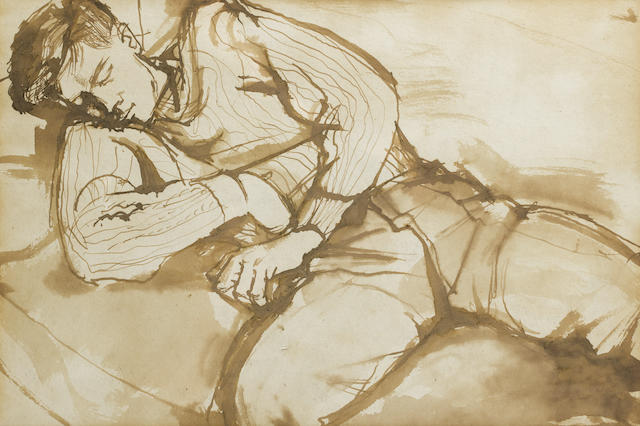
While working at the theater, John Minton met Kevin Maybury, an Australian carpenter working in the scenery department. A relationship developed and by the winter of 1956 Maybury had moved into Minton’s Chelsea house at 9 Apollo Place. Although Minton made several portrait drawings of Maybury, the”Portrait of Kevin Maybury”, shown above, is the only painting of Maybury known to be done by Minton. 

Finding himself out of sync with the new abstract expressionist movement, John Minton found himself left by the wayside in the painting world. He suffered psychological problems and turned to self-medicating with alcohol. In January of 1957, John Minton died, at the age of thirty-nine, from an overdose of sleeping pills in what was ruled a suicide.

After Minton’s death, Kevin Maybury subsequently had a distinguished career as a stage manager in South Africa and was the first person to earn a lifetime achievement award for services to South African theatre. Kevin Maybury died. at the age of eighty-four, in July of 2013 at his home in Johannesburg.

The “Portrait of Kevin Maybury”, most likely painted at the workshop in The Royal Court Theater during the summer of 1956, shows Kevin Maybury, posed and informally dressed,  holding a collapsible ruler and surrounded by the tools of his trade. The surface of the canvas is composed of geometric forms upon which tools lie at angles. The right side of the canvas is dominated by the easel which seems to lie flat on the plane of the canvas surface. This combined with the tilted up floor shortens the depth of the image.

Top Insert Image: Michael Ayrton, “John Minton”, October 1941, Oil on Panel, 41 x 33.5 cm, Private Collection

Middle Insert Image: John Minton, “Kevin Maybury Having a Nap”, 1956-1957, Ink and Wash on Paper, 25.2 x 37 cm, Private Collection

Bottom Insert Image: John Minton, “Kevin Maybury and Spanish Boy”, Pen, Ink, Gouache and Crayon on Paper, 37.3 x 27.3 cm, Private Collection


John Minton

The Artwork of John Minton

Born in Great Shelford, Cambridgeshire in December of 1917, Francis John Minton was an English illustrator, painter, stage designer and educator. He studied art at St. John’s Wood School of Art in northern London from 1935 to 1938.  Minton was introduced to the work of the French Neo-Romantic painters by his fellow student Michael Ayrton, who would become renowned for his writings and sculptural work. Between 1938 to 1939, he spent eight months studying art in France, often in the company of Ayrton, until the start of the second World War necessitated his return to England.

In 1941, John Minton joined the Pioneer Corps, a division of the British Army combatant corps used for light engineering tasks. He received a commission in a light infantry regiment in 1943, but was discharged in the same year on medical grounds. While in the army, Minton, collaborating with Michael Ayrton, designed sets and costumes for actor and theater director John Gielgud’s 1942 production of “Macbeth”. In the same year, they presented their paintings in a joint exhibition at London’s Leicester Galleries. Minton’s intense, realistic work was expressed in dark color schemes and included a self-portrait and cityscapes of streets and bombed buildings.

During the war years, Minton met painters Adrian Ryan and Lucian Freud and developed a close friendship which soon became an intimate sexual relationship with both men that lasted until the late 1940s. After he had seen Freud’s portrait of Francis Bacon, Minton commissioned in 1952 his own portrait from Freud. Between 1943 and 1946, Minton taught illustration at London’s Camberwell College of Arts. He often attended late night sessions at The Colony Room Club, a private members’ drinking and social club known for its debauchery, and visited jazz clubs that dotted London’s Soho district. 

After he left Camberwell College, John Minton served as the head of the drawing and illustration department at the Central School of Art and Design from 1946 to 1948. During these years, he  continued his own work and shared a studio, first with painters and theater set designers Robert Colquhoun and Robert MacBryde, and later with painter Keith Vaughan, all of whom were artists of the Neo-Romantic circle in that immediate post-war period. 

Minton began a prolific period of work after 1945; besides entries in group exhibitions, he had seven solo shows at London’s prestigious Lefevre Gallery before 1956. Minton, in addition to creating his paintings and illustrative work, also became a tutor of painting in 1949 at the Royal College of Art, where he taught until the year before his death. By the mid-1950s with the arrival of the newly popular American Abstract Expressionism, Minton’s commitment to figural composition had begun to be seen as out-dated. 

John Minton returned to the world of the theater and accepted a commission to design stage sets for two productions by playwright Ronald Duncan for London’s Royal Court Theater, “Don Juan” and “The Death of Satan”. While working at the theater, he met Kevin Maybury, an Australian carpenter working in the scenery department. A relationship soon developed and, by the winter, Maybury had moved into Minton’s house in Chelsea. Maybury became the model for several drawings by Minton and also posed for a portrait in which he is shown seated in his workshop surrounded by the tools of his trade. 

Finding his work out of fashion and suffering from psychological problems, Minton began to self-medicate with alcohol. In April of 1956, he left the Royal College of Art on a one-year unpaid leave; his departure caused by a lack of confidence in his own ability as both teacher and painter, and by deep-seated doubts about the relevance of painting in the modern world. He started suffering from extreme mood swings and became more dependent on alcohol. John Minto was found dead on the 22nd of January in 1957. The coroner’s verdict was suicide. 

John Minton’s final work, an ambitious large-scale painting, was incomplete at the time of his death and depicted a gravely injured man surrounded by distraught onlookers.  On the day before Minton’s death, the painter Ruskin Spear had visited him at his studio and was told that Minton identified the dying figure with Hollywood actor James Dean, who had died two years previously in a car accident. The painting, known as the 1957 “The Death of James Dean”, is clearly unfinished; there were indications through friends that Minton never intended to finish it as he was worried about not being able to break out of his past style.

Minton’s range of work was wide and included designs for stamps, textiles and wallpapers; posters for the London Transport system and Ealing Studios, a television and film producer; large scale paintings for the Royal Academy and the Dome of Discovery exhibition space at the 1951 Festival of Britain; and numerous landscapes of the British countryside. However, he is best remembered for his illustrative work for books, both interior work and book jackets. Among these are poet Alan Ross’s travel book “Time Was Away-A Notebook in Corsica”, author Herbert Ernest Bates’s “The Country Heart”, and two ground-breaking cook books by food writer Elizabeth David.

Note: A history of the relationship between John Minton, Lucian Freud and Adrian Ryan, interspersed with images of their work, can be found at the online Museum Crush magazine located at: https://museumcrush.org/art-sex-and-death-the-unholy-trinity-of-freud-minton-and-ryan/

Top Insert Image: Rollie McKenna, “John Minton”, 1951, Bromide Print, 24.5 x 19.4 cm, National Portrait Gallery, Washington DC

Second Insert Image: John Minton, “John Minton”, circa 1953, Oil on Canvas, 35.6 x 25.4 cm, National Portrait Gallery, Washington DC

Third Insert Image: John Minton, “The Life Model”, 1948, Oil on Canvas, 63.5 x 76 cm, Private Collection 

Bottom Insert Image: John Deakin, “John Minton, Soho”, 1951, Gelatin Silver Print, Michael Hoppen Gallery

Wayne Howarth

The Artwork of Wayne Howarth

Based in North West England, Wayne Howarth is a British artist, the son of illustrator Walt Howarth who was known for his interior and cover art of such British serial comics as Doctor Who, The Avengers, and Tarzan .After graduating from Liverpool Polytechnic in 1979, Wayne Howarth became a successful interior designer for many high profile clients throughout Great Britain. In 2009, Howarth changed the focus of his career to drawing, a passion he has had since childhood.

Howarth’s portraiture work is most often done in a combination of mediums. Harris’s figurative images, mainly done in pencil, are combined with surface pattern designs taken from textiles and wall coverings, which are then rendered by Howarth in acrylics and watercolors. Gold and copper leaf are also occasionally applied to the background patterns for embellishment.

Wayne Howarth’s work and contacts, including image purchases and  commissions for portraits, can be found at the artist’s site located at: https://www.waynehowarthillustration.com

John Craxton

Paintings by John Craxton

Born to pianist and composer Harold Craxton and his wife Essie in October of 1922, John Leith Craxton RA, was an English painter. Considered too young to attend nude life drawing at the Chelsea School of Art, he instead studied at Paris’s Academie Julian and later at the Académie de la Grande Chaumière in 1929. With the outbreak of war in Europe, he returned to London and completed his training at Westminster School of Art and the Central School of Arts and Crafts.

Rejected for military service, Craxton attended Goldsmiths College, part of the University of London, and had his first solo exhibition was in London in 1942 at the Swiss Cottage Café. In 1943, Craxton traveled through the Pembrokeshire woodlands with artist and designer Graham Sutherland, who had recently begun painting surreal, organic landscapes in oils. Returning to London, he had his first major solo show in 1944 at the Leicester Galleries, known for its exhibitions of modern international artists.

John Craxton’s work was considered part of the Neo-Romantic revival which sought to provide meaning and content to the modern existence. His early works done before 1945 showed the influences of artists Graham Sutherland and painter and printmaker Samuel Palmer whose visionary Shoreham landscapes had a great effect on both Craxton and Sutherland. Craxton was also heavily influenced by his friend and patron Peter Watson, a wealthy gay English art collector who provided financial assistance to Craxton, as well as Francis Bacon and Lucien Freud among others.

With the end of the Second World War, John Craxton began to travel extensively from 1946 to 1966, during which time he visited Switzerland, Spain, Italy, Istanbul, and Italy. However, his main interest was in Greece, and especially the island of Crete, where he permanently settled in 1970 with return visits to Paris and London. Writing in his memoirs, American painter and food writer Richard Olmey remembered Craxton’s visits to Paris during the summer of 1951: “Most nights, John Craxton, a young English painter, arrived to share my bed; we kept each other warm. He moved in a bucolic dreamworld, peopled with beautiful Greek goat herders. Soon he left for Greece.“

In 1951, Craxton designed the stage sets for the production of French composer Maurice Ravel’s longest work, “Daphnis et Chloé”, a retelling of the romance tale from the second century concerning the love between the goatherd Daphnis and the shepherdess Chloé. Craxton was able to use his experiences in Greece as a basis for his set designs. The Sadler’s Wells Ballet, now The Royal Ballet, performed Ravel’s work at Covent Garden in central London. In 1968, Craxton produced costumes and scenery for one more ballet: the 1968 performance of Igor Stravinsky’s “Apollo” performed at the Royal Opera House.

John Craxton exhibited his works in England and Greece, with a major retrospective of his work shown at the Whitechapel Art Gallery in 1967. He his work has appeared in print magazines; he also illustrated English writer Patrick Leigh Fermor’s series of books, and  produced lithographs for several anthologies edited by poet and critic Geoffrey Grigson. Elected a Royal Academician in 1993, Craxton also became a British Honorary Consul of Crete. In 2006, Craxton and his long-term partner Richard Riley were united in an official Civil Partnership. John Craxton died in 2009 at the age of eighty-seven, survived by his husband Richard. 

Top Insert Image: John Craxton, “Tree Trunk and Ruin”, 1944, Watercolor, Ink and Gouache on Paper, 21 x 14.5 cm, Private Collection

Middle Insert Image: Wolfgang Suschitzky, “John Craxton in Hydra, Greece”, 1969, Gelatin Silver Print

Bottom Insert Image: John Craxton, “Self Portrait”, 1946-1947, Oil on Paper, 32.3 x 23.2 cm, Private Collection