Servando Cabrera Moreno

The Artwork of Servando Cabrera Moreno 

Born in Havana, Cuba, in 1923, Servando Cabrera Moreno was a painter and sketcher, whose work contains a wide range of themes and styles. from traditional to abstraction, cubism and expressionism. A supporter of the Cuban revolution, his paintings are rooted in the tradition of vanguardia, a vigorous avant-garde current of artistic, cultural and social innovation, and are especially indebted to the work of Carlos Enríquez Gómez, one of the most original painters and illustrators of the vanguardia.

Along with painter Umberto Peña, Servando was the first of the 1960s artists to make homoerotic art in Cuba. Various artists in Cuba, including painters Raul Martinez and Manuel Mendive, used the theme of eroticism in their work; however, Servando and Peña dared to portray the issue of homosexuality in their work during a time when such work resulted in ostracism and exclusion from exhibitions.

Servando graduated, after winning first place in the painting examination, from the San Alejandro School of Fine Arts in 1942. He held his first individual exhibition, consisting of charcoal portraits, in the Havana Lyceum in September of  1943. Three years later, Servando  traveled to the United States and studied at the Art Students League in New York, where he also became involved in theater, and costume and stage design. 

Servando  traveled to Europe in 1949 and continued his studies at Paris’s  Grande Chaumiére in the Montparnasse district, where he discovered  and became influenced by the artwork of Pablo Picasso.  In 1950 and 1951, Servando gained recognition with his geometric and cubist oil paintings which were leaning towards abstraction. Mainly influenced by the works of Jean Miró and Paul Klee, he later entered a brief period of intense abstraction from 1953 to 1954; the works from this period were exhibited in solo exhibitions in France and Spain. 

During his stay in Paris, Servando met and became good friends withAlfredo Guevara. The friendship later deepened when Servando worked, along with filmmakers Julio Garcia Espinosa and Guevara, on the 1954 “El Megano”, a semi-documentary on the life of the charcoal makers of the Ciénaga de Zapata wetlands. Guevara became an important support for Servando during the difficult period of the 1970s, which were marked by discrimination towards homosexuals and a restrictive Cuban political culture. 

Servando  Cabrera Moreno , discouraged by the art market system, made  a sudden change in his style after a successful solo exhibition in January of 1954 at Paris’s La Roue Gallery. In Spain Servando began a series of realistic charcoal drawings of popular and village characters, which he would continue until 1955. This series of drawings and his work on the documentary  would lead to Servando’s 1955 oil painting “Los Carboneros del Megano (Megano’s Charcoal Workers)”. 

Servando traveled extensively through Europe and visited both Mexico and Central America. Observing the works of Matisse, Léger, and the cubist period of Picasso, he developed a new style in which architectural ornamentation and the  elements of modern painting are integrated. With the 1959 triumph of the revolution in Cuba, Servando’s art reached a turning point; he began incorporating topics from recent Cuban history in his paintings and, in 1961, his style was fully committed to the new reality. 

Towards the end of 1961, Servando exhibited at the National Museum of Fine Arts in Havana the first of  his Cuban epic paintings in which he decided to represent all those who had never achieved a leading  role in the arts. Servando documented events, such as the April 15th bombardment, and produced paintings of crowded popular assemblies, the literary campaign brigades, and the young people in the streets. This series of epic  paintings would continue to 1964, when he exhibited the “Heroes, Riders, and Couples” at the Habana Gallery. 

After again traveling to Europe in 1965, Servando began a five year period of expressionism that would lead to a sudden and long  period of eroticism in his work, a period which became the climax of his artistic development. Beginning in 1970, the male figure became the central focus of his work; he portrayed the human body as a sensual landscape of intertwined torsos and embracing couples. In this period, Servando made a 1077 series of  fifty-four drawings entitled  “La Soledad de un Autorretrato” and a series of explicitly erotic large ink drawings

Servando suffered a heart attack in 1967 and his work during the 1970s was regularly criticized  due to his consistent addressing of the homoerotic theme.  He was eventually fired from the faculty at the National Art School, which left scars on his personal life. A 1971 exhibition of Servando’s work at the Museo National de Belles Arts was dismantled and banned. That same year, issue number forty=four of the revolutionary cultural magazine, “Caimán Barbudo”, illustrated by Servando, was destroyed after printing. After 1971, exhibition space in Cuba was closed to him. 

Servando Cabrera Monero  participated in many Biennials in Venice, Säo Paulo, and Mexico, as well as the Inter-American Painting, Sculpting, and Print Biennial. Hs received a number of prizes at Cuban salons: a gold medal at the Pan-American Tampa Exhibition and silver medal at the 1969 International Joan Miró Drawing Contest held in Barcelona.

Along with all of Servando’s  friends and relatives, Alfredo Guevara was deeply affected  by the artist’s early death in 1981. He  became the legal trustee of Servando’s stored works which contained half of his oeuvre. This collection, overseen by Guevara, was transferred by the National Heritage Council and now resides at the Servando Cabrera Moreno Museum Library in Havana. An equal number of works are in the collection of Havana’s Museo Nacional de Bellas Arts. 

Note: A complete online copy of “Servando Cabrera Moreno: The Embrace of the Senses” by Rosemary Cruz and Claudia Machado can be found at the international database ISSUU located at: https://issuu.com/pepe_nieto/docs/libro_scm_ing

Albert Russo: “Dramatis Personae”

Photographers Unknown, The Parts and Pieces Making a Whole: Set Twelve

They call me Gianni
They call me Jim
But also Dominic
In both genders
In every guise

Whether it be Gianni, Jim or Dominic
In the present tense as in the past
First or third person
We’re talking of the same person
With the difference that each one
Speaks in another tongue
Confounding strangers
Claims the spiteful gossip

At time Gianni and Jim will be one and the same
At times they will oppose each other
Sometimes they might act as total strangers
And so it goes for both Dominics

The distance between them may be paper thin
Or else wide as the ocean
That which separates two languages
Or lies, mute, within the blood cells

Albert Russo, Dramatis Personae, The Crowded World of Solitude, Vol. 2

Born in February, 1943, in the Democratic Republic of Congo, Albert Russo is a poet, short story writer, novelist and photographer. The son of a British mother and an Italian Sephardic father, he attended the high school in Bujumbura, a coastal city in Burundi, where he mastered four languages: French, English, Dutch, German, and vernacular Swahili. Russo earned a Bachelor of Science degree in Business Administration at New York University in 1964  He traveled to Heidelberg in 1965, where he earned a degree in German culture and literature at the Collegium Palatinum. 

Russo first began writing poems in English in 1964 during his years at New York University. In 1965, he settled in Milan, Italy, where he  worked at the family firm and continued his writing. His first novel entitled “La Pointe du Diable”, written in French, was published in 1973 in Brussels. For this work, Russo won the Prix Colette in Cannes and the Prix de la Liberté in Paris. 

In 1975, Albert Russo returned to New York for three years. During this period, he taught language classes and published several poems and short stories in a variety of international magazines, including The Literary Review, Culture Française, La Libre Belgique, and Revue Zaire. Russo also worked with UNICEF translating scripts for children’s documentary films. He returned to Europe in 1978  and settled in Paris. 

Albert Russo has written more than twenty-five works, translated into twelve languages. His main themes are the defense of individual and collective rights, including ethnic, gender and religious, and the fight against racism. Many of his works are centered around life in Africa; two of which are“Mixed Blood” and “Eclipse over Lake Tanganyika”, both published in 2000. Russo wrote a large two-volume series entitled “The Crowded World of Solitude”, the first volume which includes short stories, essays, and fables: the second volume contains forty year collection of poems. 

During the 1980s, through their common Congolese experience and love for Africa, Russo met and befriended Italian artist and philosopher Joseph Pace. Later in the 2999s, he became friends with poet and photographer Adam Donaldson Powell. Together they authored the 2009 “Gaytude”, a volume of poetry, with photographs by Russo, which dealt with the gay experience of life on five continents.

As a professional photographer, Albert Russo has earned several prizes, including winning a National Indie-Excellence award and a silver medal from a Gallery Photografica competition. His photographic work has been shown at Switzerland’s Musée de l’Elysée in Lausanne. In 2019, Russo won a UNICEF Award for his poetry oeuvre and, in 2020, an Artavita Certificate for his photography.

Jake Grewal

Drawings and Paintings by Jake Gerwal

Born in South London in 1994, Jake Grewal is an artist whose work, done in the mediums of oil paint, watercolor and colored pencils, expresses his own life experiences. 

In 2013, Grewal received his Foundation Diploma in Art and Design from Kingston University in London. He received his Bachelor of Arts with first-class Honors in Fine Art and Painting from the University of Brighton in 2016. Grewal completed a year of postgraduate studies at London’s Royal Drawing School in 2019 and, following that, undertook a month-long residency at the Rhode Island School of Design in Providence.

Grewal’s autobiographical work is a blend of Romanticism and his South Asian heritage. His drawings and paintings are influenced by his early exposure to the Romantic artists who emphasized nature and individualism, such as painter and watercolorist William Turner, landscape artist Caspar David Friedrich, biblical artist John Martin, and visionary artist William Blake. 

Themes of love and loss, identity, violence, and adolescence are presented  in Grewal’s populated scenes of the natural world. Seen through a queer perspective, the two dominant aspects of his work are the natural idyllic world setting and the relationship between the nude male figures contained within. 

Grewal’s paintings and drawings have evolved over the years to a point where natural surroundings, often used as an allegory for the work’s narrative, has become an intrinsic feature of his observational work. A major influence on this evolution was a trip taken to Borneo where he viewed the extensive deforestation undertaken to increase palm oil production.

Jake Grewal had his first solo show, held at Very Lab, which was entitled “When I First Met You, I Was Younger”. His work has been exhibited at Baltic 39, a contemporary art center in Newcastle, where he won the 2016 Woon Foundation Prize. In 2019, Grewal’s work was exhibited at the “Looking for Validation” group exhibition at the Nayland Rock Hotel and at the “Full English” exhibition at the multi-discipline art program Platform Southwark, both in London. Among other exhibitions, his work has also been shown at Christie’s in London and the Pallant House Gallery in Chichester.

Images of Jake Grewal’s work and contact information may be found through his website located at: http://www.jakegrewal.com

Works by Jake Grewal that are available for purchase may be found at the online UTA artist site located at: http://utaartistspace.com/viewing-rooms/jake-grewal/

Jonathan Williams: “Glittering Frostily”

Photographers Unknown, Glittering Frostily

There are more things to love
than we would dare to hope for.
–Richard of St. Victor

where the car hit him, fireweed sprang with
blossoms of fennel

and umbels
of dill fell
through the spokes of a wheel

on Whistun holiday to the sun, Denton
Welch spun a web in his crushed cycle,

sat in the seat, spine curled up like a spider–

and spied: “saw
the very drops of sweat glittering frostily
between the shouder blades”

of a lad

…on and on he spied and bled from the blades of his cycle
small as a spider,
hiding in the fireweed, getting
wet from the skins of many human suns aground
at the Kentish river near
Tunbridge Wells,

where the dill
lulls,

and all boys
spoil…

Jonathan Williams, The Wreck on the A-222 in Ravensbourne Valley, Jubilant Thicket: New & Selected Poems, 2995

Born in Asheville, North Carolina, Jonathan Williams was a poet, photographer and graphic artist. He attended St. Albans School in Washington DC, and then Princeton University. After leaving Princeton to pursue the arts, Williams studied painting with Karl Knaths at the Phillips Gallery, and graphic arts and engraving under Stanley William Hayter at Atelier 17 in New York City. He later studied photography at Black Mountain College with Harry Callahan and Aaron Siskind.

In 1951, Williams, along with David Ruff, founded the book publishing company, The Jargon Society, with the goal of publishing obscure writers. This press, long associated with the Black Mountain Poets, an  post-modern group in North Carolina, launched a number of artists, both literary and visually artistic, who pioneered the 1980s avant-garde movement in United States. 

Jonathan Williams was a link between the experimental poets of the second generation of Modernists and the upcoming vernacular artists of Appalachia. Akin to a cultural anthropologist, he based his work on “found’ language, acquired through listening to others reminisce about their lives and experiences. Williams loved to reveal the poetic within the pedestrian, whether from commercial signs, such as “O’Nan’s Auto Service”, to amorous lavatory wall scribblings, such as “The Current Sexist Machismo in a Loo Along the River Kent”. He often infused light verse forms such as limericks, clerihews, and acrostics with his own ribald wit.Williams also invented a form of his own called the Meta-Four, which specified no length, only that every line contain four words. 

Jonathan Williams and his life-long partner, the poet Thomas Meyer, typically divided their year between Skywinding Farm, the property he owned in the Blue Ridge Mountains, outside Highlands, North Carolina, and a seventeenth-century stone cottage in  Cumbria, England. A longtime contributing editor of the photography journal Aperture, Jonathan Williams died from pneumonia on March 16, 2008 in his Blue Ridge Mountain home.

Insert Image: Guy Mendes, “Jonathan Williams and Thomas Meyer at Corn Close”, 1081, Silver Gelatin Print

Edward O. Phillips: “The Universe is Copernican”

Photographers Unknown, Parva Scaena (Brief Scenes): Photo Set Twenty-Three

“To grow old is to realize the universe is Copernican, not Ptolemaic, and that self and the loved one do not form the epicenter of the solar system>”

—Edward O. Phillips

Born on November 26th of 1931 in Westmount, an enclave of Montreal, Edward Openshaw Phillips was a Canadian novelist who has written mainstream literary fiction and is best known for his series of mystery novels featuring gay detective Geoffry Chadwick. 

Edward Phillips earned his Bachelor of Arts from McGill University in Montreal, and earned his Bachelor of Civil Law Degree from the Université de Montréal. After deciding against legal practice, he graduated from Harvard University with a Master’s Degree in Education, and later earned a second Master’s Degree in English Literature from Boston University. Phillips taught English for seven years, first in the public English school system and later at Selwyn House School, an independent boys’ school located in Westmount. 

Having a long-established interest in drawing and painting, Phillips pursued this interest with art classes at both the Visual Arts Center in Westmount and the Montreal Museum School of Art. He later entered his work in numerous group shows and was exhibited in five solo shows within Canada.

Throughout his teaching career and painting period, Edward O. Phillips devoted himself to his writing, from which would come twelve novels and numerous short stories. His first novel, “Sunday’s Child”, the first of six titles in the Geoffry Chadwick series, was published in 1981, and was shortlisted for the Books in Canada First Novel Award. Phillips won the Arthur Ellis Award, presented annually by the Crime Writers of Canada, in 1987 for his novel “Buried on Sunday”, the second book of the Chadwick series. In 1989, his novel, “Hope Springs Eternal”, was shortlisted for the Stephen Leacock Memorial Medal for Humor. 

Phillips’s short story, entitled “Matthew and Chauncy”, was adapted by director and screenwriter Anne Claire Poirier into the 1990 film “Salut Victor”. Produced by the National Film Board, the film starred Jean-Louis Roux as Philippe and Jacques Godin as Victor in the story of two older men, one openly gay and one closeted, who fall in love during their stay at a retirement home.

Edward O. Phillips spent most of his life in Westmount, Quebec. Openly gay, he was in a fifty-two year relationship with partner Kenneth S. Woodman, who passed away in 2018. Edward Phillips died on May 30th of 2020 of complications from Covid-19. 


Frank Bidart: “The Primary, the Crucial Scenario”

Photographers Unknown, The Primary, the Crucial Scenario

Lie to yourself about this and you will
Forever lie about everything.

Everybody already knows everything

so you can
lie to them. That’s what they want,

But lie to yourself, what you will

lose is yourself. Then you
turn into them.

For each gay kid whose adolescence

was America in the forties and fifties
the primary, the crucial

scenario

forever is coming out—
or not. Or not. Or not. Or not. Or not.

Involuted velleities of self-erasure.

Quickly after my parents
died, I came out. Foundational narrative

designed to confer existence.

If I had managed to come out to my
mother, she would have blamed not

me, but herself.

The door through which you were shoved out
into that light 

was self-loathing and terror.

Thank you, terror!

You have learned early that adults’ genteel
fantasies about human life

were not, for you, life. You think sex

is a knife
driven into you to teach you that.

–Frank Bidart, Queer, 2012

Born in May of 1939 in Bakersfield, California, poet Frank Bidart was educated at the University of California at Riverside, where he was attracted to the works of T.S. Eliot and Ezra Pound. Upon graduation, he moved to Cambridge, Massachusetts, to study literature at Harvard University. During his graduate years, Bidart became a student and friend of poets Robert Lowell and Elizabeth Bishop. 

Frank Bidart has written his work in a variety of forms, of which the best known are his earliest books containing monologues by troubled characters. Throughout the wide range of his work,  the dilemma of individual guilt, both its origins and consequences,has a prominent place in the work and is explored in its various forms. In order to express the importance of words and sentences in his stories, Bidart regularly uses varied forms of typography in the formal structure of the work, including blank spaces, block capitalization, italics, punctuation, and techniques such as quotations, monologues, and paraphrasing. 

Frank Bidart’s first volume of poetry, “Golden State”, an eight year project of self-reflection and a search for identity, was published in 1973. The volume was selected  for the Brazilier Poetry series by Pulitzer Prize recipient Richard Howard. The first poem, and most famous, in the collection is “Herbert White”, which presents the first-person confession of a child-murdering necrophiliac without any introduction or narrative frame. Bidart’s intent was to present someone, whose violent pattern grew out of the drama of his past, as the direct opposite of a previous poem’s character who sought insight through order and analyzation.

In 1977, Bidart published his second collection of poetry, “The Book of the Body”, a series of poems featuring characters struggling to overcome both emotional and physical adversity. The opening poem, “The Arc”, is written through the musings of an amputee. Included also in Bidart’s collection is a monologue, entitled “Ellen West”, spoken by a woman with an obsessive eating disorder. The narratives in this collection are not seamless, but spliced together bits of speech, journal notes, anecdotes, reminiscences, and analogies which follow each other in a progression.

Frank Bidart gained his reputation as an original poet with his 1983 collection “The Sacrifice”, which received widespread praise. The core of this volume is a thirty-page work entitled “The War of Vaslav Nijinsky”, a poem which alternates prose sections on the dancer’s  life with monologues by Nijinsky. A two year project, it went through many revisions and emerged as an experiment in language and punctuation.

Frank Bidart’s  1997 book “Desire” was published as a single work in two sections. The first section contains thirteen short poems, including a memorial to New York City artist and writer Joe Brainard, who died of AIDS-induced pneumonia in 1994. The book’s second half , entitled “The Second Hour of the Night”, contains a recounting of Ovid’s tale of Myrrha’s incestuous love for her father Cinryus. Appearing at the end of the work, the tale is told in a single-narrative of formal dictation which is essentially a meditation on longing and desire. This collection was nominated for the National Book Award, the Pulitzer Prize, and the National Book Critics Circle Award; it received the Library of Congress’s 1998 Rebekka Bobbit Prize for best poetry book.

Bidart’s 2005 “Star Dust”. also divided in two parts, has a central theme: man’s drive toward creation, the way we give form and shape to experience. The first section is composed of the short poems about the failure of men to realize the human need to create. These poems were  previously published in the Pulitzer nominated chapbook “Music like Dirt”. The second section consists of eight short lyrics and a long narrative poem entitled “The Third Hour of the Night”, which tells the story of Benvenuto Cellini’s struggle to complete his statue of Perseus holding the head of Medusa. Composed of poems which emphasized the way we shape our lives and experiences, “Star Dust” was nominated for a National Book Award.

Frank Bidart’s  most recent collections include the 2008 “Watching the Spring Festival: Poems”, “Metaphysical Dog: Poems” published in 2013, and “Half-light: Collected Poems 1965-2016” which won the Pulitzer Prize and the National Book Award. Frank Bidart was elected a Chancellor of the Academy of American Poets in 2003. He  has taught at Wellesley College since 1972. 

Ego Rodriguez

The Illustrative Work of Ego Rodriguez

Born in Gijón, Spain, in 1976, Ego Rodriguez is a self-taught, freelance graphic designer who has been based in the East End of London for the last twenty years. Born into an artistic family and initially trained by his parents in the arts, he began drawing in sketchbooks at an early age. Rodriguez’s work is currently focused on digital media; but he also creates work in acrylics, inks, mixed media, and watercolor.

Inspired by the fashion illustrations of Antonio López and Stefano Canulli, Rodriguez’s illustrative work is predominately  portraiture, done with well-defined aesthetics, clean edges, bold strokes, and contrasting colors, similar in style to the fashion illustrations of René Gruau, one of the best known artists of the haute couture world during the 1940s and 1950s. The central part of Rodriguez’s work has formed around his homoerotic images of male figures and his film world images due to their popularity.

In the beginning of Rodriguez’s art career, commissioned portraits for friends formed the basis of his art. Since then, his current body of work has included postcards, editorial work, logos, websites, wall paintings, and illustrative work for magazines, both online and published. Some of his clients have been Attitude, QX Magazine, Gay Times, and The Advocate. Rodriguez has also contributed work for The Pigeon Hole, an online global book club, and Swide, an online luxury magazine. 

Ego Rodriguez’s exhibition entitled “Macho” was featured in 2012 and 2014 in London, and also has been shown at Pride events worldwide.

More images, information on commissions, and contact can be found at the artist’s site: https://www.egorodriguez.com

Kelly Fearing

Kelly Fearing, “The Lifters”, 1944, Etching, 24.3 x 20.9 cm, Blanton Museum of Art, Austin, Texas

Born in Arkansas in 1918, Kelly Fearing was a painter, print maker, and teacher. He studied art at Louisiana Tech University and New York’s Columbia University, where he earned his Master’s Degree in 1950. He relocated to Fort Worth, Texas, in 1943 and joined the Fort Worth Circle, a progressive art colony, mostly young artists, which was active during the 1940s and 1950s.

Though not defined by a specific aesthetic, the Fort Worth Circle was important for moving beyond the realism and agrarian subject matter of American Regionalism, which dominated Texas art in the 1930s and 1940s. Kelly Fearing and his Fort Worth cohorts were the first artists in the state to respond in a significant way to European artists such as Picasso, Braque, Klee, Kandinsky, Modigliani, Ernst, Klee, and Miro.

After teaching from 1945 to 1947 at Texas Wesleyan, Kelly Fearing assumed the Professorship of Art in the Department of Art and Art History at the University of Texas at Austin, where he taught for forty years. A noted art educator, he  co-authored several multi-volume art education textbooks from 1960 through the 1980s. As a pioneer in art education in America, Fearing founded The University of Texas Junior Art Project, the first visual arts outreach program of its kind in Texas. He became Professor Emeritus at the University of Texas in 1987 and, after  his retirement, continued to work as a professional artist. 

Kelly Fearing worked in almost all traditional mediums, with prominence in oil painting and collage work. The work from his Fort Worth years is abstract in form, surrealistic and filled with allegory., characteristics which would remain throughout the body of his work. Fearing’s art has been referred to as magical realist, mystical naturalist and Romantic surrealist.

Kelly Fearing died on March 13, 2011 from congestive heart failure at the age of ninety-two. More than 80 of his prints and drawings are in the Blanton Museum of Art’s permanent collection.

More works by Kelly Fearing can be found at: https://ultrawolvesunderthefullmoon.blog/2015/07/16/six-etchings-by-kelly-fearing-kelly-fearing-was/

Manuel Ramos Otero: “The Pendulum of the Body”

Photographers Unknown, The Parts and Pieces Making a Whole: Set Thirteen

La muerte no fue la clave del secreto,
?Qué cuento no comienza en el crepúsculo?
?Qué cangrejo no busca su fantasma
en los fuegos fúnebresdel tiempo?
?Qué brujo no sabe que la luna
sostiene el péndulo del cuerpo?

Adánico regreso hasta la sombra.
Añosa regresión hasta el silencio.

Sin hilos. Sin agujas. sin cenizas.
Mi novio no havuelto de su tumba.

?Qué triangular el traje de mis nupcias!

Es perfecto este tálamo sin sangre.
Estoy en las ruinas del castillo.
Arranco los erizos de lacrare.
La orina se desborda de la copa.
Que nunca soledad. Que llegue nadie.

Death was not the key to secrecy,
What story does not start at twilight?
What crab does not look for its ghost in the funeral fires of time?
What a warlock does not know that the moon supports the pendulum of the body?

Adamic return to the shadow.
My years regress to silence.

Without threads. Without needles. without ashes.
My boyfriend has not returned from his grave.

How to triangulate the suit of my nuptials?

This bloodless thalamus is perfect.
I am in the castle ruins.
I pluck the lacrare hedgehogs.
The urine overflows from the glass.
That never loneliness. Let no one arrive.

–Manuel Ramos Otero, El Libro de la Muerte

Over the passage of time, Puerto Rican literature evolved from the art of oral story telling to its present-day status. Originally, written works by the native islanders of Puerto Rico were prohibited and repressed by the Spanish colonial government. Only those authors who were commissioned by the Spanish Crown to document the chronological history of the island were allowed to write. In the late 19th century, with the arrival of the first printing press and the founding of the Royal Academy of Belles Letters,  Puerto Rican literature finally began to flourish.

Born in Manati, Puerto Rico, in 1948, Manuel Ramos Otero is widely considered to be one of the first openly homosexual writers of the Puerto Rican diaspora.. Throughout his literary career, he boldly put his homosexuality at the core of his poetic, fiction, and non-fiction work. Feeling repressed and persecuted in his homeland because of the openness of his sexuality, Ramos Otero left Puerto Rico and relocated to New York City in 1968, where he received in 1979 his Master’s Degree in Literature from New York University. 

Otero’s writings, primarily semi-autobiographical pieces that dealt with themes of exile and rejection, are often considered controversial because of their unabashedly political, feminist and homoerotic subject matters. Exiled from Puerto Rico, Otero felt rejected in the United States because his writing did not deal with issues of race and class status that had become expected of Latino writers. Using  urban  gay Puerto Rican male writers as his protagonists,  he explored New York City’s gay subculture of  the 1970s and 1980s,  with its drugs, hustlers, prostitution, and dark sexual playgrounds  found beneath the rotting piers of the Greenwich Village and Chelsea waterfronts. 

In September of 1971, Ramos Otero founded Aspasguanza, a theatrical workshop in the Lower East Side of Manhattan. His traveling theater performed as part of the 1980 celebration of Fuegos Funebres in the historical district of Old San Juan in Puerto Rico. Dressed in a black kimono with face painted white,  Ramos Otero enacted the character of Tsuchigumo, a spider found in Noh dramas, Japanese mythology, and comic Japanese performances. 

During the decade of the 1970s, Ramos Otero traveled and collaborated creatively with his live-in partner, John Anthes, whose relationship is highlighted in much of Otero’s semi-autobiographical writing. In 1975, Otero founded the publishing group El Libro Viaje, which was devoted to increasing the publication of Puerto Rican authors in the United States. His highly experimental 1976 novel “La Novelabingo ( The Bingo Novel)”, was published through this press. After Anthes’s death in 1979, Otero dedicated two of his works to him: “Ritos Cancelado (Canceled Rites)” and “Ceremonia de Bienes y Raices (Ceremony of Goods and Roots)”. 

In 1980, Ramos Otero would later meet and develop a relationship with the Puerto Rican painter Angel Rodríguez-Díaz. In one of his better known stories, “Descuento”, Otero described a painting by Rodriquez-Dias, which would illustrate the cover of his last book of stories, “Página en Blanco Staccato”. This illustration of a Japanese Noh drama character would serve as inspiration for the theater performance at the 1980 Fuegos Funebres festival.

Ramos Otero taught writing and literature at Rutgers University, York College, LaGuardia Community College, and Lehman College. In addition to being a writer, he fostered and strengthened the literary community by helping to organize conferences and gatherings of Puerto Rican writers in the United States. Throughout his life, Ramos Otero participated in  literary collaborations and maintained close friendships with other influential Puerto Rican authors, including Rosario Ferré, Ana Lydia Vega, and Magalí García Ramis.

Manuel Ramos Otero returned to his hometown of Manati in 1990 to live out his final days, He died from complications of HIV/AIDS in San Juan, Puerto Rico, on October 7th of 1990 at the age of forty-two. Ramos Otero is remembered for his well-regarded short stories, his essays on literary criticism, and for his two  published works, the 1985 “El Libro de la Muerte”, which includes his Epitaphios Cycle of poems, and his “Invitacion al Polvo”,  a  work posthumously published in 1991 that directly addresses topics around the AIDS crisis.

Columbia University’s Archives houses a collection of Ramos Otero’s personal and professional correspondence, notebooks, reviews,  photographs and newspaper clippings which range from infancy to his death. Included in this collection are many letters from Otero to his mother discussing his relationship with John Anthes; there are also letters from Anthes to Otero’s mother.

Notes: A full translation of Manuel Ramos Otero’s work “Vivre del Cuento”, translated as “The Scheherazade Complex”, can be found at the Fordham University Library located at:  https://www.fordham.edu/download/downloads/id/463/scheherazade_complex

For those interested, a more extensive study of Manuel Ramos Otero’s life, including a history of his Traveling Theater, can be found at The Free Library located at: https://www.thefreelibrary.com/The+Travelling+Theater+of+Manuel+Ramos+Otero.-a0557578965

Rafael Campo: “What I Would Give”

Photographers Unknown, What I Would Give

What I would like to give them for a change
is not the usual prescription with
the hubris of the power to restore,
to cure; what I would like to give them, ill
from not enough of laying in the sun
not caring what the onlookers might think
while feeding some banana to their dogs–
what I would like to offer them is this,
not reassurance that their lungs sound fine,
or that the mole they’ve noticed change is not
a melanoma, but instead of fear
transfigured by some doctorly advice
I’d like to give them my astonishment
at sudden rainfall like the whole world weeping,
and how ridiculously gently it
slicked down my hair; I’d like to give them that,
the joy I felt while staring in your eyes
as you learned epidemiology
(the science of disease in populations)
the night around our bed like timelessness,
like comfort, like what I would give to them.

–Rafael Campo, What I Would Give, Landscape and Human Figure, 2002

Born in Dover, New Jersey, in November of 1964, Rafael Campo is a poet, doctor, and author. He graduated from Amherst College, where he earned his BA and MA degrees, and Harvard Medical School, where he earned his MD degree. Campo started practicing internal medicine in the early 1990s, at the height of the HIV-AIDS epidemic in the US. He currently practices medicine at both Harvard Medical School and Beth Israel Deaconess Medical Center in Boston.

Campo’s writing reflects his commitment to poetry as the fullest expression of self, and his understanding of it as a necessary tool for healing and empathy. A master of poetic meter, his work is highly structured in its various forms, including blank verse, villanelles and rhymed tercets. This attention to form tends to be mixed with narratives of family and illness, and often is structured around personal feelings for his patients and those who suffered from homophobic and racist encounters.

Rafael Campo’s first collections of poems, entitled “The Other Man Was Me: A Voyage to the New World”, won the National Poetry Series Open Competition in 1993. His 1996 collection “What the Body Told” was a winner of the Lambda Literary Award. Campo’s 1999 “Diva”, a collection which included his translations of poems by Federico García Lorca, was a finalist for the National Book Critics Circle Award. Three collections pf poetry followed: the “Landscape with Human Figure” published in 2002. “The Enemy” published in 2007, and “Alternative Medicine” published in 2013.

Rafael Campo is also the author of prose works, including the 2003 “The Healing Art: A Doctor’s Black Bag of Poetry”, which was reviewed favorably in medical journals. In this work, he used poems from poets such as Marilyn Hacker and William Carlos Williams, to address the necessity of differentiating between curing, which makes illness go away, and healing, which transforms one’s attitude toward illness. Campo’s earlier essay collection, “The Poetry of Healing”, published in 1997, received a Lambda Literary Award.

Campo is a PEN Center West Literary Award finalist and a recipient of the National Hispanic Academy of Arts and Sciences Annual Achievement Award. He recently received fellowships from the Guggenheim Foundation and the Echoing Green Foundation.

Note: Although Rafael Campo does not name his bed partner at the end of “What I Would Give”, it is understood from other poems and essays that it is Jorge, his longtime partner, then spouse. Rafael Campo came out as gay in the 1990s, and writes about this in his essay “The Desire to Heal” from “The Poetry of Healing”.

A small collection of Rafael Campo’s poetry can be found at: https://poets.org/poet/rafael-campo

The photo of the fighter, center of bottom row, is from a photo shoot of model Yuri Zalomov taken by photographer Andrei Vishnyakov.


Marcel Proust: “We See the World Multiply Itself”

Photographers Unknown, We See the World Multiple Itself

“Through art alone are we able to emerge from ourselves, to know what another person sees of a universe which is not the same as our own and of which, without art, the landscapes would remain as unknown to us as those that may exist on the moon. Thanks to art, instead of seeing one world only, our own, we see that world multiply itself and we have at our disposal as many worlds as there are original artists, worlds more different one from the other than those which revolve in infinite space, worlds which, centuries after the extinction of the fire from which their light first emanated, whether it is called Rembrandt or Vermeer, send us still each one its special radiance.” 

—Marcel Proust, In Search of Lost Time, Volume Six: Time Regained and A Guide to Proust

Born into a comfortable household in the Parisian borough of Auteuil in July of 1871, Valentin Louis Georges Eugène Marcel Proust was a novelist, essayist and critic. The event of his birth took place during the suppression of the Paris Commune, a revolutionary socialist government that seized control of Paris for two months, and the consolidation of the French Third Republic, which would last until World War II. These vast changes in France’s existence played an important role in Proust’s most prominent work, “In Search of Lost Time”.

Marcel Proust suffered from poor health throughout his life. When he was nine, he experienced the first attack of the asthma that would constrict and dominate his life. As a child, he spent long holidays in the village of Illiers, a commune in north central France, where he took pleasure in the natural surroundings. This village would become the model for the fictional town of Combray, later described within “In Search of Lost Time”. In 1882 Proust, at age eleven, became a pupil at the Lycée Condorcet, a prestigious high school in Paris, where he received an award for excellence in literature. Illness, however, disrupted his education.

Proust, in spite of his poor health, served a year, from 1889 to 1890, in the French army, stationed at Coligny Barracks in the river port city of Orléans. As a young man, Proust frequented the art and literary salons of Paris, including the salon of Madame Geneviève Straus, the mother of Proust’s school friend Jacques Bizet; the salon of French painter Madeleine Lemaire; and the salon of Madame Arman de Caillavet, the mother of playwright and close friend Gaston de Caillavet. Among those who knew him, he was considered a dilettante with a lack of self-discipline and a need to impress others with his knowledge.

Marcel Proust was involved in writing from an early age. He published a regular society column in the journal “Le Mensuel” from 1890 to1891. Proust co-founded in 1892 the literary journal “Le Banquet”, in which he regularly published articles through subsequent years. In the summer of 1894 and for three weeks in 1895, Proust and French composer Reynaldo Hahn were invited by Madame Lemaire to her château de Réveillon. The two young men began an intense affair, Proust’s only real liaison, that would last two years and evolve into a lifetime friendship. 

In 1896, a collection of Proust’s early writings, including drawings by Madame Lemaire, was published in an expensive edition with a forward written by poet Anatole France. In the same year, Proust began working on what would be an unfinished work. Many of the themes in “In Search of Lost Time”, including the enigma of memory and the necessity of reflection, are articulated in this unfinished work. Failing to resolve the plot, Proust gradually abandoned the work in 1897 and stopped entirely in 1899. This work, dealing with the relationship between writers and society, was published posthumously in 1952 by Éditions Gallimard under the title “Jean Santeuil”.

In 1908, after publishing in journals works which imitated other writers, Marcel Proust began to solidify his own style. Beginning in 1909 at the age of thirty-eight, Proust started work on his magnum opus, the seven volume  “In Search of Lost Time”. This novel is his most prominent work, known both for its length and its theme of involuntary memory. The story follows the narrator’s recollections of his childhood and experiences into adulthood during the late 1800s and early 1900s of aristocratic France, and examines his reflection on the loss of time and lack of meaning to the world. 

Proust established the structure of the novel early in the process, but kept adding new material and edited one volume after another for publication. He continued to work on it until his final illness in the autumn of 1922 forced him to stop. The last three volumes of the novel only existed in draft form, with oversights and fragmented passages, at Proust’s death in November of 1922. These last three volumes were edited and published posthumously by his younger brother Robert Proust. The finished novel totaled about thirty-two hundred pages and featured more than two thousand characters.

Marcel Proust never openly admitted to his homosexuality, although his family and close friends either knew or suspected it. His romantic relationship with composer Reynaldo Hahn and his infatuation with his chauffeur and secretary, Alfred Agostinelli, are well documented. Proust was also one of the men identified by police on a January 1918 raid on a male brothel run by Albert Le Cuziat. Although the influence of Proust’s sexuality on his writing is debatable, his “In Search of Lost Time” discusses gay life at length and features several main characters, both men and women, who are either homosexual or bisexual.

Note:  An interesting and informative biography on the life of Marcel Proust by Elyse Graham for “The Modernist Lab” can be found at:  https://campuspress.yale.edu/modernismlab/marcel-proust/

Claude McKay: “The Shadow-Fact with Which I Strove”

Photographers Unknown, The Shadow-Fact with Which I Strove

I
Not once in all our days of poignant love,
Did I a single instant give to thee
My undivided being wholly free.
Not all thy potent passion could remove
The barrier that loomed between to prove
The full supreme surrendering of me.
Oh, I was beaten, helpless utterly
Against the shadow-fact with which I strove.
For when a cruel power forced me to face
The truth which poisoned our illicit wine,
That even I was faithless to my race
Bleeding beneath the iron hand of thine,
Our union seemed a monstrous thing and base!
I was an outcast from thy world and mine.

II
Adventure-seasoned and storm-buffeted,
I shun all signs of anchorage, because
The zest of life exceeds the bound of laws.
New gales of tropic fury round my head
Break lashing me through hours of soulful dread;
But when the terror thins and, spent, withdraws,
Leaving me wondering awhile, I pause–
But soon again the risky ways I tread!
No rigid road for me, no peace, no rest,
While molten elements run through my blood;
And beauty-burning bodies manifest
Their warm, heart-melting motions to be wooed;
And passion boldly rising in my breast,
Like rivers of the Spring, lets loose its flood.

Claude McKay, One Year After, 2003

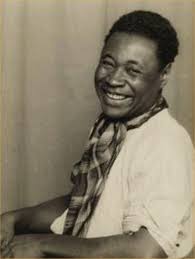
Born in Sunny Ville, Jamaica, in 1889, Festus Claudius McKay was poet and writer, one of the key figures in the literary movement of the 1920s Harlem Renaissance. His work ranged from vernacular verse celebrating peasant life in Jamaica to poems which protested racial and economic inequities. 

Proud of his African heritage, Claude McKay’s early interests were in the study of English poetry. He received his formative education under the tutelage of his brother, schoolteacher Uriah Theophilus McKay, and a local Englishman Walter Jekyll, who advised aspiring poet McKay to write verse in the Jamaican dialect. McKay’s studies were based in the British classic writers, such as Milton and Pope, and the later Romantic authors. McKay also studied the writings of philosopher Arthur Schopenhauer, whose works Jekyll was translating into English.

In 1906, McKay spent a year in Brown’s Town and the Jamaican capital of Kingston; but, after encountering extensive racism, he returned to Sunny Ville. In 1912, McKay published through a London company two collections of verses portraying opposing aspects of Black life inJamaica:“Songs of Jamaica” and “Constab Ballads”. His “Songs of Jamaica” presented a celebration of Jamaican peasant life and the people’s connections to the land. McKay’s “Constab Ballads”, however, portrayed a bleaker outlook on the plight of Black Jamaicans and was explicitly critical of the discrimination in urban Kingston. 

For his “Songs of Jamaica”, Claude McKay received an award and a stipend from the Jamaican Institute of Arts and Sciences, which he used to travel to America in 1912. He studied briefly at Kansas State College, but left in 1914 for New York City where he worked various menial jobs and continued writing poetry. In 1917, McKay published two poems in the short-lived periodical “Seven Arts”; a few years later, he published poems in the “Liberator” magazine. among these was his famous “If We Must Die”, a response to mob attacks by white Americans upon Afro-American communities during the ?Red Summer” from April to November of 1919.

McKay began a two year period of travel and work abroad, which began with a stay in Holland and Belgium, before moving to London and working at the “Workers’ Dreadnought” periodical, published on behalf of the East London Federation of Suffragettes. In 1920 he published his third collection of poetry, “Spring in New Hampshire”, notable for containing  “Harlem Shadows”, a poem of the plight of Black sex workers in the degrading urban city. 

Returning to the United States in 1921 McKay involved himself in various social causes. His 1922 anthology collection of poems, “Harlem Shadows”, assured his stature as a leading member of the Harlem Renaissance. Working on behalf of Blacks and laborers, McKay became involved with the Universal Negro Improvement Association and produced several articles for its publication. His travels took him to Paris, where he was hospitalized for a severe respiratory infection; upon recovery, McKay  traveled for the next eleven years, touring Europe and northern Africa. 

During this travel period, Claude McKay published three novels and a short story collection. His first novel, the 1928 “Home to Harlem”, tells the story of two black men, one who represents the instinctual aspect of an individual and, the other, the intellectual perspective, whose lives in Harlem are affected with either happiness or despair. This social-realist novel detailed a portrait of the hardships of Black urban life and recounted  different ways of rebelling against its ensuing circumstances. 

Mc Kay followed this book with the 1929 “Banjo” A Story without a Plot”, a novel about Banjo, a Black vagabond living in the French port city of Marseilles, who embodies the largely instinctual way of life, and Ray, a struggling, intellectual artist conventionally employed. The two men, always dissatisfied and disturbed by their limited roles in the racist society of Marseilles, cope with their problems in their own way, but both eventually decide to leave the city. 

In his third novel “Banana Bottom”, McKay presented a more incisive exploration of the Black individual’s quest for cultural identity in the face of racism, and explored the underlying racial and cultural tensions. In this story, the protagonist was a Jamaican peasant girl, who with pride and independence, fled the oppressive racist society in which she was forced to live and returned to an idealized peasant Jamaican environment.

During his final years abroad, Claude McKay published his 1932 “Gingertown”, a collection of twelve short stories, six of which were addressed to Harlem life and dealt with Black exploitation, and six stories which were set in Jamaica and North Africa, McKay’s last home before his return to the United States. Upon his return to Harlem in the mid-1930s, he began work on an autobiography, “A Long Way from Home”, a work published in 1937 about his challenges as a Black man in society.

Developing a keen interest in Catholicism after his disillusionment with Communism in the late 1930s, McKay became active in Harlem’s Friendship House, a missionary movement and a leading proponent of interracial justice. His work with the organization inspired his 1940 non-fiction historical treatise “Harlem: Negro Metropolis”, an account of the black community in Harlem during the 1920s and 1930s. McKay later moved to Chicago and worked as a teacher for a Catholic organization. 

In 1943, McKay started “Cycle Manuscript”, a collection of forty-four poems, which were never published; this important document remains as a typescript at the Beinecke Library of Yale University. By the middle of the 1940s, McKay’s health had deteriorated. He endured several illnesses throughout his last years and eventually died of heart failure in May of 1948. Claude McKay was buried at Calvary Cemetery in Queens, New York. 

Notes: An extensive collection of Claude McKay’s poetry can be found at: https://www.poemhunter.com/claude-mckay/poems/

An interesting read is “A Love So Fugitive and So Complete: Recovering the Queer Subtext of Claude McKay’s Harlem Shadows” by Lindsay Tuggle of the University of Sydney (originally printed in the journal “The Space Between; Literature and Culture 1914-1945”) which is located at: https://www.monmouth.edu/department-of-english/documents/a-love-so-fugitive-and-so-completerecovering-the-queer-subtext-of-claude-mckays-harlem-shadows.pdf/

Maurice Grosser

Paintings by Maurice Grosser

Born on October 23, 1903 in Huntsville, Alabama, Maurice Grosser was an American writer, art critic, and painter. He attended Harvard University and graduated with a degree in Mathematics with honors in 1924. While at Harvard, Grosser received painting instruction from painter and professor Denman Ross, a trustee of Boston’s Museum of Fine Art. Grosser also studied both life drawing and painting at Boston’s Architectural School and South Boston’s Art School,

Awarded Harvard’s Sheldon Fellowship for a two year period, Grosser was able to study painting in both France and Italy. In 1925 in Paris, he met for the second time and began a relationship with American composer and critic Virgil Thomson, who became his life partner and frequent collaborator. After meeting Gertrude Stein in Paris in 1926, they returned to the United States and took up residence at New York’s Hotel Chelsea, where they presided over a salon which attracted leading figures in the arts, such as writer and poet Frank O’Hara, composer Leonard Bernstein, author Tennessee Williams, and avant-garde composer John Cage

Maurice Grosser first began his collaborative work with Virgil Thomson around 1928, when he assisted in the production of Thomson’s new opera “Four Saints in Three Acts”. The libretto for the opera was prepared by Gertrude Stein, the music was composed by Thomson, and the scenario was developed by Grosser. This opera was noted for its musical content, its form, and its portrayal of the European saints by a cast of black performers, with singers directed by Eva Jessye, a prominent black choral director. 

Grosser next worked with Thomson on his provocative 1947 opera “The Mother of Us All”, based on the life of social reformer Susan B.  Anthony. The libretto for this opera was written by Gertrude Stein, who sent the finished work to Thomson in March of 1946, just a few months before her death in July. The two-act opera premiered in May of 1947 with soprano Dorothy Dow as Susan B. Anthony. The work was a 1956 Off-Broadway production, part of the Santa Fe Opera’s 1976 season, and staged at the New York City Opera in 2000 and the San Francisco Opera in 2003. 

A third collaboration between Maurice Grosser and Thomson was the 1985 “18 Portraits”. For many years, they had made portraits, some dating from the 1920s, of mutual friends in both music and paint forms. The portraits of each sitter were presented in eighteen separate bi-folios, with a single sheet insert consisting of two pages of music and an original lithograph of a  pencil and charcoal portrait.

A writer as well as a painter, Maurice Grosser lived among a circle of avant-garde authors, artists, and musicians. He spent long periods living and working abroad, first in Paris and later in Morocco, Spain, Turkey, Greece, Israel, Nigeria, Canada, and Brazil. As an artist, Grosser painted in a conservative realist style, in which he depicted structured landscapes in New England, and in the southern and western states. He was also a portraitist whose more famous subjects were  his companion, composer Virgil Thomson, Scottish operatic soprano Mary Garden, writer and playwright Jane Bowles, and British mathematician Alfred North Whitehead.

Between 1956 and 1967, Maurice Grosser served as art critic for “The Nation” magazine. As an author, he wrote four books on painting and art criticism, including “Painting in Public / Painting in Our Time” in 1948 and republished in 1964; “The Painter’s Eye” in 1951; the 1962 “Critic’s Eye”; and “Painter’s Progress” in 1971. Grosser’s memoir entitled “Visiting Gertrude Stein and Alice Toklas” was published posthumously in 2006 by New York Review Books. 

Maurice Grosser died on December 22, 1986, at the age of eighty-three. His ashes are interred at Maple Hill Cemetery in Huntsville, Alabama. Virgil Thomson died on September 30, 1989, in his suite at the Hotel Chelsea in Manhattan at age ninety-two. 

Note: Maurice and Virgil first met in 1920 while both were attending meetings of The Liberal Club at Harvard; but the intimate relationship between the two would not fully evolve until they met by chance in 1925 at the Parisian cafe “Deux Magots”.

Top Insert Image: Maurice Grosser, “Self Portrait”, 1925, Oil on Canvas, Location Unknown

Middle Insert Image: Maurice Grosser, “Self-Portrait”, 1985, Lithograph, Private Collection

Bottom Insert Image: Carl Van Vechten, “Maurice Grosser”, 1935, Silver Gelatin Print, Library of Congress

R.M. Vaughan: “A Smile Pulled from the Eyes”

Photographers Unknown, But, Once You Start Living, It Never Ends

“Mais, une fois qu’on a commence’ de vivre, ca n’en finit plus.”
-Anne He’bert, La Robe Corail

yes, I could be transparent, have no more than 2 meanings
for every sentence, smother      the small inhalations
in duck-lined beds  (instinctual)
but I am not

tired, only some part of me, the corner of intellect
reserved for newspapers, educated company, family fights
won’t shut up, won’t misread for me, play blind man’s bluff or
any game with kissing and shut eyes      won’t say  –  this means
nothing. I am safe-

from harm, I take baby steps      dangle limbs over balconies
sit on cane back chairs made for light men in linens      even dance
fat-legged, convinced of rhythm      but from love all manner
and logic, knoves if necessary      nothing closes me, nothing

to danger, a smile pulled from the eyes, where smartness lives
or a wrist, the left, folding surrendered air in cross-cuts      language
for events microscopic, just as loud      but to love
no tricks no practiced feints of hip or cape, no tangles of scarves
to swirl over the very idea      because love happened, once, and
like anything charming      love was just another language, another dress,
a sneaky link of party half-grins      spread chair to chair, room to room
sogning the trickster from his mark

–R.M. Vaughan, Untitled, Invisible to Predators, ECW Press, Fall 1999

Born in the city of Saint John in New Brunswick, Canada, in 1965, Richard Murray Vaughan was a poet, novelist, and playwright. He earned both his Bachelor of Arts degree in Creative Writing and his Masters of Arts in English from the University of New Brunswick. Openly gay, he was playwright-in-residence for the years 1994 and 1995 at Buddies in Bad Times, a professional Canadian theater company. Originally focused on staged adaptions of poetry, the company became dedicated to the promotion of queer theatrical expression during the 1980s.

RM Vaughan published many works in his career, including fiction, poetry, anthologies, stage plays, and journalistic articles for such publications as the digital digest Utne Reader, the digital LGBYQ2-focused Xtra magazine, and the print newspaper The Globe and Mail. Vaughan’s memoir about his struggles with insomnia, entitled “Bright Eyed”, was published in 2015. 

Vaughan has written many poetry books and chapbooks. Some of his most successful works include “A Selection of Dazzling Scarves” published in 1996 and “96 Tears (in my Jeans)” published in 1997 by Broken jaw Press. The most recent collections of his poetry include the 2004 “Ruined Stars” and “Troubled: A Memoir in Poems” published in 2008. His single poems have been included in over fifty anthologies. 

As a novelist, RM Vaughan’s work includes “A Quilted Heart” in 1998 and “Spells” in 2003; as a playwright, his work includes the 1998 “Camera, Woman” and the 2003 “The Monster Trilogy”. Vaughan’s short narrative and experimental videos have been exhibited in many Canadian and international galleries and festivals, and are represented by V-Tape and the Canadian Filmmakers’s Distribution Centre.

RM Vaughan’s works often touched on queer stories of coming-of-age and eroticism. He had a taste for the supernatural and macabre, and was captivated by the world of the celebrity. Vaughan published the book of essays “Compared to Hitler” in 2013 which featured  many of his opinions on contemporary culture.

While working as writer-in-residence at the University of New Brunswick, located in Fredericton, RM Vaughan was reported missing on October 13th of 2020. His body was reported discovered ten days later on October 23rd; his death was not considered as foul play. 

Note: A collection of six poems by Richard Murray Vaughan can be found at Canadian Poetry Online, located at: https://canpoetry.library.utoronto.ca/vaughan/poems.htm

César Moro: “Like a Road That Vanishes”

Photographer Unknown, Like a Road That Vanishes

“The same as your non-existent window
Like a hand’s shadow in a phantom instrument
The same as your veins and your blood’s intense journey
With the same equality with the precious continuity that ideally
reassures me of your existence
At a distance
In the distance
Despite the distance
With your head and your face
And your entire presence without closing my eyes
And the landscape arising from your presence when the city was
only, could only be, the useless reflection of your slaughter
presence

In order to better moisten the birds’ feathers
The rain is falling a great distance
And it encloses me within you all by myself
Within and far from you
Like a road that vanishes on another continent.”
—César Moro, The Illustrated World

Born in Lima in 1903, César Moro, birth name Alfredo Quispez Asin, was a Peruvian poet and painter, whose only fond memory of his Jesuit childhood education was his learning French. He changed his name to César Moro, at the age of twenty, after a character by author Romón Gómez de la Serna. After years of unbearable parochialism and hostility towards any form of poetic expression, which characterized Lima between 1920 and 1930, Moro traveled to Paris in 1925 to pursue dance and art; but later poetry and art became his focus. 

Moro exhibited in group shows in Brussels in 1926, and in Paris the next year. He became a member of the Surrealist movement and exchanged ideas and art with such figures as poet Paul Éluard, writer and poet André Breton, poet Benjamin Péret, and outside the surrealist group, painters Henri and Simone Jannot. Moro promptly adopted French as his second writing language and became the only Latin American poet to contribute to Andre Breton’s surrealistic journals of the 1920s and 1930s.

While living in Paris, César Moro continued to publish his work in Latin America, including the Peruvian periodical “Amauta” whose April 1928 edition printed Moro’s poems “Oráculo”, “Infancia”, and “Following You Around”. He was active in the Parisian political protests through his contribution to the writing of the 1933 manifesto “Mobilization Against the War is Not Peace”. Moro added a note to the manifesto condemning Peru’s dictator Sánchez Cerro’s violent suppression of an uprising of sailors who were protesting against cruel discipline and poor nutrition. 

Moro returned to Lima in 1934 and continued to write against those in power. The police of Peruvian dictator Benavides entered his home and confiscated copies of the clandestine pamphlet, CADRE, which supported the Spanish Republic. As a result of continual police harassment, Moro fled Peru in March of 1938. He traveled to Mexico City, his residence for  the next ten years, and befriended other progressive artists seeking haven, such as  Austrian painter Wolfgang Paalen, photographer Eva Sulzer, surrealist painters Remedios Varo and Gordon Onslow Ford and British painter and novelist Leonora Carrington. 

With assistance from Wolfgang Paalen and André Breton, the modernist avant-garde artists of Mexico City organized the 1940 International Exhibition of Surrealism at the Galeria de Art Mexicano. This large exhibition followed two others exhibitions staged by Moro, the earliest in 1935 with Chilean artists Maria Valencia, Waldo Paaraguez, and Carlos Sotomayor. Moro became more closely associated with Wolfgang Paalen and his international literary and art journal “Dyn”. This journal gave Moro the opportunity to publish his French-language poetry, and allowed him to expand on his exploration of indigenous culture as subject matter. 

César Moro was prolific in his output during his stay in Mexico, where he also published in the periodicals “El Hijo Prodigo (The Prodigal Son)” and “Lettas de México (Letters from Mexico)”. He also translated the surrealist poems in the periodicals and a poem of his, a tribute to Breton, was published in the “Letters to Mexico”. As a result of his association with Paalen, Moro published two collections of his poetry, “Le Chateau de Grisou (Firedamp Castle)” and “Lettre d’Amour (Love Letter)”, and many translations of his surrealist and avant-garde texts.

César Moro, who was gay, led a self-described scandalous life quietly and privately. Many of his fellow surrealists were unaware of his homosexuality, which he embraced for the first time in Mexico. While his love poetry written in France is tortured; the poetry written in Mexico City for his collection “The Equestrian Turtle”, an oblique chronicle of Moro’s relationship with army lieutenant Antonio Acosta, is openly homoerotic. Throughout 1939, Moro wrote a series of letters and poems which expressed the totality of his feelings for Acosta as being the sum total of his life. This totality of love lasted the duration of Moro’s residency in Mexico; even after Acosta married and became a father. Moro appears to have played an almost godfather-like role in the life of Acosta’s son.

The intensity of Moro’s relationship with Antonio coincided with Moro’s rift with Breton and the surrealist movement after the publication of Breton’s 1944 “Arcane 17”, a work combining memoir, poetry and political treatise in which Breton cited that heterosexual love was the only legitimate one. Moro denounced, not without reason,the shortsightedness of Breton who had placed himself as the ultimate champion of freedom. From then on Breton, who could not accept love between members of the same sex, no longer had as great an impact on Moro’s artistic development. Moro turned instead to figures such as Paalen for direction in his work.

In 1948 César Moro returned to Lima, where he wrote poetry for the periodicals “The Magazine of Guatemala” and “Dwellings”, taught French at the Leoncio Prado military college, and met his future partner and lover, the French writer André Coyne. In 1954, he made his last public appearance at a conference on Marcel Proust, where he delivered a paper entitled “Passionately Loved and Admired”. César Moro died of leukemia in Lima on January 15th of 1956. His death went unnoticed by “Bief”, the surrealist main publication at that time. A large part of his prose and poetry was collected and published posthumously through the efforts of his lover and literary executor André Coyné.

Notes: César Moro’s 1939 collection “Le Tortuga Ecustre (The Equestrian Turtle)” contained an editorial and introduction by poet Américo Ferrari as well as  an epilogue by Moro’s lover André Coyné. In his epilogue on page 88, Coyné noted that the title of the collection is an erotic symbol derived from their 1934-35 experience in Lima of seeing two turtles copulating in a park.

On the Asymptote Journal site, there are three poems from “TheEquestrian Turtle” that were translated by Leslie Bary and Esteban Quispe. These poems are located at: https://www.asymptotejournal.com/poetry/cesar-moro-the-equestrian-turtle/

More extensive information on the life of poet César Moro can be found at JSTOR’s online library located at:  https://www.jstor.org/stable/90024968?seq=1