Ernst Neuschul, “Messias”, Self-Portrait, 1919, Oil on Canvas, 95.5 x 55.5 cm, Leicester Museum and Art Gallery, East Midlands, England
Born in 1895 in Aussig, North Bohemia now the Czech Republic, Ernst Neuschul was a painter of the German Expressionist movement. He was the eldest of three sons born to ironmonger Josef Neuschul and Jeanette Feldmann, members of the town’s prestigious and influential Jewish community. Neuschul received his primary education at Auseig’s State Gymnasium but left without graduating.
Neuschul wanted to study at the Academy of Arts in Prague; however, his parents refused to financially support his attendance. He worked in Prague as a painter and attended courses at the Academy as an extern participant. Neuschul then went to Vienna, attended the K.K. Graphische Lehranstalt, and became captivated by the paintings of Austrian artists Gustav Klimt and Egon Schiele, as well as those by Oskar Kokoschka whose theories on vision played an important role in the development of Viennese Expressionism.
At the outbreak of World War I, Ernst Neuschul avoided conscription by relocating to Kraków, Poland in 1916. He continued his studies at Kraków’s Art Academy studying under Art Nouveau artist Józef Mehoffer. In the summer of 1918 Neuschul went to Prague, where he studied at the Academy of Fine Arts under Franz Thiele. In Prague during August of that year, he met Lucie Lindermann, a Dutch-Javanese dancer raised in Berlin who performed under the name Takka-Takka, When the war ended, Neuschul entered Berlin’s Academy of Art where he was awarded the Rome Prize in 1918.
 In July 1919, Neuschul had his first solo exhibition of 39 works at Weinert’s salon in Prague. He and Lindermann took an apartment in Berlin and embarked on a series of trips to Java and the East Indies. Upon his return, Neuschul became involved with East Indian dance, wrote scripts for experimental films based on Asian myths, and designed dance costumes for his wife, who performed with them in theaters in Lucerne and other cities. On the twenty-fourth of July in 1922, Neuschul and Lucie Lindermann were married in Berlin; in the following years she became his most important model.
In 1926, Neuschul became a member of Berlin’s November Group, a collective of expressionist artists and architects who shared socialist values and sought a greater voice in the organization of art schools and new laws surrounding the arts. An important breakthrough came to Neuschul in 1927; for the first time, he was noticed by a broad public in Germany. Neuschul successfully participated in eight exhibitions, six of them in Berlin with his work praised in multiple press articles. In the same year Neuschul received a contract with Berlin’s renowned Neumann-Nierendorf Gallery, which now ensured the artist a regular income. In the following years he also participated in exhibitions in many German cities.
On November 13, 1928, Ernest Neuschul and Lucie Lindermann divorced. In 1929 he became a member of the Reich Association of Visual Artists in Germany. 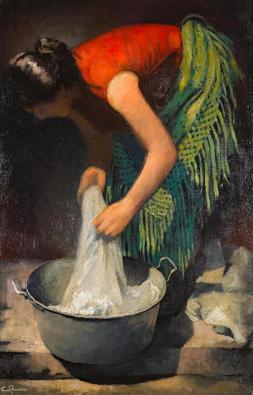 Two years later, Neuschul took over the chair of drawing and painting at the Charlottenburg Municipal Art School. In 1933, Neuschul became the last chairman of the November Group before it was banned by the Nazis. At his last exhibition in February 1933 at the “Haus der Künstler” on Schöneberger Ufer in Berlin, his works on display were confiscated and many of them destroyed. Immediately after these events, Neuschul fled to Czechoslovakia. Lucie Lindermann and Neuschul’s later second wife Christl Bell saved the works in his Berlin studio and brought them to Aussig.
In mid-1935, Neuschul received an invitation to Moscow from the Moscow Artists’ Union. In September of1935, he and his wife Christl traveled to Moscow with forty works created between 1929 and 1934. The state newspaper Pravda reported very positively on his solo exhibition at the Museum of New Western Art in Moscow; as a result, Neuschul subsequently received a number of commissions. Among others, he was commissioned to paint portraits of Josef Stalin and Georgi Dimitroff. On January 1, 1936 Neuschul became a member of the Moscow Union of Artists and the Union of Soviet Artists. Shortly before the beginning of Stalin’s second purges, Ernst Neuschul received advice from Andrei Bubnov, the People’s Commissar for National Education, to leave Moscow as soon as possible.
In February 1936, Neuschul gave a lecture on the Soviet Union in Aussig.  The Prague press’s June 1936 pictorial supplement “Die Welt am Sonntag” reported in detail on Neuschul’s stay in the Soviet Union. In 1937, his last exhibition took place in his hometown of Auseig. In this exhibition two of Neuschul’s works were cut up and smeared with swastikas. On the third of November in 1937, Neuschul left his hometown of Aussig for good and moved with his family to Prague before the Czechoslovak borderlands were annexed by Hitler’s Germany in 1938.
Neuschul became a member of the Oskar Kokoschka Club and gave lectures on Degenerate Art, a category that was given to his own work. In 1938, Neuschul was on the Nazi blacklist and, as a Sudeten German, was threatened with extradition to the Third Reich by the Czech authorities. On March 10, 1939, Neuschul deregistered with the police and continued to live as an “illegal” in Prague. Through a connection to the British Labour Party, he was able to prepare his family’s emigration to England. The German Wehrmacht, not yet connected to the Gestapo, issued the exit permit, and on March 24, 1939, the Neuschul family left for England via Holland. Neuschul’s mother, who stayed in Prague to care for Neuschul’s sick brother, was later murdered in Auschwitz with those family members still in Prague.
On May 19, 1939, Neuschul became a member of the Free German Artists Association in England. As a rejection of the past, he changed his name from Neuschul to Norland. Neuschul lived in the family house in London-Hampstead until the end of his life. On September 11, 1968, Ernest Neuschul died at the age of 73.
At the beginning of Ernst Neuschul’s artistic activity, expressionism was in vogue, with intense colors in abstract forms. For his own work, Neuschul transformed this style into the more concrete style of New Objectivity. Gradually socially critical themes found their way into his range of motifs. Neuschul depicted the fringe groups of society; he painted drunkards, women on the streets, and workers in the fields or at their machines. During his time in Moscow, Neuschul was given to understand that he should paint the workers in the style of Socialist Realism that expressed the ideal state. He rejected this idea and continued to paint what he saw and not what he was supposed to see. After the war, Neuschul continued to abstract his style, but like other émigrés who had left Germany, he was unable to match the success he had enjoyed before he fled. Neuschul was rediscovered in Germany in 2001, when the Kunstforum Ostdeutsche Galerie, in cooperation with the Czech Republic, organized a four-week retrospective of his paintings in Regensburg.
Notes: The University of Birmingham, England, has a short article on Ernst Neuschul’s 1931 painting “Black Mother”, painted at a time in which the Nazi Party was making significant gains in elections. The article can be found at: https://www.birmingham.ac.uk/schools/lcahm/departments/historyofart/research/projects/map/issue3/arts-trail-pages/ernst-neuschul-black-mother.aspx
In 1924, Ernst Neuschul painted his biblical scene “Samson II”. An interesting article on its creation process can be found at Berlin’s Jewish Museum website located at: https://www.jmberlin.de/en/ernest-neuschul-samson-II
Top Insert Image: Helen Craig, “Ernst Neuschul”, circa 1960s, Gelatin Silver Print, Collection of Helen Craig
Second Insert Image: Ernst Neuschul, “Black Mother”, 1931, Oil on Canvas, 100.5 x 65.5 cm, Leicester Museum and Art Gallery, Leicester, England
Third Insert Image: Ernst Neuschul, “Laundress”, Date Unknown, Oil on Canvass, 100.3 x 65.1 cm, Private Collection
Fourth Insert Image: Ernst Neuschul, “Woman ironing”, circa 1930, Oil on Canvas, 65 x 46 cm, Staattiche Museen, Berlin
Bottom Insert Image: Ernst Neuschul, “Meine Drei Frauen”, Date Unknown, Oil on Canvas, 100 x 81 cm, Private Collection


 contorted and sculptural portrayal. Rather than a literal interpretation, he elongated both limbs and torsos with some features accented and others diminished. Schiele’s dynamic line work, an essential element in his portraiture works, creates both tension and movement within the composition.
 eventually settled for a short period in Neulengbach, the lower Austrian district of Sankt Pölten-Land.
 three days after his wife. He was twenty-eight years old.


