Marvin K. White: “And When I Placed My Lips on His”

Photographers Unknown, Doubles

When I learned of Gregory’s death
I cried silently
But at the funeral
Giiiirl! I’m telling you
I rocked Miss Church
Hell I fell to my knees twice
Before I reached my seat
Three people had to carry me
To my pew
I swayed and swooned
Blew my nose
On any and every available sleeve
The snot was flying everywhere
Then when I finally saw his body
My body jerked itself
Right inside that casket
And when I placed my lips on his
Honey the place was shaking
I returned to my seat
But not before passing by his mother
Who I’m sure at this point
Was through with me
I threw myself on her knees
Shouting “Help me
Help me Jesus”
When someone in the choir
Sang out “Work it girl
Wooooork it”
I was carried out
Kicking and screaming
Ushered into the waiting limo
Which sped me to his family’s house
Where I feasted
On fried chicken
Hot water corn bread
Macaroni and cheese
Johnny Walker Black
Finally in my rightful place

Marvin K. White, Last Rights, Last Rights, 2004

Born in Oakland, California, Marvin K. White is a poet, performer, playwright, public theologian, visual artist, and community arts organizer. He graduated with a Masters of Divinity from the Pacific School of Religion in Berkeley, California. White holds a fellowship in the national African-American poetry organization, Cave Canem, and is a former member of the board of Fire & Ink, a national black LGBT writers’ organization.

White has authored four collections of poetry which were published by RedBone Press. His 2004 “Last Rights” contains poems which portray the caring, humor, despair, the kinship of friends and family, and the unqualified love that occurs in the everyday lives of the gay community. It was nominated as a finalist for the Lambda Literary Award. In the same year, his second collection “Nothin’ Ugly Fly” was published. This collection of poems, both witty and intense, explores a boy’s life from its unpredictable and dangerous beginning to his becoming a man, a growth achieved through his love for another man. This collection was also a finalist for a Lambda Literary Award.

In 2011, Marvin K. White followed his previous work with two new collections. His “Status”, a compilation of several years of Facebook statuses, is a collection of wisdoms, remembrances, lessons in life, riddles, and guiding principles, told in both poem and prose. The book is small in size and reads as if it was a conversation over a cup of coffee.White’s “Our Name Be Witness” is composed of freely written prose poems, spoken in women’s  voices, that describe the complicated communities of neighborhoods, and the aspirations and heart of their people. Aside from the introductory poem, “Devil’s food”, the following prose poems do not possess titles and range from three pages to a few short lines. 

White’s work has appeared in many anthologies including “The Road Before Us: 100 Black Gay Poets”, “Bad Boys and Barbarians: New Gay Writing”, and “My Brothers Keeper”, as well as local and national publications. He is the co-editor of  “If We Have to Take Tomorrow: HIV, Black Men and Same Sex Desire”. White’s  poetry has been adapted for stage at San Francisco’s Theater Rhinoceros; he has performed his own work at the 2014 BAN7 Festival held at the Yerba Buena Center for the Arts.

Beginning as a Teaching Artist for WritersCorps, Marvin K. White continues to lead creative arts and writing workshops for a range of audiences, from youth centers for runaway kids to black gay support groups to literary conferences, faith communities and social justice organizations. He is cofounder of B/GLAM, the Black Gay Letters and Arts Movement, an organization located in the Bay Area of California, whose goal was to preserve, present and incubate black gay artistic expressions.

Note: More information on Marvin K. White and his current projects can be found at his site located at: https://www.marvinkwhite.com/copy-of-home-house-1

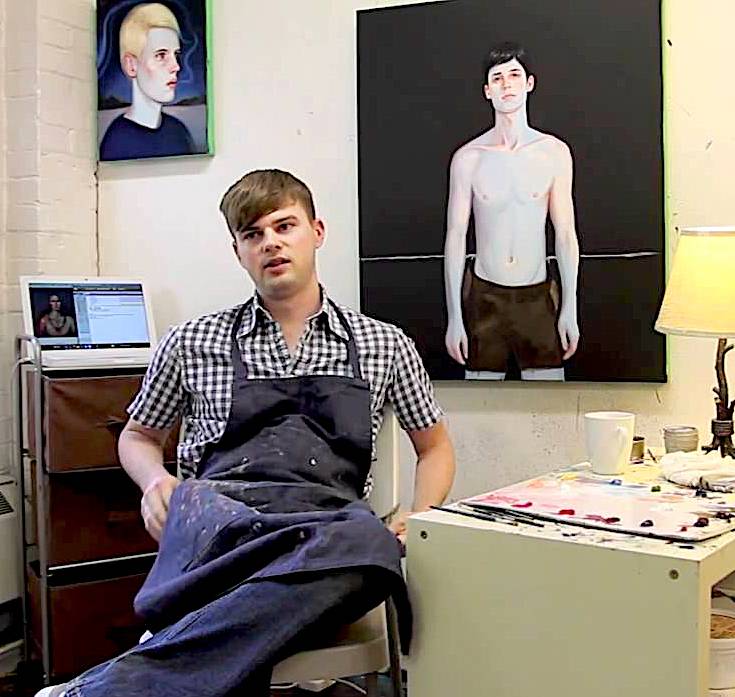
Kris Knight

Paintings by Kris Knight

Born in 1980 in Windsor, Kris Knight is a Canadian painter who has been interested in art since a young age. He moved to Toronto at the age of nineteen and studied at the Ontario College of Art and Design, where he majored in Painting and Drawing, with minors in Curating and Criticism.

The majority of Knight’s work, often painted in series, has been portraits based on real people, mostly close friends and family members. He has also produced self-portraits, collaged images taken from mass media, and works on the themes of loss, bonding and secrets. The subjects of Knight’s work have mostly been either young or androgynous-appearing men, who are portrayed in mute color tones effecting a powdered or translucent appearance. His pastels and tonal oil paintings, set in both theatrical and ordinary settings, combine nostalgia and romanticism in their exploration of life’s experiences.

Inspired by an eighteenth-century style of painting, Knight’s work draws from the movements of Romanticism, Symbolism and artwork of the Rococo period. Having had an interest in the era of the French Revolution since a child, he was also inspired by the portraiture work of French painters Louise Élisabeth Vigée Le Brun and Baron Joseph Ducreux. Additional influences came from the works of portrait painter Thomas Lawrence, Baroque painter Nicolas Poussin, and John Singer Sargent, considered the leading portrait painter of his day.

Kris Knight painted his “Lost and Found” series in 2012. This series of portraits dealt with disenchanted youths who subtly play the roles of hunter and the hunted. Often shown wearing furs and masks, the paintings explored the emotional state of being lost and the process of recovery. His 2013 series “Secrets Are Things We Grow” explored secrets that people keep and the bond that forms once a secret is revealed to those held close. The use of patterns and symbols of nature are used to represent the growth of secrets over time.

In 2014, Knight painted his “Smell the Magic” series, which had its premiere, sponsored by Gucci, at the Spinello Project’s pop-up gallery in Wynwood, Florida. The paintings in this series were done with brighter color tones; an influence of surrealism can be seen in the use of Ouija board pointers for eyes and overlaid flower blossoms on faces. In 2017, Knight had a solo exhibition at Art Toronto which contained work in a smaller scale with a more theatrical approach. These works focused on the subject of performance in everyday life and the roles portrayed to others.

Kris Knight began involved in the fashion industry early in his career. His paintings were used for four 2012 covers for Fashion for Men magazine and, in 2014, his paintings’ pastel color palette was credited for Gucci’s men’s ready-to-wear fall and winter collection. Collaborating with Gucci, Knight created several botanical floral prints, based on a previous work in 1966, which were incorporated into creative director Frida Giannini’s designs for Gucci’s Cruise 2015 seasonal wear. Knight’s work was later shown at the group exhibition, “Carte Blanche a Christin Lacroix”, at Paris’s Musée Cognacq-Jay in November of 2014.

Kris Knight’s work is represented by the Spinello Gallery in Miami, Florida, and at Paris’s Galerie Alain Gutharc. His website, which includes upcoming exhibitions, can be found at: https://krisknight.com/home.html .

Middle Insert Image: Kris Knight, “Let’s Not Speak So Heavy”, 2020, Oil on Canvas, 35.6 x 27.9 cm

Gerrit Lansing: “Your Kiss Is My Justice”

Photographers Unknown, Your Kiss Is My Justice

Dreamer of purified fury and fabulous habit,
your eyes of deserted white afternoons
target, stiffen, riot with unicorn candor
so I swallow your body like meanings or whisky or as you swallow me.
 
Break rhythm here:      your kiss is my justice:
look then now how orange blooms of jubilation unfold in satisfied air!
This sex is more than sex, under the will of the God of sex,
so I softly invoke transformation of your rueful image of haven
–those frozen rocks, that guilty lighthouse isolate from temptation–
to warm Flemish landscape green and brighteyed with daisies of
     dizzying color
where pilgrims are dancing after gospelling bird who sing of
      new springs, good water.
 
Garret Lansing, A Poem of Love in Eleven Lines, Heavenly Tree, Northern Earth, 2009

Born in Albany, New York in February of 1928, Gerrit Lansing was a poet, editor and critic. After a brief stay in Colorado Springs, his family  moved to the Cleveland area where his father served on Western Reserve University’s board of trustees.  A piano prodigy, Lansing played Bach, Mozart and Scriabin for pleasure and, in his teen-years, played pop songs with a band. In the mid-1940s, he attended Harvard College, where he studied philosophy and  graduated with a Bachelor of Arts degree in 1949.

Gerrit Lansing’s social set during his college years included the artist Eduard Gorey, poets Frank O’Hara and John Ashbery, and his childhood friend, the writer and poet Kenward Elmslie. His poetic origins can be traced back to his time at Harvard, where he studied the works of William Blake and William Butler Yeats, under critic and biographer Richard Ellmann, and attended readings by T.S. Eliot and Wallace Stevens. Upon graduation from Harvard, Lansing relocated to New York City, where he received his Masters Degree in English from Columbia University and worked on the Columbia University Press.

In the early 1950s, Lansing became friends with Harry Smith, the artist, filmmaker, and musicologist best known for his 1952 “Anthology of American Folk Music”. Both interested in jazz and bebop music, they also studied magic together under Count Stefan Walewski, owner of New York City’s Esoterica curio shop. It was through his association with lyricist John LaTouche that Lansing was introduced to the world of theater, ballet and opera and to a network of writers. Known in his circles as a thinker and conversationalist, he associated with writers Christopher Isherwood, Paul and Jane Bowles, Alan Ginsberg, and Jack Karouac; painters Larry Rivers and Jane Freilicher; and poets Robert Kelly and Jonathan Williams.

Lansing’s poetry first began to appear in New York School periodicals such as “A New Folder”, “Semi-Colon”. and later in a small offset literary journal entitled “Set” which he edited.  By the time the first of Set’s two issues appeared in 1961, Lansing had grown weary of New York City and accepted an invitation by his acquaintance John Hays Hammond Jr., the pioneer of the electronic remote control, to stay at Hammond Castle in Gloucester, Massachusetts. The invitation to Lansing came through Harry Martin, who was LaTouche’s lover at that time and also the clandestine lover of John Hammond.

In Gloucester, Gerrit Lansing met two men who would greatly shape his life; the first was Charles Olson, an innovative poet and essayist who was previously rector at Black Mountain College. Lansing surprised Olson with an unannounced visit to the poet’s Fort Square apartment and soon became a fast friend, drinking companion, and regular correspondent with him. He also made arrangements for Olson’s first public reading of his work. Lansing was the understated expert for Olson on the role of tarot, astrology, and the esoteric; his knowledge would have an impact on Olson’s 1952 collection, “The Maximus Poems”. The second man to shape Lansing’s life was Deryk Burton, a sailor born in Wallasey, England, who skippered private yachts. They met at the Studio Restaurant on Rocky Neck in Gloucester and soon became lifelong partners.  Together they set up house in Gloucester and sailed private yachts to their winter berths in Florida and the Caribbean.

The deaths of close friends, Charles Olson and Boston poet Stephen Jonas, both within a month of each other in early 1970, greatly affected Lansing. In 1972, he and Burton left Massachusetts on a period of wandering which led to Annapolis, Maryland, due to Burton’s nautical career. There, Lansing co-founded the antiquarian bookstore, Circle West, which specialized in rare occult books. He was also hospitalized successfully for alcoholism, a result of his earlier drinking bouts with friends and gay bar cruising.

In 1982, Lansing and Burton returned to Gloucester. Intrigued by the occult since high school, Gerrit had become an encyclopedic resource on the topic and opened in Gloucester a second bookstore, Abraxas, which specialized in magic, philosophy, and rare esoteric volumes. Lansing operated the Abraxas bookstore until his and Burton’s retirements in 1992. They then purchased a sea captain’s house overlooking Gloucester Bay where they spent the remainder of their lives.

A careful reader and interpreter of Emerson’s works, Gerrit Lansing used a range of forms in his poetry to explore spiritual, social, and natural engagements with the world. His books of poetry include the 1995 “Heavenly Tree/Soluble Forest”, a cross-genre collection entitled “A February Sheaf” published in 2003 by Pressed Wafer, and the 2009 “Heavenly Tree, Northern Earth”. He collaborated, along with conceptual-installation artists Nora Ligorano and Marshall Reese, on the 2002 art book “Turning Leaves of Mind”.

Predeceased by his partner Deryk Burton, who died in 1997, Gerrit Lansing died peacefully at his Gloucester home on the evening of February 11th in 2018, at the age of ninety years.

Note: An interesting read on Gerrit Lansing’s work is an article, entitled “ The Metaphysics of Gerrit Lansing”,  written by Robert Baker for the online literary magazine, Rain Taxi. It can be found at: https://www.raintaxi.com/the-metaphysics-of-gerrit-lansing/

Also, the online publication, Wonderland, had a memorial article on Gerrit Lansing in which personal remembrances by three close friends of Lansing are included. That article can be found at: https://gregcookland.com/wonderland/2018/03/02/gerrit-lansing-3/

Andrés Miró Quesada

Paintings by Andrés Miró Quesada

Born in Lima, Andrés Miró Quesada is a Peruvian painter whose narrative works depicting male figures generate a sense of playful eroticism and sensuality. He studied at Lima’s Alexander von Humboldt College, a German international, school from kindergarten to bachelor degrees. Miró Quesada graduated in 2009 with a degree in Visual Arts from Lima’s  Corriente Alterna School in Miraflores, where he received a silver medal for his work.

Miró Quesada’s work is very cinematographic in nature; the narrative scenes he creates appear as frozen frames from a film. Starting with an initial idea, he takes photographs of the scene until he is satisfied with its composition.After this  composition is passed onto a canvas, Miró Quesada begins the fluid process of painting, in which the final idea is personalized by his addition of a broader range of colors and tones, and  alterations in scale.

Andrés Miró Quesada has exhibited in various collective exhibitions including “Set/Action” at the Vértice Gallery in San Isidro, Peru; the “Play” exhibition at the Luis Miró Quesada Garland Room, a non-profit contemporary art center; and the October 2014 collective exhibition “Homo Ludens/Urbe Ludens”, directed by the Vértice Gallery, at the El Olivar Cultural Center in Lima. Miró Quesada also presented his work in a 2015 solo exhibition, entitled “Amateur” in the Ricardo Palma Cultural Center in Miraflores, Peru.

Melvin Dixon: “We Live Bravely in the Light”

Photographers Unknown, Parva Scaena (Brief Scenes): Photo Set Twenty-Four

They won’t go when I go. (Stevie Wonder)
Live bravely in the hurt of light. (C.H.R.)

The children in the life:
Another telephone call. Another man gone.
How many pages are left in my diary?
Do I have enough pencils? Enough ink?
I count on my fingers and toes the past kisses,
the incubating years, the months ahead.

Thousands. Many thousands.
Many thousands gone.

I have no use for numbers beyond this one,
one man, one face, one torso
curled into mine for the ease of sleep.
We love without mercy,
We live bravely in the light.

Thousands. Many thousands.

Chile, I knew he was funny, one of the children,
a member of the church, a friend of Dorothy’s.

He knew the Websters pretty well, too.
Girlfriend, he was real.
Remember we used to sit up in my house
pouring tea, dropping beads,
dishing this one and that one?

You got any T-cells left?
The singularity of death. The mourning thousands.
It begins with one and grows by one
and one and one and one
until there’s no one left to count.

Melvin Dixon, One by One, Love’s Instruments, 1995, Tia Chuca Press, Chicago

Born in Stanford, Conneticutt in May of 1950, Melvin Dixon was a creative writer, as a novelist, poet, translator and literary critic. He graduated from Wesleyan University in 1971 with a Bachelor of Arts in American Studies, and earned a Master of Arts in 1973 and a Doctor of Philosophy in 1975 from Boston University.

Dixon wrote poems, novels, short stories, essays, critical studies, and translated many works from French. Searching for his literary heritage, he traveled throughout the Caribbean, Africa and Europe, and researched such men as Leopold Senghor, the poet and former president of Senegal; the Haitian novelist and poet Jacques Roumain; and author Richard Nathaniel Wright, whose 1945 book “Black Boy” became an instant success and a work of historical and sociological significance.

Melvin Dixon wrote openly about his homosexuality in both his published and unpublished works. As an active spokesman for gay communities and their issues, he incorporated the complexities of gay lifestyle and identity, as well as his identity as a black man, into his work. Dixon’s first collection of poems, “Change of Territory” published in 1983, examined the involuntary journeys of African slavery and the later historical migration of African Americans from the southern United States to the north. In 1987, he wrote a critical study of African-American literature entitled “Ride Out the Wilderness”.

The influence of James Baldwin’s work upon Dixon’s writings can be seen in his two novels, the 1989 “Trouble the Water”, a novel of family reconciliation which won the Nikon Award for Excellence in Minority Fiction, and the 1991 “Vanishing Rooms”, a novel of homophobia and racism revolving around three people who are each affected by the death of a gay man in New York City. “Vanishing Rooms” was nominated for a Lambda Literary Award for Gay Men’s Fiction. Dixon’s final volume of poetry, entitled “Love’s Instruments” published posthumously in 1995, was a tribute to gay men with AIDS-related illness.

Melvin Dixon translated many works from French to English. Included in these works are his translations of Haitian poet Jacques Roumain’s poetry; Professor of American Literature at the University of Paris, Genevierve Fabre’s history of black theater since 1945, entitled “Drumbeats, Masks, and Metaphor” and  published in 1983; and “The Collected Poetry of Leopold Seder Senghor”, published in 1991. This translation of Senghor’s work contains the majority of his poetic oeuvre, including his “lost” poems.

Dixon was an Assistant Professor at Williams College from 1975 to 1980, and a Professor of English Literature at Queens College of the City University of New York from 1980 until 1992. He also taught at the Graduate Center of the City University of New York, Fordham University and Columbia University. Dixon received a number of awards and fellowships including a Fulbright lectureship in Senegal from 1985 to 1986.

Melvin Dixon was in a long-term partnership with Richard Horowitz, an openly gay man who worked from 1983 to 1987 as a program officer of the Ford Foundation in Dakar, West Africa. Upon Horowitz’s return to the United States, he worked with the Ford Foundation to finance projects for AIDS patients internationally. He died at his summer home in Provincetown, Massachusetts, from complications due to AIDS in July of 1991. He was forty-four years in age.

Melvin Dixon had been battling AIDS since an initial diagnosis in 1989. At the age of forty-two, he died from AIDS-related complications in Stanford, Conneticutt, on October 28, 1992, one year after his partner. The Melvin Dixon Papers, which contain primarily of manuscripts, correspondence, notes, and journals, are part of the Archives and Manuscripts department of the New York Public Library. They are housed at the Schomburg Center for Research in Black Culture, Manuscripts, Archives and Rare Books Division, located at 515 Malcolm X Boulevard, New York City.

Note: “this one” in the second stanza of the poem, “One by One”, refers to Dixon’s lover, Richard Horowitz

Emilio Baz Vlaud

The Artwork of Emilio Baz Vlaud

Born in Mexico City in 1918, Emilio Baz Vlaud was a painter whose work mostly included portraiture and scenes in the style of  Costumbrismo, images of local Hispanic life, customs, and mannerisms executed in  both artistic Realism and Romanticism.  Influenced by the Magical Realism movement that spread through the art and literary worlds after the first World War, Vlaud was known for his meticulous brushwork and his trompe-d’oeil technique. 

Emilio Baz Vlaud, at a very early age, had great skill in the arts. He would often watch his older gay brother, Ben-Hur Baz Vlaud, a 1926 graduate of the Academy de San Carlos and twelve years his senior, working on his own precisionist drawings and paintings. At the age of seventeen, Emilio Vlaud executed his first self-portrait, the 1935 “Self Portrait as a Teenager”, a highly refined work that is closely related to a self-portrait painted by his brother in the same year. In his self-portrait, Emilio shows himself with perfectly combed hair and dressed in a white shirt. He is  holding a green pencil at an angle, a position which visually divides the canvas in two,  and is shown gripping his elbow with his left hand. 

Emilio Baz Vlaud entered the Academia de San Carlos in 1938 where he initially studied architecture before changing his vocation to painting. He later took courses at the Escuela Nacional de Artes Plásticas, where he studied under the strict training of painter Manuel Rodríguez Lozano, an openly gay artist whose work is often linked to the works of metaphysical painter Giorgio de Chirico. Vlaud made several visits over the years to his older brother who had moved to New York City and was working as a successful commercial illustrator for magazines, such as Newsweek and Time. 

In 1950, Emilio Vlaud relocated to San Miguel Allende, situated in the far eastern part of Guanajuato. He exhibited his work in several collective exhibitions, where he showed his work alongside such prominent artists as painters and muralists Diego Rivera and David Alfaro Siqueiros. In 1951, Vlaud had his first solo exhibition; his flamenco-inspired technique of applying dry oil paints to surfaces by means of small strokes of a short brush were praised by critics and his fellow artists. During his eight year stay in San Miguel Allende, he received a gold medal for artistic merit from the University of Guanajuato. 

In 1962, Emilio Baz Vlaud entered the Monastery of Santa María de la Resurrecion for the purpose of studying psychoanalysis. After several years, he abandoned these studies to return to his vocation as a painter. Although Vlaud is mostly know for his portraiture and scenes done before 1955, he also went through an intense period of abstraction during the 1970s. In 1984, his work was presented at a collective exhibition entitled “Siete Pintores (Seven Painters)” at the Palacio de Bellas Artes in Mexico City. Emilio Baz Vlaud died in 1991. 

Notes: Vlaud’s 1952 “Portrait of Nazario Chimez Barlet”, the last image in the header collection, sold at Sotheby’s in November of 2024 for $204,o00. This bid was was over the estimated value by a great amount. When the bid was hammered and finalized, applause broke out among the bidders.

Insert Images: Emilio Baz Viaud, “Self Portrait as a Teenager”, 1925, Watercolor, Pencil and Dry Brush on Board, 60 x 39.7 cm, Private Collection

Emilio Baz Vlaud, “El Coco”, circa 1955, Oil on Masonite, 50 x 40 cm, Blaisten Collection

Emilio Baz Vlaud, “Self Portrait in Blue Shirt”, 1941, Watercolor, Pencil and Dry Brush on Board, 100 x 65.5 cm, Blaisten Collection, Mexico City


Digby Mackworth Dolben: “For Should He Ever Pass. . .”

Photographers Unknown, For Should He Ever Pass

My sister Death! I pray thee come to me
Of thy sweet charity,
And be my nurse but for a little while;
I will indeed lie still,
And not detain thee long, when once is spread,
Beneath the yew, my bed:
I will not ask for lilies or for roses;
But when the evening closes,
Just take from any brook a single knot
Of pale Forget-me-not,
And lay them in my hand, until I wake,
For his dear sake;
(For should he ever pass and by me stand,
He yet might understand—)
Then heal the passion and the fever
With one cool kiss, for ever.

Digby Macworth Dolben, Sister Death

Born in Guernsey in February of 1848, Digby Augustus Stewart Mackworth Dolben was an English poet. His father, William Harcourt Isham Mackworth, was the younger son of the Third Baronet, Sir Digby Mackworth, and his mother Frances Dolben was the daughter and heiress of Sir John English Dolben, the Fourth Baronet. Digby Dolben was raised, under a strict and uncompromising Protestant discipline, at Finedon Hall, his mother’s family estate in Northamptonshire, England.

Digby Mackworth Dolben was educated at Cheam School, a mixed preparatory school in Hampshire, and, starting in 1862, at Eaton College, where he studied under Headmaster and poet William Johnson Cory. William Cory’s method of teaching and his collection of verses, “Ionica” were sources of inspiration for Dolben in his own poetic writings. While at Eaton in the early 1860s, Dolben met his distant older cousin, Robert Bridges, who became his mentor and introduced him to his circle of high church friends. During his school years, Dolben seemed abstracted and other-worldly to his college friends; by his activities, he appeared to his headmaster as an agitator who was dangerously misguided.

In 1863, Dolben started to cause considerable scandal at Eaton College with his eccentric and exhibitionist behavior. Defying his strict Protestant upbringing, he became a novice in the English Order of Saint Benedict and began to sign his letters ‘Dominic’. By associating with the new ritualistic, religious revival of that time and wearing a monk’s habit, Dolben would cause scandal by walking, often barefoot, through the streets of the city. He also began to mark his romantic attachment to fellow student Martin Le Merchant Gosselin, a year senior, with written love poems. It was during this period that Dolben destroyed by fire all his previous written poetic work.

In July of 1863, Robert Bridges left Eaton to attend Oxford College. Several weeks later on July 30th, Digby Dolben was dismissed from Eaton after engaging in secret meetings with Jesuit priests. He maintained his communication with Bridges through letters sent to Oxford; however, there is no evidence of any poems being written since the destruction of his earlier work. It was not until the Lenten season of 1864 that Dolben resumed his poetry writing. At the age of sixteen, he wrote his first mature poem “Homo Factus Est” and had six poems published in the Union Review.

On his seventeenth birthday in 1865, Digby Dolben was introduced by his cousin Robert Bridges to Gerald Manley Hopkins, a fellow poet who was attending Oxford’s Balliol College. In accounts to his biographer, Hopkins stated that meeting Dolben, who was four years his junior, was the most emotional event of his undergraduate years, and probably his entire life. After Hopkins was forbidden by his High Anglican confessor to have any contact with Dolben, Hopkins and Dolben maintained their communication through letters; Hopkins wrote, during this time, two poems about his love for Dolben, “Where Art Thou Friend” and “The Beginning of the End’.

In 1865, Dolben’s work began to mature as he turned from writing Christian themed poetry to poems portraying a more Greco or pagan ideal of beauty. By 1866, he had moved to the Welsh village of Boughrood and studied there under tutor Henry de Winton for his Oxford entrance exams. Dolben took his entrance exams on May 2nd of 1867; however, he fainted during the exams and received a failing score. Thirteen days later on June 28th, Digby Mackworth Dolben, at the age of nineteen, drowned in the River Welland.

In 1865, Dolben’s work began to mature as he turned from writing Christian themed poetry to poems portraying a more Greco or pagan ideal of beauty. By 1866, he had moved to the Welsh village of Boughrood and studied there under tutor Henry de Winton for his Oxford entrance exams. Dolben took his entrance exams on May 2nd of 1867; however, he fainted during the exams and received a failing score. Thirteen days later on June 28th, Digby Dolben, at the age of nineteen, drowned in the River Welland.

Digby Dolben had taken Walter, the ten year old son of his tutor, Reverend C. E. Pritchard, on his back across the deep river. Upon the return swim, Dolben sank within several yards of the shoreline. Walter Pritchard, only able to float on his back, made it to shore with the assistance of men who came to the rescue. Dolben’s body was found several hours later when it surfaced further down the river. He was buried under the altar at Finedon Estate on July 6th of 1867.

In 1911, Robert Bridges, who would become poet laureate of England two years later, published the poetry of his cousin Digby Dolben, all of which had been written in the last three years of Dolben’s life. Approached by Gerald Manley Hopkins as to whether the Dolben family would publish Dolben’s work, the independently wealthy Bridges decided he would finance the publishing of both Dolben’s and Hopkins’s collectibe poetry. Published in a single volume entitled “Poems”, Digby Dolben’s work is considered to be among the best poetry of the Oxford Movement.

In 1981, “The Poems and Letters of Digby Mackworth Dolben, 1848-1867”, compiled by Martin Cohen, was published by the Avebury press. In 2017, author Simon Edge published his historical fiction novel “The Hopkins Conundrum”, a story about Gerald Hopkins’s infatuation with Dolben.

Note: A journal article on the life of Digby Mackworth Dolben, written by Liam Brophy, can be found at the JSTOR site located at: https://www.jstor.org/stable/20513622

An online copy of Robert Bridges’s 1911 “Poems of Digby Mackworth Dolben”, published by Oxford University Press, can be found on The Internet Archive located at: https://archive.org/details/poemsofdigbymack00dolb_0/page/n3/mode/2up

Carl Phillips: “How They Woke, Finally, in a Bed of Ferns”

Photographers Unknown, Twelve Men Seated

How they woke, finally, in a bed of ferns — horsetail ferns.
How they died singing. All night, meanwhile, as if somehow
the fox’s mouth that so much of this life has amounted to had
briefly unshut itself — and the moth that’s trapped there,
unharmed, gone free — a snow fell; the snow-filled street
seemed a toppled column, like the one in the mind called
doubt, or that other one,
                                              persuasion, the broken one, in three
clean pieces …Well, it’s morning, now. Out back, the bamboo
bows and stiffens. Thoughts in a wind. Thoughts like (but
nobody saying it): Nobody, I think, knows me better by
now than you do. Or like: The bamboo, bowing, stiffening,
seems like nothing so much as, in this light, competing forms
of betrayal that, given time, must surely cancel each other
out, close your eyes; patience; wait. Maybe less the foliage
than the promise of it. Less that shame exists, maybe, than that
the world keeps saying it does, know it, hold on tight to it, as if
the world were rumor, how every rumor
                                                                           rings true, lately.
When I’m ashamed, I make a point of reminding myself what
is shame but to have shown — to have let it show — that variety
of love that goes hand in hand with having wished to please
and, in pleasing, for a while belong. So shame can, like love, be
an eventual way through? There’s a minor chord sparrows make
with doves that’s not the usual business — it’s not sad at all, any of it:
this always waiting for what I’ve always waited for; this not being
able to assign to what’s missing some shape, a name; this body
neither antlered nor hooved — brave too, this body, unapologetic…

Carl Phillips, Blow It Back

Born in Everett, Washington in 1959, Carl Phillips is an American writer and poet. As a child of a military family, he moved frequently around the United States in his formative years until his family settled in Cape Cod, Massachusetts. Phillips earned his Bachelor of Arts from Harvard University and Master of Arts in Teaching from the University of Massachusetts. He continued his education at Boston University, where he earned a Master of Arts in Creative Writing.

Along with other black poets such as John Keene, Natasha Trethewey, and Major Jackson, Carl Phillips was a member of the Dark Room Collective. Founded after the funeral of James Baldwin in 1987, this collective began as an intergenerational reading series which hosted and cultivated the work of black poets of various aesthetic movements. Many of the current leading figures in the poetic movement had their beginnings with the Dark Room Collective.

Beginning as a teenager, Phillips wrote poetry until his entry into Harvard University on a scholarship, where he began to study Latin and Greek. It was not until 1990, while coming to terms with his gay identity, that he resumed his poetic writing. A classicist by training, Phillips often uses classical forms in his work and often references classical art, music, and literature. He received critical acclaim early in his career with the publication of his debut collection, “In the Blood”, which won the Samuel Morse Poetry Prize in 1992.

Carl Phillips’s second collection, “Cortège”, was nominated in 1995 for the National Book Critics Circle Award. Six years later, his collections, “Pastoral” in 2000 and “The Tether” in 2001, were both well received, with “Pastoral” winning the 2001 Lambda Literary Award for Best Poetry. Two of Phillips’s works, the 2009 “Speak Low” and the 2011 “Double Shadow”, winner of the Los Angeles Times Book Prize for Poetry, were finalists for the National Book Award.

In addition to over a dozen volumes of poetry, Carl Phillips has published works of criticism and translation. Two collections of essays, “Coin of the Realm: Essays on Life and the Art of Poetry” and “The Art of Daring: Risk, Restlessness, Imagination”, were published by Graywolf Press in 2004 and 2014, respectively. Phillips’s translation of Sophocles’s “Philoctetes” was published in 2003 by the Oxford University Press.

Before teaching English at the university level, Phillips taught Latin at several high schools in Massachusetts. He is currently a Professor of English at Saint Louis’s Washington University, where he also teaches Creative Writing. Phillips was elected a chancellor of the Academy of American Poets in 2006 and, since 2011, has served as a judge for the Yale Series of Younger Poets.

Carl Phillips’s honors include fellowships from the Guggenheim Foundation and the Library of Congress. He is the recipient of the Academy of American Poets Fellowship, an Award in Literature from the American Academy of Arts and Letters, the Academy of American Poets Prize, and a Pushcart Prize, and he has been inducted into the American Academy of Arts and Sciences.

Mati Gelman

Mati Gelman, “Joel”, Date Unknown, Trending Deities Series, Photograph, Computer Graphics

Born in Hungary, Mati Gelman is a commercial and fine art photographer who spent his early years living in Israel. Interested in the processes of nature and humans’ interaction with them, he initially pursued a vocation in the field of science and earned a Bachelors of Science in Biochemistry from the Israel Institute of Technology in Haifa and a Masters of Science in Chemistry from the Bar Han University in Tel Aviv. Upon moving to New York City in 2015, Gelman decided to enhance his self-taught photographic skills with technical courses at the International Center for Photography and the Pratt Institute, both located in Manhattan.

Gelman’s work aesthetic focuses on the connections between the forces of nature and the human body. His images explore the issues of human integration with nature, sexuality, and queerness; they are heavily influenced by legends and fairytales, which have had a lasting impact on human society. Gelman tends to create scenes which provoke an ominous sensation in order to induce a sense of the unknown. As human beings are pattern recognizers and often prescribe meaning to unaccustomed phenomena, the elements of Gelman’s works are intentionally left open to the viewers’ interpretations.

Mati Gelman creates stories and shapes his characters through both his imagination and his life experiences. His work is a blend of photography and computer graphics. Using a Sony a7R11 with a 24-70 lens, Gelman photographs his posed subjects and continues his work with Lightroom for minor adjustments and Photoshop for the basic effects. Gelman won the ViewPoint Gallery International Photography competition for his work entitled “Flight”, an image of a figure mid-air surrounded by billowing cloth in the light of a sunset. His “Entangled”, a figure seemingly suspended by strips of white cloth, won first place in the 2018 Chromatic Awards. Gelman has also won awards at the Annual Fine Art Photography Awards, FAPA, in 2019 and 2020.

Besides his fine art photography, Gelman has executed photo shoots for off-Broadway theater productions. He shot the promotional images for playwright and director Asher Gelman’s 2018 theater production, “Afterglow”, a character study which explored the dynamics of an open gay relationship involving three personality archetypes. Mati Gelman’s work also includes photo shoots for the following plays: “Diaspora”, “Safeword”, “Eco Village”, “Counting Sheep”, “We Are the Tigers”, and “Medusa”.

The title image “Joel” and the middle insert image, title unknown, are from Mati Gelman’s “Trending Deities” series which explores the parallels between ritual and worship in both religion and social media. Using both modern and traditional references throughout the series, Gelman’s work uses cinematic proportions as a reference to smartphone screens and, by multiplying the characters and placing them in ritualistic activities, depicts the virtual cult-like following that is adherent on social media platforms. The color palettes and compositions were inspired by Renaissance, Greco-Roman, and Medieval art.

The work of Mati Gelman can be found at the artist’s sites: https://www.matigelman.com and Instagram @matigelman .

John Giorno: “An Unemployed Machinist”


Photographers Unknown, Thirteen Men Who Traveled Here

An unemployed
machinist
An unemployed machinist
who travelled
here
who travelled here
from Georgia
from Georgia 10 days ago
10 days ago
and could not find
a job
and could not find a job
walked
into a police station
walking into a police station
yesterday and said
yesterday
and said:

“I’m tired
of being scared
I’m tired of being scared.”

—John Giorno, An Unemployed Machinist, Balling Buddha, 1970

Born in New York City in December of 1936, John Giorno was a poet and performance artist. Raised in both Brooklyn and Roslyn Heights, Long Island, he graduated from New York’s Columbia University in 1958. In his early life, Giorno was a muse to and entered into romantic relationships with other artists, among them Robert Rauschenberg and Andy Warhol, whom he met in 1963 during Warhol’s first solo exhibition at the Stable Gallery in New York City. Giorno starred in Warhol’s 1963 four-minute film entitled “John Washing” and also appeared in Warhol’s eight-hour 1964 silent film, “Sleep”, the plot of which entailed Giorno sleeping on camera.

Inspired by his associations with Rauschenberg, Warhol, and Jasper Johns, Giorno began to appropriate found textual imagery to his poetry. An example of this can be found in the1964 poem “The American Book of the Dead”. Portions of this poem were used in works contained in Giorno’s first full collection “Poems”, published in 1967. Later meetings with sound poet and performance artist Brion Gysin and writer William S. Burroughs led to Giorno applying cut-up and montage techniques to found texts, and, influenced by the work of Gysin, the recording of his first audio poem pieces.

Established as an active presence in New York’s art scene, John Giorno collaborated with Brion Gysin on “Subway Sound” in 1965, and with Robert Rauschenberg in 1966 on “Nine Evenings of Theater and Engineering”. From 1967 to 1969, John Giorno presented his “Electronic Sensory Poetry Environments”, a series produced in collaboration with synthesizer creator Robert Moog and other artists. These psychedelic happenings and poetry installations were shown at St. Marks Church in Manhattan. In 1965, Giorno founded Giorno Poetry Systems, a non-profit production company that connected new audiences to poetry by the use of new technologies, engaged in political organizing, and created new artworks.

Giorno organized the first Dial-A-Poem event in 1968 at the non-profit Architectural League of New York. This poetic event was repeated at the Museum of Modern Art from 1969 to 1970, and resulted in a series of long-playing records issued by Giorno Poetry Systems. Poets who participated in these events included Patti Smith, William Burroughs, Eldridge Cleaver, and Bobby Seale. John Giorno was unapologetic in his use of politically-charged and sexually salacious content; he used his work to draw attention to his own status as a gay man, police violence in America, and the countless deaths caused by the war in Vietnam.

In the late 1960s, John Giorno’s work evolved to include the appropriation of entire texts from newspapers, the development of double-column poems, montages of diverse and often radically different texts, and the extensive use of repetition both across and down the page.This use of repetitive words and phrases reproduced textually the echos and distortions which occurred in Giorno’s vocal performances. Several of these poems were included in his 1970 “Balling Buddha”.

After traveling to India in 1971 and meeting His Holiness Dudjom Rinpoche, Giorno became one of the early Western students of Tibetan Buddhism, a practice in which he participated for several decades. His early poetic works occasionally reflect Asian religious themes; but those after the 1970 collection, “Cancer in My Left Ball”, are a mixture of Buddhist and Western practices and poetic techniques seen through Giorno’s original interpretation. For instance in his 1970-72 poem “Guru Rinpoche”, Giorno mixed pop imagery with sacred sutras and portrayed gay eroticism as a form of spiritual devotion.

In 1972, John Giorno began releasing compilation records under the newly incorporated Giorno Poetry Systems media label. Presented through cassettes, long-playing records and compact discs, these audio works included new wave and punk music, and an assortment of vocal artists, musicians, and poets. Giorno Poetry Systems expanded in 1984 with the establishment of the AIDS Treatment Project, an emergency response to the impacts of the epidemic on artists’ lives. This project provided funds for artists living with AIDS through the early 2000s, when it was officially transformed into the Poets and Artists Fund.

Retired from performing in 2017, Giorno spent the last two years of his life in meditation, composing his poetry, and editing his memoir “Great Demon Kings”. John Giorno died of a heart attack at age eighty-two in October of 2019 at his home in Lower Manhattan. At the time of his death, he was married to Swiss-born Ugo Rondinone, a mixed-media artist known for his paintings and large-scale land-art sculptures.

Notes:
The John Giorno Foundation can be found at: https://www.giornofoundation.org/the-foundation

There are two interesting reads for those interested in John Giorno’s life story and work. The first is an interview between journalist and essayist Marcus Boon and John Giorno, which is presented by Bomb Magazine, It can be found at: https://bombmagazine.org/articles/john-giorno-1/

The second is an article, written in 1994, by journalist and author Robert Coe and entitled “Becoming Buddha: John Giorno”. This more extensive biographical piece can be found at The Buddhist Review, Tricycle, located at: https://tricycle.org/magazine/becoming-buddha/

Oscar Santasusagna

The Artwork of Oscar Santasusagna

Born in Barcelona in 1973, Oscar Santasusagna is a self-taught Spanish artist who began drawing and painting at an early age. The style and techniques of his work have been influenced by the many artists he has studied, including illustrators and painters Andrew and Newell Conners Wyeth; narrative painter Hernan Bas, best known for his scenes of dandies and waifs; painter and draftsman David Hockney; and printmaker and landscape painter Winslow Homer, among others.

Santasusagna believes that a well-executed painting must make a connection with the viewer and produce an emotional response. His work is narrative in style, with each painting accompanied by  a poem or text that relays a personal message to the viewer. The source of these messages are derived from either a song heard, an image seen, or a personal  experience he has had. The subjects most often presented in Santasusagna’s work are the issues of loneliness, friendship, freedom and equality, homosexuality, and man’s relationship to the natural world.

Since 2015, Oscar Santasusagna has exhibited his paintings at many solo exhibitions throughout Spain. These include his 2015 exhibition “Desperta de la Realitat” and his 2016 “Apunts Dispersos” , both of which were held at Barcelona’s Galeria Moraima. In 2018, Santasusagna had a solo exhibition, entitled “Wanderlust”, at the Galeria Departure located in Barcelona and, in 2021, an exhibition in the United States,  entitled “Fables Keeper”, at the Contemporanco Art Gallery in Asheville, North Carolina.

Santasusagna has exhibited in several collective exhibitions, including  the 2015 Seleccio d’Artistes held at Galeria Escolà in Barcelona, the 2021 Una Mirada LGBTI+ exhibition held at the Taller Balam Gallery in Barcelona, and the 2021 Fundació Barcelona Olimpica, where he won third prize for his painting “Sempre hay un Comienso para cada Historia”. He  has also been finalist at the Sanvicens Painting Contest in Sitges, the Concurs FMPC held in Tarragona, and the annual Premium Painting Contest held in the city of Centelles.

Oscar Santasusagna collaborated with theater playwright Bill Lattanzi on his musical comedy production “Jenny Must Die”, which was premiered at the Providence, Rhode Island, Fringe Festival in 2020. He also painted the book cover illustration for “Projecto Wemen”, published by Madrid’s Editorial Silex in 2018. Santasusagna’s paintings on in many private collections in Spain, Belgium, Canada and the United States.

Top Insert Image: Oscar Santasusagna, “Ode for Tenderness”, 2015, Acrylic on Paper 

Oscar Santasusagna’s work can be found at his website located at https://www.santasusagna.com and at https://www.flickr.com/photos/santasusagna .

Küçük İskender: “You Should Have a Macedonian Name: Nicola”

Photographers Unknown, Parva Scaena (Brief Scenes): Photo Set Twenty-Four

you decerebrate the rose, don’t do this
verses, cannot find the poems they deserted
you become a humiliated evening
your hair wet to your waist
your eyes
turned away and fixed on a couple of cracked glasses
left on a claret, velvet coverlet
almost exploded. Soon to blow
before the storm
closely shielding your face, poor and lonely child
storyless, bashful and amicable
you should have a macedonian name: nicola
I sat on your balcony, drank Choπcko beer,
over the way were
grand men wounded by the earth
grand women are sleeping
grand women wounded on account of grand men
turned into tramps by grand men
a pen knife, holds its blade inside like a secret
the pen knife I put on the table on leaving
a perfect portrayal
if it were nicola what would appear
somehow, not far away
was a beautiful graveyard where songs are laid

Küçük İskender, Nicola, Ascaracus Journal of Gay Poetry, February 2016, Translation by Caroline Stockford

Born Derman İskender Över in Istanbul in May of 1964, Küçük İskender was a Turkish critic, actor, and one of Turkey’s few openly gay poets. He studied at Istanbul University’s Cerrahpaşa Faculty of Medicine, where he left in his last year. İskender later studied for three years at the university’s Department of Sociology. After leaving, he pursued his passions: cinema, theater and poetry.

Starting from the 1980s, İskender published poems, essays, and criticisms in various literary magazines, including the National Young Art Magazine where they appeared under the name Alexander Över. His first poem, “Milliyet Genç Sanat (National Young Art)”, was published under the name İskender Över. His poetry began to be published professionally in 1985 when Adam Sanat Magazine accepted his work.

Küçük İskender was one of the top ten poets in Italy’s 2000 European Young Poets Competition, and in the same year, was awarded at the annual poetry, film, and photography competition held in honor of Turkish poet Orhon Murat Ariburnu. Between 2001 and 2002, he was a speaker at poetry performances in Germany and the Netherlands, and at Berlin’s 2003 First Gay Turkish Congress. In 2004,  İskender lectured and read poetry at universities in New York and North Carolina; he also joined panels and workshops at various educational facilities in Turkey.

Reminiscent of the poems of García Lorca and Arthur Rimbaud in their urgency, İskender’s work is close to the clarity of expression found in the works of Spanish poet Luis Cernuda. His poems contain many sensual affirmations of gay life, but they also contain political and cultural commentaries. Many of his poems, written outside the traditional style of Turkish poetry, were polemic and abrasive in their language and spoke of injustice, the arrogance of those who plunder others, and intolerance in regard to sexual identity.

In additional to his poems and poetry collections, İskender wrote three novels: the 1998 “Flu’es”, “Cehenneme Gitmo Yöntemleri (Gitmo: Methods in Hell)” published in 1999, and the 2000 “Zatülcenp”. He also acted in two of director Mustafa Altioklar’s movies, the 1997 “Agir Roman” and the 2002 “O Simdi Asker”. 

Küçük İskender was diagnosed with cancer in June of 2018. His last year was spent in the intensive care unit of the state hospital in Istanbul. He died on July 2nd in 2019 and is buried in Zincirlikuyu Cemetery in Istanbul.

Christopher Soden: “Dionysus”

Photographers Unknown, Dionysus

i am wielder of chaos
bearer of cozy poison
hidden son of jupiter
gestated from his thigh
supple strapping boy
follow the crooked
steps of spontaneous
capering i will soothe
your terrified gaze
summon frantic defiant
nymphs to slake
your thumping skull
with tender anarchy
my fierce priestesses
in robes of moonlight
diaphanous cobweb
will sing lilting implacable
spells to wreck
planets in their courses
wine and feral milk spouting
from tap of hyssop branch
i will swaddle you
in mother night caress
you with snake tongue
drizzle silky
secret language
of the rapacious
in your ear nudge
succulent fissure
yearning for arc
of scalding bliss
sap of brief
delectable death

Christopher Soden, Dionysus

Born in Texas, Christopher Soden is a poet, playwright, and a critic of film, literature and theater. He attended the Vermont College of Fine Arts where he received in January of 2005 his Masters of Fine Art in Poetry. Soden has taught classes on the craft and theory of poetry, English literature, and the process of publication; he currently teaches literature in the Continuing Education Program at the Dallas College Richland Campus.

Soden’s first full-length poetry collection, “Closer” was published by Rebel Satori Press in June of 2011. While realizing that one can get only so close to another being, the works in this collection, written mostly in free verse, display the persistent sense of longing that one has for another. Soden’s collection of confessional narratives present an honest look at same-gender sexuality, maleness, loss and regret, and the complexity of the human condition.

Christopher Soden’s “Queer Anarchy”, a collection of short plays, monologues and performance pieces, dealt with gay and lesbian life in America; it received the Best Stage Performance award from The Dallas Voice, the first newspaper to represent Dallas’ LBGTQ community. Two of his plays, “Water” and “A Christmas Wish” were staged at Dallas’ Bishop Arts Theater Center. Other plays written by Soden include “All That Glitters Ain’t Goldie”, “Lizards Need Love Too”, and “Space Cowboy, Aunt Velma and the Macaroon”.

Soden received a Full Fellowship to Lambda Literary’s Retreat for Emerging LBGT Voices. He is a member of the Distinguished Poets of Dallas, the Poetry Society of America’s Poetry in Motion Series, and is a Founding Member and President Emeritus of the Dallas Poets Community. Soden’s poetry has appeared in many print and online magazines, including G&L Review and Chelsea Station; he currently writes for the Dallas Art Beat, the Examiner.com, and the online theater review, sharpcritic.com.

“I remember the first time I heard Sylvia Plath’s ‘Lady Lazarus’ in a writer’s workshop I was taking. Our teacher, Jack, read it aloud, and I was unacquainted with Plath and her poetry. Didn’t even know she was dead. As anyone who knows the poem can tell you, it gathers steam and just continues to escalate by way of rage and audacity. Plath just keeps pushing and pushing until you think she couldn’t possibly go any further, and yet she does. By the time Jack finished with those three lines, ‘Herr God, Herr Lucifer, Beware. Beware. / Out of the ash I rise with my red hair, / and I eat men, like air,’ I could feel deep shudders traveling up my back. My scalp was ablaze. Until that moment I didn’t even know such poetry was possible. That was when I knew I wanted to be a poet.”

– Christopher Soden

Herbert List

Photography by Herbert List

Herbert List was a classically educated artist who combined his fascination with  Surrealism and Classicism with his love for photography. His austere, classically posed black and white compositions, particularly his Greek and Italian homoerotic nudes, became a prominent influence on both fashion and contemporary photography. 

Born in Hamburg, Germany, in October of 1903 to a wealthy business family, Herbert List  studied art and literature between 1921 and 1923 at the University of Heidelberg. In 1923, he began to travel for the family’s coffee business, Kaffee-Import Firma List & Heineken. List made contacts and visited plantations in Costa Rica, Guatemala, Brazil and El Salvador; during this four year period, he began to record his travels photographically.  

Through his connections to the European avant-garde, List became associated with  American photographer Andreas Bernhard, known for his dynamic black and white city scenes and natural structures. Bernhard  introduced him to the Rolleiflex camera which allowed for more sophisticated compositions. Beginning in 1930, influenced by the Bauhaus artists and  the emerging surrealist movement, List began photographing still life and portraits of friends, often employing draped fabrics, masks, and double exposures. 

Once the National Socialist Party was in control of Germany, the Gestapo began to pay attention to Herbert List’s openly gay lifestyle and Jewish heritage. In 1936, he left Germany for Paris and decided to begin a professional career as a photographer. During 1937 List maintained a studio in London and held his first solo show at Galerie du Chasseur d’Images, the first Paris gallery dedicated to photography.  Starting in 1936 with a reference from fashion photographer George Hoyningen-Huene to Harper’s Bazaar magazine, List began a three year period working as a fashion photographer for various magazines, including Verve, Vogue, and Life.

Dissatisfied  with fashion photography, List returned to his still life and portraiture  work. He traveled throughout Greece from 1937 to 1939 where he took photographs of ancient temples, sculptures and landscapes; two hundred of these photographs would be published in his 1953 “Licht Über Hellas: Eine Symphonie in Bildern”. During this time, List supported himself with work for magazines and the press, and by doing portraiture work. 

Working in Athens, Herbert List hoped to escape World War II; however, when troops invaded Greece, he was forced in 1941 to return to Germany, where, due to a grandparent’s Jewish heritage, he was denied the ability to work or publish professionally. Near the end of the war in 1944, despite his Jewish heritage, he was drafted into the German military and served in Norway as a map designer. A trip to Paris during his military service allowed him the opportunity to photograph images of Jean Cocteau, Pablo Picasso, Georges Braque, Jean Arp, Joan Miró, and other artists.

After the war, List continued to live in Munich until 1960, where he photographed its ruins and produced freelance photo essays for newspapers and magazines such as Look, Picture Post, Heute, and Harper’s Bazaar. List was made art editor in 1948 for the Swiss-German language, daily free newspaper Heute, which was published by the Allied Forces. In 1951 through an invitation by photojournalist Robert Capa, he started contributing photographs to Magnum, an international photographic cooperative. 

Through the next decade Herbert List focused his interest on photographing life in Italy. where he shot photo essays, street scenes, architectural views, and portraits using a 35 mm camera and a telephoto lens. His work became more spontaneous and was influenced by the Italian neorealist film movement and the work of his Magnum colleague Henri Cartier-Bresson. List ’s travels for his photographic work was extensive, including trips to Spain, France, Mexico, and the Caribbean. 

List’s publications include “Rom”, a collection of his work in Rome, published in Munich in 1950:“Caribia”, his Caribbean Island series published in 1958: “Nigeria”, published in 1963; and “Napoli”,  a 1962  collaboration with Italian director Vittorio de Sica. List is best known for his  1988 book “Junge Männer”, a collection of seventy images of young men lounging in the sun, wrestling, or gazing at the camera. The introduction of the book was written by English novelist Stephen Spender, who fictionalized List as Joachim Lenz in his novel “The Temple”. 

Herbert List passed away in Munich on the 4th of April in 1975. His archive of photographs, originally part of the Ratjen Collection, is now housed in the National Gallery in Washington DC. His work is held in many private and public collections, including New York’s Metropolitan Museum of Art, Boston’s Museum of Fine Art, Kunsthaus Zürich, Cologne’s Museum Ludwig, Munich;s Stadtmaueum, and the Musée Picasso in Paris.

Insert Images:

Herbert List, “Self Portrait, Herrsching”, 1947, Silver Gelatin Print

Herbert List, “Man and Dog”, 1939, Gelatin Silver Print

Photographer Unknown, “Herbert List and Max Scheler, Venice”, 1952, Silver Gelatin Print, Mas Scheler Estate

Herbert List, “Young Man Under Reed Roof, Torremolinos”, 1951, Gelatin Silver Print

Sjohnna McCray: “We’re Mostly Made of Water”

Photographers Unknown, We’re Mostly Made of Water

Driving the highway from Atlanta to Phoenix
means swapping one type of heat for another.
A bead of sweat rolls over my chest,
around my belly and evaporates
so quickly I forget I’m sweating.
Body chemistry changes like the color
of my skin: from yellow to sienna.
My sisiter says, it’s a dry heat.
At dusk, lightning storms over the mesas.
Violets and grays lie down together.
Mountains are the color of father’s hands,
layers of dark–then light.
People move west to die, retire in a life
of dust, trade the pollen of the south
for a thin coat of grit, the Arizona desert–
promesas, promesas.
We stop on the outskirts of town
and think about being reborn.
When he places his mouth near my mouth
because he’s so obviously thirsty,
when he moves to the well
where my tongue spouts out
because we’re mostly made of water
two-thirds of me is certain:
este infierno vale la pena.

Sjohnna McCray, I Do, 1972

Born on March 7, 1972 in Cincinnati, Ohio, Sjohnna McCray is an American author and poet. He earned a Bachelor of Science degree from Ohio University and his Master of Fine Art from the University of Virginia, where he was a recipient of the Henry Hoyns Fellowship. McCray also received his Master of Arts in English Education from the Teachers College at Columbia University.

Growing up in the diverse working-class neighborhoods of Cincinnati, McCray was raised by his mother and his father, a Vietnam War veteran. Influences on his work include contemporary poets James Wright and Sharon Olds; Lucille Clifton, a finalist twice for the Pulitzer Prize for Poetry; Robert Hass, Poet Laureate from 1995 to 1997; and Robert Hayden, the first African-American to serve as Consultant to Poetry to the Library of Congress, a post now known as Poet Laureate.

Sjohnna McCray’s poetry collection “Rapture”, a chronological poetic narrative published in 2016 by Graywolf Press, was selected by Poet Laureate of the United States, Tracy K. Smith, as the winner of the 2015 Walt Whitman Award of the Academy of American Poets. The poems in the latter half of the collection portray some of the intimate and middle-age aspects of gay life. McCray has also be honored with the Intro Journal Award from the Association of Writers and Writing Programs, Ohio University’s Emerson Poetry Prize, and a Pushcart Prize nomination.

McCray’s poetry is interwoven with family memories, history, and the issues of race and desire. In addition to his poetry, he has published essays on race, mental illness, and homosexuality in numerous journals. His poems and essays have appeared in Tin House Online, The Southern Review, The Tahoma Literary Review, StorySouth, The Columbia Daily Tribune, and Harpur Palate.

Sjohnna McCray has taught in Chicago, Phoenix, and New York City. He and his partner currently live in Savannah, Georgia, where he teaches in the English department of the Savannah State University.

“My partner and I have been together for seventeen years and in retrospect, before gay marriage was legal, our commitment was sealed when we decided to mover across the country- to the desert. The poem (“I Do”) attempts to address how external shifts in landscape can transform and reflect on what’s going on internally.”- Sjohnna McCray, 2021