Illustrations for Edmund Weiss’s “Bilderatlas der Sternenwelt “

Illustrations for Edmund Weiss’s “Bilderatlas der Sternenwelt (Stellar Atlas)“, 1888-1892, Verlag von J.F. Schreiber, Stuttgart

Born at Freiwaldau, now Jeseník, a town in the Olomouc Region of the Czech Republic in August of 1837, Edmund Weiss was a professor and astronomer who became the director of the Vienna Observatory in 1878, a post he held until his retirement in 1910. 

Born to hydrotherapy pioneer Josef Weiss and his wife, Edmund Weiss was the twin brother of noted botanist Adolf Gustav Weiss, Professor of Botany at Prague. Edmund Weiss spent his early years in Richmond, England where his father was the director of the hydrotherapy center at Stansteadbury in Hertfordshire. After his fathers death in 1847, Josef Weiss returned to his native land where he studied at the Gymnasium in Troppau, now Opava, from 1847 to 1855. He continued his education at the Vienna University with studies in mathematics, astronomy and physics. 

On the completion of his studies, Weiss was appointed an assistant at the Vienna Observatory in 1858. While employed at the observatory, he continued his studies and was awarded in 1860 the degree of Doctor of Philosophy. As an assistant, Weiss was a diligent and skilled observer; he was noted for his accuracy in the measurement of a meridian arc during the period of 1864 to 1867. Although offered positions by astronomer Otto Wilhelm von Struve at the Pulkovo Observatory in Petrograd  and chemist Adolf von Baeyer at Berlin’s Geodetic Institute, Weiss remained in Vienna where he received the title of honorary professor in 1869 and, in 1875, a full professorship. 

In 1872, Edmund Weiss visited England and North America in order to study the leading observatories and new developments in optical works. The knowledge he gained was utilized at the building of a new observatory in the Vienna district of Währing as well as the purchase of its new instruments, among which were the 1882 twenty-seven inch equatorial by Dublin’s Grubb Telescope Company and an eleven three-quarter inch equatorial by Alvan Clark & Sons of Cambridgeport, Massachusetts. The construction of the Währing observatory was overseen by its director Karl Ludwig Littrow who died before the observatory’s  completion. Weiss was appointed its new Director in 1878 and retained that post until 1910 when he retired with the title Emeritus Director. 

The detailed observations at the Währing Observatory were related to the planets, comets, occultations (the concealment of celestial bodies by another), variable stars and meteors. From these studies, Weiss published a large number of papers among which were those that examined the connection between comets and meteors, the meteor swarm of Halley’s Comet, the magnitude of minor planets, the nebulae in the Pleiades, and a method of obtaining True Anomaly and the radius vector of great orbital eccentricity. He published a new edition of astronomer Joseph Johann von Littrow’s popular “Die Wunder des Himmels (The Wonders of Heaven)” and, in 1890, a revised edition of Wilhelm Albrecht Oeltzen’s 1857 astronomical catalogue “Argelander’s Southern Zones”. Weiss also published a pictorial atlas of astronomy in German, the 1888-1892 “Bilderatlas der Sternenwelt (Stellar Atlas)”.

Edmund Weiss made multiple journeys to observe astronomical phenomena, particularly eclipses. He observed the 1861 eclipse in Greece, that achieved just total before sunset; the 1867 annular (ring) eclipse from Dalmatia, Croatia; the 1868 total eclipse from Eden, Ireland; the total eclipse of 1870 from Tunis, Tunisia; and the 1874 Transit of Venus, the first of two transits in the nineteenth- century, from Jassy, Romania. These eclipse expeditions led to Weiss’s interest in solar physics and his membership with the International Union for Solar Research. 

Weiss developed a high reputation in Vienna as a lecturer on astronomy. He was elected a Fellow of the Vienna Academy in 1878 and an Associate of the Society in 1883. Awarded the Bessemer Gold Medal in 1883, Edmund Weiss died at the age of seventy-nine in June of 1917 after a long and painful illness. He was survived by his wife Adelaide Fenzl and seven children. The “Weiss” lunar crater along the southern edge of the Mare Nubium was named after him.

Notes: It should be noted that Edmund Weiss is not the illustrator for the “Bilderatlas der Sternenwelt”. If anyone locates the name of the artist, please make a note in the comment section.

An annular eclipse occurs when the Moon passes directly between the Earth and the Sun but does not completely cover the Sun’s disk, leaving the outer edge visible as a bright ring around the Moon.

Top Insert Image: Photographer Unknown, “Professor and Astronomer Edmund Weiss”, 1872, Vintage Photo

Second Insert Image: Edmund Weiss, Title Illustration, “Bilderatlas der Sternenwelt”, 1888-1892, Verlag von J.F. Schreiber, Stuttgart

Bottom Insert Image: Edmund Weiss, “Uppenines at Sunrise”, Illustration for “Bilderatlas der Sternenwelt”, 1888-1892, Verlag von J.F. Schreiber, Stuttgart

Corrado Cagli: “The Battle of San Marino”

Corrado Cagli, “The battle of San Marino”, 1936, Encaustic Tempera on Hollow-Core Wood, 545 x 651 cm,  Uffizi Gallery, Florence 

Born in the city of Ancona in February of 1910, Corrado Cagli was an Italian painter of Jewish heritage. Little information on his formative years is available; however, it is known that, at the age of five, his family relocated to Rome. Cagli grew up in a largely assimilated secular family, who had come to terms with its Jewish religion as antisemitism became more aggressive in Fascist Italy. His ties to his Italian heritage were always strong; even in his later years of exile from Italy, it was important for him to maintain a tie with his birth nation. 

Corrado Cagli helped organize the Gallleria La Cometa in Rome and, along with poet Libero De Libero, created an artistic circle of musicians, writers, architects, painters and sculptors. He was involved with New York’s Museum of Modern Art’s 1949 exhibition, “20th Century Italian Art” and facilitated the 1950 opening of the Catherine Viviano Gallery in New York City. Cagli was awarded the Guggenheim Prize in 1946 and, in 1954, the Marzotto Prize, given by the Marzotto fashion company for his contributions to the cultural rebirth of Italy after the war. Corrado Cagli died in Rome in 1976.

Corrado Cagli’s “Battle of San Marino” depicts the final battle of the Second War of Independence in which the Piedmont army, directed by King Vittorio Emanuele and supported by the French troops of Napoleon III, defeated in a fierce battle the Austrian forces commanded by Emperor Franz Joseph I. The battle is considered the founding moment of the Italian Risorgimento, the period leading to unification and the formation of the new state of Italy. 

The battle scene, depicted from a bird’s eye perspective, with the hectic confusion of weapons, horses, infantry and knights crushed together amid the surrounding hillsides, clearly highlights Cagli’s relationship with traditional painting styles, with influences ranging from Paolo Uccello to Piero della Francesca. Owned by Francesco Muzzi, secretary of the Cagli Foundation, and graciously loaned to the Uffizi in 1978, it was finally donated to the Uffizi Gallery in 2003.

Note: An interview between author Raffaele Bedarida and Alessandro Cassin, Director of Centro Primo Levi, entitled “Corrado Cagli, the American Years” can be found online at Printed_Matter located at: http://primolevicenter.org/printed-matter/corrado-cagli-the-american-years/

John Warner Barber: “Death of Capt. Ferrer”

John Warner Barber, “The Death of Capt. Ferrer”, 1840, Etching, Frontpiece from the “A History of the Amistad Captives”, Unfolded 22.9 x 49.3 cm, Partially Hand-Colored, Private Collection 

Born in East Windsor, Connecticut in February of 1798, John Warner Barber was an engraver and historian whose books of local, state, and national history featured his colorful  illustrations. He learned his craft as an apprentice to East Windsor printmaker Abner Reed, who also was a bank note engraver for the United States and Canada. In 1823, Barber opened a business in New Haven, where he printed religious and historical books, illustrated with his own steel and wood engravings. 

Barber traveled throughout Connecticut, creating ink sketches of town greens, churches, hotels and harbors; he also researched local histories on his travels. From his research, Barber produced in 1836 what is considered the first popular local history book published in the United States, the “Connecticut Historical Collections, Containing a General Collection of Interesting Facts, Traditions, Biographical Sketches, Anecdotes, Etc. . .”. His pencil sketches were developed into more detailed wash drawings, which in turn were transferred directly to small blocks of boxwood on which he engraved the designs. The book sold well, seven thousand copies in the first year at a cost of what was then an average week’s pay.

In 1840, John W. Barber produced his thirty-two page “ A History of the Amistad Captives: Being a Circumstantial Account of the Capture of the Spanish Schooner Amistad, by the Africans on Board; Their Voyage, and Capture Near Long Island, New York; with Biographical Sketches of Each of the Surviving Africans, Also, an Account of the Trials , , , Compiled from Authentic Sources”. Documenting one of the most important events of its time, Barber’s  book was published the same year of the Amistad trial and its ruling by the New Haven court.

In February of 1839, Portuguese slave hunters abducted hundreds of Africans from what is now present-day Sierra Leone and transported them to Cuba, then a Spanish colony. Spanish plantation owners Pedro Montes and Jose Ruiz purchased fifty-three of the African captives as slaves, forty-nine adult males and four children. On June 28th, Montes and Ruiz with the African captives set sail from Havana on the Amistad, Spanish for ‘friendship’, for their plantations on Puerto Principe.

Several days into the journey, Sengbe Pieh, one of the Africans also known as Joseph Cinque, managed to unshackle himself and his fellow captives. Armed with knives, they seized control of the Amistad and killed the Spanish captain and the ship’s cook. In need of navigation, the Africans ordered Montes and Ruiz to return to Africa; however, the two men  changed the ship’s course in the middle of the night, sailed through the Caribbean and up the eastern coast of the United States. 

On August 26th of 1839, the U.S. Navy brig Washington found the ship anchored off the coast of Long Island to get provisions. The naval officers seized the Amistad, put the Africans back in chains, and escorted the ship to Conneticut, where they would claim salvage rights to the ship and its human cargo. Originally charged with murder and piracy, Cinque and the other Africans were imprisoned in New Haven. Though the charges were dropped, they remained in prison while the courts decided their legal status, as well as the competing property claims by the Washington’s officers, Montes and Ruiz, and the Spanish government. 

In January of 1840, a judge in U.S. District Court in Hartford ruled that the Africans were not Spanish slaves, but had been illegally captured, and should be returned to Africa. After appealing the decision to the Circuit Court, which upheld the lower court’s decision, the U.S. attorney appealed to the Supreme Court, which heard the case in ealry 1841. 

On March 9, 1841, the Supreme Court ruled seven to one to uphold the lower courts’ decisions in favor of the Africans of the Amistad. However, the court did not require the government to provide funds for the Africans’ return voyage, but did award salvage rights for the Amistad to the officers who apprehended it. In November of 1841 after abolitionists raised money for the return voyage, Cinque and the surviving thirty-four Africans of the Amistad, the others either died at sea or in prison awaiting trial, sailed from New York aboard the ship Gentleman to return to their homeland.

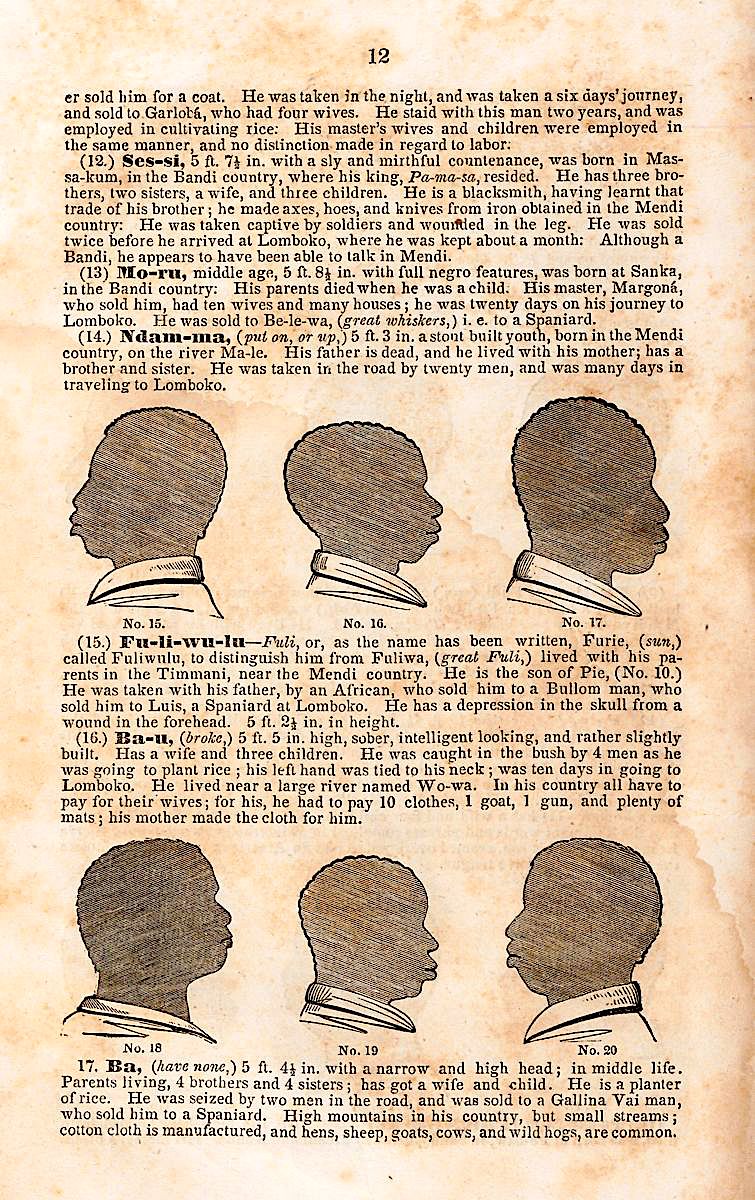
James Warner Barber attended the court hearings between January 7th and 13th in 1840 when Judge Andrew Johnson rule that the Africans were illegally transported to Cuba, and thus would not be returned to Montes and Ruis. On the first of April, Barber began drawing the Amistad Africans in jail and, over the next two months, would create drawings and engravings to illustrate his book. Barber drew portraits, from which he engraved silhouettes of the Africans, and added other illustrations to his book, including a map of the Mendi country, home of the Amistad Africans.

Horus

Photographer Unknown, Horus

Horus, in the ancient Egyptian religion, was one of the most important deities. The god appeared in the form of a falcon, whose left eye was the moon, representing healing, and whose right eye was the sun, representing power and the intrinsic substance of the heavenly bodies. Falcon cults were evident in late predynastic times and became widespread throughout Egypt. 

In the beginning stages of Egypt’s ancient religion, Horus was believed to be the god of war and the sky. As the religion progressed, Horus was seen as the son of Osiris and Isis, the divine child of the holy family triad. He is depicted as a falcon wearing a crown with a cobra, and later, wearing the Double Crown of the united Upper and Lower Egypt. The hooded cobra, worn by the gods and pharaohs on their foreheads, symbolized light and royalty. 

One of the oldest cultures in human history, ancient Egyptians are well-known for pioneering the fields of art, medicine, and the documentation of discoveries as mythological tales. The Egyptians mastered the integration of anatomy and mythology into artistic symbols and figures. The Eye of Horus was used as a sign of prosperity and protection, derived from the myth of Isis and Osiris. Comprised of six different parts, each an individual symbol, the Eye of Horus has an astonishing connection between neuroanatomical structure and function.

For those interested in the possible scientific speculation of the ingenuity of ancient Egyptians’ insight into human anatomy and physiology, a treatise, entitled “The Eye of Horus” by Karim ReFaey, Gabriella C. Quinones, William Clifton, and others can be found at the Cureus site, located at:https://www.cureus.com/articles/19443-the-eye-of-horus-the-connection-between-art-medicine-and-mythology-in-ancient-egypt

British Pathé, “RMS Titanic”: Film History Series


Artist Unknown, Titanic Moored at Dock, Gifs, British Pathé, 1912

These three colorized gifs were taken from the beginning of a film, jointly owned by British Pathé and Gaumont Newsreels, containing known footage of the R.M.S. Titanic. Slightly different versions of this film are held by British Movietone and the National Film and Television Archive.

The three gifs depict the Titanic moored, probably on April 2nd of 1912, at the Thompson Graving Dock on Queen’s Island in Belfast, where the RMS Titanic was fitted out. In these shots, men can be seen walking beside the ship and smoke is seen issuing from the third funnel of the Titanic.

The British Pathé’s newsreel, just over six minutes in length,  covers several episodes in the story of the RMS Titanic’s final days. The captain of the RMS Titanic, Edward J. Smith, who perished when the ship sank, is shown on board the RMS Olympic, before assuming duty on the Titanic. Newsreel footage of icebergs and ice floes are shown to portray the scene of the disaster. Scenes of the rescue ship, Carpathia, nearing New York City with survivors, and scenes of the departing search and rescue vessel, Mackay Bennet, also are included in this Pathé footage.

At the forefront of cinematic journalism, British Pathé was a producer of newsreels and documentaries from 1910 to 1970 in England. The company blended information with entertainment for movie theater attendees who came to watch the news. Over the course of its sixty years, it documented everything from major armed conflicts and international political crises to the curious hobbies and eccentric lives of ordinary people.

British Pathé’s roots lie in 1896 Paris, France, when Société Pathé Frères  was founded by Charles Pathé and his brothers, who pioneered the development of the moving image. In 1908, the company invented the cinema newsreel with its introduction of the Pathé-Journal and opened a newsreel office on Wardour Street, London, in 1910. These early silent  newsreels, issued every two weeks and running about four minutes in length, were shown in local theaters; sound was introduced beginning in 1928. The Pathé newsreels captured events such as suffragette Emily Danison’s fatal injury by a racehorse at the 1913 Epsom Derby and Franz Reichelt’s fatal descent by parachute from the Eiffel Tower in February of 1912.

Considered now to be the finest newsreel archive in the world, British Pathé is a treasure trove of eighty-five thousand films unmatched in their historical and cultural significance. The company also represents the Reuters historical collection, which includes more than one hundred thirty-six thousand items from the following news agencies: Gaumont Graphic, active from 1910 to 1932; Empire News Bulletin, a film library from 1926 to 1930;  British Paramount,  a collection spanning from 1931 to 1957; and Gaumont British’s collection  from 1934 to 1959. Included in Pathés vast library of film is the collected content from the Visnews service active from 1957 until the end of 1984.

The full footage of British Pathé’s Titanic black and white newsreel can be found at: https://www.youtube.com/watch?v=05o7sOAjtXE

All footage can be viewed on the British Pathé website. https://www.britishpathe.com/

Arcangelo Corelli: Music History

Arcangelo Corelli, Concerto in D Major Op. 6 No. 4, 1714, Performed by the Voices of Music Ensemble

Born on February 17, 1653 in Fusignano, Papal States, Italy, Arcangelo Corelli was a violinist and composer of the Italian Baroque era, whose  family were prosperous landowners, but not of the nobility. Known chiefly for his influence on the development of violin style and for his sonatas, Corelli’s “12 Concert Grossi “ established the contrast between a small group of soloists and the full orchestra as a popular compositional medium. 

Historical records of the poet Giovanni Mario Crescimbeni, founder of the celebrated Academy of Arcadians, state Arcangelo Corelli initially studied music under priests, first in the city of Faenza and then in Lugo, before he moved in 1666 to Bologna, a major center of musical culture. Plausible, but largely unconfirmed, historical accounts link his musical education with several master violinists, including Giovanni Benvenuti, Bartolomeo Laurenti, and Giovanni Battista Bassani. 

Although it is unclear exactly when Corelli arrived in Rome, it is known that he was actively engaged as a violinist in 1675. He played as one of the supporting violinists in three Lenten oratorios: one at the church of San Giovanni dei Florentini, one held on August 25th for a celebration at the church San Luigi dei Francesi, and one for the ordination ceremony of a noble Chigi family member held at the church Santi Domenico e Sisto. By February of 1675, Corelli was third violinist in the Chapel of San Luigi dei Francesi’s orchestra in Rome; by the following year Corelli was second violinist.

Corelli rapidly gain a reputation by playing in a number of ensembles sponsored by wealthy patrons at San Marcello al Corso, for whom he played in oratorios during the Lenten seasons from 1671 to 1679. In June of 1677, Corelli completed and sent his first composition “Sonata for Violin and Lute” to Count Fabrizio Laderchi, a noble in Faenza attached to the household of Prince Francesco Maria de Medici. Corelli’s “Twelve  Trio Sonatas (Two Violins and Cello, with Organ Basso Continuo), Opus 1”, dedicated to Queen Christina of Sweden, was published in 1681. 

From September 1687 to November 1690, Arcangelo Corelli was musical director at the Palazzo Pamphili, where he performed and conducted important musical events, Including conducting an orchestra of one hundred fifty strings for Queen Christina. A favorite of the great music patron Cardinal Pietro Ottoboni, Corelli in 1690 entered into the Cardinal’s service where he performed in concerts at Ottoboni’s Palazzo della Cancelleria. Joining him at these concerts were the violinist Matteo Fornari, the cellist G. B. Lulier from Spain, and the harpsichordist Bernardo Pasquini, and other orchestral players.

Corelli had first met Matteo Fornari in 1682, and they soon developed an intimate relationship which lasted until Corelli’s death. Socially protected by Ottoboni and living discreetly among male friends, they devoted their time together to the pursuit of their music which included many performances played together. Their relationship became the inspiration for two compositions by their friend Giuseppe Valentini, who dedicated his trio sonatas to both Corelli and Fornari. During this period, Corelli quietly developed his best-known and most influential works, the orchestral “Concerti Grossi”, and also became one of the most renowned violin teachers, who taught such students as Gasparini, Castrucci, and Locatelli.

In 1702, Corelli went to Naples and performed a composition by the Italian composer Alessandro Scarlatti, a performance which was probably performed  in the presence of its regent, King Philip IV.  In 1706, together with composer Bernardo Pasquini and Scarlatti, Corelli was received into the Pontifical Academy of Arcadia in Rome and conducted a concert for the occasion. By 1708 he withdrew from public view and began to revise his compositions. A contemporary of both Lully and Handel, Corelli died in Rome on the 8th of January in 1713. 

Arcangelo Corelli left his large art collection of paintings, all his instruments and music, and all future proceeds from it, to Matteo Fornari who readied Corelli’s unpublished “Op. 6 Concertos” for publication with Estienne Roger of Amsterdam. By special decree from the Pope, Corelli was buried next to Raphael in the section of the Pantheon in Rome that holds the remains of painters and architects.

Arcangelo Corelli’s “Concerto in D Major Op. 6”, was published in 1714 in Amsterdam and dramatically affected the style of the baroque concerto for the next generation of composers. The reception of this collection, considered one of the crown jewels of baroque instrumental music, owes a portion of its success to the music publishing boom which began around 1690. Corelli’s signature violin sonata set, “Opus 5”, also widely published, appeared in at least forty-two editions by 1800. 

Corelli’s concertos are written in an expanded trio sonata style, in which the two solo violins and cello form a small ensemble within the larger tutti framework, which is performed with all instruments together. The fourth concerto, played in the video linked above, is noteworthy for its suave and serene introduction, the gracefulness of the dance movement, the exceptionally well-balanced counterpoint and harmony, and the furious concluding coda which flows out of the second ending of the last movement.

Note: The video is from the Voices of Music Lamentations of Jeremiah concert held in April of 2014. Played with period instruments and practice,, there isn’t any conductor present at the performance. Kati Kyme and Elizabeth Blumenstock play solo baroque violins; Shirley Edith Hunt plays solo baroque cello; Gabrielle Wunsch and Maxine Nemerovski play ripieno baroque violins; Lisa Grodin plays baroque viola; Farley Pearce plays violone; Hanneke van Proosdij plays baroque organ; and David Tayler plays the archlute.

The Darmstadt Artists’ Colony

The Darmstadt Artists’ Colony

Between 1899 and 1914, the Mathildenhöhe (Mathilda Heights) of Darmstadt, a city in the state of Hesse, Germany, was the site of the legendary Artists’ Colony. It was founded by the young and ambitious Ernst Ludwig, Grand Duke of Hesse, who was the grandson of Queen Victoria and Prince Albert, and brother to Alexandra who married Tsar Nicholas II, the last Emperor of Russia. 

Grand Duke Ludwig was determined to turn his state into a cradle of modern design and art on the highest level. To attain this goal, he commissioned some of the most talented artists of the time to become members of the Colony, including Vienna’s distinguished architect Joseph Maria Olbrich, one of the Vienna Secession founders, and self-taught Peter Behrens, who would become Germany’s top architect in the decade to follow. 

Situated close to the city centre, the Artists’ Colony became a sensational experimental field for artistic innovations in which the sovereign and a group of young artists realized their vision of a fusion of art and life. Their intention was to revolutionize architecture and interior design in order to create a modern living culture with an integration of both housing and work space. The whole human life-style was to be reformed to gain in beauty and happiness as well as in simplicity and functionality.

Beginning during a period when art existed for the sake of its beauty alone, the progress of the Artists’ Colony was slow; however, after 1901, the program gradually became more rational and realistic. This change was evident, among other things, in the numerous buildings created on the Mathildenhöhe from 1900 to 1914. Though at first the artists concentrated on the construction of private villas, they later created apartment houses and workers’ homes in an effort to face the arising questions of their time’s life and housing.

The ensemble of the Darmstadt Artists’ Colony is considered today to be one of the most impressive records of the dawning of modern art. Its appearance is still marked primarily by the buildings of the architect Joseph Maria Olbrich, who notably created the remarkable silhouette of the Colony, facing the city of Darmstadt, with his Wedding Tower and the Exhibition Building, both completed in 1908. 

The Mathildenhöhe Darmstadt is basically an open-air museum where the artwork is present in the form of its buildings, fountains and sculptures. At the same time, Joseph  Olbrich’s 1901 Ernst-Ludwig House, the former studio house and spiritual centre of the artists’ colony, is now a museum that presents fine and decorative art from the members of the artists’ colony. The unique integrity of the building complex is today a first-class cultural attraction, and the lively. contemporary centre of the Darmstadt’s cultural landscape. 

Note: The original Artists’ Colony group, headed by Joseph Maria Olbrich, included painter, decorative artist, and architect Peter Behrens; decorator Hans Christiansen; decorator Patriz Huber; sculptor Ludwig Habich; visual artist Rudolf Bosselt; and decorative painter Paul Bürck. Between 1904 and 1907, the group was joined by ceramicist Jakob j Scharvogel, glass blower Josef Emil Schneckendorf, and book craftsman Friedrich W Kleukens. 

After Joseph Olbrich’s death in 1908, architect and designer Albin Müller led the group. Under Müller’s leadership, the group expanded with majolica craftsman Bernhard Hoetger, goldsmiths Ernst Riegel and Theodore Wende, and Emanuel Margold, a student of painter Hans Hoffman.

Osiris-Antinous

Artist Unknown, “Osiris-Antinous”, 117-138 AD, Parian Marble, 241 x 77 x 79 cm, Musei Vaticani, Vatican City, Italy

This marble statue represents the Bithynian Greek youth Antinous, the favorite of Emperor Caesar Traianus Hadrianus. Born in the city of Claudiopolis, in now north-west Turkey, in November between 110 and 12 AD, according to early sources, Antinous was most likely the son of farmers or merchants. Having been taught to read and write, he would have had a basic education as a child.

Although little is known in surviving records about Antinous’s life, it is likely he first met Emperor Hadrian in June of 123 AD, during Hadrian’s visit to Claudiopolis while touring the Roman Empire. It is probable, due to Antinous’s young age, that Hadrian sent him to Italy, where he most likely was schooled at the paedgagium, the school to train young men as servants for the imperial palace, located at the Caelian Hill. Hadrian continued his tour of the Empire, returning to Italy in September of 125 AD, when he settled at his villa in Tibur. 

It was within three years that Antinous became Hadrian’s personal favorite, for Antinous was known to be in Hadrian’s personal retinue on his journey to Greece in 128 AD. It is known that Hadrian believed Antinous to be intelligent, and they both shared a love of hunting, which was seen as a manly pursuit in Roman culture. Early sources are explicit that the relationship between Hadrian and Antinous was sexual; and there is no evidence that Antinous ever exploited Hadrian for personal or political gain. 

In April of 128, Emperor Hadrian laid the foundation stone for a temple to Venus and Rome in the city of Rome, likely accompanied at the ritual by Antinous. From the middle of 128 to late September or early October of 130, Hadrian and Antinous, with an entourage, traveled to Greece, Syria, Arabia, Judaea, Libya, Alexandria, and Egypt, where they assembled at Heliopolis to set sail upstream as part of a flotilla along the Nile River. On their journey up the river, Hadrian and Antinous stopped at the Hermopolis Magna, the primary shrine to the god Thoth, leader of the eight principal deities of Egypt. 

In October of 130, during the period for the festival to Osiris, Antinous fell into the river, his death most likely resulting from drowning. Hadrian was devastated by the death; the local priesthood immediately deified Antinous, identifying him with Osiris due to the manner of his death. In keeping with Egyptian custom, Antinous’s body was mummified by priests and interred the following year, most likely, at Hadrian’s estate in Tibur, Italy, where an inscribed obelisk was erected.

Although the public and formal divination of humans was reserved for the Emperor and members of the imperial family, Hadrian declared Antinous a god and created a formal cult devoted to him, which was highly unusual and done without permission of the Senate. The cult  of Antinous spread through the Empire, especially between 133 and 138, the year of Hadrian’s death, with some seeing Antinous as hero or god, and into Egypt, where Antinous was seen primarily as a benevolent god who could aid and cure his worshipers.

Note: The iconographic model of “Osiris-Antinous”, shown above, was intended to express the regal and divine nature of the figure. The marble statue was donated to Pope Benedict XIV, and was placed in the Capitoline Museum in 1742. Pope Gregory XVI requested for it to be transferred to the Vatican in 1838 so it could be displayed in its new Egyptian Museum.

Baker’s Dozen

Photographers Unknown, Baker’s Dozen

“Because bread was so important, the laws governing its purity were strict and the punishment severe. A baker who cheated his customers could be fined £10 per loaf sold, or made to do a month’s hard labor in prison. For a time, transportation to Australia was seriously considered for malfeasant bakers. This was a matter of real concern for bakers because every loaf of bread loses weight in baking through evaporation, so it is easy to blunder accidentally. For that reason, bakers sometimes provided a little extra- the famous baker’s dozen.”

—Bill Bryson, At Home: A Short History of Private Life

Paul Jasmin

Paul Jasmin, “Rodney, Edie, and Bosco, Hollywood”, 1990, Silver Gelatin Print

Born in April of 1935, Paul Jasmin was an actor, illustrator, and painter before focusing on photography. He left his hometown of Helena, Montana, in 1954 to travel in the world and pursue an acting career in New York and Los Angeles. He performed small cameo roles in the 1959 “Riot in Juvenile Prison”, “Midnight Cowboy” in 1969, and Spike Jonze’s 2002 “Adaption”. Working with actors Virginia Gregg and Jeanette Nolan, Paul Jasmin provided one of the three vocals mixed together for the voice of Norman’s mother in Hitchcock’s “Psycho”.

From 1965 to 1975, Jasmin concentrated on painting and illustration. He provided illustrative work for the fashion campaigns of the luxury Valentino brand. Jasmin also illustrated the advertising poster for the 1972 American porno film “Bijou”, directed by dancer and choreographer Wakefield Poole. 

Urged by friend and photographer Bruce Weber, Paul Jasmin turned to photography, with his imagery focusing on the unknown people he discovered on his travels. He began doing work for commercial clients in the late 1970s, working for the brands SAKS, Nautica, and Mr.Porter. Jasmin’s current editorial work appears in Vogue, Teen Vogue, GQ, Details, V Magazine, V Man, and Vogue Hommes, among other publications,

Since 2002, Jasmin has produced a several photographic studies of life in California, including “Hollywood Cowboy”, published in 2002 by Arena Editions; the 2008 “Los Angeles”, published by Steidl: and “California Dreaming”, published by Steidl in 2011. His 2008 “Lost Angeles” series, a study of those ‘tarnished angels’ who come to Hollywood seeking their dreams, is considered one of his most prominent works. 

Paul Jasmin currently teaches photography at the Art Center College of Design in Pasadena, California.

The Sator Square


Photographers Unknown, (The Sator Square; A Collection)

The Sator Square is a word square containing a five-word Latin palindrome in a sequence of characters that reads the same backward as forward. It is a five by five square made up of five five-letter words, consisting of twenty-five letters in total. These twenty-five letters are all derived from eight Latin letters, consisting of five consonants (STRPN) and three vowels (AEO).In particular, thr Square is a square 2D palindrome, which is when a square text admits four symmetries: identity, two diagonal reflections, and 180 degree rotation. As can be seen, the text may be read top-to-bottom, bottom-to-top, left-to-right, or right-to-left; and it may be rotated 180 degrees and still be read in all those ways.

The Sator Square is the earliest dateable 2D palindrome. It was found in the ruins of Pompeii, Italy, at Herculaneum, a city buried in the ash from the 79 AD Mount Vesuvius eruption. It consists of the five Latin words: Sator, Arepo, Tenet, Opera, and Rotes. Other Sator Squares have also been found in excavations under the church os Saint Marie Maggiore in Rome; at Cirencester in Cotswolds, England; at Dura-Europos in Syria; at the Valvisciolo Abbey, Latina, Italy; and as a partial inscription on a rune stone at Närke, Sweden.

“It seemed to him that the Square, itself the accidental masonry of many years, the chance agglomeration of time and of disrupted strivings, was the center of the universe. It was for him, in his soul’s picture, the earth’s pivot, the granite core of changelessness, the eternal place where all things came and passed, and yet abode forever and would never change.” 

–Thomas Wolfe, Lost Boy: A Novella

The Lumière Brothers: Film History Series

Auguste and Louis Lumière, (Paris Scenes), “A Trip Through Paris, France, 1896-1900”, Film Gifs

The Belle Époque was a period in the history of Paris between 1871 to 1914, from the beginning of the Third French Republic until the first World War. The nostalgic term came into use, after the despair and deaths of World War One, for what seemed a simpler time of elegance, optimism and progress. This “Beautiful Age’ brought dramatic advancements in art, culture, and technology. 

In the field of architecture, Paris saw the construction of the Paris Metro, the completion of the Paris Opera House, the building of the Eiffel Tower, and the Basilica of the Sacred Heart on Montmartre. During the three Universal Expositions of 1879, 1889, and 1900, millions of visitors came to Paris to see the latest marvels in commerce, the arts, and science. Paris was also the birthplace of the Ballets Russes, the most influential ballet company of the twentieth century, and the new art movements of Impressionism and the experimental Modern Art.

One particularly important technological invention that emerged at this time was the projected motion picture, patented in 1895 by Auguste Marie Louis Nicolas and Louis Jean Lumière. With this new technology, the Lumière brothers captured contemporary life in 19th-century Paris, culminating in the priceless black and white footage we can still see today.

Shot between 1896 and 1900, the compilation  “A Trip Through Paris, France, 1896-1900” takes viewers on a journey back in time to Paris. In six minutes, it showcases several sites around the French capital, including still-standing landmarks like Notre-Dame Cathedral, the Champs-Élysées, and the ten-year-old Eiffel Tower. In addition to featuring specific locations, it also offers a glimpse of daily life, from a scene showing firefighters on horseback to footage of children playing with little boats in the Tuileries Garden.

In order to set a lifelike scene, film restorer Guy Jones slowed the footage to a natural speed and added ambient noise. When coupled with the video’s strikingly high quality, these alterations make it possible for people today to wander through the Golden Age of Paris.

The complete film “A Trip Through Paris, France, 1896-1900” by the Lumière brothers with restoration and soundtrack can be found, along with other restored works, at Guy Jones’s Youtube site:

https://www.youtube.com/user/bebopsam1975/videos

Emperor Caracalla

Bust of Emperor Caracalla

Artist Unknown, Bust of Emperor Caracalla, White Marble Head, Alabaster Torso

Formerly known as Antoninus, Caracalla was a member of the Severan dynasty, the elder son of Julia Domna and Septinius Severus. He ruled as the Roman Emperor from 198 to 217 AD, first as a co-ruler with his father Septnius from 198, then as a co-ruler with his brother Geta from 209 AD. After his father’s death in 211, Caracalla killed his brother and assumed the position of Emperor for himself.

Although Caracalla’s reign was troubled with domestic instability and invasions by the Germanic tribes, it was notable for the Antonine Constitution which granted Roman citizenship to all free men throughout the Roman Empire. Caracalla is known for the construction of the second-largest baths in Rome, the Baths of Caracalla, and for the the new Roman currency named the antoninianus.

Ancient sources portray Caracalla as a tyrant and a cruel leader, enacting massacres in his empire and against his own Roman people. He was assassinated by a disaffected soldier in 217 AD. Macrinus, a praetorian prefect of Rome and a conspirator in the assassination against Caracalla, became Emperor on April 11, 217, three days after Caracalla’s death.

Image reblogged with thanks to http://hadrian6.tumblr.com


The Karnak Temple


Photographer Unknown, (Inside the Karnak Temple in Luxor)

Consisting of more than one hundred hectares, Karnak is an ancient temple precinct in Egypt located on the east bank of the Nile River in modern-day Luxor, formerly Thebes. The largest sector is the central portion which is dedicated to Amun-Ra, considered to be the supreme creator, the god of fertility and life.

In the southern central sector is a precinct dedicated to the goddess Mut, wife of Amun-Ra, the primal mother goddess who is associated with the waters from which everything is born. She was a patron deity of Thebes along with her husband Amun-Ra and their son Khonsu, god of the moon.

North of the central area is a precinct dedicated to Montu, the falcon headed god of war and embodiment of the conquering vitality of the Pharaoh. A very ancient god, Montu was a manifestation of the scorching destructive effect of Ra, the sun, which caused him first to be considered a warrior and eventually revered as a war-god.

To the east of the central sector, there is an area, destroyed intentionally, that was dedicated to Aten, the solar disc. The deity Aten was the focus of the monotheistic religion established by Amenhotep IV to worship Aten as the creator, the giver of life, and the nurturing spirit of the world. Horemheb, the last Pharaoh of the Eighteenth Dynasty of Egypt, reestablished the priesthood of Amun and destroyed the temple area of Atan, the solar disc. A prolific builder, Horemheb constructed the Second, Ninth, and Tenth Pylons of the great Hypostyle Hall in the precinct of Amon-Ra at the Temple of Karnak.

The last major building program at Karnak was under the reign of Nectanebo I, a king of the Thirtieth and last Dynasty of Egypt. He built a large enclosure wall around the site along with another temple. He also started, but did not complete, a new pylon at the western entrance of Karnak. The rulers of foreign descent who took control of Egypt continued work at Karnak, creating a series of burial catacombs dedicated to Osiris, god of the underworld. When Rome seized control of Egypt, work at Karnak ceased, ending a span of two thousand years of construction.

James Stroudley


Leonard James Stroudley, “The Oarsmen”, 1930, Oil on Canvas, 224 x 178 cm, Private Collection

Born in London in June of 1906, Leonard James Stroudley was a painter, printmaker, and educator. He studied at the Clapham School of Art from 1923 to 1927, and continued his studies at the Royal College of Art from 1927 to 1930, where he studied under painters William Rothenstein and Alan Gwynne-Jones. As a recipient of the first Abbey Scholarship in 1930, Stroudley was able to study for three years in Italy, where he was influenced by the paintings of Giotto and Piero della Francesca, and produced one of the last decorative cycles by a Rome Scholar prior to World War II.

On his return to London in 1933, Leonard Stroudley became a visiting lecturer at the Royal Academy School and exhibited at the Royal Academy and the Royal Society of British Artists, of which he was elected a member in 1934. Working through a series of influences, including cubism in the late 1930s, he achieved the incisive draftsmanship that is the core of his work. Stroudley’s drawings, both figurative and landscapes, from this period are technically brilliant and bear comparison with illustrative work of British sculptor Eric Kennington.

After the Second World War, in which he worked with the Camouflage Unit, Stroudley taught at St. Martin’s School of Art and continued his lectures at the Royal Academy Schools. Though he continued to live in London, Stroudley’s later work, exhibited at the Royal Academy from 1955, indicated regular painting trips to the coastal areas of Kent and Sussex. Initially a figurative artist, his later works, starting in the 1950s, moved increasingly towards abstraction. 

Leonard James Stroudley, in addition to exhibitions at the Royal Schools, had numerous gallery shows, among which were the Walker Art Gallery in 1956-1957, the Apollinaire Gallery, the Arthur Tooth and Son Gallery, and London’s Reid Gallery in 1960. His former student, realist painter Peter Coker, paid homage to his teacher by including Stroudley’s work in the 1971 exhibition “Pupil & Masters” which was held at Westgate House in Long Melford, Suffolk.

Leonard James Stroudley died in May of 1985 at Wandsworth, London. His works are in the public collections of Bradford, Brighton, Coventry, and Rochdale, as well as many private collections. 

Top Insert Image: Leonard James Stroudley, “Undercliff Walk, Looking West from Rottingdean”, Watercolor and Penccil, Private Collection

Bottom Insert Image: Leonard James Stroudley, “First Floor Front”, 1959, Oil on Canvas, The Esplanade, Rochdale, Greater Manchester, England