Ramón Novarro
Ramón Novarro, whose birth name was Jose Ramón Gil Samaniego, was a Mexican-American actor born in 1899 in Durango, Mexico. Fleeing the Mexican Revolution in 1913, Novarro and his family settled in Los Angeles, California. Within four years, he started appearing in the films of Rex Ingram and his wife 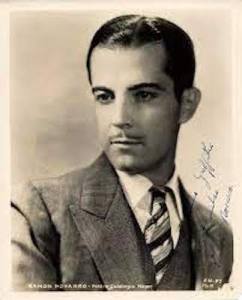 Alice Terry, while also working as a singing waiter. Novarro’s first major success was his role in the 1923 “Scaramouche”, playing the lead role of André-Louis Moreau.
Novarro’s good looks and adequate skill as an actor made him an ideal competitor for Rudolph Valentino’s dominance as a Latin lover. Three years after Valentino played the title character of “The Shiek” in 1921, Novarro played a similar role. In 1925, Novarro gave his breakthrough performance as the title character in director Fred Niblo’s “Ben Hur: A Tale of the Christ”. The film was a blockbuster hit, cementing MGM’s reputation as a quality studio and elevating Navarro into the Hollywood elite.
Valentino’s 1926 death left Novarro the title of Latin Lover Number One in Hollywood, and he enjoyed the status into the talking film era. He was popular as a swashbuckle r in action films and one of the great romantic leads of the era. Novarro appeared with Norma Shearer in the 1927 “Student Prince in Old Heidelberg” and in the 1928 “Across to Singapore” with actress Joan Crawford.
At the peak of his success in the early 1930s, Novarro was earining more than 100,000 US dollars per film. It was only after his studio contract with MGM Studios was not renewed in 1935 that his celebrity faded. After that, he made sporadic appearances in film, including John Huston’s 1949 “We Were Stagers” and the 1950 film-noir crime film “Crisis” with Cary Grant.
Ramón Novarro was gay in a time when society had little understanding and no tolerance for anyone considered different. MGM mogul Louis B. Mayer asked him to take a woman as a bride, to participate in a “lavender marriage’ for publicity purposes. Novarro refused, and maintained romantic relationships with men, including composer Harry Partch and Hollywood journalist Herbert Howe. On the night of October 30, 1968, Novarro was murdered by brothers Paul and Tom Ferguson whom he invited into his home. Believing there was a large sum of money in the house, the brothers hoped to rob him. Novarro died as a result of asphyxiation, choked to death on his own blood after having been beaten. He is buried in Calvary Cemetery in East Los Angeles.



