Julien Green: “A World He Brushes Past Without Seeing”

Photographers Unknown, A World He Brushes Past Without Seeing

Paris est une ville dont on pourrait parler au pluriel, comme les Grecs l’a fait avec Athène. Car il y a beaucoup de Paris et celui des touristes n’a qu’une relation superficielle avec celui des Parisiens. Un étranger qui traverse Paris dans en voiture ou en autobus et qui va d’un musée à l’autre n’a aucune idée de ce monde qu’il ne voit pas, bien qu’il soit dans elle.

Personne ne peut affirmer de connaître bien une ville s’il n’a pas perdu son temps dans elle. L’âme d’une grande ville ne laisse pas se comprendre légèrement. Pour qu’on se familiarise vraiment avec elle, on doit dans elle, on a dû s’ennuyer et pâtir un peu dans elle. Bien sûr, chacun peut s’acheter un guide de la ville et constater que tous les monuments indiqués sont là. Mais, à l’intérieur de la frontière de Paris, une ville qui est accessible autant dure que Tombouctou l’était autrefois se cache. 

Paris is a city that might well be spoken of in the plural, as the Greeks used to speak of Athens, for there are many Parises, and the tourists’ Paris is only superficially related to the Paris of the Parisians. The foreigner driving through Paris from one museum to another is quite oblivious to the presence of a world he brushes past without seeing.

Until you have wasted time in a city, you cannot pretend to know it well. The soul of a big city is not to be grasped so easily; in order to make contact with it, you have to have been bored, you have to have suffered a bit in those places that contain it. Anyone can get hold of a guide and tick off all the monuments, but within the very confines of Paris there is another city as difficult to access as Timbuktu once was. 

Julien Green, Paris, 1987, Illustrator: Jean William Hanoteau, Publisher: Les Bibliophiles du Palais, Paris 

Born in Paris in September of 1900, Julien Hartridge Green was an American writer who spent most of his life in France. Over a seventy-year career as an author, he wrote novels,  essays, several plays, a journal written daily from 1919 to 1998, and a four-volume autobiography. In 1971, Green had the honor of being the first non-French national to be elected a member of the Académie Françoise. He had been awarded the Académie’s grand prize for literature in the previous year.

Julien Green was the youngest of seven children born to American parents Edward Green, a native of Virginia, and Mary Adelaide Hartridge from Savannah, Georgia. The family had emigrated and settled in Paris seven years before his birth. Raised in a traditional Protestant home, Green received his education in French schools including the city’s distinguished Lycée Janson-de-Sailly. After his mother’s death in 1914, he became a Roman Catholic two years later. 

After sitting for the French baccalaureate in 1917, Green served as an underage volunteer ambulance driver during the first World War, initially for the American Field Service and then for the American Red Cross. He entered the French Army in 1918 and served in an artillery unit until the end of the war. At the invitation of his uncle Walter Hartridge, Green studied from 1919 to 1922 at the University of Virginia, his first direct contact with the United States and its Southern culture. 

Julien Green returned to France in 1922 and began his career as a writer. His first published work in French was a critique entitled “Pamphlet Contre les Catholiques de France”, written under the name of Théophile Delaporte. In 1926, Green published his first novel “Mont-Cinère (Avarice House)” through philosopher and publisher Jacques Maritain who later published Green’s 1927 novel “Adrienne Mesurat (The Closed Garden)”. Until his death in 1973, Maritain remained a loyal friend, supporter and regular correspondent to Green

In the early 1930s, Green returned to the United States and began work on a novel set in the American South during the 1800s, an effort he abandoned after learning that Margaret Mitchell was nearing publication on her 1936 “Gone with the Wind”. Green’s Southern epic would be a three-volume saga written in France. The first volume “Les Pays Lointains (The Distant Lands, Dixie I)” was published in 1987. “Les Étoiles du Sud (The Stars of the South, Dixie II)” was published two years later. Both of these were reprinted in English in 1991 and 1993, respectively. The third volume of the saga, “Dixie (Dixie III)”, was published in both French and English in 1995.

In 1938, Julien Green began the publication of journals that provided a chronicle of his personal, literary and religious life as well as the atmosphere and events in the French capital. He extensively edited each of the journals to suppress accounts of his and others’ sexual adventures as well as the opinions he had expressed candidly to others. Of the nineteen volumes in the series, only two were published before the German invasion in 1940. Publication resumed after the war with volume three, “Devant la Porte Sombre (1940-1943)”, in 1946. The final volume, “Le Grand Large du Soir (1997-1998)”, was published in 2006.

After France’s surrender in July of 1940, Green fled Paris for the city of Pau in southwest France near the Spanish border. He was able to obtain visas for himself and his long-time partner, journalist Robert de Saint-Jean, for passage to Portugal from which they sailed on the 15th of July to New York City. After a brief stay with a cousin in Baltimore, Green was mobilized in 1942 by the United States Office of War Information to serve as a French-speaking broadcaster for the Voice of America. While in New York, he wrote his first English work, the  1942 memoir “Memories of Happy Days” and gave lectures at both Mills and Goucher colleges. Green also translated two works by French poet and essayist Charles Péguy into English and wrote articles for periodicals. 

After his return to Paris in late September of 1945, Julien Green continued the editing and publication of his journals. In the next fifteen years, he published four major novels: the 1947 “Si J’Étais Vous (If I Were You)”; the 1951 ““Moïre” set in Charlottesville, Virginia; the 1956 “Le Malfaiteur (The Transgressor)”; and the 1960 “Chaque Homme dans sa Nuit (Each in His Own Darkness)”, a novel of a young Catholic troubled by homosexual urges. Between 1963 and 1974, Green published four volumes of memoirs that had been written before his published journals. In the third volume of this set, the 1966 “Terre Lointaine (Love in America)”, Green described how he became aware of his homosexuality while at the University of Virginia. These four memoirs were reissued in 1985 under the title “Jeunes Années”. 

Julien Hartridge Green died in Paris on the thirteenth of August in 1996, shortly before his ninety-eighth birthday. His remains were entombed in a chapel designed for him at St. Egid Church in Klagenfurt, Austria. After his death, Green’s adopted adult son, novelist and playwright Éric Jourdan, served as executor of Green’s estate. Controversy surrounded Jourdan’s attempts to control and censor Green’s publications. After Jourdan’s death in 2015, his executor Tristan Gervais de Lafond supported the publication of an uncensored edition of Green’s journals; the first volume of this set was published in 2019.

Notes: Julien Green had been for many years the companion of author and journalist Robert de Saint-Jean whom he met in November of 1924. They lived together in an intimate and physical open  relationship for most of the inter-war years. Green and Saint-Jean frequented Paris’s popular gay clubs, traveled together in the 1920s and 1930s through Europe, Tunisia, and the  United States, and spent months together in London during the mid-1930s. For his body of work, Robert de Saint-Jean received in 1984 France’s literary award, the Prix Marcel Proust. He died in Paris at the age of eight-five in January of 1987.

The National Endowment for the Humanities’s online magazine “Humanities” has a feature article entitled “Julien Green: The End of a World”, written by NEH research fellow Francis-Noël Thomas. This article on Green’s life in Paris can be found at: https://www.neh.gov/humanities/2012/julyaugust/feature/julien-green-the-end-world

A complete list of Julien Green’s hundred seventy-two published works can be found at the GoodReads site located at: https://www.goodreads.com/author/list/36431.Julien_Green

Top Insert Image: George Hoyningen-Huene, “Julien Green”, 1930, Gelatin Silver Print, Vanity Fair 

Second Insert Image: Julien Green, “Journal (1928-1939)”, January 1958, Limited Edition, Volume Nine of Ten, Publisher Librairie Plon, Paris

Third Insert Image: Carl van Vechten, “Julien Green”, 1933, Gelatin Silver Print

Fourth Insert Image: Julien Green, “Les Pays Lointains”, 1987, Publisher Éditions de Seuil, Paris

Bottom Insert Image: Photographer Unknown, “Julien Green”, circa 1971, Gelatin Silver Print

Robert Hamberger: “He Bequeths the Gift of Breath”

Photographers Unknown, He Bequeths the Gift of Breath

And they all forsook him and fled. And there followed him a certain young
man, having a linen cloth cast about his naked body; and the young men laid
hold on him: And he left the linen cloth, and fled from them naked.

St Mark, Chapter 14, Verses 50-52

He’s my firmament.
I hang on every word,
lassoed by considering the lilies,
by camels and needle eyes,
bread of life and light of the world.

I studied his mouth, hour by hour,
until I confessed a thirst for his throat
exposed below the beard,
his wrists, slender gazelles
when loose sleeves slip to reveal them.

What could I do
but give up everything
to sip his shadow?
He admits me to his gaze,
permits my passion. He lets me stay.

I could have been the woman
who stroked the edge of his robe,
who wiped his heels with her hair.
His men buzz as if he’s honey
as if we might swallow him whole.

Tonight’s moon notes his cry
among the camellias.
He kneels to call the air father.
Saints snore while I shiver in linen,
keeping my chilly vigil.

My prayer marries his:
Run with me now where no God
can catch us. He walks instead
to swords and spears and glamour,
one man kissing another.

When they prod a blade at my ribs
I leap from their net,
wrestle free from my sheet
as water strips a skin.
My glimmer swims naked through fig trees.

He leaves me to my betrayal
between the olive groves.
He bequeaths the gift of breath
to my body’s temple.

Robert Hamberger, Gethsemane Nude, Torso, 2007, Redbeck Press, Bradford, West Yorkshire, UK

Born in Whitechapel, East London in 1957, Robert Hamberger is an English poet, author and educator. He studied English Literature from 1975 to 1978 at Sussex University, a highly-ranked university in Brighton, United Kingdom. Hamberger was awarded his Master of Arts in Social Work from Leicester University in 1988. 

Following his graduation, Hamberger worked for thirty-eight years in social work for the Leicestershire, Northamptonshire, and West Sussex County Councils. During his residence in the East Midlands, he established the Corby Writers’ Workshop and the Wellingborough Writers’ Workshop. Hamberger also participated in the East Midlands Art’s first New Voices Tour and edited four anthologies by local writers. He currently resides in Brighton with his husband Keith Rainger, who lends his translation skills to Hamberger’s work.

Robert Hamberger prefers writing outside the literary mainstream. He has particular interests in working-class, pro-feminist, radical and queer writings. He uses his own experiences of fatherhood, marriage and separation, loss of friends and queer identity as the foundations for his examinations of love, death and memory. As such, his work remains very personal and true to his self-identity. In addition to publishing his work, Hamberger has taken part in numerous readings online as well as poetry festivals and workshops. Most recent of these was the October 2023 reading and panel on “Genre-Bending and Queering Words” at the Coast is Queer Festival held at Sussex University.  

Hamberger’s first full-length collection of poems “Warpaint Angel” was published by Five Leaves Press in 1997. Its poetry explores the experience of fatherhood and existence as son, the meaning of family and friendship as well as the nature of love. The volume is a mixture of casual, frank narratives and lyrical poems both tough and delicate. Hamberger’s “Rule of Earth”, a winner in the 2000 Poetry Business Competition, is a chapbook that contains a sequence of twenty-one love sonnets. These sonnets describe both the daily routines and ecstasy of a gay relationship, which is unexpectedly impacted by heart disease. 

Robert Hamberger’s 2002 collection of first-person poems, “The Smug Bridegroom”, explores the experiences of fatherhood, love and change which, through shifts in family relationships, lead to both a marriage breakup and renewal of hope. The 2007 “Torso”, Hamberger’s third full-length collection, continues his exploration of existence as father, son, lover and poet. Included among its sequences are a celebration of Federico Garcia Lorca’s love sonnets, elegies for a friend, and queer interpretations of sacred texts. 

Hamberger’s fourth collection entitled “Blue Wallpaper” was published by Waterloo Press several months prior to the Covid-19 pandemic in 2019. Divided into six subtitled sections, this volume of sixty-one personal poems contains sonnets, elegies, free verse, and other poetic forms with the topic of love between men frequently central. Among the poetry in “Blue Wallpaper” are works centered on familial memories from Hamberger’s youth, his mother’s dementia, the poets he admires, mythical and natural creatures, the work of Arthur Rimbaud, and the deaths of close friends during the HIV/AIDS epidemic. “Blue Wallpaper” was shortlisted for the 2020 Polari Prize, an annual United Kingdom literary prize established for LBGTQ+ literature.

Kept in an asylum for four years, the peasant poet John Clare escaped in 1841 and walked over eighty miles to his home in Northamptonshire. Suffering from poor mental health, Clare was attempting to reunite with Mary, his idealized first love, unaware she had died three years prior. In 1995 with his personal life in crisis and mental health fragile, Robert Hamberger retraced poet John Clare’s route over a four-day walk. In June of 2021, he published his finished “A Length of Road”, a work part memoir, part-literary criticism and part travel-log. The volume is a deep, poetic exploration of the issues of class, gender, grief, masculinity and sexuality as seen through Hamberger’s own life as well as the autobiographical writings of poet John Clare.   

Notes: Robert Hamberger”s website, which contains readings on videos, interviews, writings and contact information, can be located at: https://www.roberthamberger.co.uk

Popsublime is an interesting literary, film and pop culture review site that has be publishing online since 2010. It has a review by the site’s author on Robert Hamberger’s 2002 “The Smug Bridegroom”. The article is located at: https://popsublime.blogspot.com/2010/08/robert-hamberger-smug-bridegroom-five.html

Alfred Edward Housman: “The Colour of His Hair”

Photographers Unknown, The Colour of His Hair

Oh who is that young sinner with the handcuffs on his wrists?
And what has he been after that they groan and shake their fists?
And wherefore is he wearing such a conscience-stricken air?
Oh they’re taking him to prison for the colour of his hair.

‘Tis a shame to human nature, such a head of hair as his;
In the good old time ’twas hanging for the color that it is;
Though hanging isn’t bad enough and flaying would be fair
For the nameless and abominable colour of his hair.

Oh a deal of pains he’s taken and a pretty price he’s paid
To hide his poll or dye it of a mentionable shade;
But they’ve pulled the beggar’s hat off for the world to see and stare,
And they’re haling him for justice for the colour of his hair.

Now ’tis Oakum for his fingers and the treadmill for his feet
And the quarry gang on Portland in the cold and in the heat,
And between his spells of labour in the time he has to spare,
He can curse the God that made him for the colour of his hair.

Alfred Edward Housman, Oh Who Is That Young Sinner, First Draft Summer 1895
Published 1939, Collected Poems,’Additional Poems’, Number 18

Born in Bromsgrove, Worcestershire in March of 1859, Alfred Edward Housman was an English classical scholar, educator and poet. Recognized as one of the foremost classicists of his era, he emerged as a poet with his 1896 “A Shropshire Lad”, a collection of works espoused by a simple youth preoccupied with the idea of early death. 

The eldest of seven children to Edward Housman and Sarah Jane Williams, Alfred Housman was educated at King Edward’s School in Birmingham and later at Bromsgrove School. In 1877 at the age of eighteen, he won a scholarship to St. John’s College, Oxford, where he studied the classics. Though introverted by nature, Housman developed strong friendships with two roommates, Moses John Jackson, who became the principal of Sind College in Karachi, and Alfred William Pollard, a future bibliographer and scholar of Shakespearean texts. 

At Oxford, Housman knew that emendation, the revision and  correction of scribal errors in classical texts, would be his life’s work. So, he studied accordingly. In 1879, Housman earned a first on his exam for Moderations but failed the Finals due to his neglect of ancient history and philosophy. He returned in September for the Michaelmas term to retake the exam and achieved the lower-grade pass degree. Housman, who was homosexual, fell in love at Oxford, for the first and only time, with his classmate Moses Jackson who was heterosexual. This unreciprocated love would remain a constant throughout Housman’s life and play a role in the creation of his poetry, an emotional and physiological experience for him.. 

After Oxford, Housman joined Jackson in London to work as a clerk in the Patent Office. They shared lodgings with Jackson’s brother Adalbert until 1885 at which time Housman found a flat of his own. Two years later, Jackson took a position in Karachi, India as an educator; he returned in 1889 to marry and resided with his wife and family in India until his retirement. Learning in 1922 that his friend, now back in England, was dying from stomach cancer, Housman wrote thirty-seven pages of poems that were published in early 1922. A copy of the collection was sent the hospital where Jackson was being treated. Jackson read the poems in October, a few months before his death in January of 1923. 

Housman’s most sustained period of poetry composition was during his professorship at University College. Of the work he produced during this period, his 1896 “A Shropshire Lad” became his best effort. After its rejection by Macmillan Company, it was published by Kegan Paul at Housman’s expense; at his insistence he took no royalties from Kegan Paul. Over two years, the book sold very slowly until Grant Richards, who became a lifelong friend, published five-hundred copies in 1897. Sold out, two more editions were printed and three-thousand copies sold by 1902. 

Profoundly affected by his mother’s death when he was twelve, Alfred Housman’s poetic themes largely dealt with time, seen by Housman as the enemy, and the inevitability of death. He frequently dealt with the plight of the young soldier, in which sympathy for the youth was balanced with patriotism of the nation. Housman also saw, through its changing seasons, death in nature; however, he regarded this manner of death with a stoic outlook rather than one of complete pessimism. Although the universe is seen in his poetry as cruel and hostile, his work also extolled the preciousness of both youth and youth’s beauty. 

In 1922, Housman published his “Last Poems” which greatly added to his reputation. His place in the poetic world was further enhanced by British composers setting his work to music. The cycle of poems from “A Shropshire Lad” were wet to music in 1904 by composer Arthur Somervell.  As of 2023, there have been six-hundred and forty-six musical settings of Housman’s poems. Among these are Ribert Vaughan Williams’s 1909 “On Wenlock Edge” for sting quartet, tenor and piano, George Butterworth’s 1911 “Six Songs fro A Shropshire Lad”, and John Ireland’s 1920 song cycle “Land of the Lost Content”.

Alfred Edward Housman died at the age of seventy-seven in April of 1936 at Cambridge, England. After his death, his brother Laurence published several collections of works by Housman among which include the 1936 “More Poems” and 1939 “Collected Poems”. In 1936, Laurence deposited an essay, “A. E. Housman’s ‘De Amicitia”” at the British Library with the proviso that it not be published for twenty-five years. This essay discussed Alfred Housman’s homosexuality and his love for Moses Jackson. Despite his own caution in public life and the conservative nature of the era, Housman was fairly open in his poetry about his love for Jackson.

Notes: A 2021 article by Veronica Alfano, a Research Fellow at Australia’s Macquarie University in Sydney, on the life of Alfred Edward Housman can be found at the Yellow Nineties 2.0 site located at: https://1890s.ca/aehousman_bio/

Alfred Edward Housman’s poem “Oh Who Is That Young Sinner” was written in the summer of 1895, a few months after the crimainal trial of poet Oscar Wilde on charges of gross indecency under the Criminal Law Amendment Act, which applied to same-sex activity. In his poem, Housman criticized the imprisonment of Wilde by stating that Wilde’s homosexuality was natural and created by god/nature and, as such, should not be condemned. Housman, himself gay, avoided the fate of his contemporary but, as seen in the poem, was very sympathetic to Wilde’s plight. Housman died before homosexuality was decriminalized in England during the 1960s.

More information on the trials of Oscar Wilde can be found at Professor Douglas O. Linder’s “Famous Trials” website located at: https://famous-trials.com/wilde/327-home

Top Insert Image: Photographer Unknown, “Alfred Edward Housman”, 1894, Vintage Bromide Print

Second Insert Image: Agnes Miller Parker, Illustration for “A Shropshire Lad”, Woodcut, 1954 Edition, George G. Harrap, London

Third Insert Image: Francis Dodd, “A. E. Housman”, 1926, Charcoal on Paper, 37.5 x 27.3 cm National Portrait Gallery, London

Fourth Insert Image; Agnes Miller Parker, Illustration for “A Shropshire Lad”, Woodcut, 1954 Edition, George G. Harrap, London

Bottom Insert Image: Emil Otto Hoppé, “Alfred Edward Housman”, circa 1911, Vintage Bromide Print, 29.7 x 25 cm, National Portrait Gallery, London

William Bruce Ellis Ranken

The Artwork of William Bruce Ellis Ranken

Born in Edinburgh, Scotland in April of 1881, William Bruce Ellis Ranken was a British painter and Edwardian of the English aesthetic movement of the late 19th century. Originated in the 1860s German Romanticism, Aestheticism valued the appearance of music, literature and the arts over their functions. The movement, which included such artists as William Morris and Dante Gabriel Rossetti, challenged Victorian culture by asserting Art did not have any instructive or ethical purpose; rather, the basic factor of art was beauty.

The son of Mary and Robert Burt Ranken, a wealthy and successful lawyer, William Ranken spent his childhood living on vast estates in Scotland and England. He attended Eton College and later the Slade School of Art where he studied under draftsman and painter Henry Tonks, one of the first British artists influenced by the French Impressionists. Among Ranken’s fellow students was Ernest Thesiger, the grandson of the 1st Lord Chelmsford and drama student who became a lifelong friend.

At the age of twenty-three, Ranken had his first exhibition of work at London’s Carfax Gallery which well received by artists and art critics. In his career, he worked in the mediums of watercolors, oils and pastels. In 1907, Ranken moved to the Chelsea area of London where he and his friend Thesiger began to associate with the Edwardian Aesthetes. They moved in London’s artistic, literary, and theatrical circles and became frequent guests at John Singer Sargent’s studio and friends with stage actress Beatrice Tanner, better known by her stage name Mrs. Patrick Campbell. Ranken also became a close friend with photographer Baron Adolph de Meyer, famed for his portraits of Queen Mary, John Barrymore, Lillian Gish and other celebrities.  

After the outbreak of World War I, William Ranken and John Singer Sargent traveled to America. Sargent introduced him to one of America’s leading patron and collector of the arts, Isabella Stewart Gardner, known for her intellectual curiosity and unconventional behavior. Through his connection with Gardner, Ranken received commissions to paint portraits of the wealthy, including the Vanderbilts, the Asters, and the Whitneys. Upon his return to England in the 1920s, he was given commissions from the British royal family and the aristocracy for portraits as well as interior images of their homes.

After the success of his American visit and his commissioned work in England, Ranken purchased Warbrook House, a historical estate built in 1724 by architect John James and located in Eversley, Hampshire. He undertook a considerable amount of repair work on the building; he also created paintings depicting several of its rooms. These works were included in Art Deco architect Basil Ionides’ 1926 “Color and Interior Decoration”. During England’s depression years of the 1930s, Ranken found the maintenance costs too extensive and made the decision to sell the estate in 1935 to Isabella Rosalind Humphreys-Owen, the daughter of Sir Edward Elias Sassoon, 2nd Baronet of Bombay. 

In addition to portraiture, William Ranken painted landscapes and did interior design work for architects. He worked alongside Basil Ionides on the remodeling of the renowned Claridges Restaurant, the height of luxury dining in London. Rankin pursued interests in music, embroidery, antiques and gardening. Among his many friends and patrons were such notables as songwriter Cole Porter; writer Violet Keppel Trefusis,; art collector Henry Davis Sleeper; William Lygon, the 7th Earl Beauchamp; Hugh Patrick Lygon; and American actress and interior designer Elsie de Wolfe. 

In March of 1941, William Bruce Ellis Ranken died suddenly from a cerebral hemorrhage in London. He was buried near his former Warbrook estate at the historic St. Mary’s Church in Eversley, North Hampshire. His sister, Janette Ranken-Thesiger, donated over two-hundred of his works to public galleries and museums in the United Kingdom. Ranken’s other works are in private collections and either damaged or destroyed during the air raids of World War II. His work can be found in the public collections of the National Museums of Northern Ireland, Glasgow Museum, Portsmouth Museum and the Government Art Collection of the United Kingdom, among others. 

Notes: Ernest Thesiger, who was bisexual, married Ranken’s sister, Janette Mary Fernie Ranken in 1917. The next year, Ranken painted Thesiger’s portrait; this painting is now housed in the Manchester City Galleries. Thesiger became a well-known English film and stage actor with appearances in Noël Coward’s 1925 “On with the Dance” and George Bernard Shaw’s 1923 “Saint Joan”. Friends with director James Whale since 1919, Thesiger was cast in Whale’s 1932 “The Old Dark House” and later given the role of Dr. Septimus Pretorius in Whale’s 1935 “Bride of Frankenstein”. 

As a member of the 2nd Battalion of the 9th London Regiment, Queen Victoria’s Rifles, Thesiger was sent to the Western Front in 1914, where he was wounded in the trenches. With his hands damaged, he developed sewing kits for soldiers similarly injured to provide activity and pain relief. In addition to his career as an actor, Thesiger became Vice Patron of the Embroiderers Guild. In 1960, he was appointed a Commander of the Order of the British Empire. In January of the following year, Ernest Thesiger died in his sleep from natural causes and was buried at Brompton Cemetery in London.

Top Insert Image: Baron Adolph De Meyer, “William Bruce Ellis Ranken”, 1903, Vintage Print, Private Collection

Second Insert Image: William Bruce Ellis Ranken, “Battersea Power Station, London”, circa 1940, Oil on Canvas, 68.6 x 56.1 cm, Forens Art Gallery, Hull, England

Third Insert Image: William Bruce Ellis Ranken, “Hibiscus Flower”, 1922, Oil on Canvas, 137.2 x 106.7 cm, Nottingham Castle, England

Bottom Insert Image: Photographer  Unknown, “William Bruce Ellis Ranken”, circa 1900-1910, Gelatin Silver Print, Kirkcudbright Galleries

Michael Walsh: “Whispering to the Nearby Warriors”

Photographers Unknown, Whispering to the Nearby Warriors

        At Jeffers Petroglyphs

By their initials and first names
           scratched into quartzite

underfoot, I know the culprits: Otto
           like a fancy scar

on a buffalo’s flank, Sven
           muddling the lines of a glyph,

the meaning of its shape forgotten, and Judy
           who needed to record the date

of defacement. I hear her story from the guide:
           how she stole her father’s chisel,

chipped her way into a turtle’s back,
           how much shame she brought

to her family in this search for the lost meanings
           hidden within the shapes of the letters,

written on a shell next to the sun, an attempt,
           if I’m generous,

to contrast two languages and find,
           in the mixed -up symbols,

the trees of her homeland cut down long ago.
           She still lives. I believe, on some days,

wherever she is, she hears the forest mumbling
           when the wind blows across the carved twigs

of her name, out here, whispering to the nearby warriors,
           asking forgiveness for this trespass.

Michael Walsh, The Kids Who Carved into Petroglyphs, The Dirt Riddles, 2021

Michael Walsh is a poet and writer, an independent scholar, and a creative writing instructor. With an early interest in writing, he began his studies at Illinois’s Knox College in 1993. Walsh studied under Poet-in-Residence Sheryl St. Germain and the Philip Sydney Post Professor of English Robin Metz, both of whom made an impact on his writing career. Supported by his professors, Walsh was able, as a Queer student, to connect and have meaningful conversations with the faculty. He graduated with his Bachelor of Arts in Creative Writing in 1997.

After a period of reflection on his past studies during a stay at his family’s farm, Walsh entered the University of Minnesota-Twin Cities from which he graduated with his Master of Fine Arts in Creative and Professional Writing. His first collection of poetry, “The Dirt Riddles”, was published in 2010 by the University of Arkansas Press; this volume won the Miller Williams Prize and the Thom Gunn Award for Gay Poetry. Walsh’s poetry collections also include two chapbooks through Red Dragonfly Press, the 2003 “Adam Working the Garden” and the 2011 “Sleepwalks”. His 2021 “Creep Love”, published by Autumn House Press, was a Lambda Poetry Award finalist.

Michael Walsh is the editor of the 2022 “Queer Nature: A Poetry Anthology”, the first eco-queer anthology of contemporary nature poetry that magnifies and centers LBGTQ+ voices and perspectives. It contains work from over two hundred queer writers from the nineteenth to the twenty-first century. Expanding the genre of nature poetry and offering new views on queerness and the natural world, the anthology features poets Elizabeth Bishop, Richard Bianco and Allen Ginsber, as well as, emerging poets such as Jari Bradley, Alicia Mountain and Eric Tan.

In recognition for his work, Walsh was awarded a Minnesota State Arts Board Fellowship in Poetry and a Jerome Foundation Emerging Artist Fellowship. After residing in Minneapolis for more than two decades, Michael Walsh now lives with his husband in the Driftless region of southwest Wisconsin where he continues to develop his eco-queer and literary teachings.

Michael Walsh’s website, which includes information on readings, lectures and poetry manuscript reviews, is located at: https://www.michaeltwalsh.com

Header Image (Eight): Danny Lyon, “Showers”, 1968, Gelatin Silver Print, Detail, 35.6 x 27.9 cm, Private Collection

Top Insert Photo: Adam Nelsen, “Michael Walsh”, Date Unknown, Color Print

Max Jacob: “The Winged Horse Contains My Passion”

Photographers Unknown, The Winged Horse Contains My Passion

The farmers call me by name on the roads
   as they might tell a skylark from a thrush
but they know the names of the animals better
than mine, for my name is Dolor.

If that which I love weighs upon my wound, it pains it;
if it weigh only upon summer, it is the field that suffers.

What will feed summer and my love if not that sorrow,
   since my love and summer can no longer feed on joy?

The swan disappears in the slant of branches,
and the naked muses take me in their arms;
the winged horse contains my passion
and the wild flowers spread for me.

Max Jacob, Ballad of the Country Exile, 1939 (Original French Composition)
Translation by Harvey Shapiro for Poetry, Volume 76 Issue 2, May 1950

Born in July of 1876 in Quimper, a prefecture of the Finistère department of Brittany, Max Jacob was a French poet, writer, critic and painter. His poetry, a complex blend composed of Breton, Parisian, Jewish and Roman Catholic elements, was instrumental to the new directions of modern poetry in the early twentieth-century. In addition to his birth name, Max Jacob used two pseudonyms for his writings, Morven le Gaëlique and Léon David. 

At the age of eighteen, Max Jacob relocated to Paris’s Montmartre artist community in 1894, a time when Symbolism was at its peak. He supported himself through a series of odd jobs including teaching piano and freelancing as an art critic. In the summer of 1901, Jacob met the twenty-year old Pablo Picasso who had arrived in Paris with no knowledge of the French language. Both struggling financially, they shared a studio flat on the Rue Ravignan and named their residence Bateau Laviour for its resemblance to laundry boats floating on the Seine. Through various social connections, Jacob and Picasso became friends with poet and novelist Guillaume Apollinaire and artists Jean Hugo, Christopher Wood, Jean Cocteau and Amedeo Modigliani. 

As a homosexual, Jacob attempted to achieve a sense of belonging in France, whose moral attitudes, politics, and institutions excluded him. Even though homosexuality had not technically been illegal under the Napoleonic Code since 1810, police still harassed gay men in the name of public order. Although Jacob was not involved in politics, he remembered the miscarriage of justice and antisemitism involved in the 1896-1899 Dreyfus Affair and saw first-hand the racist questioning of the French Jewish community regarding their patriotism. 

In the fall of 1906, Max Jacob told friends he received a vision of the Christ. After which, he began to embrace Catholicism and was eventually baptised in 1915. He fictionalized this spiritual vision in the 1911 “Saint Matorel (Saint Matthew)”, illustrated by Pablo Picasso, and the 1919 confessional work “La Defense de Tartufe”. Jacob began to find an audience for his literary work in France with his first collection of unique prose poetry, the 1917 “The Dice Cup” which was well received in Parisian literary circles. In 1921, he published a volume of free verse poetry entitled “Le Laboratoire Central”. 

Disenchanted with his life in Paris, Jacob sought a change and became a lay associate at the Benedictine community in Saint-Benoit-sur-Loire, where he lived on a small income earned from selling his gouache paintings. Jacob spent two long periods in association with the Benedictine community, the first from 1921 to 1928 and the second from 1936 to 1944. Though the church met his spiritual needs, he still had a series of infatuations with artistic men which he expressed through letters of spiritual and stylistic advice. Jacob later produced a series of love poems that proclaimed his desires, abeit in a heterosexual style similar to what Marcel Proust wrote about his chauffeur Alfred Agostinelli. 

Despite half of his live as a practicing Catholic and being awarded the Legion of Honor, Max Jacob was arrested by the Gestapo in February of 1944. Taken to the city of Orléans, he was place in a ten by ten meter military cell with sixty-five other Jewish men, women and children. On the twenty-sixth of February, Jacob and the others were packed into a train and hauled to the Gare d’Austerlitz in Paris. During his stay at this train station, Jacob sent out written pleas for help to his friends and influential people who might possibly intercede.

Jacob was next sent to the Drancy internment camp where, after surrendering his gold watch and money, he was registered and numbered. Given a green sticker, Jacob was scheduled to leave on transport number sixty-nine on the seventh of March. He developed severe pneumonia in the internment camp and, due to the lack of medicine, suffered severely for two days. Max Jacob died in the evening of the fifth of March, two days before the scheduled transport carried 1,501 people to Auschwitz.

Director Gabriel Aghion’s 2007 biographical drama “Monsieur Max” was a film that covered the life of Max Jacob from the First World War until his death in 1944. The role of Jacob was played by French actor and director Jean-Claude Brialy. This was Brialy’s last role before his death in May of 2007; he was survived by his partner, Bruno Finck. 

Notes: For those interested in more information on the life of Max Jacob, there are two excellent online articles worth reading:

Mardean Isaac’s 2021 article “Max Jacob and the Angel on the Wall” at the Arts & Letters section of the online Tablet located at: https://www.tabletmag.com/sections/arts-letters/articles/max-jacob-angel

Poetry editor Rosanna Warren’s October 2020 “The Death of Max Jacob”, excerpted from her book “Max Jacob: A Life in Art and Letters”, at the Arts & Culture section of The Paris Review located at: https://www.theparisreview.org/blog/2020/10/14/the-death-of-max-jacob/

Top Insert Image: Photographer Unknown, “Max Jacob”, 1922, Vintage Print

Second Insert Image: Amedeo Modigliani, “Max Jacob”, 1916, Paris, Oil on Canvas, 92.7 x 60.3 cm, Cincinnati Art Museum, Ohio

Third Insert Image: Jean Cocteau, “Manuel Ortiz de la Zarate, Moishe Kisling, Max Jacob, Pablo Picasso, and Paquerette Meeting for Lunch”,  1916, Gelatin Silver Print

Bottom Insert Image: Roger Toulouse, “Max Jacob”, 1942, Oil on Canvas, 61.2 x 53 cm, Musée des Beaux-Arts de Quimper, France

Flower Field Gif: https://rivermusic.tumblr.com

Jaime Gil de Biedma: “How Many Times Do I Remember From You”

Photographers Unknown, How Many Times Do I Remember From You

Do I ever remember
certain nights in June of that year,
almost blurry, of my adolescence
(it was in nineteen hundred it seems to me
forty nine)
because in that month
I always felt a restlessness, a small anguish
the same as the heat that began,
nothing else
than the special sound of the air
and a vaguely affective disposition.
They were the incurable nights
and fever.
The high school hours alone
and the untimely book
next to the wide open balcony (the street
freshly watered it disappeared
below, among the lighted foliage)
without a soul to put in my mouth.
How many times do I remember
from you, far away
nights of the month of June, how many times
tears came to my eyes, tears
for being more than a man, how much I wanted
morir
or dreamed of selling myself to the devil,
you never listened to me.
But also
life holds us because precisely
it is not how we expected it.

Jaime Gil de Biedma, Nights of the Month of June, Fellow Travelers, 1959

Born in November of 1929 in Nava de la Asunción, Jaime Gil de Biedma y Alba was a Spanish poet. He is considered, among his readers, one of the most proficient Anglophiles in the field of contemporary literature originating from the Iberian Peninsula. Gil de Biedma belonged to the “Generation of ’50”, a group of poets born from the cultivated social realism that arose in the aftermath of the Spanish Civil War. He introduced new techniques into traditional Spanish literature through his use of both dramatic monologue and a diary form of intimate introspection.

Born into a Catalan family with strong conventional values, Jaime Gil de Biedma studied law both in Madrid and Salamanca. As a student in Madrid, he became acquainted with intellectuals such as Gabriel Ferrater and Carlos Barral, both of whom became influential Spanish poets. Gil de Biedma’s lifelong adherence to Anglo-American culture became firmly established by his Oxford studies as a law graduate in 1953 with his reading of works by T. S. Eliot, W. H. Auden, and Stephen Spender, who would go on to become United States Poet Laureate in 1965.

Gil de Biedma was also fascinated with the work of Spanish poet Luis Cernuda, a member of the “Generation of ’27” who went into self-exile during the Spanish Civil War. Although separated in age by twenty-seven years, both men had several traits in common: great respect for lyrical English, upbringing in a conventional bourgeois family, openness in regard to their homosexuality, and opposition to the Franco dictatorship. Gil de Biedma exchanged many letters with Cernuda and dedicated his 1959 poem “Nights of the Month of June” to him. In the fall of 1962, one year before Cernuda’s death in Mexico, he published a strong tribute to Cernuda that placed him above all other poets of the 1950s.

In regard to his poetry, Jaime Gil de Biedma is a member of Spain’s “Generation of ’50” which included such poets as José Ángel Valente, Francisco Brines Bañó, and Ángel González. The poets in this group, while focused on social issues, were all aware of the literary character of their verse. Partly due to Luis Cernuda’s influence, they introduced to Spain what is now known as poetry of experience, an immediate intellectual experience presented through narration by a fictional-self.

In his work, Gil de Biedma created bridges between English and his birth language of Spanish. He brought his poetry closer to the language spoken on the street by incorporating older Spanish poetic forms such as sestina. Attributed to the twelfth-century troubador Arnaut Daniel, sestina is a fixed verse form containing six stanzas of six lines each, normally followed by a three-line envoi, essentially a postscript in the form of a ballad or dedication. A perfectionist in the composition of his work, Gil de Biedma believed the essential experience in the first reading of a poem was not the understanding of the poem but rather the feeling the verses produce in the reader. The understanding will manifest, sooner or later, when the reader asks why he was so affected.

Gil de Biedma published his first work in 1952, “Versos a Carlos Barral”, a series of poems dedicated to his friend Carlos Barral, poet and literary publisher. This was followed in 1953 by “Segun Sentencia del Tiempo (According to the Judgement of Time)”. In his early work, Gil de Biedma strongly criticized the dictatorship of Francisco Franco. The title for his 1952 “Compañeros de Viaje (Travel Companions)” referred to a Trotskyist expression for Communist sympathizers. By the early 1950s, Franco was either suppressing or tightly controlling all political opponents across the spectrum, from communist to liberal democrats and Catalan separatists.

In 1965, Jaime Gil de Biedma published a collection of love poems imbued with eroticism entitled “Un Favor de Venus” which was followed by another socially-themed collection, the 1966 “Moralidades (Moralities)”. In 1969, he published his last collection of poems, “Poemas Póstumos (Posthumous Poems)” in which a disappointed Gil de Biedma confronted himself and the facades he had erected around his personal identity. After this volume, he published poems in various literary journals and wrote his 1974 memoir “Diario de un Artista Seriamente Enfermo (Diary of a Seriously Ill Artist)”. Diary entries from February and April of 1960 reveal that Gil de Biedma was already rereading his 1956 notes; in 1971, he began a lengthy and meticulous reconstruction of the written material.

As a homosexual during a strongly conservative period in Spain, Gil de Biedma was essentially forced to lead a double life. As part of a conservative family and, since 1955, holding an important position in the family’s Compañia General de Tabacos de Filipinas, he was a discreet and respectable executive. In the company of close friends, Gil de Biedma was openly gay with a quick wit and sharp tongue. At different times, he had suffered discrimination and blackmail. Gil de Biedma’s poetry was a reflection of this duality as, while he explored themes of love, romance and sex, he never disclosed the gender of the loved one.

Even at the end of his life, Jaime Gil de Biedma was adamant about keeping his poetry neutral. After learning that a journalist wanted to analyze his work from a gay literary point of view, he was distressed and went through great trouble to ensure that the journalist would not take that approach. Ten years before his death, Gil de Biedma stopped writing poetry. He had decided that the persona of the poet James Gil de Biedma had nothing left to say and, subsequently, abandoned that role in literary society. Three years after being diagnosed in 1987, Jaime Gil de Biedma died in Barcelona on the eighth of January in 1990 from complications due to AIDS.

Notes: For the thirtieth anniversary of Jaime Gil de Biedma’s death, Javier Gil Martin, a collaborator of the Adiós Cultural magazine, wrote an article on Gil de Biedma’s “Posthumous Poems”. This article can be found at the Adiós Cultural site located at: https://www-revistaadios-es.translate.goog/articulo/165/JAIME-GIL-DE-BIEDMA-/-POEMAS-POSTUMOS.html?_x_tr_sl=es&_x_tr_tl=en&_x_tr_hl=en&_x_tr_pto=sc

Director Sigfrid Monleón’s 2009 biographical drama “El Cónsul de Sodoma (The Consul of Sodom) is a journey through the work and life of Catalan poet Jaime Gil de Biedma. It premiered at the San Sebastián International Film Festival in 2010. The film received five nominations at the Goya Awards, including Best Lead Actor (Jordi Mollá) and a Gaudi Awards nomination for Best Performance by an Actor in a Leading Role (Jordi Mollá).

Alan Hollinghurst: “A Drink, a Glow of Resolve and Sensible Postponement”

Photographers Unknown, A Drink, a Glow of Resolve and Sensible Postponement

“In truth the memoir was a game of postponement – a trick he played on himself almost daily, and fell for every time. There would be a poor and evasive morning, with letters to write as well, and a number of phone calls that had to be made; then lunch, at a place not necessarily close, and several things to do after lunch, with mounting anxiety in the two hours before six o’clock: and then a drink, a glow of resolve and sensible postponement till the following morning, when, too hung-over to do much work before ten, he would seek infuriated refuge, about eleven forty-five, in the trying necessity of going out once more to lunch. Over lunch, at Caspar’s or at the Garrick, he would be asked how work was going, when it could be expected, and the confidence of the questioner severely inhibited his answers – they had a bottle of wine, no more, but still the atmosphere was appreciably softened, his little hints at difficulties were taken as mere modesty – ‘I’m sure it will be marvelous’ – ‘It will take as long as it takes’ – and he left fractionally consoled himself, as if some great humane reprieve were somehow possible, and time (as deadline after deadline loomed and fell away behind) were not an overriding question. In the evenings especially, and towards bedtime, half-drunk, he started seeing connections, approaches, lovely ideas for the work, and sat suffused with a sense of the masterly thing it was in his power to do the next morning.” 

-Alan Hollinghurst, The Sparsholt Affair, 2017, Picador Publishers, London

Born in May of 1954 in Stroud located in the Cotswold area of Gloucestershire, Alan James Hollinghurst is an English novelist, short story author, poet and translator. Continuing the tradition of Christopher Isherwood and Edward Morgan Forster, he presents in his work the protagonist’s gay orientation as a given fact and, building on that fact, examines both the complexities and mundane aspects of everyday gay life. 

Born the only son to a bank manager father and a relatively emotionally-distant mother, Hollinghurst was raised in a politically conservative and financially comfortable family. He lived in all-male boarding schools from the age of seven to seventeen. Hollinghurst studied literature at Magdalen College, Oxford, where he earned his Bachelor of Arts in 1975. Upon receiving his degree, he taught for one-year terms on the Oxford campus at Somerville, Magdalen and Corpus Christi colleges. For his 1980 Master of Philosophy thesis, Hollinghurst wrote on the strategies adopted by such writers as Leslie Poles Hartley, Ronald Firbank and E. M. Forster to covertly express their sexuality in an age of stigma and prosecution. 

In 1981, Alan Hollinghurst lectured at University College London and, in the following year, joined the staff of London’s weekly literary review, The Times Literary Supplement,  where he edited the art and poetry pages before serving as deputy editor from 1985 to 1990. While working at the Times, he devoted his writing to poetry and published his first major collection, “Confidential Chats with Boys”, in 1982. This volume of poems was based on physician William Lee Howard’s 1911 sex education book of the same title which was adopted as standard by numerous boys’ schools.

Hollinghurst began work on four different novels before a grant allowed him to concentrate on his 1988 “The Swimming-Pool Library”. He presented his finished novel to his former housemate Andrew Motion, a subsequent Poet Laureate, who at that time was employed by London’s publishing house Chatto and Windus. The story is centered around Will Beckwith, a privileged, cultured and promiscuous gay man who meets the elderly aristocrat Lord Nantwich. This chance meeting and the later reading of Nantwich’s diaries lead Will to re-evaluate his own sense of the past as well as his family’s history. “The Swimming-Pool Library” won the Somerset Maugham Award in 1988 and, in the following year, the E. M. Forster Award of the American Academy of Arts and Letters. 

As a result of this successful literary debut, Alan Hollinghurst received an advance for his next novel, which allowed him to purchase a house in London’s Hampstead Heath and concentrate fully on writing fiction. His second novel, the 1994 “The Folding Star”, dealt with the incommunicable obsession of a middle-aged tutor for his seventeen-year old Belgian student. The tutor, Edward Manners, becomes involved in affairs with two men and, after introduced to the world of Symbolist painter Edgard Orst, is ultimately caught in the memories of his own adolescence and first love affair.

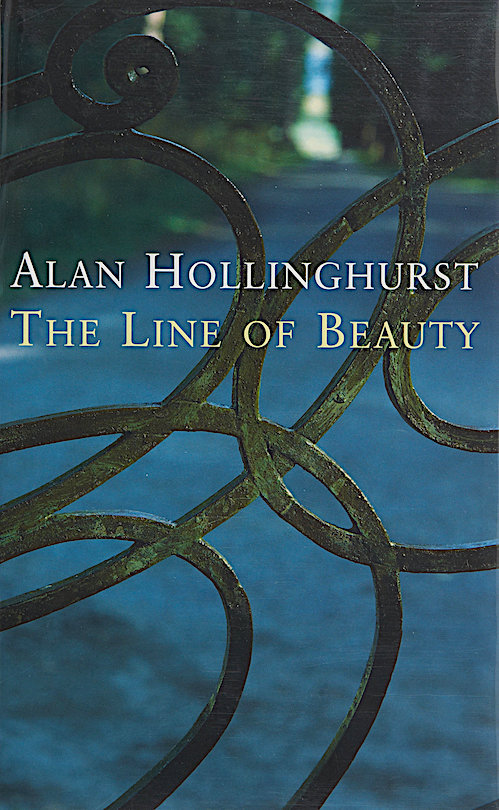
Hollinghurst’s third novel, the 1998 “The Spell”, used the satirical and romantic style of a weekend in the country plot to follow the changing relationships within a group of friends and occasional lovers. This work was followed by the 2004 three-part novel “The Line of Beauty”. Set during the Thatcher years between 1983 and 1987, the novel followed the life of the young, middle-class gay protagonist Nick Guest. Through exploring the realities of Nick’s tense and intimate relationships and life as a gay man, Hollinghurst examined the themes of hypocrisy, drugs, privilege and homosexuality during the time of England’s emerging AIDS crisis. “The Line of Beauty” won the high-profile 2004 Man Booker Prize with its fifty-thousand pound stipend and became the first gay novel to be so honored. It was also a finalist for the Lambda Literary Award and the National Book Critics Circle Award for Fiction.

Alan Hollinghurst’s fifth novel, the 2011 “The Stranger’s Child” which, told over the course of decades, revolves around a minor poet’s successful published poem and the resulting changes in his work and life. Received positively by critics, the novel was on the Man Booker Prize longlist, the Walter Scott Prize shortlist, and the winner of the 2013 Prix du Meilleur Livrr Étranger, France’s best foreign book prize. Hollinghurst’s sixth novel, the 2017 “The Sparsholt Affair”, explores the changing attitudes towards homosexuality as seen through the lives of two Englishmen: a teenager attending Oxford during the Second World War, and his later openly-gay son in London just after England decriminalizes homosexuality.

Hollinghurst currently lives in London with his partner Paul Mendez, the British author who authored the 2020 semi-autobiographical novel “Rainbow Milk” published by Dialogue Books, a Little, Brown and Company imprint.

“I grew up reading certain writers like Iris Murdoch who was very interested in sexual ambivalence and often created gay characters, usually from a cultured or academic background. I’m not sure how many straight writers I’ve read who create gay characters successfully from the inside, though I agree about Anthony Burgess and (his novel) “Earthly Powers”. — Alan Hollinghurst, 2017, Guardian Interview with Alex Clark

Note: For those interested, an interview between writer Peter Terzian and Alan Hollinghurst, “Alan Hollinghurst, The Art of Fiction No. 214”, is available through “The Paris Review”, a literary magazine featuring original writing, written interviews, podcasts and art. The article or a subscription to the magazine is available for purchase at: https://www.theparisreview.org/interviews/6116/the-art-of-fiction-no-214-alan-hollinghurst

Sir Nigel Barnard Hawthorne: Film History Series

Born in the West Midland city of Coventry in April of 1929, Sir Nigel Barnard Hawthorne was an English stage, television and film actor. Among the many honors for his work, he was appointed a Commander of the Order of the British Empire in the 1987 New Years Honors List, which highlights the good works by citizens of the Commonwealth. Hawthorne was later knighted in the 1999 New Years Honors List for services to Theater, Film and Television.

The second child of physician Charles Barnard Hawthorne and his wife Agnes Rosemary Rice, Nigel Hawthorne was three years old when the family moved to the Gardens district of Cape Town, South Africa. He attended Cape Town’s St. George’s Grammar School and later its Christian Brothers College. Hawthorne enrolled at the University of Cape Town where he acted in plays with fellow student Theo Aronson, who became biographer to England’s royal family and partner of historian Brian Roberts. Hawthorne’s professional theatrical debut was the character Archie Fellows in  the 1950 Cape Town production of British playwright Edward Percy Smith’s 1940 thriller “The Shop at Sly Corner”. 

Dissatisfied with life in South Africa, Hawthorne relocated to London where he pursued a career in acting. Through his performances, he gradually gained recognition as one of London’s great character actors. Starting in the late 1950s, Hawthorne appeared in various character roles in British television series. Seeking opportunities in the United States, he traveled to New York City where, in 1974, he was cast as Touchstone in Broadway production of Shakespeare’s comedy “As You Like It” at the Mark Hellinger Theatre. Through the persuasion of British stage actors Ian McKellen and Judi Dench, Hawthorne joined the Stratford-upon-Avon based Royal Shakespeare Company in the mid-1970s.

In 1980, Nigel Hawthorne began his most famous television role of Sir Humphrey Appleby, the Permanent Secretary of the Department of Administrative Affairs, in the BBC2 political satire series “Yes Minister” which ran from 1980 to 1984. He later portrayed the character of the Cabinet Secretary in its sequel “Yes Prime Minister”. For this role, Hawthorne won four British Academy Television Awards for Best Light Entertainment Performance. 

Hawthorne appeared as Mr. Kinnnoch in Richard Attenborough’s long delayed 1982 historical film “Gandhi”, which became the winner of eight Academy Awards and the third highest grossing film in the world for 1982. In the same year, he appeared as dissident Russian scientist Dr. Pyotr Baranovich in Clint Eastwood’s cold war thriller “Firefox”. Hawthorne returned to the New York stage in 1990 to appear as British writer C. S. Lewis in the Broadway production of William Nicholson’s “Shadowlands” performed at the Brooks Atkinson Theater. For that role, Hawthorne won the 1991 Tony Award for Best Actor in a Play. 

In 1991, Nigel Hawthorne played his most famous theatrical role, King George III, in playwright Alan Bennett’s fictionalized biographical study “The Madness of George III”. Bennett’s play toured the United Kingdom and the United States before returning to London’s Royal National Theater in 1993. For this role, Hawthorne won a Best Actor Olivier Award. He also appeared in the same role for the 1994 film adaption of the play, entitled “The Madness of King George”, for which he received an Academy Award nomination for Best Actor and the British Academy of Film and Television Arts Award for Best Actor.  

Hawthorne followed this success with the role of George the Duke of Clarence, playing opposite his friend Ian McKellen, in Richard Loncraine’s 1995 British period drama “Richard III” adapted by McKellen and Loncraine from Shakespeare’s play. He won his sixth BAFTA award for his role in the 1996 television mini-series “The Fragile Heart” and also drew praise for his role of Georgie Pillson in the London Weekend Television series “Mapp and Lucia”, based on the three 1930s novels by Edward Frederic Benson. Hawthorne next appeared in the film role of U.S. President Martin Van Buren in director Steven Spielberg’s 1997 historical drama “Amistad”, a story based on the 1839 events aboard the Spanish slave ship La Amistad and the legal battle that followed.

Beginning in the late 1970s, Nigel Hawthorne began work as a voice actor and appeared in several animated films. In 1978, he was cast as the voice of Campion in Martin Rosen’s “Watership Down”, a British animated adventure-drama film based on Richard Adams’s 1972 novel. Hawthorne was also cast in two Disney films: the voice of Ffiewddur Fflam in the 1985 dark fantasy “The Black Cauldron” and Professor Porter in the 1999 “Tarzan”, the first animated version of the novel. 

In 1968, Hawthorne met his life-long partner Trevor Bentham who at that time was the stage manager for the Royal Court Theater in the West End of London. Bentham later became a scriptwriter and wrote for John Irvin’s 1995 romantic comedy “A Month by the Lake” and “The Clandestine Marriage”. From 1979 until Hawthorne’s death, the couple lived together and acted as fundraisers for the North Hertfordshire Hospice and other local charities. 

In 2001 after undergoing several surgeries for diagnosed pancreatic cancer, Nigel Hawthorne was discharged from the hospital in time for the Christmas holidays. On the twenty-sixth of December in 2001, he died at the age of seventy-two from a heart attack at his home. His funeral, attended by many of his fellow actors, was held at St. Mary’s, the Parish Church of Thundridge, Hertfordshire; Trevor Bentham served as one of the pallbearers.

Notes: Nigel Hawthorne completed his autobiography just before he died. “Straight Face”, which covered his ambition to be an actor, his career, and his battle with cancer, was published posthumously in 2002 by Hodder & Stoughton. 

An interview with Sir Nigel Hawthorne and film critic Dan Lybarger, in which Hawthorne discussed King George III, director David Mamet, and the film “The Big Brass Ring”, can be found at the Lybarger Links website located at: http://www.tipjar.com/dan/hawthorne.htm

Top Insert Image: Photographer Unknown, “Nigel Hawthorne”, Studio Publicity Photo, Gelatin Silver Print

Second Insert Image: “Derek Fowlds, Nigel Hawthorne and Paul Eddington”, circa 1980, “Yes Minister”, Television Series Studio Shot, BBC2

Third Insert Image: Photographer Unknown, “Nigel Hawtorne”, Studio Publicity Photo, Gelatin Silver Print

Fourth Insert Image: “Nigel Hawthorne and Helen Mirren”, 1994, “The Madness of King George”, Film Clip Shot, Director Nicholas Hylner, Cinematographer Andrew Dunn

Bottom Insert Image: Photographer Unknown, “Nigel Hawthorne and Trevor Bentham”, Date Unknown, Gelatin Silver Print


Glenway Wescott: “The Very Apocalypse of Fertility”

Photographers Unknown, The Very Apocalypse of Fertility

“For Alwyn’s grandfather, who was known as “the greatest talker in the country,” used words which no one else understood, words which he did not understand, and words which do not exist, to swell a passionate theme, to confound his neighbors in an argument, and for their own sake. He would say, for example, “My farm was the very apocalypse of fertility, but the renter has rested on his oars till it is good for nothing,” or “Manifest the bounty to pass the salt shaker in my direction.” Something of the Bible, something of an Irish inheritance, something of a liar’s anxiety, made of his most ordinary remark a strange and wearisome oratory.” 

—Glenway Wescott, The Grandmothers: A Family Portrait, 1927, Harper & Brothers

Born in Kawaskum, Wisconsin in April of 1901, Glenway Wescott was an American poet, essayist, and novelist. The oldest of six children born to Bruce and Josephine Wescott, he was an openly gay figure of the 1920s American expatriate literary community in Paris. Wescott, who socialized with Ernest Hemingway in Paris, is considered the model for the young novelist character, Robert Prentiss, in Hemingway’s 1926 “The Sun Also Rises”.  

Upon his graduation from Wisconsin public schools in 1917, Glenway Wescott enrolled on a scholarship at the University of Chicago. He was a member of its literary circle which included such future writers as Elizabeth Madox Roberts and Arthur Yvor Winters. In the spring of 1919 at a Poetry Club meeting, Wescott met Monroe Wheeler, the twenty-year old founder of the Poetry journal. Their relationship together as a couple would last for almost seventy years until Wescott’s death. Both of their careers grew through these years, Wescott as a published writer and Wheeler as a publisher and the museum director of New York’s Museum of Modern Art.

In the later part of 1919, Wescott contracted the Spanish flu and withdrew from the university. For health reasons, he relocated to Santa Fe, New Mexico where he stayed for several months with friend and poet Arthur Yvor Winters. While recuperating, Wescott produced his first series of poems that was published by Wheeler in 1920 under the title “The Bittems”. He and Wheeler traveled to Europe in the fall of 1921, first staying  in Sussex with English writer and critic Ford Madox Ford before continuing onto Paris. 

With Wheeler’s return to New York City, Glenway Wescott traveled across Europe in 1923 employed as a factotum for the family of banker and philanthropist Henry Goldman. Returning to Wheeler in New York, he finished his first novel, “The Apple of the Eye”, a reflection on his Wisconsin childhood that was published in 1924.  In the following year, the couple took up residence in the French Riviera town of Villefranche-sur-Mer where they quickly became members of its literary and artistic circles. Among  their friends were dancer Isadora Duncan, German pianist Elly Ney, and artist Jean Cocteau. .

In 1925, Wescott published a second collection of poetry entitled “Natives of Rock: XX Poems”. The following year, the couple met George Platt Lynes, a minister’s son from New Jersey who, living in France, was preparing for college. Mutually infatuated, the three men would share a home for seventeen years. Wescott published his second work of fiction in 1927, “The Grandmothers: A Family Portrait”, a series of portraits drawn from his early memories in Wisconsin. This novel won the Harper Prize for that year; the critics’ praise for the best-selling work gained Wescott further recognition. Wescott published a 1928 collection of short stories entitled “Good-bye Wisconsin” that dwelt on the oppressive nature of Midwest life.

By 1930, Wescott, Wheeler and Lynes had settled in Paris, where Wheeler and the wealthy American heiress Barbara Harrison established Harrison of Paris, a book publishing enterprise with the goal of producing high quality limited editions. Although not officially a partner, Wescott provided literary advice and selected manuscripts for publication. Their first venture was a 1930 edition of Shakespeare’s poem “Venus and Adonis” with a cover design by Wescott. After a successful five years, the press was closed in 1935 due to prohibitive cost of production.

After publishing his 1930 novella “The Babe’s Bed”, Glenway Wescott wrote two underwhelming works of nonfiction, the 1932 “Fear and Trembling” and the 1933 “Calendar of Saints for Nonbelievers”. In 1935 with the closing of the Harrison press, he and Wheeler moved back to the United States where they shared a series of Manhattan apartments with now-noted photographer George Platt Lynes. The next year, the three men alternated living between New York and a farm house, named Stone-Blossom, on Wescott’s brother Lloyd’s dairy farm property in Union Township, New Jersey. 

In 1940, Wescott published his most critically-praised novel “The Pilgrim Hawk: A Love Story”. The short novel describes the event of a single afternoon in the life of Alwyn Tower, an expatriate novelist living in Paris. It is still considered one of the finest American short novels, on par with Faulkner’s “The Bear”. After his 1946 novel “Apartment in Athens”, Wescott ceased writing fiction and concentrated on publishing essays and editing the works of others. His last full-length book was the 1962 “Images of Truth”. Beginning in 1938, he worked in earnest on his journals documenting his life and thoughts. One volume of this extensive work was published posthumously as “Continual Lessons” in 1990.

In 1959, Glenway Wescott and Wheeler moved into a two-story farmhouse, Haymeadows, on Lloyd Wescott’s new farm in Rosemont, New Jersey. On the twentieth of February in 1987, Glenway Wescott died of a stroke in Rosemont and was buried in the small farmer’s graveyard behind a rock wall at Haymeadows. Two days after Wescott’s death, Wheeler had a stroke that left him blind and partially paralyzed. He died eighteen months later on August 14th in 1988 and was buried alongside Wescott. 

Notes: George Platt Lynes ended his relationship with Wescott and Wheeler in 1943, after falling in love with studio assistant George Tichenor. After a long career as a successful and renowned photographer, Lynes was diagnosed with lung cancer in May of 1955. He took one final trip to Europe and, upon his return to New York City, lived with his brother’s family. Wescott was at Lynes’s bedside when he passed away in December of 1955. 

The Monroe Wheeler Papers, consisting of correspondence, manuscripts and photographs, and the Glenway Wescott Papers, containing notebooks, journals, and correspondence, are housed at the Yale Research Initiative on the History of Sexualities of Yale University’s Department of History. 

Chelsea Station, an online magazine devoted to gay literature, has an article written by author Vinton Rafe McCabe entitled “Glenway Wescott: The Man Behind the Writer” that discusses Wescott’s “A Heaven of Words: Last Journals 1956-1984” and “A Visit to Priapus and Other Stories”, both posthumously published. The article can be found at: https://www.chelseastationmagazine.com/2014/05/glenway-wescott-the-man-behind-the-writer.html

Top Insert Image: George Platt Lynes, “Glenway Wescott” Date Unknown, Gelatin Silver Print

Second Insert Image: Bernard Perlin, “Glenway Wescott and Wheeler, Stone Blossom Farmhouse, Hampton, New Jersey” circa 1947, Gelatin Silver Print

Third Insert Image: George Platt Lynes, “Glenway Wescott”, 1938, Gelatin Silver Print, David Hunter McAlpin Fund

Bottom Insert Image: Photographer Unknown, “George Wescott and Monroe Wheeler, Nice, France”, 1927, Film Clip Shots, From “When We Were Three””, 1998, Arena Editions

Jack Anderson: “A Leap into the Unknown”

Photographers Unknown, Parva Scaena (Brief Scenes): Photo Set Twenty-Six

Look in the Salon des Refusés of most periods
and there will hang the homosexuals
labeled by critics
“contrary to nature”.

Now, to use a familiar set of distinctions, what
exists but is not nature must be art;
yet art is also an imitation
of some process of nature: so art, too, is natural,
whatever its manner.

Art may evolve through accretions of tradition
or leap ahead into the unknown.
This form of expression, the gay life
so maddening and unimaginable to some,
necessarily involves a leap into the unknown,
for its traditions, such as they are, are shadowy.

Note how, on every side, images proclaim
and sustain the straight life. In parks and town squares
one may behold the monumental figures of, say,
Cohibere guarding his family from the Amplecti,
of Scruta and Amentia denouncing the barbarians,
or of the marriage of Turpa and Insulsus on the battlefield.

Images of the gay life, in contrast, are obscure, are
curiosities kept locked from the public in cabinets: in consequence,
gay lives must style themselves with craft,
with daring. Many fail. Even so,
some grow amazing and beautiful.

And since such triumphs are typically achieved
amidst general bewilderment and in defiance
of academic theory, the gay life
deserves to be ranked among
the significant examples of art, past and present.
And because it has disordered whatever may be
the accustomed ways of seeing in its time,
it is therefore avant-garde,
naturally avant-garde.

Jack Anderson, A Lecture on Avant-Garde Art, Word of Mouth: An Anthology of Gay American Poetry, Editor Timothy Liu, 2000

Born in Milwaukee, Wisconsin in June of 1935, Jack Anderson is an American poet, dance critic and dance historian. He has contributed numerous reviews on dance performances for both the “New York Times” and “Dance Magazine”. Anderson is also known for his scholastic work on dance history and eleven volumes of poetry.

In his formative years, Jack Anderson studied piano and acted in theater groups before his departure to college. He earned his Bachelor of Arts at Northwestern University with a major in Theater and minors in English Literature and Philosophy. Anderson completed his graduate studies at Indiana University where he earned his Master of Arts in Creative Writing. He pursued further studies at the University of California, Berkeley, until a position became available at the “Oakland Tribune”. 

Anderson joined the staff of the weekly news publication in 1959 as a copy boy. He was promoted after one year to assistant drama critic and, in addition to his work at the Tribune, began writing dance criticism for both the English periodical “Ballet Today” and America’s leading dance periodical “Dance Magazine”. After relocating to New York in 1969, Anderson was a member of the editorial staff of “Dance Magazine” until 1970, after which he continued to contribute reviews until 1978. 

While living in London with his partner, dance historian and writer George Dorris, Jack Anderson was deputy dance critic from 1970 to 1971 at the “Daily Mail” under critic and broadcaster Oleg Kerensky. In 1972, he became the New York correspondent for London’s “Dancing Times” magazine. Already writing and teaching dance history, Anderson along with George Dorris founded the scholarly journal “Dance Chronicle: Studies in Dance and the Related Arts”, which became one of the genre’s leading periodicals. In 1978, he joined Anna Kisselgoff and Jennifer Dunning as the dance critics for “The New York Times”, where he remained until 2005.  

Drawn to poetry throughout his adult life, Anderson published his first two collections of poetry in 1969: “The Hurricane Lamp” and “The Invention of New Jersey”. His subtle yet witty poems often explore themes of urban life and travel. Anderson has the urban sophistication and the alertness to create often lurid tales that in a strange way make sense. Among his many volumes are the 1978 “Toward the Liberation of the Left Hand”, “The Clouds of That Country” published in 1982, the 1990 “Field Trips on the Rapid Transit”, and “Backyards of the Universe” published in 2017. In recognition of his work, Anderson received a creative writing fellowship and a literary award from the National Endowment for the Arts.

Recognized as both an effective teacher and lecturer, Jack Anderson has taught dance history and criticism at the University of Adelaide in Australis, the University of Minnesota, the North Carolina School of the Arts, the University of Oklahoma, and New York’s New School, among others. From the 1970s through the 1990s, Anderson has produced seven books on various aspects of dance. Among these are the 1979 “The Nutcracker”, the “Ballet & Modern Dance” available in three editions, and the 1981 “The One and Only: The Ballet Russe de Monte Carlo” which won that year’s José de la Rorre Bueno Prize for best English-language writing in dance history.

Note: Jack Anderson and George Dorris, a dance scholar and now retired English professor, had known each other slightly at Northwestern University. They later met in 1965 on the Lincoln Center subway platform after a New York City Ballet performance. They have traveled together throughout the world and become friends with dance scholars in many countries. In 2006, they were married in Toronto and currently reside in Manhattan, New York.

A collection of six poems by Jack Anderson can be found at the Poetry Foundation website located at: https://www.poetryfoundation.org/poets/jack-anderson#tab-poems  

The second edition, recently updated, of Anderson’s “Ballet and Modern Dance: A Concise History” is available through Amazon. 

William Dickey: “The Silent Traffic of Bystanders”

Photographers Unknown, The Silent Traffic of Bystanders

Henry went over the edge of the bridge first; he always did.
Then Mr. Interlocutor and Mr. Bones, then the blackface
minstrels
with their tambourines. You have to empty out
all the contents before the person himself dies.

The beard went over the edge, and Stephen Crane,
and the never-completed scholarly work on Shakespeare,
and faculty wives, and a sheaf of recovery wards
white-tiled in the blue shadow of the little hours.

He loosened his necktie and the recurrent dream
of walking out under water to the destined island.
His mother went over in pearls; his father went over.
His real father went over, whoever his father was.

He thought to go over with someone, hand in hand
with perhaps Mistress Bradstreet, but someone always
preceded him.
The news of his death preceded him. It hit the water
with a fat splash and the target twanged.

When there was nothing to see with or hear with, the
silent traffic
of bystanders wrapped in snow, his only body
let itself loose, turned and waved before it went over
to what it could never understand as being the human
shore.

William Dickey, The Death of John Berryman, January 1996

Born in Bellingham, Washington in December of 1928, William Hobart Dickey was an American poet and educator. While his talent was known to critics, Dickey worked on his poetry without actively promoting it and, thus, was largely unknown to the general public. In his work, he often used abstract ideas that contained both insight and feeling. Dickey expressed his personal visions through poetry and gave preceptive observations on life that spoke to his readers.

William Dickey attended Reed College in Portland, Oregon where he earned his Bachelor of Arts, with a novel as his thesis, in 1951. With an awarded Woodrow Wilson Fellowship, Dickey earned his Master of Arts in 1955 at Harvard University and his Master of Fine Arts at the University of Iowa in 1956. As a Fulbright scholar, he studied from 1959 to 1960 at the University of Oxford’s Jesus College.

Dickey studied at the Iowa Writers’ Workshop under poet John Berryman, a major figure in American poetry in the latter half of the century and a key figure in Confessional Poetry, a form which focused on extreme moments of individual experience. Barrymore, whose childhood was shaken by the suicide death of his father, developed his own style and is best known for his 1964 “The Dream Songs”, short lyric poems of eighteen lines in three stanzas. Dickey studied in Barrymore’s intense poetry workshop with such poets as Henri Coulette, Donald Justice, Jane Cooper, and Robert Dana.

In 1959, William Dickey published his first volume of poetry, “Of the Festivity”, a balanced collection of  humorous and serious works expressing keen observations on life. Selected by scholars as being culturally important, “Of the Festivity” was chosen by Oxford’s Professor of Poetry William Hugh Auden as the winner of the Yale Series of Younger Poets Competition. In his 1971 volume “More Under Saturn”, Dickey wrote darker toned poems with an added degree of cynicism to their humor. For this collection, he won a 1972 silver medal from the Commonwealth Club of California.

Dickey’s sixth volume of work “The Rainbow Grocery” was also published in 1971. It later received the Juniper Prize from the University of Massachusetts Press in 1978. The poems in this volume, which achieved a balance between humor and seriousness, were more loosely constructed, more sexual, and more frenzied than the poems in “Of the Festivity”. Dickey published seven more volumes of poetry. Among these are the 1981 “The Sacrifice Consenting”, “Brief Lives” and “The King of the Golden River”, both published in 1985, the 1994 “In the Dreaming”, and his last volume, the posthumously published 1996 “The Education of Desire”.

William Dickey, after receiving his Masters at the University of Iowa,  taught English at Cornell University from 1956 to 1959. After returning from Oxford in 1960, he was an assistant professor of English at Dennison University in Granville, Ohio until 1962. At which time, Dickey joined San Francisco State University’s faculty as a Professor of English and Creative Writing and taught until his 1991 retirement. In 1988, he was the editor of the tenth-anniversary edition of the established literary journal “New England Review and Bread Loaf Quarterly”. In 1990, the journal returned to its original 1978 name “New England Review”.

Dickey lived in San Francisco with life-partner Leonard Sanazaro, a poet and teacher of English and Creative Writing at San Francisco’s City College. Due to complications from a series of HIV-related surgeries, William Hobart Dickey died at the age of sixty-five at San Francisco’s Kaiser Hospital in May of 1994.

Notes: William Dickey’s poem “The Death of John Berryman”, an elegy to his former professor, was completed shortly before Dickey’s death. It was published posthumously in the January 1996 issue of “Poetry” and in the 1997 anthology “The Best American Poetry”.

Living as a gay man in San Francisco during the AIDS epidemic, William Dickey used the Hypercard program on his first Macintosh to produce a total of fourteen “Hyperpoems”,  unique documents of gay life in San Francisco during the epidemic. Writer Matthew Kirscherbaum, with the assistance of Dickey’s literary executor Susan Tracz, extracted those files and added them to the Internet Archive. Organized into two volumes, they can be found at: https://archive.org/details/william_dickey_hyperpoems_volume_1     https://archive.org/details/william_dickey_hyperpoems_volume_2

Charles de Sousy Ricketts

The Artwork of Charles de Sousy Ricketts

Born in Geneva in October of 1866, Charles de Sousy Ricketts was a versatile British illustrator, author and printer known for his work as a book designer, typographer, and designer of theatrical sets and costume. He was the only son of Charles Robert Ricketts, a Royal Navy veteran and amateur painter, and Héléne Cornélie de Sousy, daughter of the Marquis de Sousy. Ricketts spent his formative years mainly in France and received his education through his governesses. 

After the death of his mother in 1880, Charles Ricketts relocated with his father to London where, considered too frail for school, he became largely self-educated through reading and visiting museums. In 1882, Ricketts entered the City and Guilds of London Art School where he apprenticed to wood-engraver Charles Roberts. Later that year, his father died and he became dependent on the modest support of his paternal grandfather. On his sixteenth birthday, he met his lifelong partner Charles Haslewood Shannon, a fellow student three years his senior who was studying painting and lithography. The two men lived together in both a personal and professional partnership until Ricketts’s death.

After finishing their studies, Ricketts became a commercial and magazine illustrator; Shannon took a teaching post at London’s newly founded Croyton School of Art. In 1888, Ricketts took possession of painter James Whistler’s former house, The Vale, in Chelsea which soon became a gathering place of contemporary artists. Starting in 1889 until its final issue in 1897, Ricketts and Shannon produced “The Dial”, a journal of poetry, prose, and English Pre-Raphaelite and French Symbolist illustrations. This portfolio became a major publication of the Aesthetic Movement. 

Charles Ricketts, in collaboration with Shannon, illustrated their close friend Oscar Wilde’s 1891 ”A House of Pomegranates” and the 1894 “The Sphinx”. Ricketts and Shannon worked together on the type and illustrations for editions of “Daphnis and Chloe” in 1893 and “Hero and Leander” in 1894. After initially running a small press, they founded London’s Vale Press in 1896 which published more than seventy-five books including a thirty-nine volume edition of Shakespeare’s work. Ricketts designed illustrations as wells fonts, initials, and borders specific to Vale Press. He also executed woodcut illustrations of Art Nouveau design and androgynous figures for their publications. After a 1904 fire at their printer Ballantyne Press destroyed their engraving woodcuts, Ricketts and Shannon made the decision to abandon publishing; Ricketts destroyed all the typefaces he had designed for Vale Press.

Beginning in the early 1900s, Ricketts placed his focus on painting and sculpture. He had a deep knowledge of earlier painters and was particularly influenced by the works of the Symbolist painter Gustave Moreau and the French Romantic painter Eugène Delacroix. Among Ricketts’s many paintings are the 1904 “Betrayal of Christ”, the 1911 “The Death of Don Juan”, “Bacchus in India” painted in 1913, “Jepthah’s Daughter” painted in 1924, and the 1915 “Montezuma”, now at the Manchester Art Gallery. Over the course of his career, Ricketts produced about twenty sculptures among which are “Silence”, a memorial to his friend Oscar Wilde, and two bronze works entitled “Paolo and Francesca” and “Orpheus and Eurydice”.

From 1906 to his death, Charles Ricketts was a celebrated theatrical set and costume designer. His first commission was for a private production of s double billing of Oscar Wilde’s plays, “Salome” and “A Florentine Tragedy”, at King’s Hall in Covent Garden. In 1907, he designed costumes and stage sets for Aeschylus’s “The Persians” also performed at King’s Hall. During the early 1900s, Ricketts designed both costume and sets for many commercial theater productions including Hugo Hofmannsthal’s “Electra” in 1908, “King Lear” at the Haymarket in 1909, and two of Bernard Shaw’s plays, “The Dark Lady of the Sonnets” in 1910 and “Annajanska, the Bolshevik Empress” in 1918.

After World War One, Ricketts continued his theatrical design with Shaw’s “Saint Joan” at the New Theater in 1924, “Henry VIII” at the Empire Theater in 1925 and “Macbeth” at the Princess Theater in 1926. He also designed costumes and sets  for the D’Oyly Carte Opera Company’s 1926 production of “The Mikado” at the Savoy Theater. Most of Ricketts’s designs for “The Mikado” were retained by other designers of the company for more than fifty years. Ricketts final theater designs were for the 1931 production of Ferdinand Bruckner’s “Elizabeth of England” preformed at London’s Cambridge Theater and a production of Donald Tovey’s opera “The Bride of Dionysus” staged posthumously in Edinburgh after Ricketts’s death.

As a writer, Charles Ricketts published two monographs on art as well as essays and articles  on a wide range of subjects for publications. Using the pen-name of Jean Paul Raymond, he wrote and designed two collections of short stories published in 1928 and 1933. Under the same pen-name, Ricketts wrote the 1932 “Recollections of Oscar Wilde”, an extremely personal memoir that was published after Ricketts’s death. Ricketts’s last years were were greatly effected by Charles Shannon’s serious fall and resulting permanent brain damage. The strain of the situation with the addition of overwork to finance the household contributed to the decline of Ricketts’s health and ultimately his death.

Charles de Sousy Ricketts died suddenly at age sixty-five from coronary heart disease on the 7th of October in 1931 at the Regent’s Park house. He was cremated and his ashes partly scattered in London’s Richmond Park, and the remainder buried at Arolo, Lake Maggiore in Italy. Charles Shannon outlived him by six years and died in March of 1937.

Note: The New York Public Library’s assistant curator Julie Carlsen, along with Henry W. and Albert A. Berg of the English and American Literature Collection, have written an interesting article on Ricketts and Shannon’s designs for the bindings of Oscar Wilde’s work published by Vale Press. The article can be found at: https://www.nypl.org/blog/2021/10/12/publishers-bindings-oscar-wilde-charles-shannon-charles-ricketts

Top Insert Image: George Charles Beresford, “Charles de Sousy Ricketts”, October 1903, Sepia-Toned Platinotype Print, 15.5 x 10.7 cm, National Portrait Gallery, London

Second Insert Image: Charles de Sousy Ricketts, Page from Ricketts’s “The Prado and Its Masterpieces”, 1923, Published by E.P. Dutton and Company, New York, Private Collection

Third Insert Image: Charles de Sousy Ricketts, Illustration and Text from Michael Field’s “The Race of Leaves”, 1901, Woodcut, The Ballantyne Press, Private Collection

Bottom Insert Image: George Charles Beresford, “Charles Haslewood Shannon and Charles de Sousy Ricketts”, October 1903, Modern Print from Original Negative, 11 x 15.7 cm, National Portrait Gallery, London

Douglas A. Powell: “The Spokes of Fortune’s Wheel in Constant Turn”

Photographers Unknown, The Spokes of fortune’s Wheel in Constant Turn

I have had to learn the simplest things
        last. Which made for difficulties….
                                           –Charles Olson

We know from accounts of the judgment of Paris how Love took
first:
the apple burnished by–it turns out–her own husband, working
the bellows,
forging to Discord’s specifications, her need to break the
spaghetti strands
of marriage, her undiluted vitriol, that oversaw his flux and
foundry,
guided the sparking hammer to its urgent deeds.

Spoils of war.

Power, undeterred and wily as it always is, the figural eye and its
agency,
took gladly the second chair, from which advantage
machinations could be seen.
Advised, conferred, deployed the second wave of ships, provided
mercenary aid
to every side and fanned the air, and made her counsel with all
sides, supporting
every one and none, out-waiting tides.

If we believe the Greeks, the spokes of Fortune’s wheel in
constant turn would allow
the last to be the first–beatitudes bestowed upon the losing
side,
a draught of time in which the wily ones, by their equine portage
made
the mind the victor over Love’s inconstancy and strife,
and, over brute acts, gave thought dominion in a golden age. But
that’s just a myth.

Wisdom, you are the last to whom I turn. Not for your spear,
fashioned in that same fire as all bright jealous objects of desire,
But for you shield.
Protect the least of us. Or lift me from this battlefield,
and take me home.

D. A. Powell, To Last, 2019

Born in Albany, Georgia in May of 1963, Douglas A. Powell is an American poet. After finishing his primary education in the California town of Olivehurst, he relocated to Santa Rosa where he entered Sonoma State University. Powell earned his Bachelor of Arts in 1991 and his Master of Arts in 1993. After completing his graduate work, he studied at the Iowa Writer’s Workshop at the University of Iowa and received his Master of Fine Art in 1996. 

After his formal studies, D. A. Powell began a career as a poet and university professor. He has taught at New York’s Columbia University, Sonoma State University, San Francisco State University and the University of Iowa. He also served as the Biggs-Copeland Lecturer of Poetry at Harvard University. In 2004, Powell left Harvard to take a teaching position in the English department at the University of San Francisco. 

Powell’s work blends the mythology of gay culture with his own distinctive voice and personal experiences. His first exposure to poetry was through Dudley Randall’s anthology “The Black Poets”. An early exposrue to such authors as Amiri Baraka, Ntozake Shange and Alice Walker also played an influential role in Powell’s development. While exploring local bookstores, he came across T. S. Eliot’s “The Waste land and Other Poems”. Eliot’s poetic  influence can be seen in Powell’s use of fragmented life experiences later reconstructed in verse on paper.  

In his work, D. A. Powell mixes both conventional and non-conventional techniques of poetic format. There were no titles to his early poems; the poems’ working titles were their first lines. Similar to the work of E. E. Cummings, the first letter of a new sentence is not capitalized. Shifting between popular culture and more complicated themes like religion and AIDS, Powell uses rhetorical devices, such as puns, to serve as bridges between these separate areas of experience. Open typographical spaces are often inserted in the middle of his lines that in effect lend pause to the cadence of the poem.

Powell’s first published collection was the 1998 “Tea”, a work he started the day he arrived in Iowa for grad school. This early work gathered reference material from both high and low culture: Whitman’s poetry and biblical heroes to Hollywood romances and Batman’s Robin. In 2000, Powell published “Lunch”, layered poems of memories from childhood and adolescence fractured by his adulthood and diagnosis of HIV. His third collection, the last of this trilogy, was the 2004 “Cocktails”, a contemporary Divine Comedy composed from witty and eloquent poems born of the AIDS pandemic. “Lunch’ was a finalist for the National Poetry Series and “Cocktails” was a finalist for the National Book Critics Circle Award for Poetry.

D. A. Powell’s 2009 “Chronic” was a work of wildly varied subject matter with effects drawn from contemporary free verse. The poems contained colloquial clichés, odd punctuation, parenthetical marks, lack of capitalization and quotes without any ascribed credit. Among the poems included in this volume were  “clown burial in winter”, “clutch and pumps”, and “cancer inside a little sea”. In February of 2010, Powell won the prestigious Kingsley Tufts Poetry Award for his work. “Chronic” also won the 2009 California Book Award. Powell’s next work “Useless Landscape, or A Guide for Boys”, published in 2012, won the National Book Critics Circle Award for that year. 

Powell was made a Guggenheim Fellow in 2011 and in 2019 received the John Updike Award from the American Academy of Arts and Letters. 

Notes: Additional poems by D. A. Powell can be found on the PoemHunter website located at: https://www.poemhunter.com/d-a-powell/

There is a more comprehensive article on D. A. Powell’s poetry collections, entitled “D. A. Powell’s Unruly Elegies” and written by Christopher Richards, in the online New Yorker Magazine that is worth reading. This Page-Turner article can be found at: https://www.newyorker.com/books/page-turner/d-a-powell-poetry

Patrick Anthony Hennessy

The Paintings of Patrick Anthony Hennessy

Born in August of 1915 in Cork, Patrick Anthony Hennessy was an Irish realist painter known for his landscapes, still lifes, portraits, and trompe l’oeil paintings. Often considered an outsider of latter day Irish painting, he developed a distinctive personal style of carefully observed realism executed with highly finished surfaces that he faithfully followed  throughout his career.

After his father’s battle death in 1917 during World War I, Hennessy’s mother remarried to John Duncan from Scotland in 1921; the family relocated to Arbroath, a royal burgh on the coast of Scotland where Duncan’s relatives resided. During his primary education at the Arbroath High School, Hennessy showed an aptitude for art and graduated in 1933 with the honor, Dux for Art, and an accompanying medal. In the autumn of that year, he entered the Duncan of Jordanstone College of Art & Design at the University of Dundee where he studied drawing and painting under portrait painter Edward Baird and noted landscape painter James McIntosh Patrick.  

Patrick Hennessy, in addition to his art studies, wrote a ballet entitled “Paradise Lost” which was performed at the college in 1935. In each year of his course, he gained a First Class Pass, as well as winning first prize in 1934 and 1936 for the work he produced during summer breaks. Hennessy graduated with a First Class Distinction in 1937 and, with a scholarship, earned his Post-Graduate Diploma in 1938. During his studies, Hennessy met his life-long partner, British-Irish landscape and portrait painter Harry Robertson Craig who was also attending courses at Dundee. Aside from the period between 1939 and 1946 when they were separated by the war, they spent the rest of their lives together.

A month after finishing his post-graduate work, Hennessy entered his paintings in a group exhibition at the Art Galleries in Arbroath. Awarded an Annual Traveling Scholarship for further studies in Italy and France, he traveled to Europe in June of 1938. In Paris, Hennessy reunited with two friends, Robert Colquhoun and Robert MacBryde. whom he had met the previous year. Known as the two Roberts, these painters and theater set-designers had established both a lifelong romantic relationship and a professional collaboration in their art. Hennessy and the couple traveled together through the south of France until their arrival in Marseilles at the end of 1938. 

Upon his return to Scotland, Patrick Hennessy was selected for the residential summer course at the historical arts center, Hospitalfield House, under painter James Cowie, an artist of detailed draftsmanship based on studies of the Old Masters. Two of Hennessy’s paintings from this period were accepted for the Annual Exhibition held by the Royal Scottish Academy. With war looming in the autumn of 1939 and feeling disenchanted by his time at Hospitalfield House, he made the decision to return to his native Ireland. On his arrival in Dublin, Hennessy was offered an exhibition in December of 1939 at abstract artist Mainie Jellett’s Country Shop gallery on St. Stephens Green in the city center.

After his well received exhibition, Hennessy was invited to join the Society of Dublin Painters with whom he would exhibit annually during the 1940s and early 1950s. Beginning in the early 1940s, a visual homosexual subtext began to be incorporated into some of Hennessy’s paintings. In addition to the work he produced for exhibition in this period, he also received many portrait commissions from clients. Hennessy began a long relationship with the Royal Hibernia Academy in 1941 with the acceptance of three of his paintings for their annual exhibition; he exhibited with the academy virtually every year from 1941 until his death.

In 1946, Patrick Hennessy reunited with Harry Robertson Craig who had recently been discharged from the intelligence branch of the British Army where he served during the Second World War. Prior to his service, Craig had extensively traveled throughout Europe where he painted landscapes and portraits. Hennessy and Craig soon moved to Crosshaven in Cork and later to the seaport town of Cobh on the southern coast of County Cork. In 1948, Hennessy had an exhibition at Dublin’s Victor Waddington Gallery, which had emerged as Ireland’s most important modern art venue. After a year as an associate, he became  a full member of the Royal Hibernian Academy in 1949.

Hennessy’s work became noticed in North America when his published work “De Profundis” was included in the Contemporary Irish Painting Exhibition that toured various cities on the continent. The 1950s brought Hennessy a retrospective of his work from 1941 to 1951 at the Dublin Painters Society and several painting excursions to Italy and Sicily. One of his works at this time, “Bronze Horses of St. Marks”, was exhibited at London’s Royal Academy in 1954. In 1956, Hennessy had two major solo exhibitions of his work: London’s Thomas Agnew Gallery which showed thirty-eight paintings and Dublin’s Ritchie Hendriks Gallery which would be the main outlet for his work over twenty-two years.

In the winter of 1959, Patrick Hennessy became seriously ill with pneumonia. As a consequence, he and Harry Craig decided to spend the winter season in Morocco. After 1959, they never spent a full year in Ireland and increasingly spent time abroad. In the 1960s, Hennessy continued to be true to his personal style; however, as he did not follow the current trends in art, he began to receive less favorable reviews from the art critics. Finally in 1965, Chicago’s Guildhall Gallery, which had accepted his work for years, offered Hennessy a major exhibition in 1966. The success of which enabled him to become an artist with work on permanent display at the gallery and a scheduled annual exhibition.

In 1968, Hennessy made a permanent move to Tangier, Morocco where he painted prolifically for nine years to keep up with the demand from both the Hendriks and Guildhall Galleries as well as the Royal Hibernian Academy. A highly successful retrospective of Hennessy’s work was held in 1975 at the Guildhall Gallery. Three years later, he had his last show in Dublin at the Hendriks Gallery. After his move with Harry Craig to the Algarve in Portugal, Hennessy had little contact with Ireland and began to have health problems that soon grew more serious. In November of 1980, Craig brought him to a London hospital for treatment. Diagnosed with cancer, Patrick Hennessy died on the thirtieth of December in 1980. 

Following cremation, Patrick Anthony Hennessy’s ashes were buried in London’s Golders Green Crematorium. He had left his entire estate to Harry Robertson Craig, with the proviso that on Craig’s death the Royal Hibernian Academy should be the beneficiary. Upon Craig’s death in 1984, this legacy was used to set up the biennial Hennessy Craig Scholarship for aspiring artists. Hennessy’s work, in addition to many private collections, can be found in major public collections including the Irish Museum of Modern Art, the National Gallery of Ireland, the University Colleges of both Cork and Dublin, and the Crawford Art Gallery, among others.  

Note: The Irish Museum of Modern Art has an excellent article on Patrick Hennessy’s connections which such figures as Francis Bacon, Elizabeth Bowen, Roger Casement and other artists. This Modern Irish Masters article can be found at: http://www.modernirishmasters.com/context/patrick-hennessy-context/#stags

Top Insert Image: Photographer Unknown, “Patrick Hennessy and Harry Robertson Craig”, Date Unknown, Gelatin Silver Print

Second Insert Image: Patrick Hennessy, “Boy and Seagull”, 1949, Oil on Canvas, 52 x 38 cm, Irish Museum of Modern Art

Third Insert Image: Patrick Hennessy, “Cliffs of Etretat (Self Portrait)”, 1962, Oil on Canvas, Private Collection

Fourth Insert Image: Patrick Hennessy, “Portrait of Elizabeth Bowen at Bowenscourt”, 1957, Oil on Canvas, 91 x 71 cm, Crawford Art Gallery, Cork, Ireland

Bottom Insert Image: Patrick Hennessy, “Men Bathing, Etretat”, circa 1954, Oil on Canvas, Date and Location Unknown