Calendar: November 10

A Year: Day to Day Men: 10th of November

The Homestead Fire

November 10, 1889 was the birthdate of British actor Claude Rains.

William Claude Rains was a British film and stage actor known for his smooth, distinguished voice; polished, ironic style; and intelligent portrayal of a variety of roles, ranging from villains to sympathetic gentlemen. He began his acting career at the age of eleven working backstage jobs before making his adult stage debut. He enjoyed a successful stage career in London and taught at the Royal Academy of Dramatic Arts; two of his students were John Gielgud and Charles Laughton.

Claude Rains toured the United States in the 1926 play “The Constant Nymph” and made a name for himself on Broadway. He came relatively late in his career to film acting and, while working for the Theater Guild in New York City, was given a screen test for a role in the 1932 “A Bill of Divorcement” by RKO. Rains did not get that role but was cast in the title role, partly because of his voice, in James Whale’s 1933 “The Invisible Man”. Although Rains’s face is hidden behind bandages throughout most of the film, his ominous voice effectively reflects the heightening madness of the megalomaniacal scientist he portrays.

Claude Rains went on to play a variety of leading and supporting roles, including criminals, aristocrats, politicians, spies, learned professionals, and family men, all with equal charm and finesse. He displayed great chemistry with Bette Davis as her sympathetic psychiatrist in the 1942 “Now, Voyager” and as her patient, loving husband in the 1944 “Mr. Skeffington”, for which he received an Academy Award nomination for Best Supporting Actor.

Rains was also nominated for Oscars as best supporting actor for his work in three much-loved American film classics: as the corrupt senator in the 1939 “Mr. Smith Goes to Washington” by Frank Capra; as the charming, opportunistic police chief in the 1942 “Casablanca”, one of his most famous roles; and as the likable, sensitive Nazi agent in love with costar Ingrid Bergman in Alfred Hitchcock’s 1946 “Notorious”.

In 1951 Claude Rains won a Tony Award for his lead role in the play “Darkness at Noon”. He was nominated for four Academy Awards for Best Supporting Actor in his career: “Mr Smith Goes to Washington”, “Casablanca”, “Mr. Skeffington”, and “Notorious”. He was awarded a star on the Hollywood Walk of Fame on February 8, 1960.

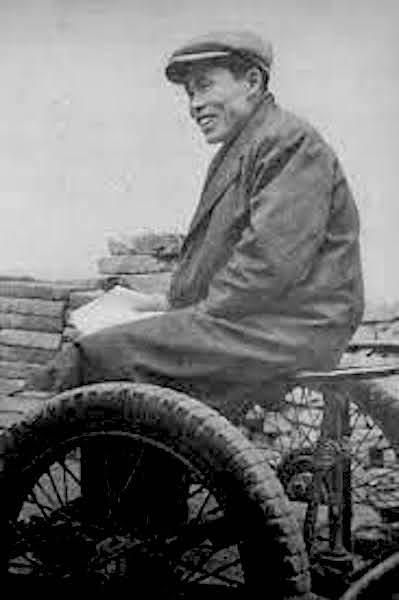
Top Insert Image: Photographer Unknown, “Claude Rains in Costume as Kees Popings”, 1952, “The Man Who Watched Trains Go By”, Vintage Photo, 20 x 25 cm, Private Collection

Bottom Insert Image: Arthur Edeson, “Claude Rains as Captain Louis Renault”, 1942, “Casablanca”, Film Shot, Director Michael Curtiz

Calendar: November 9

A Year: Day to Day Men: 9th of November

An Autumn Afternoon

November 9, 1980 marks the passing of character actor Victor Sen Yung.

Victor Sen Yung , born Sen Yew Cheung, was born in San Francisco to parents who were both immigrants from China. After his mother died in the great flu epidemic of 1919, he and his younger sister were placed in a children’s shelter by their father, who returned to China seeking a new wife. Upon his father’s and his new wife’s return, the family again reunited as a household.

Sen Yung made his first significant acting debut in the 1938 “Charlie Chan in Honolulu”, as the detective’s ‘number two son”, Jimmy Chan. In this movie, Sidney Toler had his first role as Charlie Chan, replacing the recently deceased Warner Oland; Sen Yung replaced Oland’s ‘number one son’ Lee, who had been played by actor Keye Luke. Sen Yung played his Jimmy Chan role for ten “Charlie Chan” films from 1938 to 1942.

In 1940 Victor Sen Yung played the crucial role of the lawyer’s clerk Ong Chi Seng in the Bette Davis film “The Letter”, a film noir murder story. Like other Chinese-American actors, he was cast in Japanese roles during World War II, appearing as a traitor in the 1942 Humphrey Bogart film “Across the Pacific”. After enlisting in the Army Air Force, Sen Yung’s military service included training films and a role in the Army Air Force play and film “Winged Victory”.

After the war, Victor Sen Yung resumed his Hollywood career, appearing in the final two of Sidney Toler’s  Charlie Chan films, “Shadows Over Chinatown” and “The Trap”. Following Toler’s death in 1947, Sen Yung continued in films but also appeared on television, most notably as Hop Sing, the cook on the long-running “Bonanza” western series, appearing in 102 episodes during its fourteen year run.

An accomplished and talented cook, Sen Yung frequently appeared on cooking programs and authored “The Great Wok Cookbook” in 1974.

Victor Sen Yung died under unusual circumstances at his North Hollywood home in 1980. A creative ceramic artist with a small business, he died of natural gas poisoning from a gas leak while creating clayware and curing the items in an oven. After an investigation, the authorities ultimately ruled the death an accident. A memorial scholarship is awarded each year at his alma mater, the University of California at Berkeley. Victor Sen Yung’s eulogy was given by fellow “Bonanza” actor Pernell Roberts, who also paid the funeral expenses.

Calendar: November 6

A Year: Day to Day Men: 6th of November

The Edge of the World

November 6, 1914 was the birthdate of character actor Jonathan Harris.

Born in the Bronx section of New York City, Jonathan Harris was the son of a Russian-Jewish family. He attended Fordham University, New York, to study medicine, earning a degree in 1936. Harris transformed himself into the American idea of an Englishman by replacing his Bronx accent with the lightly modulated vocal tone he heard on British films.

After joining the Millpond Playhouse repertory company, on Long Island in 1939, Harris appeared in more than 100 regional theaters, before his debut on Broadway in 1942. He appeared in the 1946 play “A Flag is Born” opposite Quentin Reynolds and Marlon Brando. His first television work came in 1949 with The Chevrolet Tele-Theatre’s “His Name Is Jason”, followed by roles in many other series: “Bonanza”, “The Twilight Zone”, “Zorro” and others.

Jonathan Harris was in a co-star role opposite Michael Rennie, who played Harry Lime, in the television series “The Third Man”, playing sidekick Bradford Webster for seventy-two episodes. From 1963-1965, Harris co-starred in the sitcom “The Bill Dana Show”. He played Mister Phillips, the pompous manager of a posh hotel who is constantly at odds with Bill Dana’s character José Jiménez.

Jonathan Harris was cast over two other actors for the role of Dr. Zachary Smith, the evil and conniving double agent on “Lost in Space”. The series was already in production when Harris joined the cast, and the starring/co-starring billing had already been contractually assigned. Harris successfully negotiated to receive “Special Guest Star” billing on every episode.

The series was successful upon its debut, and midway through the first season, Harris began to rewrite his own dialogue. Due to Harris’s popularity on the show, creator and producer Irwin Allen approved his changes and gave him carte blanche as a writer. Harris subsequently stole the show, mainly via a seemingly never-ended series of alliterative insults directed toward The Robot, which soon worked their way into popular culture.

Jonathan Harris spent much of his later career as a voice actor, heard in television commercials as well as cartoons such as “Darkwing Duck”, “A Bug’s Life”, the series “Buzz Lightyear of Star Command”, and “Toy Story 2”. In 2001, a year prior to his death, he recorded voice work for the animated theatrical short “The Bolt Who Screwed Christmas”. This film, Harris’s last work, was released posthumously in 2009.

Calendar: November 4

A Year: Day to Day Men: 4th of November

The Heat of the Sun

November 4,1896 was the birthdate of American character actor Ian Wolfe.

Born in Illinois, Ian Wolfe worked in theater productions until 1934 when he started his career as a character actor in film and later television. Central to Wolfe’s appeal was the fact that, until he reached actual old age, he always looked considerably older than he actually was. His career lasted until the last years in his life, encompassing almost four hundred roles in television and film, including many classics.

Ian Wolfe appeared in many well known films: Alfred Hitchcock’s “Saboteur” playing Robert in the film noir spy thriller; “Rebel Without a Cause” as Dr. Minton, the astronomy professor; the role of Maggs in the 1935 “Mutiny on the Bounty”; and George Lucas’s “THX 1138”, playing the prisoner PTO.

American at birth, Ian Wolfe, because of his experience in theater, had very precise diction which caused him to be often cast as an Englishman. He appeared in the 1943 film :Sherlock Holmes in Washington” , as an antique shop clerk. He also was in the final film of the Holmes series, the 1946 “Dressed to Kill” as the Commissioner of Scotland Yard. In Billy Wilder’s “Witness for the Prosecution”, Ian Wolfe played Carter, chief clerk to Sir Wilfrid, played by Charles Laughton.

Ian Wolfe guest-starred on many television series over the course of his career. The first season of “The Lone Ranger” had him playing a crooked small town doctor attempting to swindle a man. He  appeared on the episode “The Case of the Midnight Howler” of the 1966 “Perry Mason” series. Star Trek fans will recognize him in two episodes of the original series: the 1968 “Bread and Circuses” as Septinus, and the 1969 “All Our Yesterdays” acting in the role of Mr. Atoz.

Wolfe’s last film role, at the age of 94, was as Munger in the 1990 released “Dick Tracy”, produced and directed by Warren Beatty. Ian Wolfe died a year later at the age of 95 of natural causes in January of 1992.

“Mostly, they know the face, but they don’t know the name. Some people are funny. Some are nice. They don’t try to take up your time. They say, “I see you a lot and I sure enjoy you” and they’re gone. It’s my voice, too, that people recognize. I had no idea that my voice is distinctive in any way. But people will say, “I knew you by your voice”. – Ian Wolfe

Calendar: November 3

A Year: Day to Day Men: 3rd of November

The Redness of the World

November 3, 1928 was the birthdate of Japanese manga artist and film producer Osamu Tezuka.

Osamu Tezuka was born in the Osaka Perfecture of Japan. Drawing from a early age, he continued his manga skills throughout his school years, creating his first adept amateur works. In 1945, Tezuka was accepted into Osaka University in the field of medicine. It was during tihis time that he began publishing his first professional works.

After the end of World War II, at the age of seventeen, Osamu Tezuka published his first work, “Diary of Ma-chan”, a collection of four-panel comic strips about a small pre-school boy. After a discussion with fellow manga artist Shichima Sakai, Tezuka completed a manga based loosely on the famous story “Treasure Island”. This manga, entitled “Shin Takarajima (New Treasure Island)”, was published and became an overnight success, starting the golden age of manga, similar to the craze in America for comic books at the time.

With the success of his manga Treasure Island, Tezuka traveled to Tokyo to seek a publisher. The publisher Shinseikaku agreed to purchase “The Strange Voyage of Dr. Tiger” and publisher Domei Shuppansha purchased “The Mysterious Dr. Koronko”. While he was still studying in medical school , Tezuka published his first masterpiece: a science-fiction trilogy called “Lost World”, “Metropolis”, and “Next World”.

In 1951, Tezuka graduated from the Osaka School of Medicine and published ”Ambassador Atom”, the first appearance of the Astro Boy character. The humanoid robot Atom with human emotions became extremely popular with young boys. In February of 1952, “Tetsuwan Atom” became a serial in the  Weekly Shonen Magazine. The character Atom and his adventures became an instant phenomenon in Japan.

Tezuka entered the animation industry in Japan in 1961, founding Mushi Productions. He innovated the industry with the broadcast of the animated version of “Astro Boy” in 1963, the first Japanese animation to be dubbed into English for an American audience. Other series were later translated to animation, including “Jungle Emperor”, the first Japanese animated series produced in full color.

Osamu Tezuka is a descendent of Hattori Hanzō, a famous ninja and samurai who faithfully served the shogun Tokugawa Ieyasu during the Sengoku period in Japan. Tokugawa Ieyasu was one of the three unifiers of Japan in the late 1500s.

Buster Keaton: “The Haunted House”: Film History Series

Buster Keaton, “The Haunted House”, 1921, Directors Buster Keaton and Edward F Cline, Cinematographer Elgin Lessley≠≠≠

Happy Halloween

Written and directed by Buster Keaton and Edward F. Cline, the 1921 “The Haunted House”, an American two-reel silent comedy film, starred actor and comedian Joseph Frank “Buster” Keaton. Keaton is best known for his silent film work with its physical comedy and his stoic, deadpan expression. 

“The Haunted House” was shot in a time of simplistic comedic storytelling.The film used a generic, two-decades old story of haunted houses occupied by criminals, one which remained a favorite of theater audiences. Cinematography was done by special effects artist Elgin Lessley, a groundbreaking hand-cranked cameraman who had previously worked with Roscoe “Fatty” Arbuckle. The film was produced by Joseph M. Schenck who became the second president of United Artists Studio, and later, co-founded Twentieth Century Pictures with Darryl F. Zanuck.

In the film, Buster Keaton plays a teller at a successful bank who, in the process of thwarting a robbery, is mistaken for one of the thieves. He takes refuge in an old house unaware that it is a rehearsal space for a theatrical troupe clad in scary costumes. Keaton and the robbers, also hiding there, have many encounters with the costumed actors and the house’s booby traps. 

After it is revealed that the thieves’ leader is the bank’s manager, Keaton suffers a blow to the head which renders him unconscious. A dream sequence follows in which he is revived by angels and taken to Heaven. Denied entrance by Saint Peter, Keaton is sent to Hell instead. At the end of the twenty-one minute film, he regains consciousness to realize only a few seconds had passed. 

Reblogged with thanks to http://catholicboysdetention.tumblr.com

Calendar: October 29

A Year: Day to Day Men: 29th of October

The News of the Day

October 29, 1938 was the birthdate of director and animator Ralph Bakshi.

Ralph Bakshi, at the age of eighteen, was hired by the cartoon studio Terrytoons as a cel polisher, a position that involved removing dust and dirt from animation cels. After a few months, he was promoted to cel painter and began to practice animating. Aware of his desire  to become an animator, he started to receive help and advice from established animators: Connie Rasinski, Manny Davis, Larry Silverman and others.

At the age of twenty-five, Ralph Bakshi was promoted to director. His first assignment was the series “Sad Cat”, a Terrytoon animation series of a scraggly cat and his friends. Unsatisfied with the traditional role of a Terrytoons director, Bakshi pitched to CBS a superhero parody called “The Mighty Heros”. The executives liked the idea and, after seeing the character designs, agreed to the show with Bakshi as its creative director. It appeared as a segment on the “Mighty Mouse Playhouse” and ran from 1966 through 1967.

Ralph Bakshi started in 1968 his own studio, Bakshi Productions, located in garment district of Manhattan.  His studio paid higher salaries than other studios and expanded opportunities for female and minority animators. The studio began work on “Rocket Robin Hood” and took over the “Spider-Man” television series. In 1969, its division’ Ralph’s Spot, produced commercials and a series of educational shorts for Encyclopedia Britannica.

Uninterested in the animation the studio was making, Bakshi wanted to produce something personal. He soon developed “Heavy Traffic”, a tale of inner-city life. Impressed with the satire of Robert Crumb’s “Fritz the Cat”, Bakshi wanted to adapt Crumb’s artwork to animation. After several failed attempts to get Crumb to sign the contract, he acquired the film rights through Dana, Crumb’s wife who had power of attorney. After Warner Brothers backed out of the deal to finance the film, Jerry Gross, the owner of Cinemation Industries, agreed to fund its production and distribution through his grindhouse network.

Despite receiving finances from other sources, the budget was very tight. So pencil tests of the animations were excluded. Artist Ira Turek inked the outlines of scene photographs onto cels with a Rapidograph, giving the backgrounds a stylized realism virtually unprecedented in animation.  When the production was finished at the now Los Angeles studio, the Motion Picture Association of America gave it an X rating, making it the first animation film to receive such a rating.

The MPAA refused to hear an appeal about changing the rating. Thirty American newspapers rejected display advertisements and refused to give it editorial publicity. The film “Fritz the Cat” opened on April 12, 1972, in Hollywood and Washington DC. It went on to become a worldwide hit, becoming the most successful independent animated film of all time.

Calendar: October 27

A Year: Day to Day Men: 27th of October

Shirt of Stars

October 27, 1955 was the release date of the film “Rebel Without a Cause”.

“Rebel Without a Cause” is a 1955 American drama film, filmed during the Eisenhower years in the United States, and directed by Nicholas Ray, who became an important influence on the French New Wave in film. The film was an attempt to explore the differences and conflicts between the generations, and the emotional lives of middle-class teenagers.

Although the rights to author Robert Lindner’s book “Rebel Without a Cause’ were acquired, an entirely new script by Irving Shulman and Stewart Stern was used for the film. The film starred James Dean in his last role as the lead character Jim Stark; Natalie Wood as Judy; Sal Mineo as John “Plato” Crawford; and Jim Backus and Ann Doran as Jim Stark’s parents.

“Rebel Without a Cause” was one of James Dean’s three major films which included the 1955 “East of Eden”, for which he was nominated for Best Actor; and the 1956 released “Giant”, for which he was nominated posthumously for Best Actor. “Rebel Without a Cause” was the last film James Dean starred in before his early death in a car crash. Just before his death, his agent Jane Deacy had negotiated a six-year, nine film deal with the Warner Brothers Studio.

The film was in production from March 28 to May 25 in 1955. Originally considered just a B-movie, the initially filming was in black and white film stock. When the studio recognized the star significance of Jame Dean, filming was switched to color, with many scenes being reshot. It was shot in the widescreen CinemaScope format, a recent introduction to film making.

“Rebel Without a Cause”, known as an epochal story of a new non-conforming generation in the 1950s, was also a gay-positive cinema landmark. It was filmed in an era when homosexuality was still a crime in many parts of America; the Motion Picture Production Code censors of the era had a long list of forbidden topics, irrespective of the manner in which they were treated. In the spring of 1955, a Production Code memo was sent to producer Jack Warner with a reminder that it was vital that there be no inference of a questionable relationship between the characters of Plato and Jim.

“Rebel Without a Cause” is considered as the first in mainstream films to depict gay desire. James Dean’s character Jim becomes both friend and fascination to Sal Mineo’s Plato, a lonely younger kid who is obviously gay. Most of the references, due to the era, are non-verbal: the pin-up photo of Alan Ladd in Plato’s school locker, the looks of adoration Plato gives Jim, and late in the film a coded declaration of love from Plato to Jim. The film marks a turning point in film’s and society’s attitude from one of hostility to tolerance and support of gay life.

“Rebel Without a Cause” was nominated for three Academy Awards: Sal Mineo for Best Supporting Actor; Natalie Wood for Best Supporting Actress; and Nicholas Ray for Best Writing of a Motion Picture Story. It was entered into the National film Registry in 1990. As a side note, the film upon its release was banned in New Zealand out of fears it would incite teenage delinquency (released one year later with scenes cut out).

Ramón Novarro: Film History Series

Ramón Novarro

Ramón Novarro, whose birth name was Jose Ramón Gil Samaniego, was a Mexican-American actor born in 1899 in Durango, Mexico. Fleeing the Mexican Revolution in 1913, Novarro and his family settled in Los Angeles, California.  Within four years, he started appearing in the films of Rex Ingram and his wife Alice Terry, while also working as a singing waiter. Novarro’s first major success was his role in the 1923 “Scaramouche”, playing the lead role of André-Louis Moreau.

Novarro’s good looks and adequate skill as an actor made him an ideal competitor for Rudolph Valentino’s dominance as a Latin lover. Three years after Valentino played the title character of “The Shiek” in 1921, Novarro played a similar role. In 1925, Novarro gave his breakthrough performance as the title character in director Fred Niblo’s “Ben Hur: A Tale of the Christ”.  The film was a blockbuster hit, cementing MGM’s reputation as a quality studio and elevating Navarro into the Hollywood elite.

Valentino’s 1926 death left Novarro the title of Latin Lover Number One in Hollywood, and he enjoyed the status  into the talking film era.  He was popular as a swashbuckler in action films and one of the great romantic leads of the era. Novarro appeared with Norma Shearer in the 1927 “Student Prince in Old Heidelberg” and in the 1928 “Across to Singapore” with actress Joan Crawford.

At the peak of his success in the early 1930s, Novarro was earining more than 100,000 US dollars per film.  It was only after his studio contract with MGM Studios was not renewed in 1935 that his celebrity faded.  After that, he made sporadic appearances in film, including John Huston’s 1949 “We Were Stagers” and the 1950 film-noir crime film “Crisis” with Cary Grant.

Ramón Novarro was gay in a time when society had little understanding and no tolerance for anyone considered different. MGM mogul Louis B. Mayer asked him to take a woman as a bride, to participate in a “lavender marriage’ for publicity purposes.  Novarro refused, and maintained romantic relationships with men, including composer Harry Partch and Hollywood journalist Herbert Howe. On the night of October 30, 1968, Novarro was murdered by brothers Paul and Tom Ferguson whom he invited into his home. Believing there was a large sum of money in the house, the brothers hoped to rob him. Novarro died as a result of asphyxiation, choked to death on his own blood after having been beaten. He is buried in Calvary Cemetery in East Los Angeles.

Jean Cocteau: Film History Series

Enrique Riveros, “The Blood of a Poet”, 1932, Director Jean Cocteau, Cinematographer Georges Périnal

Jean Cocteau’s “The Blood of a Poet” is an avant-garde film which starred Enrique Riveros, a Chilean actor who had a successful career in European films. It is the first part of the Orphic Trilogy, which is continued in the 1949 “Orphee”, and followed by the 1960 “Testament of Orpheus”.

The film was financed by French nobleman Charles de Noailles who gave Cocteau one million francs to make the film. Shortly after the completion of the film, rumors began circulating that it was an anti-Christian message. Due to the riotous public reaction to Noailles’s previous film “L’Age d’Or”, Cocteau’s release date for his film was delayed for more than a year. “The Blood of a Poet” was finally released on January 20, 1932.

In this scene from the second section of the film, the artist played by Riveros is transported through the mirror to a hotel, where he peers through several keyholes, witnessing such people as an opium smoker and a hermaphrodite. The artist finally cries out that he has seen enough and returns back through the mirror.

“Many years ago, as I was glancing through a catalogue of jokes for parties and weddings, I saw an item, ‘An object difficult to pick up’. I haven’t the slightest idea what that ‘object’ is or what it looks like, but I like knowing that it exists and I like thinking about it.

A work of art should also be ‘an object difficult to pick up’. It must protect itself from vulgar pawing, which tarnishes and disfigures it. It should be made of such a shape that people don’t know which way to hold it, which embarrasses and irritates the critics, incites them to be rude, but keeps it fresh. The less it’s understood, the slower it opens its petals, the later it will fade. A work of art must make contact, be it even through a misunderstanding, but at the same time it must hide its riches, to reveal them little by little over a long period of time. A work that doesn’t keep its secrets and surrenders itself too soon exposes itself to the risk of withering away, leaving only a dead stalk.” 

Jean Cocteau, Cocteau on the Film, 1972, Dover Publications

Reblogged with thanks to http://bandit1a.tumblr.com

Calendar: October 25

A Year: Day to Day Men: 25th of October

Flair for the Orient

October 25, 1909 was the birthdate of American character actor Whitner Nutting Bissell.

Born in New York City, Whitner Bissell trained with the Carolina Playmakers, a theatrical organization associated with the University of North Carolina at Chapel Hill, where he majored in drama and English. Bissell also was in the Moss Hart play “Winged Victory”, produced by the US Army Air force during World War II as a morale booster and a fund raiser for the Army Emergency Relief Fund.

Whitner Bissell’s first role in film was in the 1943 “Holy Matrimony”, playing the valet Henry Leek in the comedy film. He regularly was cast in science fiction and horror films, appearing in the 1954 “Creature from the Black Lagoon” playing doctor Edwin Thompson who is severely injured by the creature. Bissell has an uncredited role in the 1956 “The Invasion of the Body Snatchers” as Doctor Hill, the psychiatrist in the film’s opening scene.

Between the early 1950s and the mid-1970s, Bissell guest-starred in many television series followed by more occasional roles in later years. He appeared in episodes of “Whirlybirds”, “Peyton Place and “The Brothers Brannagan”. He was also cast in the NBC education drame series “Mr. Novack” for the 1965 episode “May Day, May Day”. Bissell made four appearances on the “Perry Mason” series and played different roles in multiple episodes fo the long-running western series “The Rifleman” starring Chuck Connors.

Whitner Bissell often played silver-haired authority figures in many of the television series. His most prominent television role was that of General Heywood Kirk in thirty episodes of the 1966-67 season of the sci-fi series “The Time Tunnel”, establishing his screen persona of a man of military bearing, but in an annoyingly dominating way, especially with regard to petty or trivial matters. This characterized persona  showed up in other series: “The Outer Limits”, “Hogan’s Heros”, and “The Man from U.N.C.L.E.”.

In 1960, Whitner Bissell appeared in George Pal’s production of “The Time Machine” as Walter Kemp,, one of the time-traveler’s dining friends. He also appeared in a 1978 television movie of Wells’ novel set in the modern era. Thirty-three years later, in the 1993 documentary film “Time Machine: The Journey Back” featuring the original stars of the movie, Rod Taylor, Alan Young, and Bissell, he recreated his role as Walter Kemp. This was Bissell’s last acting performance.

Whitner Bissell served for many years on the board of directors of the Screen Actors Guild, and represented the actors’ branch of the Academy of Motion Picture Arts and Sciences board of governors. In 1994, two years before his death, he received a life career award from the Academy of Science fiction, Fantasy, and Horror Films.

Calendar: October 23

A Year: Day to Day Men: 23rd of October

Afternoon Slumber

October 23, 1941 marks the release in New York City of Walt Disney’s “Dumbo”.

“Dumbo” was the fourth animated film produced by Walt Disney Productions. It is based on the storyline written by Helen Aberson and Harold Pearl. Jumbo Junior is the main character, an anthropomorphic young elephant cruelly nicknamed “Dumbo”. He has unusually large ears with which he is capable of flying. His only true friend is Timothy, a mouse, which belied the stereotypical animosity between the two animal species.

The voice actors in “Dumbo” were not given any credit for their roles. This was done for all four of the first animated films Disney made; Walt Disney wished to maintain the illusion with the audience that the characters were real. The title character Dumbo did not have an actor since he did not have any spoken dialogue. Timothy Mouse was voiced by character actor Edward Brody, who frequently played dumb cops and gangsters in films, one of which was role as Brogan in the 1944 “The Thin Man Goes Home”.

“Dumbo” was originally intended to be a short film; but Disney realized, that to do justice to Helen Aberson and Harold Pearl’s book, it needed to be feature-length. Disney Studios was in financial difficulty at the time, as both “Pinocchio” and “Fantasia” did poorly at the box office due to the war in Europe. When the film went into production in early 1941, director Ben Sharpsteen was told to keep the film simple and inexpensive. Thus, “Dumbo” lacks the lavish detail of the previous three animated films; background paintings are less detailed; and the character designs are simpler.

During its production period, the leader of the Screen Cartoonist’s Guild, Herbert Sorrell, demanded that Disney sign with his union, rather than the International Alliance of Theatrical Stage Employees, with which Disney had already signed. After Disney refused twice, much of the Disney studio staff went on strike. The strike lasted five weeks, and ended the family atmosphere and camaraderie at the Disney Studios.

The movie was completed in fall of 1941 and RKO Radio Pictures released “Dumbo”. After its October 23 release in New York City, “Dumbo” proved to be a financial success despite the advent of World War II. Despite its low cost, substantially lower than the three previously released Disney animated films, “Snow White”, “Pinocchio”, and “Fantasia”, it eventually grossed the equivalent of twenty-seven million dollars today. “Dumbo” and “Snow White” were the only pre-1943 Disney features to earn a profit.

“Dumbo” won the 1941 Academy Award for Best Original Score, awarded to its musical directors Frank Churchill and Oliver Wallace. The film also won Best Animation Design at the 1947 Cannes Film Festival. On July 8, 2014, it was announce that a live-action re-imagining of “Dumbo” was in development, directed by Tim Burton. Casting is now complete and the film is scheduled to be released in March of 2019.

Kaneto Shindo, “Onibaba”: Film History Series


Kaneto Shindo, “Onibaba (Demon Hag)”, 1964, Cinematogapher Kiyomi Kuroda

Born in Saeki in the Hiroshima Prefecture in April of 1912, Kaneto Shindo was a Japanese film director, screenwriter, film producer and writer. One of the pioneers of independent film production in Japan, he co-founded, with director Kōzaburō Yoshimura and actor Taiji Tonoyama, the film company Kindai Eiga Kyōkai which produced most of Shindo’s films, most notably “The Naked Island” and “Ohibaba”.

Born to wealthy landowners, Kanato Shindo was the youngest of four children. His father was a loan guarantor; however, he went bankrupt and all family members, now living in a storehouse, had to seek employment to support the household. Shindo’s mother worked as an agricultural worker until her death in his early childhood. Living with his brother in 1933, Shindo was inspired by Sadao Yamanak’s early film “Bangaku No Isshō” to seek a career in film. He saved enough money working for a year at a bicycle shop to enable his move to Kyoto, the major cultural capital of Japan.  

In Kyoto, Kanato Shindo found employment at the film developing department of Shinkō Kinema, a successful film studio and distributor in the 1930s. With access to old scripts, he studied them and their relationships to the films that were processed. When Shinkō Kinema moved to Tokyo in November of 1936, Shindo was able to get a position in its art department managed by Hiroshi Mizutani, a talented art director and production designer. For his work as an art director, he scouted and sketched locations for film shooting, cameras being less used at the time.

While working at Shochiku Film Studios after World War Two, Shindo met director Kōzaburo Yoshimura and began one of the most successful film partnerships in Japan’s postwar industry. The partnership’s first critical hit was the 1947 “A Ball at the Anjo House”, a drama film that won the prestigious Kinema Junpo Award. Both men left Shochiku Studios to form, along with actor Taiji Tonoyama, the independent film company Kindai Eiga Kyokai, which produce most of Shindo’s films. 

In 1951, Kanato Shindo made his debut as director with the autobiographical drama “Story of a Beloved Wife”, with actress Nobuko Otowa in the role of his deceased common-law wife Takako Kuji. After directing the 1952 “Avalanche”, Shindo made the 1952 “Children of Hiroshima”, a drama of a young teacher who returns to Hiroshima to find surviving friends. Premiered at the 1953 Cannes Film Festival, this first Japanese film to deal with the atomic bomb was an international success. This pivotal film was followed by Shindo’s 1953 “Epitome”, whose central theme was the strength and endurance of women in times of distress.

Between 1953 and 1959, Shindo made political films that were critiques of poverty and women’s suffering in contemporary Japan. These included the 1953 “Life of a Women”, the 1954 “Dobu”, and the 1955 “Wolf”, based on a true story of desperate men and women who rob a money transport. In 1960, Shindo put all his resources into producing his “The Naked Island”, a non-dialogue black and white drama film of a struggling couple with two young sons living on a small island with no water supply. The film was awarded the Grand Prize at the Second Moscow International Film Festival in 1961.

After making “Ningen” in 1962 and “Mother” in 1963, Kanato Shindo shifted his focus as filmmaker to the individuality of a person, specifically a person’s sexual nature. From these ideas came his 1964 film “Onibaba”. Written and directed by Shindo, this historical drama-horror film was inspired by the Shin Buddhist parable of “yome-odoshi-no men”, in which a mother used a mask to scare her daughter from going to the temple. In the parable, the mother was punished by the mask sticking to her face. After begging to remove it, she was able to take it off, but the flesh of her face came with it.

“Onibaba” stars Nobuko Otowa and Jitsuko Yoshimura as fourteenth-century Japanese peasant women living in a reed-filled marshland who survive by killing and robbing defeated samurai. Wanting to film in a field of suski grass, Shindo found his location at inna-Numa in Chiba. Filming for the black and white film started on the thirtieth of June in1964 and continued for three months. Some of the sequences were shot in slow-motion. Its background and title music consists of Taiko drumming combined with jazz.

“Onibaba” won numerous awards and the Grand Prix at the Panama Film Festival. The Award for Best Supporting Actrress went to Jitsuko Yoshimura and the Best Cinematography Award to Kiyomi Kuroda at the 1964 Blue Ribbon Awards by the Association of Tokyo Film Journalists.  

Calendar: October 19

A Year: Day to Day Men: 19th of October

Vertical Elements

October 19, 1903 was the birthdate of wrestler and actor Tore Johansson, known by his stage name Tor Johnson.

Karl Erik Tore Johansson was born in Brännkyrka, Stockholms län, Sweden. He was a professional wrester in Sweden, billed as the “Swedish Angel”. Johnson was a one-time Midwest Wrestling Association champion. In his persona as the “Swedish Angel”, he fought in a live event in Kansas City, Kansas, on December 3, 1943, winning and holding the title for six days. At that time in history, these major professional events were not televised.

Tor Johnson at his heaviest weighed 440 pounds, or 200 kilograms. He had a full head of brown hair; but he shaved it to appear more imposing and villainous in his wrestling bouts. After moving to California, Johnson started appearing in small parts in films starting in 1934. These roles were usually as a strongman or a weightlifter. Practically all of his roles in his early work as an actor were uncredited; however he made many appearances in some well known films.

Tor Johnson had a small role as the wrestler “Jack the Ripper” in the William Powell and Myrna Loy film “Shadow of the Thin Man” in 1941. He had an uncredited small role as “The Mauler” in the Errol Flynn 1942 boxing movie “Gentleman Jim”. Johnson had another uncredited small role in the Bob Hope, Bing Crosby, and Dorothy Lamour comedy “Road to Rio”, in the role of Sandor. In 1949, he appeared in his persona of the “Swedish Angel” in two films: “Alias the Champ” and the classic film “Mighty Joe Young”. The year 1950 saw Johnson appearing as Abou Ben in the comedy “Abbott and Costello in the Foreign Legion”.

During his career as an actor, Tor Johnson became friends with director Ed Wood, who placed him in a number of his films.  He appeared in Wood’s biggest budget film, the science fiction horror “Bide of the Monster” which finished filming in 1959, but was not released because of financial problems until 1964. His perhaps best known appearance was in Ed Wood’s 1959 now-famous cult classic “Plan 9 From Outer Space”, playing Inspector Daniel Clay in what was dubbed as “the worst movie ever made” by authors Harry and Michael Medved.

In reality, Tor Johnson was a big guy with a big heart, a very learned and eloquent man to those who knew him personally. He had a reputation of being a warm and friendly guy who would even have drinks with his opponents after his wrestling matches. He and his wife Greta would graciously welcome many guests to their home for Swedish-style dinners, along with homemade ice cream. Friends, after his death, would reminisce how Tor Johnson would manage to get his large size into his small foreign car. Tor Johnson died on May 12, 1971, in San Fernando, California, of a heart ailment at the age of sixty-seven.

Calendar: October 17

A Year: Day to Day Men: 17th of October

Beautiful Morning

October 17, 1956, marks the release date of the film “Around the World in Eighty Days”.

“Around the World in Eighty Days” is a 1956 American epic adventure-comedy starring Cantinflas, the Mexican film actor and producer, and the English actor David Niven. It was produced by Michael Todd, who had never before produced a film, and released by United Artists. The screen play was based on Jules Verne’s novel of the same name and directed by Michael Anderson, who had directed the WWII film “The Dam Busters” the previous year.

The film was significant as the first of the so-called Hollywood “make-work” films, employing dozens of film personalities. Besides Niven and Cantinflas as the main characters, Shirley MacLaine had the role of Princess Acuda, and Robert Newton played Detective Fix, his last role in film before his death. More than forty famous performers made cameo appearances, including Marlene Dietrich, Ronald Colman, George Raft, and Frank Sinatra.

The filming of “Around the World in Eighty Days” took place in late 1955, from August 9 to December 20. The crew worked fast, shooting 680,000 feet of film in seventy-five days; the final film was edited down to just under 26,000 feet. The film cost just under six million dollars to make, using 112 locations in thirteen countries and 140 stage sets. The crew traveled to every country portrayed in the final film, including France, India, Spain, Thailand, and Japan. There were 68,894 people, including extras, in the final cast of the film; the photographers also used almost 8,000 animals in the shooting.

The famous bullfight scene in Spain with Cantinflas as the matador included ten thousand extras, using all 6,500 residents of the nearby town of Chinchon and another 3,500 from other nearby towns to fill the stadium seats. The scene of the collapsing train bridge was filmed partially with models; the overhead shot was full scale, but the bridge collapse was done using a large-scale model on a stage set. All the steamships in the first half of the movie are models, shot in an outdoor studio tank.

“Around the World in Eighty Days” premiered on October 17 at the Rivoli Theater in New York City. The film was nominated for eight Oscars, of which it was awarded five, beating out its competitors: “Giant”, “The Ten Commandments” and “The King and I”. It won Best Picture, Best Color Cinematography, Best Film Editing, Best Music, and Best Writing for an Adapted Screenplay. Although not nominated for Best Song, the film’s theme “Around the World: became popular and a hit for Bing Crosby in 1957.