


Photographers Unknown, A Drink, a Glow of Resolve and Sensible Postponement
“In truth the memoir was a game of postponement – a trick he played on himself almost daily, and fell for every time. There would be a poor and evasive morning, with letters to write as well, and a number of phone calls that had to be made; then lunch, at a place not necessarily close, and several things to do after lunch, with mounting anxiety in the two hours before six o’clock: and then a drink, a glow of resolve and sensible postponement till the following morning, when, too hung-over to do much work before ten, he would seek infuriated refuge, about eleven forty-five, in the trying necessity of going out once more to lunch. Over lunch, at Caspar’s or at the Garrick, he would be asked how work was going, when it could be expected, and the confidence of the questioner severely inhibited his answers – they had a bottle of wine, no more, but still the atmosphere was appreciably softened, his little hints at difficulties were taken as mere modesty – ‘I’m sure it will be marvelous’ – ‘It will take as long as it takes’ – and he left fractionally consoled himself, as if some great humane reprieve were somehow possible, and time (as deadline after deadline loomed and fell away behind) were not an overriding question. In the evenings especially, and towards bedtime, half-drunk, he started seeing connections, approaches, lovely ideas for the work, and sat suffused with a sense of the masterly thing it was in his power to do the next morning.”
-Alan Hollinghurst, The Sparsholt Affair, 2017, Picador Publishers, London
Born in May of 1954 in Stroud located in the Cotswold area of Gloucestershire, Alan James Hollinghurst is an English novelist, short story author, poet and translator.  Continuing the tradition of Christopher Isherwood and Edward Morgan Forster, he presents in his work the protagonist’s gay orientation as a given fact and, building on that fact, examines both the complexities and mundane aspects of everyday gay life.
Born the only son to a bank manager father and a relatively emotionally-distant mother, Hollinghurst was raised in a politically conservative and financially comfortable family. He lived in all-male boarding schools from the age of seven to seventeen. Hollinghurst studied literature at Magdalen College, Oxford, where he earned his Bachelor of Arts in 1975. Upon receiving his degree, he taught for one-year terms on the Oxford campus at Somerville, Magdalen and Corpus Christi colleges. For his 1980 Master of Philosophy thesis, Hollinghurst wrote on the strategies adopted by such writers as Leslie Poles Hartley, Ronald Firbank and E. M. Forster to covertly express their sexuality in an age of stigma and prosecution.
In 1981, Alan Hollinghurst lectured at University College London and, in the following year, joined the staff of London’s weekly literary review, The Times Literary Supplement, where he edited the art and poetry pages before 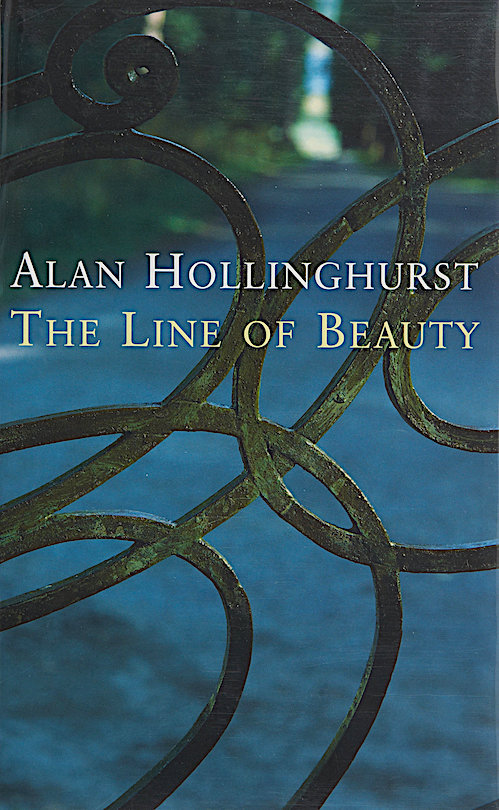 serving as deputy editor from 1985 to 1990. While working at the Times, he devoted his writing to poetry and published his first major collection, “Confidential Chats with Boys”, in 1982. This volume of poems was based on physician William Lee Howard’s 1911 sex education book of the same title which was adopted as standard by numerous boys’ schools.
Hollinghurst began work on four different novels before a grant allowed him to concentrate on his 1988 “The Swimming-Pool Library”. He presented his finished novel to his former housemate Andrew Motion, a subsequent Poet Laureate, who at that time was employed by London’s publishing house Chatto and Windus. The story is centered around Will Beckwith, a privileged, cultured and promiscuous gay man who meets the elderly aristocrat Lord Nantwich. This chance meeting and the later reading of Nantwich’s diaries lead Will to re-evaluate his own sense of the past as well as his family’s history. “The Swimming-Pool Library” won the Somerset Maugham Award in 1988 and, in the following year, the E. M. Forster Award of the American Academy of Arts and Letters.
 As a result of this successful literary debut, Alan Hollinghurst received an advance for his next novel, which allowed him to purchase a house in London’s Hampstead Heath and concentrate fully on writing fiction. His second novel, the 1994 “The Folding Star”, dealt with the incommunicable obsession of a middle-aged tutor for his seventeen-year old Belgian student. The tutor, Edward Manners, becomes involved in affairs with two men and, after introduced to the world of Symbolist painter Edgard Orst, is ultimately caught in the memories of his own adolescence and first love affair.
Hollinghurst’s third novel, the 1998 “The Spell”, used the satirical and romantic style of a weekend in the country plot to follow the changing relationships within a group of friends and occasional lovers. This work was followed by the 2004 three-part novel “The Line of Beauty”. Set during the Thatcher years between 1983 and 1987, the novel followed the life of the young, middle-class gay protagonist Nick Guest. Through exploring the realities of Nick’s tense and intimate relationships and life as a gay man, Hollinghurst examined the themes of hypocrisy, drugs, privilege and homosexuality during  the time of England’s emerging AIDS crisis. “The Line of Beauty” won the high-profile 2004 Man Booker Prize with its fifty-thousand pound stipend and became the first gay novel to be so honored. It was also a finalist for the Lambda Literary Award and the National Book Critics Circle Award for Fiction.
Alan Hollinghurst’s fifth novel, the 2011 “The Stranger’s Child” which, told over the course of decades, revolves around a minor poet’s successful published poem and the resulting changes in his work and life. Received positively by critics, the novel was on the Man Booker Prize longlist, the Walter Scott Prize shortlist, and the winner of the 2013 Prix du Meilleur Livrr Étranger, France’s best foreign book prize. Hollinghurst’s sixth novel, the 2017 “The Sparsholt Affair”, explores the changing attitudes towards homosexuality as seen through the lives of two Englishmen: a teenager attending Oxford during the Second World War, and his later openly-gay son in London just after England decriminalizes homosexuality.
Hollinghurst currently lives in London with his partner Paul Mendez, the British author who authored the 2020 semi-autobiographical novel “Rainbow Milk” published by Dialogue Books, a Little, Brown and Company imprint.
“I grew up reading certain writers like Iris Murdoch who was very interested in sexual ambivalence and often created gay characters, usually from a cultured or academic background. I’m not sure how many straight writers I’ve read who create gay characters successfully from the inside, though I agree about Anthony Burgess and (his novel) “Earthly Powers”. — Alan Hollinghurst, 2017, Guardian Interview with Alex Clark
Note: For those interested, an interview between writer Peter Terzian and Alan Hollinghurst, “Alan Hollinghurst, The Art of Fiction No. 214”, is available through “The Paris Review”, a literary magazine featuring original writing, written interviews, podcasts and art. The article or a subscription to the magazine is available for purchase at: https://www.theparisreview.org/interviews/6116/the-art-of-fiction-no-214-alan-hollinghurst


