Erin Morrison

Erin Morrison, “Black Palm (no. 1)”, 2015, Ink and Wax on Hydrocal, 35.5 x 37.5

Erin Morrison is a 2014 graduate of UCLA’s MFA program, and has exhibited with Samuel Freeman gallery in Culver City. She grew up in Arkansas and received her BFA from Memphis College of Art. She previously lived in New York and Seattle, relocating to Los Angeles in 2011. Here, she teaches and maintains a studio practice.

Her work considers both the domestic and the institutional conditions of painting, combining the visual language of pattern common to textile design alongside heavy gestures associated with modernist painting. Spanning the processes of printmaking, painting, ceramic, and quilting, her work is linked to considerations of the reproducible graphic as well as the meditative act of creating a singular, unique object.

Made of Hydrocal (a cross between concrete and plaster), Morrison’s biggest pieces are more than 7 feet tall and 4 feet wide. Set in solid wood frames, each leans against the main gallery’s walls. The surfaces of her works are where the details reside. Individual stitches, woven fabrics, palm fronds and air bubbles can be seen. Each is the result of Morrison’s laborious process: gather fabrics, sew a quilt, lay it flat, build a mold, pour in Hydrocal, let it dry, tear out the quilt and then begin painting the cast slab.

Edward Gorey

Illustrations by Edward Gorey

Edward St. John Gorey was an American writer and artist noted for his illustrated books. His characteristic pen-and-ink drawings often depict vaguely unsettling narrative scenes in Victorian and Edwardian settings.

Gorey’s illustrated (and sometimes wordless) books, with their vaguely ominous air and ostensibly Victorian and Edwardian settings, have long had a cult following. Gorey became particularly well-known through his animated introduction to the PBS series Mystery! in 1980, as well as his designs for the 1977 Broadway production of Dracula, for which he won a Tony Award for Best Costume Design. He also was nominated for Best Scenic Design. In the introduction of each episode of Mystery!, Vincent Price would welcome viewers to “Gorey Mansion”.

In response to being called gothic, he stated, “If you’re doing nonsense it has to be rather awful, because there’d be no point. I’m trying to think if there’s sunny nonsense. Sunny, funny nonsense for children – oh, how boring, boring, boring. As Schubert said, there is no happy music. And that’s true, there really isn’t. And there’s probably no happy nonsense, either.”

Notes: Among the February 2018 archive of this site, there is a Calendar article for February 22nd that contains a biography of short biography of Edward Gorey’s life.

For those Edward Gorey fans, which I admit to having been one since the time I could read, I highly recommend reading Acocella’s wonderful article about Gorey’s life and wit.

https://www.newyorker.com/magazine/2018/12/10/edward-goreys-enigmatic-world

Diego Rivera

Sketches and Finished Murals by Diego Rivera

Diego Rivera made large preparatory drawings, which served as drafts for the final murals.. Placed alongside the panels they inspired, the exuberant charcoal sketches he called “cartoons” reveal how Rivera translated his broad strokes into the final scenes.

Diego Rivera had some success as a Cubist painter in Europe, but the course of world events would strongly change the style and subject of his work. Inspired by the political ideals of the Mexican Revolution (1914-15) and the Russian Revolution (1917), Rivera wanted to make art that reflected the lives of the working class and native peoples of Mexico. He developed an interest in making murals during a trip to Italy, finding inspiration in the Renaissance frescos there.

Returning to Mexico, Rivera began to express his artistic ideas about Mexico. He received funding from the government to create a series of murals about the country’s people and its history on the walls of public buildings. In 1922, Rivera completed the first of the murals at the Escuela Nacional Preparatoria in Mexico City.

Nicola Verlato


Paintings and Drawings by Nicola Verlato

Nicola Verlato was born in Verona and began painting at a very early age, learning from Fra’ Terenzio, a painter in the monastery of Franciscan monks of Lonigo. He was trained in classical music and studied lute and composition at the conservatories of Verona and Padua. He studied architecture at University IUAV in Venice from 1984 to 1990.

Around 28 years old, Veriato started to be involved in contemporary art scene, and, consequentially, to show in numerous gallery in Italy and abroad in solo and group shows. In 1996, Verlato moved to Milan where he created his well grounded notoriety in Italy. In the same year, he exhibited his work at XII Quadrinnale at Palazzo delle Esposizioni in Rome. In 2004, Verlato relocated from Milan to New York, New York. While living in New York, he was a professor teaching composition and painting courses at New York Academy of Art. His works are in the permanent collection at MART in Trentino, MUSAC in León, and MUDIMA Foundation in Milano.

Nicola Verlato creates his works through an articulated process that makes use of classical techniques as well as modern technology such as 3D Modeling programs such as Maya and ZBrush. In a 2012 interview, Nicola Verlato stated “ The use of computers didn’t change my approach to painting, it just expanded the scope of what I can introduce in the representations and how much control I have over it.”

Keith Vaughan

Keith Vaughan “Drawing of a Group of Five Nude Males”

Born in August of 1912 in Selsey, England, John Keith Vaughan was a British painter and photographer who was one of the leading proponents of Neo-Romanticism. Britain’s foremost painter of male nudes before David Hockney and Patrick Procktor, he created muted depictions of anonymous male nudes set in abstract landscapes that expressed his internal struggle with his homosexuality. Due to legal laws against homosexuality, Vaughan was compelled to self-censor and veil his imagery due to legal risks and possible charges from obscenity laws.
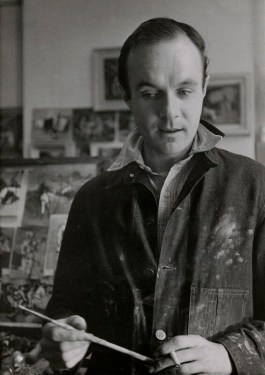
Keith Vaughan attended Christ’s Hospital school. As an intending conscientious objector during the Second World War, he was conscripted into the Non-Combatant Corps, providing physical labor to the army. In 1942, stationed at Ashton Gifford in Wiltshire, Vaughan had his first exhibition of paintings at the Manchester Art Gallery. 

During the war, Keith Vaughan became friends with painters Graham Sutherland, notable for his work in glass and fabrics, and John Minton, an illustrator and stage designer. In 1946 after leaving service, the three men shared living and studio premises. It was through their association that Vaughan became part, for a brief period, of the Neo=Romantic movement of the immediate post-war period.  Upon his leaving the genre, his work, concentrating on studies of male figures, became increasingly more abstract.

During the years of the mid to late 1940s, Keith Vaughan produced around twenty-five paintings of male bathers, as well as scenes and drawings in gouache and other media. At Pagham, on the south coast of England between 1947 and 1948, Vaughan met John McGuinness, an ill-educated, working-class orphan from Liverpool. In some ways, the young man reminded Vaughan of his younger brother Dick, who was killed in the war seven years earlier, which led Vaughan to provide clothing, meals and an education for McGuinness. 

McGuinness, with his large hands and athletic body, represented something raw and honest, embodying all the qualities that Vaughan was attracted to. McGuinness’s gentle, unaffected character allied him with nature in Vaughan’s imagination. John McGuinness’s broad, broken nose, fringe and rugged look make their appearance in several works from this time onwards. The 1947 oil painting “Standing Male Figure”, with its blue background, and the 1949  color lithograph “The Woodsman”, both shown above. are two of the works featuring McGuinness.

An art teacher at the Camberwell College of Arts and later at the Slade School, Keith Vaughan is also known for the journals he kept, published  in 1966 and posthumously in 1989. A gay man who was troubled by his sexuality, Vaughan’s life is mostly revealed to us through these daily journals. Diagnosed with cancer in 1975, John Keith Vaughan committed suicide in London on November 4th of 1977, writing in his diary as the drug overdose took effect. 

For more extensive information on the life of Keith Vaughan, I suggest the Keith Vaughan Society which is located at: https://www.thekeithvaughansociety.com

An article by award-winning poet and art critic Sue Hubbard on Keith Vaughan’s life and his photographic work on Pagham Beach can be found online at The London Magazine located at: https://www.thelondonmagazine.org/review-keith-vaughan-pagham-beach-photographs-collages-1930s/

Top Insert Image: Felix H. Man, “Keith Vaughan”, 1948, Gelatin Silver Print, 24.9 x 17.7 cm, National Portrait Gallery, London

Middle Insert Image: Keith Vaughan, “Figure Group”, 1956, Pencil on Paper, 17.9 x 24.8 cm, Victoria and Albert Collection South Kensington

Bottom Insert Image: Keith Vaughan, “Two Men”, 1970, Charcoal on Paper, 70 x 56 cm, Private Collection

Nightwing: The New Robin

Nightwing/ Dick Grayson ( formerly know as Robin)

Nightwing Created by Bob Kane, Bill Finger, Jerry Robinson

DC Comics:  Illustration by Jem Allman

The original Boy Wonder turned into quite the leading man. He has the nicest hair, the slickest costumes, and the best backside in comics, plus a weird propensity for accidental villainous bondage. Long before Noh-Varr, Nightwing was the male superhero who was written as sexy when most of the other guys were still boy scouts at a bikini convention. When it comes to sexy guys in comics, it always comes back to Robin.

Raoul Pene duBois

Raoul Pene du Bois, “Zephyrus and Hyacinthus”

Famed as a scenic and costume designer for dozens of Broadway productions beginning in the 1930s, Raoul Pene du Bois was one of a distinguished family of artists and designers going back to his grandfather, the art critic Henri Pene du Bois. He won Tony awards for scenic design work in the play “Wonderful Town” and for costume design in “No, No Nanette”. Among the many other shows he designed were the 1934 “Ziegfeld Follies”, the 1935 “Jumbo”, the 1939 “Du Barry Was a Lady”, and the 1953 “Charley’s Aunt”.

Perhaps the largest and most important extant painting by Raoul Pene duBois, was “Zephyrus and Hyacnthus”, a masterpiece of grisaille effect, using varying tones of black, grey and white with only a just a touch of sepia. Greek mythology tells us that Zephyrus rivaled Apollo for the love of Hyacinthus. When Apollo and Hyacinthus were playing quoits with discs, Zephyrus created a gust of wind that caused the disc, tragically, to strike and kill Hyacinthus instantly. From Hyacinthus’ blood sprang the first hyacinth flowers.