
Calendar: November 25

A Year: Day to Day Men: 25th of November

The Jaguar Hunter

November 25, 1920 marks the birthdate of actor Ricardo Montalbán

Born in Mexico City, Mexico, to Spanish immigrants, Ricardo Montalbán made his New York stage debut in 1940 in a small role in “Her Cardboard Lover”, starring Tallulah Bankhead. In 1947 he landed his first major Hollywood film role in the musical “Fiesta”, playing twin siblings with Esther Williams. Montalbán had a memorable dance number in that film with Cyd Charisse.

The dark, handsome Montalbán with the Spanish accent would go on to play numerous Latin romantic-types. He teamed up again with Esther Williams in two more films, the musical romantic comedy “Neptune’s Daughter” and the 1948 romantic comedy “On an Island with You”. In 1949, Montalbán broke from his romantic typecast to play a border agent in the suspense drama film “Border Incident” directed by Anthony Mann.

During the 1950s and 1960s Montalbán was one of only a handful of actively working Hispanic actors in Hollywood, often playing characters of different ethnicities, such as the character Nakamura in the 1957 “Sayonara” and Tokura in a “Hawaii Five-O” episode. He also starred as a naive, penniless French duke in the romance comedy “Love is a Ball” released in 1963.
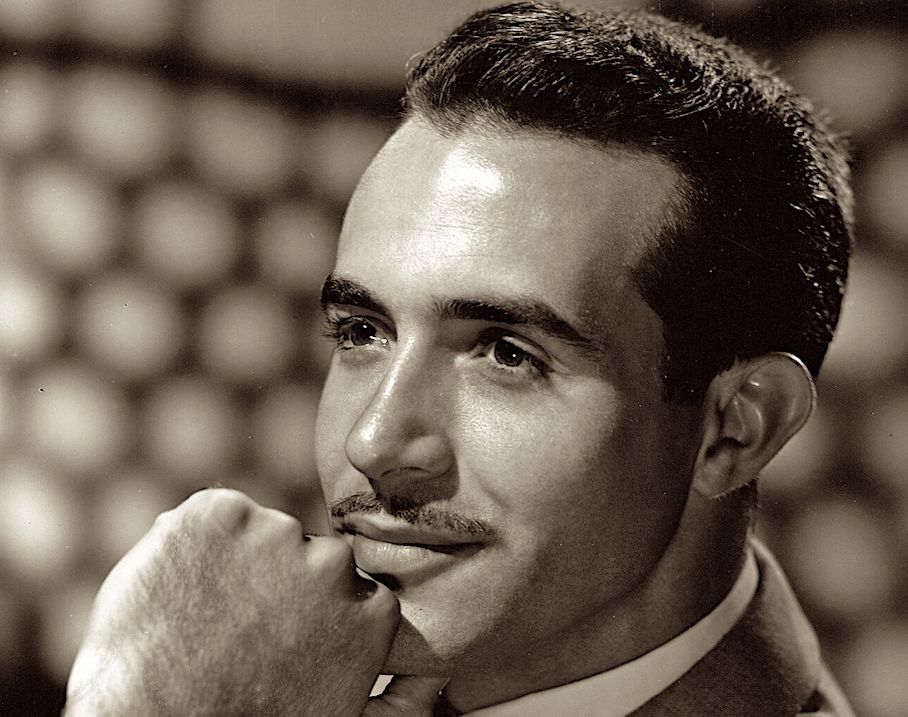
Ricardo Montalbán’s best known television role was that of the man in the white suit with the cultured demeanor, Mr. Roarke, on the television series “Fantasy Island” which ran from 1977 to 1984. The series was one of the most popular on television at that time, making him and his co-star Herve Villechaize, playing Tattoo, popular icons.

Montalbán’s most well-known film role was the character of Khan Noonien Singh in the 1982 “Star Trek II: The Wrath of khan”, in which he reprised the role he had originated in the 1967 episode of “Star Trek” titled “Space Seed”. Montalbán was already physically fit; so Khan’s costume was specifically designed to display his physique. He agreed to take the role at a significant pay cut because he relished reprising his original character. His only regret, Montalbán said, was that he and William Shatner never interacted in their roles; the scenes were all done through video communication, filming their scenes months apart to accommodate Montalbán’s schedule for “Fantasy Island”.

Montalbán reacted to the poor way Mexicans were being portrayed by establishing with other stars the Nosotros (We) Foundation in 1970 to advocate for Latinos in the movie and television industry. He served as its first president. The foundation created the Golden Eagle Awards, an annual awards show that highlights Latino actors. The awards are presented in conjunction with the Nosotros American Latino Film Festival, held at the now renamed Ricardo Montalbán Theater in Hollywood.

Calendar: November 24

A Year: Day to Day Men: 24th of November

One Facet of Life

November 24, 1639 marks the first known observation and recording of a transit of Venus.

By the 17th century, two developments allowed for the transits of planets across the face of the sun to be predicted and observed. One was the telescope of which the actual inventor is unknown; a patent for a refracting telescope was submitted in 1608 in the Netherlands by spectacle maker Hans Lippershey. Galileo heard about it, and in 1609 built his own version for observing celestial objects.

The second development was the new astronomy of Johannes Kepler, which assumed elliptical rather than circular orbits fro the planets. In 1627, Kepler published his “ Rudolphine Tables”, a star catalogue and planetary tables using some observational data collected by Danish astronomer Tycho Brahe. Two years later, Kepler published extracts from his tables concerning the transit of Mercury and of Venus for the year 1631. These occurred as predicted and were observed by several astronomers, vindicating Kepler’s approach to astronomical theory.

The first known observations and recording of the transit of Venus across the sun were made in 1639 by the English astronomers Jeremiah Horrocks and his friend and correspondent William Crabtree. These observations were made on November 24, under the Julian calendar then in use in England. This calendar was refined and gradually replaced by our Gregorian calendar initiated by Pope Gregory XIII, changing the observation date to December 4th of that year. Horrocks observed the event from the village of Much Hoole, Lancashire, and Crabtree, independently, observed the event from his home in Broughton, near Manchester.

Both men, followers of Kepler’s astronomy, were self-taught mathematical astronomers who methodically worked to correct and improve Kepler’s Tables by observation and measurement. In 1639, Horrocks was the only astronomer who realized that the transit of Venus was imminent; others became aware only upon receiving Horrocks’s report. The two men’s observations and later mathematical work were influential in establishing the size of the solar system. For their achievements, they are considered the founders fo British research astronomy.

Insert Image: Ford Madox Brown, “Crabtree Watching the Transit of Venus AD 1639”, 1883, Oil on Canvas, Manchester Town Hall, Manchester, England

Calendar: November 23

A Year: Day to Day Men: 23rd of November

Tiny Bears in a Row

November 23, 1862 was the birthdate of Belgian Neo-Impressionist painter Théo van Rysselberghe.

Born in Ghent, Théo van Rysselberghe studied at the Academy of Ghent under Theo Canneel and later at the Academie Royal des Beaux-Arts in Brussels under Jean-François Portaels. Van Rysselberghe was strongly influenced by North African paintings, which had become the fashion in Belgium. He made three trips to Morocco, staying there for a year and a half.

Van Rysselberghe painted his “Self Portrait with Pipe” in 1880, in the somber colors of the Belgium realistic tradition. His “Child in an Open Spot in the Forest”, also painted in that year, showed a move to impressionism. He started traveling extensively with his friends, impressionist Frantz Charlet and Asturian painter Dario de Regoyos, throughout Spain and Morocco, staying in Tanger for four months starting in October  of 1882. At this  time, Van Rysselberghe painted and drew many scenes form the streets and in the souk, including the 1882 “Arabian Street Cobbler”, the 1882 “Arabian Boy”, and “Resting Guard” in 1883.

Van Rysselberghe saw the works of the impressionists Monet and Auguste Renoir at the show of “Les XX” in 1886, becoming deeply impressed. He experimented with this technique in his 1886 “Woman with Japanese Album”. This impressionist influence became prominent in his later paintings. In 1886 he also discovered the pointillist techniques at that Eighth Impressionist Exhibition in Paris, abandoning realism and became an adept of pointillism,

Theo Van Rysselberghe’s “Gate of Mansour-El-Hay” and”Morocco-the Great Souk”, both done in 1887, are painted in the pointillist style, but still with short strokes of paint and not with points. These are among his rare pointillist paintings of Morocco. When he had finished these paintings, he stopped completely with this Moroccan period in his life. Van Rysselberghen then turned to portraiture, resulting in a series of neo- impressionist portraits. His famous portrait of Alice Sèthe, painted in 1888 in blue and gold, would become a turning point in his life. In this painting he used only points of paint on the canvas.

In 1898 Van Rysselberghe moved to Paris, although he maintained close links with the artistic milieu of Brussels, and executed in 1902, among other works, a series of decorative panels for the Hôtel Solvay, belonging to Victor Horta. Van Rysselberghe also played an important role in the introduction of the fauvist painters, whom he had met through his friend Paul Signac, to Belgium. From 1903 onward, his neo- Impressionism began to give way to more restrained forms, and during the last years of his life he also executed some sculptures. Van Rysselberghe died on the 13th of December of 1926 in Saint-Clair, France.

Calendar: November 22

A Year: Day to Day Men: 22nd of November

Red Knit Hat and Boots

November 22, 1932 was the birthdate of actor Robert Vaughn.

Born in New York City, Robert Vaughn studied at the Los Angeles State College of Applied Arts and Sciences, earning a Master’s Degree in theater. He received a Ph. D in communications from the University of Southern California in 1970. He published his dissertation as a book, “Only Victims: A Study of Show Business Blacklisting” in 1972.

Vaughn made his television debut in November of 1955 on the series “Medic”, the first of more than two hundred appearances on the show. He first film appearance was as an uncredited extra playing a golden calf idolater visible behind Yul Brynner in a scene from “The Ten Commandments”. Vaughn’s first credited movie role was playing Bob Ford, the killer of Jesse James, in the 1957 western “Hell’s Crossroads”.

Vaughn’s first film appearance of note was in “The Young Philadelphians”, for which he received an Academy Award nomination for Best Supporting Actor and the Golden Globe Award for Best Supporting Actor. He next appeared as the gunman Lee in “ The Magnificent Seven” in 1960, the western adaption of Kuorsawa’s epic “ Seven Samurai”.

Robert Vaughn was offered his most memorable role in 1964, starring in his own series as secret agent Napoleon Solo in the television series “The Man from U.N.C.L.E.”. His co-star was Scottish actor David McCallum who played fellow agent Illya Kuryakin. This role would make Robert Vaughn a household name even behind the Iron Curtain. This series which ran from 1964 to 1968 created a spin-off show, large amounts of merchandising, overseas theatrical movies, and a sequel.

After the series ended, Vaughn was given the role of playing the ambitious California politician Chalmers, in the critical and box-office smash film “Bullitt” starring Steve McQueen. Vaughn was nominated for a BAFTA Award for Best Supporting Actor for this role. He won an Emmy for his portrayal of Frank Flaherty in ABC’s 1977 “Washington: Behind Closed Doors”. Vaughn did acting work in England also, appearing on the BBC drama “Hustle” and the British soap opera “Coronation Street”.

Robert Vaughn died from acute leukemia in Danbury, Connecticut on the 11th of November in 2016, eleven days before his eighty-fourth birthday. He was the first popular American actor to take a public stand against the Vietnam War and was an active member in the peace group Another Mother for Peace. Vaughn published his autobiography “A Fortunate Life” in 2008.

Calendar: November 20

A Year: Day to Day Men: 20th of November

Blue Sky and Two Ravens

November 20, 1890 was the birthdate of American film actor Robert Armstrong.

Robert Armstrong, born in Bay City, Michigan, attended the University of Washington, where he studied law. He gave up his studies to manage his uncle’s touring company. In his spare time, Armstrong wrote plays, appearing in one when it was produced. In 1926, he traveled to London and appeared on the British stage for one season.

Robert Armstrong’s film career began in 1927 when he appeared in Pathé’s romantic silent film drama ”The Main Event”, produced by Cecil DeMille. He had a very prolific film career in the late 1920s and early 1930s, making nine movies just in 1928. Armstrong is best know for his role as film director Carl Denham in the 1933 monster adventure film “King Kong”. He reprised his role as Denham in the sequel “Son of Kong”, released at the end of 1933.

Merian C. Cooper, the producer of “King Kong”, used Armstrong in several more movies. Armstrong and Fay Wray starred in “The Most Dangerous Game”, filmed at night on the same sets being used during the day for “King Kong”. He worked throughout the 1930s and 1940s for several film studios, starring in the 1937 musical comedy “The Girl Said No”, released by Grand National Films. In 1940, Armstrong co-starred in the Universal Pictures film “Enemy Agent”, a story about A Nazi spy ring in the country.

In 1942, Armstrong teamed up with actor Richard Cromwell in the notable gangster B-movie “Baby Face Nelson”, playing “Doc” Rogers, the boss of ‘Baby Face’ played by Cromwell. Later he played another leading character role, similar to Carl Denham, as Max O’Hara in “Mighty Joe Young” released in 1949. This film, produced by Merian C. Cooper and directed by Ernst B. Schoedsack, became a stop-motion animation classic, winning the Academy Award for Best Visual Effects in 1950.

Armstrong appeared in the 1950s as Sheriff Andy Anderson on the syndicated wester-themed television series “State Trooper”. He also made four guest appearances on the long-running television series “Perry Mason”, playing the both title character and murder victim on one show, a defendant on another, and the murderer in “The Case of the Accosted Accountant”. Robert Armstrong died of cancer in Santa Monica, California, within sixteen hours of the death of the co-producer of “King Kong”, Merian C. Cooper.

Bottom Insert Image: Robert Armstrong and Frank Reicher, “Song of Kong”, 1933, Director Ernest B. Schoedsack, Cinematography Edward Linden, J. O. Taylor and Vernon L. Walker, Film Clip Photo

Calendar: November 19

A Year: Day to Day Men: 19th of November

Superman

November 19, 1959 marks the release date for the television show “Rocky and His Friends”.

“Rocky and His Friends” was a serialized animation show, produce by Jay Ward Productions, that ran from November 1959 to June of 1964. During its history, it appeared under several broadcast titles, most notably “The Rocky and Bullwinkle Show”. The series was structured as a variety show, with the main feature being the adventures of Rocky the Flying Squirrel and the moose Bullwinkle. Their main adversaries were the two “Russian” spies Boris Badenov and Natasha Fatale. both who worked for the Fearless Leader.

The animation show included three other supporting segments: the old-time melodrama styled “Dudley Do-Right of the Mounties”; “Peabody’s Improbable History”, in which the dog Mr. Peabody takes his boy Sherman to different historical events in time; and “Fractured Fairy Tales”, a new look, albeit slightly askew, at the classic fairy tales.

The idea for “Rocky and His Friends” was from Jay Ward and Alex Anderson, who had both collaborated on “Crusader Rabbit”, the first animated series created specifically for television. Production began in February of 1958 with the hiring of the voice actors: June Foray who voiced Rocky, Natasha, and every female character on the show; Paul Frees who voiced Boris and Inspector Fenwick,; Bill Scott who voiced Bullwinkle, Dudley Do-Right and Mr. Peabody, and William Conrad who narrated the Rocky and Dudley Do-Right segments..

“Rocky and His Friends” was sponsored by the cereal-manufacturer General Mills, who insisted that the show have an late-afternoon time slot, targeting it toward children. The writers and designers were hired; however, no animators were hired. Instead in a move to save cost, the advertising agency for General Mills outsourced the animation to a Mexican company called Gamma Productions, which caused many productions problems because of its quality of animation and mistakes in the continuity of the animated characters and scenes.

“Rocky and His Friends” abounded with quality writing and wry humor, appealing to adults as well as children. Its segments mixed puns, self-humor, and satire on the existing culture and topics in life. The animation art has an unpolished look with limited action compared to the other animated series produced at that time. Despite this, the series is still held in high esteem by critics, with some viewing it as a well-written radio program with visual images. The series was influential to the development of other animated series and, to date, has aired in one hundred countries.

Calendar: November 18

A Year: Day to Day Men: 18th of November

The Cross

November 18, 1908 was the birthdate of American comic actress Imogene Coca.

Imogene Coca, born Imogene Fernandez de Coca in Philadelphia, Pennsylvania was the daughter of José Fernandez de Coca, a conductor, and his wife Sadie Brady, a dancer and magician’s assistant.

In her youth, Imogene Coca received piano, dance, and voice lessons. While still a teenager, she moved from Philadelphia to seek a living as a dancer, starting in the chorus of the 1925 Broadway musical “When You Smile” which ran forty-nine performances in New York City. Coca came to be featured as a headliner, appearing in Manhattan nightclubs, with music arranged by her first husband, Robert Burton. She came to prominence when she began to combine music with comedy. Coca’s first big critical success was in Broadway musical revue “New Faces of 1934”. A well-received part of her act was a comic striptease, during which Coca made sultry faces and gestures but would manage to remove only one glove.

Imogene Coca played opposite Sid Caesar on “The Admiral Broadway Revue” from January to June in 1949. In the early days of live television, she again played opposite Sid Caesar in a sketch comedy program, “Your Show of Shows”, which was immensely popular from 1950 to 1954. Coca won the second-ever Primetime Emmy Award for Outstanding Lead Actress in a Comedy Series in 1951 and was nominated for four other Emmys for her work in the show. Her success in that program earned Coca her own series “The Imogen Coca Show which ran from 1954-1955.

Imogene Coca continued to appear on comedy and variety series from the 1950s to the 1980s. She appeared on “The Carol Burnett Show” and “The Hollywood Palace”, made guest appearances on “Bewitched” and “The Brady Bunch”, and occasionally appeared in films such as “Under the Yum Yum Tree” in 1963 and the 1963 “National Lampoon’s Vacation”, as Aunt Edna.

After having appeared in several Broadway musical-comedy revues and plays between the 1930s and the 1950s, Imogene Coca returned to Broadway at the age of 70 with a Tony Award-nominated performance as religious zealot Letitia Primrose in “On the Twentieth Century”, a 1978 stage musical adapted from the 1934 film. Her role, that of a religious fanatic who plasters decals onto every available surface, had been a male in both the film and the original stage production, and was rewritten specifically as a vehicle for Coca.

Bottom Insert Image: Sid Caesar and Imogene Coca, “Your Show of Shows”, 1950-1954, Publicity Shot, Shout Factory

Calendar: November 17

A Year: Day to Day Men: 17th of November

Alongside His Steed

November 17, 1933 was the released date of the Marx Brothers film “Duck Soup”.

Movies gave the Marx Brothers a mass audience, and the films were the instrument that translated what was once essentially a Jewish style of humor into the dominant note of American comedy. Although they were not taken as seriously, the Marx Brothers were as surrealist as Dali, and as verbally outrageous as Gertrude Stein. Because they worked the genres of slapstick and screwball comedy, the Marx Brothers did not get the same kind of attention. However, their effect on the mind of the population was very influential.

The Marx Brothers created a body of work in which individual films are like slices from the whole, but the 1933 “Duck Soup” is probably the best. It represents a turning point in their movie work; it was their last film for Paramount, and the last in which all of the scenes directly involved the brothers.

When “Duck Soup” became a box office disappointment for Paramount, the Marx Brothers moved over to MGM. Production chief Irving Thalberg ordered their plots pf new films to find room for roles of conventional romantic couples, breaking up the madcap routines and slowing the pace. Buster Keaton’s sound comedies for MGM suffered from the same interference, meddling and dilution by the studio.

To describe the plot of a Marx Brothers film would be an exercise in futility, since a Marx Brothers movie exists in moments, bits, sequences, and dialogue, not in comprehensible stories. The film “Duck Soup” stars Groucho as Rufus T. Firefly, who becomes dictator of Fredonia under the sponsorship of the rich Mrs. Teasdale, played wonderfully as Margaret Dumont. The neighboring nation of Sylvania and its Ambassador Trintino have designs on the country of Fredonia. So Ambassador Trintino hires Harpo and Chico as spies for information. This premise provides a basis for one inspired sequence after another, including sustained examples of Groucho’s puns and sneaky double entendres. It also supports a couple of wordless physical sequences that probably have their roots in the vaudeville acts the brothers performed and saw years earlier.

One comedy sequence in “Duck Soup” is one of the highlights of the first century of film. Harpo, who has disguised himself as Groucho, sneaks into Mrs. Teasdale’s room , tries to break into a safe and shatters a mirror. Groucho himself comes downstairs to investigate. Harpo is standing inside the frame of the broken mirror, and tries to avoid detection by pretending to be Groucho’s reflection. This leads to a sustained pantomime involving flawless timing, as Groucho tries to catch the reflection in an error, and Harpo matches every move. Finally, in a perfect escalation of zaniness, Chico blunders into the frame, also dressed as Groucho.

Calendar: November 16

A Year: Day to Day Men: 16th of November

Yellow Skyscrapers

On November 16, 1581, Ivan the Terrible attacks his son and heir, Ivan Ivanovich.

Ivan Ivanovich was a Tsarevich, a heir apparent of Russia, and the second son of Ivan IV Vasilyevich, known as Ivan the Terrible. Young Ivan at the age of fifteen accompanied his father, who was seeking control of the city of Novgordo, during what became known as the Massacre of Novgordo. For a period of five weeks, Ivan and his father watched the army attack the city and slaughter all its noblemen.

Ivan Ivanovich’s relationship with his father began to deteriorate during the later stages of the Livonian War, where Russia faced a coalition of armed forces from Denmark, Norway, Sweden and the Union consisting of Lithuania and Poland. Angry with his father for his military failures, Ivan demanded to be given command of some of the troops to liberate the besieged city of Pskov, a Russian-held city under attack.

The relationship between father and son deteriorated further in November of 1581 when the Tsar physically assaulted Ivan’s pregnant wife. As a consequence, Ivan the younger’s wife, Yelena, suffered a miscarriage. Confronted about this, the Tsar changed the subject, accusing the younger Ivan of inciting rebellion and insubordination regarding Ivan’s recent actions of liberating the city of Pskov from the siege.

Angered, the Tsar Ivan struck his son, the younger Ivan, on the head with his scepter. Boris Godunov, minister to the court, tried to intervene but only received blows from the scepter himself. The younger Ivan fell, barely conscious with a bleeding wound on his temple. The younger Ivan only briefly regained consciousness before being transported to his chamber. For the next few days, Ivan the Terrible prayed for a miracle to save his son, but to no avail, Ivan Ivanovich, the Tsaravich, died on three days later on November 19, 1581.

Insert Image: Ilya Repin, “Ivan the Terrible and His Son Ivan on 16 November 1581”, 1883-1865, Oil on Canvas, 199.5 x 254 cm, Tretyakov Gallery, Moscow

Calendar: November 15

A Year: Day to Day Men: 15th of November

Flesh and Flowers of Thread

November 15, 1920 was the birthdate of American painter Wayne Thiebaud.

Born in Arizona, Wayne Thiebaud’s interest in art was inspired initially by cartoons and comic strips, such as George Herman’s “Krazy Kat”. As a teenager, he established himself as a cartoonist, working for a brief time as an animator for the Walt Disney Studios. Thiebaud also worked as a poster designer and a commercial artist both in California and New York.

Wayne Thiebaud’s formal art training was provided under the GI Bill at San Jose State College and the California State College in Sacramento. He received a teaching appointment at Sacramento Junior College in 1951, while still in graduate school, and has continued as a distinguished teacher for many years.

Thiebaud moved to New York, where he was in the midst of the Abstract Expressionist movement. He was particularly interested in work by Willem de Kooning and Franz Kline, but fashioned his own approach to art, adapting the thick pigments used by the abstract expressionists to his own subjects and style. Having returned to California, by the early 1960s Thiebaud’s best-known works, colloquial paintings of food and consumer goods, had emerged in mature form.

Depictions of everyday items in American life—sandwiches, gum-ball machines, jukeboxes, toys, cafeteria-type foods, and cakes and pies—reflect a turn toward representational painting. These deadpan still life subjects are set against light backgrounds, often white, with the objects rendered in lush, shiny oil paints. The thick, insistent textures and the playful colors Thiebaud uses for his commonplace objects and their shadows challenged the perceptions of art subjects and meaning. These well-defined shadows, characteristic of advertisements, are almost always included in his work

Although his works are often classified as part of the American pop art movement because of his interest in objects of mass culture, Thiebaud also painted portraits, but even these retained his signature broad treatment of light and shadow, thick paint, and bright Kool-Aid colors.

In 1972, Thiebaud settled permanently in San Francisco and added paintings of the landscape and city views to his subject matter. Using the unique geography of the Bay Area for inspiration, Thiebaud’s landscapes are dramatic representations distinguished by forms plunging at breathtaking angles into or across space and rendered in bold patterns of color. His paintings such as the 1985 “Sunset Streets” and the 1997 “Flatland River” are noted for their hyper realism, and have been compared to Edward Hopper’s work, another artist who was fascinated with mundane scenes from everyday American life.

Calendar: November 14

A Year: Day to Day Men: 14th of November

Pale Skin and Leather

November 14, 1922 was the birthdate of American actress Veronica Lake.

Born Constance Frances Marie Ockelman in the Borough of Brooklynn, Veronica Lake moved to Miami, Florida with her family and attended Miami High School. In 1938 the family moved to Beverly Hills, California, where she was briefly under contract to MGM. Lake enrolled in MGM’s acting school, the Bliss-Hayden School of Acting, and soon went to an audition at RKO studio. She later appeared in the 1939 play “Thought for Food” and had a small role in “She Made Her Bed”.

Veronica Lake appeared as an extra in a number of movies. Her first appearance on screen was for RKO in the 1939 co-ed film “Sorority House”, which wound up being cut from the film. Lake was given similar roles in “All Women Have Secrets” “Forty Little Mothers” and “Dancing Co-Ed”. Producer Arthur Hornblow Jr. from Paramount Pictures decided to give her a chance in the role of a nightclub singer in a military drama entitled “I Wanted Wings”, released in 1940. This role made Veronica Lake, still in her teens, a star.

It was during the filming of “I Wanted Wings” that Veronica Lake developed her signature look. Lake’s long blonde hair accidentally fell over her right eye during a take and created a peek-a-boo effect. After the film was a big hit, the hairstyle became Lakes’s trademark and inspired women to copy it. Paramount next cast Lake in Preston Sturges’s “Sullivan’s Travels” with Joel McCrea. Next came the 1942 thriller “This Gun for Hire” with Robert Preston and Alan Ladd. She and Alan Ladd both had cameos in the all-star Paramount film “Star Spangled Rhythm” in 1942.

During World War II, Veronica Lake became popular as a pin-up girl for soldiers and traveled throughout the United States raising money for war bonds. Lake’s career began to falter after her portrayal as a Nazi spy in the 1944 “The Hour Before the Dawn”. Diagnosed early in her life with schizophrenia, Lake, after receiving scathing reviews, began drinking more heavily during this period, prompting many actors to refuse to work with her. After some time off, Lake was brought back in the 1945 “Bring On the Girls”, her first proper musical.

Veronica Lake made more movies between 1947 and 1951: a western “Ramrod” in 1947; the 1948 “Saigon” which reunited her with actor Alan Ladd; a romantic drama “Isn’t It Romantic” and a comedy “The Sainted Sisters”, both in 1948 and not well received by audiences. In 1948 Paramount decided not to renew Veronica Lake’s contract. After that, she performed in two more films in minor roles, was a television host for a brief stint and performed in summer stock theater.

In June of 1972, Veronica lake visited a doctor complaining of stomach pains. She was diagnosed with cirrhosis of the liver as a result of her years of drinking and was admitted on June 26 to the University of Vermont Medical Center in Burlington. She died there on July 7, 1973 of acute hepatitis and acute kidney injury. Veronica Lake was cremated and her ashes scattered off the coast of the Virgin Islands. For her contributions to the film industry, Lake has a star on the Hollywood Walk of Fame at 6918 Hollywood Boulevard.

Calendar: November 13

A Year: Day to Day Men: 13th of November

Blackwork and Cigarette

November 13, 1850 was the birthdate of author Robert Louis Stevenson.

Robert Louis Stevenson was born in Edinburgh, Scotland, the son of a noted lighthouse builder and harbor engineer. Though healthy at birth, Stevenson soon became a victim of constant breathing problems that later developed into tuberculosis. These persistent health problems made him extremely thin and weak most of his life.

By the time Stevenson entered Edinburgh University at the age of sixteen, he had fallen under the spell of language and had begun to write. For several years, he attended classes irregularly, developing a bohemian existence. At the age of twenty-one, he openly declared his intention of becoming a writer, against the strong opposition of his father. Having traveled to the European mainland several times for health and pleasure, he now traveled between Scotland and a growing circle of artistic and literary friends in London and Paris.

Stevenson’s first book, “An Inland Voyage” published in 1878, related his adventures during a canoe trip on Belgium and France’s canals. In 1879, Stevenson stayed in an abandoned mining camp in the United States, later recounted in the 1883 “The Silverado Squatters”. A year later, he was back in Scotland; however, the climate in Scotland proved to be a severe hardship on his health. Stevenson and his wife soon moved and lived in Switzerland and the south of France. Despite his health, these years proved to be productive. The stories Stevenson collected at that time, ranging from detective stories to Scottish dialect tales, were published as “The New Arabian Nights” and “The Merry Men”.

“Treasure Island”, first published as a series in a children’s magazine, ranks as Stevenson’s first popular book, and it established his fame. A perfect romance, according to Stevenson’s formula, the novel tells the story of a boy’s involvement with murderous pirates. “Kidnapped” published in 1886, set in Scotland during a time of great civil unrest, has the same charm. In the 1886 “The Strange Case of Dr. Jekyll and Mr, Hyde”, Stevenson dealt directly with the nature of evil in man and the hideous effects that occur when man seeks to deny it. This work pointed the way toward Stevenson’s more serious later novels.

In 1889 Stevenson and his family set out on a cruise of the South Sea Islands. When it became clear that only there could he live in relatively good health, he settled on the island of Upolu in Samoa. He bought a plantation, built a house, and gained influence with the natives, who called him Tusifala or “teller of tales”. By the time of his death on December 3, 1894, Stevenson had become a significant figure in island affairs. His observations on Samoan life were published in the 1896 collection “In the South Seas” and in the 1892 “A Footnote to History”.

Calendar: November 12

A Year: Day to Day Men: 12th of November

Bravery

November 12, 1920 was the birthdate of American B-western film star Sunset Carson.

Born Winifred Maurice Harrison, Sunset Carson became an accomplished rodeo rider in his youth, working for a time in a western show owned by early cowboy actor Tom Mix. In 1940, Carson traveled to South America, where he competed in rodeos for two years. After he returned to the States, he appeared in a small role in the 1943 “Stage Coast Canteen”, a film featuring many celebrities of that time. In the next year, Carson had a role in the 1944 film “Janie”, under the name of Michael Harrison.

Carson caught the attention of Lou Grey, an executive of Republic Pictures, who signed him to a contract, giving him his own series of B-westerns and the stage name of Sunset Carson. He was given a horse named “Cactus” and had a succession of popular western genre films. Carson was in the 1944 “Bordertown Trail”, followed in the same year by “Code of the Prarie” and “Firebrands of Arizona”, playing opposite comic western actor Smiley Burnette.

Sunset Carson’s peak year was in 1945, appearing in seven western films. He appeared in his own name in “Sheriff of Cimarron”, “Bandits of the Badlands”. “The Cherokee Flash”, and four other hour-long films. Carson began the year of 1946 strong, starring in five films including “The El Paso Kid” and “The Red River Renegades”. By the end of 1946, however, Republic Pictures and Carson were having disputes. Carson claimed it was over his contract; the studio claimed that Carson was fired after attending a studio function while intoxicated and accompanied by an underage girl. At the end of the year, he and the studio parted company.

In 1948, Sunset Carson starred in “Sunset Carson Rides Again” produced by Oliver Drake. In 1949 he starred in “Rio Grande” and in 1950 the film “Battling Marshal”, his last role as the main character. For the next several years, Carson just obtained small bit parts. He played the lead once again in the B-movie “The Marshall of Windy Hollow”, a 1972 that costarred many old-time western actors. Then Carson had bit parts in two movies during the next thirteen years: “Buckstone County Prison” in 1978 and the 1985 sci-fi “Alien Outlaw”, his final movie role.

Sunset Carson retired to Reno, Nevada and died in a Reno hospital on May 1, 1990 of an apparent heart attack. He died one day after winning a settlement in a three-year old lawsuit over money earned from some of his old films.

Note: The image above is reblogged with many thanks to a great instagram site that I follow, having a “green thumb” and an inclination towards hot guys. The site is https://www.instagram.com/explore/tags/boyswithplants.

Calendar: November 11

A Year: Day to Day Men: 11th of November

Natural State of the Wilderness

November 11, 1868 was the birthdate of French painter Jean-Édouard Vuillard.

Jean-Édouard Vuillard was born in Cuiseaux, France, where he spent his youth until his family in 1878 moved to Paris. At the age of sixteen, he received a scholarship to continue his education. Vuillard attended the Lycée Condorcet, one of the four oldest high schools in Paris and the most prestigious. There he met Ker Xavier Roussel, a fellow artist who became a friend, Maurice Denis, the musician Pierre Hermant, and the writer Pierre Verber.

Vuillard left the Lycée Condorcet in 1885, and on the advice of his closest friend Roussel, he refused military service; he then joined Roussel at the studio of painter Diogene Maillart to study painting. Vuillard studied also at both the Académie Julian and the L’École des Beaux-Arts in the period between 1886 and 1888.

In 1890, after meeting the avant-garde painters Pierre Bonnard and Paul Sérusier, Vuillard joined Les Nabis, a group of art students inspired by the synthetism of Henri Paul Gauguin. Vuillard contributed to the exhibitions of the group and shared a studio with Bonnard and Maurice Denis, whose later work was associated with the Symbolist movement.

After traveling around Europe and painting, Vuillard had his first exhibition at the Salon des Artistes Indépendants in 1901 and, two years later, had an exhibition at the first annual Salon d’Automne in Paris. This massive exhibition was a reaction against the conservative policies of the official Paris Salon and received wide support from artists such as Renoir, Matisse, and Auguste Rodin. After this Vuillard received many commissions for his paintings and graphics.

Jean-Édouard Vuillard painted his first decorative frescoes for the house of Mme Desmarais in 1892. He later fulfilled many other commissions of this kind, leading up to more prominent works; the Théâtre des Champs-Élysées in 1913; the Palais de Chailot in Paris, which he executed with Pierre Bonnard in 1937; and in 1939 the Palais des Nations in Geneva, working with fellow artists Roussel, Denis, and Chastel.

On November 13, 2017, “Misia et Vallotton à Villeneuve” painted in 1899 became the most valuable Vuillard sold at auction when it achieved $17.75 million at Christie’s. It is now in a private collection.