Chris Plytas

Photography by Chris Plytas

Born in 1953 in London, Chris Plytas is an established contemporary visual artist whose work covers the psychology of self-image and identity. His photographic portraiture works have been admired often for their way of unearthing the primal and sensual core of their subjects, and the way they sometimes straddle the borderline between beatific innocence and animal rage.

From 1974 to 1977, Plytas studied fine art, painting and sculpture at St. Martins School of Art in London and earned a BFA with honors. After graduation, he developed his darkroom skills on landscape and portraiture photography.Plytas also  did reportage photography for publications, in which he covered  events such as night clubs, concerts, fashion shows, the Royal Wedding, and the Cannes Film Festival.
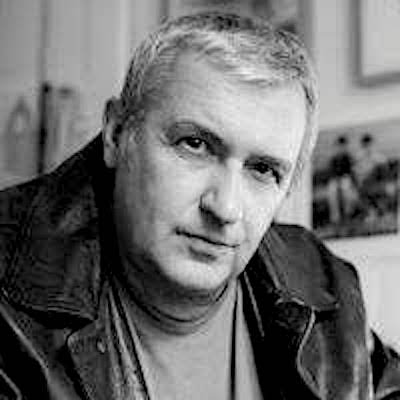
During the period form 1977 to 1985, Chris  Plytas did photographic printing, layouts, and personal design realization in London for Vivienne Westwood, the English fashion designer largely responsible for bringing punk and new wave fashions into the mainstream. In 1982, he became Director of Berwick Universal Pictures, Limited, an award-winning documentary film company based in Soho, London.  Starting in 1985, Plytas began concentrating on his own personal, black and white, fine art photography, shot with Hasselblad cameras, for exhibition and personal archives. 

Chris Plytas’ first series, entitled “Australia”, was shot over a six month period mostly in the New South Wales and Victoria provinces of Australia. This large body of work, consisting of landscape and portraiture, was exhibited in 1987 at London’s Photographers Gallery and toured Europe for six years with support from Fonds National d’Art Contemporain, a public collection of France’s contemporary art. 

Starting in 1987, Plytas engaged in a six-year shoot for his series “Hadrian: The Violence and Sexuality of Adolescence” series, a coming of age story shot in real time. His next series “Le Corps Enjeux (The Body)” was shown as part of the Mois de la Photo exhibition, sponsored by Audiovisuel and Kodak,  held in Paris in 1988. Plytas spent a year from 1992 to 1993 in the Xi’an and the Yannan regions of China, where he shot his “China: Voyage to the East” portfolio, a series which he dedicated to Sun Wukong, the trickster Monkey King.

Known for his exhibited photographic series, Chris Plytas began to receive commissions for portraiture work. His “Family Portraits” series was commissioned by the De Ganay Archives and, at present, consists of forty-eight individual portraits of members of the French aristocratic family. He has also received portraiture commissions from various  other European  and American families 

After shooting his “Miami Beach” series in  1994.  Plytas  has continued working, throughout his career, on multiple personal portfolios, some of which have been exhibited and published. These include his “The Burden of Classicism”; “Nature and Nurture”; “Youth: A Retrospective” shot in Italy; “Beach-Scapes” shot in  Italy and Sicily; a series entitled “Allegorical Portraits”; and “Blood Ties”, a portfolio documenting family member connections.

In addition to his participation in numerous group exhibitions, Plytas  has shown his work in solo gallery exhibitions, including  Paris’ Galerie PONS in 1995, Paris’ Galerie Serge Aboukrat in 2000, a 2002 exhibition in Italy entitled “Frascati Doc”, an exhibition project at the Chateau de Courances in France in 2004, and in 2015 a Paris exhibition entitled “What is Erotic?”. 

Chris Plytas’ work is available in limited editions and custom portfolios. Private individual or family portraits can be commissioned. His website is located at: https://www.chrisplytas.com/index

Insert Images:

Chris Plytas,, Title Unknown (Slogan on Wall), 1992-93, China, Voyage to the East Series, Silver Gelatin Print

Chris Plytas,, “Boy and Girl Entwined”, 1986-2003, The Body Series, Silver Gelatin Print

Salem Beiruti

Salem Beiruti, “Cernunnos”, 2020, Digiatal Art Print with Watercolor and Gold Gouache

Born in Lebanon, Salem Beiruti is a conceptual artist and illustrator residing in Madrid. Working after graduation as an art director in the fields of advertising, graphics, and fashion design, he has more than seventeen years of client and freelance work. Upon his move to Madrid, Beiruti became a full=time illustrator and artist.

Beiruti’s skillful digital illustrations are unique and inspired by such artists and photographers as Patrick Fillion, Paul Freeman, Issauro Cairo, and Francisco Prato. His project  of mixed-media works “Morphosis” is a result of his personal journey as a man of an Arabic mid-eastern culture and its traditions to the man he is today. The art book was published in June of 2017 by German publisher Bruno Gmnuender.

Salem Beiruti’s “Cernunnos” is based on model Francesc Gascó.

For those interested in purchasing a print, Art of Salem is offering all prints at a 40% discount for Easter 2021. Please reference Ultrawolves when ordering. Thank you.   https://www.instagram.com/artistsalem/

Sebastiano Ricci

Sebastiano Ricci, “The Fall of the Rebel Angels”, 1720, Oil on Canvas, 82 x 68 cm, Dulwich Picture Gallery, London

Born in August of 1659, Sebastiano Ricci, an Italian painter of the late Baroque school of Venice, enjoyed an international reputation. He worked all over Italy, Austria, France, and England, primarily painting walls and ceilings with decorative schemes. Ricci’s patrons included Anne, Queen of England, Scotland and Ireland, and Lord Burlington, who commissioned Ricci for eight canvases of mythological frolics. 

In his 1720 “The Fall of the Rebel Angels”, Sebastiano Ricci portrays the War in Heaven, as described in the Bible’s Book of Revelation 12,2-9. Archangel Michael leads the angels of Heaven against the rebel angels, who follow Satan. Ricci portrays, with great exuberance, the moment when Saint Michael drives the fallen angels from Heaven. The light radiating from the upper left quadrant illuminates St. Michael while casting the fallen angels into darkness, offering a poignant juxtaposition between virtue and vice. 

There are five drawings relating to this composition at the Royal Library of Windsor Castle and one drawing in the Galleria dell’ Accademia in Venice.

Luke Nugent, “Lithunium Snow”


Luke Nugent, “Lithunium Snow”, Photo Shoot

Luke Nugent is a British photographer living in London and working internationally. He studied photography at London’s University of Greenwich, and has been shooting professionally since his late teens. Working primarily in the fields of music, portraiture and fashion, Nugent works with top models, musicians and personalities to develop imagery of a high technical and aesthetic standard. He has experience assisting world renowned photographer Rankin and has collaborated on various projects for Nick Knight’s award winning fashion website “SHOWstudio” including editorial features, video projects and live events.

Born in October of 1998 in Haarlem, Netherlands, Nils Kuiper, known as Lithunium Snow, is a model in the alternative modeling world, having been featured in publications like Dark Beauty Magazine and Gothesque Magazine. In 2016, he won the title of Mr. Alternative.

The website of photographer Luke Nugent can be found at: https://lukenugent.co.uk

Walter Nobbe

Paintings by Walter Nobbe

Walter Nobbe was born in 1941 in Malang, Indonesia, later moving with his family in 1950 to the Netherlands. He studied at the Royal Academy of Arts in The Hague, graduating as a professor of art in 1963. Nobbe began teaching but later decided to concentrate on his painting; he was a master in drawing and painting the male figure. His first exhibition was held in 1966 at Felix Valk’s Galerie 20, which concentrated on the New Realist artists. 

Together with philosopher and politician Peter Blokhuis and painter-sculptor Pat Andrea, Nobbe formed the ABN group, a group of young painters who were considered the top echelon of the new Dutch Realist painters. His high level of craftsmanship makes his paintings stand out from the others, Nobbe’s work is represented in museums and galleries in the Netherlands, Belgium and France, as well as in private collections.

In 1972, Walter Nobbe started to design for the Netherland Dance Theater, designing ballets for dancers and choreographers Cliff Keuter, Jiří Kylián and Nacho Duato. His production designs include “Overgrown Path, the “Dream Dances”, “Bolero”, and “Arenal”. Nobbe has worked with dance companies throughout the world: the English National Ballet in London, The Culberg Ballet of Sweden, and the Houston Ballet in Texas. Nobbe’s ballet “Overgrown Path” is one of his three works in the repertoire of the American Ballet Theater.

Robert Flynt

The “History” Series by Robert Flynt

Robert Flynt is a graduate of the Tyler School of Art in Philadelphia and its post-graduate program in Rome. He lives and works in upstate New York. His “History” series, reproduced in “Your Numbered Days”, literally combines found images of the past with images of the present and metaphorically transcends the intersections of then and now.

Fading, distorted, out of focus men seem to be Flynt’s metaphorical reminders of the ephemeral, transitory nature of the physical body and the fragility of the spirit. In some photographs, figures converge with deceased ancestors or ancient art. Floating bodies share space with planetary bodies and celestial heavens. These are poetic meditations on our connections to the past and our place in the infinite cosmos.” -Vance Martin

“We look to (and at) images to find information: practical, aesthetic, erotic, and points between or overlapping. We are often seduced; we believe the photograph’s illusory diorama of a point in time, the diagram or chart’s authoritative organization of fact. My primary concern is to re-imagine the human body – in relation to its own assumed / perceived structure, as well as to “others” (other bodies, spaces, systems). Each image is the intersection of two layers: one a figure photographed with limited control (usually underwater), the other a found photograph or textbook illustration.”          – Robert Flynt

Jason Hess

Jason Hess, Ceramics

Ceramic artist Jason Hess uses a variety of clay materials, firing his pieces, generally unglazed, in a wood burning kiln. His work is either utilitarian or refers to utility in form. In his more sculptural work, he seeks to group pieces that evoke characters relating to one another.

Jason holds an MFA in ceramics from Utah State University and is currently a professor of art at Northern Arizona University in Flagstaff. His ceramic art has been featured in many exhibitions nationally and internationally. The artist has participated in residencies at Montana’s Archie Bray Foundation and at The Pottery Workshop in Jingdezhen, China.

Bartolomeo Manfredi

Bartolomeo Manfredi, “Cupid Chastised”, 1607-1610, Oil on Canvas, 175 x 130 cm, The Arr Institute of  Chicago

Manfredi’s “Cupid Chastised” first appearred in art-literature in 1937, when it was published as a newly found work by Caravaggio. There is no date, signature, or inscription on the painted to indicate otherwise. The great Caravaggio expert had already recognized and published it as by Manfredi, when it was acquired in 1947 for the Chicago Art Institute as a Caravaggio.

“Cupid Chastised” was included in the epochal 1951 Caravaggio exhibition in Milan with an attribution to the “School of Caravaggio”. Soon after acquiring the painting, The Chicago Art Institute relabeled it with its current attribution to Manfredi. However, as recently as 1972, it was suggested that it is instead by an unknown Nordic follower of Carravaggio.

Following the example of Caravaggio, Bartolomeo Manfredi chose to depict ordinary individuals in his scenes from the Bible and Greek and Roman mythology. Caravaggio had demonstrated to Manfredi and an entire generation of European artists that such lofty themes could be transformed into events experienced by ordinary people. Employing dramatic lighting and locating the action directly before the viewer, these artists were able to endow their narratives with great immediacy and power.

The depiction of Cupid’s chastisement shows a moment of high drama: Mars, the god of war, beats Cupid for having caused his affair with Venus, the goddess of love, which exposed him to the derision and outrage of the other gods. Venus implores him in vain to desist. Surrounded by darkness, the three figures are boldly illuminated from the left, intensifying the dynamism and impact of the composition.

The sheer physicality of the figures — the crouching Venus, whose broadly realized face strays from the classical ideal; the powerful Mars, whose musculature and brilliant red drapery seem to pulsate with fury; and Cupid, whose naked flesh and recumbent position render him particularly vulnerable—conveys the violent discord of the scene. On one level a tale of domestic disturbance, the story also symbolizes the eternal conflict between love and war.


Zdenka Braunerová


Zdenka Braunerová, “Study of a Baker”, Late 1800s, Gouache on Paper, 29 x 33.5 cm

Zdislava Rosalina Augusta Braunerová, called Zdenka, was a Czech landscape painter, illustrator and graphic artist. She was born in Prague on April 9th of 1858 into a wealthy family. Her father was František August Brauner, a member of the Imperial Council.

Braunerová developed her interest in art from her mother, Augusta, who was an amateur painter.  As her talents became apparent, she began taking lessons from Amalie Mánesová. Later, she studied with Soběslav Pinkas. In 1896, she became the first female member of the Mánes Union of Fine Arts, but was apparently expelled in 1906. Zdenka Braunerová died in Prague on May 23, 1934.