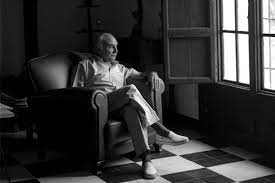
Christopher Soden: “Dionysus”

Photographers Unknown, Dionysus

i am wielder of chaos
bearer of cozy poison
hidden son of jupiter
gestated from his thigh
supple strapping boy
follow the crooked
steps of spontaneous
capering i will soothe
your terrified gaze
summon frantic defiant
nymphs to slake
your thumping skull
with tender anarchy
my fierce priestesses
in robes of moonlight
diaphanous cobweb
will sing lilting implacable
spells to wreck
planets in their courses
wine and feral milk spouting
from tap of hyssop branch
i will swaddle you
in mother night caress
you with snake tongue
drizzle silky
secret language
of the rapacious
in your ear nudge
succulent fissure
yearning for arc
of scalding bliss
sap of brief
delectable death

Christopher Soden, Dionysus

Born in Texas, Christopher Soden is a poet, playwright, and a critic of film, literature and theater. He attended the Vermont College of Fine Arts where he received in January of 2005 his Masters of Fine Art in Poetry. Soden has taught classes on the craft and theory of poetry, English literature, and the process of publication; he currently teaches literature in the Continuing Education Program at the Dallas College Richland Campus.

Soden’s first full-length poetry collection, “Closer” was published by Rebel Satori Press in June of 2011. While realizing that one can get only so close to another being, the works in this collection, written mostly in free verse, display the persistent sense of longing that one has for another. Soden’s collection of confessional narratives present an honest look at same-gender sexuality, maleness, loss and regret, and the complexity of the human condition.

Christopher Soden’s “Queer Anarchy”, a collection of short plays, monologues and performance pieces, dealt with gay and lesbian life in America; it received the Best Stage Performance award from The Dallas Voice, the first newspaper to represent Dallas’ LBGTQ community. Two of his plays, “Water” and “A Christmas Wish” were staged at Dallas’ Bishop Arts Theater Center. Other plays written by Soden include “All That Glitters Ain’t Goldie”, “Lizards Need Love Too”, and “Space Cowboy, Aunt Velma and the Macaroon”.

Soden received a Full Fellowship to Lambda Literary’s Retreat for Emerging LBGT Voices. He is a member of the Distinguished Poets of Dallas, the Poetry Society of America’s Poetry in Motion Series, and is a Founding Member and President Emeritus of the Dallas Poets Community. Soden’s poetry has appeared in many print and online magazines, including G&L Review and Chelsea Station; he currently writes for the Dallas Art Beat, the Examiner.com, and the online theater review, sharpcritic.com.

“I remember the first time I heard Sylvia Plath’s ‘Lady Lazarus’ in a writer’s workshop I was taking. Our teacher, Jack, read it aloud, and I was unacquainted with Plath and her poetry. Didn’t even know she was dead. As anyone who knows the poem can tell you, it gathers steam and just continues to escalate by way of rage and audacity. Plath just keeps pushing and pushing until you think she couldn’t possibly go any further, and yet she does. By the time Jack finished with those three lines, ‘Herr God, Herr Lucifer, Beware. Beware. / Out of the ash I rise with my red hair, / and I eat men, like air,’ I could feel deep shudders traveling up my back. My scalp was ablaze. Until that moment I didn’t even know such poetry was possible. That was when I knew I wanted to be a poet.”

– Christopher Soden

Sjohnna McCray: “We’re Mostly Made of Water”

Photographers Unknown, We’re Mostly Made of Water

Driving the highway from Atlanta to Phoenix
means swapping one type of heat for another.
A bead of sweat rolls over my chest,
around my belly and evaporates
so quickly I forget I’m sweating.
Body chemistry changes like the color
of my skin: from yellow to sienna.
My sisiter says, it’s a dry heat.
At dusk, lightning storms over the mesas.
Violets and grays lie down together.
Mountains are the color of father’s hands,
layers of dark–then light.
People move west to die, retire in a life
of dust, trade the pollen of the south
for a thin coat of grit, the Arizona desert–
promesas, promesas.
We stop on the outskirts of town
and think about being reborn.
When he places his mouth near my mouth
because he’s so obviously thirsty,
when he moves to the well
where my tongue spouts out
because we’re mostly made of water
two-thirds of me is certain:
este infierno vale la pena.

Sjohnna McCray, I Do, 1972

Born on March 7, 1972 in Cincinnati, Ohio, Sjohnna McCray is an American author and poet. He earned a Bachelor of Science degree from Ohio University and his Master of Fine Art from the University of Virginia, where he was a recipient of the Henry Hoyns Fellowship. McCray also received his Master of Arts in English Education from the Teachers College at Columbia University.

Growing up in the diverse working-class neighborhoods of Cincinnati, McCray was raised by his mother and his father, a Vietnam War veteran. Influences on his work include contemporary poets James Wright and Sharon Olds; Lucille Clifton, a finalist twice for the Pulitzer Prize for Poetry; Robert Hass, Poet Laureate from 1995 to 1997; and Robert Hayden, the first African-American to serve as Consultant to Poetry to the Library of Congress, a post now known as Poet Laureate.

Sjohnna McCray’s poetry collection “Rapture”, a chronological poetic narrative published in 2016 by Graywolf Press, was selected by Poet Laureate of the United States, Tracy K. Smith, as the winner of the 2015 Walt Whitman Award of the Academy of American Poets. The poems in the latter half of the collection portray some of the intimate and middle-age aspects of gay life. McCray has also be honored with the Intro Journal Award from the Association of Writers and Writing Programs, Ohio University’s Emerson Poetry Prize, and a Pushcart Prize nomination.

McCray’s poetry is interwoven with family memories, history, and the issues of race and desire. In addition to his poetry, he has published essays on race, mental illness, and homosexuality in numerous journals. His poems and essays have appeared in Tin House Online, The Southern Review, The Tahoma Literary Review, StorySouth, The Columbia Daily Tribune, and Harpur Palate.

Sjohnna McCray has taught in Chicago, Phoenix, and New York City. He and his partner currently live in Savannah, Georgia, where he teaches in the English department of the Savannah State University.

“My partner and I have been together for seventeen years and in retrospect, before gay marriage was legal, our commitment was sealed when we decided to mover across the country- to the desert. The poem (“I Do”) attempts to address how external shifts in landscape can transform and reflect on what’s going on internally.”- Sjohnna McCray, 2021

John Kingsley Orton: “Ordinary Decent People”

Photographers Unknown, Parts and Pieces Making a Whole: Set Thirteen

Sir- As a playgoer of forty years standing, may I say that I heartily agree with Peter Pinnell in his condemnation of ‘Entertaining Mr Sloane’. I myself was nauseated by this endless parade of mental and physical perversion. And to be told that such a disgusting piece of filth now passes for humor! Today’s young playwrights take it upon themselves to flaunt their contempt for ordinary decent people. I hope that the ordinary decent people of this country will shortly strike back! Yours truly, Edna Welthorpe (Mrs)

—John Kingsley Orton, Letter Sent for Publication under the Alias of Edna Welthorpe

Born in Leicester, England in January of 1933, John Kingsley Orton, known under the pen name of Joe Orton, was a working-class, gay playwright whose outrageous black comedies shocked, outraged, and amused theatre audiences in the 1960s. 

After attending secretarial classes at Clark’s College in Leicester from 1945 to 1947, Joe Orton worked as a junior clerk for three pounds a week. He began performing in theater productions beginning in 1949 and joined several groups, including the Leicester Dramatic Society. Orton was accepted for a scholarship at London’s Royal Academy of Dramatic Art in November of 1950; however, due to appendicitis, his entrance was delayed until May of 1951. It was at the Royal Academy that Orton met the seven-year older Kenneth Leith Halliwell, who also was a struggling actor and writer. After moving into a West Hampstead flat, they quickly formed a strong relationship and became lovers.

After graduation, Orton and Halliwell collaborated on writing several novels, which were unsuccessful at  publishing. Due to a lack of serious work, they began to amuse themselves with pranks and hoaxes. From January 1959 to May of 1962, Orton and Halliwell removed books from several local public libraries and began to modify the blurbs and cover art. One volume of poetry by writer and broadcaster John Betjeman was found with a new dust jacket featuring a photograph of a nearly naked, tattooed middle-aged man. Discovered by the authorities in May of 1962 and later found guilty of five counts of theft and malicious damage to seventy books, the two men served six months in prison. A collection of these altered book covers are now housed in the Islington Local History Center.

In 1959, Joe Orton wrote his only novel, which was  posthumously published as “Head to Toe”, and soon began to have success in his plays’ productions. His first play “Fred and Madge” was written in 1959; and “The Visitors” followed two years later. In 1963 the BBC purchased Orton’s radio play “The Ruffian on the Stair”, which was broadcast on August 31st of 1964 and, later in 1966, adapted as a stage play. 

By the end of August, Orton had also completed his play “Entertaining Mr. Sloane”, which premiered on May 6th of 1964 to reviews which ranged from praise to outrage. Although it lost money on its short run, the play tied for first in the Variety Critics’ Poll for Best New Play, and Orton came second in the category for Most Promising Playwright. By 1965, “Entertaining Mr. Sloane” was being performed in Spain, Israel, Australia, and New York, as well as being adapted into both a film and television play.

Written between June and October of 1964, Joe Orton’s next play was “Loot”, a wild parody of detective fiction, which added the blackest farce and jabs at established ideas on death, the police, religion, and justice. It underwent sweeping rewrites before it was judged fit for the West End. “Loot” was first staged in London on September 27th of 1966 to rave reviews. In November the play moved to the Criterion Theater where it ran for three hundred forty-two performances, won several awards and firmly established Orton’s fame.

Orton, over the next ten months, revised his “The Ruffian on the Stair” and his “The Erpngham Camp” for the stage as a double play entitled “Crimes of Passion”. He also wrote his television play “Funeral Games”, the screenplay entitled “Up Against It” for the Beatles music group, and his final full-length play “What the Butler Saw”, a play of seduction, blackmail, and cross-dressing, which came to the West End stage in 1969, eighteen months after Orton’s death.

On the 9th of August of 1967, John Kingsley Orton was bludgeoned to death by Kenneth Halliwell at their home in Islington, London, killed by nine hammer blows to the head. Halliwell then committed suicide with an overdose of Nembutal. Later evidence showed that Orton had earlier confided to a friend that he wanted to end his relationship with Halliwell; and it also showed that Halliwell had spoken to his psychiatrist three times on the day of the murder. Halliwell had felt increasingly threatened and isolated by Orton’s success, and had come to rely on barbiturates and antidepressants. The bodies, along with Halliwell’s suicide note, were found on the morning of August 10th by a chauffeur who had arrived to transport Orton for a meeting in London. 

The body of Joe Orton was brought into the chapel of London’s Golders Green Crematorium to a recording of the Beatles’ song “A Day in the Life”. Playwright and director Harold Pinter read the eulogy. After Orton’s cremation, his ashes and Halliwell’s ashes were mixed together and scattered in a section of the Garden of Remembrance at Golders Green; no marking memorial stone is erected there. A statue of Joe Orton was later installed in the city of Leicester and, in 1987, a film adaption of John Lahr’s 1978 biography of Orton was released under the title “Prick Up Your Ears”.

Note: For those interested in theater and gay history, an interesting article is Greg Buzwell’s 2019 “Homosexuality, Censorship, and British Drama During the 1950s and 1960s” located at the British Library site: https://www.bl.uk/20th-century-literature/articles/homosexuality-censorship-and-british-drama-during-the-1950s-and-1960s

Manuel Puig: “The Most Beautiful Thing”


Photographers Unknown, The Most Beautiful Thing

“—What is being a man for you? —It’s many things, but for me… well, the most beautiful thing about a man is that, being pretty, strong, but without making a fuss of strength, and that he is advancing safely. That he walks safely, like my waiter, that he speaks without fear, that he knows what he wants, where he is going, without fear of anything. “It’s an idealization, a guy like that doesn’t exist.” “Yes, he exists, he is like that.” —Well, it will give that impression, but inside, in this society, without power, no one can advance safely, as you say.—Being a man is much more than that, it means not putting anyone down, with an order, with a tip. Moreover, it is… not allowing anyone next to you to feel less, that no one next to you feel bad.”

Manuel Puig, The Kiss of the Spider Woman

Born in December of 1932 in General Villegas, Argentina, Manuel Puig was a novelist and a screenwriter. As there was no secondary school in his hometown, his parents sent him to Buenos Aires in 1946 where he attended College Ward, an educational institute with intercultural bilingual education at all levels. During his time at College Ward, Puig began to systematically read books. Starting with the Nobel Prize winners, he read works by such writers as André Gide, Hermann Hesse, Aldous Huxley, Thomas Mann, and Jean-Paul Sartre.

After seeing Henri-Georges Clouzot’s 1947 police drama film, “Quai des Orfèvres”, Puig decided on a film career as a director. For this profession, he learned three languages: Italian, French, and German. In 1950, Puig enrolled at the University of Buenos Aires Faculty of Architecture; but, in 1951, he switched to its School of Philosophy. He was already working, upon graduation, as a film archivist and editor in Buenos Aires; and later, after  winning a scholarship from the Italian Institute of Buenos Aires, he continued that employment in Italy.

Returning to Argentina, Manuel Puig started his obligatory military service in 1953 where he served as a translator in the Aeronautics section. Living in Buenos Aires in the 1968, Puig wrote his first major novel, “La Traición de Rita Hayworth (Betrayed by Rita Hayworth)”, a novel told in multiple voices to create a portrayal of ordinary Argentinian lives in the1930s and 1940s. In 1969, he wrote his second novel “Boquitas Pintadas (Heartbreak Tango)”, a story about the contrast between mediocre reality and fantastical dreams; the novel also raised questions about machismo and the damage it causes. The narrative is told through confessions, letters, diaries, newspaper clippings, eyewitness accounts, and rememberances of life.

Holding leftist political tendencies and seeing the instability of the Argentinian government, Puig relocated to Mexico in 1973, a place where he would live in exile throughout rest of his life. He wrote his third novel “The Buenos Aires Affair” in 1973, and three years later, wote possibly his best known work, the 1976 “El Beso de la Mujer Araña (The Kiss of the Spider Woman)”. Unusual in that it has no traditional narrative voice, the novel is told in large part through dialogue, without any indication of who is speaking, except the insertion of a dash to show change of speaker. 

“Kiss of the Spider Woman” depicts the daily conversations between two Argentinian prison cellmates, one a political prisoner who was part of a group attempting the overthrow of the government and the other a transgender woman in jail for corruption of a minor. The two characters, seemingly opposites, form an intimate bond in their cell and become lovers, albeit briefly, and they are both changed by that relationship.   

Manuel Puig’s novel was initially published only in Spain; however, upon its publication, it was included on a list of novels banned to the population of Buenos Aires. Despite having been entered into the Frankfurt Book Fair in Germany, it remained banned in Argentina until Raúl Alfonsin’s government took control in 1976. Puig adapted “Kiss of the Spider Woman” into a stage play in 1983. The novel was later adapted in 1985 into an Academy Award-winning film of the same name, starring William Hurt and Raul Julia. Hurt’s winning the 1986 Oscar for Best Actor marked the first time an Academy Award went to an actor in an openly gay role. 

In 1989, Puig moved from Mexico City to Cuernavaca, Mexico. Following doctor’s orders to stop smoking, he took daily walks, but the high altitude of the area labored his breathing. He had access to higher quality medical care than most and received care at a clinic near his home. Experiencing pain for several days, he was admitted to the Las Palmas Surgical Center on July 21, 1990, for risk of peritonitis. 

An emergency operation removed Manuel Puig’s inflamed gall bladder; however, his lungs filled with fluid and he became delirious. He died from an acute heart attack, on July 22, 1990.  After funeral rites, attended by only six people including his mother, Manuel Puig’s body was sent to Argentina and placed in the Puig family tomb in the La Plata Cemetery.

Andreas Fux

Photography by Andreas Fux

Born in East Berlin of the German Democratic Republic in 1964, Andreas Fux is a photographer whose body of work focuses on how the human individual evolves into his own artistic creation. He belongs to the Prenzlauerberg photo artist scene, which documented the last decade of the German Democratic Republic. 

Andreas Fux initially trained from 1980 to 1982 as an electrician. In 1983, he began his own sstudy of  the process and techniques of photographic work. During the years between 1983 and 1988, Fux exhibited his photographs in private gallery spaces. His first published works appeared in a 1988 issue of Das Magazin, a monthly East Berlin magazine that focused on culture and lifestyle. Working as a freelancer, Fux provided the publication with black and white photographs covering Berlin’s punk and youth culture.

 In 1989, Fux worked on photo productions for Deutsche Film-Aldiengesellschaff, the state-owned film studio of East Germany. Since 1990, he has been working as a freelance photographer for various newspapers and magazines, as well as executing his own photographic projects. In 1992, Fux’s first solo photographic book was published entitled “The Russians”; it was a supplement to his solo exhibition, of the same name, at the Janssen Gallery in Berlin, a show which later traveled to Hamburg and Munich. 

Andreas Fux gained a wider audience for his work with the 2005 series “The Sweet Skin”, which covered a decade of works between 1995 and 2005. For this series of portraits which focused on tattoos and skin scarification; he followed the lives of his models, with daily documentation and night shoots in his studio. Against a mostly white background and in the silence of the photo studio, nude photographs of his models were taken, in which the contrast between intimacy of the body and clinical sterility of the room was exaggerated. In another series entitled “At the End of the Night”, whose topic was body culture, the nude, and sexuality, Fux posed his subjects against a black background with a selective light source that modeled and fragmented the models sculpturally. 

Fux’s 2001 series “The Horizonte” is reminiscent in its formality of the 1980s “Seascapes” series done by Japanese photographer and architect Hiroshi Sugimoto, in which Sugimoto bifurcated the landscape images exactly in half by the horizon line. At the beginning of September 2001, Fux travelled across the North Sea on board a Ukrainian training sailboat. For this series, he celebrated the beauty of the horizon as an interaction between sea, clouds and light. The images of “The Horizonte” series were seen by the critics as an expression of calm and innocence. For his 2010 series “Kerberos and Chimaira”, Fux staged his motifs in a wind tunnel at Berlin-Adlershot. Using the strict compositions of expressionism and the aesthetic codes of the latex and fetish scene, his series examined  a dangerous and often not considered proximity between the erotic picture codes of fetishism and the aesthetics of National Socialism.

For his 2016 exhibition “Shame and Beauty”,  Andreas Fux opposed new portraits with a selection of older works, a combination which showed the development of his oeuvre over the years. His new work preserved the almost tender and respectful handling of his subjects found in his early works. The photographic sessions in which he bathed his models in soft light took an entire night, were meticulously planned, and took place in a highly sensitized atmosphere. This Berlin show contextualized the discussion on governmental and social repression and persecution; the works in this show had previously been exhibited by Fux in Moscow in September of 2015 under rather adverse conditions.

Andreas Fux has had solo exhibitions in Germany and abroad, including the Widmer and Theodoris Gallery in Zurich, the Photo Festival in New York, the Esther Woerdehoff Gallery in Paris and the Pasinger Fabrik Gallery in Munich.

A collection of Fux’s photo work from Berlin can be found at: https://andreas-fux.berlin

Maurice Sendak: “Where the Wild Things Are”

Photographers Unknown,  Where the Wild Things Are

Max stepped into his private boat
and waved goodbye
and sailed back over a year
and in and out of weeks
and through a day
and into the night of his very own room
where he found his supper waiting for him
and it was still hot”

—Maurice Sendak, Where the Wild Things Are

Born to Polish Jewish immigrant parents in Brooklyn, New York, in June of 1928, Maurice Bernard Sendak was an American writer and illustrator of children’s books. He was affected in his childhood by the deaths of many of his extended family who perished in the Holocaust. An early reader of books, Sendak decided at the age of twelve to become an illustrator after seeing Walt Disney’s film “Fantasia”.

Sendak started his professional career with the creation of window displays, one of which was in the toy store FAO Schwarz located on Fifth Avenue in Manhattan. His first published illustrations, a series of figures explaining the atom and its energy, were in the 1947 textbook “Atomics for the Millions” written by Maxwell Leigh Eidinoff. In the 1950s, Sendak illustrated children’s books written by other authors, including two books written by his older brother, author Jack Sendak, and the “Little Bear” series of books written by Danish-American author Else Holmelund Minarik.

In 1956 Maurice Sendak published his first authored book, “Kenny’s Window”. and soon started working on second effort, for which he was inspired to use the Yiddish expression ‘vilde chaya”, or wild animals, to indicate overexcited children. Sendak’s authored and illustrated 1963 children’s book “Where the Wild Things Are” received international acclaim. Initially banned for two years by libraries and critiqued negatively, the book won the annual Caldecott Medal in 1964 for recognition as the most distinguished American illustrated book for children. Since its publication, it has sold over nineteen million copies worldwide.

Sendak illustrated Isaac Bashevis Singer’s first children’s book “Zlateh the Goat and Other Stories, which was published in 1966 and received the Newbery Honor for children’s literature. He authored and illustrated the 1970 “In the Night Kitchen”, a young boy’s dream journey through a surreal baker’s kitchen, one of a trilogy of books which contains “Where the Wild Things Are” and the 1981 “Outside Over There”. Illustrated in a different style from his previous works, the book is mainly pictorial with few captions. “In the Night Kitchen”, with its depiction of the young protagonist’s nudity, was controversial upon its release and is still ranked as one of the most frequently challenged books. 

Maurice Sendak’s works included many in the fields of television and stage. He was active in the development of the “Sesame Street” series, and wrote and designed four stories for the series, including an adaption of his book “Bumble Ardy” into an animated film. Sendak adapted his “Where the Wild Things Are’ into a stage production in 1979, and also designed sets for many operas and ballets, including Tchaikovsky’s “The Nutcracker:, Mozart’s “The Magic Flute”,  and Prokofiev’s “The Love for Three Oranges”.

In 1957, Maurice Sendak met his partner, psychoanalyst Eugene Glynn, with whom he remained for fifty years until Glynn’s death in May of 2007. After his partner’s death, he donated one million dollars to the Jewish Board of Family and Children’s Services in memory of Glynn, who had treated children and young adults there. While his sexuality was known among his friends, Sendak kept his sexuality from public view for almost his entire life. When the social climate regarding homosexuality began to change, he  came out, at the age of eighty years old, during a 2008 interview with the New York Times.

Considered one of the most important children’s book artists of the twentieth century, Maurice Sendak died on May 8th of 2012 at the Danbury Hospital in Conneticutt from stroke complications. His body was cremated and his ashes scattered at an unconfirmed location. Under an agreement with, and supported by a grant from, the Maurice Sendak Foundation, his original artwork, sketches, books, and other materials, totaling close to ten thousand items, are housed at the University of Conneticutt’s Archives and Special Collections in the Thomas J Dodd Research Center.

Francisco Brines: “The Cause of Love”

Photographers Unknown, The Cause of Love

When they have asked me the cause of my love
I have never answered: You already know its great bearuty.
(And there are still more beautiful faces.)
Nor have I described the certain qualities of his spirit
that he always showed me in his customs,
or in readiness for silence or smile
as required by my secret.
They were things of the soul, and I said nothing about her.
(And I should still add that I have met higher souls.)
The fruit of my love now I know:
man’s imperfections overcome his presence,
it is atrocious to think
that bodies do not correspond to souls in us,
and so the grace of the spirit blinds bodies,
its clarity, the aching flower of experience,
goodness itself.
important events that we never discovered,
or we find out late.
The bodies lie, other times, an airy heat,
moved light, honda freshness;
and the damage reveals its dry falsehood to us.
Know the truth of my love now:
matter and breath joined in his life
like the light that falls on the mirror
(it was a small light, a tiny mirror);
It was a perfect random creation.
A being in order grew next to me,
and my disorder was serene.
I loved its limited perfection.

–Francisco Brines, Cause of Love

Born in Oliva, Valencia, in January of 1932, Francisco Brines Bañó was a Spanish poet and essayist. He was a prominent member of the Generation of “50, a Spanish literary movement whose new literary language incorporated metaphysical and philosophical techniques to undermine the strict censorship of the Franco government.

After studying at the Jesuits of Valencia, Francisco Brines attended the University of Madrid, where he studied Philosophy and Letters, and also the Universities of Valencia, Deusto and Salamanca, where he earned a degree in Law. He became a reader of Spanish literature at the University of Cambridge and a Professor of Spanish at the University of Oxford.

Described as a metaphysical poet, Brines was highly influenced by the work of Luis Cernuda, an openly gay poet of the Generation of ’27; inspired by these works, many of Brines’s poems also convey the theme of homosexual love. His poetry is characterized by the intimate tone of his verses, the constant reflection on the passage of time and decay of the living, and observations on the condition of a human being subjected to his own limitations. Memory also plays a fundamental role in Brines’s writing; although, his poems reveal the belief that neither poetry nor memory can endure the passage of time or save the moments of the past.

Francisco Brines’s first collection of poems, entitled “Las Brasas (Embers)”, was published in 1959 and won the 1960 Adonais Poetry Prize. In 1966, Francisco Brines published “Words in the Dark”, which earned him the National Critics Award in 1967. In the same year, he also won the Valencian Literature Award. “The Autumn of Roses’, a collection of sixty poems written over a ten year period, was published in 1986 and won the National Prize for Literature. This book, in which elegies of lamentation and exaltation merge, was his most critically acclaimed work.

Entering the world of theater, Brines revised and adapted playwright Pedro Calderón de la Barca’s 1636 drama“El Alcalde de Zalamea (The Mayor of Zalamea)”. Directed by José Luis Alonso, the play was performed by the Classical Theater Company in 1988. Told in three acts, it explored the power of a self-made man against political authority in seventeenth-century Spain,

Brines was recognized for his work by the Royal Spanish Academy in 1998 with the Fastenrath Prize and, later, received the 1999 National Prize for Spanish Letters for his poetic oeuvre. Elected a member of the Royal Spanish Academy of the Language in April of 2000, Brines gave his institutional speech on the poetry of Luis Cernuda, one of the poets who influenced his work. In 2020, he won the Premio Cervantes, the most important literary award of the Spanish language world.

Francisco Brines Bañó was taken to Gandía Hospital shortly after King Felipe VI and Queen Letizia presented him with the 2020 Cervantes Prize at his family estate in Oliva, Valencia, as he was unable to attend the official ceremony due to his delicate state of health. He died on the 20th of May in 2021, at the age of eighty-one, at Gandía Hospital, after a hernia operation.

Note: An interesting article on the homoeroticism of Francisco Brines’s poetry, long regarded as an open secret but rarely acknowledged in critical studies, entitled “Francisco Brines and the Humanist Closet” by Jonathan Mathew of the University of Kansas, can be found at: https://kuscholarworks.ku.edu/bitstream/handle/1808/7478/Mayhew_Francisco%20Brines.pdf?sequence=1&isAllowed=y

Horus

Photographer Unknown, Horus

Horus, in the ancient Egyptian religion, was one of the most important deities. The god appeared in the form of a falcon, whose left eye was the moon, representing healing, and whose right eye was the sun, representing power and the intrinsic substance of the heavenly bodies. Falcon cults were evident in late predynastic times and became widespread throughout Egypt. 

In the beginning stages of Egypt’s ancient religion, Horus was believed to be the god of war and the sky. As the religion progressed, Horus was seen as the son of Osiris and Isis, the divine child of the holy family triad. He is depicted as a falcon wearing a crown with a cobra, and later, wearing the Double Crown of the united Upper and Lower Egypt. The hooded cobra, worn by the gods and pharaohs on their foreheads, symbolized light and royalty. 

One of the oldest cultures in human history, ancient Egyptians are well-known for pioneering the fields of art, medicine, and the documentation of discoveries as mythological tales. The Egyptians mastered the integration of anatomy and mythology into artistic symbols and figures. The Eye of Horus was used as a sign of prosperity and protection, derived from the myth of Isis and Osiris. Comprised of six different parts, each an individual symbol, the Eye of Horus has an astonishing connection between neuroanatomical structure and function.

For those interested in the possible scientific speculation of the ingenuity of ancient Egyptians’ insight into human anatomy and physiology, a treatise, entitled “The Eye of Horus” by Karim ReFaey, Gabriella C. Quinones, William Clifton, and others can be found at the Cureus site, located at:https://www.cureus.com/articles/19443-the-eye-of-horus-the-connection-between-art-medicine-and-mythology-in-ancient-egypt

Leonardo Corredor

The Black and White Photography of Leonardo Corredor

Born in Mérida, Venezuela, and based in New York City, Leonardo Corredor is a photographer and art film director. Before his photography career, he was professional model, named Best Venezuelan Model in 2007. Since his first appearance as an actor in 2010, Corredor has appearred in several acting roles on television series, including “Control Remoto”, “Dum Dum”, and “La Merienda”. He has also hosted Telemundo’s show “Invasion Casera”.

In 2012 Corredor became a creative director and fashion photographer for webzines, print magazines and fashion advertisers, including Essential Homme, Man About Town, Rollercoaster Magazine, Portrait, Fashionably Male, and Solar Magazine, among others. He is represented by The Industry MGMT, a artist and model management agency, focused on still and motion photography,  with offices in New York and Los Angeles.

Examples of Leonardo Corredor’s photographic and video work can be found at his site located at: https://www.leonardocorredor.com

Paul Monette: “Everything Extraneous Has Burned Away”

Photographers Unknown, Everything Extraneous Has Burned Away

everything extraneous has burned away
this is how burning feels in the fall
of the final year not like leaves in a blue
October but as if the skies were a paper lantern
full of trapped moths beating their fired wings
and yet I can lie on this hill just above you
a foot beside where I will lie myself
soon soon and for all the wrack and blubber
feel still how we were warriors when the
merest morning sun in the garden was a
kingdom after Room 1010 war in not all
death it turns out war is what little
thing you hold onto refugees and far from home
oh sweetie will you please forgive me this
that every time I opened a box of anything
Glad Bags One-A-Days KINGSIZE was
the worst I’d think will you still be here
when the bus is empty Rog Rog who will
play boy with me now that I bucket with tears
through it all when I’d cling beside you sobbing
you’d shrug it off with the quietest I’m still
here
I have your watch in the top drawer
which I don’t dare wear yet help me please
the boxes grocery home day after day
the junk that keeps men spotless but it doesn’t
matter now how long they last or I
the day has taken you with it and all
there is now is burning dark the only green
is up by the grave and this little thing
of telling the hill I’m here oh I’m here

Paul Monette, Here, Love Alone: Eighteen Elegies for Rog 

Born in October of 1945 in Lawrence, Massachusetts, Paul Monette was n poet, author, and gay rights activist, best known for his essays about gay relationships. He graduated from the Phillips Academy, a university-preparatory school, in 1963 and earned his Bachelor of Arts at Yale University in 1967.  

Monette’s formative years in the rigid social boundaries and strict religious atmosphere of his middle-class upbringing prompted him to not disclose his gay orientation. Questioning his sexual identity, he moved to Boston, where he taught writing and literature at Milton Academy and Pine Manor College. In 1974 in Boston, Monette met his longtime partner, lawyer Roger Horwitz, a graduate of Harvard Law School, with a Ph.D in comparative literature from Harvard University.

In November of 1977, Paul Monette and Roger Horwitz moved to Los Angeles, where they became strongly associated with the gay rights movement in the city. Monette wrote and published several novels during this period; his first novel, “Taking Care of Mrs Carroll”, featuring two male lovers and a legendary movie goddess, was published in 1978. In the period from 1977 to 1982, he wrote several more works of poetry, fiction and memoirs, including the 1979 “The Gold Diggers” and the 1981 murder mystery “The Long Shot”.

Monette’s more serious work began with the onslaught of the AIDS crisis, when his work focused on its occurring loss and heartbreak. In 1985, his partner, Roger Horwitz, was diagnosed with the AIDS virus and, after a long nineteen month fight against the virus, passed away in October of 1986. After Horwitz’s death, Monette continued his writing and remained active with many public speaking appearances.

In 1988, Paul Monette published his “Love Alone: Eighteen Elegies for Rog”, a collection of poems in remembrance of Horwitz. Using different fonts and no punctuation, the lines are interpreted by the reader’s determination when to begin and end a sentence. Through the poetry Monette described the events that occurred during Roger’s decline in health and his own transition through the various  emotions he experienced, which included denial, anger, bargaining, depression and, finally, acceptance. His description of his loss is particularly evident in the poem “The Very Same”, written on the day of Horwitz’a funeral.

Monette published his “Afterlife” in 1990 and “Halfway Home” in 1991, both which were centered around people with AIDS and their families’ experiences. His most acclaimed book, the 1988 “Borrowed Time: An AIDS Memoir”, chronicles his partner Roger Horwitz’s long fight, and eventual death, from the AIDS virus. Describing the devastating loneliness felt by AIDS patients and their loved ones, the memoir received both the PEN Center West and Lambda literary awards. Monette’s 1992 memoir “Becoming a Man: Half a Life Story”, an autobiography of his early closeted life, culminating with his meeting Roger, was written as a classical coming of age story and won the National Book Award in 1992. 

Monette’s life story, including the final years before his own death from AIDS in February of 1995, is documented in Monte Bramer and Lesli Klainberg’s 1996 film “Paul Monette: The Brink of Summer’s End”. Premiered at the 1996 Los Angeles Outfest, the film went on to win four awards for best documentary, including the GLAAD Media Award and the Sun Dance Film Festival. 

Paul Monette died in Los Angeles where he lived with his partner of five years, author and psychotherapist Winston Wilde. He is buried alongside Roger Horwitz at Forest Lawn Memorial Park in Hollywood Hills Los Angeles. Shortly before his death, Paul Monette established the Monette-Horwitz Trust to support future LBGT activism and scholarship.Trust Awards are given annually to individuals and organizations for their contribution to eradicating homophobia through literary, scholarly, archival, or activist work. 

Jonathan Williams: “Glittering Frostily”

Photographers Unknown, Glittering Frostily

There are more things to love
than we would dare to hope for.
–Richard of St. Victor

where the car hit him, fireweed sprang with
blossoms of fennel

and umbels
of dill fell
through the spokes of a wheel

on Whistun holiday to the sun, Denton
Welch spun a web in his crushed cycle,

sat in the seat, spine curled up like a spider–

and spied: “saw
the very drops of sweat glittering frostily
between the shouder blades”

of a lad

…on and on he spied and bled from the blades of his cycle
small as a spider,
hiding in the fireweed, getting
wet from the skins of many human suns aground
at the Kentish river near
Tunbridge Wells,

where the dill
lulls,

and all boys
spoil…

Jonathan Williams, The Wreck on the A-222 in Ravensbourne Valley, Jubilant Thicket: New & Selected Poems, 2995

Born in Asheville, North Carolina, Jonathan Williams was a poet, photographer and graphic artist. He attended St. Albans School in Washington DC, and then Princeton University. After leaving Princeton to pursue the arts, Williams studied painting with Karl Knaths at the Phillips Gallery, and graphic arts and engraving under Stanley William Hayter at Atelier 17 in New York City. He later studied photography at Black Mountain College with Harry Callahan and Aaron Siskind.

In 1951, Williams, along with David Ruff, founded the book publishing company, The Jargon Society, with the goal of publishing obscure writers. This press, long associated with the Black Mountain Poets, an  post-modern group in North Carolina, launched a number of artists, both literary and visually artistic, who pioneered the 1980s avant-garde movement in United States. 

Jonathan Williams was a link between the experimental poets of the second generation of Modernists and the upcoming vernacular artists of Appalachia. Akin to a cultural anthropologist, he based his work on “found’ language, acquired through listening to others reminisce about their lives and experiences. Williams loved to reveal the poetic within the pedestrian, whether from commercial signs, such as “O’Nan’s Auto Service”, to amorous lavatory wall scribblings, such as “The Current Sexist Machismo in a Loo Along the River Kent”. He often infused light verse forms such as limericks, clerihews, and acrostics with his own ribald wit.Williams also invented a form of his own called the Meta-Four, which specified no length, only that every line contain four words. 

Jonathan Williams and his life-long partner, the poet Thomas Meyer, typically divided their year between Skywinding Farm, the property he owned in the Blue Ridge Mountains, outside Highlands, North Carolina, and a seventeenth-century stone cottage in  Cumbria, England. A longtime contributing editor of the photography journal Aperture, Jonathan Williams died from pneumonia on March 16, 2008 in his Blue Ridge Mountain home.

Insert Image: Guy Mendes, “Jonathan Williams and Thomas Meyer at Corn Close”, 1081, Silver Gelatin Print

The Liberty of a Frozen Morning

Photographer Unknown, The Liberty of a Frozen Morning

“The approach of a man’s life out of the past is history, and the approach of time out of the future is mystery. Their meeting is the present, and it is consciousness, the only time life is alive. The endless wonder of this meeting is what causes the mind, in its inward liberty of a frozen morning, to turn back and question and remember. The world is full of places. Why is it that I am here?”

—Wendell Berry, The Long-Legged House

Edward O. Phillips: “The Universe is Copernican”

Photographers Unknown, Parva Scaena (Brief Scenes): Photo Set Twenty-Three

“To grow old is to realize the universe is Copernican, not Ptolemaic, and that self and the loved one do not form the epicenter of the solar system>”

—Edward O. Phillips

Born on November 26th of 1931 in Westmount, an enclave of Montreal, Edward Openshaw Phillips was a Canadian novelist who has written mainstream literary fiction and is best known for his series of mystery novels featuring gay detective Geoffry Chadwick. 

Edward Phillips earned his Bachelor of Arts from McGill University in Montreal, and earned his Bachelor of Civil Law Degree from the Université de Montréal. After deciding against legal practice, he graduated from Harvard University with a Master’s Degree in Education, and later earned a second Master’s Degree in English Literature from Boston University. Phillips taught English for seven years, first in the public English school system and later at Selwyn House School, an independent boys’ school located in Westmount. 

Having a long-established interest in drawing and painting, Phillips pursued this interest with art classes at both the Visual Arts Center in Westmount and the Montreal Museum School of Art. He later entered his work in numerous group shows and was exhibited in five solo shows within Canada.

Throughout his teaching career and painting period, Edward O. Phillips devoted himself to his writing, from which would come twelve novels and numerous short stories. His first novel, “Sunday’s Child”, the first of six titles in the Geoffry Chadwick series, was published in 1981, and was shortlisted for the Books in Canada First Novel Award. Phillips won the Arthur Ellis Award, presented annually by the Crime Writers of Canada, in 1987 for his novel “Buried on Sunday”, the second book of the Chadwick series. In 1989, his novel, “Hope Springs Eternal”, was shortlisted for the Stephen Leacock Memorial Medal for Humor. 

Phillips’s short story, entitled “Matthew and Chauncy”, was adapted by director and screenwriter Anne Claire Poirier into the 1990 film “Salut Victor”. Produced by the National Film Board, the film starred Jean-Louis Roux as Philippe and Jacques Godin as Victor in the story of two older men, one openly gay and one closeted, who fall in love during their stay at a retirement home.

Edward O. Phillips spent most of his life in Westmount, Quebec. Openly gay, he was in a fifty-two year relationship with partner Kenneth S. Woodman, who passed away in 2018. Edward Phillips died on May 30th of 2020 of complications from Covid-19. 


This Vast Expanse

Photographer Unknown, This Vast Expanse

Je vois les effroyables espaces de l’Univers qui m’enferment, et je me trouve attaché à un coin de cette vaste étendue, sans savoir pourquoi je suis plutôt en ce lieu qu’en un autre, ni pourquoi ce peu de temps qui m’est donné à vivre m’est assigné à ce point plutôt qu’à un autre de toute l’éternité qui m’a précédé, et de toute qui me suit.

I see the dreadful spaces of the Universe that lock me up, and I find myself attached to a corner of this vast expanse, without knowing why I am more in this place than in another, nor why this little time given to me to live is assigned to me at this point rather than to another in all the eternity that preceded me, and all that follows me.

—Pascal, Pensées sur la Religion

Frank Bidart: “The Primary, the Crucial Scenario”

Photographers Unknown, The Primary, the Crucial Scenario

Lie to yourself about this and you will
Forever lie about everything.

Everybody already knows everything

so you can
lie to them. That’s what they want,

But lie to yourself, what you will

lose is yourself. Then you
turn into them.

For each gay kid whose adolescence

was America in the forties and fifties
the primary, the crucial

scenario

forever is coming out—
or not. Or not. Or not. Or not. Or not.

Involuted velleities of self-erasure.

Quickly after my parents
died, I came out. Foundational narrative

designed to confer existence.

If I had managed to come out to my
mother, she would have blamed not

me, but herself.

The door through which you were shoved out
into that light 

was self-loathing and terror.

Thank you, terror!

You have learned early that adults’ genteel
fantasies about human life

were not, for you, life. You think sex

is a knife
driven into you to teach you that.

–Frank Bidart, Queer, 2012

Born in May of 1939 in Bakersfield, California, poet Frank Bidart was educated at the University of California at Riverside, where he was attracted to the works of T.S. Eliot and Ezra Pound. Upon graduation, he moved to Cambridge, Massachusetts, to study literature at Harvard University. During his graduate years, Bidart became a student and friend of poets Robert Lowell and Elizabeth Bishop. 

Frank Bidart has written his work in a variety of forms, of which the best known are his earliest books containing monologues by troubled characters. Throughout the wide range of his work,  the dilemma of individual guilt, both its origins and consequences,has a prominent place in the work and is explored in its various forms. In order to express the importance of words and sentences in his stories, Bidart regularly uses varied forms of typography in the formal structure of the work, including blank spaces, block capitalization, italics, punctuation, and techniques such as quotations, monologues, and paraphrasing. 

Frank Bidart’s first volume of poetry, “Golden State”, an eight year project of self-reflection and a search for identity, was published in 1973. The volume was selected  for the Brazilier Poetry series by Pulitzer Prize recipient Richard Howard. The first poem, and most famous, in the collection is “Herbert White”, which presents the first-person confession of a child-murdering necrophiliac without any introduction or narrative frame. Bidart’s intent was to present someone, whose violent pattern grew out of the drama of his past, as the direct opposite of a previous poem’s character who sought insight through order and analyzation.

In 1977, Bidart published his second collection of poetry, “The Book of the Body”, a series of poems featuring characters struggling to overcome both emotional and physical adversity. The opening poem, “The Arc”, is written through the musings of an amputee. Included also in Bidart’s collection is a monologue, entitled “Ellen West”, spoken by a woman with an obsessive eating disorder. The narratives in this collection are not seamless, but spliced together bits of speech, journal notes, anecdotes, reminiscences, and analogies which follow each other in a progression.

Frank Bidart gained his reputation as an original poet with his 1983 collection “The Sacrifice”, which received widespread praise. The core of this volume is a thirty-page work entitled “The War of Vaslav Nijinsky”, a poem which alternates prose sections on the dancer’s  life with monologues by Nijinsky. A two year project, it went through many revisions and emerged as an experiment in language and punctuation.

Frank Bidart’s  1997 book “Desire” was published as a single work in two sections. The first section contains thirteen short poems, including a memorial to New York City artist and writer Joe Brainard, who died of AIDS-induced pneumonia in 1994. The book’s second half , entitled “The Second Hour of the Night”, contains a recounting of Ovid’s tale of Myrrha’s incestuous love for her father Cinryus. Appearing at the end of the work, the tale is told in a single-narrative of formal dictation which is essentially a meditation on longing and desire. This collection was nominated for the National Book Award, the Pulitzer Prize, and the National Book Critics Circle Award; it received the Library of Congress’s 1998 Rebekka Bobbit Prize for best poetry book.

Bidart’s 2005 “Star Dust”. also divided in two parts, has a central theme: man’s drive toward creation, the way we give form and shape to experience. The first section is composed of the short poems about the failure of men to realize the human need to create. These poems were  previously published in the Pulitzer nominated chapbook “Music like Dirt”. The second section consists of eight short lyrics and a long narrative poem entitled “The Third Hour of the Night”, which tells the story of Benvenuto Cellini’s struggle to complete his statue of Perseus holding the head of Medusa. Composed of poems which emphasized the way we shape our lives and experiences, “Star Dust” was nominated for a National Book Award.

Frank Bidart’s  most recent collections include the 2008 “Watching the Spring Festival: Poems”, “Metaphysical Dog: Poems” published in 2013, and “Half-light: Collected Poems 1965-2016” which won the Pulitzer Prize and the National Book Award. Frank Bidart was elected a Chancellor of the Academy of American Poets in 2003. He  has taught at Wellesley College since 1972.