Film History: Alan Ladd

Director Frank Tuttle, “Alan Ladd as Philip Raven”, 1942, “This Gun for Hire”, Cinematography John Seitz, Paramount Pictures

Born at Hot Springs, Arkansas in September of 1913, Alan Walbridge Ladd was an American actor and film producer who found success with portrayals in film noir, war movies and Westerns in the 1940s and early 1950s.

The only child born to freelance accountant Alan Ladd and English-born Ina Raleigh, Alan Walbridge Ladd was four years old at his father’s death of a heart attack. He and his mother moved to Oklahoma City where she married house painter Jim Beavers. The family relocated to California and eventually settled in the San Fernando Valley where Beavers was given a position at the silent film studio FBO Pictures (Film Booking Offices of America).

Ladd enrolled at North Hollywood High School where, despite his small stature, he became a swimming and diving champion in his teen years. In his senior year, he also participated in the high-school’s theatrical productions, one of which included his role as the comic Ko-Ko in “The Mikado”. After graduating in February of 1934, Ladd worked in various jobs including gas station attendant, lifeguard and hot dog vendor. His first employment in the film industry was a two-year position as a grip at the Warner Brothers studios. 

After appearing in several stage productions for the Ben Bard Theater in Hollywood, Alan Ladd appeared in an uncredited role in director David Butler’s 1936 musical football-comedy “Pigskin Parade”. Although able to get short-term work at MGM and RKO, he was signed later that year by radio station KFWB as its sole radio actor, a position he held for three years. Ladd’s work as multiple characters was noticed by actress and talent agent Sue Carol who began to promote him for films and radio. Ladd’s first role through Carol was a credited role in director Frank Lloyd’s 1939 historical drama “Rulers of the Sea” with Douglas Fairbanks Jr. and Margaret Lockwood. 

Over the next few years, Ladd had several small roles in films, among these were the 1940 “Green Hornet” serial,  the 1941 comedy horror “The Black Cat”, and an uncredited role as a newspaper reporter in “Citizen Kane”. He gained some recognition for his featured role as a Royal Air Force pilot in the 1942 RKO Radio Pictures war film “Joan of Paris”, a critical success that featured the U.S. screen debuts of Paul Henried and Michèle Morgan. Ladd was given a contract with Paramount Pictures and, after a successful audition, the role of Raven, a paid killer with a conscience in director Frank Tuttle’s 1942 crime film “This Gun for Hire”. Although he had only received fourth billing, Ladd was made a star due to critical praise and fan reaction.  

Paramount recognized that Alan Ladd was a potential star and immediately signed him for the adaptation of detective-novel writer Dashiell Hammett’s “The Glass Key” released in October of 1942. This was Ladd’s second pairing with Veronica Lake, who had co-starred with him in “This Gun for Hire”. He followed “The Glass Key” with the 1942 all-star musical “Star Spangled Rhythm” and two films released in 1943, “Lucky Jordan” with Helen Walker and “China” with Loretta Young. 

Although classified as unfit for military service due to stomach issues, Ladd enlisted in January of 1943, briefly serving in the U.S. Army Air Forces’ First Motion Picture Unit. He attained the rank of corporal but was given a honorable medical discharge at the end of October due to a stomach disorder complicated by influenza. When Ladd returned to Paramount, he was given the 1944 drama film “And Now Tomorrow”, a melodrama that co-starred Loretta Young. He next acted in the leading role for John Farrow’s historical adventure film “Two Years before the Mast”, which became one of the most popular films in the United States after its belated release in 1946. 

In 1945, Paramount Pictures bought American-British detective fiction writer Raymond Chandler’s first original film screenplay “The Blue Dahlia” as a vehicle for Alan Ladd, Veronica Lake and William Bendix. Shot quickly by director George Marshall, the film ranked among the most popular films at the British box office in 1946. Chandler was nominated for the Academy Award for Best Original Screenplay; Ladd was noted for his role as a tough guy in what became known as the film noir genre.

Ladd appeared in several films of mixed critical and commercial reception in 1949 and 1950. These include the 1949 “The Great Gatsby”, “Chicago Deadline”, “Appointment with Danger”, and two Westerns, the 1950 “Branded” and the 1951 “Red Mountain”. These dynamic action-packed roles were followed by Ladd’s most memorable performance as the drifter Shane, an honest character troubled by conflicting emotions. The role of Shane became the highpoint of Ladd’s film career. Directed by George Steven, the 1953 Western “Shane” won an Academy Award for its Technicolor cinematography and became a critical as well as commercial success for Paramount Pictures.

Alan Ladd entered independent film making in 1954 through the founding of  Jaguar Productions, a Hollywood production company that released films through Warner Brothers. His first film, the 1954 Western “Drum Beat” was successful and was followed by the 1955 “Hell on Frisco Bay” with Edward G. Robinson, and the 1957 Western “The Big Land” in which he acted opposite Virginia Mayo. In the following year, Ladd acted with his eleven-year old son David and co-star Olivia de Havilland in the 1958 Technicolor Western “The Proud Rebel”, a Michael Curtiz film produced by Samuel Goldwyn Jr. 

Ladd continued his acting with films for United Artist, Warner Brothers and 20th Century Fox Studios. He also starred in directors Ferdinando Baldi and Terence Young’s 1961 “Duel of Champions”, an epic Roman adventure film shot in Italy. In 1963, Ladd accepted his last film role, the former gunslinger turned actor Nevada Smith, for director Edward Dmytryk’s drama “The Carpetbaggers”. This film adaptation of Harold Robbins’s novel was released to financial success in April of 1964, three months after Ladd’s death. 

Alan Ladd was recuperating after knee injuries at his Palm Springs house in January of 1964. He had been suffering badly from insomnia and found solace in sedatives and an increasing dependence on alcohol. The butler saw Ladd on his bed in the morning of the twenty-ninth of January; upon his return in the afternoon, the butler found Ladd dead on the bed. The death was officially ruled accidental. Alan Ladd died at the age of fifty due to cerebral edema caused by acute overdose of alcohol and a mixture of tranquilizers. Ladd was interred at the Forest Lawn Memorial Park in Glendale California. 

Notes: The CMG Worldwide website has a page on Alan Ladd which includes a biography and a complete filmography: http://www.cmgww.com/stars/ladd/

The Hollywood’s Golden Age website has an extensive biography on Alan Ladd at: http://www.hollywoodsgoldenage.com/actors/alan_ladd.html

Writer, critic and performer Trav S.D. has an excellent 2020 article on his WordPress site “Travalanche” entitled “The Short Life of Alan Ladd” at: https://travsd.wordpress.com/2020/09/03/the-short-life-of-alan-ladd/

An extensive article entitled “The Dynamic Duos Blogathon: Alan Ladd and Veronica Lake” can be found on the “ShadowsandSatin” WordPress site: https://shadowsandsatin.wordpress.com/2013/07/12/the-dynamic-duos-blogathon-alan-ladd-and-veronica-lake/

Top Insert Image: Photographer Unknown, “Alan Ladd as Philip Raven”, 1942, “This Gun for Hire”, Publicity Photo, Paramount Pictures 

Second Insert Image: Film Poster, “Captain Carey, U.S.A>”, 1950, Director Mitchell Leisen, Cinematography John F. Seitz, Paramount Pictures

Third Insert Image: Photographer Unknown, “Alan Ladd”, Paramount Publicity Photo, Gelatin Silver Print

Fourth Insert Image: Film Poster, “the Blue Dahlia”, 1946, Director George Marshall, Cinematography Lionel Lindon, Paramount Pictures, 76 x 102 cm, Private Collection 

Fifth Insert Image: Eugene R Richee, “Alan Ladd”, 1941, Gelatin Silver Print, Private Collection

Bottom Insert Image: Film Poster, “Calcutta”, 1947, Director John Farrow, Cinematography John F. Seitz, Paramount Pictures

Derek Jarman: Film History Series

Derek Jarman, “Caravaggio”, 1986, Film Scene Gifs, Cinematography Gabriel Beristain, Cinevista (USA)

Born in Northwood, Middlesex in January of 1942, Michael Derek Elworthy Jarman was an English artist, film maker, costume and stage designer, writer and poet, and gay rights activist. His film career began with experimental Super 8mm shorts and developed into such mainstream films as the 1986 historical drama “Caravaggio” and the 1989 “War Requiem”, that featured Laurence Olivier’s last screen performance.

As an author, Jarman published several works: a poetry collection entitled “A Finger in the Fishes Mouth”; two diaries, “Modern Nature” and “Smiling in Slow Motion”; two treatises on his art and films, “Chroma” and “The Last of England (aka Kicking the Pricks)”; and the 1984 “Dancing Ledge”, an autobiography of his life until the age of forty.

The son of Royal Air Force officer Lancelot Elworthy Jarman and Elizabeth Evelyn Puttock, Derek Jarman received his elementary education at the preparatory Walhampton School and Dorset’s Cranford School, a progressive boarding and day institution. Beginning in 1960, he studied Art and English at King’s College, London, which was followed in 1963 by four years of study at University College London’s Slade School of Fine Art. In the 1970s, Jarman embraced his homosexuality and became a public figure for the gay rights campaign. 

Jarman’s first venture in film making was a series of experimental shorts filmed with Super 8mm film, a format he used frequently throughout his career. Among these films are the 1984 “Imagining October, an examination of art and politics at the end of the Cold War; 1985 “The Angelic Conversation”, an arthouse drama of homoerotic images combined  with Judi Dench’s readings of Shakespeare sonnets; and 1990 “The Garden”, an arthouse allegory that examined the suffering and ostracism of a gay male couple during the AIDS crisis. “The Garden” was entered in 1991 into the 17th Moscow International Film Festival.

As a stage set and costume designer, Derek Jarman did the design work for the 1968 Sadler’s Wells Opera production of “Don Giovanni” at London’s newly renovated Coliseum in the West End. He was chosen as the production designer for director Ken Russell’s 1971 historical horror-drama “The Devil’s”, a controversial film for which Russell received the Best Foreign Director Award at the 1972 Venice Film Festival. Jarman’s work with this film, as well as his work on Russell’s 1972 “Savage Messiah”, gave him a transition into mainstream narrative filmmaking.

Jarman’s debut film was the 1976 “Sebastiane”, a story spoken in ancient Latin dialogue about the martyrdom of Saint Sebastian. This film featured some of the first positive images of gay sexuality in British films. “Sebastiane” was influenced by films from the Italian arthouse oeuvre, particularly the cinematic style of Frederico Fellini. In 1977, Jarman began shooting scenes for the 1978 “Jubilee”, a heavily punk-influenced film that transports Queen Elizabeth I forward in time to an England troubled by the unemployment and rising inflation of the 1970s. Now considered a cult classic, the film was adapted in 2017 as a play for the Manchester Royal Exchange Theater.

After several years of preparation, Derek Jarman directed his next film, the  1979 adaptation of Shakespeare’s “The Tempest”. His original adaptation was intended for a stage play; however, he ultimately decided to proceed with a film adaptation. Seeking a balance between the aspects of theater and film, Jarman reworked the text so it would capture the mystery of the original without the theatrics. Inspired by films produced by Hammer Film Productions, Jarman utilized voice-over narration, costumes from muliple eras, sounds of heavy breathing, and blue camera filters to create a film that was well received upon its release.

Jarman learned his HIV-positive diagnosis on the twenty-second of December in 1986. An outspoken advocate of gay rights, he openly spoke publicly about his condition and his struggle with the virus. Despite his illness, Jarman continued making both mainstream films and Super 8mm shorts. In 1987, his arthouse film “The Last of England” was released. This film dealt with the loss of English culture in the 1980s and the formation of the Section 28 Local Government Act that banned any “promotion” or discussion of homosexuality and thus stifled LGBT support groups.

Derek Jarman’s 1989 “War Requiem”, produced by Scottish novelist and director Don Boyd, brought Laurence Olivier out of retirement for his last screen appearance. For its soundtrack, the film used noted composer Benjamin Britten’s “War Requiem”, a work he wrote for the consecration of the Coventry Cathedral. Violent war footage and poetry written by war hero Wilfred Owen were overlaid on the score. While filming his 1990 “The Garden”, Jarman became seriously ill but managed to complete the work. This arthouse film was loosely based on Christ’s crucifixion; however, the film’s protagonist is a gay male couple whose idealistic existence is interrupted by arrest, humiliation, torture and death.

Now working in a simpler format due to his failing health, Jarman directed his 1991 “Edward II”, a romantic historical drama based on Christopher Marlowe’s 1594 play of the same name. This was followed by the 1993 experimental comedic-drama “Wittgenstein” based on the life of philosopher and professor Ludwig Wittgenstein, whose life and career were affected by periods of depression. By 1993, Jarman was dying of AIDS-related complications that had already rendered him partially blind and only able to see in shades of blue. 

Despite his advancing illness, Derek Jarman completed his 1993 “Blue”, a single screenshot of saturated blue color with a background soundtrack by Simon Fisher Turner. Over the soundtrack, Jarman and some of his long-time collaborators described Jarman’s life and artistic vision. “Blue” made its debut at the 1993 Venice Biennale and later became part of the collections at the Centre Georges Pompidou, New York’s Museum of Modern Art, the Tate Collection, and the Walker Art Institute in Minneapolis. Jarman’s final film was the 1994 “Glitterbug”, a documentary of his life as seen through home movies, that was posthumously aired on BBC Two’s episodic television show “Arena”.

Jarman died on the nineteenth of February in 1994 at the age of fifty-two at London’s St. Bartholomew’s Hospital. His body is interned in the graveyard at St. Clement’s Church, Old Romney, Kent. A blue English Heritage plaque honoring Derek Jarman’s  life was placed at the site of his live-in studio at London’s Butler’s Wharf in 2019. 

Notes: After his HIV-positive diagnosis, Jarman made the decision to leave London for a period and bought a small fisherman’s cabin, Prospect Cottage, on the beaches of Dungeness, Kent, with an inheritance received from his father. Using his creative energy, Jarman created a sculpture garden from discarded metal engine parts and local coastal plants. After his death, Prospect Cottage was purchased in 2020 through an Art Fund campaign and is now a public site overseen by the UK charity Creative Folkestone. Jarman’s archives from the cottage were placed on a long-term loan to the Tate Museum Archive. 

An 2023 article by artist and curator Robert Priseman for “ART UK”, entitled “Derek Jarman’s Garden: A Heart of Creativity”, examines Jarman’s life at Prospect Cottage: https://artuk.org/discover/stories/derek-jarmans-garden-a-heart-of-creativity

“FILM London” has a short 2024 article on Jarman’s life and the Jarman Award for emerging artist filmmakers that was instituted in 2008: https://filmlondon.org.uk/flamin/about-derek-jarman

Alastair Curtis wrote an excellent 2023 article for “FRIEZE’ magazine on Derek Jarman’s final film “Blue” and its adaptation into a stage production: https://www.frieze.com/article/derek-jarman-blue-now-2023

Top Insert Image: Trevor Leighton, “Derek Jarman”, 1990, Bromide Fibre Print, 36.7 x 29 cm, National Portrait Gallery, London

Second Insert Image: Derek Jarman, “Caravaggio”, 1986, Cinematography Gabriel Beristain, Cinevista (USA), Umbrella Entertainment (Australia)

Third Insert Image: Steve Pyke, “Derek Jarman”, 1983, Bromide Print, 37.6 x 38 cm, National Portrait Gallery, London

Fourth Insert Image: Derek Jarman, “Sebastiane”, 1976, Cinematography Peter Middleton, Cinegate Ltd

Fifth Insert Image: David Thompson, “Derek Jarman”, 1992, Toned Archival Print on Kentmere Paper, 34.5 x 27.7 cm, National Portrait Gallery, London

Bottom Insert Image: Derek Jarman, “Jubilee”, 1978, Cinematography Peter Middleton, Cinegate Ltd

Segundo de Chomón: Film History Series

Segundo de Chomón, “Hôtel Électrique”, 1908, Running Time 8 Minutes, Producer and Distributor Pathé Frères

Soundtrack Courtesy of Japan’s Euodia Chamber Ensemble

Born in the Aragon city of Teruel in October of 1871, Segundo Victor Aurelio Chomón y Ruiz was a cinematographer, film director and screenwriter. A pioneer in camera and optical techniques, he is regarded as the most significant Spanish silent film director in the international context. Known for his technical quality and creativity, Chomón worked with the most important film companies of the time, including Italia Films and Pathé Frères. 

Segundo de Chomón was the son of Isaac Chomón Gil, a military doctor, and Luisa Ruiz Valero, born in the city of Calamocha located in the Teruel Province. It is believed he undertook engineering studies; however, there are no known records of graduation. Chomón resided in Paris between 1895 and 1897 where he discovered the cinematic works of Auguste and Louis Lumière, French pioneers best known for the films produced through their Cinématographe motion picture system. While in Paris, Chomón met French silent film actress Julienne Alexandrine Mathieu whom he would later marry. In addition to acting in Chomón’s films, Mathieu would collaborate with Chomón on scripts and special effects.

Between 1897 and 1898, Chomón fulfilled his military service in Cuba; upon his return to Paris, he became interested in film production. At Georges Méliès’s recently founded film company Star Films, Chomón worked alongside his wife in the workshop where they hand-colored film, frame by frame. He designed some celluloid templates that facilitated this work and achieved greater precision in color delimitation. With slight changes, this system was later patented by Pathé Frères under the name “Pathécolor”. At the turn of the century, Chomón relocated to Barcelona where, acting as an agent for Pathé Frères, he opened a workshop to publicize and distribute the company’s films. 

In 1901, Segundo de Chomón began making films on an independent basis with distribution through Pathé. His first film was the 1901 silent short “Descente du Mont Serrat”. In the following year, Chomón produced a series of films which were inspired by the stories he found through the book publisher Editorial Calleja. He experimented in this period with double exposures and techniques to create gigantic effects which he used successfully in his 1903 “Gulliver en ie Pais de los Gigantes”. Due to the quality of his films, Chomón received financial support for his filmmaking from Charles Pathé who desired to compete with Georges Méliès’s company, Star Films. 

Now a valuable asset to Pathé, Chomón relocated in 1905 back to Paris, where in addition to directing films, he was given charge of the color stenciling workshop. In 1907, he was selected to co-direct the remake of Pathé’s top director Ferdinand Zecca’s 1903 “Vie et Passion de Notre Seigneur Jésus Christ”. Chomón’s most productive years were between 1907 and 1912, a period in which he worked with Zecca and such talented directors as Gaston Velle and Émile Cohl. In 1912, Chomón accepted an invitation to make films in Italy. He worked on the special effects for other directors’ films, most notably Giovanni Pastrone’s 1914 epic “Cabiria”. Pastrone recipocally collaborated on Chomón’s last directorial film, the 1916 “La Guerra e il Sogno di Momi”. 

After his move to Italy, Segundo de Chomón’s own films became less frequent. In 1924, he worked in a collaboration with Swiss engineer Ernest Zellinger on a color cinema system for which they won the Gold Medal at the International Exhibition of Photography, Optics and Cinematography in Turin. Instead of directing his own films, Chomón primarily worked in visual effects for the films of others, including Italian actor and director Guido Brignone’s 1925 “Meciste in Hell” and French actor and director Abel Gance’s 1927 “Napoléon”. Both these directors were highly regarded: Guido Brignone was the first Italian director to win at the Venice Film Festival, and Gance’s epic “Napoléon” is widely considered one of the greatest and innovative films of the silent era, if not all time. 

Chomón was a meticulous and perfectionist technician who would spend months to perfect a special effect, even if it would only last a few seconds on screen. In his films, he used a vast repertory of special effect techniques including colorization of film, the use of models, double exposures, overprints, schüfftan effects (covering part of the camera’s view with a mirror to create an image with multiple parts), pyrotechnics, camouflage and crank pitch, the removal of an object while the camera is turned off and then on to cause a disappearance.

Best remembered for his special effect films, Segundo de Chomón died in Paris on the second of May in 1929 at the age of fifty-seven. Over the course of his career, he received credits on one hundred forty-five films from 1901 to 1916.

Notes: The 1908 silent French comedy-fantasy film “Hôtel Électrique” was directed by Segundo de Chomón and produced by Pathé Frères. The film’s cast included just Segundo de Chomón as Betrand and his wife Julienne Mathieu as Laura. This eight-minute film is one of the earliest uses of stop motion animation in history, though it is not the first. Chomón used the technique in his 1906 film “Le Théâtre de Bob”, which animated puppets, and the American director J. Stuart Blackton used stop motion for his 1907 “The Haunted Hotel” produced by the American Vitagraph Company. However, the “Hôtel Électrique” is unique in its early use of pixilation, a technique using live actors as the frame-by-frame subjects.  

From 1907 to 1909, Julienne Mathieu was credited in at least forty-two films, many of them shot by Chomón with her assistance on special effects. She also appeared in films by Ferdinard Zecca, Gaston Velle, Albert Capellani, and Lucien Nonguet. Mathieu ended her film career in 1909. From 1912 to 1925, she is reported to have been living with her family in Turin, Italy. On the first of December in 1943, Julienne Alexandrine Mathieu died at the Ospizio della Carità (Hospice of Charity) in Chieri while the city was under German occupation after the fall of Fascist Italy.

In the Ultrawolves Archive, there is a 2018 article on Segundo de Chomón’s French 1908 colorized short silent film “La Grenouille (The Frog)”. This rather unusual film for the era can be located at: https://ultrawolvesunderthefullmoon.blog/2018/07/15/segundo-de-chomon-la-grenouille-the-frog/

Second Insert Image: Segundo de Chomón, “Les Roses Magiques (The Magic Roses)”, 1906, Pathé Frères

Third Insert Image: Segundo de Chomón, “La Voyage sur la Planète Jupiter”, 1909, Pathé Frères

Bottom Insert Image: Segundo de Chomón, “Les Oeufs de Paques (Easter Eggs), 1907, Pathé Frères

Cecil Milton Hepworth: Film History Series

Cecil Hepworth and Percy Snow, “Alice in Wonderland”, 1903, Silent Blcak and White Film, Cinematographer Cecil Hepworth, Hepworth Studios, Film Gifs

Born in the London borough of Lambeth in March of 1874, Cecil Milton Hepworth was a British film director and producer, screen writer, and inventor. Among the founders of the British film industry, he continually made films at his Hepworth Studios from 1897 to 1923,

Born to the magic-lantern showman and author Thomas Cradock Hepworth, Cecil Hepworth began working in the early stages of filmmaking under film pioneer Birt Acres, the inventor of the Birtac, Britain’s first 35 mm moving picture camera. He also worked during this time under film producer and distributor Charles Urban, a pioneer of documentary and educational films, many of them produced through the Kinemacolor motion picture color system. With the knowledge he acquired from this experience, Hepworth wrote in 1897 the first British book on filmmaking.

Hepworth and his cousin Monty Wicks founded the Hepworth Film Manufacturing Company, later renamed Hepworth Picture Plays. In 1899, they established Hepworth Studios, a small film studio in Walton-on-Thames in northwest Surrey. In 1901, the British director Percy Stow entered into a partnership with Hepworth until 1904 when Snow founded his Clarendon Film Company, a movie camera equipment company which made short films. Snow specialized in film effects and became co-director on the 1903 “Alice in Wonderland”, his second film with Hepworth Studios.

Cecil Hepworth was the inventor of the Hepworth Vivaphone, a 1910 early sound on disc system developed and marketed by the Hepworth Film Manufacturing Company. It was not a true synchronized sound system for film. The performers appearing in the films would typically synch their singing and speech to prerecorded phonograph records. The device and the short films produced on this system were distributed in Britain and later, beginning in 1913, to Canada and the United States.

Despite Hepworth’s increasingly outdated film style, Hepworth Studio continued making popular films into the 1920s. The studio had several successful films, including the 1905 “Rescue by Rover”, whose collie is considered the first canine film star, and the internationally successful 1919 “Alf’s Button”, the story of a British soldier whose magic button produces a wish-fulfilling genie. Despite these successes, Hepworth failed to raise the necessary capital to fund studio development. After the box office failure of the 1923 “Coming Thro the Rye”, Hepworth declared bankruptcy, which put the studio in receivership and ended his career as a director and producer. All of the original films in Hepworth’s possession were melted down by the receiver to sell the silver. Though some originals and copies have survived, many of the studio’s films are considered lost to history. 

Cecil Hepworth, proud of his place in history, toured in later life with a lecture program on the birth of cinema. Among the films he had produced were several Charles Dickens adaptions, including “Oliver Twist” and “David Copperfield”, and a version of “Hamlet” starring Sir Johnston Forbes-Robinson, an actor considered the finest Hamlet of the Victorian era. So popular were Hepworth’s films that actress Alma Taylor, who starred in fourteen films by his studio, became one of the major British stars of the 1910s and early 1920s. Cecil Hepworth died in February of 1953 in Greenford, Middlesex, England at the age of seventy-eight.

Hepworth Studio’s 1903 British silent fantasy film “Alice in Wonderland” was directed by Cecil Hepworth and Percy Snow. Only one copy of the original twelve-minute film is known to exist. The British Film Institute partially restored the film and its original film tinting and, in 2010, released the restoration with a running time of nine minutes. Filmed mostly in Oxford’s Port Meadow, it is the first movie adaption of Lewis Carroll’s 1865 children’s book “Alice’s Adventures in Wonderland”. Instead of a flowing narrative found in the book,  the story is seen through several vignettes taken from the novel. 

The 1903 “Alice in Wonderland” starred May Clark, already a Hepworth Studio veteran at age eighteen, as Alice; Cecil Hepworth as The Frog Footman; Cecil’s wife Margaret Hepworth as the White Rabbit and the Red Queen of Hearts; Norman Whitten as the Mad Hatter and The Fish; and the two Faithfull brothers, Geoffrey and Stanley, as Playing Cards. The Hepworth’s family cat made its appearance as the Cheshire Cat. The film is notable for the early special effects work by Percy Snow, among which are Alice’s shrinking in the Hall of Many Doors and the regrown Alice stuck inside the White Rabbit’s tiny home. 

Note: The restored 1903 “Alice in Wonderland” was released as a bonus feature on a 1996 British Broadcasting Company disc. It is now available from several sources including online venues. A full-length restoration with a piano soundtrack, which is available as a download, can be found at the Internet Archive located at:  https://archive.org/details/AliceInWonderland1903

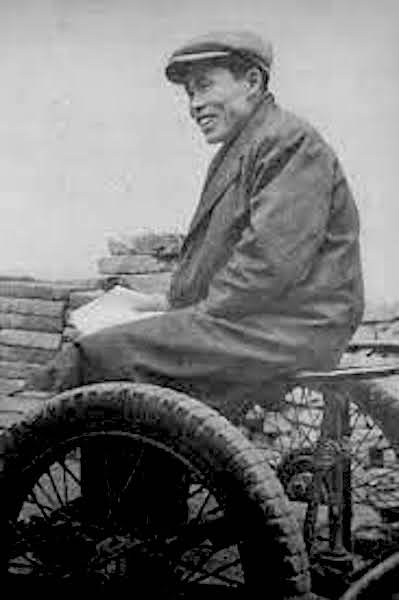
Top Insert Image: Photographer Unknown, “Cecil Milton Hepworth”, circa 1910-1920

Three Insert Images: Lewis Carroll, “Alice’s Adventures in Wonderland”, 1895, Book Cover with Two Illustrations by John Tenniel, Publisher McMillan & Company, New York

James Sibley Watson Jr: Film History Series

James Sibley Watson Jr., “Lot in Sodom”, 1933, Black and White Film, Twenty-Seven Minutes, Co-Producer: Melville Weber, Musical Score: Alex Wilder, Starring Friedrich Haak, Hildegarde Watson, Dorothea Haus, Lewis Whitbeck

Born in Rochester, New York in August of 1894, James Sibley Watson Jr. was an American medical doctor, publisher, photographer and experimenter in motion pictures. As an heir to the Western Union telegraph fortune created by his grandfathers, Don Alonzo Watson and Hiram Sibley, he grew up in a wealthy family that cultivated appreciation for the arts and encouraged an active, generous engagement in the Rochester community.

In June of 1916, Watson graduated from Harvard where he made two lifelong friends: poet, art collector and future business partner Scofield Thayer and poet-playwright E. E. Cummings. After graduation, Watson married the singer and actress Hildegarde Lasell who shared Watson’s passion and generous support for all fields of the arts. Despite his shy personality, Watson had several successful careers during his life. He became not only a practicing medical doctor but also contributed in both the publishing and film industries. 

James Sibley Watson was directly involved in the Modernist literary movement through his association with the modernist magazine “The Dial”. Originally an editorial reader, he and Scofield Thayer purchased the magazine in 1918 and produced their first issue in January of 1920. The magazine would feature works by friends of Thayer and Watson such as Cummings and the versatile sculptor Gaston Lachaise. After Thayer suffered a nervous breakdown in 1926, poet and critic Marianne Moore took his place as  editor. These three figures developed “The Dial” into one of the most influential magazines of American Modernism.

In the waning years of “The Dial” before it ceased publication in 1929, Watson became increasingly interested in experimental short films. He was joined in his endeavors by fellow Harvard graduate Melville Folsom Webber, who would become his permanent partner in film. The first film produced was a 1928 seventeen-minute ethnographic film entitled “Nass River Indians” which was distributed solely in Canada. Later in 1928, they produced a short avant-garde film “The Fall of the House of Usher”. Based on Edgar Allan Poe’s short story, this film achieved widespread success and was hailed as a major contribution to motion film. The third film of their collaboration was a lesser known work, the 1930 parody of sound-film melodrama “Tomatos Another Day”.

James Watson and Melville Webber’s next serious avant-garde film was the 1933 “Lot in Sodom” based on the Biblical tale of Sodom and Gomorrah. Directed by Watson and Webber, the twenty-seven minute film used multiple experimental techniques, avant-garde imagery and presented strong allusions to sexuality, particularly homosexuality. Composer Alec Wilder, a close friend of Watson, recruited the actors for the production, acted as assistant director and composed the original experimental soundtrack. The cast included Friedrich Haak as Lot, James’s wife Hildegarde as Lot’s wife, Dorothea Haus as Lot’s daughter and Lewis Whitbeck as the angel. 

Watson and Webber also produce a 1931 industrial film in collaboration with optical company Bausch & Lomb entitled “The Eyes of Science”. Multiple exposures, lap dissolves, color and micro-cinematography, as well as a number of unusual photographic effects, gave this film a technical interest much above the average. In 1938, Watson, this time in collaboration with filmmaker Ken Edwards, was engaged by the Kodak Research Laboratories to produce an industrial film on its manufacturing process for film and cameras. In “Highlights and Shadows”, Watson used the multiple exposure imagery he had used in his previous films to make the tool and die drill presses, assembly lines of camera parts, and the film coating process every bit as expressive and interesting as an MGM historic drama. The film featured a score performed by the symphony orchestra of the Eastman School of Music directed by Dr. Howard Hanson. 

After his work with “The Dial” and motion pictures, James Sibley Watson continued his medical career, with a specialization in gastrointestinal studies. The first color photographs of the stomach’s interior have been credited to him. Watson kept up his correspondence with E. E. Cummings, Alex Wilder and others from his days at “The Dial”. In the 1980s, he founded a private press, the Sigma Foundation, with writer and publisher Dale Davis. After Watson’s death in March of 1982, his second wife Nancy Watson Dean appointed Davis as executor and sold the Watson papers that Davis had compiled to the New York Public Library. 

Note:The full-length 1933 “Lot and Sodom” by James Sibley Watson Jr. can be found at the Internet Archive located at: https://archive.org/details/Lot_in_Sodom_1933

An excellent 1975 article written by James Sibley Watson Jr. on his production of the films “The Fall of the House of Usher” and “Lot in Sodom” was published in the University of Rochester Library Bulletin. The article can be found at: https://rbscp.lib.rochester.edu/3507

The 1938 black and white film “Highlights and Shadows” and an article on its production can be found at the online Eastman Museum site located at: https://www.eastman.org/highlights-and-shadows 

Top Insert Image: Photographer Unknown, “James Sibley Watson Jr.”, circa 1930-1940, Memorial Art Gallery of the University of Rochester

Remaining Insert Images: James Sibley Watson Jr, “The Fall of the House of Usher”, 1928, Film Scene Gifs

Dziga Vertov: Film History Series

Dziga Vertov, “Man with a Movie Camera”, 1929, Film Scene Gifs, Cinematographer Mikhail Kaufman, Silent Film, Running Time 68 Minutes, All-Ukrainian Photo Cinema Administration/Dovzhenko Film Studios

“Man with a Movie Camera” is a 1929 experimental film which was written and directed by the Soviet pioneer documentary film and newsreel director Dziga Vertov. His filming practices and theories influenced the cinéma vérité style of documentary film-making which combined improvisation with the use of the camera to unveil truth or hidden subjects. This style would sometimes involve stylized set-ups and interaction, at times provocative, between the filmmaker and the subject. 

The cinematographer was Mikhail Kaufman, the younger brother of Vertov and the actor who played the man of the film. The film was edited by Vertov’s wife, Yelizaveta Svilova, who became known for her documentaries on World War II and for her work as co-director of the 1945 “The Fall of Berlin”, the 1946 Stalin Prize winner. The film is famous for its cinematic techniques which included multiple exposures, fast and slow motion, split screens, extreme close-ups, tracking shots, and jump cuts, in which footage from a scene is removed to render a jump in time.

“Man with a Movie Camera” presents urban life in Moscow, Kyiv, and Odesa during the late 1920s. Ordinary Soviet citizens are shown, from dawn to dusk at work and at play, in scenes where they interact with the structure of everyday life. Divided into six separate parts, one for each film reel printed, the film is done in an avant-garde style with varying subject matter. Mixed in with scenes of laborers at work and sporting scenes are scenes of Mikhail Kaufman traveling to locations and setting up his camera, as well as Svilova cutting and editing strips of film. Several staged situations are also on the film, including a spliced scene of falling chess pieces played backwards.

Dziga Vertov was a member of a movement of filmmakers know as the kinoks whose mission was to abolish all non-documentary styles of film making. Most of his films were controversial and despised by many filmmakers. Vertov’s “Man with a Movie Camera” was a response to critics who rejected his previous film “A Sixth Part of the World”. Produced in 1926, it depicted through a travelogue format the multitude of Soviet people in remote areas and the wealth of the nation. Although well received by Pravda, the newspaper of the Communist Party, prominent critics gave it bad reviews. 

“Man with a Movie Camera” was not always a highly regarded work; it was criticized for both its stark experimentation and for its staging. Vertov’s Soviet contemporaries criticized its focus on form rather than content. The pace of the film’s editing, four times faster than a typical film of the era, with about seventeen hundred individual shots, bothered many viewers and critics. Today it is regarded by many as one of the great films ever made; it ranked nine in the 2022 Sight & Sound poll of the world’s best films. Throughout the years, many notable composers have written soundtracks for the film. 

Note: Dziga Vertov’s “Man with a Movie Camera” in its entirety can be seen on YouTube and on the DailyMotion website located at: https://www.dailymotion.com/video/x21992b  

Teinosuke Kinugasa: Film History Series

Teinosuke Kinugasa, “Kurutta Ippeiji (Page of Madness)”, 1926/1975, Film Scene Gifs, Cinematogapher Kōhei Sugiyama, Seventy-one Minutes, Kinugasa Productions/New line Cinema

Born in January of 1896 in Kameyama located in the northern prefecture of Mie, Teinosuke Kinugasa was a Japanese film maker. He began his career as an onnagata, an actor who specialized in female roles, and performed in the silent films of the Nikkatsu Studio, Japan’s oldest major movie studio founded in 1912.

Kinugasa started directing in the early 1920s when Japanese cinema began using actresses in its films. He worked for various producers, including Shozo Makino considered one of the pioneering directors of Japanese film. Kinugasa became an independent director and producer to make what is considered his best known film “A Page of Madness”. Lost for forty five years, the film was discovered by Kinugasa in his storehouse in 1971 and re-released in 1975 with a new print and score.

Released in September of 1926, the silent film “A Page of Madness” is part of the work of the Shinkankakuha, an avant-garde group of Japanese modernist artists  known as the School of New Perceptions which sought to produce direct, intuitive sensations to its subjects through dramatic and theatrical strategies. Yasunari Kawabata, who would win the 1968 Nobel Prize for Literature, is credited on the film with the original storyline and also worked on the film’s scenario with Banko Sawada and Minoru Inuzuka, who became well known for his later scripts on the Zatoichi film series. 

The film takes place in a countryside asylum where a janitor interacts with various patients with mental illnesses. His daughter arrives to visit her mother who happens to be a inmate in the asylum, gone insane due to her husband, the janitor. Feeling guilty, her husband had taken a job at the asylum to care for her. After hearing from his daughter the plans of her marriage, the janitor becomes worried due to the belief  that his wife’s mental illness might cause the marriage to be canceled. The stress of his wife’s condition and the impending marriage of his daughter causes the janitor to lose control of the difference between dreams and reality. He experiences fantasies of taking his wife from the asylum and his daughter marrying a bearded inmate. He finally returns to a sense of realtiy after his dreams of providing happy-faced masks to the inmates.

Teinosuk Kinugasa’s “A Page of Madness” and his later 1928 silent film “Jûjiro (Crossroads)”, the first Japanese film to be commercially released in Europe, are both praised for their inventive camera work, which has been compared to Germany’s Expressionist work of the same period. In “Crossroads”, Kinugasa dispensed with chronological construction and instead used flashbacks to stimulate the mind of the main character. He also used a drab gray setting and an experimental camera technique which focused attention on one significant detail at a time, such as a hand. 

Following a period of silent films, Kinugasa directed jidaigeki, period dramas most often set in the Edo period of Japanese history, at the Shochiku Studios where he helped to establish the career of  film and stage actor Chōjirō Hayashi, known by his professional name Kazuo Hasegawa. After the war, Kinugasa produced films for Daiei Studios, including lavish costume dramas and films such as the 1946 “Aru Yo No Tonosama (Lord for a Night)”, which won the first Mainichi Film Award for Best Film, and the 1952 “Daibutsu Kaigen (Dedication of the Great Buddha)” which was entered into the 1953 Cannes Film Festival.

In 1953, Kinugasa wrote and directed the 1953 jidaigeki film “Jigokumon (Gate of Hell)”. This film, one of the most internationally famous of all Japanese films, exemplified Kinugasa’s mastery of period film in its meticulous reproduction of a historical period. Produced during the golden age of Japanese cinema, the film was the first color work released by Daiei Film and also the first Japanese color film to be released outside of Japan. The film won the grand prize award at the 1954 Cannes Film Festival, a 1055 Academy Honorary Award for Best Foreign Language Film in 1954, and the Academy Award for Best Costume Design, Color. Kinugasa’s film also won the Golden Leipard at the Locarno International Film Festival and the 1954 New York Film Critics Circle Award for Best Foreign Language Film. 

The director of fifteen films, many of them award winners, Teinosuk Kinugasa died at the age of eighty-six from cerebral thrombosis on February 26th of 1982 in Kyoto, Japan. He was the first Japanese motion-picture director to present his story from the point of view of one of the characters and thus create a subjective world in a film.  He also pioneered in the use of flashbacks and in the creation of a visual atmospheric effect. 

Note: Teinosuk Kinugasa’s “Page of Madness” is available in its entirety on YouTube located at https://www.youtube.com/watch?v=yb6JEY3M_Ag

Second Insert Image: Film Scene, Teinosuke Kinugasa, “Dai Chushingura”, 1932, Starring Jusaburo Bando and Chojiro Hayashi, First Sound Version of the Classic Story, 139 Minutes

Third Insert Image: Photographer Unknown, “Teinosuke Kinugasa”, circa 1912-1920, Gelatin Silver Print

Bottom Insert Image: Film Scene, Teinosuka Kinugasa, “Jujiro (Crossroads)”, 1928, Starring Akiko Chihaya, Toshinosuke Bando and Yukiko Ogawa, 88 Minutes

Gloria Grahame: Film History Series

tumblr_po4zqc02cP1qadho7o1_500

Gloria Grahame, “Human Desire”, 1954, Director Fritz Lang, Cinematographer Brunett Guffey

Gloria Grahame Hallward, born November 28, 1923, was an American film star, singer, and stage and television actor. After appearing on Broadway for several years, she was signed to a contact with MGM Studios in 1944 . Two years after her film debut in “Blonde Fever”, she was given the role of flirty Violet Bick, saved from disgrace by Stewart’s George Bailey,  in the 1946 “It’s A Wonderful Life”. Her contract was then sold to RKO Studios in 1947 which featured her in several film noir pictures, portraying beautiful, flawed but seductive, women.

Gloria Grahame received an Oscar nomination for Best Supporting Actress for her role portraying Ginny Tremaine in the 1947 “Crossfire”, a film noir drama based on the theme of anti-Semitism. In 1950 she appeared with Humphrey Bogart in Columbia Pictures’ film “In a Lonely Place”, garnering praise from critics. Her very short role of nine minutes playing southern belle Rosemary Bartlow in the 1952 “The Bad and the Beautiful” won her the Academy Award for Best Supporting Actress.

Grahame appeared in two films directed by Fritz Lang: the 1953 film noir “The Big Heat”, a crime drama co-starring Lee Marvin and Glenn Ford; and the 1954 film noir “Human Desire”, playing the femme fatale Vicki Buckley opposite her jealous film husband played by Broderick Crawford. As her film career began to wane, Grahame returned to the stage and made several guest appearances on television, including “The Twilight Zone” and “The Fugitive”.

After an initial bout with breast cancer in 1974, which had gone into remission, Gloria Grahame was again diagnosed with its return in 1980. Despite her failing health, she continued to work on stage in England and the United States. At the age of fifty-seven in 1981, Gloria Grahame was admitted to Saint Vincent’s Hospital in New York City, where she passed a few hours after admittance. She is buried at the Oakwood Memorial Park Cemetery in Los Angeles. For her work in the film industry, Gloria Grahame has a star on the Hollywood Walk of Fame. An account of Grahame’s final years of life, based on recollections of actor Peter Turner, was presented in the 2017 film “Film Stars Don’t Die in Liverpool”.

Main Image reblogged with thanks to http://doctordee.tumblr.com

Tope Insert Image: Burnett Guffey, “Gloria Grahame and Humphrey Bogart”, 1950, “In a Lonely Place, Film Still

Bottom Insert Image: Charles Lang, “Gloria Grahame”, 1953, “The Big Heat”, Film Still

Buster Keaton: “The Haunted House”: Film History Series

Buster Keaton, “The Haunted House”, 1921, Directors Buster Keaton and Edward F Cline, Cinematographer Elgin Lessley≠≠≠

Happy Halloween

Written and directed by Buster Keaton and Edward F. Cline, the 1921 “The Haunted House”, an American two-reel silent comedy film, starred actor and comedian Joseph Frank “Buster” Keaton. Keaton is best known for his silent film work with its physical comedy and his stoic, deadpan expression. 

“The Haunted House” was shot in a time of simplistic comedic storytelling.The film used a generic, two-decades old story of haunted houses occupied by criminals, one which remained a favorite of theater audiences. Cinematography was done by special effects artist Elgin Lessley, a groundbreaking hand-cranked cameraman who had previously worked with Roscoe “Fatty” Arbuckle. The film was produced by Joseph M. Schenck who became the second president of United Artists Studio, and later, co-founded Twentieth Century Pictures with Darryl F. Zanuck.

In the film, Buster Keaton plays a teller at a successful bank who, in the process of thwarting a robbery, is mistaken for one of the thieves. He takes refuge in an old house unaware that it is a rehearsal space for a theatrical troupe clad in scary costumes. Keaton and the robbers, also hiding there, have many encounters with the costumed actors and the house’s booby traps. 

After it is revealed that the thieves’ leader is the bank’s manager, Keaton suffers a blow to the head which renders him unconscious. A dream sequence follows in which he is revived by angels and taken to Heaven. Denied entrance by Saint Peter, Keaton is sent to Hell instead. At the end of the twenty-one minute film, he regains consciousness to realize only a few seconds had passed. 

Reblogged with thanks to http://catholicboysdetention.tumblr.com

Jean Cocteau: Film History Series

Enrique Riveros, “The Blood of a Poet”, 1932, Director Jean Cocteau, Cinematographer Georges Périnal

Jean Cocteau’s “The Blood of a Poet” is an avant-garde film which starred Enrique Riveros, a Chilean actor who had a successful career in European films. It is the first part of the Orphic Trilogy, which is continued in the 1949 “Orphee”, and followed by the 1960 “Testament of Orpheus”.

The film was financed by French nobleman Charles de Noailles who gave Cocteau one million francs to make the film. Shortly after the completion of the film, rumors began circulating that it was an anti-Christian message. Due to the riotous public reaction to Noailles’s previous film “L’Age d’Or”, Cocteau’s release date for his film was delayed for more than a year. “The Blood of a Poet” was finally released on January 20, 1932.

In this scene from the second section of the film, the artist played by Riveros is transported through the mirror to a hotel, where he peers through several keyholes, witnessing such people as an opium smoker and a hermaphrodite. The artist finally cries out that he has seen enough and returns back through the mirror.

“Many years ago, as I was glancing through a catalogue of jokes for parties and weddings, I saw an item, ‘An object difficult to pick up’. I haven’t the slightest idea what that ‘object’ is or what it looks like, but I like knowing that it exists and I like thinking about it.

A work of art should also be ‘an object difficult to pick up’. It must protect itself from vulgar pawing, which tarnishes and disfigures it. It should be made of such a shape that people don’t know which way to hold it, which embarrasses and irritates the critics, incites them to be rude, but keeps it fresh. The less it’s understood, the slower it opens its petals, the later it will fade. A work of art must make contact, be it even through a misunderstanding, but at the same time it must hide its riches, to reveal them little by little over a long period of time. A work that doesn’t keep its secrets and surrenders itself too soon exposes itself to the risk of withering away, leaving only a dead stalk.” 

Jean Cocteau, Cocteau on the Film, 1972, Dover Publications

Reblogged with thanks to http://bandit1a.tumblr.com

Kaneto Shindo, “Onibaba”: Film History Series


Kaneto Shindo, “Onibaba (Demon Hag)”, 1964, Cinematogapher Kiyomi Kuroda

Born in Saeki in the Hiroshima Prefecture in April of 1912, Kaneto Shindo was a Japanese film director, screenwriter, film producer and writer. One of the pioneers of independent film production in Japan, he co-founded, with director Kōzaburō Yoshimura and actor Taiji Tonoyama, the film company Kindai Eiga Kyōkai which produced most of Shindo’s films, most notably “The Naked Island” and “Ohibaba”.

Born to wealthy landowners, Kanato Shindo was the youngest of four children. His father was a loan guarantor; however, he went bankrupt and all family members, now living in a storehouse, had to seek employment to support the household. Shindo’s mother worked as an agricultural worker until her death in his early childhood. Living with his brother in 1933, Shindo was inspired by Sadao Yamanak’s early film “Bangaku No Isshō” to seek a career in film. He saved enough money working for a year at a bicycle shop to enable his move to Kyoto, the major cultural capital of Japan.  

In Kyoto, Kanato Shindo found employment at the film developing department of Shinkō Kinema, a successful film studio and distributor in the 1930s. With access to old scripts, he studied them and their relationships to the films that were processed. When Shinkō Kinema moved to Tokyo in November of 1936, Shindo was able to get a position in its art department managed by Hiroshi Mizutani, a talented art director and production designer. For his work as an art director, he scouted and sketched locations for film shooting, cameras being less used at the time.

While working at Shochiku Film Studios after World War Two, Shindo met director Kōzaburo Yoshimura and began one of the most successful film partnerships in Japan’s postwar industry. The partnership’s first critical hit was the 1947 “A Ball at the Anjo House”, a drama film that won the prestigious Kinema Junpo Award. Both men left Shochiku Studios to form, along with actor Taiji Tonoyama, the independent film company Kindai Eiga Kyokai, which produce most of Shindo’s films. 

In 1951, Kanato Shindo made his debut as director with the autobiographical drama “Story of a Beloved Wife”, with actress Nobuko Otowa in the role of his deceased common-law wife Takako Kuji. After directing the 1952 “Avalanche”, Shindo made the 1952 “Children of Hiroshima”, a drama of a young teacher who returns to Hiroshima to find surviving friends. Premiered at the 1953 Cannes Film Festival, this first Japanese film to deal with the atomic bomb was an international success. This pivotal film was followed by Shindo’s 1953 “Epitome”, whose central theme was the strength and endurance of women in times of distress.

Between 1953 and 1959, Shindo made political films that were critiques of poverty and women’s suffering in contemporary Japan. These included the 1953 “Life of a Women”, the 1954 “Dobu”, and the 1955 “Wolf”, based on a true story of desperate men and women who rob a money transport. In 1960, Shindo put all his resources into producing his “The Naked Island”, a non-dialogue black and white drama film of a struggling couple with two young sons living on a small island with no water supply. The film was awarded the Grand Prize at the Second Moscow International Film Festival in 1961.

After making “Ningen” in 1962 and “Mother” in 1963, Kanato Shindo shifted his focus as filmmaker to the individuality of a person, specifically a person’s sexual nature. From these ideas came his 1964 film “Onibaba”. Written and directed by Shindo, this historical drama-horror film was inspired by the Shin Buddhist parable of “yome-odoshi-no men”, in which a mother used a mask to scare her daughter from going to the temple. In the parable, the mother was punished by the mask sticking to her face. After begging to remove it, she was able to take it off, but the flesh of her face came with it.

“Onibaba” stars Nobuko Otowa and Jitsuko Yoshimura as fourteenth-century Japanese peasant women living in a reed-filled marshland who survive by killing and robbing defeated samurai. Wanting to film in a field of suski grass, Shindo found his location at inna-Numa in Chiba. Filming for the black and white film started on the thirtieth of June in1964 and continued for three months. Some of the sequences were shot in slow-motion. Its background and title music consists of Taiko drumming combined with jazz.

“Onibaba” won numerous awards and the Grand Prix at the Panama Film Festival. The Award for Best Supporting Actrress went to Jitsuko Yoshimura and the Best Cinematography Award to Kiyomi Kuroda at the 1964 Blue Ribbon Awards by the Association of Tokyo Film Journalists.  

Gaston Velle, “La Metamorphose du Papillon”: Film History Series

Gaston Velle, “Métamorphoses du Papillon (The Butterfly’s Metamorphosis)”, 1904,  Silent Hand-Colored Nitrate Film, Running Time Two Minutes, Pathé Frères, Collection of the AMCI 

Born in Rome, Italy in 1868, Gaston Velle was a French silent film director and a pioneer in the field of special effects. He was a prominent figure in both French and Italian cinema in the early twentieth-century.

Gaston Velle was the son of Hungarian entertainer Joseph ‘Rrofessor’ Velle, a magician who traveled throughout Europe preforming for the nobility. He began his career as a traveling magician; however when the opportunity presented itself, he entered the developing world of cinematography where he employed his illusionist skills. Velle worked under the Lumière brothers, Auguste and Louis Jean, who were using the newly patented Cinematograph system to make short silent films. Velle nest served as the head of production for the Italian studio Società Italiana Cines, both a producer and distributor of films.

Velle created more than eighty films between 1903 and 1911. He is best known for those works produced at Pathé Frères, a business founded by the four Pathé brothers in 1896. By the early 1900s, this company developed into the world’s largest film equipment and production company, as well as, a major producer of phonographs and their cylinder and disc records. Velle produced for Pathè short films designed to feature special effects; these were intended to rival those of film director Georges Méliès, France’s leading pioneer of special effects films. 

One of Gaston Velle’s earliest directorial works was the 1904 short silent crime film “Les Devaliseurs Nocturnes (Night Burglars)”. Some of Velle’s films pioneered techniques which have been used by others over the years. His 1906 “Les Invisibles” is the first known invisible man film. Valle also created some of the first Féerie films known for their fantasy plots, visual effects and lavish scenery. These films used a fairy-tale design to combine theater with dance, mime and acrobatics.

Velle collaborated with other directors on film projects, including Spanish director Segundo de Chomón, who previously did the cinematography on Velle’s “Night Burglars”, and French director Ferdinand Zecca, who as a Pathé director set up the Pathé pavilion at the 1900 Paris Exposition Universelle. Among these collaborative efforts were such silent film classics as the 1905 “Réve à la Luna (The Moon Lover)”, the 1906 “L’ecrin du Rajah (The Rajah’s Casket)” and the 1905 “La Poule aux Oeufs d’Or (The Hen Who Laid the Golden Egg)”. Director Martin Scorsese inserted “La Poule aux Oeufs d’Or”  into his 1997 Academy Award nominated film “Kundun”. 

Gaston Velle retired from the film industry in 1913. There is little information available about the last decades of his life. He still remained part of a prominent cinematic family as his son Maurice Velle, a cinematographer, married and had a family with screenwriter Mary Murillo. Gaston Velle died in Paris on the eighth of January in 1953 at the age of eighty-five. 

Gaston Velle’s 1904 “Métamorphoses du Papillon (The Butterfly’s Metamorphosis)” is a hand-colored, silent nitrate print film with a running time of less than two minutes. The film follows a caterpillar’s change into a butterfly which later morphs into a female dancer. It is currently housed in the collection of the Australian Centre for the Moving Image, ACMI, at Federation Square in Melbourne. Additional information, as to cinematographer and the actress portraying the dancer, is not known. The full length film can be seen on several online venues including YouTube.  

Second Insert Image: Gaston Velle, “Voyage Autour d’Une Étoile (Voyage Around a Star)”, 1906, Short Silent Film, Pathé Frères

Bottom Insert Image: Gaston Velle, “La Poule aux Oeufs d’Or”, 1905, Short Silent Film, Pathé Frères

Riz Ahmed, “Encounter”: Film History Series

Riz Ahmed as Malik Khan in “Encounter”, Directed by Michael Pearce, 2021

“Encounter” is a 2021 drama-thriller film directed by Michael Pearce from a screenplay written by Pearce and British screenwriter Joe Barton. It is a story of a recently paroled man, suffering from a mental disturbance, who abducts his two sons and flees on a road trip. The film stars Riz Ahmed as Malik Khan as the parolee, Janina Gavankar as  his wife Piya, and Lucian-River Chauhan and Aditya Geddada as the two sons, Jay and Bobby Khan. Misha Collins plays Dylan, the mother’s new partner, and Octavia Spencer plays Hattie Hayes, the federal law enforcer attempting to retrieve the children.

In October of 2018, Film4 Productions and Raw, both British film production companies, agreed to produce the film. The principal photography began in October of 2020; by November of that year, all the cast members had joined the production. Amazon Studios became the distributor. “Encounter had its world premiere at the Telluride Film Festival and an international premiere at the Toronto Film Festival. It was later screened at film festivals in London, Chicago, and Philadelphia. “Encounter” appeared on Amazon Prime Video on the 10th of December in 2021.

Born in December of 1982, Riz Ahmed is a British actor and rapper. He has won multiple awards for his acting, including a London Film Critics’ Circle Award, a Primetime Emmy Award, and two British Independent Film Awards. He was also nominated for two Golden Globes, an Academy Award, two Emmy Awards, and two Screen Actors Guild Awards.

Ahmed appeared in the 2016 action film “Jason Bourne”, the Star Wars anthology film “Rogue One” as the character Bodhi Rock, the 2018 film “Venom” as Carlton Drake, and Ruben Stone in the 2020 “Sound of Metal”, which earned him his second Golden Globe nomination and his first Academy Award nomination.