


Photographers Unknown, Alive in Our Skins
Spared by a car or airplane crash or
cured of malignancy, people look
around with new eyes at a newly
praiseworthy world, blinking eyes like these.
For I’ve been brought back again from the
fine silt, the mud where our atoms lie
down for long naps. And I’ve also been
pardoned miraculously for years
by the lava of chance which runs down
the world’s gullies, silting us back.
Here I am, brought back, set up, not yet
happened away.
But it’s not this random
life only, throwing its sensual
astonishments upside down on
the bloody membranes behind my eyeballs,
not just me being here again, old
needer, looking for someone to need,
but you, up from the clay yourself,
as luck would have it, and inching
over the same little segment of earth-
ball, in the same little eon, to
meet in a room, alive in our skins,
and the whole galaxy gaping there
and the centuries whining like gnats—
you, to teach me to see it, to see
it with you, and to offer somebody
uncomprehending, impudent thanks.
William Morris Meredith, Accidents of Birth, Effort at Speech: New and Selected Poems, 1997
Born in January of 1919 in New York City, William Morris Meredith attended Lenox School in Massachusetts, graduating in 1936, and began writing poetry as a student at Princeton University. He graduated magna cum laude in 1940; his senior these was on the poet Robert Frost. After graduating, he worked for a year at the New York Times as a reporter before joining the army. Meredith transferred to the United States Navy in 1942 to become a pilot; he served on aircraft carriers in the Aleutian Islands and the Pacific Theater until the end of World War II.
Meredith’s first collection of poems, entitled “Love Letter from an Impossible Land”, was chosen by poet and playwright Archibald MacLeish for publication in the 1944 Yale Series of Younger Poets, an annual debut collection of promising U.S. poets. The poetry in this first collection were written while Meredith was still serving as a navy flier; many of the poems speak about the uncertainty of wartime life. His second collection of poems, “Ships and other Figures” was published in 1948. The volume contained twenty-nine brief poems, which included a trio of poems based on his wartime service.
William Meredith re-enlisted in 1952 to fly air missions in the Korean War, for which he received two Air Medals. In 1955 after his military service, he entered the academic field and taught English at the University of Hawaii, Connecticut College, and Princeton University until his retirement in 1983. In 1964, Meredith was elected as the Chancellor of the Academy of  Poets, a position he held until 1987. From 1978 to 1980, he was Consultant in Poetry to the Library of Congress, the position which in 1985 became Poet Laureate Consultant. Meredith was the first gay poet to receive this honor.
During his academic career, Meredith published his 1958 “Open Sea and Other Poems”, a collection of poems previously published in journals, and his 1964 “The Wreck of the ‘Thresher’ and Other Poems”, of which the title poem is an elegy to the “Thresher”, an American submarine lost at sea with its crew in 1963. Meredith sustained a stroke in 1983, was immobilized for two years, and began to experience expressive aphasia, a condition which affected his ability to produce language. He retired early from teaching and endured a long period of intensive rehabilitation to slowly regain his ability to speak.
A gathering of poems from Meredith’s career, entitled “Partial Accounts: New and Selected Poems” was published in 1987. Crafted from sonnets, quatrains, and and other formal poetic structures, the collection won the Pulitzer Prize for Poetry and a Los Angeles Times Book Award. 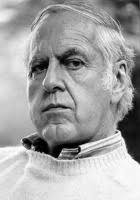 A compilation of new and previously published works, “Effort at Speech: New and Selected Poems”, published in 1997, received the National Book Award for Poetry. Both these works, written during Meredith’s long rehabilitation, won poetry’s highest awards at a time in which he was without speech.
William Morris Meredith died in 2007 at the age of eighty-eight in New London, Connecticut. Throughout his long illness, he was nursed by his longtime partner of thirty-six years, the poet and fiction writer Richard Harteis. The William Meredith Foundation and the William Meredith Center for the Arts were established to continue his legacy through residency programs, poetry series, and other activities.
One of the most complete collections of William Meredith’s work can be found at Connecticut College. Acquired in 1994, the collection contains letters, drafts, speeches and papers from his time with the Library of Congress, government agencies, and many colleges.
Thanks for sharing this. I am glad someone else put those thoughts into words—-the ones in the poem above!