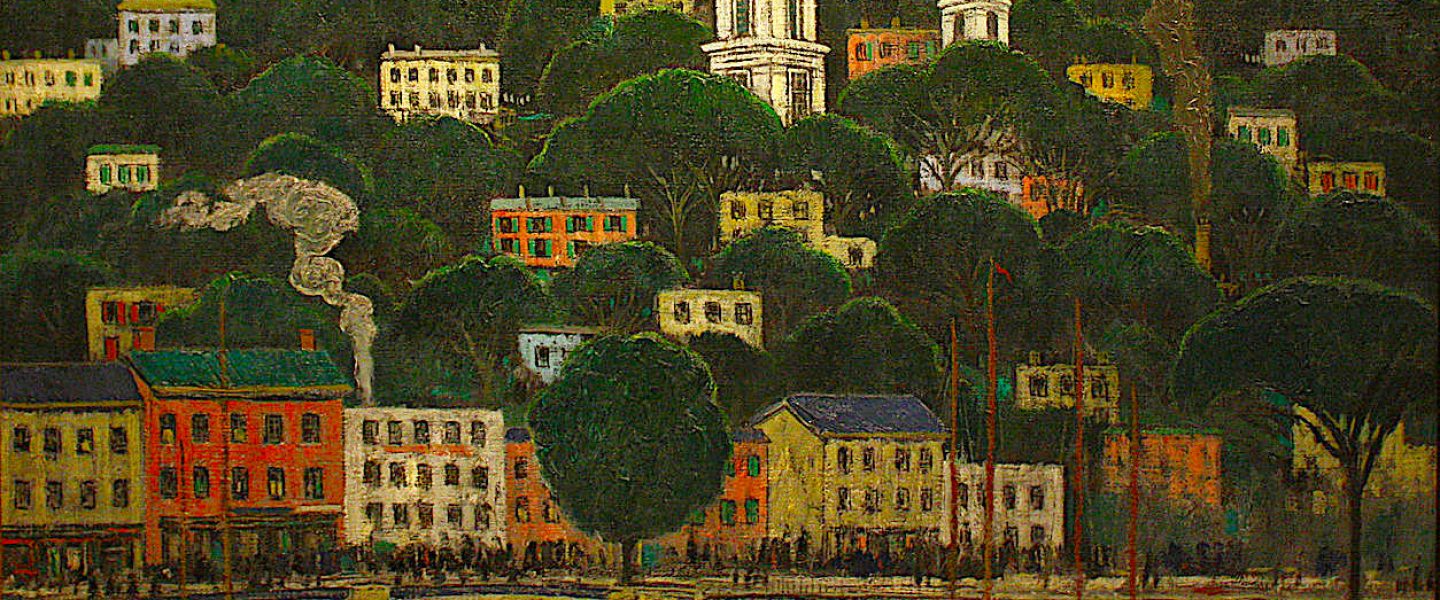
Michael Murfin

Paintings by Michael Murfin

Born in 1954, Michael Murfin is a British contemporary painter naturally inclined to find evoking images of  both memory and culture in the everyday world. An early and important influence on his artistic development came from Dave Terry, head of his school’s art department, who emphasized the thoughtful and concentrated viewing of the subject to be painted or drawn. This foundational method played an essential role in Murfin’s later work.

Murfin attended Trent Polytechnic in Nottingham, earning his BA in Fine Art, and earned his MA in Painting at Birmingham Polytechnic. After leaving college, he worked for a time as a builder’s merchant laborer and sawmill assistant, while continuing to produce a series of drawings and paintings. These were exhibited in 1981 at the Summer Exhibition, presented by the Serpentine Gallery, in Kensington Gardens. After an exhibition at the Imperial College in London, Murfin’s work received regular showings at the Piccadilly Gallery throughout the 1980s and 1990s. 

Michael Murfin’s work has shown in many local exhibitions, including the 2003 “Full Circle” at the St. Neots Museum, the 2010 “Mixed Exhibitin” ath the Sheridan Russell Gallery in London, and, between 2005 and 2018, four shows at the Yarrow Gallery in Northamptonshire where he has been Artist in Residence.His work has also been exhibited at the International Art Fairs in London, Basel, and Cologne. Most recently, his work has been supported by the Woodbine Contemporary Arts with locations in Spalding and Uppingham. 

Michael Murfin’s work can be found at : http://www.michaelmurfinartist.com

Ram Shergill, “Aaran Sly”

Ram Shergill, “Aaran Sly”, Photo Shoot Entitled ‘The Proust Ball’

British-born Indian fashion photographer Ram Shergill was severely visually impaired as a child. After having his eyesight corrected, he discovered the work of artists such as Richard Avedon, Cecil Beaton, and Irving, whom he credits as important inspirations and whose influence can be seen in his works. Shergill often uses the iconic images of previous fashion photographers and Old Master painters as inspirational starting points for his images, transforming them to create new effects for his contemporary models and settings. 

During his studies, Shergill initially worked with Philip Treacy on a project and, as a result, starting to work with Isabella Blow and Alexander McQueen, becoming a force within the fashion and art world himself. Shergill has became one of the key imagists of the avant-garde ‘Cool Britannia’ fashion scene and one of Britain’s leading fashion photographers and has since progressed into fine art photography.

Ram Shergill often designs his fashion and art photography toward the Indian Subcontinent, a region. often overlooked, with which he maintains a strong relationship. His works often show models exploring the culture and landscape of India’s culturally diverse provinces. A selection of his work of singer songwriter Amy Winehouse has been acquired by the National Portrait Gallery and are now part of the permanent Collection alongside artists such as David Hockney and Cecil Beaton.

Ram Sergill’s image above shows English model Aaran Sky in a setting with an atmospheric reminiscence of the Proust Ball. This gala occasion was considered socialite Marie-Helene de Rothschild’s greatest triumph, a 1971 ball thrown in honor of the 100th anniversary of Marcel Proust’s birth. Around 350 guests attended the extremely rich dinner at Château de Ferrières, her home outside of Paris, with 350 more guests arriving in time for a second, later dinner. Among the guests were Princess Grace of Monaco, Audrey Hepburn, Elizabeth Taylor and Richard Burton, and French model and actress Marisa Berenson. The photographer for the event was the renowned Cecil Beaton.

Ram Sergill’s website is located at: https://www.ramshergill.com

Keith Haring

Keith Haring, Unfinished Painting, 1989

The Keith Haring Foundtion

The mission of the Keith Haring Foundation is to sustain, expand, and protect the legacy of Keith Haring, his art, and his ideals. The Foundation supports not-for-profit organizations that assist children, as well as organizations involved in education, prevention, and care related to AIDS.

Keith Haring generously contributed his talents and resources to numerous causes. He conducted art workshops with children, created logos and posters for public service agencies, and produced murals, sculptures, and paintings to benefit health centers and disadvantaged communities. In 1989, Haring established a foundation to ensure that his philanthropic legacy would continue indefinitely.

The Keith Haring Foundation makes grants to not-for-profit groups that engage in charitable activities. In accordance with Haring’s wishes, the Foundation concentrates its giving in two areas: the support of organizations which enrich the lives of underprivileged children and the support of organizations which engage in education, prevention, and care with respect to AIDS and HIV infection.

Keith Haring additionally charged the Foundation with maintaining and protecting his artistic legacy after his death. The Foundation maintains a collection of art along with archives that facilitate historical research about the artist and the times and places in which he lived and worked. The Foundation supports arts and educational institutions by funding exhibitions, programming, and publications that serve to contextualize and illuminate Haring’s work and philosophy.

For more information on the Foundation, current exhibitions, and information on Keith Haring’s life, please visit: https://www.haring.com

Notes: For those interested in Keith Haring’s life and art, I recommend Brian Ferrari’s reprint of the short-lived gay men’s magazine “Heat” article entitled “The Life and Loves of Keith Haring” which can be located at Ferrari’s blog: https://brianferrarinyc.com/2025/06/12/keith-haring-in-heat-magazine-1992/

Arthur Schopenhauer: “Desipere est jus Gentium”

Photographers Unknown, A Collection of Twelve Portraits for a Midsummer’s Day

“The only safe rule, therefore, is that which Aristotle mentions in the last chapter of his ‘Topica’: not to dispute with the first person you meet, but only with those of your acquaintance of whom you know that they possess sufficient intelligence and self-respect not to advance absurdities; to appeal to reason and not to authority, and to listen to reason and yield to it; and, finally, to cherish truth, to be willing to accept reason even from an opponent, and to be just enough to bear being proved to be in the wrong, should truth lie with him. From this it follows that scarcely one man in a hundred is worth your disputing with him. You may let the remainder say what they please, for every one is at liberty to be a fool—desipere est jus gentium.” 

–Arthur Schopenhauer, The Essays of Arthur Schopenhauer: The Art of Controversy


Thomas Banks

Thomas Banks, “The Falling Titan”, 1795, Etching, 26 x 35.7 cm, Published by Richard Morton Paye, Royal Academy of Arts, London

Thomas Banks, “The Falling Titan”, 1786, Marble, 85 x 90 x 58 cm, Royal Academy of Arts, London

Born in 1735 in London, Thomas Banks was educated in Ross-on Wye, a small market town on the River Wye in Herefordshire. He was apprenticed to woodcarver William Barlow in London from 1750 to 1756, during which time he also studied at the studio of Flemish classical sculptor Peter Scheemakers. Banks also enrolled in the St. Martin’s Lane Academy and exhibited several works at the Free Society of Artists during the 1760s. 

Banks was admitted to the Royal Academy Schools in 1769, and had his first exhibition at the Royal Academy in 1770. In 1772, he became the first sculptor to receive the Academy’s traveling scholarship, which enabled him to travel to Rome. Banks lived in Rome between 1772 and 1779, when due to illness and financial disappointments, he returned to England. After two years in England, his desire to accomplish larger-scaled works took him to St. Petersburg in 1981 where he received commissions from Catherine the Great. who purchased his Neo-Classical “Cupid”. 

On his return to England, Thomas Banks received a number of commissions for church memorials, which included the monuments to Sir Eyre Coote and Sir Clifton Wintringham in Westminster Abbey, and monuments to Captain George Westcott and Captain Richard Burgess in St. Paul’s Cathedral. Bank’s best known work is perhaps the colossal sculptural group “Shakespeare Attended by Painting and Poetry”, commissioned in 1788 for the upper facade of the new Shakespeare Gallery in Pall Mall in Central London. It remained there until 1869, when upon the building’s demolishment, it was moved to New Place, the site of Shakespeare’s final residence.

Thomas Banks was elected in 1784 as an associate of the Royal Academy. In recognition of the support he had been given by the Academy earlier in his career, Banks presented “The Falling Titan” to the Royal Academy as his Diploma work after he was elected as a full member Academician in 1786. In comparison with the Diploma Works deposited by the earlier Academician sculptors Edward Burch, Joseph Nollekens and John Bacon, “The Falling Titan” was an extremely prestigious work to present.

Thomas Banks died in London on February 2, 1805, and became the first sculptor to have a tablet erected in his name in Westminster Abbey. He is buried in Paddington Churchyard. 

Note: Thomas Banks’ Neo-cCassical “Cupid”, purchased by Catherine the Great, was a marble statue on a pedestal. In order to save the work from the advancing German troops in World War II, the curator of the Pavlovsk Palace buried the statue next to its pedestal. Upon his return in 1944, no trace of the statue could be found; excavations for the work during a restoration garden project in the 1980s proved fruitless. More complete information on the statue’s history can be found at: https://www.thefreelibrary.com/Thomas+Banks%27s+missing+%27Cupid%27%3A+the+sculptor+Thomas+Banks+is…-a0128792200

Teresa Oaxaca

Teresa Oaxaca, “Patrick”, 2012, Oil on Canvas, 70 x 40 Inches, Private Collection

Teresa Oaxaca is an American-born painter who is currently living and working in Washington DC. She graduated with a BA from the Angel Academy of Art located in Florence, Italy. Oaxaca did her graduate studies at the Florence Academy, with an apprenticeship with Swedish-born figurative painter Odd Nerdum in Norway. She continues her studies at the Art League of Alexandria, Virginia, training with realist artists Robert Liberace. Oaxaca currently teaches workshops in the United States and Europe. 

With her studies in Italy, Teresa Oaxaca has mastered the mid-17th century Renaissance painting technique of chiaroscuro. The term ‘chiaroscuro’ originated as drawing on colored paper, where the artist worked from the paper’s base tone towards light using white gouache, and towards dark using ink or watercolor. This technique enables a painter or draftsman to increase the depth and solidity of an image, heightening realism through the use of strong contrasts between light and dark tones.

Teresa Oaxaca has participated with local groups including The Arts Club of Washington, The Art League School of Alexandria, and the National Education Association. She became a member in 2014 of the Young Partners Circle of The national Museum of Women in the Arts. Oaxaca’s work has been recognized by the Corcoran Gallery of Art, the Posey Foundation, The American Museum of the Cowboy, The Portrait Society of America, and the Museu Europeu d’Art Modern located in Barcelona. 

Current works by Teresa Oaxaca can be seen at her site: https://www.teresaoaxaca.com

Koloman Moser

The Work of Koloman Moser

Born in Austria in 1868, Koloman Moser, instead of  applying his flair and art education to paintings, embodied the idea of “Gesamt Kunstwerk”, meaning all-embracing artwork, by designing architecture, furniture, jewelry, graphics, and tapestries meant to coordinate every detail of an environment. His work transcended the imitative decorative arts of earlier eras and helped to define Modernism for generations to come. Moser achieved a remarkable balance between intellectual structure, often geometric, and hedonistic luxury.

Collaborating with Gustav Klimt and Josef Hoffmann, Moser was an editor and active contributor to “Ver Sacrum (Sacred Spring)”, the journal of the Viennese Secession that was so prized for its aesthetics and high quality production that it was considered a work of art. The magazine featured drawings and designs in the artist movement “Jugendstil (Youth Style)”  along with literary contributions from distinguished writers from across Europe. It quickly disseminated both the spirit and the style of the Secession.

In 1903 Moser and Josef Hoffmann founded and led the “Wiener Werkstatte (Viennese Workshop)’, a collective of artisans that produced elegant decorative arts items, not as industrial prototypes but for the purpose of sale to the public. The plan, as idealistic then as now, was to elevate the lives of consumers by means of beautiful and useful interior surroundings.

Moser’s influence has endured throughout the century. His design sensibility is evident from the mid-century modern furniture of the 1950s and ‘60s to the psychedelic rock posters of the 1970s and remains a source of inspiration to those currently working within the field of applied arts.

For additional information and images, the Fine Arts Library of Harvard University has an online copy of the 1902 “Surface Decoration” by Koloman Moser. The portfolio of thirty lithographs can be seen at : https://www.harvardartmuseums.org/art/56214

Arthur Schopenhauer: “Like Words to Music”

A Collection: Fauna and Flora

“Now it is very striking, and well worth investigating, that such trifling, nay, apparently childish, means as meter and rhyme produce so powerful an effect. I explain it to myself in the following manner: That which is given directly to the sense of hearing, thus the mere sound of the words, receives from rhythm and rhyme a certain completeness and significance in itself for it thereby becomes a kind of music; therefore it seems now to exist for its own sake, and no longer as a mere means, mere signs of something signified, the sense of the words.

To please the ear with its sound seems to be its whole end, and therefore with this everything seems to be attained and all claims satisfied. But that it further contains a meaning, expresses a thought, presents itself now as an unexpected addition, like words to music – as an unexpected present which agreeably surprises us – and therefore, since we made no demands of this kind, very easily satisfies us; and if indeed this thought is such that, in itself, thus said in prose, it would be significant, then we are enchanted.” 

–Arthur Schopenhauer, The World as Will and Representation: Volume Two

Every Craving

Photographer Unknown, (Every Craving), Photography / Digital Art

“To crave and to have are as like as a thing and its shadow. For when does a berry break upon the tongue as sweetly as when one longs to taste it, and when is the taste refracted into so many hues and savors of ripeness and earth, and when do our senses know any thing so utterly as when we lack it? And here again is a foreshadowing — the world will be made whole. For to wish for a hand on one’s hair is all but to feel it. So whatever we may lose, every craving gives it back to us again.”
― Marilynne Robinson

Sergei Eisenstein

Drawings and Sketches by Sergei Eisenstein

People who are passionate about cinema are familiar with Sergei Eisenstein’s films and cinema theory; fewer people know of his enthusiasm for drawing. Ever since his childhood in the Latvian city of Riga, Eisenstein has been drawing, eventually producing five thousand works over the course of his lifetime, with only a short break in the 1920s when he made his first films. The drawings were playful, funny, provocative, and inventive. 

Drawing for Eisenstein was a means to develop a visually effective language, which he applied in his work as film director. He drew circus scenes, story boards for his films, sketches to map out his filming process, as well as erotic, sacrilegious, and sexual scenes. The drawings were private affairs to Eisenstein, sources for his amusement and also a form of freedom, emotionally and artistically, from the pressures, often political, he experienced in his work. Some of the drawings were in-jokes meant to be shared with close friends; and some drawings were given away as gifts.

In 1931, Sergei Eisenstein worked in various locations of Mexico on the film project “¡Que viva México!”, produced by Upton Sinclair and a small group of investors. During this time, which included an intimate affair with his Guanajuato guide Jorge Palomino y Cañedo, the production of Eisenstein’s drawings resulted in a dramatic increase. His interest in line and the interplay of figures showed his connection to the work of Mexican muralists including Diego Rivera, whom Eisenstein first met in 1927, and whose work he greatly admired. At the end of his Mexican adventure, he told his friend Anita Brenner, that drawings were just as important to him  as film writing and film production.

“it was in Mexico that my drawing underwent an internal catharsis, striving for mathematical abstraction and purity of line. The effect was considerably enhanced when this abstract, ‘intellectualized’ line was used for drawing especially sensual relationships between human figures.” —Sergei Eisenstein, 1947

Drawings done after Eisenstein’s return to the Soviet Union are no less provocative than the Mexican ones, but they are more sparsely articulated. In these later works, Eisenstein used line only, minimizing the shading and shaping of figures. Included in these, we find two sketches for an unrealized film on Alexander Pushkin; several drawings done during the filming of his “Ivan the Terrible”; and а series that appears to have been inspired by George Grosz’s images of maimed war veterans.

After Eisenstein’s death, his widow, Pera Atasheva, gave most of his drawings to the Russian State Archive of Literature and Art. She did not release a relatively small cache of about 500 drawings that had sexual subject matter, because Atasheva feared that they might be considered harmful to the Eisenstein’s legacy. Later, she passed them for safekeeping to Andrei Moskvin, a friend and the cameraman who had worked with Eisenstein on the filming of “Ivan the Terrible”. After perestroika, Moskvin’s descendants sold the drawings to a private collector in the west. 

Eisenstein’s drawings kept at the Russian State Archive were first shown in 2000 at the Drawing Center, a not-for-profit art institution, in Soho. New York, A first-show  exhibition of the drawings, once held safely by Andrei Moskvin, were shown at the contemporary art gallery Alexander Gray Associates in New York in early 2017.