Minor White


Minor White, “Tom Murphy (San Francisco)”, 1948, Gelatin Silver Print from the Series “The temptation of Saint Anthony is Mirrors”

Minor Martin White was an photographer, theoretician, critic and educator. He combined an intense interest in how people viewed and understood photographs with a personal vision that was guided by a variety of spiritual and intellectual philosophies.

Starting in Oregon in 1937 and continuing until he died in 1976, Minor White made thousands of black-and-white and color photographs of landscapes, people and abstract subject matter, created with both technical mastery and a strong visual sense of light and shadow.

Minor White taught many classes, workshops and retreats on photography at the Rochester Institute of Technology, California School of Fine Arts, the Massachusetts Institute of Technology, and in his own home. He lived much of his life as a closeted gay man, afraid to express himself publicly for fear of loss of his teaching jobs. Some of White’s most compelling images are figure studies of men whom he taught or with whom he had relationships.

Calendar: December 1

A Year: Day to Day Men: 1st of December

The Painted Wall

December 1, 1887 marks the first appearance of Sherlock Holmes in print.

The first appearance of Sherlock Holmes was in the detective novel “A Study in Scarlet” written by British author Sir Arthur Conan Doyle. It appeared in the magazine “Beeton’s Christmas Annual” on December 1st of 1887, published by Ward Lock and Company of London. Although Sir Conan Doyle wrote fifty-six short stories featuring Holmes, “A Study in Scarlet” is one of only four full-length novels in the original canon.

Sir Conan Doyle, a general practice doctor,  wrote “A Study in Scarlet” at the age of twenty-seven in less than three weeks. The novel was originally entitled “A Tangled Skein” but changed for publication in the Christmas Annual. Doyle received twenty-five pounds for the novel, but no royalties.

“A Study in Scarlet” begins with a heading which establishes the role of Dr. John Watson as narrator, setting up the point that the work to follow is not fiction but fact, being a reminiscence of Dr. Watson. The novel introduces Holmes to Watson, establishes their friendship, and brings in the character of Inspector Lestrade. It is also the first work of detective fiction to incorporate the magnifying glass as an investigative tool.
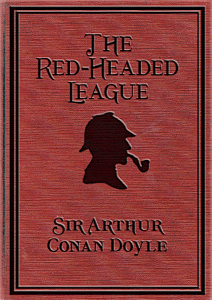
There are only eleven complete copies of the 1887 “Beeton’s Christmas Annual” known to exist; each now having considerable value. Ward Lock and Company published “A Study in Scarlet in a book form in July of 1888 with featured illustrations by Charles Doyle, Conan’s father. A second edition was published in the following year, this time illustrated by George Hutchinson. In 1890 the first American version was published by Philadelphia-based J.B. Lippincott and Company.

As the first Sherlock Holmes story published, “A Study in Scarlet” was among the first to be adapted to the screen. In 1914, Conan Doyle authorized a silent film to be produced by G. B. Samuelson. Holmes was played by James Bragington, an accountant who worked as an actor for the only time of his life. He was hired for his resemblance to Holmes, as presented in the sketches originally published with the story. Due to the nature of film at that time and the rarity of archiving, it is now a lost film. The success of the film allowed for a second version to be produced that same year by Francis Ford, which has also been lost.

The novel “A Study in Scarlet” has rarely been adapted in full: the 1933 film entitled “A Study in Scarlet” with Reginald Owen actually bears no plot relation to the novel. The most notable instance closest to the novel is the episode in the second season of the BBC television series “Sherlock Holmes” with Peter Cushing as Holmes and Nigel Stock as Dr. Watson, which put more detail into the screenplay.

Bottom Insert Image: Sidney Paget, “Holmes Gives Me a Sketch of the Events”, 1892, Illustration for “Silver Blaze”, Strand Magazine, December, 1892, Private Collection

Kay Sage

Kay Sage, “Festa”, 1947, Oil on Canvas, 46 x 36 cm, Private Collection

Kay Sage was an American surrealist and poet. A member of the Golden Age and Post-War periods of Surrealism, Sage is mostly recognized for her artistic works, which typically contain themes of an architectural nature. She received her formal training in art at the Corcoran Art School in Washington DC in 1919 to 1920. She later studied art in Rome for several years, learning conventional techniques and styles.

Kay Sage’s exposure to surrealism at the International Surrealist Exhibit at Galerie Beaux-Arts in 1938 inspired Sage to begin painting in earnest. She exhibited six of her new oils in the Salon des Surindépendants show at the Porte de Versailles in the fall of 1938. These semiabstract paintings, including “Afterwards” and “The World is Blue”, borrowed motifs and styles from de Chirico and the Surrealists, but showed hints of Sage’s own future work as well.

Rachel Newling

Rachel Newling, “Green Tree Python”, Date Unknown, Hand-Colored Linocut on Handmade Japanese Paper, 76 x 50 cm.

Rachel Newland is an established Australian artist, specializing in hand colored and reduction linocuts, mixed media engravings and drawings. Prints are available at her site: https://www.rachelnewling.com

Reblogged with thanks to https://crofs.tumblr.com

Calendar: November 30

A Year: Day to Day Men: 30th of November

The Sextant-Carrier

November 30 1937 was the birthdate of British film director and producer Ridley Scott.

Ridley Scott grew up in West Hartlepool, England, and attended the West Hartlepool College of Art and the Royal College of Art in London. He worked as a set designer and a director in British television. In 1967, Scott began to direct commercials, known for their visual stylization and their distinctive atmospheric lighting effects.

Scott brought these effects into his feature films which he began directing in 1977. His directorial debut was the 1977 film “The Duelists”, a period film set in Napoleonic France base on a short story by Joseph Conrad. This film won the best first-feature award at the Cannas Film Festival. Scott followed the success with three more films, now widely regarded as classics:

The first, the science fiction horror story “Alien” was released in 1979. It was met with critical acclaim and box office success. It won the Academy Award for Best Visual Effects, three Saturn Awards for Best Science Fiction Film, Best Direction for Scott and Best Supporting Actress for Veronica Cartwright. The second was the 1985 “Legend”, an allegorical fairy tale, was fleshed out with the help of American author William Hjortsberg, with the final screenplay going through fifteen revisions. The makeup effects were designed by special effects artist Rob Bottin, who had worked on “The Howling” and Carpenter’s “The Thing”.  The third, a dystopian fable of a dark, grim and polluted future, “Blade Runner” was released in 1982 and was based on a Philip K Dick novel. This contemporary film noir heavily employed Scott’s use of set design to enhance the mood of the film. It later became an acclaimed cult classic, hailed for its retrofitted future.

Ridley Scott’s 1991 “Thelma and Louise was acclaimed for its visual style as well as the lead characters and the feminist theme. Scott received an Academy Award nomination for his work on the film. After a series of commercial failures, Scott directed the 2000 “The Gladiator”, starring Russell Crowe in the title role. the action drama set in ancient Rome was a critical and commercial success, winning the Academy Award for Best Picture. It also earned Scott his second nomination for best director.

Scott revisited the eerie world of “Alien” in the sci-fi Thriller “Prometheus” in 2012. He brought his spectacular sensibilities to bear on the biblical story of Moses in “Exodus:Gods and Kings” in 2014, following that with the taut space drama “The Martian”, released in 2015 and starring Matt Damon as the astronaut who must survive on Mars. Ridley Scott also served as producer for a number of films and television programs, including the series “Numb3rs” from 2005-2010 and “The Good Wife” form 2009 to 2016.