Francisco Brines: “The Cause of Love”

Photographers Unknown, The Cause of Love

When they have asked me the cause of my love
I have never answered: You already know its great bearuty.
(And there are still more beautiful faces.)
Nor have I described the certain qualities of his spirit
that he always showed me in his customs,
or in readiness for silence or smile
as required by my secret.
They were things of the soul, and I said nothing about her.
(And I should still add that I have met higher souls.)
The fruit of my love now I know:
man’s imperfections overcome his presence,
it is atrocious to think
that bodies do not correspond to souls in us,
and so the grace of the spirit blinds bodies,
its clarity, the aching flower of experience,
goodness itself.
important events that we never discovered,
or we find out late.
The bodies lie, other times, an airy heat,
moved light, honda freshness;
and the damage reveals its dry falsehood to us.
Know the truth of my love now:
matter and breath joined in his life
like the light that falls on the mirror
(it was a small light, a tiny mirror);
It was a perfect random creation.
A being in order grew next to me,
and my disorder was serene.
I loved its limited perfection.

–Francisco Brines, Cause of Love

Born in Oliva, Valencia, in January of 1932, Francisco Brines Bañó was a Spanish poet and essayist. He was a prominent member of the Generation of “50, a Spanish literary movement whose new literary language incorporated metaphysical and philosophical techniques to undermine the strict censorship of the Franco government.

After studying at the Jesuits of Valencia, Francisco Brines attended the University of Madrid, where he studied Philosophy and Letters, and also the Universities of Valencia, Deusto and Salamanca, where he earned a degree in Law. He became a reader of Spanish literature at the University of Cambridge and a Professor of Spanish at the University of Oxford.

Described as a metaphysical poet, Brines was highly influenced by the work of Luis Cernuda, an openly gay poet of the Generation of ’27; inspired by these works, many of Brines’s poems also convey the theme of homosexual love. His poetry is characterized by the intimate tone of his verses, the constant reflection on the passage of time and decay of the living, and observations on the condition of a human being subjected to his own limitations. Memory also plays a fundamental role in Brines’s writing; although, his poems reveal the belief that neither poetry nor memory can endure the passage of time or save the moments of the past.

Francisco Brines’s first collection of poems, entitled “Las Brasas (Embers)”, was published in 1959 and won the 1960 Adonais Poetry Prize. In 1966, Francisco Brines published “Words in the Dark”, which earned him the National Critics Award in 1967. In the same year, he also won the Valencian Literature Award. “The Autumn of Roses’, a collection of sixty poems written over a ten year period, was published in 1986 and won the National Prize for Literature. This book, in which elegies of lamentation and exaltation merge, was his most critically acclaimed work.

Entering the world of theater, Brines revised and adapted playwright Pedro Calderón de la Barca’s 1636 drama“El Alcalde de Zalamea (The Mayor of Zalamea)”. Directed by José Luis Alonso, the play was performed by the Classical Theater Company in 1988. Told in three acts, it explored the power of a self-made man against political authority in seventeenth-century Spain,

Brines was recognized for his work by the Royal Spanish Academy in 1998 with the Fastenrath Prize and, later, received the 1999 National Prize for Spanish Letters for his poetic oeuvre. Elected a member of the Royal Spanish Academy of the Language in April of 2000, Brines gave his institutional speech on the poetry of Luis Cernuda, one of the poets who influenced his work. In 2020, he won the Premio Cervantes, the most important literary award of the Spanish language world.
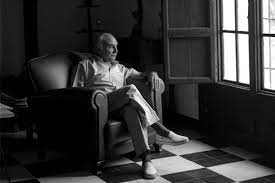
Francisco Brines Bañó was taken to Gandía Hospital shortly after King Felipe VI and Queen Letizia presented him with the 2020 Cervantes Prize at his family estate in Oliva, Valencia, as he was unable to attend the official ceremony due to his delicate state of health. He died on the 20th of May in 2021, at the age of eighty-one, at Gandía Hospital, after a hernia operation.

Note: An interesting article on the homoeroticism of Francisco Brines’s poetry, long regarded as an open secret but rarely acknowledged in critical studies, entitled “Francisco Brines and the Humanist Closet” by Jonathan Mathew of the University of Kansas, can be found at: https://kuscholarworks.ku.edu/bitstream/handle/1808/7478/Mayhew_Francisco%20Brines.pdf?sequence=1&isAllowed=y

Virgilio Pinera: “The Waves of Music We Made”

Photographers Unknown, The Waves of Music We Made

Can it be they are going to kill?
Will they pierce the heart with a huge knife?
And with the sharpest scalpel empty the eyes?
And with the steeliest chisel break the skull?
And with the most hammer of hammers crush the bones?

Can it be that on the exotic table
–table of sex, table of love–
my love, you and I,
being startled one night
your heart spoke
when you were under my blood?
Can it be the same as it was
when it was an oath, and even more so,
your work, your word bled,
soaked by the soft perfume of kisses,
so as not to deny, to be one indivisible?
And can it be so blindly believed,
so blindly, that all the suns go dark forever
while the soul travels in darkness?
Can it be there never was a soul despite the waves of music
we made?
Soul that never was though you might be for an instant?

Renenber that instant when you were a soul and adored
me,
and then your own monster came suddenly
to take you to the place where being you were?

Can it be that after you are no longer,
when not being is merely a mound of dried out kisses,
you wil be by not being, instead of being love?

Virgilio Pinera, Poem to be Said in the Midst of a Great Silence, The Weight of the Island, 1967

Born in Cárdenas, Matanzas, Cuba in 1912, Virgilio Piñera was an author, playwright, poet, and essayist known for his avant-garde work, caustic wit, acid tongue, and bohemian lifestyle. He lived under the dual repression of the Catholic church and reactionary government leaders such as Argentina’s Juan Perón and Cuba’s Fulgencio Batista. Piñera’s homosexuality and non-conformism led to his marginalization during a well-documented period of Cuban history when homophobia and petty bureaucracy stifled creative freedom

An avid reader from an early age, which included works by Marcel Proust and Herman Melville, Piñera drew his inspiration from different genres, a foundation which became fundamental to his distinctive work with its combination of Cuban vernacular and more refined language.At the age of thirteen, Piñera’s family moved to Camagüey, a municipality located in central Cuba, where he earned his high school diploma. After settling in Havana in 1938,  he received his Doctoral Degree in philosophy from the University of Havana in 1949. 

Piñera published in his poems in Havana’s literary magazine “Espuela de Plata” and, in 1941. wrote his first poetry collection, “Las Furias (The Furies)” and  his most famous play “Electra Garrigó”, which featured the choral structure of a Greek tragedy alongside distinctive Cuban elements. Staged both before and after the revolution of Castro and Guevara, this play later became a powerful symbol of the Revolution and was consciously performed before foreign and  notable public figures as  being emblematic of the transformed nation.

Following his founding of the magazine “Poeta” in 1942, Piñera wrote his collection of poems entitled “La Isla en Peso (The Weight of the Island)”. Drawing upon episodes in his personal life as well as the social interactions occurring inside Cuba, he explored the nebulous regions between sadness and beauty, and disillusion and reality. Published posthumously after Piñera’ death in 1979, “The Weight of the Island” was initially scorned by some poets and critics; however, the collection is now regarded as one of the classics of Cuban literature.

In 1944, Virgilio Piñera, along with writer José Lezama Lima and editor and critic José Rodríguez Feo, founded the prestigious literary and arts review “Origenes”, which provided a focal point for promising poets and critics in Cuba during the 1940s and 1950s. The journal published short stories, poetry, and critical essays on art, literature, music and philosophy. Among Piñera’s contributions were several poems, an essay on Argentinian literature, and an 1945 essay entitled “El Secreto de Kafka”, a work in which Piñera developed his theory on the creation of images into a literary surprise. 

Piñera lived in Buenos Aires, Argentina, for a twelve year period from 1946 to 1958; it was  during this stay that he developed his voice as a writer. He worked as a translator and proofreader at the Cuban Embassy and became friends with writers Jorge Luis Borges and essayist José Bianco, who would write the forward to Piñera’s collection of short stories “El que Vina a Salvarme (The One Who Came to Save Me)”. Along with other writers, Piñera worked on the translation of Polish author Witold Gombrowicz’s 1937 controversial novel “Ferdydurke” into Spanish. 

Virgilio Piñera wrote two plays in Buenos Aires,  “Jesús” and “Falsa Alarma”, a fast paced, absurdist play of humor and anguish, to which he lengthened with dialogue for a later 1957 staging. His first novel, entitled “La Carne de René (René’s Flesh)”, was published in 1952 and told the dark story of a twenty-year old protagonist forced into a merciless life. After the closure of his literary review “Origenes” and the founding of his final magazine “Ciclón (Cyclone)”, Piñera left Argentina in 1958 to settle permanently in Cuba, where he arrived shortly before the Revolution. His work appeared in the newspaper “Revolución” and other numerous journals. In 1962, with the Cuban revolution in full motion, Piñera’s  most autobiographical play, “Airo Frio (Cold Air)”, a very personal celebratory work supporting the ouster of dictator Batista’s police and army, opened in Havana. 

Shortly after the opening of “Airo Frio”, Fidel Castro’s government made the decision that there was no room for any views other than those completely sympathetic to the Revolution. Intellectuals and other luminaries, as well as the religious and those youths not conforming to the revolution, were to face persecution. Virgilio Piñera, although never public about his homosexuality, was arrested under the revolutionary government’s clampdown on the prostitutes, pimps and homosexuals. By 1971, he was ostracized by the Cuban government and the literary establishment. As his career declined into obscurity. Piñera continued to write at n increased rate; however, his plays were no longer performed. 

In 1968, Piñera received Latin America’s most prestigious literary prize, the Premio Casa de las Américas, for his play “Dos Viejos Pánicos (Two Old Panics)”. Despite the award and acclaim, the play would not have its first performance in Cuba until the 1990s.  Leaving behind more than twenty plays, three novels, volumes of short stories and a vast number of poems, Virgilio Piñera, who lived the last years of his life in poverty, died of a cardiac arrest on the 18th of August in 1979, without any official recognition of his death. He is buried in his native town of Cárdenas.

As a way to redress some of the wrongs committed against Piñera in the past, Cuba declared the year 2012 as “El Añ0 Virgiliano”. In the month of June, a group of thirty researchers from countries, such as the United Kingdom, Mexico, Spain and the United States, came together in Havana to discuss the life, work and legacy of Virgilio Pañera, one of Latin America’s prominent writers. His two best known plays, “Airo Frio” and “Dos Viejos Pánicos”, were performed and a new ballet by choreographer Iván Tenorio, entitled “Virgiliando”, had its premiere. 

Note: The University of Miami Libraries contains the digital Cuban Heritage Collection which includes material on Virgilio Piñera. Included in the material are correspondence exchanged between Piñera and Adolfo de Obieta during the 1940s and 1950s, as well as a typescript of Piñera’s play “Una Caja de Zapatos Vacía” that he sent to his friend Luis F. González-Cruz, who published it in Miami in 1986. This material can be found at: https://merrick.library.miami.edu/cdm/search?collection=chc5278

Jorge Eduardo Eielson: “Half of My Body Smiles”

Photographers Unknown, Half of My Body Smiles

Si la mitad de mi cuerpo sonríe
La otra mitad se llena de tristeza
Y misteriosas escamas de pescado
Suceden a mis cabellos. Sonrío y lloro
Sin saber si son mis brazos
O mis piernas las que lloran o sonríen
Sin saber si es mi cabeza
Mi corazón o mi glande
El que decide mi sonrisa
O mi tristeza. Azul como los peces
Me muevo en aguas turbias o brillantes
Sin preguntarme por qué
Simplemente sollozo
Mientras sonrío y sonrío
Mientras sollozo

If a half of my body smiles,
The other one is steeped in sadness,
And strands of my hair
Turn into mysterious fish scales as they grow.
I smile and I cry
Oblivious as to whether it is my arms
Or my legs that smile or cry,
Oblivious as to whether it is my head,
My heart or my glans
Deciding on my smile
Or sadness. Blue like the fish,
I swim through waters troubled or shimmering,
Never wondering why
I just sob
As I smile and I smile
As I sob.

–Jorge Eduardo Eielson, Cuerpo Dividido (Body Divided), Translation by Juan Ribó Chalmeta and Irina Urumova

Paul Monette: “Everything Extraneous Has Burned Away”

Photographers Unknown, Everything Extraneous Has Burned Away

everything extraneous has burned away
this is how burning feels in the fall
of the final year not like leaves in a blue
October but as if the skies were a paper lantern
full of trapped moths beating their fired wings
and yet I can lie on this hill just above you
a foot beside where I will lie myself
soon soon and for all the wrack and blubber
feel still how we were warriors when the
merest morning sun in the garden was a
kingdom after Room 1010 war in not all
death it turns out war is what little
thing you hold onto refugees and far from home
oh sweetie will you please forgive me this
that every time I opened a box of anything
Glad Bags One-A-Days KINGSIZE was
the worst I’d think will you still be here
when the bus is empty Rog Rog who will
play boy with me now that I bucket with tears
through it all when I’d cling beside you sobbing
you’d shrug it off with the quietest I’m still
here
I have your watch in the top drawer
which I don’t dare wear yet help me please
the boxes grocery home day after day
the junk that keeps men spotless but it doesn’t
matter now how long they last or I
the day has taken you with it and all
there is now is burning dark the only green
is up by the grave and this little thing
of telling the hill I’m here oh I’m here

Paul Monette, Here, Love Alone: Eighteen Elegies for Rog 

Born in October of 1945 in Lawrence, Massachusetts, Paul Monette was n poet, author, and gay rights activist, best known for his essays about gay relationships. He graduated from the Phillips Academy, a university-preparatory school, in 1963 and earned his Bachelor of Arts at Yale University in 1967.  

Monette’s formative years in the rigid social boundaries and strict religious atmosphere of his middle-class upbringing prompted him to not disclose his gay orientation. Questioning his sexual identity, he moved to Boston, where he taught writing and literature at Milton Academy and Pine Manor College. In 1974 in Boston, Monette met his longtime partner, lawyer Roger Horwitz, a graduate of Harvard Law School, with a Ph.D in comparative literature from Harvard University.

In November of 1977, Paul Monette and Roger Horwitz moved to Los Angeles, where they became strongly associated with the gay rights movement in the city. Monette wrote and published several novels during this period; his first novel, “Taking Care of Mrs Carroll”, featuring two male lovers and a legendary movie goddess, was published in 1978. In the period from 1977 to 1982, he wrote several more works of poetry, fiction and memoirs, including the 1979 “The Gold Diggers” and the 1981 murder mystery “The Long Shot”.

Monette’s more serious work began with the onslaught of the AIDS crisis, when his work focused on its occurring loss and heartbreak. In 1985, his partner, Roger Horwitz, was diagnosed with the AIDS virus and, after a long nineteen month fight against the virus, passed away in October of 1986. After Horwitz’s death, Monette continued his writing and remained active with many public speaking appearances.

In 1988, Paul Monette published his “Love Alone: Eighteen Elegies for Rog”, a collection of poems in remembrance of Horwitz. Using different fonts and no punctuation, the lines are interpreted by the reader’s determination when to begin and end a sentence. Through the poetry Monette described the events that occurred during Roger’s decline in health and his own transition through the various  emotions he experienced, which included denial, anger, bargaining, depression and, finally, acceptance. His description of his loss is particularly evident in the poem “The Very Same”, written on the day of Horwitz’a funeral.

Monette published his “Afterlife” in 1990 and “Halfway Home” in 1991, both which were centered around people with AIDS and their families’ experiences. His most acclaimed book, the 1988 “Borrowed Time: An AIDS Memoir”, chronicles his partner Roger Horwitz’s long fight, and eventual death, from the AIDS virus. Describing the devastating loneliness felt by AIDS patients and their loved ones, the memoir received both the PEN Center West and Lambda literary awards. Monette’s 1992 memoir “Becoming a Man: Half a Life Story”, an autobiography of his early closeted life, culminating with his meeting Roger, was written as a classical coming of age story and won the National Book Award in 1992. 

Monette’s life story, including the final years before his own death from AIDS in February of 1995, is documented in Monte Bramer and Lesli Klainberg’s 1996 film “Paul Monette: The Brink of Summer’s End”. Premiered at the 1996 Los Angeles Outfest, the film went on to win four awards for best documentary, including the GLAAD Media Award and the Sun Dance Film Festival. 

Paul Monette died in Los Angeles where he lived with his partner of five years, author and psychotherapist Winston Wilde. He is buried alongside Roger Horwitz at Forest Lawn Memorial Park in Hollywood Hills Los Angeles. Shortly before his death, Paul Monette established the Monette-Horwitz Trust to support future LBGT activism and scholarship.Trust Awards are given annually to individuals and organizations for their contribution to eradicating homophobia through literary, scholarly, archival, or activist work. 

David Levithan: “Every You, Every Me”

Photographers Unknown, The Faces of Man: Photo Set Eleven

“I thought about the word ‘profile’ and what a weird double meaning it had. We say we’re looking at a person’s profile online, or say a newspaper is writing a profile on someone, and we assume it’s the whole them we’re seeing. But when a photographer takes a picture of a profile, you’re only seeing half the face… It’s never the way you would remember seeing them. You never remember someone ‘in profile.’ You remember them looking you in the eye, or talking to you. You remember an image that the subject could never see in a mirror, because you are the mirror. A profile, photographically, is perpendicular to the person you know.” 

― David Levithan, Every You, Every Me

Born in Short Hills, New Jersey in 1972, David Levithan is an American fiction author, who has written works which feature strong male gay characters. After graduating from Millburn High School in 1990, he received an internship at Scholastic Corporation, a multinational publishing and media company, where he was edited the young-adult novel series “The Baby-Sitters Club”. Levithan is still an editorial director at Scholastic and is also the founding editor of PUSH, an imprint of Scholastic focused on new authors. 

Levithan acknowledged his style of writing, both humorous and affecting, was influenced by the works of author Judith Viorst, known for her humorous observational poetry and children’s literature. The majority of Levithan’s work is in the young-adult category, of which several have been adapted for film. He collaborated with writer Rachel Cohn on the 2006 novel “Nick and Nora’s Infinite Playlist’, which was adapted into the 2008 feature film directed by Peter Sollett. David Levithan’s 2012 novel “Every Day” was adapted into a romantic fantasy drama, of the same name, and was released in 2018. A second collaboration between him and Cohen produced the 2007 novel “Naomi and Ely’s No Kiss List”, a best-friends relationship story of two apartment neighbors, one gay male and one heterosexual female. This novel was adapted into a film directed by Kristin Hanggi, best known for her 2009 Broadway musical “Rock of Ages”, and released in 2015 at the Outfest Film Festival. 

David Levithan/s first novel specifically for adults was the 2011 “The Lover’s Dictionary”. The novel was inspired by the alphabetical order of entry of words in the book “Words You Need to Know” shich was sitting on his desk. The “Dictionary” is told entirely through alphabetically arranged dictionary entries, both brief and concise and  without chronological order, that reveal the two characters joyful but struggling relationship. 

Levithan has edited, along with Billy Merrell, the 2006 anthology “The Full Spectrum: A New Generation of Writing About Gay, Lesbian, Bisexual, Transgender, Questioning and Other Identities”. He was also a collaborative author with Ned Vizzini for the 2021  graphic novel “Be More Chill: The Graphic Novel”, illustrated by Nick Betozzi, known for his Alternative Comics series “Rubber Necker”..

Albert Russo: “Dramatis Personae”

Photographers Unknown, The Parts and Pieces Making a Whole: Set Twelve

They call me Gianni
They call me Jim
But also Dominic
In both genders
In every guise

Whether it be Gianni, Jim or Dominic
In the present tense as in the past
First or third person
We’re talking of the same person
With the difference that each one
Speaks in another tongue
Confounding strangers
Claims the spiteful gossip

At time Gianni and Jim will be one and the same
At times they will oppose each other
Sometimes they might act as total strangers
And so it goes for both Dominics

The distance between them may be paper thin
Or else wide as the ocean
That which separates two languages
Or lies, mute, within the blood cells

Albert Russo, Dramatis Personae, The Crowded World of Solitude, Vol. 2

Born in February, 1943, in the Democratic Republic of Congo, Albert Russo is a poet, short story writer, novelist and photographer. The son of a British mother and an Italian Sephardic father, he attended the high school in Bujumbura, a coastal city in Burundi, where he mastered four languages: French, English, Dutch, German, and vernacular Swahili. Russo earned a Bachelor of Science degree in Business Administration at New York University in 1964  He traveled to Heidelberg in 1965, where he earned a degree in German culture and literature at the Collegium Palatinum. 

Russo first began writing poems in English in 1964 during his years at New York University. In 1965, he settled in Milan, Italy, where he  worked at the family firm and continued his writing. His first novel entitled “La Pointe du Diable”, written in French, was published in 1973 in Brussels. For this work, Russo won the Prix Colette in Cannes and the Prix de la Liberté in Paris. 

In 1975, Albert Russo returned to New York for three years. During this period, he taught language classes and published several poems and short stories in a variety of international magazines, including The Literary Review, Culture Française, La Libre Belgique, and Revue Zaire. Russo also worked with UNICEF translating scripts for children’s documentary films. He returned to Europe in 1978  and settled in Paris. 

Albert Russo has written more than twenty-five works, translated into twelve languages. His main themes are the defense of individual and collective rights, including ethnic, gender and religious, and the fight against racism. Many of his works are centered around life in Africa; two of which are“Mixed Blood” and “Eclipse over Lake Tanganyika”, both published in 2000. Russo wrote a large two-volume series entitled “The Crowded World of Solitude”, the first volume which includes short stories, essays, and fables: the second volume contains forty year collection of poems. 

During the 1980s, through their common Congolese experience and love for Africa, Russo met and befriended Italian artist and philosopher Joseph Pace. Later in the 2999s, he became friends with poet and photographer Adam Donaldson Powell. Together they authored the 2009 “Gaytude”, a volume of poetry, with photographs by Russo, which dealt with the gay experience of life on five continents.

As a professional photographer, Albert Russo has earned several prizes, including winning a National Indie-Excellence award and a silver medal from a Gallery Photografica competition. His photographic work has been shown at Switzerland’s Musée de l’Elysée in Lausanne. In 2019, Russo won a UNICEF Award for his poetry oeuvre and, in 2020, an Artavita Certificate for his photography.

Jonathan Williams: “Glittering Frostily”

Photographers Unknown, Glittering Frostily

There are more things to love
than we would dare to hope for.
–Richard of St. Victor

where the car hit him, fireweed sprang with
blossoms of fennel

and umbels
of dill fell
through the spokes of a wheel

on Whistun holiday to the sun, Denton
Welch spun a web in his crushed cycle,

sat in the seat, spine curled up like a spider–

and spied: “saw
the very drops of sweat glittering frostily
between the shouder blades”

of a lad

…on and on he spied and bled from the blades of his cycle
small as a spider,
hiding in the fireweed, getting
wet from the skins of many human suns aground
at the Kentish river near
Tunbridge Wells,

where the dill
lulls,

and all boys
spoil…

Jonathan Williams, The Wreck on the A-222 in Ravensbourne Valley, Jubilant Thicket: New & Selected Poems, 2995

Born in Asheville, North Carolina, Jonathan Williams was a poet, photographer and graphic artist. He attended St. Albans School in Washington DC, and then Princeton University. After leaving Princeton to pursue the arts, Williams studied painting with Karl Knaths at the Phillips Gallery, and graphic arts and engraving under Stanley William Hayter at Atelier 17 in New York City. He later studied photography at Black Mountain College with Harry Callahan and Aaron Siskind.

In 1951, Williams, along with David Ruff, founded the book publishing company, The Jargon Society, with the goal of publishing obscure writers. This press, long associated with the Black Mountain Poets, an  post-modern group in North Carolina, launched a number of artists, both literary and visually artistic, who pioneered the 1980s avant-garde movement in United States. 

Jonathan Williams was a link between the experimental poets of the second generation of Modernists and the upcoming vernacular artists of Appalachia. Akin to a cultural anthropologist, he based his work on “found’ language, acquired through listening to others reminisce about their lives and experiences. Williams loved to reveal the poetic within the pedestrian, whether from commercial signs, such as “O’Nan’s Auto Service”, to amorous lavatory wall scribblings, such as “The Current Sexist Machismo in a Loo Along the River Kent”. He often infused light verse forms such as limericks, clerihews, and acrostics with his own ribald wit.Williams also invented a form of his own called the Meta-Four, which specified no length, only that every line contain four words. 

Jonathan Williams and his life-long partner, the poet Thomas Meyer, typically divided their year between Skywinding Farm, the property he owned in the Blue Ridge Mountains, outside Highlands, North Carolina, and a seventeenth-century stone cottage in  Cumbria, England. A longtime contributing editor of the photography journal Aperture, Jonathan Williams died from pneumonia on March 16, 2008 in his Blue Ridge Mountain home.

Insert Image: Guy Mendes, “Jonathan Williams and Thomas Meyer at Corn Close”, 1081, Silver Gelatin Print

The Liberty of a Frozen Morning

Photographer Unknown, The Liberty of a Frozen Morning

“The approach of a man’s life out of the past is history, and the approach of time out of the future is mystery. Their meeting is the present, and it is consciousness, the only time life is alive. The endless wonder of this meeting is what causes the mind, in its inward liberty of a frozen morning, to turn back and question and remember. The world is full of places. Why is it that I am here?”

—Wendell Berry, The Long-Legged House

This Vast Expanse

Photographer Unknown, This Vast Expanse

Je vois les effroyables espaces de l’Univers qui m’enferment, et je me trouve attaché à un coin de cette vaste étendue, sans savoir pourquoi je suis plutôt en ce lieu qu’en un autre, ni pourquoi ce peu de temps qui m’est donné à vivre m’est assigné à ce point plutôt qu’à un autre de toute l’éternité qui m’a précédé, et de toute qui me suit.

I see the dreadful spaces of the Universe that lock me up, and I find myself attached to a corner of this vast expanse, without knowing why I am more in this place than in another, nor why this little time given to me to live is assigned to me at this point rather than to another in all the eternity that preceded me, and all that follows me.

—Pascal, Pensées sur la Religion

Sinclair Lewis: “All Sorts of Edifying Things”

Photographers Unknown, A Collection: Ten Portraits of the Self

“They decided now, talking it over in their tight little two-and-quarter room flat, that most people who call themselves ‘truth seekers’ – persons who scurry about chattering of Truth as though it were a tangible separable thing, like houses or salt or bread – did not so much desire to find Truth as to cure their mental itch. In novels, these truth-seekers quested the ‘secret of life’ in laboratories which did not seem to be provided with Bunsen flames or reagents; or they went, at great expense and much discomfort from hot trains and undesirable snakes, to Himalayan monasteries, to learn from antiseptic sages that the Mind can do all sorts of edifying things if one will but spend thirty or forty years in eating rice and gazing on one’s navel.

To these high matters Martin responded, ‘Rot!’ He insisted that there is no Truth but only many truths; that Truth is not a colored bird to be chased among the rocks and captured by its tail, but a skeptical attitude toward life.” 

—Sinclair Lewis, Arrowsmith

Born in February of 1885 in the village of Sauk Centre, Minnesota, Sinclair Lewis was a writer and playwright, the first writer from the United States to receive the Nobel Prize in Literature. In late 1902, he studied for a year at Oberlin Academy, a preparatory school, to qualify for acceptance at Yale University. Lewis entered Yale in 1903, but received his Bachelor’s Degree in 1908; he had taken personal time to work at Upton Sinclair’s Helicon Home Colony, a cooperative-living colony in New Jersey, and to spend time in Panama. 

Lewis’s earliest published work, short sketches and poetry, appeared in the two Yale publications, the Yale Courant and the Yale Literary Magazine, of which he was editor. After graduation, he took employment at various newspapers and publishing houses, where he wrote short popular stories for the public. Lewis’s first published book was a 1912 juvenile adventure story, written under the name Tom Graham, entitled “Hike and the Aeroplane”. 

Sinclair Lewis’s first serious novel, “Our Mr Wrenn: The Romantic Adventures of a Gentile Man”, a whimsical story that sold nine thousand copies, was published in 1914. This novel was followed by the 1915 “The Trail of the Hawk” and, in 1917, “The Job”, a novel whose story discussed the rights of working women. Lewis published in 1917 and 1919 two redeveloped serial stories for the public, “The Innocents: A Story for Lovers” and “Free Air”, which was adapted as a silent film in 1922.  

As early as 1916, Lewis had begun making notes for a novel about small town life. After moving to Washington DC, he completed writing the novel in the middle of 1920. His “Main Street”, published in October of 1920, achieved phenomenal success, eventually selling two million copies in a few years. Lewis followed this success with the 1922 “Babbit”, a satirical novel about commercial culture and civic promotion in the United States. 

Sinclair Lewis’s 1925 “Arrowsmith”, a novel written with preparatory assistance by science writer Paul de Kruif, contained social commentary on the state and prospects of medicine in 1920s United States. Lewis describes many aspects of medical training, medical practice, scientific research, scientific fraud, medical ethics, public health, and the personal and professional conflicts that are still relevant today. Professional jealousy, institutional pressures, greed, stupidity, and negligence are all satirically depicted. But, throughout the story, Lewis also discusses tireless dedication, intellectual honesty, and respect for the scientific method. Read by generations of pre-medical and medical students, the novel won the 1926 Pulitzer Prize for Literature.

Lewis published “Elmer Gantry” in 1927, a novel denounced by many religious leaders for depicting a hypocritical evangelical minister, and “Dodsworth”, a satirical novel depicting the differences between US and European intellect, manners and morals, in 1929. “Dodsworth” was adapted for stage in 1934 and became a film in 1936, one highly regarded by the critics and now preserved in the National Film Registry. “Elmer Gantry” was adapted as a drama film in 1960 by director Richard Brooks and, in the following year, won three Academy Awards.

In 1930, Sinclair Lewis won the Nobel Prize in Literature, the first writer from the United States to receive the award. After winning the Nobel Prize, he wrote eleven more novels, ten of which were published in his lifetime. Of these, the most known is his 1935 “It Can’t Happen Here”, a novel about the election of a fascist to the American presidency. In 1937, Lewis, a long-time drinker, was checked in for treatment at the Austen Riggs Center, a psychiatric hospital in Massachusetts. After ten days, he checked himself out with no understanding of his drinking problem. 

During the 1940s, Sinclair Lewis appeared frequently with author Lewis Browne, discussing a wide range of topics,  on popular lecture tours throughout the United States. He also worked on his novel “Kingsblood Royal”, an early contribution to the civil rights movement  completed and published in 1947, which dealt with the denial of oppurtunity for Afro-Americans to purchase homes in white communities.

By 1948, after first renting and later purchasing rural property in Massachusetts, Sinclair Lewis had created a 720 acre gentleman’s farm of agricultural and forest land. His intention to make this homestead a permanent residence, however, was denied to him by his declining health due to serious  medical issues.. Three years later, Sinclair Lewis died in Rome from advanced alcoholism on January 10, 1951, at the age of sixty-five. His body was cremated and the ashes buried at Greenwood Cemetery in his hometown of Sauk Centre.

Top Insert Image: Artist Unknown, “Sinclari Lewis”, 1925, Halftone Photo Print

Bottom Insert Image: Jack Coughlin, “Sinclair Lewis”, Date Unknown, Etching, 15.9 x 13.3 cm,

Note: The text for the autobiography written by Sinclair Lewis for his 1930 Nobel Prize for Literature can be found at the Nobel Prize Organization’s site: https://www.nobelprize.org/prizes/literature/1930/lewis/biographical/

Friedrich Dürrenmatt: “What Will the Future Bring?”

Photographers Unknown, What Will the Future Bring?

“What is going to happen? What will the future bring? I do not know, I have no presentiment. When a spider flings itself from a fixed point down into its consequences, it continually sees before it an empty space in which it can find no foothold, however much it stretches. So it is with me; before me is continually an empty space, and I am propelled by a consequence that lies behind me. This life is turned around and dreadful, not to be endured.” 

–Friedrich Dürrenmatt, The Assignment: or, On the Oberving of the Observer of the Observers

Born in Konolfingen, Switzerland, in 1921, Friedrich Dürrenmatt was an author and dramatist who was a proponent of epic theater, a form of dramatic, political plays staged through documentary effects and audience interaction.  After studies in philosophy and German literature, he stopped his academic career in 1943 to become an author and dramatist. He became one of the more prolific writers in the German language on the crisis of the nuclear bomb and arms race.

Written when he was twenty-six,  Dürrenmatt’s first play. the 1946 “It is Written”, revolves around a battle, occurring in a city under siege, between a religious fanatic who takes scripture literally and a cynic who craves sensation. The play’s 1947 premiere resulted in fights and protests in the audience.  Between 1948 and 1949, Dürrenmatt wrote several sketches for Zürich’s anti-Nazi Cabaret Cornichon, a Swiss cabaret company opposed to fascism and Nazism. 

Friedrich Dürrenmatt’s first major success was the 1950 play “Romulus the Great”, an exploration of the last days of the Roman Empire presided over by Romulus, its last emperor. In the same year, he published a novel entitled “The Judge and His Hangman”.  Dürrenmatt’s 1956 play “Der Besuch der Alten Dame (The visit of the Old Woman)” was a strange fusion of comedy and drama about a wealthy woman who offers a fortune to the people of her hometown if they would kill the man who jilted her years earlier.

During his youth, Dürrenmatt hesitated for a long time between a career as a writer and a painter. Although he chose writing, he continued to paint and draw, which he considered his passion. Dürrenmatt had some exhiibitons of his work in Neuchâtel, Switzerland, in 1976 and 1985; he also had a show in Zürich in 1978. A permanent exhibition of his collective work, both artistic and literary, is on display at the Centre Dürrenmatt in Neuchâtel.

Throughout four decades, Dürrenmatt produced novels, novellas, radio plays, and theater performances. Among these were the radio plays “Incident at Twilight” in 1952 and “The Mission of the Vega” in 1954, the novella “The Pledge: Requiem for the Detective Novel”in 1948, and the 1962 play “The Physicists: A Comedy in Two Acts” which dealt with scientific ethics and mankind’s intellectual responsibilities. 

In 1990, Friedrich Dürrenmatt gave two famous speeches, the first in honor of Václav Havel, the Czech statesman and former dissident, and the second in honor of Mikhail Gorbachev, who moved his country to more social democracy and promoted the policy of glasnot, or openness. Later that year, on December 14th, Friedrich Dürrenmatt died from heart failure in Neuchâtel, Switzerland.

Middle Insert Image: Frederich Dürrenmatt, “Minotaurus. Eine Ballade VII”, 1984 – 85, Ink on Paper, 40 × 30 cm,  Centre Dürrenmat Neuchâtel

Bottom Insert Image: Sabine Gisiger, “Friedrich Dürrenmatt”, from Gisiger’s  2016 documentary film “Dürrenmatt: Eine Liebesgeschichte”

Vasily Grossman: “Modest Peculiarities”

Photographers Unknown, Modest Peculiarities

“Human groupings have one main purpose: to assert everyone’s right to be different, to be special, to think, feel and live in his or her own way. People join together in order to win or defend this right. But this is where a terrible, fateful error is born: the belief that these groupings in the name of a race, a God, a party or a State are the very purpose of life and not simply a means to an end. No! The only true and lasting meaning of the struggle for life lies in the individual, in his modest peculiarities and in his right to these peculiarities.” 

—Vasily Grossman, Life and Fate

Born into a Ukrainian Jewish family December of 1905, Vasily Semyonovich Grossman was a writer and a journalist. He trained as a chemical engineer at Moscow State University and, upon graduation, took a job in Stalino, now Donetsk, in south-eastern Ukraine. In the mid 1930’s, Grossman committed himself fully to writing;  he published, by 1936, two collections of short stories and the novel “Glyukauf” and was accepted into the privileged Union of Writers in 1937. Grossman’s 1940 novel “Stepan Kol’chugin”, written over the course of three years, was nominated fro a Stalin Prize, but was deleted from the list by Stalin himself during his campaign of political repression.

When Nazi Germany invaded the Soviet Union in 1941, Grossman, although exempt from military service, volunteered for the front lines where he spent almost three years. He became a war correspondent for the popular Red Army newspaper “Krasnaya Zvezda (Red Star)”. Grossman covered the major battles, including the Battle of Stalingrad and the Battle of Berlin, and also published his novels as serials in newspapers. His 1950 novel “Stalingrad”, published under the name “For a Just Cause”, is based upon his experiences during the siege. 

In his works, Vasily Grossman described Nazi ethnic-cleansing in occupied Ukraine and Poland, and the liberation by the Red Army of the extermination camps in Treblinka and Majdanek. His article “The Hell of Treblinka”, a collection of interviews taken from special work unit inmates who had escaped from Treblinka, was disseminated at the Nuremberg Trials as evidence for the prosecution. 

Grossman, along with Ilya Ehrenburg, participated in the assembly of the five-hundred page “Black Book”, compiled by the Jewish Anti-Fascist Committee in late 1944. This book documented the anti-Jewish crimes of the Holocaust and the participation of Jewish resistance members against the Nazi occupation during World War II. Upon the conclusion of the war, the book was denounced initially by the Russian Central Committee as anti-Soviet and finally refused publication in 1948.

Due to this suppression of the book, Vasily Grossman began to question his loyal support of the Soviet regime. He also criticized the process of collectivization and the political repression of peasants during the Great Famine of 1932 to 1933, which  resulted in the death by starvation of millions of Ukrainians. Persecuted by the state, only a few of Grossman’s works were published in his lifetime. In 1959 after submitting for publication his most prominent novel, “Life and Fate”, the Committee for State Security, KGB, raided his apartment, seized his manuscripts, notebooks and all typed copies, and refused publication for political reasons.

Vasily Grossman died of stomach cancer on September 14th in 1964. He was buried at the Troyekurovskoye Cemetery in Moscow. With the assistance of dissident researchers and writers, Grossman’s “Life and Fate” was retyped and finally published in the Soviet Union in 1988 after the initiation of the policy of glasnost. Other works by Grossman include “The People Immortal” published in 1943, and two posthumously published works published in 2010: “Everything Flows” and “The Road, Stories, Journalism, and Essays”. 

A Second Glance: Revisited

Photographers Unknown, A Second Glance: Revisited

“Everything goes forward like oiled clocks; for each minute of the dial there are a million noiseless clocks which tick off the rinds of time. We are traveling faster than the lightning calculator, faster than starlight, faster than the magician can think. Each second is a universe of time. And each universe of time is but a wink of sleep in the cosmogony of speed. When speed comes to its end we shall be there, punctual as always and blissfully un-denominated. We shall shed our wings, our clocks and our mantelpieces to lean on. We will rise up feathery and jubilant, like a column of blood, and there will be no memory to drag us down again.” 

—Henry Miller, Tropic of Capricorn

Yukio Mishima: “Someone, Somewhere, Had Tied Up the Darkness”

Photographers Unknown, Someone, Somewhere, Had Tied Up the Darkness

“Someone, somewhere, had tied up the darkness, he thought as he went: the bag of darkness had been tied at the mouth, enclosing within it a host of smaller bags. The stars were tiny, almost imperceptible perforations; otherwise, there wasn’t a single hole through which light could pass.

The darkness in which he walked immersed was gradually pervading him. His own footfall was utterly remote, his presence barely rippled the air. His being had been compressed to the utmost – to the point where it had no need to forge a path for itself through the night, but could weave its way through the gaps between the particles of which the darkness was composed.” 

—Yukio Mishima, Acts of Worship: Seven Stories

When Yukio Mishima committed ritual suicide in November 1970, he was only forty-five. He had written over thirty novels, eighteen plays, and twenty volumes of short stories. During Mishima’s lifetime, he was nominated for the Nobel Prize three times and had seen almost all of his major novels appear in English. 

While the flamboyance of Yukio Mishima’s life and the apparent fanaticism of his death, through the ritual rite of seppuku,  have dominated the public’s perception of his achievement, Japanese and Western critics alike are in agreement that Mishima’s literary gifts were prodigious.

A short biography of Yukio Mishima can be found on this site. For a more extensive biography on Yukio Mishima: https://www.bbc.com/culture/article/20201124-yukio-mishima-the-strange-tale-of-japans-infamous-novelist

Manuel Ramos Otero: “The Pendulum of the Body”

Photographers Unknown, The Parts and Pieces Making a Whole: Set Thirteen

La muerte no fue la clave del secreto,
?Qué cuento no comienza en el crepúsculo?
?Qué cangrejo no busca su fantasma
en los fuegos fúnebresdel tiempo?
?Qué brujo no sabe que la luna
sostiene el péndulo del cuerpo?

Adánico regreso hasta la sombra.
Añosa regresión hasta el silencio.

Sin hilos. Sin agujas. sin cenizas.
Mi novio no havuelto de su tumba.

?Qué triangular el traje de mis nupcias!

Es perfecto este tálamo sin sangre.
Estoy en las ruinas del castillo.
Arranco los erizos de lacrare.
La orina se desborda de la copa.
Que nunca soledad. Que llegue nadie.

Death was not the key to secrecy,
What story does not start at twilight?
What crab does not look for its ghost in the funeral fires of time?
What a warlock does not know that the moon supports the pendulum of the body?

Adamic return to the shadow.
My years regress to silence.

Without threads. Without needles. without ashes.
My boyfriend has not returned from his grave.

How to triangulate the suit of my nuptials?

This bloodless thalamus is perfect.
I am in the castle ruins.
I pluck the lacrare hedgehogs.
The urine overflows from the glass.
That never loneliness. Let no one arrive.

–Manuel Ramos Otero, El Libro de la Muerte

Over the passage of time, Puerto Rican literature evolved from the art of oral story telling to its present-day status. Originally, written works by the native islanders of Puerto Rico were prohibited and repressed by the Spanish colonial government. Only those authors who were commissioned by the Spanish Crown to document the chronological history of the island were allowed to write. In the late 19th century, with the arrival of the first printing press and the founding of the Royal Academy of Belles Letters,  Puerto Rican literature finally began to flourish.

Born in Manati, Puerto Rico, in 1948, Manuel Ramos Otero is widely considered to be one of the first openly homosexual writers of the Puerto Rican diaspora.. Throughout his literary career, he boldly put his homosexuality at the core of his poetic, fiction, and non-fiction work. Feeling repressed and persecuted in his homeland because of the openness of his sexuality, Ramos Otero left Puerto Rico and relocated to New York City in 1968, where he received in 1979 his Master’s Degree in Literature from New York University. 

Otero’s writings, primarily semi-autobiographical pieces that dealt with themes of exile and rejection, are often considered controversial because of their unabashedly political, feminist and homoerotic subject matters. Exiled from Puerto Rico, Otero felt rejected in the United States because his writing did not deal with issues of race and class status that had become expected of Latino writers. Using  urban  gay Puerto Rican male writers as his protagonists,  he explored New York City’s gay subculture of  the 1970s and 1980s,  with its drugs, hustlers, prostitution, and dark sexual playgrounds  found beneath the rotting piers of the Greenwich Village and Chelsea waterfronts. 

In September of 1971, Ramos Otero founded Aspasguanza, a theatrical workshop in the Lower East Side of Manhattan. His traveling theater performed as part of the 1980 celebration of Fuegos Funebres in the historical district of Old San Juan in Puerto Rico. Dressed in a black kimono with face painted white,  Ramos Otero enacted the character of Tsuchigumo, a spider found in Noh dramas, Japanese mythology, and comic Japanese performances. 

During the decade of the 1970s, Ramos Otero traveled and collaborated creatively with his live-in partner, John Anthes, whose relationship is highlighted in much of Otero’s semi-autobiographical writing. In 1975, Otero founded the publishing group El Libro Viaje, which was devoted to increasing the publication of Puerto Rican authors in the United States. His highly experimental 1976 novel “La Novelabingo ( The Bingo Novel)”, was published through this press. After Anthes’s death in 1979, Otero dedicated two of his works to him: “Ritos Cancelado (Canceled Rites)” and “Ceremonia de Bienes y Raices (Ceremony of Goods and Roots)”. 

In 1980, Ramos Otero would later meet and develop a relationship with the Puerto Rican painter Angel Rodríguez-Díaz. In one of his better known stories, “Descuento”, Otero described a painting by Rodriquez-Dias, which would illustrate the cover of his last book of stories, “Página en Blanco Staccato”. This illustration of a Japanese Noh drama character would serve as inspiration for the theater performance at the 1980 Fuegos Funebres festival.

Ramos Otero taught writing and literature at Rutgers University, York College, LaGuardia Community College, and Lehman College. In addition to being a writer, he fostered and strengthened the literary community by helping to organize conferences and gatherings of Puerto Rican writers in the United States. Throughout his life, Ramos Otero participated in  literary collaborations and maintained close friendships with other influential Puerto Rican authors, including Rosario Ferré, Ana Lydia Vega, and Magalí García Ramis.

Manuel Ramos Otero returned to his hometown of Manati in 1990 to live out his final days, He died from complications of HIV/AIDS in San Juan, Puerto Rico, on October 7th of 1990 at the age of forty-two. Ramos Otero is remembered for his well-regarded short stories, his essays on literary criticism, and for his two  published works, the 1985 “El Libro de la Muerte”, which includes his Epitaphios Cycle of poems, and his “Invitacion al Polvo”,  a  work posthumously published in 1991 that directly addresses topics around the AIDS crisis.

Columbia University’s Archives houses a collection of Ramos Otero’s personal and professional correspondence, notebooks, reviews,  photographs and newspaper clippings which range from infancy to his death. Included in this collection are many letters from Otero to his mother discussing his relationship with John Anthes; there are also letters from Anthes to Otero’s mother.

Notes: A full translation of Manuel Ramos Otero’s work “Vivre del Cuento”, translated as “The Scheherazade Complex”, can be found at the Fordham University Library located at:  https://www.fordham.edu/download/downloads/id/463/scheherazade_complex

For those interested, a more extensive study of Manuel Ramos Otero’s life, including a history of his Traveling Theater, can be found at The Free Library located at: https://www.thefreelibrary.com/The+Travelling+Theater+of+Manuel+Ramos+Otero.-a0557578965