The Artwork of John Minton
Born in Great Shelford, Cambridgeshire in December of 1917, Francis John Minton was an English illustrator, painter, stage designer and educator. He studied art at St. John’s Wood School of Art in northern London from 1935 to 1938. Minton was introduced to the work of the French Neo-Romantic painters by his fellow student Michael Ayrton, who would become  renowned for his writings and sculptural work. Between 1938 to 1939, he spent eight months studying art in France, often in the company of Ayrton, until the start of the second World War necessitated his return to England.
In 1941, John Minton joined the Pioneer Corps, a division of the British Army combatant corps used for light engineering tasks. He received a commission in a light infantry regiment in 1943, but was discharged in the same year on medical grounds. While in the army, Minton, collaborating with Michael Ayrton, designed sets and costumes for actor and theater director John Gielgud’s 1942 production of “Macbeth”. In the same year, they presented their paintings in a joint exhibition at London’s Leicester Galleries. Minton’s intense, realistic work was expressed in dark color schemes and included a self-portrait and cityscapes of streets and bombed buildings.
During the war years, Minton met painters Adrian Ryan and Lucian Freud and developed a close friendship which soon became an intimate sexual relationship with both men that lasted until the late 1940s. After he had seen Freud’s portrait of Francis Bacon, Minton commissioned  in 1952 his own portrait from Freud. Between 1943 and 1946, Minton taught illustration at London’s Camberwell College of Arts. He often attended late night sessions at The Colony Room Club, a private members’ drinking and social club known for its debauchery, and visited jazz clubs that dotted London’s Soho district.
After he left Camberwell College, John Minton served as the head of the drawing and illustration department at the Central School of Art and Design from 1946 to 1948. During these years, he continued his own work and shared a studio, first with painters and theater set designers Robert Colquhoun and Robert MacBryde, and later with painter Keith Vaughan, all of whom were artists of the Neo-Romantic circle in that immediate post-war period.
Minton began a prolific period of work after 1945; besides entries in group exhibitions, he had seven solo shows at London’s prestigious Lefevre Gallery before 1956. Minton, in addition to creating his paintings and illustrative work, also became a tutor of painting in 1949 at the Royal College of Art, where he taught until the year before his death. By the mid-1950s with the arrival of the newly popular American Abstract Expressionism, Minton’s commitment to figural composition had begun to be seen as out-dated.
 John Minton returned to the world of the theater and accepted a commission to design stage sets for two productions by playwright Ronald Duncan for London’s Royal Court Theater, “Don Juan” and “The Death of Satan”. While working at the theater, he met Kevin Maybury, an Australian carpenter working in the scenery department. A relationship soon developed and, by the winter, Maybury had moved into Minton’s house in Chelsea. Maybury became the model for several drawings by Minton and also posed for a portrait in which he is shown seated in his workshop surrounded by the tools of his trade.
Finding his work out of fashion and suffering from psychological problems, Minton began to self-medicate with alcohol. In April of 1956, he left the Royal College of Art on a one-year unpaid leave; his departure caused by a lack of confidence in his own ability as both teacher and painter, and by deep-seated doubts about the relevance of painting in the modern world. He started suffering from extreme mood swings and became more dependent on alcohol. John Minto was found dead on the 22nd of January in 1957. The coroner’s verdict was suicide.
 John Minton’s final work, an ambitious large-scale painting, was incomplete at the time of his death and depicted a gravely injured man surrounded by distraught onlookers. On the day before Minton’s death, the painter Ruskin Spear had visited him at his studio and was told that Minton identified the dying figure with Hollywood actor James Dean, who had died two years previously in a car accident. The painting, known as the 1957 “The Death of James Dean”, is clearly unfinished; there were indications through friends that Minton never intended to finish it as he was worried about not being able to break out of his past style.
Minton’s range of work was wide and included designs for stamps, textiles and wallpapers; posters for the London Transport system and Ealing Studios, a television and film producer; large scale paintings for the Royal Academy and the Dome of Discovery exhibition space at the 1951 Festival of Britain; and numerous landscapes of the British countryside. However, he is best remembered for his illustrative work for books, both interior work and book jackets. Among these are poet Alan Ross’s travel book “Time Was Away-A Notebook in Corsica”, author Herbert Ernest Bates’s “The Country Heart”, and two ground-breaking cook books by food writer Elizabeth David.
Note: A history of the relationship between John Minton, Lucian Freud and Adrian Ryan, interspersed with images of their work, can be found at the online Museum Crush magazine located at: https://museumcrush.org/art-sex-and-death-the-unholy-trinity-of-freud-minton-and-ryan/
Top Insert Image: Rollie McKenna, “John Minton”, 1951, Bromide Print, 24.5 x 19.4 cm, National Portrait Gallery, Washington DC
Second Insert Image: John Minton, “John Minton”, circa 1953, Oil on Canvas, 35.6 x 25.4 cm, National Portrait Gallery, Washington DC
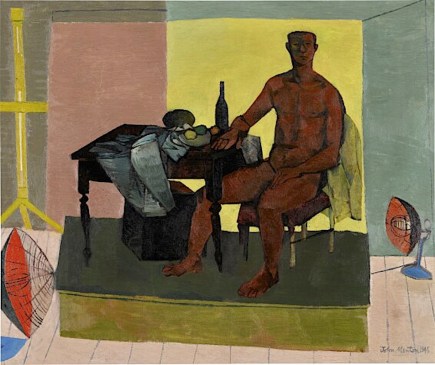
Third Insert Image: John Minton, “The Life Model”, 1948, Oil on Canvas, 63.5 x 76 cm, Private Collection
Bottom Insert Image: John Deakin, “John Minton, Soho”, 1951, Gelatin Silver Print, Michael Hoppen Gallery


 Minton was having profound doubts about the relevance of painting in the modern world and doubts about his own ability as a teacher and a painter.
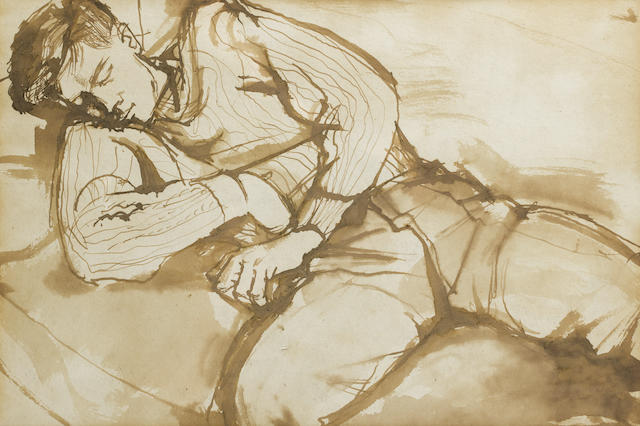 Although Minton made several portrait drawings of Maybury, the”Portrait of Kevin Maybury”, shown above, is the only painting of Maybury known to be done by Minton.
  first person to earn a lifetime achievement award for services to South African theatre. Kevin Maybury died. at the age of eighty-four, in July of 2013 at his home in Johannesburg.


