F. W. Murnau, “Nosferatu: A Symphony of Horror”, 1922, Film Scene Gifs, Cinematography Fritz Arno Wagner and Günther Krampf (Uncredited), Premiere Music Score Hans Erdmann, Prana Film
Born in Bielefeld, a city near the Teutoburg Forest in December of 1888, Friedrich Wilhelm Murnau was a German film director, producer and screenwriter. Recognized as one of  the most influential filmmakers of the silent era, he achieved international recognition for his 1922 film “Nosferatu”, an adaptation of Bram Stoker’s 1897 Gothic horror novel “Dracula”.
Born Friedrich Wilhelm Plumpe to Otilie Volbracht and Heinrich Plumpe, the owner of a cloth factory, Murnau was one of four children raised in a wealthy family of the northwest part of Germany. By the age of twelve, Friedrich had already read works by Henrik Johan Ibsen, Friedrich Nietzsche, Arthur Schopenhauer and Shakespeare. He studied philology, the study of language in oral and written historical sources, at the University of Berlin and later art history and literature at the University of Heidelberg.
Noticed for his acting ability in university performances, Friedrich was invited in 1908 by film and theater director Max Reinhard to attend his drama school. It was during this period that he changed his name to Friedrich Wilhelm Murnau, as his parents did not accept either his homosexuality or his choice of a career in the theater. While studying at Reinhard’s school, Murnau met and began a relationship with the poet, writer and musician Hans Ehrenbaum-Degele. It was  Ehrenbaum who introduced Murnau to the work of such Expressionists as painter Franz Marc and Else Lasker-Schüler, a writer of plays, poetry and prose.
In addition to his acting in several of Reinhardt’s plays, F. W. Murnau’s experience with film making began with his position as Reinhardt’s assistant on the production of the 1912 silent “The Miracle”, a full-color film experience that included a full- sized symphony orchestra and chorus. During World War I, Murnau fought in the infantry on the Eastern front and, beginning in 1916, served as a member of the Imperial German Flying Corps. He survived several missions over France and eight crashes without serious injuries. Murnau was detained in neutral Switzerland in 1917 until the end of the war. His friend and lover, Hans Ehrenbaum served in the war as an infantry soldier but was killed on the Eastern front in 1915, an event which had a profound effect on Murnau.
After the war, Murnau returned to Germany and, in 1919, entered into a collaboration with actor Conrad Veidt to establish a film studio. His directorial debut, now considered a lost film, was the 1919 feature-length drama “Der Knabe in Blau (The Boy in Blue)” inspired by Gainsborough’s 1770 painting of the same name and Oscar Wilde’s novel “The Picture of Dorian Gray”. Between 1919 and 1922, Murnau created films on a variety of topics and in a variety of styles. An Expressionist film of this period, now lost, was Murnau’s fourth feature film, the 1920  “Der Janus Kopf (The Head of Janus)“. This was a variation on Robert Louis Stevenson’s novella “Doctor Jekyll and Mr. Hyde” and starred Conrad Veidt and Hungarian actor Bela Lugosi.
F. W. Murnau’s best known film is the 1922 “Nosferatu”, an adaptation of Bram Stoker’s “Dracula” that was produced through his newly founded Prana Film Company. This film was the only one released by the company due to a copyright infringement lawsuit brought by Florence Stoker, Bram Stoker’s widow. In its judgement, the court ordered all existing copies destroyed; only one copy of “Nosferatu” survived and became the basis of all prints existing today. Working alongside cinematographer Fritz Arno Wagner, Murnau created macabre visual effects for the film that included negative images of trees against a black sky, stop-motion movements, and projected shadows.
Murnau’s collaboration with scriptwriter Carl Mayer and cinematographer Karl Freund resulted in the 1924 “Der Letzte Mann (The Last Man)”, starring Emil Jennings in his best known role. This film, nearly as important as “Nosferatu”, established Murnau’s reputation as one of the foremost German directors. Mounted cameras on bicycles and overhead wires created a rapid series of subjective images; the entire film was pantomime with only one title card used in the entire seventy-seven minute silent film. Murnau’s final two films produced in Germany were the 1925 “Herr Tartüff  (Tartuffe)”, an adaptation of Molière’s satiric play, and “Faust”, a silent 1926 fantasy film that starred Emil Jennings as Mephisto and Gösta Ekman as Faust.
Acquiring a contract in the United States with Fox Film Corporation in 1926, F. W. Murnau and his staff of German technicians and craftsman produced the 1927 “Sunrise: A Song of Two Humans” which won several Oscars and Janet Gaynor her first Academy Award for Best Actress. The film shared what is now the Best Picture Award with William A Wellman’s “Wings” and was held by critics as the finest silent film ever produced by a Hollywood studio. Murnau did two more films for Fox Film Corporation: the 1928 “Four Devils”, now considered a lost film, and the 1929 “Our Daily Bread” to which Fox Film in an attempt to be more current hastily added spoken dialogue to the silent scenes, essentially compromising Murnau’s vision.
In 1928, Murnau formed a film production company with documentary film maker Robert Flaherty in order to better control the content of his films. They traveled to the Tahiti in 1929 to film “Tabu”. Flaherty withdrew from the project in its early stages when Murnau began incorporating a fictionalized love story into what had started as an objective documentary of Polynesian life. Finished at Murnau’s own expense and released in 1931, “Tabu: A Story of the South Seas” was a synchronized sound film split into two chapters with a music score and sound effects. “Tabu” became Murnau’s most popular and successful film. Deep in debt, he was offered a ten-year contract with Paramount Studios upon his return to Hollywood.
On the tenth of March in 1931, one week prior to the premiere of “Tabu”, Friedrich Wilhelm Murnau was driven up the Pacific Coast Highway from Los Angeles in a rented Packard touring car by his young Filipino driver Eliazar Stevenson. The fast-driven car swerved to avoid a truck that unexpectedly veered into the northbound lane. After striking an embankment, Murnau and Stevenson were thrown out of the vehicle. Murnau suffered a fractured skull and died in the hospital the next day. His body was transported to Germany and entombed in the Stahnsdorf South-Western Cemetery near Berlin on the thirteenth of April.
Notes: An excellent biographical article on F. W. Murnau’s life can be found at the CineCollage site: http://cinecollage.net/murnau.html
A 1967 article, “Shadow and Substance: F. W. Murnau’s Nosferatu”, written by Gilberto Perez Guillermo for the Sight and Sound Archive can be found at the British Film Institute’s site located at: https://www.bfi.org.uk/sight-and-sound/features/shadow-substance-f-w-murnaus-nosferatu
The University of California’s Berkeley Art Museum & Pacific Film Archive has a listing with information on thirteen of F. W. Murnau’s films that were previously screened: https://bampfa.org/program/f-w-murnau-voyages-imaginary
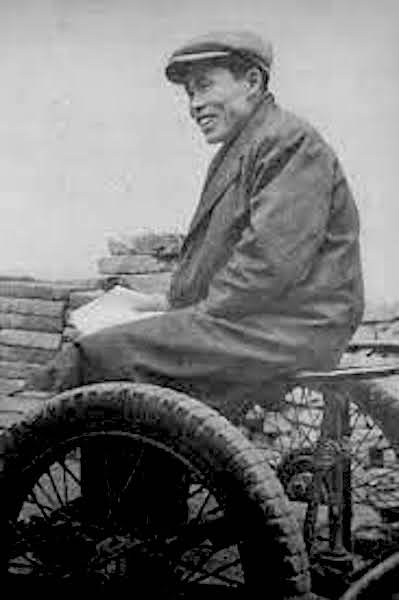
Top Insert Image: Thomas Staedeli, “Friedrich Wilhelm Murnau”, Date Unknown, Studio Publicity Card, Private Collection
Second Insert Image: F. W. Murnau, “Matahi and Anne Chevalier”, 1931, “Tabu: A Story of the South Seas” Film Still, Cinematography Floyd Crosby, Flaherty-Murnau Productions, Paramount Pictures
Third Insert Image: F. W. Murnau, “George O’Brien and Margaret Livingston”, 1927, “Sunrise: A Song of Two Humans”, Film Still, Cinematography Charles Rosher and Karl Struss, Fox Film Corporation
Fourth Insert Image: F. W. Murnau, “The Haunted Castle”, 1921, Film Still, Cinematography Franz Arno Wagner and László Schäffer, Uco-Film Company
Bottom Insert Image: F.W. Murnau, “Gösta Ekman as Faust”, 1926, Film Still, Cinematography Carl Hoffmann, Ufa (Germany) Metro-Goldwyn-Mayer (USA)