Mime Misu: Film History Series

Mime Misu, “In Nacht und Eis (In Night and Ice)”, 1912, Written and Directed by Mime Misu, Film Runtime 42 Minutes, Continental-Kunstfilm, Berlin, Germany,

Remastered with English Subtitles and Score by Swiss Composer Christophe Sturzenegger

Born in January of 1888 at the county seat of Botosani in the northern part of Romania, Misu Rosescu was a pantomime artist, ballet dancer, film actor and director. He was nephew to the prominent writer Rahel Levin Varnhagen whose home became a center for the intellectual and political figures of German culture. Born into a family of musicians, artists and performers, Rosescu made his stage debut as a child performing ballet and pantomime.

Rosescu’s many talented performances were recognized and gained him free entrance into the Bucharest Art Academy. During his studies, he was assigned to the Royal National Theatre in the capital city of Bucharest. After his graduation with honors, Rosescu began a successful career appearing in theatrical performances at the provincial theaters of Romania. After his performance at the 1900 World Fair in Paris, Rosescu established his own theatrical production company and toured Berlin, Budapest, Vienna and London. 

Misu Rosescu, now using the name Mime Misu, entered into the growing film industry. In Paris, he was initially employed by Lux, a film production company located in the 14th arrondissement, and later at Pathé Frères which was becoming the world’s largest film equipment and production company. In 1912, Misu signed with Berlin’s newly established Continental=Kunstfilm which had just begun to release a mix of comedies, melodramas and documentaries. mis

Through Continental-Kunstfilm, Mime Misu wrote and directed three films in his first year. The 1912 silent film “Das Gespenst von Clyde (The Ghost of von Clyde)” was a media story of Count Arthur Hamilton who died in the British Castle of Clyde under mysterious circumstances. Misu’s 1912 “In Nacht und Eis (In Night and Ice)” was a silent adventure-disaster film depicting the recent sinking of RMC Titanic. Having achieved some success with his drama-documentary narrative style, Misu made the 1912 “Das Mirakel (The Miracle)”. Based on the thirteenth-century temptation legend of Sister Beatrice, the film later appeared under the title “Das Marienwunder: Eine alte Legende (The Miracle of Mary: An Old Legend)” due to legal rulings in the United Kingdom and the United States.

Misu made one more film in Germany, the 1913-1914 “Der Excentric Club”, for Projektions-AG Union, a Frankfurt film production company that soon moved to Berlin, the new center of the German film industry. He traveled to the United States where he made one film, the 1914 “Money God”, under his personal production company Misugraph-Film. Lacking support in the United States just as the First Great War began, Misu returned to Europe and settled with his new wife, Bertha, in Berlin’s inner-city district of Wilmersdorf. In 1915, he directed in the Netherlands his last film, a disaster film of a sinking ship entitled “Ontmaskerd (Unmasked)”; the credits list his birth name, Misu Rosecu, as director.

Mime Misu traveled to the United States every year from 1915 to 1917. He maintained office space in Berlin for his production company Misugraph-Film until 1921. There is, however, no record of any artistic activity from 1915 to 1921. In 1921, Misu apparently misrepresented himself as to his involvement with the Famous Players Film Company, a film venture owned by Paramount Pictures’ founder Adolph Zukor. This led to the publishing of their exchanged letters in Berlin’s film journal Fil-Kurier. An accomplished stage performer and director of six films, (Mime) Misu Rosescu died in Antwerp, Belgium in the summer of 1953. 

Among the films in his career, Mime Misu’s best known work is the 1912 “In Nacht und Eis’, the earliest surviving film depiction of the RMS Titanic disaster. Camera work was done by Willy Hameister, Emil Schünemann and Victor Zimmermann. Most of its footage was shot in a glasshouse studio inside the courtyard of Continental-Kunstfilm’s offices at 123 Chausseestrasse. Other footage was shot in Hamburg and, possibly, aboard the Hamburg-docked German ocean liner Kaiserin Auguste Victoria. 

At a running time of thirty-five minutes, “In Nacht und Eis” was shot in black and white with various scenes tinted to increase their impact. The film starred actors Waldemar Hecker as the telegrapher, Otto Rippert as the Captain, and Ernst Rückert as the First Officer. The Berlin Fire Department provided the flood waters necessary for the scenes of the Titanic’s sinking. “In Nacht und Eis” was considered a lost film until February of 1998. At that time, the German film archivist Horst Lange, after reading an article discussing this loss, informed the newspaper that he possessed a print of the film.

Note: The above video of “In Nacht und Eis” is from the Titanic Officers site which contains a multitude of articles on the ship’s officers and other aspects of the Titanic and its sinking. The Titanic Officers website can be found at: https://www.titanicofficers.com/articles.html

For those film buffs who are purists, there is a restored silent version, sans soundtrack, on the Internet Archive. This slightly shorter film with a runtime of thirty-four minutes is located at:  https://archive.org/details/silent-in-nacht-und-eis

Top Insert Image: Mime Misu, “Das Mirakel”, 1912, Publicity Photo on Cardstock

Bottom Insert Image: Mime Misu, “In Nacht und Eis”, 1912, (Otto Rippert and Ernst Rüchert) Film Clip Photo

Corrado Cagli: “The Battle of San Marino”

Corrado Cagli, “The battle of San Marino”, 1936, Encaustic Tempera on Hollow-Core Wood, 545 x 651 cm,  Uffizi Gallery, Florence 

Born in the city of Ancona in February of 1910, Corrado Cagli was an Italian painter of Jewish heritage. Little information on his formative years is available; however, it is known that, at the age of five, his family relocated to Rome. Cagli grew up in a largely assimilated secular family, who had come to terms with its Jewish religion as antisemitism became more aggressive in Fascist Italy. His ties to his Italian heritage were always strong; even in his later years of exile from Italy, it was important for him to maintain a tie with his birth nation. 

Corrado Cagli helped organize the Gallleria La Cometa in Rome and, along with poet Libero De Libero, created an artistic circle of musicians, writers, architects, painters and sculptors. He was involved with New York’s Museum of Modern Art’s 1949 exhibition, “20th Century Italian Art” and facilitated the 1950 opening of the Catherine Viviano Gallery in New York City. Cagli was awarded the Guggenheim Prize in 1946 and, in 1954, the Marzotto Prize, given by the Marzotto fashion company for his contributions to the cultural rebirth of Italy after the war. Corrado Cagli died in Rome in 1976.

Corrado Cagli’s “Battle of San Marino” depicts the final battle of the Second War of Independence in which the Piedmont army, directed by King Vittorio Emanuele and supported by the French troops of Napoleon III, defeated in a fierce battle the Austrian forces commanded by Emperor Franz Joseph I. The battle is considered the founding moment of the Italian Risorgimento, the period leading to unification and the formation of the new state of Italy. 

The battle scene, depicted from a bird’s eye perspective, with the hectic confusion of weapons, horses, infantry and knights crushed together amid the surrounding hillsides, clearly highlights Cagli’s relationship with traditional painting styles, with influences ranging from Paolo Uccello to Piero della Francesca. Owned by Francesco Muzzi, secretary of the Cagli Foundation, and graciously loaned to the Uffizi in 1978, it was finally donated to the Uffizi Gallery in 2003.

Note: An interview between author Raffaele Bedarida and Alessandro Cassin, Director of Centro Primo Levi, entitled “Corrado Cagli, the American Years” can be found online at Printed_Matter located at: http://primolevicenter.org/printed-matter/corrado-cagli-the-american-years/

John Warner Barber: “Death of Capt. Ferrer”

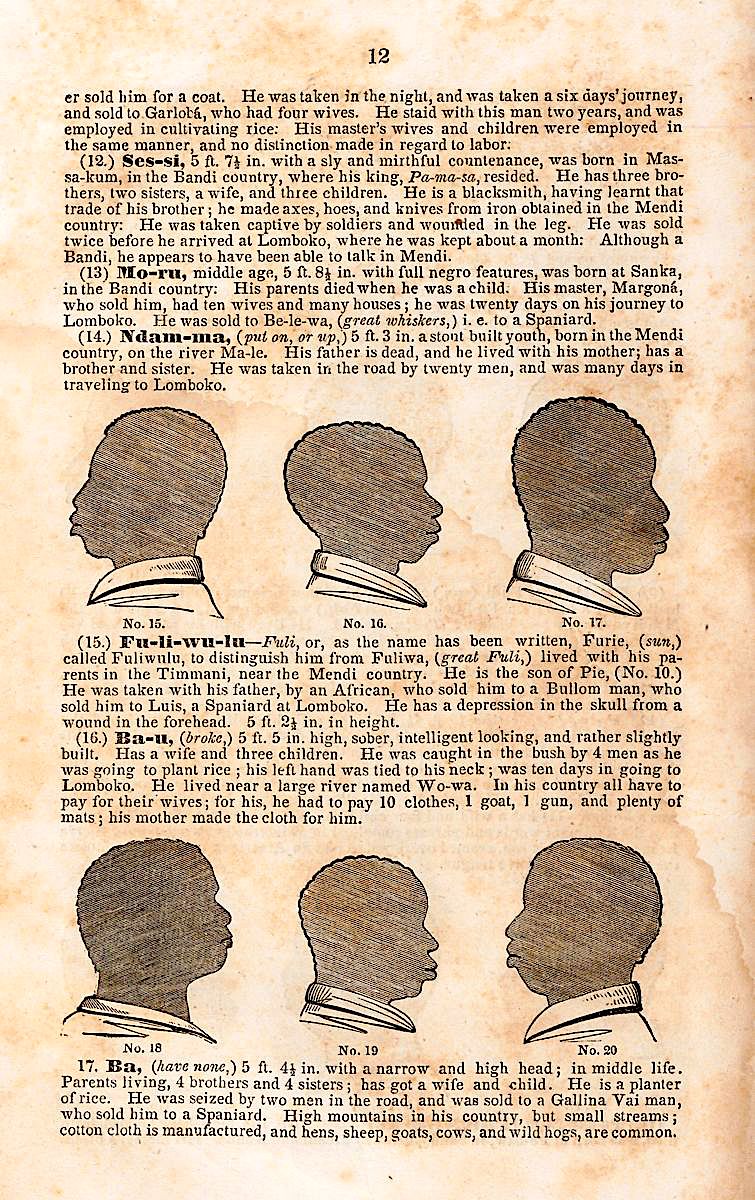
John Warner Barber, “The Death of Capt. Ferrer”, 1840, Etching, Frontpiece from the “A History of the Amistad Captives”, Unfolded 22.9 x 49.3 cm, Partially Hand-Colored, Private Collection 

Born in East Windsor, Connecticut in February of 1798, John Warner Barber was an engraver and historian whose books of local, state, and national history featured his colorful  illustrations. He learned his craft as an apprentice to East Windsor printmaker Abner Reed, who also was a bank note engraver for the United States and Canada. In 1823, Barber opened a business in New Haven, where he printed religious and historical books, illustrated with his own steel and wood engravings. 

Barber traveled throughout Connecticut, creating ink sketches of town greens, churches, hotels and harbors; he also researched local histories on his travels. From his research, Barber produced in 1836 what is considered the first popular local history book published in the United States, the “Connecticut Historical Collections, Containing a General Collection of Interesting Facts, Traditions, Biographical Sketches, Anecdotes, Etc. . .”. His pencil sketches were developed into more detailed wash drawings, which in turn were transferred directly to small blocks of boxwood on which he engraved the designs. The book sold well, seven thousand copies in the first year at a cost of what was then an average week’s pay.

In 1840, John W. Barber produced his thirty-two page “ A History of the Amistad Captives: Being a Circumstantial Account of the Capture of the Spanish Schooner Amistad, by the Africans on Board; Their Voyage, and Capture Near Long Island, New York; with Biographical Sketches of Each of the Surviving Africans, Also, an Account of the Trials , , , Compiled from Authentic Sources”. Documenting one of the most important events of its time, Barber’s  book was published the same year of the Amistad trial and its ruling by the New Haven court.

In February of 1839, Portuguese slave hunters abducted hundreds of Africans from what is now present-day Sierra Leone and transported them to Cuba, then a Spanish colony. Spanish plantation owners Pedro Montes and Jose Ruiz purchased fifty-three of the African captives as slaves, forty-nine adult males and four children. On June 28th, Montes and Ruiz with the African captives set sail from Havana on the Amistad, Spanish for ‘friendship’, for their plantations on Puerto Principe.

Several days into the journey, Sengbe Pieh, one of the Africans also known as Joseph Cinque, managed to unshackle himself and his fellow captives. Armed with knives, they seized control of the Amistad and killed the Spanish captain and the ship’s cook. In need of navigation, the Africans ordered Montes and Ruiz to return to Africa; however, the two men  changed the ship’s course in the middle of the night, sailed through the Caribbean and up the eastern coast of the United States. 

On August 26th of 1839, the U.S. Navy brig Washington found the ship anchored off the coast of Long Island to get provisions. The naval officers seized the Amistad, put the Africans back in chains, and escorted the ship to Conneticut, where they would claim salvage rights to the ship and its human cargo. Originally charged with murder and piracy, Cinque and the other Africans were imprisoned in New Haven. Though the charges were dropped, they remained in prison while the courts decided their legal status, as well as the competing property claims by the Washington’s officers, Montes and Ruiz, and the Spanish government. 

In January of 1840, a judge in U.S. District Court in Hartford ruled that the Africans were not Spanish slaves, but had been illegally captured, and should be returned to Africa. After appealing the decision to the Circuit Court, which upheld the lower court’s decision, the U.S. attorney appealed to the Supreme Court, which heard the case in ealry 1841. 

On March 9, 1841, the Supreme Court ruled seven to one to uphold the lower courts’ decisions in favor of the Africans of the Amistad. However, the court did not require the government to provide funds for the Africans’ return voyage, but did award salvage rights for the Amistad to the officers who apprehended it. In November of 1841 after abolitionists raised money for the return voyage, Cinque and the surviving thirty-four Africans of the Amistad, the others either died at sea or in prison awaiting trial, sailed from New York aboard the ship Gentleman to return to their homeland.

James Warner Barber attended the court hearings between January 7th and 13th in 1840 when Judge Andrew Johnson rule that the Africans were illegally transported to Cuba, and thus would not be returned to Montes and Ruis. On the first of April, Barber began drawing the Amistad Africans in jail and, over the next two months, would create drawings and engravings to illustrate his book. Barber drew portraits, from which he engraved silhouettes of the Africans, and added other illustrations to his book, including a map of the Mendi country, home of the Amistad Africans.

British Pathé, “RMS Titanic”: Film History Series


Artist Unknown, Titanic Moored at Dock, Gifs, British Pathé, 1912

These three colorized gifs were taken from the beginning of a film, jointly owned by British Pathé and Gaumont Newsreels, containing known footage of the R.M.S. Titanic. Slightly different versions of this film are held by British Movietone and the National Film and Television Archive.

The three gifs depict the Titanic moored, probably on April 2nd of 1912, at the Thompson Graving Dock on Queen’s Island in Belfast, where the RMS Titanic was fitted out. In these shots, men can be seen walking beside the ship and smoke is seen issuing from the third funnel of the Titanic.

The British Pathé’s newsreel, just over six minutes in length,  covers several episodes in the story of the RMS Titanic’s final days. The captain of the RMS Titanic, Edward J. Smith, who perished when the ship sank, is shown on board the RMS Olympic, before assuming duty on the Titanic. Newsreel footage of icebergs and ice floes are shown to portray the scene of the disaster. Scenes of the rescue ship, Carpathia, nearing New York City with survivors, and scenes of the departing search and rescue vessel, Mackay Bennet, also are included in this Pathé footage.

At the forefront of cinematic journalism, British Pathé was a producer of newsreels and documentaries from 1910 to 1970 in England. The company blended information with entertainment for movie theater attendees who came to watch the news. Over the course of its sixty years, it documented everything from major armed conflicts and international political crises to the curious hobbies and eccentric lives of ordinary people.

British Pathé’s roots lie in 1896 Paris, France, when Société Pathé Frères  was founded by Charles Pathé and his brothers, who pioneered the development of the moving image. In 1908, the company invented the cinema newsreel with its introduction of the Pathé-Journal and opened a newsreel office on Wardour Street, London, in 1910. These early silent  newsreels, issued every two weeks and running about four minutes in length, were shown in local theaters; sound was introduced beginning in 1928. The Pathé newsreels captured events such as suffragette Emily Danison’s fatal injury by a racehorse at the 1913 Epsom Derby and Franz Reichelt’s fatal descent by parachute from the Eiffel Tower in February of 1912.

Considered now to be the finest newsreel archive in the world, British Pathé is a treasure trove of eighty-five thousand films unmatched in their historical and cultural significance. The company also represents the Reuters historical collection, which includes more than one hundred thirty-six thousand items from the following news agencies: Gaumont Graphic, active from 1910 to 1932; Empire News Bulletin, a film library from 1926 to 1930;  British Paramount,  a collection spanning from 1931 to 1957; and Gaumont British’s collection  from 1934 to 1959. Included in Pathés vast library of film is the collected content from the Visnews service active from 1957 until the end of 1984.

The full footage of British Pathé’s Titanic black and white newsreel can be found at: https://www.youtube.com/watch?v=05o7sOAjtXE

All footage can be viewed on the British Pathé website. https://www.britishpathe.com/

Calendar: December 24

A Year: Day to Day Men: 24th of December

Namor the Sub-Mariner: Homo Mermanus

On December 24, 1851, a fire burns 35,000 volumes at the United States Library of Congress.

As Americans celebrated Christmas Eve, 1851, a fire ripped through the US Library of Congress in Washington, DC, destroying 35,000 volumes. A faulty chimney flue set off the blaze, which took two-thirds of the collection, including most of Thomas Jefferson’s personal library that had been sold to the institution in 1815.

Initially established in 1800 when President John Adams approved legislation that appropriated $5,000 to purchase “such books as may be necessary for the use of Congress” — the first books, ordered from London, arrived in 1801. They were stored in the U.S. Capitol. Twelve years later, the British army invaded the city of Washington and burned the Capitol, including the 3,000-volume Library of Congress. Jefferson responded to that loss by selling his personal library of 6,487 volumes — the largest and finest in the country — to Congress to “recommence” the library.

After the fire of 1851, architect of the Capitol Thomas U. Walter presented a plan to repair and enlarge the Library room using fireproof materials throughout. The elegantly restored Library room was opened on August 23, 1853. Called by the press the “largest iron room in the world,” it was encircled by galleries and filled the west central front of the Capitol. A month before the opening, Pres. Franklin Pierce inspected the new Library in the company of British scientist Sir Charles Lyell, who pronounced it “the most beautiful room in the world.”

The current collection consists of more than 164 million total items: more than 38 million books and other printed materials, 3.6 million recordings, 14 million photographs, 5.5 million maps, 8.1 million pieces of sheet music and 70 million manuscripts. It also has 5,711 incunabula (early printed books before 1501) and 122,810,430 items in the nonclassified (special) collections. Although the Library is open to the public, only high-ranking government officials and Library employees may check out books and materials (except through interlibrary loan, which is available to the public.

Calendar: November 24

A Year: Day to Day Men: 24th of November

One Facet of Life

November 24, 1639 marks the first known observation and recording of a transit of Venus.

By the 17th century, two developments allowed for the transits of planets across the face of the sun to be predicted and observed. One was the telescope of which the actual inventor is unknown; a patent for a refracting telescope was submitted in 1608 in the Netherlands by spectacle maker Hans Lippershey. Galileo heard about it, and in 1609 built his own version for observing celestial objects.

The second development was the new astronomy of Johannes Kepler, which assumed elliptical rather than circular orbits fro the planets. In 1627, Kepler published his “ Rudolphine Tables”, a star catalogue and planetary tables using some observational data collected by Danish astronomer Tycho Brahe. Two years later, Kepler published extracts from his tables concerning the transit of Mercury and of Venus for the year 1631. These occurred as predicted and were observed by several astronomers, vindicating Kepler’s approach to astronomical theory.

The first known observations and recording of the transit of Venus across the sun were made in 1639 by the English astronomers Jeremiah Horrocks and his friend and correspondent William Crabtree. These observations were made on November 24, under the Julian calendar then in use in England. This calendar was refined and gradually replaced by our Gregorian calendar initiated by Pope Gregory XIII, changing the observation date to December 4th of that year. Horrocks observed the event from the village of Much Hoole, Lancashire, and Crabtree, independently, observed the event from his home in Broughton, near Manchester.

Both men, followers of Kepler’s astronomy, were self-taught mathematical astronomers who methodically worked to correct and improve Kepler’s Tables by observation and measurement. In 1639, Horrocks was the only astronomer who realized that the transit of Venus was imminent; others became aware only upon receiving Horrocks’s report. The two men’s observations and later mathematical work were influential in establishing the size of the solar system. For their achievements, they are considered the founders fo British research astronomy.

Insert Image: Ford Madox Brown, “Crabtree Watching the Transit of Venus AD 1639”, 1883, Oil on Canvas, Manchester Town Hall, Manchester, England

Calendar: April 10


A Year: Day to Day Men: 10th of April

In Cool Water

Mount Tambora’s eruptions reached a violent climax on April 10, 1815.

Mount Tambora is on the island of Sumbawa in Indonesia. It experienced several centuries of dormancy before 1815, caused by the gradual cooling of the hydrous magma in its closed magma chamber. During this cooling, crystallization of the magma occurred. resulting in an over-pressurization of the chamber and a rising of the temperature. In 1812, the volcano began to rumble and generated a dark cloud.

On the 5th of April in 1815, a very large eruption occurred, followed by thunderous detonation sounds heard in Makassar on Sulawesi 240 miles away, and as far as Ternate on the Molucca Islands 870 miles away. On the morning of April 6, volcanic ash began to fall in East Java with faint detonation sounds lasting until the 10th of April. Detonation sounds were heard on  April 10th at Sumatra, more than 1,600 miles away.

At about 7 pm on April 10th, the eruptions intensified. Three columns of flame rose up and merged. The whole mountain was turned into a flowing mass of “liquid fire”. Pumice stones of up to 8 inches in diameter started to rain down around 8 pm, followed by ash at around 9–10 pm. Pyroclastic flows cascaded down the mountain to the sea on all sides of the peninsula, wiping out the village of Tambora. Loud explosions were heard until the next evening, April 11. The ash veil spread as far as West Java and South Sulawesi.

The explosion had an estimated Volcanic Explosivity Index of 7 (on a scale of 0 to 8) making it one of the most powerful in recorded history. An estimated 10 cubic miles of pyroclastic rock were ejected, weighting about 10 billion tons. This left a caldera measuring about four miles across and 2,300 feet deep. Before the explosion, Mount Tambora’s peak elevation was about 14,100 feet, making it one of the tallest peaks in the Indonesian archipelago. After the explosion, its peak elevation had dropped to 9,354 feet, about two thirds of its previous height.

The 1855 Zollinger report puts the number of direct deaths at 10,000, probably caused by pyroclastic flows. On Sumbawa island, 38,000 people starved to death; on Lombok island about 10,000 people died from disease and hunger. However, other journal reports put the combined deaths from volcanic activity and from post-eruption famine and epidemic diseases higher at 70,000 to 100,000 people. The ash from the eruption dispersed around the world, lowering global temperatures and triggering harvest failures.

Calendar: April 3

A Year: Day to Day Men: 3rd of April

The Railroad Yard

On April 3, 1882, Jesse Woodson James was shot in the back of the head at his home.

After the failed bank robbery of the First National Bank of Northfield, Minnesota, on September 7, 1876, only Jesse and Frank James remained alive and free, escaping to Missouri. Later in 1876 Jesse and Frank surfaced in the Nashville, Tennessee, area using the names Thomas Howard and B.J. Woodson, respectively. Frank seemed to settle down, but Jesse recruited a new gang, leading them on a spree of crimes. A law enforcement posse attacked and killed two of the outlaws but failed to capture the entire gang.

By 1881, with the local Tennessee authorities getting closer, Frank and Jesse James returned to Missouri. James moved his family to Saint Joseph, Missouri, in November 1881, not far from his birthplace. Frank made the decision to head east and settle in Virginia. Both intended to give up crime.

With his gang nearly annihilated, Jesse James trusted only the Ford brothers, Charley and Robert. For protection, he asked the Ford brothers to move in with him and his family. By that time, Robert Ford had already conducted secret negotiations with Missouri Governor Crittenden to bring Jesse in and secure the $5000 bounty reward from the railroad.

On April 3, 1882, after eating breakfast, the Ford brothers and Jesse went into the living room before traveling to a planned robbery. Jesse had learned from a newspaper of one of his gang members who was captured and had confessed to a murder. Jesse was suspicious that the Fords did not mention the news; but he did not confront them. Robert Ford believed that Jesse James had realized the Fords were about to betray him. When Jesse turned his back to them, Robert Ford drew his weapon, and shot the unarmed Jesse James in the back of the head.

The Fords acknowledged their role in Jesse James’ death; Robert wired the governor to claim his reward. The Ford brothers surrendered to the authorities and were dismayed to be charged with first-degree murder. In the course of a single day, the Ford brothers were indicted, pleaded guilty, were sentenced to death by hanging, and were granted a full pardon by Governor Crittenden. The governor’s quick pardon suggested he knew the brothers intended to kill James rather than capture him. The implication that the chief executive of Missouri conspired to kill a private citizen startled the public and added to Jesse James’ notoriety

Suffering from tuberculosis and a morphine addiction, Charley Ford committed suicide on May 6, 1884, in Richmond, Missouri. Bob Ford operated a tent saloon in Creede, Colorado. On June 8, 1892, Edward O’Kelley went to Creede, loaded a double-barrel shotgun, entered Ford’s saloon and said “Hello, Bob,” before shooting Ford in the throat, killing him instantly. O’Kelley was sentenced to life in prison, but his sentence was subsequently commuted because of a 7,000-signature petition in favor of his release. The Governor of Colorado pardoned him on the third of October in 1902.

Calendar: March 22

A Year: Day to Day Men: 22nd of March

The Fire Fighter

The Emerald Buddha was moved with great ceremony on March 22, 1784 to His current place in Wat Phra Kaew, Thailand.

Phra Kaeo Morakot, the Emerald Buddha, is considered the palladium of the Kingdom of Thailand; an figure of great antiquity on which the safety of Thailand is said to depend. The figure of the meditating Buddha seated in a yogic posture is made of semi-precious jade, clothed in gold and 26 inches tall in His seated position. Historical sources indicate the the figure of the Buddha surfaced in northern Thailand in the Lanna kingdom in 1434.

In 1779, the Thai General Chao Phraya Chakri put down an insurrection, captured Vientiane, the capital of Laos where the Buddha had resided for 214 years, and took the Emerald Buddha to Siam. It was installed in a shrine close to Wat Arun in Thonburi, Siam’s new capital. Chao Phraya Chakri took control of the country and founded the Chakri Dynasty of Rattanakosin Kingdom. He adopted the title ‘Rama I’ and shifted his capital across the Menam Chao Phra River to its present location in Bangkok.

There Rama I constructed the new Grand Palace including Wat Phra Kaew within its compound. Wat Phra Kaew was consecrated in 1784, and the Emerald Buddha was moved with great pomp and pageantry to its current home in the Ubosoth, the holiest prayer room, of the Wat Phra Kaew temple complex on 22 March 1784.

The Emerald Buddha is adorned with three different sets of gold seasonal costume; two were made by King Rama I, one for the summer and one for the rainy season, and a third made by King Rama III for the winter or cool season. The clothes are changed by the King of Thailand, or another member of the royal family in his stead, in a ceremony at the changing of the seasons – in the first waning of lunar months around March, August and November.

King Rama I initiated this ritual for the hot season and the rainy season, Rama III introduced the ritual for the winter season. The robes, which adorn the figure of Buddha, represent those of monks and the King, depending on the season, a clear indication of highlighting its symbolic role “as Buddha and the King”, which role is also enjoined on the Thai King who formally dresses the Emerald Buddha image. The costume change ritual is performed by the Thai king who is the highest master of ceremonies for all Buddhist rituals.

Calendar: February 28

A Year: Day to Day Men: 28th of February

White Drawstring

February 28, 1824 marks the birthdate of Jean-Francois Gravelet, known to many by his stage name Charles Blondin.

In 1829, when he was five years old, a circus troupe performed near his home, and Jean-Francois Gravelet became enthralled by the tightrope walker. It was the first time he had ever seen anyone attempting such stunts. He was so impressed that he felt compelled to try and accomplish the same kind of feats.

Instead of discouraging this rather risky pursuit, Gravelet’s father, who was a gymnast, supported his son’s ambitions. That same year he enrolled his son in the Ecole de Gymase, a school focused on physical education that was located in Lyon, France. Gravelet proved to be quite adept, and after only six months of training he made his amateur performance debut. Billed as “The Little Wonder,” the future Blondin became a popular attraction, as his performances demonstrated surprising skill and originality.

In 1851 he was recruited by an agent for William Niblo, the famed theatrical promoter, to perform with the Ravel Troupe of family acrobats in the United States at Niblo’s Garden. Gravelet then toured America with the troupe that, at one point, performed in New York City, working for P. T. Barnum as part of the world-famous circus impresario’s “Greatest Show on Earth.” During this period, Gravelet assumed his stage name, Charles Blondin.

Charles Blondin toured with the Ravel Troupe for several years. Seeing Niagara Falls for the first time in 1858, he became obsessed with the idea of crossing the gorge on a tightrope. On June 30, 1859, a crowd of 100,000 people witnessed Blondin’s historic feat. For this first attempt, Blondin used a single three-inch hemp cord that was 1,100 feet long and rigged 160 feet above the Falls at one side and 270 feet at the other.

After this first successful crossing, Blondin performed the stunt many times throughout the next year. Each time the crowds grew larger, and he employed different and much more dangerous variations. Once he crossed the Falls while blindfolded. On August 17, 1859, he crossed the Falls while carrying his manager, Harry Colcord, on his back. On September 14, 1860, he traversed the tightrope while walking on stilts. During this period of his career, he became known as “the Prince of Manila,” because the rope he used was made of Manila hemp. In all, Blondin walked across Niagara Falls 17 times.

Calendar: February 13

A Year: Day to Day Men: 13th of February

Red Bell Peppers

On February 13, 1961, the Coso artifact is discovered near the town of Olancha, California.

The Coso artifact is an object claimed by its discoverers to be a spark plug found encased in a lump of hard clay or rock. It was found by Wallace Lane, Virginia Maxey and Mike Mikesell while they were prospecting for geodes near the town of Olancha. It has been long claimed as an example of an out-of-place artifact. Such an artifact is an object of historical, archaeological, or paleontological interest found in an unusual context, that challenges conventional historical chronology by being “too advanced” for the level of civilization that existed at the time.

Following its collection, Mikesell destroyed a diamond-edged blade cutting through the rock containing the artifact and discovered the item. In a letter written to “Desert Magazine of Outdoor Southwest” a reader stated that a trained geologist had dated the nodule as at least 500,000 years old and it had contained a manmade object. The identity of the alleged trained geologist and means of geologic dating were never clarified, nor the findings ever published in any known periodical.

At the time that Virginia Maxey reported the Coso artifact being dated at 500,000 years old, there was no known method, including the use of guide fossils, by which either the artifact or concretion could have been dated as being this old. The nodule surrounding the spark plug may have accreted in a matter of years or decades, as demonstrated by examples of very similar iron or steel artifact-bearing nodules, which are discussed and illustrated by J. M. Cronyn’s “Elements of Archaeological Conservation”, a reference work for the conservational excavation of materials at sites.

An investigation carried out with the help of members of the Spark Plug Collectors of America, suggested that the artifact is a 1920s Champion spark plug. Chad Windham, President of the Spark Plug Collectors of America, identified the Coso artifact as a 1920s-era Champion spark plug, which was widely used in the Ford Model T and Model A engines. Other spark plug collectors concurred with his assessment.

The location of the Coso artifact is unknown as of 2008. Of its discoverers, Wallace Lane has died, Virginia Maxey is alive but avoids public comment, and the whereabouts of  Mike Mikesell are not known.

Calendar: January 10

A Year: Day to Day Men: 10th of January, Solar Year 2018

A Bed of Green

January 10, 1863 marked the beginning of the London Underground when the Metropolitan Railway, the world’s oldest underground railway, opened its route between Paddington and Farringdon.

The Metropolitan Railway was a goods and passenger railway that served London from 1863 to !933. Its main line headed northwest from the financial heart of the city to what became the Middlesex suburbs. The first section built was beneath New Road between Paddington and King’s Cross and then in tunnel and cuttings besides Farringdon Road to Smithfield, near the city. It opened on January 10 with gas-lit wooden carriages hauled by steam locomotives. It is the world’s first passenger carrying underground railway.

The line was extended from both ends, eventually extending to Verney Junction in Buckinghamshire, more than 80 kilometers from the Baker Street station to the center of London. In 1905, electric traction was introduced and by 1907 electrical multiple units operated most of the services. The Metropolitan developed land near the rail lines, promoting after World War I housing estates using the “Metro-land” brand. In July of 1933, the Met was merged with other railways, tram lines, and bus services to form the London Passenger Transport Board. After the amalgamation in 1933 the “Metro-land” brand was discontinued.

The spirit of “Metro-land” was remembered in a television documentary “Metro-land”, first broadcast on February 26, 1973. A comedy-drama film, starring Christian Bale and Emily Watson, called “Metroland” was released in 1997. That film explored the tension between the youthful idealism of a hedonistic existence and that of the inevitable middle-class establishment. The film title referred to the London suburbs which were served by the expansive London Underground network, an environment that the lead characters had always promised themselves they would escape.

Calendar: January 5

A Year: Day to Day Men: 5th of January

A Cyclist in Blue

On January 5, 1903, the general public could use the Pacific cable for the very first time.

The Commercial Pacific Cable Company was founded in 1901, and ceased operations in October 1951. It provided the first direct telegraph route from America to the Philippines, China, and Japan.

The company was established as a joint venture of three companies: the Commercial Cable Company (25%), the Great Northern Telegraph Company (25%), and the Eastern Telegraph Company (50%). Though the Eastern (a British firm) was the majority shareholder, the CPCC was registered in the United States.

The company used cable ships to lay its undersea cable across the Pacific Ocean from America’s west coast. The cables extended a length of 6,912 miles (11,124 km) and the project cost about $12 million. Before this, messages had to travel across the Atlantic to the Far East via Cape Town, South Africa, and the Indian Ocean, or by way of London to Russia, then across the Russian landline to Vladivostok, then by submarine cable to Japan and the Philippines.

The first section of cable was laid in 1902 by the cable ship CS Silvertown from Ocean Beach, adjacent to the famous Cliff House in San Francisco to Honolulu. It began operating on January 1, 1903. Later that year, cables were laid from Honolulu to Midway Atoll, thence to Guam, thence to Manila. The cables carried the first message to ever travel around the globe from US President Theodore Roosevelt on July 4, 1903. He wished “a happy Independence Day to the US, its territories and properties…” It took only nine minutes for the message to travel worldwide, an incredibly short time compared to past history.