


Photographers Unknown, The Cause of Love
When they have asked me the cause of my love
I have never answered: You already know its great bearuty.
(And there are still more beautiful faces.)
Nor have I described the certain qualities of his spirit
that he always showed me in his customs,
or in readiness for silence or smile
as required by my secret.
They were things of the soul, and I said nothing about her.
(And I should still add that I have met higher souls.)
The fruit of my love now I know:
man’s imperfections overcome his presence,
it is atrocious to think
that bodies do not correspond to souls in us,
and so the grace of the spirit blinds bodies,
its clarity, the aching flower of experience,
goodness itself.
important events that we never discovered,
or we find out late.
The bodies lie, other times, an airy heat,
moved light, honda freshness;
and the damage reveals its dry falsehood to us.
Know the truth of my love now:
matter and breath joined in his life
like the light that falls on the mirror
(it was a small light, a tiny mirror);
It was a perfect random creation.
A being in order grew next to me,
and my disorder was serene.
I loved its limited perfection.
–Francisco Brines, Cause of Love
Born in Oliva, Valencia, in January of 1932, Francisco Brines Bañó was a Spanish poet and essayist. He was a prominent member of the Generation of “50, a Spanish literary movement whose new literary language incorporated metaphysical and philosophical techniques to undermine the strict censorship of the Franco government.
After studying at the Jesuits of Valencia, Francisco Brines attended the University of Madrid, where he studied Philosophy and Letters, and also the Universities of Valencia, Deusto and Salamanca, where he earned a degree in Law.  He became a reader of Spanish literature at the University of Cambridge and a Professor of Spanish at the University of Oxford.
Described as a metaphysical poet, Brines was highly influenced by the work of Luis Cernuda, an openly gay poet of the Generation of ’27; inspired by these works, many of Brines’s poems also convey the theme of homosexual love. His poetry is characterized by the intimate tone of his verses, the constant reflection on the passage of time and decay of the living, and observations on the condition of a human being subjected to his own limitations. Memory also plays a fundamental role in Brines’s writing; although, his poems reveal the belief that neither poetry nor memory can endure the passage of time or save the moments of the past.
Francisco Brines’s first collection of poems, entitled “Las Brasas (Embers)”, was published in 1959 and won the 1960 Adonais Poetry Prize. In 1966, Francisco Brines published “Words in the Dark”, which earned him the National Critics Award in 1967. In the same year, he also won the Valencian Literature Award. “The Autumn of Roses’, a collection of sixty poems written over a ten year period, was published in 1986 and won the National Prize for Literature. This book, in which elegies of lamentation and exaltation merge, was his most critically acclaimed work.
Entering the world of theater, Brines revised and adapted playwright Pedro Calderón de la Barca’s 1636 drama“El Alcalde de Zalamea (The Mayor of Zalamea)”. Directed by José Luis Alonso, the play was performed by the Classical Theater Company in 1988. Told in three acts, it explored the power of a self-made man against political authority in seventeenth-century Spain,
Brines was recognized for his work by the Royal Spanish Academy in 1998 with the Fastenrath Prize and, later, received the 1999 National Prize for Spanish Letters for his poetic oeuvre. Elected a member of the Royal Spanish Academy of the Language in April of 2000, Brines gave his institutional speech 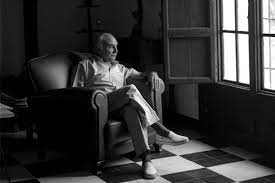 on the poetry of Luis Cernuda, one of the poets who influenced his work. In 2020, he won the Premio Cervantes, the most important literary award of the Spanish language world.
Francisco Brines Bañó was taken to Gandía Hospital shortly after King Felipe VI and Queen Letizia presented him with the 2020 Cervantes Prize at his family estate in Oliva, Valencia, as he was unable to attend the official ceremony due to his delicate state of health. He died on the 20th of May in 2021, at the age of eighty-one, at Gandía Hospital, after a hernia operation.
Note: An interesting article on the homoeroticism of Francisco Brines’s poetry, long regarded as an open secret but rarely acknowledged in critical studies, entitled “Francisco Brines and the Humanist Closet” by Jonathan Mathew of the University of Kansas, can be found at: https://kuscholarworks.ku.edu/bitstream/handle/1808/7478/Mayhew_Francisco%20Brines.pdf?sequence=1&isAllowed=y