Henry Ernest Schnakenberg

Henry Ernest Schnakenberg, “Indians Trading with the Half Moon”, 1941, One of Four Fresco Murals, Post Office Fort Lee, NewJersey

Born at New Brighton, Staten Island, New York in September of 1892, Henry Ernest Schnakenberg was an American realist painter and etcher known primarily for his renderings of New York’s Central Park and other cityscapes. He began his art studies with evening classes at the Arts Student League in 1913. Schnakenberg’s experience of attending the 1913 International Exhibition of Modern Art at the city’s 69th Regiment Armory on Lexington Avenue, known now as the Armory Show, solidified his desire to be an artist. After that exposure, he began full-time classes at the League, that continued as three years of study under painter and printmaker Kenneth Hayes Miller.

After exhibiting two works at the Society of Independent Artists, Schnakenberg enlisted in the Army Medical Corps in 1917 at America’s entry into World War I. Discharged in 1919, he quickly returned to art, exhibiting alongside Joseph Stella at the Whitney Studio Club. Beginning in 1923, Schnakenberg taught for two years at the Art Students League and, later, became the League’s president in 1932. In addition to his teaching, he wrote essays and reviews throughout his career for art magazines.

Henry Schnakenberg regularly exhibited his work at the Society of Independent Artists as well as museum invitationals, including those at the Whitney Museum of American Art, the Art Institute of Chicago, the Corcoran Gallery of Art in Washington DC, and the Pennsylvania Academy of the Fine Arts in Philadelphia. He participated in the Carnegie International from 1920 to 1949 and exhibited alongside his mentor Kenneth Miller at the 1939 New York World’s Fair. Beginning in 1932, Schnakenberg was represented by New York’s C.W. Kraushaar Galleries.  

After completing mural commissions from the Treasury Department’s section of Fine Arts for post offices in Amsterdam, New York and Fort Lee, New Jersey, Schnakenberg relocated to Newtown, Connecticut. He would travel from there to paint the summer landscapes of Vermont and New England farmlands. A member of the National Institute of Arts and Letters, Henry Ernest Schnakenberg died at the age of seventy-eight in October of 1970 at Newtown. His body in interred at the Moravian Cemetery in New Dorp, New York.  

Bottom Insert Image: Henry Ernest Schnakenberg, “Air Plants, Puerto Rico”, 1927, Oil on Canvas, 77.2 x 92.1 cm, Whitney Museum of American Art, new York

Frank Brangwyn

The Artwork of Sir Frank William Brangwyn

Born at Bruges in May of 1867, Sir Frank William Brangwyn was a Welsh artist, painter, illustrator, watercolorist, printmaker and designer. A prolific artist, he created more than twelve-thousand works including ceramics, stained glass panels and windows, glass tableware, furniture, and both interior and exterior architectural designs.

One of four children born to ecclesiastical architect William Curtis Brangwyn and Eleanor Griffiths, Frank Brangwyn received his primary education at Westminster City School. However, he often played truant, spending time at his father’s workshop and sketching at the South Kensington Museum. Brangwyn later took an apprenticeship with progressive architect and designer Arthur Heygate Mackmurdo, a major influence in the Arts and Craft Movement. With a recommendation from Mackmurdo, he was able to enter the workshops of designer William Morris, one of the most significant cultural figures in Victorian England.

After one of his paintings sold at the 1884 Summer Exhibition of the Royal Academy, Brangwyn joined the Royal Navy Volunteer Reserve and began painting seascapes. Securing a berth on a freighter to Istanbul, he spent 1890 and most of 1891 at sea, visiting Spain, Morocco, South Africa and Zanzibar. Brangwyn created many paintings during these voyages. His 1890 “Funeral at Sea”, a work done with a largely gray palette, was awarded a medal at the 1891 Paris Salon. Brangwyn, while traveling with Scottish orientalist painter Arthur Melville, became particularly influenced by the bright light and colors of the southern countries. He altered his palette towards lighter colors and produced many paintings and drawings in Spain, Morocco, Egypt and Turkey.

In 1895, German-French art dealer Samuel Siegfried Bing commissioned Frank Brangwyn to decorate the exterior of his Parisian art gallery, the Galerie L’Art Nouveau. Pleased with the work, Bing encouraged him to broaden the scope of his art. Brangwyn began creating tapestry and carpet designs, murals, posters and stained-glass designs for Louis Comfort Tiffany. In 1896, he created a series of illustrations for a six-volume reprint of British orientalist Edward William Lane’s translation of  “One Thousand and One Nights”. After collaborating with Japanese artist Urushibara Mokuchu on a 1917 series of woodblock prints, Brangwyn met a fellow collector of Asian art, industrial magnate Kojiro Matsukata, who later became his patron.

Although not an official war artist during the First World War, Brangwyn produced more than eighty poster designs during the conflict. The majority of these designs were donated to charities including the Red Cross, the  Royal National Institute for the Blind, and the L’Orphelinat des Armées, a charity that supported French orphanages. Brangwyn also produced six lithographs for the Ministry of Information’s 1917 “Britain’s Efforts and Ideals” portfolio to raise money for the war effort. As the chairman of the English Committee for Diksmuide, a Belgian city torn apart by the war, he donated a series of woodcuts to aid in its reconstruction.

Frank Brangwyn became widely known for his mural work and received numerous commissions from both England and the United States. Originally commissioned to paint the altar recess of Saint Aidan’s Church in Leeds, he decided to work in glass mosaic due to the pollution in the air. This work, completed in 1916, covers the entire altar recess with scenes from the life of St. Aidan. Included among Brangwyn’s other mural commissions were the Great Hall of the Worshipful Company of Skinners for the Royal Exchange in London, the Missouri State Capitol Building, the Manitoba Legislative Building in Winnipeg, and a mural created specifically for exhibition at the 1915 San Francisco Panama-Pacific International Exposition. Brangwyn, in collaboration with muralists Diego Rivera and Josep Maria Sert, decorated the concourse of the RCA Building in New York City.

The most notable of Brangwyn’s mural commissions, due to both its size and its history, was the one requested by Edward Cecil Guinness, First Earl of Iveagh, in 1926. Brangwyn was to paint a pair of large canvases for the Royal Gallery of the House of Lords at Westminster. These canvases were to honor those peers and their family members who died in the First World War. Finished after the death of Edward Guinness, the life-size battle scenes were found by the House of Lords to be too grim and, thus, they refused the work. In 1928, the Lords offered a second commission, a series of sixteen large works which became known as the British Empire Panels. This series, completed in 1933, was viewed by the Lords who, considering them too colorful and lively for the proposed location, again refused the work.The sixteen canvas murals were later purchased in the following year by the Swansea City Council who installed them in the city’s Brangwyn Hall.

Frank Brangwyn became increasingly pessimistic after the House of Lords twice refused his work. During the 1930s, he began to dispose of his possessions, donating many of his and other artworks to museums in Britain and Europe, including the British Museum and the William Morris Gallery. In 1936, Brangwyn presented over four hundred works to the Arents House Museum in Bruges, Belgium. The two 1926 life-size battle scenes were included with the group of gifts he donated to the National Museum Wales between 1929 and 1935. 

In 1944, Brangwyn, now recovered from his depression, secured Pre-Raphaelite illustrator Frederic Shields’s designs for architect Herbert Horne’s Chapel of the Ascension in London. This was an important achievement as the chapel was completely destroyed in 1940 during the bombing of London. One of Brangwyn’s last works was a 1950 series of illustrations for his friend Herbet Julyan’s book “Sixty Years of Yachts” published by London’s Hutchinson & Company. Frank William Brangwyn lived in his final years as a recluse in East Sussex until his death in June of 1956. His body was interred at St. Mary’s Catholic Cemetery, Kensal Green.

Among Sir Frank William Brangwyn’s many awards and honors were the 1902 Chevalier of the Legion of Honor; the Gold Medal of Venice and the Grand Prix of Milan, both in 1906; the 1911 Chevalier of the Order of the Crown of Italy; the 1919 Commander and Cross of the Order of Leopold I of Belgium; and the 1932 Albert Medal of the Royal Society of Arts. Brangwyn was awarded the title of Knight Bachelor, Great Britain in 1941. 

Notes: The definitive Frank Brangwyn website is located at: https://frankbrangwyn.org

Sir Frank William Brangwyn was elected a full Royal Academician of the Royal Society of British Artists in 1910. The Royal Academy of Arts has a biography and a collection of his works at its website: https://www.royalacademy.org.uk/art-artists/name/frank-brangwyn-ra

An extensive biographical article on Frank Brangwyn can be found at the Chris Beetles Gallery website: https://www.chrisbeetles.com/artists/brangwyn-sir-frank-ra-hrsa-rsw-rws-prba-re-hrms-roi-1867-1956.html

A lecture on Frank Brangwyn’s British Empire Panels, written by University of Bristol’s Art History lecturer Dr. Sehra Jumabhoy, can be found at the Glynn Vivian Art Gallery site: https://www.glynnvivian.co.uk/brangwyns-british-empire-panels/

Top Insert Image: Photographer Unknown, “Frank Brangwyn”, circa 1900, Vintage Print

Second Insert Image: Frank Brangwyn, “Study of Artichokes”, Date Unknown, Gouache and Pencil on Paper, 121 x 81 cm, Private Collection

Third Insert Image: Frank Brangwyn, “The Tarpit”, Date Unknown, Intaglio Etching on Paper, 65.4 x 73.3 cm, Museum Wales

Fourth Insert Image: Frank Brangwyn, “Bricklayers, Study for Rebuilding Belgium”, 1915, Black and Red Chalk on Buff Paper, 69 x 47 cm, Private Collection

Bottom Insert Image: Frank Brangwyn, “Makeing Sailors, The Gun”, circa 1917, “The Great War, Britain’s Efforts and Ideals” Series, Lithograph on Paper, 47.1 x 37.1 cm, Tate Gallery, London

Max Beckmann

The Artwork of Max Beckmann

Born in February of 1884 at Leipzig in the Province of Saxony, Max Carl Friedrich Beckmann was a German painter, printmaker, sculptor and writer who is often classified as an Expressionist artist, a term and movement he rejected during his lifetime. He pursued a very personal artistic path that examined the themes of redemption, terror, eternity and fate.

The youngest child born to Carl and Antonie Beckmann, Max Beckmann exhibited artistic talent at an early age. At the age of sixteen, he enrolled at the Weimar Grand Ducal Art Academy where he completed his studies in three years. Beckmann moved to Paris in 1903 and was deeply impressed by the works of Paul Cézanne. Returning to Germany in 1904, he settled in Berlin and, in 1910, began exhibiting work with the Berlin Secessionist artists. Beckmann also had a show at Galerie Paul Cassirer, which represented the Secessionists and French artists, notably Paul Cézanne and Vincent van Gogh. 

At a time when abstractionist work was developing in Germany, Beckmann was exploring figuration and narrative works with fragments of myths, bible stories, and obscure allegories. He was recognized for his history paintings and portraits of muted palettes and impressionistic brushwork. At the outbreak of World War I, Beckmann volunteered as a medical orderly in Belgium; however, the traumatic experiences he suffered in the field led to a nervous breakdown in July of 1915. He was eventually discharged from military service in 1917. 

Max Beckmann relocated to Frankfurt for his recovery, but his experiences in the war changed the scope of his work. The romantic compositions of his early work were replaced by more angular forms; his use of paint became more subdued and his palette darkened. Beckmann’s post-war subjects, often depicted more violently, centered around issues of political intolerance, social injustice and poverty. His cynical, crowded, and turbulently colored canvases were populated by characters caught in the chaos of post-World War I urban life. During this immediate post-war period, Beckmann also focused on etching and lithography. He created several black and white print portfolios, among which was the 1918-1919 “Hell” which featured scenes of a devastated Berlin.

Beckmann began teaching a master class in 1925 at Frankfurt’s Städel School and its School for Applied Arts. Having achieved widespread critical and commercial success, he was widely exhibited in Europe and America and his work was held in important museums and many private collections. Beckmann was among the leading artists who practiced the new realist style known as the Neue Sachlichkeit, or New Objectivity. His work was among those featured in art historian Gustav Hartlaub’s public survey on New Objectivity held at the Kunsthalle Mannheim in 1924. 

As the National Socialist Party in Germany increased its dominance in the early 1930s, modern art became increasingly under attack. Beginning in 1933, exhibitions of modern art toured several German cities solely for the purpose of defaming the work of modern artists, which included Max Beckmann and his contemporaries. The director of Berlin’s National Gallery, Ludwig Justi, attempted to protect its modern art collection by establishing special exhibition rooms in its Museum of Contemporary Art. However, after Adolf Hitler assumed power, Beckmann’s paintings were among those collected and exhibited in the Degenerate Art Exhibition that toured Germany until 1939.

Although he attempted to keep a low profile, Beckmann lost his teaching position in April of 1933. On the day the Degenerate Art Exhibition opened in March of 1937, he and his second wife Quappi relocated to Amsterdam, never to return to Germany. Beckmann joined a large exiled community and remained in contact with his supporters. During this period, he held a teaching position and created over two hundred and fifty paintings, the majority of which were his self-portraits. In 1938, Beckmann traveled to London and gave a speech at the New Burlington Galleries as part of the Exhibition of Twentieth Century German Art.

In September of 1947, Max Beckmann relocated to the United States and was given a teaching position at Saint Louis’s Washington University Art School where he taught alongside German-American printmaker Werner Drewes. In 1948, Beckmann had his first retrospective in the United States at the City Art Museum in Saint Louis. Art collector Morton D. May became his patron and student; he later donated a large collection of Beckmann’s work to the City Art Museum.

In the autumn of 1949, Beckmann and his wife Quappi relocated to a 69th Street apartment in Manhattan, New York where he accepted a teaching professorship at the Brooklyn Museum Art School. In 1950, Beckmann had a solo exhibition at the Venice Biennale and also painted his “Falling Man”, an oil on canvas work similar to the falling men illustrations he created for a 1943-1944 edition of Goethe’s “Faust II”. On the twenty-seventh of December in 1950, Max Beckmann was struck down by a heart attack not far from his building while on his way to the Metropolitan Museum of Art to view one of his paintings. 

After his death, Max Beckmann’s work was rarely seen in the United States, except for retrospectives held in 1964 and 1965 by New York’s Museum of Modern Art, the Boston Museum of Fine Art and the Art Institute of Chicago. However since the late twentieth century, retrospectives have been held in major cities throughout Europe and the United States. Many of his late paintings are displayed in American museums, with the Saint Louis Art Museum holding the largest public collection in the world. A new record for a German Expressionist work occurred with the 2017 sale of Max Beckmann’s 1938 “Hölle der Vögel (Birds’ Hell)” at Christie’s London for 45.8 million dollars (42.09 million Euros).

Notes: The Harvard Art Museums has a collection of eighty-five works by Max Beckmann, the majority of which consists of prints and drawings. Images of this collection can be found at: https://harvardartmuseums.org/collections/person/27201

A biography of Max Beckmann and short articles on six of his more important paintings can be found at the non-profit Art Story site located at: https://www.theartstory.org/artist/beckmann-max/

Top Insert Image: Photographer Unknown, “Max Beckmann in Armchair”, circa 1920-1930, Black and White Print, 8.5 x 5.9 cm, Tate Museum, London

Second Insert Image: Max Beckmann, “Frontal Self Portrait with House Gable in Background”, 1918, Drypoint Print, 49.8 x 37.5 cm, Harvard Museums/Fogg Museum

Third Insert Image: Max Beckmann, “Café Music”, 1918, Drypoint Print, Harvard Museums/Fogg Museum, Cambridge, Massachusetts

Fourth Insert Image: Max Beckmann, “Self Portrait (Still Life with Globe as the Cover of Portfolio)”, 1946, “Day and Dream” Portfolio Series, Lithograph, Harvard Art Museums/Fogg Art Museum

Bottom Insert Image: Mas Beckmann, “Der Vorhang hebt sich (The Curtain Rises)”, 1923, Drypoint Print, 29.7 x 21.7 cm, Harvard Museums/Busch-Reisinger Museum

Jean Alaux

Jean Alaux, “Cadmus in Combat with the Dragon”,  1830, Engraving, 38.6 x 29.5 cm, Musée des Beaux-Arts de Lyon, France

Born in 1786 in the port city of Bordeaux, Jean Alaux was a French history painter, one of four brothers who all became painters. He received his first art lessons from his father. Alaux’s formal training was under history painter Pierre Lacour and Pierre-Narcisse Guérin, a Parisian painter known for his portraits and melodramatic mythological scenes. In 1807, Alaux was admitted to the École des Beaux-Arts in Paris.

Beginning in 1808, Jean Alaux began entering his work in the Prix de Rome; however, he took a hiatus from his own work to assist his older brother Jean-François Alaux on a large-scale panorama. Subsequently, Alaux entered his “Briseis Weeping Over the Body of Patroclus” in the 1815 Prix de Rome. This work, inspired by Homer’s “Illiad”, was awarded the major prize at the exhibition. Alaux was elected to the French Academy in Rome and, from 1816 to 1820, received an annual pension.

While at the Academy, Jean Alaux became a friend of Neo-classical painter Jean-Auguste-Dominique Ingres and associated with such artists as painters François-Édouard Picot and Michel Martin Drolling, and sculptors David d’Angers and Jean-Jacques Pradier. Alaux’s first oil painting at the Academy was “Cadmus Killing the Dragon at the Fountains of Dirce”, purchased by the Duke of Orleans and later destroyed in a a fire at the Royal Palace during the 1848 French Revolution. Alaux painted two other mythology-based scenes during his stay at the Academy: “Episode in Combat with the Centaurs and the Lapithes” and “Diamedes Carrying Off the Palladium”. 

Alaux returned to France in 1821 where his reputation grew as his new works were well received. In 1825 he painted the historical work  “The Baptism of Clovis”, which depicted the warlord King Clovis’s baptism by Saint Remigius, the Bishop of Rheims, surrounded by a crowd of spectators. This work was followed by “States General of 1838”, “The Assembly of the Notables at Rouen in 1596”, and “States General of 1814”. 

During the liberal constitutional reign of Louis Philippe I which began in July of 1830, Alaux worked at the Galerie des Batailles under the auspices of the Chàteau de Versailles. He painted three historical works for the gallery: the 1836 “Battle of Villaviciosa”, “The Capture of Valenciennes” in 1837, and the 1839 “The Battle of Denain”. 

In 1846, Jean Alaux was appointed director of the French Academy in Rome. During his directorship, he and his students were forced to temporarily flee to France during the siege of Rome in 1849 when Garibaldi’s defending forces fought the invading French army. Alaux continued his directorship at the Academy until his retirement in 1852. Jean Alaux died twelve years later in Paris on the second of March in 1864. 

Jean Alaux’s work can be found in many private and public collections including the Metropolitan Museum of New York which holds his 1817 “Léon Pallière in His Room at the Villa Medici, Rome”, the British Museum in London which houses a collection of Alaux’s etchings, and the Harvard Art Museum, among others.

Top Insert Image: Jean-Auguste-Dominique Ingres, “Portrait of Jean Alaux”, Date Unknown, Engraving

Middle Insert Image: Jean Alaux, “Narcisse”, 1818, Oil on Canvas, 95.3 x 76 cm, Private Collection

Bottom Insert Image: Jean Alaux, “A Man with Gun Seen from Behind”, Date Unknown, Black and White Chalk on Brown Paper, 57.7 x 39.1 cm, Private Collection

Will Barnet

The Artwork of Will Barnet

Born in Beverly, Massachusetts in May of 1911, Will Barnet was an American artist whose career spanned nearly nine decades. He is known for his prints, watercolors, paintings and drawings which elegantly depicted figures seen in daily life and dream-like scenes. Barnet’s works were laden with symbolic meaning; his paintings often presented solitary figures with birds set amidst portentous landscapes or interiors.

Will Barnet studied at Boston’s School of the Museum of Fine Arts under Impressionist artist and writer Philip Leslie Hale whose brushwork and palette were influenced by the paintings of Claude Monet. Beginning in 1930, Will Barnet studied at the Art Students League of New York under early Modernist painter Stuart Davis and Charles Locke, an accomplished painter and printmaker who taught lithography at the League. 

In the mid-1930s, Barnet taught at the New School for Social Research and, beginning in 1936, began a long professional association with the Arts Student League when he was appointed the official printer for the school. He later became an instructor in graphic arts at the school and influenced a generation of artists including sculptor and painter Knox Martin, pop art painter James Rosenquist,  abstract-impressionist painter Ether Fisher, woodworker Emil Milan, and Cy Twombly, known for his calligraphic, large scale works. 

As with many of the American painters in his generation, Barnet observed the evolving trends in European art and integrated them into his own vocabulary. He was formal though, in accordance with his teachings, to the basic  elements that form any work of art: the principles of color use, composition, and subject matter. Barnet’s  works encompassed the different art movements of his era, from his early works in social realism to his minimalist works of carefully placed solid colors. 

Will Barnet was one of the few artists, along with Claude Monet and Pablo Picasso, who produced inspired work over a continuous, decades-long period through a logical progression of different artistic phases. His early social realist work, produced for the graphic arts division of the WPA’s Federal Art Project in New York, were lithographs and etchings of farm laborers, factory workers, and urban dwellers. These sullen dark-toned portraits depicted the struggle of the depression era and the simple love of family life; they reflected the popular Ashcan School style, also seen in the contemporary works of etcher John Sloan and painter George Bellows.

Well known as a painter and prolific graphic artist by the 1940s, Barnet began to experiment with Abstraction and added more vibrant color to his work. His work, though, never became fully abstract; there was always some presence of figuration in the composition. Barnet became a prominent figure in the 1940s New York art movement called Indian Space Painting, which based their abstract work on the art of Native Americans. Through the 1950s, Barnet’s moved more towards Abstract Expressionism and created more studied, formal works of shapes and color. Near the end of the 1950s, his work incorporated more gestural forms and his attention became more drawn to domestic scenes, which became a major element in his later work. 

Will Barnet’s style had matured by the mid-1960s. Influenced by traditional Japanese color woodcuts, Renaissance paintings, and the newly arrived American Pop Art, his work evolved again into more figurative work with silhouetted forms set against geometrically designed backgrounds. Barnet is probably best known for his enigmatic portraits of family, such as his 1969 “Silent Seasons” series, a suite of figurative work comprising four prints for each season. He continued to experiment with these harmonious compositions of domestic tranquility and produced work in this style for the next fifty years. 

Barnet, in addition to his teaching positions at the New School for Social Research and the Art Students League, also held positions at Yale University, New York City’s Cooper Union, and the Pennsylvania Academy of Fine Arts. He was a member of the National Academy of Design and the American Academy of Arts and Letters, as well as a fellow of the Royal Society of Arts in London. In 2011, Barnet received the National Medal of Arts from President Obama in Washington DC. 

Will Barnet’s work is in the permanent collections of the National Gallery of Art in Washington, D.C., the Guggenheim and the Museum of Modern Art in New York, the Philadelphia Museum of Art, the Vatican Museum in Rome, and the Museum of Fine Arts in Boston, among others. Barnet died of cardiac arrest on November 13, 2012, at the age of 101, in New York City, his home for twenty-eight years.

Top Insert Image: Sidney J. Waintrob, “Will Barnet”, 1966, Gelatin Silver Print, Albright-Knox Art Gallery, Buffalo, New York

Second Insert Image: Will Barnet, “Big Grey”, 1987, Lithograph, 32.4 x 24.9 cm, Whitney Museum of American Art

Third Insert Image: Will Barnet, “Gladys”, 1936, Lithograph, 37.5 x 25.4 cm, Metropolitan Museum of Art, New York

Bottom Insert Image: Marc Royce, “Will Barnet”, Date Unknown, Gelatin Silver Print

Lucas van Leyden

Lucas van Leyden, “The Standard Bearer”, circa 1510, Engraving, 11.8 x 7 cm, Metropolitan Museum of Art, New York

Lucas van Leyden, “The Pilgrims”, circa 1508, Engraving, 15.1 x 11.9 cm, Metropolitan Museum of Art

Painter and printmaker Lucas van Leyden was born in the city of Leiden in the province of South Holland, the Netherlands. He was among the first Dutch artists of genre painting, an accomplished engraver and woodcut printmaker. 

There is some controversy over the date of his birth as there is no confirming documentary evidence available. Finnish painter and art historian Karel van Mander suggests that Lucas was born in 1494 and was a prodigy having executed, in 1508 at the age of fourteen, his earliest dated engraving “Mohammed and the Monk Sergius”. Other scholars believe it more likely that Lucas was born circa 1489, which would have made him nineteen years old at the execution of the early print.

Outside of his existing dated artwork, there is very little historical documentation of Lucas van Leyden’s life. He is first mentioned in a 1514 register as a member of the civil guard in Leiden. In both 1515 and 1519, Lucas’s name appears in a list of crossbowmen for the city of Leiden. It is known that Lucas married Elisabeth van Boschhuysen, the daughter of a Leiden magistrate, sometime around 1515.

There is equally some controversy on the artistic training of Lucas van Leyden as there is very little documentation on his relationship with the two men responsible for his training. It is likely Lucas  received his first instructions in art from his father, Huygh Jacobsz, who is listed in Leyden’s municipal archives as being a painter in the city in 1480. There is evidence that Lucas was in the workshop of Cornelis Engelbrechtsz, who is considered the first important painter from the city of Leyden. 

Several scholars believe that Lucas van Leyden’s early paintings and engravings suggest that he had entered Engebrechtsz’s workshop with an already well-developed personal style, most likely influenced  by the teachings of his father. Lucas was familiar with the numerous works of the engraver Marcantonio Raimondi, whose motifs Lucas reworked in his early paintings and engravings. Raimondi’s studies of nudes inspired Lucas in his later works, particularly in his altarpieces where he was an early adapter of the Italian-style nude figure. 

Lucas was friends with and influenced by both master engraver Albrecht Dürer and Romanist painter Jan Gossaert. Albrecht Dürer’s diary entry and his silverpoint portrait drawing of Lucas, now in the Musée Wicar in Lille, confirm the two artists met each other in Antwerp in 1521. According to Karel van Mander, Lucas made a second journey through the southern Netherlands, circa 1527, at which time  he met Jan Gossaert in the city of Middleburg.

Lucas van Leyden is thought to have developed the technique of etching on copper, instead of iron, plates. The softness of the copper plate made it possible to combine etching and line engraving in the same print. One of the earliest examples of Lucas’s use of this technique is his 1521 portrait of the Holy Roman Emperor Masimilian. Lucas was also among the first engravers to use an aerial perspective in his prints.

Seventeen paintings directly attributed to Lucas van Leyden survive in collections; a further twenty-seven paintings are known through contemporary copies or drawings of them made by printmaker and publisher Jan de Bisschop in the later seventeenth-century. From 1513 to 1517, Lucas created a series of woodcut engravings called “The Power of Women”, a theme which was extremely popular in Renaissance art and literature. Consisting of two large and small sets of prints, the series includes “Samson and Delilah”, “The Fall of Man” depicting Adam and Eve, and “Herod and Herodias”, shown with their daughter holding the head of John the Baptist on a plate.

Lucas van Leyden’s health deteriorated drastically following his trip to southern Netherlands in 1527. Lucas, who thought he had been poisoned by an envious colleague, was often ill and bedridden. He died in the summer of 1533.

Top Insert Image: Lucas van Leyden, “The Apostle Peter”, circa 1510, Engraving, 11.4 x 6.9 cm, Rijksmuseum, Amsterdam,

Middle Insert Image: Lucas van Leyden, “Christ Before Annas”, 1521, Engraving, 11.4 x 7.6 cm, Metropolitan Museum of Art, New York

Bottom Insert Image: Lucas van Leyden, “The Beggars (Eulenspiegel)”, 1520, Etching and Engraving, 17.5 x 14.1 cm, Metropolitan Museum of Art, New York

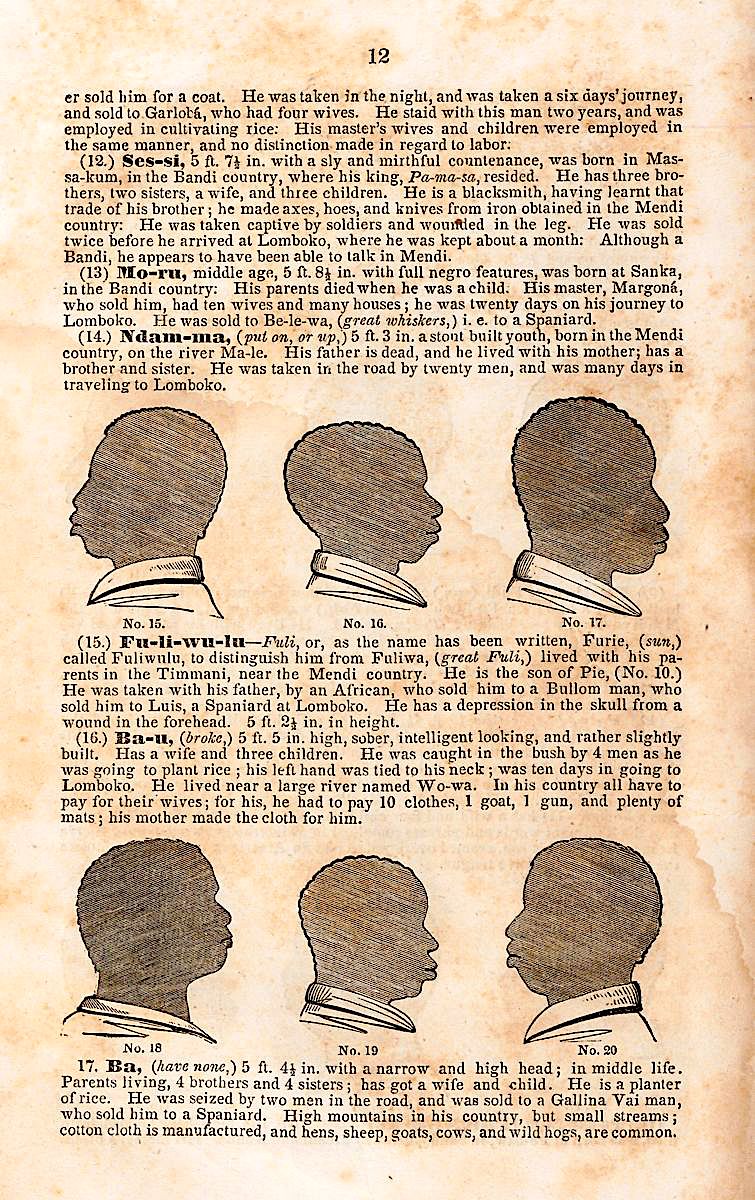
John Warner Barber: “Death of Capt. Ferrer”

John Warner Barber, “The Death of Capt. Ferrer”, 1840, Etching, Frontpiece from the “A History of the Amistad Captives”, Unfolded 22.9 x 49.3 cm, Partially Hand-Colored, Private Collection 

Born in East Windsor, Connecticut in February of 1798, John Warner Barber was an engraver and historian whose books of local, state, and national history featured his colorful  illustrations. He learned his craft as an apprentice to East Windsor printmaker Abner Reed, who also was a bank note engraver for the United States and Canada. In 1823, Barber opened a business in New Haven, where he printed religious and historical books, illustrated with his own steel and wood engravings. 

Barber traveled throughout Connecticut, creating ink sketches of town greens, churches, hotels and harbors; he also researched local histories on his travels. From his research, Barber produced in 1836 what is considered the first popular local history book published in the United States, the “Connecticut Historical Collections, Containing a General Collection of Interesting Facts, Traditions, Biographical Sketches, Anecdotes, Etc. . .”. His pencil sketches were developed into more detailed wash drawings, which in turn were transferred directly to small blocks of boxwood on which he engraved the designs. The book sold well, seven thousand copies in the first year at a cost of what was then an average week’s pay.

In 1840, John W. Barber produced his thirty-two page “ A History of the Amistad Captives: Being a Circumstantial Account of the Capture of the Spanish Schooner Amistad, by the Africans on Board; Their Voyage, and Capture Near Long Island, New York; with Biographical Sketches of Each of the Surviving Africans, Also, an Account of the Trials , , , Compiled from Authentic Sources”. Documenting one of the most important events of its time, Barber’s  book was published the same year of the Amistad trial and its ruling by the New Haven court.

In February of 1839, Portuguese slave hunters abducted hundreds of Africans from what is now present-day Sierra Leone and transported them to Cuba, then a Spanish colony. Spanish plantation owners Pedro Montes and Jose Ruiz purchased fifty-three of the African captives as slaves, forty-nine adult males and four children. On June 28th, Montes and Ruiz with the African captives set sail from Havana on the Amistad, Spanish for ‘friendship’, for their plantations on Puerto Principe.

Several days into the journey, Sengbe Pieh, one of the Africans also known as Joseph Cinque, managed to unshackle himself and his fellow captives. Armed with knives, they seized control of the Amistad and killed the Spanish captain and the ship’s cook. In need of navigation, the Africans ordered Montes and Ruiz to return to Africa; however, the two men  changed the ship’s course in the middle of the night, sailed through the Caribbean and up the eastern coast of the United States. 

On August 26th of 1839, the U.S. Navy brig Washington found the ship anchored off the coast of Long Island to get provisions. The naval officers seized the Amistad, put the Africans back in chains, and escorted the ship to Conneticut, where they would claim salvage rights to the ship and its human cargo. Originally charged with murder and piracy, Cinque and the other Africans were imprisoned in New Haven. Though the charges were dropped, they remained in prison while the courts decided their legal status, as well as the competing property claims by the Washington’s officers, Montes and Ruiz, and the Spanish government. 

In January of 1840, a judge in U.S. District Court in Hartford ruled that the Africans were not Spanish slaves, but had been illegally captured, and should be returned to Africa. After appealing the decision to the Circuit Court, which upheld the lower court’s decision, the U.S. attorney appealed to the Supreme Court, which heard the case in ealry 1841. 

On March 9, 1841, the Supreme Court ruled seven to one to uphold the lower courts’ decisions in favor of the Africans of the Amistad. However, the court did not require the government to provide funds for the Africans’ return voyage, but did award salvage rights for the Amistad to the officers who apprehended it. In November of 1841 after abolitionists raised money for the return voyage, Cinque and the surviving thirty-four Africans of the Amistad, the others either died at sea or in prison awaiting trial, sailed from New York aboard the ship Gentleman to return to their homeland.

James Warner Barber attended the court hearings between January 7th and 13th in 1840 when Judge Andrew Johnson rule that the Africans were illegally transported to Cuba, and thus would not be returned to Montes and Ruis. On the first of April, Barber began drawing the Amistad Africans in jail and, over the next two months, would create drawings and engravings to illustrate his book. Barber drew portraits, from which he engraved silhouettes of the Africans, and added other illustrations to his book, including a map of the Mendi country, home of the Amistad Africans.

Kelly Fearing

Kelly Fearing, “The Lifters”, 1944, Etching, 24.3 x 20.9 cm, Blanton Museum of Art, Austin, Texas

Born in Arkansas in 1918, Kelly Fearing was a painter, print maker, and teacher. He studied art at Louisiana Tech University and New York’s Columbia University, where he earned his Master’s Degree in 1950. He relocated to Fort Worth, Texas, in 1943 and joined the Fort Worth Circle, a progressive art colony, mostly young artists, which was active during the 1940s and 1950s.

Though not defined by a specific aesthetic, the Fort Worth Circle was important for moving beyond the realism and agrarian subject matter of American Regionalism, which dominated Texas art in the 1930s and 1940s. Kelly Fearing and his Fort Worth cohorts were the first artists in the state to respond in a significant way to European artists such as Picasso, Braque, Klee, Kandinsky, Modigliani, Ernst, Klee, and Miro.

After teaching from 1945 to 1947 at Texas Wesleyan, Kelly Fearing assumed the Professorship of Art in the Department of Art and Art History at the University of Texas at Austin, where he taught for forty years. A noted art educator, he  co-authored several multi-volume art education textbooks from 1960 through the 1980s. As a pioneer in art education in America, Fearing founded The University of Texas Junior Art Project, the first visual arts outreach program of its kind in Texas. He became Professor Emeritus at the University of Texas in 1987 and, after  his retirement, continued to work as a professional artist. 

Kelly Fearing worked in almost all traditional mediums, with prominence in oil painting and collage work. The work from his Fort Worth years is abstract in form, surrealistic and filled with allegory., characteristics which would remain throughout the body of his work. Fearing’s art has been referred to as magical realist, mystical naturalist and Romantic surrealist.

Kelly Fearing died on March 13, 2011 from congestive heart failure at the age of ninety-two. More than 80 of his prints and drawings are in the Blanton Museum of Art’s permanent collection.

More works by Kelly Fearing can be found at: https://ultrawolvesunderthefullmoon.blog/2015/07/16/six-etchings-by-kelly-fearing-kelly-fearing-was/

Thomas Banks

Thomas Banks, “The Falling Titan”, 1795, Etching, 26 x 35.7 cm, Published by Richard Morton Paye, Royal Academy of Arts, London

Thomas Banks, “The Falling Titan”, 1786, Marble, 85 x 90 x 58 cm, Royal Academy of Arts, London

Born in 1735 in London, Thomas Banks was educated in Ross-on Wye, a small market town on the River Wye in Herefordshire. He was apprenticed to woodcarver William Barlow in London from 1750 to 1756, during which time he also studied at the studio of Flemish classical sculptor Peter Scheemakers. Banks also enrolled in the St. Martin’s Lane Academy and exhibited several works at the Free Society of Artists during the 1760s. 

Banks was admitted to the Royal Academy Schools in 1769, and had his first exhibition at the Royal Academy in 1770. In 1772, he became the first sculptor to receive the Academy’s traveling scholarship, which enabled him to travel to Rome. Banks lived in Rome between 1772 and 1779, when due to illness and financial disappointments, he returned to England. After two years in England, his desire to accomplish larger-scaled works took him to St. Petersburg in 1981 where he received commissions from Catherine the Great. who purchased his Neo-Classical “Cupid”. 

On his return to England, Thomas Banks received a number of commissions for church memorials, which included the monuments to Sir Eyre Coote and Sir Clifton Wintringham in Westminster Abbey, and monuments to Captain George Westcott and Captain Richard Burgess in St. Paul’s Cathedral. Bank’s best known work is perhaps the colossal sculptural group “Shakespeare Attended by Painting and Poetry”, commissioned in 1788 for the upper facade of the new Shakespeare Gallery in Pall Mall in Central London. It remained there until 1869, when upon the building’s demolishment, it was moved to New Place, the site of Shakespeare’s final residence.

Thomas Banks was elected in 1784 as an associate of the Royal Academy. In recognition of the support he had been given by the Academy earlier in his career, Banks presented “The Falling Titan” to the Royal Academy as his Diploma work after he was elected as a full member Academician in 1786. In comparison with the Diploma Works deposited by the earlier Academician sculptors Edward Burch, Joseph Nollekens and John Bacon, “The Falling Titan” was an extremely prestigious work to present.

Thomas Banks died in London on February 2, 1805, and became the first sculptor to have a tablet erected in his name in Westminster Abbey. He is buried in Paddington Churchyard. 

Note: Thomas Banks’ Neo-cCassical “Cupid”, purchased by Catherine the Great, was a marble statue on a pedestal. In order to save the work from the advancing German troops in World War II, the curator of the Pavlovsk Palace buried the statue next to its pedestal. Upon his return in 1944, no trace of the statue could be found; excavations for the work during a restoration garden project in the 1980s proved fruitless. More complete information on the statue’s history can be found at: https://www.thefreelibrary.com/Thomas+Banks%27s+missing+%27Cupid%27%3A+the+sculptor+Thomas+Banks+is…-a0128792200

Macrocosm of London

Rudolph Ackermann, William Henry Pyne, “Fire in London (Albion Mills, Blackfriars Bridge)”, 1808-1810, Colored Etching, Plate 35, Illustration from “Macrocosm of London”, British Library

The “Macrocosm of London”, published in three volumes between 1808 and 1810, was the result of an ongoing collaboration between publisher Rudolph Ackermann; cartoonist and illustrator Thomas Rowlandson; architectural draughtsman Auguste Charles Pugin; engravers John Bluck, Joseph Constantine Stadler, Thomas Sunderland, John Hill and Richard Bankes Harraden; authors William Henry Pyne and William Combe; and anonymous hand-colorists.

This publication “Macrocosm of London” tapped into the demand for highly-colored prints of real-life subjects that proved something of a publishing sensation during the Regency period in England. Its prints stand as a fascinating historical record of London life in the early years of the 19th century. Auguste Pugin’s fine architectural drawings captured the size and shape of the capital’s principal buildings, both externally and from within. The keenly observed figures drawn by Thomas Rowlandson depicted the vitality and color of both the rich and the poor in late Georgian society.

The Albion flour mill opened at the southern foot of Blackfriars Bridge in London in 1786 and became one of the most visible symbols of Britain’s industrial progress during the late 18th century. Designed in a Neo-Classical style by architect and proprietor James Wyatt, the building contained revolutionary steam engines engineered to the designs of James Watt and his partner Matthew Boulton. 

The sheer power of the engines, which drove twenty pairs of mills stones, promised staggering levels of output in the milling of corn for flour, which was needed for the seemingly endless demand for bread by London’s rapidly growing population. As such, the Albion mill was widely resented by existing millers in London who were still reliant on water or wind power, and who saw the arrival of steam as a death sentence for their trade.

On the 2 March 1791, the Albion mill was totally destroyed by fire, an event that caused much rejoicing in some quarters and some rumors of arson. Though poor maintenance was probably to blame, the burning of the mill was nevertheless the cause of a popular sensation in London which drew crowds of onlookers to the site for weeks afterwards. 

The catastrophe of the mill burning also stood as a useful literary metaphor for the potential harm caused by industrial progress. Most famously it is thought that poet William Blake was inspired by the burnt-shell of the building to portray his vision of ‘dark satanic mills’, contained in the preface poem “And Did Those Feet in Ancient Times” for his 1804 epic work “Milton: A Poem in Two Books”.

Oldřich Kulhánek

Lithographs by Oldřich Kulhánek

Born  in Prague, Czechoslovakia in 1940, Oldřich Kulhánek was a graphic designer, painter, illustrator, and stage designer. He graduated in 1964 from the Prague Academy of Applied Arts, in the atelier of graphic artist and muralist Karel Svolinský.  At the time of his graduation, he had produced a series of illustrations to Vladimir Holan’s poetic work “Dreams” and poet Christian Morgenstern’s “The Gallows Songs”.  

Kulhánek had his first solo exhibition in Prague in 1968. He captured the Soviet-led invasion of Czechoslovakia in that year in a series of allegorical drawings, which included pictures of Stalin and other communist dignitaries. These twelve prints made their way to the West, and were exhibited at the 1970 World’s Fair in Osaka, Japan.

Kulhánek’s prominence among the dissidents in the Communist Era led to his arrest in 1971 by the State Security Police. His allegorical images of Stalin, Mao Zedong, andKhrushchev were judged slanderous and led to charges of ‘slandering a fraternal Soviet State’..  The images,, which included a distorted portrait of Stalin,  were deemed ideologically dangerous and destroyed. After a month in prison,  Kulhánek was banned from exhibiting his work in his home country and interrogated regularly for two years.

“I remember one interrogation by the secret police, when one idiot kept screaming at me. He wanted to know who Hieronymus Bosch was,  where he worked and how I had met him. Even though I knew that he wanted to throw me in jail and was screaming at me, I said to myself ‘I must be dreaming’.  When I told him that [Bosch] died 500 years ago, he told me to drop the intellectual mockery.” – Oldřich Kulhánek

In the 1980s, Oldřich Kulhánek created many lithographs based on the development of the human body.  In 1982 he was awarded the silver medal for his illustrations of Faust at the International Exhibit of Book Art in Leipzig. With the occurrence of the 1989 Velvet Revolution in Czechoslovakia and its resulting transition of political power, Kulhánek was able to travel to the United States and attend the Lithographic Workshop in Los Angeles. Later he was invited to give a series of workshops at universities, including the University of Houston. Kulhánek also traveled to Belgium during this period  to study the classical works in its museums.

Oldřich Kulhánek was one of the more visible artists of the Czech Republic. He was the president of the Society of Czech Graphic Artists founded in 1917, the President of the State Jury of Postage Stamp Design,  and the designer of all currency now in circulation in the Czech Republic.  Kulhánek also became one of the principle designers of Czech postage stamps, many bearing his images of important Czech personalities. He passed away suddenly in Prague on January 28th of 2013 at the age of seventy-two.

Julio Ruelas

Julio Ruelas, “Critica”, 1906, Etching, 19 x 15 cm, Museo National de Arte, Mexico City, Mexico

Born on June 21, 1870, in Zacatecas, Julio Ruelas was a Mexican graphic artist, printmaker and painter. He was one of the pioneers of Mexican Modernism and a significant representative of Symbolism in the country. 

In 1885m Ruelas enrolled in the National School of Fine Arts and later at the Escuela de Bellas Artes. He traveled to Germany in 1892, studying at the Academy of Arts in Karlsruhe, where he developed a serious interest in the works of Swiss Symbolist painter Arnold Boeklin. During his stay in Germany, Ruelas was introduced to the Romantic art movement, a style whose emphasis on emotion and the glorification of nature and the past would have a deep influence upon his works. 

After his return to Mexico in 1895, Ruelas published his works in the extremely influential symbolist publication, “Revista Moderna”, founded by poet Jssús E Valenzuela, and became its principal illustrator. In 1904, Ruelas traveled to Paris, perfecting his etching techniques, and then briefly onto Belgium to observe its symbolist movement’s works.

Julio Ruelas spent the last three years of his life in Paris. He died on September 16, 1907 from tuberculosis at the age of thirty-seven. His works are on display In the Museo de la Ciudad de Mexico and in the Francisco Goitia Museum in his home city of Zacatecas, among other collections. 

Julio Ruelas’ 1906 etching “Critica” is from a series of personal portrait etchings that he produced. On the artist’s head sits a fantastic being with bird feet, two small arms and a body of chicken without feathers. The animal has a pair of large breasts that can be seen behind its arms. The creature, wearing an elegant, fashionable hat for upper-class men of the late 20th century, appears to be about to pierce the artist’s head with its beak. The grotesque feeling of this etching reflects Ruelas’ aversion to the unpleasant criticism being given to his symbolist works at this point in time.

Paul Cadmus

Paul Cadmus, “Nude #1”, Nude #2, and “Nude #3”, Etchings, 1984

After traveling to Italy in the early 1930s, American artist Paul Cadmus became fascinated with Renaissance art, particularly the works of painters Luca Signorelli, known for his structure of the nude, and Andrea Mantegna, known for his strongly marked forms of design and the parallel hatching used to portray shadow.  Cadmus adopted certain Renaissance drawing techniques, especially when rendering male nudes.

Cadmus placed nudes like these in tight boxes, focusing on how the tension of the body conveys physical and emotional struggle. The lines in the background  imply a shifting momentum from left and right toward the center. Like Michelangelo, he rendered his nudes sculpturally, employing finely hatched lines to define their musculature and to create the effect of light reflecting on marble.

David Hockney

David Hockney, “Jungle Boy”, 1964, Etching and Aquatint Printed in Colors, Printed on Mould-Made Paper, Published by Associated American Artists

This etching is from a formative part of David Hockney’s life: the years from 1961 to 1964, That period spans part of his time at the Royal College of Art, where he was a student form 1959 to 1962; his first years as an independent London artist; and a period in which his printmaking focused entirely on etching. During this time, Hockney had his first visit to the United States, funded by an art prize for one of his prints. It was also during this period that Hockney created his renowned “A Rake’s Progress” series of etchings after his return to London.

David Hockney’s early print work are examples of his raw talent and ability to transform the artistic medium he works with. He began making prints as a student in 1961 because he could not afford paint supplies. He mastered the medium and made prints with abandon, using the medium to reflect upon his life as a young art student in London at that time, creating a portrait of the artist as a young man.

“I started doing graphic work in 1961 because I’d run out of money and I couldn’t buy any paint, and in the graphic department they gave you the materials for free. So I started etching, and the first I did was Myself and My Heroes. My heroes were Walt Whitman and Gandhi. There was a little quote from each of them, but for myself I couldn’t find anything – I hadn’t made any quotes – so it just said, ‘I am twenty-three years old and wear glasses,’ the only interesting thing I could think to say about myself.” -David Hockney, 1976

Bernard Buffet

Bernard Buffet, Illustration for “Les Chants de Maldoror”, 1952, Drypoint Etching, Edition of 125

“Les Chants de Maldoror” was published by Les Dix of Paris and was printed by Atelier Daragnes in 1952. It was presented in-folio with leaves loose in two black cases with a limited edition of 125 copies. The 125 original etchings enclosed, each in a 12 x 16 inch format, were by Bernard Buffet. “Les Chants de Maldoror” was Buffet’s first illustrated book.