Fiona Hall

The Artwork of Fiona Hall

Born in Oatley, New South Wales in November of 1953, Fiona Margaret Hall is an Australian sculptor and photographer. Born to radio-physicist and astronomer Ruby Payne-Scott and telephone technician William Hall, she developed an early appreciation of nature during weekend walks in the Royal National Park. During her primary school years, Hall’s mother took her to the Art Gallery of New South Wales to see the 1967 exhibition “Two Decades of American Painting” which heightened her exposure to the world of art. 

Fiona Hall made the decision to pursue an art career and majored in painting at the East Sydney Technical School, now the National Art School, under John Firth-Smith, a Sydney abstract painter highly regarded for his Sydney Harbor scenes. Through her participation in Sydney’s early 1970s experimental art scene, Hall became interested in photography. As the college did not offer a major in photography, Firth-Smith initially mentored her in the subject. Hall later studied photography as a minor for her degree under printmaker and photographer George Schwarz; it was Schwarz who wrote and taught the first photography course at the National Art School. 

In 1974 while still a student, Hall exhibited her photographic work as part of the “Thoughts and Images” group exhibition at the Ewing and George Paton Galleries, a central hub for experimental art in Australia during the 1970s and 1980s. Hall graduated in 1975 with her graduate exhibition solely based in photography. She relocated to London in January of 1976 and spent three months of that year visiting numerous art institutions in Europe. Upon her return to London, Fiona Hall began working with Peter Turner, the editor of the photography magazine “Creative Camera”. 

While in London in 1977, Fiona Hall became an assistant to black and white landscape photographer Fay Goodwin and held her first solo photographic exhibition at the Creative Camera Gallery in London. Returning to Australia in 1978, she had her first Australian solo exhibition at the Church Street Photography Center in Melbourne. Hall relocated to the United States to study at New York’s Visual Studies Workshop in Rochester where she earned her Masters of Fine Arts in Photography in 1982. 

Throughout the 1980s, Hall established a significant profile in the art world through her involvement in solo and group shows in Australia. In 1981 in Australia, she created “The Antipodean Suite”, a series of photographs of objects such as power cords and bananas. In the same year, five of her photographs were acquired for the public collection of the Art Gallery of New South Wales. Beginning in 1983, Hall lectured in photography at Adelaide’s South Australian School of Art until her formal resignation in 2002. She received a commission in 1984 to document the new Parliament House of Australia and produced a portfolio of forty-four photographs depicting the new structure.

Beginning in the 1980s, Fiona Hall began to incorporate more sculptural works into her exhibitions. In 1984, she produced the series “Morality Dolls: The Seven Deadly Sins”, a group of seven cardboard marionettes constructed from photocopies of medical engravings. Hall’s “Illustrations to Dante’s Divine Comedy” consisted of photographs of human figures made from painted and burnished aluminum cans. Starting in 1989, she produced a continuing series of work entitled “Paradisus Terestris” which used sardine tins to form botanical sculptures. These botanical forms sat on top of opened sardine cans which revealed human sexual parts corresponding to the attributes of the plants above. By the late 1990s, Hall had completely stopped her photographic work to focus on sculpture. 

Since then, Hall has received numerous commissions for many public works. Among these are the 1998 “Fern Garden”, a twenty-square-meter permanent installation of landscape art at the National Gallery of Australia; the 1998 series “Cash Crop” at the Mt Coot-tha Botanic Gardens; the 2000 “A Folly for Mrs Macquarie” in Sydney’s Royal Botanic Gardens; and a sculpture for the Chancellery Building of the University of South Australia. 

Fiona Hall represented Australia in 2015 at the 56th International Art Exhibition at the Venice Biennale with an installation work entitled “Wrong Way Time”. This work was created with the collaboration of the Tjanpi Desert Weavers, a social enterprise of the Ngaanyatjarra, Pitjantjatjara and Yankunytjatjara Women’s Council which provides a range of community, family, research and advocacy services. This exhibition focused on the themes of death, extinction and annihilation. Included in the installation was Hall’s “All the King’s Men”, a series of twenty sculptures constructed of shredded military uniforms knitted by the artist into twenty oversized heads adorned with teeth, bones and found objects. These hollow skeletal figures represented the many who have fallen, and would fall, in war and conflict.

Hall continues to exhibit her work at the Roslyn Oxley9 Gallery in Sydney where she has exhibited since 1995. In 2013 she became an Officer in the general division of the Order of Australia for distinguished service to the visual arts as a painter, sculptor, photographer and art educator.  

Note: An interview between Fiona Hall and Anna Dickie on Hall’s “Wrong Way Time” exhibition can be found at the online art magazine “Ocula” located at: https://ocula.com/magazine/conversations/fiona-hall/

A listing of Fiona Hall’s exhibitions and additional images of her “Paradisus Terestris” sculptures can be found at the Roslyn Oxley9 Gallery site located at: https://www.roslynoxley9.com.au/exhibition/paradisus-terestris/5ukxp

Second Insert Image: Fiona Hall, “Wrong Way Time”, 2015, Installation View, Australian Pavilion, 56th Venice Biennale

Third Insert Image: Fiona Hall, “”Lair”, 2004, 15 cm / “Lesion”, 2004, 19 cm / “Rising Tide”, 2002, 15 cm, Musical Snow Domes, Private Collection

Fourth Insert Image: Fiona Hall, “Wrong Way Time”, 2015, Installation View, Australian Pavilion, 56th Venice Biennale

Bottom Insert Image: Fiona Hall, Untitled, 2015, Coal and Aluminum, 50 x 40 x 32 cm, Roslyn Oxley9 Gallery

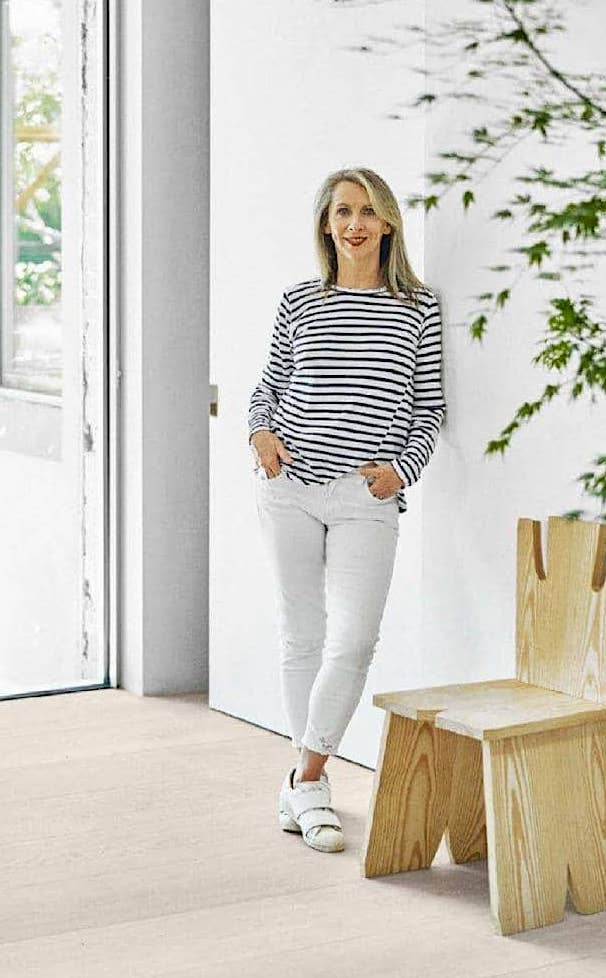
Susi Leeton

Susi Leeton, The Birch Tree House

Susi Leeton graduated with honors in a Bachelor of Architecture Degree from Melbourne University. After gaining international experience in Rome and Singapore, she returned to Melbourne and began working on a range of residential, retail and commercial projects. In 1997, Leeton established her office, Susi Leeton Architects and Interiors, where she has creatively explored both urban and rural settings. 

Susi Leeton Architects and Interiors is a small practice, located in the South Yarra area of Melbourne, Australia, which focuses on high-end residential projects. The practice encompasses all the disciplines of architecture and interior design: conceptual design, regulatory, town planning, engineering, documentation, and furnishing. Working with clients on a holistic level, the practice ensures design continuity within strict budget parameters throughout the project. 

The Birch Tree House is a sculptural, four bedroom, family home approached along a pathway aligned with a row of birch trees. The entry is sheltered within an arch containing an oversized door. The focus of the house is towards the northern wall of large steel sliding doors which open onto the yard with its large oval pool. The volumes of space are soft, sculptural forms that overlap and intersect creating workable family zones both inside and out. 

Natural light and soft materials, whose finishes were deliberately refined and tonal, were selected to create a chiaroscuro of light and shade. Texture was a main consideration in the design. Natural limestone, oak timber flooring, polished plaster walls, and linen curtains were the understated palette. The walls of polished concrete create a shimmering effect throughout every space. 

Birch Tree House was on the 2020 shortlist for the Australian Interior Design Awards. Construction was done by Visioneer Builders, an Australian award-winning construction group located in Richmond, Victoria Province, which is  focused on unique, highly-specified single residences, multi=residential developments and commercial structures. 

The photography was done by Felix Mooneeram, a freelance photographer from the United Kingdom with a focus on design, architecture and lifestyles, and Nicole England, a Melbourne-based architecture and interiors photographer who has worked with many of the industry’s top architects and designers worldwide. 

Mick Namarari Tjapaltjarri

Mick Namarari Tjapaltjarri, “Untitled (Yam Story)”, 1972, Acrylic on Board, 65 x 44 cm, Private Collection 

Mick Namarari Tjapaltjarri, “Tingari”, 1988, Acrylic on Belgian Linen, 121 x 180 cm, Private Collection

Born at Marnpi located in Australia’s Northern Territory in 1926, Mick Namarari Tjapaltjarri is one of the most important painters to emerge from Australia’s Western Desert. He was one of the foundation members of the art movement that emerged in Papunya Tula. While many of his peers painted according to stylized conventions, Namarari’s work is distinguished by an extraordinary range of visual inventions.

As a boy, Namrari was taken by his parents on traditional travels throughout the local area, including north to Nyunmanu, a major dingo dreaming site, south to Lake Neal,  and northwest to the Warnman Rocks and Warhungurru, a remote settlement in the Kintore Range of the Northern Territory. Following the murder of his father by a Aboriginal avenger group and his mother’s resulting suicide by fire, Namarari, along with his sister, fled the desert and traveled east to the safety of the Lutheran Hermannsburg Mission. 

In 1932, Namarari had his first associations with Australians of European background and began to attend the Hermannsburg Mission School. While attending the school, he became acquainted with the work of Aboriginal artist Albert Namatjira and his fellow Western Aranda landscape painters. At the age of eleven, Namarari began stock work for cattleman Billy MacNamara at a cattle station located near the early settlement of Areyonga, where he later became initiated in a ceremony that signified his manhood. With the establishment of cattle stations at Haasts Bluff in the 1950s and, later, at Papunya in the 1960s, Namarari and his wife, Elizabeth Nakamarra Marks,  eventually moved closer to their traditional country; they would later have one daughter, Angeline Nungurrayl.  

In 1971 encouraged by Geoff Bardon, one of the founding members of the Papunya Tula Artists, Namarari, at the age of forty-five, began painting at Papunya. His early works have a bare background of a single color, most often black or rich red-brown, with most depictions related to Aboriginal Dreaming stories of the Moon. Namarari explored figuration in this early work, in which he gave equal emphasis to both the depictions of ceremonial performers and the details of the ceremonial ground with its associated sacred objects. He also created hypnotic depictions of his birthplace, Marnpi, in which he used white pulsing lines to draw the viewer’s eye into the ancestral wind’s vortex generated at the site.

Namarari’s typical work of the 1980s were gracefully controlled renditions of the classical Tingari design of linked concentric circles, which was one of that period’s keystones of Western Desert iconography. Using such tradition patterns, he developed a image series of red and white triangular and rectangular forms. By the late 1990s, Namarari was creating works often using white and yellow paint stipples applied with his fingertips. Because of the unusually large range of totemic sites for which he held responsibilities, Namarari’s later works varied widely in their depictions and in their artistic styles. In addition to the Dreaming stories of the Moon, he painted Dingo, Wind, Kangaroo, Mallee-fowl, Crow, Tingari Men, Hopping Mouse, and Bandicoot Dreamings.

In 1981, Namarari, along with two other senior Pintupi artists, were invited, at the request of former Papunya-associated people, to paint and show their work at an exhibition in Sydney. Namarari was awarded the National Aboriginal Art Award in 1991 and, in 1994, was a co-winner of the Alice Prize and became the inaugural recipient of the Australia Council’s prestigious Red Ochre Award for lifetime achievement. He became the only artist to receive all three awards. Throughout his creative artistic career of over twenty-five years, Namarari remained a loyal member of the Papunya Tula Artists Company, despite numerous offers of representation from local and national galleries. 

A reserved man and patient teacher, Mick Namarari Tjapaltjarri died in Alice Springs in August of 1998, at the age of seventy two, and left a legacy of over seven hundred paintings that illustrate his inventiveness and the cultural richness of his heritage. His work can be found in the collections of the National Gallery of Australia in Canberra, Melbourne’s National Gallery of Victoria, Darwin’s Museum and Art Gallery of the Northern Territory, and the Kluge-Ruhe Aboriginal Art Collection of the University of Virginia in Charlottesville, as well as in many private collections.

Top Insert Painting: Mick Namarari Tjapaltjarri, Tingari Cycle, 1984, Acrylic on Canvas, 55 x 70 cm, Private Collection

Bottom Insert Painting: Mick Namarari Tjapaltjarri, Children’s Dreaming with Many Body Paint Variations, circa 1972-1973, Papunya Community School Collection

Peter Churcher

Paintings by Peter Churcher

Born in Brisbane, Australia, in 1964, Peter Churcher is a portrait and figurative painter in the realist tradition. He holds a Bachelor of Music with Honors from Melbourne University which he acquired in 1986. Traveling through Europe after gaining his Licentiate for Piano Performance from Trinity College in London, Churcher visited many galleries and decided to return to his original passion, painting. He studied at Melbourne’s Victorian College, now Deacon University, where in 1992 he earned his BFA in Painting.

Churcher first showed his work in the group exhibition “Artworks II: Thirty Emerging Melbourne Artists” held at the South Melbourne Town Hall. After entering his work in two group exhibitions at Lauraine Diggins Fine Art, he gave his first solo show at the gallery in 1994. Since that time Churcher has held solo exhibitions in Melbourne, Sydney and Brisbane, and has been represented in many group exhibitions across the country.

Peter Churcher’s work deals primarily with the human subject in  portraiture and group figurative narratives. His subjects are ordinary people sighted on the streets, who are presented on the canvas with their own personalities and natural enthusiasms. A number of commissioned portraits for both private and public personalities are also contained in Churcher’s body of work.

As a commissioned officer during the Persian Gulf War, Churcher was, in 2002, appointed to be Australia’s official war artist. Traveling to the Persian Gulf and Diego Garcia, he recorded the people and operations of the Royal Australian Navy and Royal Australian Air Force. Churcher’s work captured many aspects of army life not covered by the press photographers. His images of  Australia’s flying officers and pilots, the sailors, and the engine-room stokers aboard the HNAS Kanimbla are now included in the collection of the Australian War Memorial. 

Peter Churcher’s work is represented in many major public, corporate and private collections throughout Australia and overseas including the National Gallery of Australia  and The National Portrait Gallery, both in Canberra; The Australian War Memorial; and Parliament House in Victoria, among others. 

Peter Churcher is represented in Australia by Philip Bacon Galleries in Brisbane and Australian Galleries in Melbourne and Sydney. He is currently living and working in Barcelona, Spain. Churcher’s most recent solo show is at Lauraine Diggins Fine Art in Melbourne through April 16th of  2021. 

Top Insert Image: Peter Churcher, “Hostel”m 2017, Oil on Canvas, 116 x 98 cm, Private Collection

Bottom Insert Image: Peter Churcher, “The Young Painter”, 2014, Oil on Canvas, 78 x 60 cm, Private Collection

George Washington Lambert

George Washington Lambert, “The White Glove”, 1921, Oil on Canvas, 106 x 78 cm, Art Gallery of New South Wales, Sydney, Australia

Born in September of 1873 in St. Petersburg, Russia, George Washington Thomas Lambert was an Australian portrait artist and a war artist during the First World War. After the death of his father, he and his English mother moved to Württemberg, Germany, to stay with Lambert’s maternal grandfather. Lambert received his education at Kingston College in Somerset, England, after which the family emigrated to Australia, arriving in Sydney in January of 1887.

In 1894, George Lambert began exhibiting his work at the Art Society and the Society of Artists in Sydney. After drawing pen and ink cartoons for a year at The Bulletin magazine, he began painting full time in 1896. Lambert won the Wynne Prize for his 1899 painting “Across the Blacksoil Plains”, a depiction of a heavily laden wagon pulled by a team of draft horses. 

Lambert studied at the Julian Ashton Art School in Sydney until 1900, after which he won a government traveling scholarship from New South Wales. He spent a few years traveling, first to Paris, and later to London where he exhibited work at the Royal Academy. At an exhibition in Barcelona in 1911, Lambert won a silver medal for his painting “The Sonnet”.

During the years of the First World War, George Lambert served as an official war artist. His painting “Anzac”, depicting the 1915 landings of forces on the Gallipoli Peninsula in Turkey, is now in the Australian War Memorial collection located in Australia’s capital Canberra. In 1920, Lambert painted another notable work “A Sergeant of the Light Horse”, which he executed in London after retuning from Palestine.

Returning to Australia in 1921, Lambert had a successful solo show in Melbourne at the Fine Art Society. This was the year he painted “The White Glove”, a oil portrait depicting Miss Gladys Neville Collins, the daughter of lawyer J. T. Collins, trustee of the Public Library, Museums, and National Gallery of Victoria. 

George Lambert posed Miss Collins in a manner suggestive of John Singer Sargent’s 1905 work “Portrait of Ena Wertheimer, ‘a vele gonfie”, with its black white-feathered hat and hand raised in front of chest. Miss Collins’s tilted head, half closed eyes, half open mouth, and almost bare right arm suggests individual sensuality, but also a form of codified behavior. Significantly different from the in-vogue contemporary brown-toned portraits, George Lambert, himself, described it as a wild, dashing portrait. 

In 1922, the Art Gallery of New South Wales acquired the painting for six hundred guineas ( $53,000 in 2019),  at the time the highest price paid by a public gallery for a portrait by an Australian artist. The work remains a part of its collection.

Gary Lee

Photographs and Illustration by Gary Lee

Gary Lee is a Larrakia artist, born in 1952 and raised in Darwin, the capital city of the Northern Territory, Australia. An anthropologist, artist, writer and curator, Lee has been an active participant in and promoter of Aboriginal arts since the early 1980s.

Prior to his studies at Sydney College of the Arts, Gary Lee worked alongside Andrew Trewin to produce a line of evening and cocktail wear, incorporating Lee’s Aboriginal designs and sold under the Trewin Lee label. Lee attended a year at Sydney College majoring in glass and painting, but left to pursue a career in fashion design. After a few years in Sydney, Lee returned to the Northern Territory where he began working as a trainee Aboriginal arts advisor with Chips MacKinolty at Mimi Arts and Crafts in Katherine.

This move brought Gary Lee in contact with a wide range of Aboriginal artists and led to his curating a series of shows of Aboriginal crafts and art. Working at Mimi Arts inspired him to undertake studies, firstly as a Cultural Heritage Management student at Canberra’s College of Advanced Education and later at the Australian National University, earning a BA with Honors in Anthropology. Lee also undertook internships at the National Gallery of Australia, becoming its first Aboriginal intern, and the Australian Institute of Aboriginal and Torres Strait Islander Studies. 

After five years of study and employment as a project manager for the Australia Council for the Arts, Gary Lee returned to his homeland as a Larrakia anthropologist in a research position at the Northern Land Council. During this time, he wrote a musical play based on his maternal heritage entitled “Keep Him in My Heart: A Larrakia-Filipino Love Story”, which premiered in Darwin and showcased Lee’s skills as writer and fashion designer.  

In 1993, Gary Lee began working in the field of photography with his series “Nice Colored Boys”, an allusion to Australian film maker Tracey Moffatt’s classic short film “Nice Colored Girls”. It began as a project to reconnect Lee with the regions of Nepal and India, where he traveled in the 1970s. The film was designed to celebrate the physicality of the men in the area, to subvert Western male beauty stereotypes, and to explore nuances of Aboriginal art and identity.

In 1998, Lee’s street photography, portrait series “Bablu, Milk Boy” was published in Australia’s oldest and most respected photography magazine, Photofile. At the suggestion of Photofile editor Alasdair Forster, Lee produced the “Skin” series, placing himself in the frame alongside men from Nepal and India. Photographs from this series were later shown in the 2008 “More Than My Skin” exhibition, which focused on Aboriginal male photographers, at the Campbelltown Arts Center.

Beginning in 2005, Gary Lee’s photography came to reflect a combination of contemporary and historical Larrakia subjects. The catalyst for this was partly his involvement as co-curator in an exhibition celebrating Billiamook, who was a key Larrakia figure in the region’s contact history. In this exhibition Lee displayed a portrait of his nephew, Shannon, alongside a portrait of Billiamook by the colonial photographer Paul Foelsche, in which both sixteen year old boys exude physical prowess.

Lee’s venture into portraits incorporating his own family paralleled his work into other Aboriginal portraits, becoming an extension of his “Nice Colored Boys” series. To some extent, he had already been doing this as a way of documenting Aboriginal gay and transgender communities. From 2004, however, he began a discrete, ongoing series called “Nymgololo”, a Larrakia word for young man or bachelor,  which focused on Aboriginal men in Darwin. 

In October 2007, Gary Lee was in Canberra for the opening of the “Culture Warriors” exhibition at the National Gallery of Australia when he suffered a life-threatening stroke. While undergoing extensive rehabilitation in 2008, Lee experienced his busiest period of exhibition commitments including his very first solo exhibition, “Maast Maast”, at Darwin’s 24HR Art NT Centre for Contemporary Art. This exhibition was largely a selection of past work from the “Nice Colored Boys”, “Skin” and “Nymgolofo” series.

Gary Lee’s work has been published in books, art journals and magazines in Australia and abroad. His work can be seen in many major collections including: the National Gallery of Australia in Canberra; the Museum and Art Gallery of the Northern Territory in Darwin; and the art Gallery of Western Australia in Perth.

Note: A book of note is author Dino Hodge’s “Did You Meet Any Malagas (Men)”: A Homosexual History of Australia’s Tropical Capital”, published in 1993. It is a collection of oral histories intended to tell a gay history of the Larrakia territory, recognizing local issues of sexuality, gender, colonialism, and race. It should be noted that Hodges’ friend Gary Lee was the first indigenous person to collaborate with the Northern Territory AIDS Council.

Jeffrey Smart

Paintings by Jeffrey Smart

Influenced by the Australian modernism of the 1940s, Jeffrey Smart dedicated himself to the representation of the modern city. He executed each painting with classical precision and included repetitious architectural motifs, referencing the Renaissance perspective. Smart painted stark portrayals of contemporary life, choosing as his subject matter the highways, trucks, factories, and even the vacant lots of everyday scenes.

Jeffrey Smart was born in Adelaide, Australia, in 1921. He studied part-time in the late 1930s at the South Australian School of Arts and Crafts under painter Marie Tuck and Rupert Bunny, a master of figure composition. Beginning in 1939, Smart also trained at the Adelaide Teachers College for two years. In this period, Smart visited the studio of Adelaide-based artist Doritt Black, who introduced him to the rules of dynamic symmetry, as seen in the work of the Old Masters and developed by avant-garde artists such as Braque, Cézanne, and Léger. 

The 1940s were a period of artistic growth and raise to fame for Smart, who started to exhibit in group shows alongside other emergent Australian artists, including Jaqueline Hick and Horace Trennery, and was given in his first solo show at Kosminsky Gallery in Melbourne in 1944. In 1945, Smart painted “The Waste Land I” and “The Wasteland II”. These desolate rural views, inspired by T.S. Eliot’s poem of the same name, point to the development of the artist’s distinctive hyper-clear and timeless version of landscape painting.

Between 1948 and 1950, Smart travelled to America and Europe, and then moved in Paris in 1949 to study at the Académie Montmartre under Fernand Léger. His several visits to European museum collections in this period will bring Smart to become particularly fascinated with the art of Giorgione, Giovanni Bellini, and especially Piero della Francesca, whose clarity of forms and rigorous use of perspective would greatly influence Smart’s works. In 1950, he lived on the island of Iachia in the bay of Naples, painting alongside contemporaries Donald Friend, Michael Shannon, and Jacqueline Hick. 

Upon his return to Australia in 1951, the artist settled in Sydney, where he will remain for the next twelve years. In the same year he won the Commonwealth Jubilee Prize for his 1951 painting “Wallalroo”, a scene from the daily life of that copper mining town. During his years in Sydney, Smart also worked as an art teacher and art critic at the Daily Telegraph while continuing to paint landscapes. Works from this period, such as the 1962 “Copper Park” and “The Cahill Expressway”, painted also in 1962, mark the beginning of Smart’s mature style, characterized by an increased hyper-clarity and meticulously crafted compositions.

The year 1963 was crucial in the artistic and personal life of Jeffrey Smart, who resumed his travels around Europe and permanently moved to Rome with Australian artist and partner Ian Bent. Thoughout the 1960s and 1970s, Smart’s artistic career gained momentum thanks to prominent solo shows and exhibitions in his homeland of Australia and around the world, including the 1967 solo exhibition at the Redfern Gallery in London and the American touring group show “The Australian Painters 1964-1966”. 

In 1971, Smart purchase a farmhouse in the countryside of Arezzo, a  small town in Tuscany, where he would remain for the rest of his life. This move marked the start of the most prolific period in the his career. Starting from the 1970s, Smart dedicated himself to interpreting the landscape of modern Italy, mixing his own personal and imaginary relationship with the land with his precision details of climate, life, and landscape. While most of his work includes landscapes, in the 1980s and 1990s, Smart produced a small number of portraits and self-portraits, contrasting the accurate likeness with visionary urban settings. 

Jeffrey Smart’s last work entitled “Labyrinth” was completed in 2011, at which time he officially retired. The artist died in Arezzo in 2013 at the age of ninety-two. Even though he lived as an expatriate for most of his life, the majority of his works is now housed by Australian museums and galleries. 

“My only concern is putting the right shapes in the right colors in the right places. It is always the geometry” —Jeffrey Smart

Top Insert Image: Robert Walker, “Jeffrey Smart in Studio”, 1967, Print from Negative, 2.4 x 3.6 cm, Art Gallery of New South Wales

Second Insert Image: Jeffrey Smart, “The Picnic”, 1980, Oil and Acrylic on Canvas, 106 x 70.7 cm, Private Collection

Third Insert Image: Jeffrey Smart, “Labyrinth, 2011, Oil on Canvas, 100 x 100 cm, National Gallery of Australia, Canberra

Bottom Insert Image: Jeffrey Smart, “The Surfers Bondi”, 1963, Oil on Canvas, Private Collection

Johnny Warangkula Tjupurrula

Johnny-Warangkula-Water-Dreaming-Tjikari

Johnny Warangkula Tjupurrula, “Water Dreaming Tjikari”, 1998, Acrylic on Linen, 121 x 182 cm

Johnny Warangkula Tjupurrula was born 1925 at Mintjilpirri, north-west of the Kangaroo Dreaming site of Ilpili waterhole. He was one of the founding members of the Western desert Aboriginal art movement. He was an extremely innovative artist who depicted traditional ceremonial ground designs as abstract depictions on canvas and board.

Warangkula’s painting career began after working as a labourer for many years building airstrips and settlements in Haasts Bluff. In return for his work building and labouring, he was remunerated with consumable goods. After moving from Haasts Bluff to Papunya, Warangkula served on the Papunya Council along with Mick Namarai, Limpi Tjapangati and Kingsley Tjumgarrayi.

During the 1960’s, Warangkula’s rapidly developed a distinctive style of his own which came to be known as ‘overdotting’. He uses several layers of dots to depict his dreaming’s, which consist of water, yam, fire and egret stories. This more painterly approach signified his expanding encounter with the outside world, creating effects that art patron Geoffrey Bardon called ‘tremulous illusion’.  Warangkula’s artworks are strictly Aboriginal stories without conscious European influence, they remain of major significance and are of considered of modern aesthetic.

Rachel Newling

Rachel Newling, “Green Tree Python”, Date Unknown, Hand-Colored Linocut on Handmade Japanese Paper, 76 x 50 cm.

Rachel Newland is an established Australian artist, specializing in hand colored and reduction linocuts, mixed media engravings and drawings. Prints are available at her site: https://www.rachelnewling.com

Reblogged with thanks to https://crofs.tumblr.com

Glen Iris House

Steffen Welsch Architects, Underground Rain Water Collecting Pool

Combining art with technology and social responsibility, the Australian firm of Steffen Welsch Architects uses sustainable materials like hemp and rammed earth while embodying the ideals of Bauhaus architecture to staggering results. This is their underground pool created by harvesting rainwater. In addition to rammed-earth houses that generate their own energy and capture their own water, they also build modern abodes like the Glen Iris House, a two storey modern Californian-style house in suburban Melbourne. .

Robert Buratti

Robert Buratti, “The Hierophant”, Date Unknown, Ink and Pen on Paper, 15.7 x 11.8 Inches

This work is part of the Arcana Series by Robert Buratti and was inspired by “The Hierophant” card of the Thoth tarot deck. Buratti’s work is chiefly concerned with the role of the spiritual within contemporary art, and the talismanic and transformational power of the image. Influenced by the approach and experimentation of artists such as James Gleeson, Andre Breton, Aleister Crowley, Paul Gauguin and Pablo Picasso, Buratti’s work seeks a balance between the seen and unseen, the technical and the intuitive.

Amanda Parer

Amanda Parer, “Rabbits” from Her “Intrude” Series

Amanda Parer examines the relationship between humans and the natural world in her massive inflatable artworks. The Tasmania-based artist works with a team including New York based co-producer Chris Wangro. Together, Parer Studio realizes her larger-than-life versions of translucent rabbits, a series of works called” Intrude”.

The white fabric appears opaque during the day as it reflects sunlight. After dark, the creatures take on a different dimension: they are illuminated from within and reduce surrounding humans into diminutive silhouettes. Parer grew up in Australia, where rabbits are a non-native species and are considered a serious pest as opposed to a domestic pet.  Since being introduced by settlers in the late 18th century, their overpopulation has caused substantial ecological destruction.

“They represent the fairytale animals from our childhood – a furry innocence, frolicking through idyllic fields. Intrude deliberately evokes this cutesy image, and a strong visual humour, to lure you into the artwork only to reveal the more serious environmental messages in the work. They are huge, the size referencing ‘the elephant in the room’, the problem, like our environmental impact, big but easily ignored.”- Amanda Parer

Andrew Sibley

Andrew Sibley, “The Complete Trick”, 1983, Oil and Enamel Paint on Canvas, National Gallery of Victoria, Melbourne, Australia

Andrew John Subley was an English-born Australian artist. Sibley has been commonly listed in histories and encyclopedias of Australian art as a significant figurative painter of the mid and late 20th century.  In 1944 Sibley was awarded a scholarship at Gravesend School of Art, where he studied with fellow students including English artist Peter Blake.

Sibley commenced his formal painting career in Brisbane during the latter half of the 1950s alongside notable artists such as Roy Churcher,Jon Melvin and Ian Fair-weather, Charles Blackman and Clifton Pugh. In 1960 Sibley had his first solo exhibition at Rowes Arcade Gallery. In 1962 Sibley received the Australia’s largest art award the Transfield Art Prize with his painting “The Bathers”.

In 2001, Andrew Sibley took part in an expedition to Lake Eyre in South Australia, along with nine other artists, which resulted in a book “William Creek and Beyond”, a film documentary and a touring exhibition. Sibley joined Kick Gallery in Melbourne in 2012, where he exhibited until his death in 2015.