Every Craving

Photographer Unknown, (Every Craving), Photography / Digital Art

“To crave and to have are as like as a thing and its shadow. For when does a berry break upon the tongue as sweetly as when one longs to taste it, and when is the taste refracted into so many hues and savors of ripeness and earth, and when do our senses know any thing so utterly as when we lack it? And here again is a foreshadowing — the world will be made whole. For to wish for a hand on one’s hair is all but to feel it. So whatever we may lose, every craving gives it back to us again.”
― Marilynne Robinson

Theodor Hildebrandt

Theodor Hildebrandt, “Düsseldorf Freundschaftsbild (Düsseldorf Friendship)”, c1823, Oil on Canvas, 53 x 34.5 cm

Born in September of 1804 in Stettin, Germany, Theodor Hildebrandt was an entomologist and an artist of the Düsseldorf school of painting. He studied under German Romantic painter Friedrich Schadow at the prestigious Berlin Academy of the Arts. In 1828, upon Schadow’s appointment to the new Düsseldorf Academy of the Arts, Hildebrandt decided to relocate, following his teacher to Düsseldorf. 

Hildebrandt began his artistic career by painting illustrative themes from the works of Shakespeare and Goethe. His “Faust and Mephistopheles” was painted in 1824, followed the next year by his work “Faust and Margaret”. In 1828, Hildebrandt painted a Shakespearean scene featuring King Lear and his youngest daughter Cordelia in the work entitled “Lear and Cordelia”.

Beginning in 1829, Hildebrandt traveled outside of Germany, initially with Schadow in the Netherlands and later, in 1930, alone in Italy. After his return to Düsseldorf, he painted several works in alternating styles: the more realistic style of the 1829 “The Robber”; the Shakespearean scene of the 1830 “Romeo and Juliet”; in the same year, “Tancred and Clorinda” a scene from Torquato Tasso’s poem “Jerusalem Delivered”; and in 1832 “The Captain and His Infant Son”, an affected realistic work that captivated the public.

Theodor Hildebrandt’s most famous work is the 1836 “The Murder of the Sons of King Edward IV, King of England”. In this canvas, Hildebrandt shows the men’s hesitation, given the innocence of the sleeping boys, and highlights the frozen action in the midst of the dramatic plot. The painting was considered realistic in tone and regarded by contemporary reviewers to be the crowning achievement of the Düsseldorf School of Painting. This painting currently resides in the Spiegel Collection at Halberstadt. 

After 1847, Hildebrandt concentrated on portrait paintings, a genre that succeeded in supplying a large number of commissions. He continued through the rest of his life painting and, as a member of the Entomological Society of Stettin, studying the order of insects known as Coleoptera, the group containing beetles. Theodor Hildebrandt died in Düsseldorf in 1874

Bottom Insert Image: Theodor Hildebrandt, “The Robber”, 1829, Oil on Canvas, 114 x 99 cm, National Gallery, Berlin, Germany

Italo Calvino: “Invisible Cities”

Photographer Unknown, (A View of the City), Photo Shoot

“What he sought was always something lying ahead, and even if it was a matter of the past it was a past that changed gradually as he advanced on his journey, because the traveller’s past changes according to the route he has followed: not the immediate past, that is, to which each day that goes by adds a day, but the more remote past. Arriving at each new city, the traveller finds again a past of his that he did not know he had: the foreignness of what you no longer are or no longer possess lies in wait for you in foreign, unpossessed places.”
― Italo Calvino, Invisible Cities

Henry Jasper Redfern

Henry Jasper Redfern, Untitled, (British Athlete), Early 1900s, Silver Gelatin Print

Henry Jasper Redfern was a British optician, photographer, filmmaker, and an x-ray and radiographic pioneer. Born in Sheffield, England, in 1871, he operated a photographic studio and sold cameras and other optical goods such as opera glasses. Redfern also worked as an optician in Sheffield, offering photographic lessens as a side line. In 1898, he became an agent for Lumière’s Cinématographe in England, holding demonstration exhibitions for the Lumière company.

In 1894, Redfern, teaming with photographer and cinema projectionist Fred Holmes, presented film and x-ray demonstrations with a Kineopticon, a recently patented projector that was becoming popular. In 1898, Redfern secured an exclusive contract in England for the right to tour the groundbreaking, first feature film of the Corbett-Fitzsimmons boxing match of 1897. This, along with a number of high profile films of local sports events, marked a step towards the headline feature as an event in itself, and with a view towards securing return audiences week after week.

Frustrated by the limitations of the music hall circuit and having thoroughly exhausted many of the non-theatrical spaces in and around Sheffield, Redfern struck into new territory in 1904 by pitching his own theatre on a beach outside Southend. With deckchairs for stalls, and a tent to cover the rafters Redfern, with the assistance of Holmes, brought his own programme of film and variety performers to the seaside resort for the summer. The venture successfully addressed a niche in the still open market, yet the concerns of the local licensing authorities over the non-permanent structure ultimately made this a short-term venture and it ran for two seasons.

During the first World War Redfern was called to serve as a field radiologist  and eventually was assigned to the 2nd Western General Hospital in the clinical staff. In 1914, he enlisted in the Royal Army Medical Corps with the much needed skill as a radiographer, particularly during wartime. The small x-ray department at the hospital was called upon to use the new technology of x-rays for diagnostic and therapeutic studies. 

Jasper Redfern, a pioneer in the field, accepted the call to serve his fellow wounded soldiers. He became a martyr by performing radiographs and paid the price by losing all of his fingers from the radiation exposure. In 1928, Redfern died of cancer, probably due to his heroic efforts and prolonged exposure to radiation from x-rays.

Insert Image: Photographer Unknown,”Henry Jasper Redfern”, circa 1914-1920, Vintage Photograph

Alan D. Rogers, “Zion Tobias”

Alan D. Rogers, “Zion Tobias”

New York-born Alan D Rogers is a fashion-style portrait photographer based in Atlanta, Georgia. His initial project with photography was the documentation of a concert series performed by singer and songwriter Janelle Monáe. Rogers’ work now includes portraits in the genres of stage and screen arts and music, modeling, and commercial print work. His website is https://www.alexdrogers.studio.

The image of Philadelphia musical artist Zion Tobias by Alan D Rogers was reblogged with thanks to https://thouartadeadthing.tumblr.com.

Zion Tobias’ Soundcloud site is https://soundcloud.com/ziontabias

Thomas Wolf: “This is a Moment”

Pjotographer Unknown, (This is a Moment)

“A destiny that leads the English to the Dutch is strange enough; but one that leads from Epsom into Pennsylvania, and thence into the hills that shut in Altamont over the proud coral cry of the cock, and the soft stone smile of an angel, is touched by that dark miracle of chance which makes new magic in a dusty world.

Each of us is all the sums he has not counted: subtract us into nakedness and night again, and you shall see begin in Crete four thousand years ago the love that ended yesterday in Texas.

The seed of our destruction will blossom in the desert, the alexin of our cure grows by a mountain rock, and our lives are haunted by a Georgia slattern, because a London cutpurse went unhung. Each moment is the fruit of forty thousand years. The minute-winning days, like flies, buzz home to death, and every moment is a window on all time.

This is a moment:”
― Thomas Wolfe, Look Homeward, Angel

Eric Henri Kennington

Eric Henri Kennington, “Portrait of Leading Seaman Dove of HMS Hardy”, 1940, Pastel on Paper, National Maritime Museum, Greenwich, London

Born in Chelsea, London, in 1888, Eric Henri Kennington was an English illustrator sculptor, and an official war artist in both World Wars. He was educated at St. Paul’s School and the Lambeth School of Art, both in London. In 1908, Kennington had his first exhibition at the Royal Academy and, in 1914, an exhibition at the international Society, which financially allowed him to set up a studio in London. 

Wounded in 1915 during World War I, Kennington spent time, during his convalescence,  painting his “The Kenningtons at Laventie”, a portrait of his own infantry platoon, which caused a sensation at its 1916 showing. In May of 1917, he accepted an official war artist commission from the Department of Information, spending eight months in France. During this tour, Kennington produced 170 charcoal, pastels, and watercolors of servicemen and the war action before returning to London in 1918.

During the years between the two wars,, Kennington worked mostly on portraits of an idealized style;  book illustrations, notably those for T. E. Lawrence’s “Seven Pillars of Wisdom”; and a number of public sculptures and monuments. His 1924 War Memorial to the 24th Division located in Battersea Park and his 1928 Memorial to the Allied Forces located in Soissons, France, established his position as a direct carver working on a monumental scale. In September of 1931, Kennington finished a series of allegorical reliefs for the Shakespeare Memorial Theater in Stratford on Avon. A life-sized tomb effigy of British archeologist and writer T. E. Lawrence was carved, between 1937 and 1939, by Kennington for St. Martin’s Church in Wareham, Dorset. 

In 1951 Kennington became an associate member of the Royal Academy and was elected a full academician in 1959. He passed away on April 13, 1960 at the age of seventy-two. His last work, which was completed on his death by his assistant Eric Stanford, was a stone relief panel that decorates the James Watt South Building in the University of Glasqow.

Note: Kennington drew his pastel portrait of Leading Seaman Dove, along with other seamen, in 1940. The badge worn by Seaman Dove indicates that he was a gunnery specialist. Dove served on the HMS Hardy, a H-class destroyer, launched in 1943, which was later capsized from an assault by German destroyers, finally sinking off Narvik, Norway, in April of 1940. 

Top Insert Image: Howard Coster, “Eric Kennington”, 1936, Half Plate Film Negative Print, National Portrait Gallery, Washington DC

Bottom Insert Image: Eric Henri Kennington, “Sleeping Figure”, Date Unknown, Charcoal on Paper, 24.2 x 34.3 cm, Private Collection

Domenico Cinnamon

Domenico Cennamo, “Ragazzo in Rosso”, 2019, Giclée Print, Edition of 12, 65 x 43.5 cm

Domenico Cennamo is a fashion and portrait photographer.

The artist’s website is ;   http://www.domenicocennamo.com

A great site for purchasing queer and gay photographic art images, including those of Domenico Cennamo, can be found at : https://boysboysboys.org

Image reblogged with many thanks to: https://doctordee.tumblr.com

Dr. Suess: “Oh, The Places You’ll Go”

Photographer Unknown, (Oh, The Places You’ll Go)

“Out there things can happen, and frequently do,

To people as brainy and footsy as you.

And when things start to happen, don’t worry, don’t stew.

Just go right along, you’ll start happening too!”

–Dr. Seuss, Oh, the Places You’ll Go

Image reblogged with thanks to : https://joselito28.newtumbl.com

James Joyce: “If He Had Smiled”

Photographer Unknown, (If He Had Smiled)

“If he had smiled why would he have smiled? To reflect that each one who enters imagines himself to be the first to enter whereas he is always the last term of a preceding series even if the first term of a succeeding one, each imagining himself to be first, last, only and alone whereas he is neither first nor last nor only nor alone in a series originating in and repeated to infinity.” 

—James Joyce, Ulysses

HardCiderNY, “Luis Coppini”

HardCiderNY, “Luis Coppini”, Photo Shoot for Yup Magazine

HardCiderNY is a fashion and fine art photography studio located in New York City. It is dedicated to natural-light male physique work. The studio works regularly with Wilhelmina, Ford, DNA, Soul Artist and the Red Modeling Agency. The site is located at: :https://www.facebook.com/hardciderny/

Luis Coppini is a Brazilian model working with the agency Q Management located in New York and Los Angeles. He has previously done photo shoots with photographers Ronaldo Gutierrez, Karl Simone, Thiago Martini, and Glauber Bassi.

Yup Magazine is a men’s fashion digital magazine based in NYC : https://yup-mag.com

Vaslav Nijinsky

N. Rimsky-Korsakov, “Vaslav Nijinsky in the Ballet Scheherazade”, 1910, Private Collection

Born Waclaw Niżyński on March 12, 1889, in Kiev to Polish parents, both touring dancers, Vaslav Nijinsky was a ballet dancer and choreographer, considered the greatest male dancer of the early 1900s. Praised for his virtuosity and intensity of the characters he portrayed, Nijinsky possessed the ability to dance ‘en pointe’, on his toes with feet fully extended, a rarity among male dancers at the time. 

In 1909, Nijinsky joined the Ballets Russes, a new ballet company started by ballet impresario Sergei Diaghilev, who concentrated on promoting Russian arts abroad, particularly in Paris. Diaghilev became deeply involved in directing and managing Nijinsky’s career, eventually becoming Nijinsky’s lover for a time. Despite complications in both reworking existing ballets and financial issues, the 1909 Paris season of colorful Russian operas and ballets was a success, with Nijinsky displaying his unique talents and the performances setting new trends in dance, music and fashion.

Breaking against tradition, Nijinsky began choreographing in 1912 original ballets with new trends in music and dance, sometimes causing riotous reactions at the Théâtre de Champs-Élysées. His “Afternoon of the Faun”, set to music by Debussy, is onsidered one of the first modern ballets; though, the ballet’s sexually suggestive final scene caused controversy among its Parisian viewers. His ballet “Rite of Spring”, set to music by Stravinsky, which exceeded the limits of traditional ballet, music scores, and propriety, resulted in violence among the audience at the premier.

In September of 1913, while on tour with the Ballets Russes in South America, Nijinsky married Hungarian aristocrat and actress Romola de Pulszky, despite warnings to both parties by friends. They toured together with the troupe for the season, living in seperate rooms. Nijinsky realized he had made a mistake with the marriage; but the marriage was never legally ended. After the tour was ended, Nijinsky and troupe traveled back to Paris.

Relations, both work and personal, between Diaghilev and Nijinsky had been deteriorating for some time. Upon his return from the South American tour, Nijinsky was notified by an assistant to Diaghilev that he would no longer be employed by the Ballets Russes and also learned that none of his original ballets would be performed by the group. This was particularly devastating as the Ballets Russes was the pre-eminent ballet company and the only innovative modern-thinking one. An attempt was made by Nijinsky to form his own dance company, but he did not succeed.

Classified a Russian citizen and no longer with a military exemption from service, Nijinsky was interned in Budapest during World War I, under house arrest until his release was arranged in 1916. The complex arrangements for this included the agreement that Nijinsky would dance and choreograph for the North and South America tour of the Ballets Russes. The tour proved very stressful to Nijinsky, already in an unsteady position, resulting in anxiety and bouts of rage and frustration. His last performance was in Montevideo, Uruguay, for the Red Cross on September 30, 1917 at age twenty-eight. It was at this time that signs of Nijinsky’s existing schizophrenia became apparent to members of the company. 

In 1919 in Zurich, Nijinsky was diagnosed with schizophrenia and committed to Burghölzli, the leading psychiatric hospital in Switzerland. For the next 30 years, Nijinsky was in and out of hospitals and asylums, maintaining long periods of silence during his years of illness. From 1947 Nijinsky lived in Surrey, England, with his wife Romola who tended to his care. He died from kidney failure at a London clinic on April 8, 1950, and was buried in London, his body later being moved in 1953 to Montmartre Cemetery in Paris.

Nijinsky wrote his “Diary”, reflecting the decline of his household into chaos, during the six weeks in 1919 he spent in Switzerland before being committed to the asylum to Zurich. Discovering years later the three notebooks of the diary plus another with letters to a variety of people, his wife Romola published a bowdlerized version of the diary in 1936, translated into English by Jennifer Mattingly. She deleted about forty per cent of the diary, especially references to bodily functions, sex, and homosexuality, recasting Nijinsky as an “involuntary homosexual.” Romola also removed some of his more unflattering references to her and others close to their household. The first unexpurgated edition of “The Diary of Vaslav Nijinsky” was published in 1995, edited by New Yorker dance critic Joan Acocella and translated by Kyril Fitz Lyon. 

Nijinsky is immortalized in numerous still photographs, many of them by British portrait photogaper E. O. Hoppe, who photographed the Ballets Russes seasons in London extensively between 1909 and 1921. No film exists of Nijinsky dancing; Diaghilev never allowed the Ballets Russes to be filmed because he felt that the quality of film at the time could never capture the artistry of his dancers.

Top Insert Image: Photographer Unknown, “Vaslav Nijinsky in His Practice Outfit, Krasnoya Selo”, 1908

Second and Third Insert Images: Auguste Bert, “Vaslav Nijinsky as the Golden Slave in Scheherazade”, 1911

Bottom Insert Image: Photographer Unknown, Vaslav Nijinsky, circa 1910, Jerome Robbins Dance Division, New York Public Library Collection

James A. Owen, “Here, There Be Dragons”

Photographer Unknown, (Here, There Be Dragons)

“Power, true power, comes from the belief in true things, and the willingness to stand behind that belief, even if the universe itself conspires to thwart your plans. Chaos may settle; flames may die; worlds may rise and fall. But true things will remain so, and will never fail to guide you to your goals.”
― James A. Owen, Here, There Be Dragons

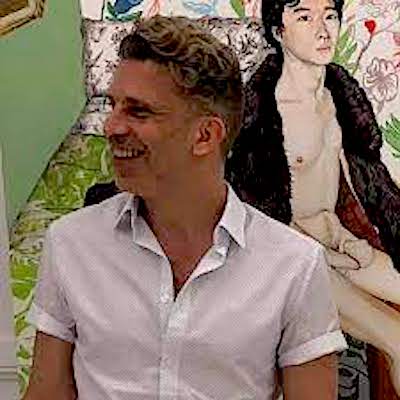
Bruno Leydet

Portraitures by Bruno Leydet

Born in 1968, Bruno Leydet is a Canadian painter who graduated from New York University and is currently based in Montreal. He is a portrait painter whose style was influenced mainly by expressionist painter Alice Neel, known for her portraits of family and friends, and the works of experimental filmmaker Kenneth Anger, whose short films merged surrealism and homoeroticism with a documentary style.

Leydet’s work features a tableaux collection centered on acrylic homoerotic portraitures, which narrate the sitters’ gay identities, surrounded by both pattern-oriented and surreal backgrounds. The inspiration for a work comes to Leydet from a pattern he finds, a historic painting, the model himself, or even a film he has seen. His male figures, even those appearing in groups, are often  displayed with contemplative expressions or with a sense of melancholy amid their exotic surroundings . 

“In the case of “Toile de Jouy Dream,” the painting started with Samuel. He had posed for another painting and had told me that he had this suit made with a toile de Jouy pattern. I knew I had to do a painting of him wearing it. Then almost two years passed, and I had this dream – I often have these weird dreams of these strange landscapes and places in crazy Technicolor, or great big old houses filled with objects. In this dream, I saw a prairie with a row of odd-looking houses, with huge storks made of green tiles in front. And then I thought of putting Samuel in that place, and using the greens and blues to give it this unreal night-time feel and add depth to the surroundings.”

– Bruno Leydet, June 2017

Bruno Leydet is represented by Craven Contemporary for Europe and the United States. The artist’s site is :  https://www.instagram.com/brunoleydetmtl/?hl=en

My thanks to https://doctordee.tumblr.com