Mikhail Kuzmin: “Night Was Done. We Rose and After. . .”

Photographers Unknown, Night Was Done

Умывались, одевались,
После ночи целовались,
После ночи, полной ласк.
На сервизе лиловатом,
Будто с гостем, будто с братом,
Пили чай, не снявши маск.

Наши маски улыбались,
Наши взоры не встречались,
И уста наши немы.
Пели «Фауста», играли,
Будто ночи мы не знали,
Те, ночные, те — не мы.

Night was done. We rose and after
Washing, dressing, — kissed with laughter, —
After all the sweet night knows.
Lilac breakfast cups were clinking
While we sat like brothers drinking
Tea, — and kept our dominoes.

And our dominoes smiled greeting,
And our eyes avoided meeting
With our dumb lips’ secrecy.
“Faust” we sang, we played, denying
Night’s strange memories, strangely dying,
As though night’s twain were not we.

Mikhail Kuzmin, Night was Done. We Rose and After…, 1906

Translated by Babette Deutsch and Avrahm Yarmolinsky

Born in October of 1872 in Yaroslavi, Mikhail Alekseevich Kuzmin was a Russian poet, musician and novelist who was a prominent contributor to the Silver Age of Russian Poetry, an exceptionally creative period of poetry at the turn of the twentieth-century. Born into a noble family, he grew up in St. Petersburg where he studied music at its Conservatory under Russian composer Nikolai Rimsky-Korsakov, known for his mastery of orchestration. 

Although the main focus of his career became poetry, Mikhail Kuzmin still retained his interest in music. He composed the music for theatrical producer Vsevolod Meyerhold’s 1906 production of Alexander Blok’s play “Balaganchik (The Fair Show Booth)”. Kuzmin’s personal compositions, sung while playing the piano, were popular in the city’s salons, such as The Stray Dog cafe and Ivanov’s Tower, the most famous of St.Petersburg’s literary salons and a major intelligentsia gathering place owned by the poet Vyacheslav Ivanov and his wife. Kuzmin was charismatic and well-liked, and the fact that he was open about his many relationships and trysts did not damage his social standing.

One of Kuzmin’s closest friends and a major influence as a young man was the aristocrat Georgy Chicherin, a distant relative of Aleksandr Pushkin and a passionate supporter of philosopher Friedrich Nietzsche and composer Wilhelm Wagner. In his youth, Kuzmin made pilgrimages to Egypt, Italy, and northern Russia with the Old Believers, a Russian Orthodox Church sect which maintained its old liturgy and traditions. Settling in St. Petersburg, he began, at the age of thirty-two,  to associate with the art circle centered around the art magazine Mir Iskusstva or World of Art, which introduced Russian artists to the European art movements.

Mikhail Kuzmin’s first work, “The Green Collection of Verse and Prose”, was published in 1905; this work was seen by writer and critic Valery Bryusov who invited Kuzmin to publish in the literary magazine Vesy. Kuzmin published two works in 1906: his most celebrated work, “Alexandrian Songs”, a collection of free verse love songs with homosexual undertones, and his first erotic novel, “Wings”, a story of a young man in St. Petersburg learning to accept his homosexuality. Told with Platonic subtexts, the novel caused a scandal but was immensely popular. Kuzmin’s writing style earned praise from the critics, which protected it from prosecution in the Tsar’s crumbling regime. 

Kuzmin’s  work, original and philosophical with a simple unpretentious style, set him apart from his Symbolist contemporaries’ writings. With the success of his publications, Kuzmin became a member of Russia’s cultural elite, his work sought by prestigious journals and publishers. In 1908, Kuzmin published “Seti (Nets)”, his first collection of one-hundred poems which was widely acclaimed. He was living in that year with set-design artist Serge Sudeikin and Sudeikin’s first wife, Olga Glebova; however, he was asked to move out after Olga discovered the affair between Kuzmin and her husband. 

In February of 1913, Mikhail Kuzmin met in Kiev the seventeen-year old writer and painter Yuri Yurkun, who would remain his lover until Kuzmin’s death. They lived in St. Petersburg with Yurkun’s mother in a communal apartment. Yurkun was arrested in 1918 by the Bolsheviks and detained for a brief period. Two years later, Yurkun met the young actress Olga Arbenina, who moved into the couple’s apartment and later married Yurkun. Kuzmin distanced himself from all political events after the Russian Revolution and continued writing; but it was clear that his writing was becoming less appreciated. 

For the rest of his career, Kuzmin made his living primarily as a literary translator most notably of Shakespeare’s plays. The last volume of poetry Kuzmin published was the 1929 cycle of narrative and lyric poetry entitled “The Trout Breaks the Ice”, which except for two contemptuous reviews, was ignored by the Soviet press. Mikhail Kuzmin died in poverty of pneumonia in St. Petersburg, then Leningrad, in March of 1936. Two years later in 1938, Yuri Yurkun was arrested by the secret police and executed in a massive political purge. 

At Kuzmin’s birthday ceremony in 1920, poet Alexander Blok expressed in his speech a wish that conditions be created in the future where a literary artist such as Kuzmin would have the right “to remain himself”. Considered by literary figures of his time to be a pioneer for a future age of sexual tolerance, Kuzmin became after the revolution a nonperson. The Soviet government for decades attempted to dismiss Kuzmin’s contributions to literature and kept his diaries from Western scholars.

The personal diaries Kuzmin kept from 1905 to 1934, previously published only in part, occupy a special place in his legacy and has been prized by historians of Russian culture for its unique intimate view of the country’s cultural life during that period. Interest in Kuzmin’s works and life was revived in the 1970s with the 1977 publication of a three-volume edition of his poetry, and a twelve-volume collection of his prose which was published between 1984 and 2000. Several editions of Kuzmin’s works also have been published in Russia since 1990.

Top Insert Photo: Photographer Unknown, “Mikail Kuzmin”, circa 1911

Second Insert Image: Aleksander Golovin, “Mikhail Kuzmin”, 1910 Oil on Canvas

Third Insert Image: Original Book Jacket, Hand-Colored Linocut by Ekaterina Turova for Mikhail Kuzmin’s 1913 “Dvum (For Two)”

Bottom Insert Image: Photographer Unknown, “Yuri Yurkun”, Date Unknown

Andrea Vanía: “Paolo”

Andrea Vanía, “Paolo”, Photo Shoot for Pineapple

Andrea Vanía is a photographer, dancer and choreographer who used his skill at visualizing concepts through imagery for a career in fashion and advertising. In that career, he set up art scenes for shooting both video clips and for music and fashion sets. Seeking to work without restraints from client requests, Vanía started freelance work to explore his own personal esthetic view.

Trained as a dancer to use the human form and the surrounding space as a way to interpret music, Vanía also used drawing to describe and understand the tensions and harmonies of a human body in motion. Now as a photographer, he attempts to produce intense and honest work that explores both the power and the fragility of the male nude. The figures in his work are presented through a wide range of lighting techniques and are set in environments ranging from interiors and urban settings to lush forests. 

Vanía’s photo session of Paolo, shown above, was produced for Pineapple, an online site for explicit artworks and photo sessions. It serves as an exhibition space for the wide spectrum of emerging artists and photographers in the gay scene. The site also presents interviews with the various contributing artists. 

Pineapple’s site, with contact and submission information and purchasable artwork, can be found at: http://pnpplzine.com

Rane Arroyo: “Secret Sleepwalking into Each Other’s Doubts”

Photographers Unknown, A World of Color

It’s the story of my life; minus
the big budget close-ups, plus a film
director unsure of my fate, minus
a season among sheep, plus mountains
looking like saddles for my true
love to ride, minus extras with tire irons,
minus awards, but the yes of two
men becoming one, the sí of kissing far
from angels (how Blakean), plus
Mormon underwear stripteases, Sundays
wearing vodka haloes, plus
nights spent on the floor and somehow
not stepped upon by God, plus
exorcisms and cold rivers, whispers in
Spanish from our missions, plus
secret sleepwalkings into each other’s
doubts, free to quote Wilde, plus
a plan to escape America, but
it’s the exact story of my life with
my cowboy, minus the sense of an impending
Patmos, that franchise of whispers and
wild kisses, minus the script
(we were our best scriptures), we the scarred
ghosts wearing landscape’s honesty, photogenic
Adam’s Apples, designer sorrow, minus
talk show rodeos, paparazzi round-ups,
politically-correct high fives, minus
the nightmares of winged horses with
hooves striking rocks to start fires, plus
slow motion nights on Speed, education
and library cards, the Spanish of my skin, plus
a belief in doom, nights bedding the moon,
two men without spin doctors, plus
an unedited nakedness, joy rides in beds
offering amnesty for the crime of being,
plus our Tijuana plans for a destiny makeover,
our nights as free verse Rimbauds
in cowboy boots, plus vaqueros keeping
quiet about specifics that become
the story of my life, plus Judgement Day
drinking games: showing God just
Brokeback Mountain to explain myself,
minus the editing, each moment as
Love’s monument and God’s cameo, in my
image, in my imagination, in my
nation while I and my cowboy are silent
having to learned to speak wind,
wind from nowhere, wind with news of home,
of our entangled shadows seeking
us with the plus and the minus of having
form, and we ride away from the cosmic
to the specifics of long nights without stars
with clenched fists, us undressed and
wondering what it feels like to become fiction

Rane Arroyo, Brokeback Mountain

Born in November of 1954 in Chicago, Rane Arroyo was an American poet, playwright and scholar of Puerto Rican descent. He earned his PhD in English and Cultural Studies form the University of Pittsburgh. Arroyo was a professor of English and Creative Writing at the University of Toledo in Ohio. 

In the 1980s, Rane Arroyo began his career as a performance artist in Chicago’s art galleries and eventually focused on his poetry. Openly gay, he wrote poetry, short stories and plays that were frequently self-reflexive, autobiographical works. Arroyo’s work dealt to a large degree with the issues of homosexuality, immigration, and the Latino culture. In his poetic stanzas and narratives, he juxtaposed his literary knowledge with contemporary pop culture.  

Arroyo’s 1996 poetry collection, “The Singing Shark”, won the 1997 Carl Sandburg Poetry Prize and his poem “Breathing Lessons”, published in Emerson College’s literary journal, won a 1997 Pushcart Prize. For his 2005 collection “The Portable Famine”, Arroyo won the2004-05 John Ciardi Poetry Prize. Included among his ten poetry collections are the 2006 “Don Quixote Goes to the Moon”;“The Roswell Poems” and “Same-Sex Séances”, both published in 2008; and his last collection, the 2010 “White as Silver: Poems”.

In addition to his poetry, Rane Arroyo wrote a book of short stories in 2005 entitled “How to Name a Hurricane”. His performed plays include such works as “The Amateur Virgin”, “Emily Dickinson in Bandages”, Prayers for a Go-Go Boy”, and “The House with Black Windows”, co-written with poet Glenn Sheldon, and performed in 1995 by the Polaris Theater in New York City.

Arroyo served as the co-Vice President of the Board of Directors for the Association of Writers and Writing Programs and as the co-Chair for the 2009 Chicago Conference. Nominated sixteen times for the Pushcart Prize for Poetry, Arroyo was awarded a Stonewall Books Chapbook Prize, the Hart Crane Memorial Poetry Prize, The Sonora Review Chapbook Prize from Arizona University, and a 2007 Ohio Arts Council Excellence Award in Poetry. 

Rane Arroyo died in the early morning of April 7th in 2010 due to a cerebral hemorrhage. He is survived by his life-long partner, American  poet Glenn Sheldon. In 2015, Rane Arroyo was inducted into the Chicago Literary Hall of Fame. His papers are archived at the Center for Puerto Rican Studies at Hunter College in New York City.

Thom Gunn: “I Dozed. I Slept. My Sleep Broke on a Hug”

Photographers Unknown, Positional Images of Men

It was your birthday, we had drunk and dined
    Half of the night with our old friend
        Who’d showed us in the end
    To a bed I reached in one drunk stride.
        Already I lay snug,
And drowsy with the wine dozed on one side.

I dozed, I slept. My sleep broke on a hug,
        Suddenly, from behind,
In which the full lengths of our bodies pressed:
         Your instep to my heel,
     My shoulder-blades against your chest.
     It was not sex, but I could feel
     The whole strength of your body set,
             Or braced, to mine,
         And locking me to you
     As if we were still twenty-two
     When our grand passion had not yet
         Become familial.
     My quick sleep had deleted all
     Of intervening time and place.
         I only knew
The stay of your secure firm dry embrace.

Thom Gunn, The Hug, The Man with Night Sweats, 1992

Born in August of 1929 in Gravesend, a port town in Kent, Thom Gunn was an English poet. A reader of works by Keats, Milton, and Marlowe, he attended Hampstead’s University College School in his youth. Gunn spent two years in the British Army for his national service and lived for six months in Paris before entering Cambridge’s Trinity College to study English literature. 

After his graduation in 1953, Gunn, young and gay at a time when it was illegal, published his first volume of poetry, “Fighting Terms”, a collection of poetic metaphors of love and self-disclosure. Received with acclaim, the volume contains his poems “Carnal Knowledge” and the tender “Tamer and Hawk”. Gunn’s initial poetry became associated with The Movement, a group of English poets who wrote traditional, simple poems nostalgic for an earlier, more pastoral Britain. His later poetry was associated with the work of Poet Laurette of England Ted Hughes who wrote frequently about the mixture of beauty and violence in the natural world.

After his first volume was published, Thom Gunn emigrated with his life-long partner Michael Kitay, whom he had met at Cambridge, to the United States. Taking a position at California’s Stanford University to teach writing, Gunn began to study poetry with poet and literary critic Yvor Winters, a modernist poet whose clear, sharp-language work was heavily influenced by Native American poetry. He began reading and studying the works of poets Gary Snyder, Robert Duncan, and William Carlos Williams, all of whom would influence his poetry. 

Gunn began teaching at the Berkeley campus of the University of California in 1958, a position he held for forty-two years, with a seven year absence beginning in 1966. His second collection of poems, the 1957 “Sense of Movement”, was a winner of the Somerset Maugham Award. Contained within that volume is the poem “On the Move”, a celebration of black-jacketed motorcyclists. In 1961, Gunn published his “My Sad Captains”, a book divided in two sections. The first section contained epic poems written in heroic verse which, in its purest form, consists of two rhyming lines written in an iambic pentameter. Gunn experimented in the second section with syllabic verse where the meter of the work is determined by the total number of syllables per line, rather than the contained stresses. This juxtaposition between two poetic forms would be repeated in other Gunn collections. 

Affected by the San Francisco bohemian lifestyle of the 1960s and 1970s, Thom Gunn became increasingly bolder in his verse and began to explore themes of homosexuality and drugs. Notable collections from the period include the 1967 “Touch”, “Moly” published in 1971 and the 1976 “Jack Straw’s Castle”. While he continued to use the  sharp, metrical forms that characterized his early work, Gunn continued his experiments with the freedom of free verse.  Coupled with his writing to a specific set of images, these free verse poems with their non-rhyming lines followed the natural rhythms of speech.

In 1982, Gunn published his first collection of essays, “The Occasions of Poetry”, which included critical pieces on writers ranging from William Carlos Williams and Gary Snyder to Thomas Hardy and Robert Duncan. The volume also contained five autobiographical essays, which covered Gunn’s development as a poet and discussed the contemporary literary currents in England and the United States, places that Gunn considered as home.

Gunn lost many of his friends when the AIDS epidemic came to the gay community in the 1980s. His grief was described to a profound degree in his 1992 “The Man with Night Sweats”, a series of first person perspective poems that explored the horrors of the epidemic as seen through the eyes of the inflicted. Through these poems, Gunn described his heartbreaking personal loss. Poems contained in this collection include “Lament”, “In Time of Plague”, and the title poem “The Man with Night Sweats”. Gunn received the Lenore Marshall Poetry Prize for this 1992 volume. Although AIDS was a focus of much of his later work, he remained HIV-negative himself. Spared from the disease, Gunn continued in his work to consider death and what it meant that he was one to survive.

Among Thom Gunn’s other works are his 1979 “Selected Poems 1950-1975”; “Passages of Joy” published in 1982; and his final book of poetry, the 2000 “Boss Cupid”, which won Publishing Triangle’s inaugural Triangle Award for Gay Poetry in 2001. This award was, after his death, renamed the Thom Gunn Award in his memory. Gunn published a second volume of critical and autobiographical essays entitled “Shelf Life” in 1993. He won many awards for his work and received fellowships from the Guggenheim and the MacArthur foundations.

Thom Gunn died in April of 2004 of acute polysubstance abuse at his home in the Haight Ashbury neighborhood of San Francisco, where he had lived since 1960. Five years after his death, a new edition of his “Selected Poems” was republished.

Notes: In the summer 2005 edition of The Threepenny Review, there is an article written by Michael Kitay about his first meeting and life with Thom Gunn. It can be found at: https://www.threepennyreview.com/samples/kitay_su05.html

A collection of Thom Gunn’s poetry can be found at the Classic Poetry Series located at:  https://www.poemhunter.com/i/ebooks/pdf/thom_gunn_2012_8.pdf


Jim French

The Photography of Jim French

Born in Beaver Falls, Pennsylvania in July of 1932, James Thomas French was an American artist, photographer, illustrator, filmmaker, and publisher. He is best known for his association with COLT Studio, one of the most successful gay male erotica companies in the United States.

For his formal art education, Jim French entered the Philadelphia Museum School of Art in 1950 to study towards a career in fashion illustration similar to that of J.C. Leyendecker. In 1953, the year before his graduation from the Museum School, he joined the United States Army Reserves and went on active duty in 1955; French earned a honorable discharge from service in 1957. Settled in New York City, he pursued a successful freelance career as an advertising illustrator for several Madison Avenue advertising firms. 

In addition to his work for Neiman Marcus and other high-end department stores, French also created textile designs for designer Tammis Keefe; collections of her work are now housed in Cooper Union and the Metropolitan Museum of Art. Working with Columbia Records, he created portrait drawings of singers, such as Johnny Mathis. Frank Sinatra and Maria Callas, for use as album art. While working on Madison Avenue in the mid-1960s, French drew homoerotic drawings in his spare time, under the pseudonym of Arion. His drawings were offered in 1966 through Ed Wild’s Times Square Studio as well as his own short-lived mail order venture, the Arion Studio. 

Jim French was approached by a friend from his Army days, Saul Stollman, who had seen some of his Arion drawings, to create a physique studio in New York City. French adopted a new pseudonym for this venture, Kurt Lüger, and under the name of Lüger Studios began producing new, more masculine figured illustrations, which featured leather men, cowboys, wrestlers, and other similar archetypes. Lüger Studio artwork first appeared as two drawings from the “Cowboy” series in the May/June 1966 issue of “Young Physique”. This series of six to eight drawings was advertised in other male erotica magazines and was available for purchase through mail order. 

The success of Lüger Studio developed quickly after being featured in the pages and on the covers of a wide assortment of physique magazines. Saul Stollman bought out French’s interests in the studio in February of 1968 and briefly ran the business on his own. However, now featuring photographs and eight millimeter films from substandard producers, Lüger Studio did not attract enough interest to survive beyond 1968. 

On December 5th of 1967, Jim French and Lou Thomas, a friend and astute businessman, took out a business license to form COLT Studio. Although originally named to evoke the image of the Colt pistol, the studio quickly changed its COLT image to that of a stallion. For this new venture, French adopted a new pseudonym, Rip Colt, and began to make highly detailed pencil drawings, using the newly marketed Polaroid camera to shoot photographs of male models for research studies. Before the camera’s  advent, it had been a challenge getting erotic subject matter that was shot on film processed as many venues were reluctant to deal with this material. The Polaroid camera which contained its own processor solved that issue with its instant results. 

In the initial years of the company, COLT Studio released French’s illustrations, under the Rip Colt name, and photo sets of masculine male models, The studio eventually added short films, magazines and calendars. Based for six years in New York City, COLT Studio was relocated in 1974 to Studio City in California, due to French’s frequent travels to Southern California. At this time, French bought the company shares owned by his partner Lou Thomas, who soon formed his own business, Target Studios, a venture which provided the underground demographic with quality homoerotic art and film. 

COLT Studio grew into one of the most successful gay photography studios of its time and offered the highest quality male erotica commercially available. Jim French’s company was famous not only for its stable of male models, but also for its magazine brands which included Spurs, COLT Men, Manpower, and its film venue, COLT Studios Presents. French ran the company until 2003 when he sold the studio to former Falcon Studios director John Rutherford and his partner Tom Settle. For a few years after the sale of COLT Studio, Jim French continued to privately sell salon-style prints of his photographs before he settled into quiet retirement. Jim French died peacefully in his sleep at his Palm Springs, California, home on the 15th of June in 2017. He was  survived by his husband Jeff Turner.

Under his own publishing imprint State of Man, Jim French published eight volumes of fine art male photography from 1972 to 1999, among which are “Man”, “Quorum”, “The Art of Jim French: the Nude Male”, and “Opus Deorum”. French’s work has been published in several collections: Felix Lance Falkon’s 1972 “A Historic Collection of Gay Art”; a collection of early 1970s photographs of model David Scrivanek entitled “Like a Moth to a Flame”; and an anthology of his early Polaroid photographs from the 1960s and early 1970s entitled “Tinker, Tailor, Soldier, Sailor: Jim French Polaroids”. French’s photographs and illustrations can be found in many private and public collections.

Notes: In 2004, Gabriel Goldberg convinced Jim French to tell his own story to the public for the first time. This personal account entitled “Life Thru a Lens: Jim French: In His Own Words” can be found at the Advocate online magazine located at: https://www.advocate.com/people/2017/6/29/story-jim-french-and-colt

Many of Jim French’s Polaroid photographs can be found at the Wessel and O’Connor Fine Art website located at:  https://wesseloconnor.com/exhibits/french/french1.phpd

Second Insert Image: Jim French, Untitled (Sailor with Shadow), Polaroid Print, 10.8 x 8.3 cm, Private Collection

Third Insert Image: Jim French, Untitled (Sailor), Polaroid Print, 10.8 x 8.3 cm, Private Collection

Bottom Insert Image: Jim French, Untitled, circa 1970s, Gelatin Silver Print, 56.5 x 71.7 cm, Private Collection

Maurice Kenny: “Hands Which Did Not Recognize Me”

Photographers Unknown, Hands Which Did Not Recognize Me

The book lay unread in my lap
snow gathered at the window
from Brooklyn it was a long ride
the Greyhound followed the plow
from Syracuse to Watertown
to country cheese and maples
tired rivers and closed paper mills
home to gossipy aunts   .   .   .
their dandelions and pregnant cats   .   .   .
home to cedars and fields of boulders
cold graves under willows and pine
home from Brooklyn to the reservation
that was not home
to songs I could not sing
to dances I could not dance
from Brooklyn bars and ghetto rats
to steaming horses stomping frozen earth
barns and privies lost in blizzards
home to a Nation, Mohawk
to faces I did not know
and hands which did not recognize me
to names and doors
my father shut

Maurice Kenny, Going Home, Between Two Rivers, 1988

The youngest of three children to a father of Mohawk and Irish heritage and a mother of English and Seneca heritage, Maurice Frank Kenny was born in Watertown, New York, in August of 1929. He spent his younger years in Watertown and on a family farm in nearby Cape Vincent. After his parents’ separation, Kenny remained with his father in Watertown until running away, at age sixteen, to Bayonne, New Jersey, to live with his mother. Truant at school, he was returned to his father’s custody in Watertown where he completed his high school education. 

Upon graduation, Maurice Kenny spent the summer traveling with a theater troupe in New York State. He spent a year in New York City attempting to establish a career as an actor; but after a year, he returned home. Kenny studied under Professors of English Warner Beyer and Roy Marz, a Fulbright Scholar, at Indiana’s Butler University, where he graduated in 1956 with a degree in English. He took additional classes under author and Professor of English Douglas Angus at St. Lawrence University in New York. 

Kenny moved to Manhattan, New York, in 1957 and became a manger for Marboro Books, which put him in contact with literary, cinematic and theatrical figures. He also took courses at New York University, where he met and studied under the fourth Poet Laureate to the Library of Congress,  Louise Bogan, who influenced his early development as a writer. 

Maurice Kenny began writing poetry as a teenager. He was particularly influenced by the writings of Walt Whitman, whose natural language and rhythm were qualities he found later in Native American oral literature. Encouraged by his former professor Douglas Angus, Kenny wrote the poems of his first chapbook, the 1956 “The Hopeless Kill”. His first full-length collection, “Dead Letters Sent and Other Poems”, was published in 1958, his first year at New York University. After a hiatus of travel in the early 1960s, Kenny settled for two decades in Brooklyn Heights, New York, to concentrate on his poetry. 

Kenny’s career coincided with a period of activism for Native Americans. In 1969 Native American activists occupied Alcatraz Island and, two years later, the American Indian movement was formed. A series of confrontations with federal authorities followed, which culminated in a violent confrontation in early 1973 at Wounded Knee, South Dakota. Native Americans were starting to embrace their traditional cultures and reject assimilation into the general society. A renaissance in Native American literature began as a result of native writers and poets seeking to authenticate their cultural identities. Poets, such as Kenny, began to draw on their heritage to produce a synthesis of traditional and modern forms in their work. 

Maurice Kenny’s exploration of his heritage resulted in his long 1973 poem “I Am the Sun”, which was written in response to the actions at Wounded Knee, the site of the 1890 massacre and the culmination of the pan-tribal Ghost Dance religion. His 1977 “North: Poems of Home”, the first full-length collection published after a span of thirteen years, and the 1979 “Dancing Back Strong the Nation” epitomized the growing consciousness of his native heritage. 

Kenny asserted his gay identity in the 1976 “Gay Sunshine” which included the poem “Winkle” and “Tinselled Bucks: An Historical Study in Indian Homosexuality”, a essay that claimed the two-spirit, or berdache, tradition as a shining example for contemporary Native Americans. Kenny was among the first nationally recognized American Indians to come out publicly as gay. 

Maurice Kenny’s “Blackrobe Isaac Jogues”, published in 1982, told the story of a Jesuit missionary martyred in 1646 by the Mohawks; it received the National Public Radio Award for Broadcasting and was nominated for a Pulitzer Prize. His “Takonwatonti / Molly Brant” is narrated by a prominent Mohawk woman who married an Englishman. Kenny in these works and later ones portrayed individuals who inhabit two worlds at the same time and crossed the boundaries between cultures and identities, such as missionaries among Indians, Indians in a white society, and gay men in a heterosexual world. 

In 1986, Kenny moved back to upstate New York and settled in Saranac Lake. He continued to travel and teach, and held the position of poet-in-residence at North Country Community College and the Potsdam campus of the University of New York. In 1995, Kenny received an honorary doctorate from the St. Lawrence University. He published over thirty collections of poetry, essays and fiction; his work has appeared in many journals and anthologies. A recipient of a Lifetime Achievement Award from the Native Writers’ Circle of the Americas, Maurice Kenny passed away, at the age of eighty-six, on April 16th of 2016. 

Note: The anthropologist James Mooney, born 1861, wrote a thousand-page account of the tragic events at Wounded Knee which was published in 1896. A summary of this account and others written about the massacre, including an article on the Ghost Dance, can be found at: https://www.encyclopedia.com/places/united-states-and-canada/miscellaneous-us-geography/wounded-knee

Douglas Alain Powell: “The Earth Has Asserted Itself”

Photographers Unknown, The Earth Has Asserted Itself

had no direction to go but up: and this, the shattery road
its surface graining, trickle in late thaw—is nothing amiss?
            —this melt, the sign assures us, natural cycle
                         and whoosh, the water a dream of forgotten white

past aspens colored in sulfur, they trembled, would
—poor sinners in redemption song—shed their tainted leaves

I tell you what boy I was, writing lyrics to reflect my passions:
the smell of a bare neck in summer
a thin trail of hairs disappearing below the top button of cut-offs
the lean, arched back of a cyclist straining to ascend a hill

in the starlight I wandered: streets no better than fields
the cul-de-sacs of suburbia just as treacherous, just as empty

if wood doves sang in the branches of the acacias, I could not hear them
anyone lost in that same night was lost in another tract

the air pulsed and dandelion pollen blew from green stalks
                        —that was all

and yes, someone took me in his car.   and another against the low fence
in the park at the end of our block.   under the willow branches
where gnats made a furious cloud at dawn and chased us away

I knew how it felt to lie in a patch of marigolds: golden stains
the way morning swarmed a hidden rooftop, the catbirds singing
the feel of ruin upon lips rubbed raw throughout the night

granite peaks: here, the earth has asserted itself. and the ice asserted
and human intimacies conspired to keep us low and apart

for an ice age I knew you only as an idea of longing:
a voice in the next yard, whispering through the chink
a vagabond outlined against the sky, among the drying grass

we journey this day to darkness: the chasm walls lift us on their scaly backs
the glaciers relinquish their secrets: that sound is the ice bowing
and the sound underneath, the trickle: the past released, disappearing

you pinnacle of my life, stand with me on this brink
half-clouded basin caked in flat grays, the very demise of green

you have surmounted the craggy boundary between us.

you open a place for me in earth, receiving my song

                                 —for Haines Eason

D. A. Powell, continental divide, Chronic, 2009, Graywolf Press

Born in Albany, Georgia in May of 1963, Douglas Alain Powell is an American poet whose work is experimental in form. Growing up in Georgia and Tennessee, he relocated, after his parents’ divorce, with his brother to live in California with their mother and new stepfather. Powell lived on and off the streets in his teen years, often running away from home and working odd jobs to support himself. He graduated from Lindhurst High School and made several attempts at colleges, including a short term at San Jose State University.

At the age of twenty-two, Powell entered Sonoma State University where he began to write poetry under the tutorage of poet David Bromige. During his years in Sonoma County, he organized poetry readings and co-founded “Avec”, which became a major journal of the post-Language Poetry avant-garde. Powell received his Bachelor of Arts in English in 1991 and his Masters in English in 1993, both from Sonoma State University.

After completing his graduate studies, Douglas Powell entered the Writer’s Workshop at the University of Iowa and received his Masters in Fine Arts in 1996. For his work during the Writer’s Workshop, he received an Academy of American Poets prize. While in Iowa, Powell wrote his first full-length poetry collection, “Tea”, which focused on AIDS in particular and the gay subculture in general. The poems in this collection examine pain, loss, abuse, rejection and suffering; however, the essence of the volume is one of survival. Published in 1998 after Powell’s return to California. this first work generated a great deal of excitement. Powell’s openness about his HIV-positive status contributed to interest in the book and readers’ response to it.

The writers cited by Powell as influences on his work cover a wide range; he uses their writings as a litmus test for his own work. These writers include t. S. Eliot, Sylvia Plath, Wallace Stevens, Frank O’Hara, Gertrude Stein, Federico García Lorca, and the Black Mountain poets, among others. Known for his syntactically inventive, longer lined and sometimes untitled work, Powell creates poems that are almost collage-like in form, where fragmentary elements of allusions and references are joined together into mosaic compositions. The source list for his 1998 volume of poems, “Tea”, include the following: Shakespeare’s “Macbeth”, the Supremes, Tennessee Williams, mid-1980s disco divas, gay slang, Batman’s sidekick Robin, and “The Exorcist”, among others.

Settled in California, Powell began doing work in San Francisco’s new media industry. In 1997, he was awarded a Paul Engle Fellowship from the James Michener Foundation. In addition to his career as a poet, Powell was a university professor with teaching positions at Columbia University, Sonoma State University, San Francisco State University and Harvard University, where he was the Briggs-Copeland Lecturer in Poetry, a prestigious five-year position.

In 2000, Douglas Powell’s second collection of poetry, entitled “Lunch”, was published by the Wesleyan University Press. This volume built on the survival aspect in “Tea” and directed it onward to restoration and rejuvenation. While again examining the issue of AIDS, the poems were not about dying from the virus, but about living with it and through it. “Lunch” was more eclectic, both in its formality and theme, and contained biblical and mythological allusions, such as the stories of King Midas and the birth of Aphrodite. The lines in the poems were shorter than those in “Tea”, almost conventional, while the poems were generally longer in length, with a greater variety.

Powell’s next collection of poems, “Cocktails”, was published in 2004 and was a finalist for the National Book Critics Circle Award for Poetry. His 2009 “Chronic” won the Kingsley Tufts Poetry Award and also was a finalist for the National Book Critics Circle Award for Poetry. The 2012 “Useless Landscapes, or a Guide for Boys” was a witty and emotional collection of poems which examined the occupied spaces of boonies, backstages, bathhouses, and bars. This fifth volume of poetry by Powell won the National Book Critics Circle Award for Poetry. His poetry can also be found in the 2008 anthology “Best American Poetry” and “American Hybrid”, an anthology published in 2009.

Note: A collection of twenty-six poems by Douglas Alain Powell, including a reading of his poem “continental divide”, can be found at the Poetry Foundation. The link to the recorded reading is: https://www.poetryfoundation.org/poems/51144/continental-divide

Alejandro Amenábar: Film History Series


Photographers Unknown, A Collection of Thirteen Men

Born in Santiago in March of 1972, Alejandro Fernando Amenábar Cantos is a Spanish-Chilean film director, composer, and screenwriter. In August of 1973, his family relocated to Spain where they settled in Madrid, initially living in a camper-van and later moving to a complex in Madrid’s outer neighborhoods. From the age of fifteen, Amenábar was passionate about cinematic art; he also wrote stories and musical compositions for the guitar and keyboard.

Amenábar began his education at The Immaculate Piarist Fathers, a parochial multi-discipline school in Madrid, and later transferred to the secular Alameda de Osuna Institute, one of Madrid’s prominent private schools. After graduating, Amenábar enrolled at the sciences faculty of Madrid’s historic, public research Complutense University where he studied cinema and directing. There he met people who would lend support to his career in cinema including Argentine journalist Carlos Montero, actor Eduardo Noriega and Mateo Gil Rodriguez,  a filmmaker who would co-write most of Amenábar’s films.

In 1991, Alejandro Amenábar released the first of his short films, “La Cabeza (Head)”. The script, based on an urban legend, was written by Mateo Rodriquez and Amenábar, who also composed the musical score in collaboration with Alfredo Alonso. This film earned Amenábar a prize from the Amateur Independent Film Association. His second short film, the 1992  “Himenóptero”, was shot on location at Alameda de Osuna Institute, his former high school. Amenábar wrote the script and music for the horror suspense film, was director and editor, and performed the only male role. (Note: Hymenoptera is a large order of insects which includes wasps, bees, sawflies and ants.)

At the age of twenty-two, Amenábar released his first full-length film, the 1996 “Tésis (Thesis)”, which secured his reputation as one of Spain’s most promising  cinematographers. This film, which commented on the Spanish film industry, Hollywood’s influence on the industry and the voyeurism of the horror genre, was nominated for eight Goya awards, of which it won seven including Best Film. In 1997, Amenábar released the science-fiction based, psychological thriller, “Abre los Ojos (Open Your Eyes)”, which starred Penelope Cruz and Eduardo Noriega. The rights to this movie were later acquired by actor Tom Cruise who directed and starred in the American remake entitled “Vanilla Sky”, with Penelope Cruz playing the same role of the original film.

Alejandro Amenábar followed his success with an English language movie in 2001, entitled “The Others”, a psychological, gothic horror film. Written and directed by Amenábar, the supernatural film relied on tension built during disturbing scenes for its horror rather than the use of special effects. “The Others”, with its film score by Amenábar, was a box-office success and won seven Goya Awards, including Best Film and Best Director. It also won three Saturn Awards for Best Horror Film, Best Actress for Nicole Kidman, and Best Supporting Actress for Fionnula Flanagan, who played the housekeeper Bertha Mills.

In 2004, Amenábar had another success with his “Mar Adentro (The Sea Inside)”, based on the true life story of Ramón Sampedro. Paralyzed from the neck down, Sampedro fought a thirty-year campaign to win the right to end his life with dignity.The film won fourteen Goya Awards, including Best Film and Best Director, and won the Academy Award for Best Foreign Language Film.

In 2008, Amenábar released the historical drama “Agora”. Written by Mateo Gil and Amenábar, the biopic told the life story of Hypatia, the fourth-century female mathematician and astronomer who investigated the flaws of the geocentric Ptolemaic system of the solar system and the heliocentric model that challenged it. Winning seven Goya Awards, the film had limited release in the United States but was Spain’s highest grossing film of 2009.

After a seven year hiatus, Alejandro Amenábar released his psychological horror mystery film “Regression” in 2015. The film premiered at the 2015 San Sebastián International Film Festival. In 2019, he released the Spanish-Argentine historical drama “While at War”, the plot of which tracks the plight of writer and philosopher Miguel de Unamuno in 1936 Salamanca, a city controlled during the Spanish Civil War by the Rebel faction. 

In addition to composing the scores of his own films, he laid the sound tracks for Josè Luis Cuerda’s 1999 coming-of-age film“Butterfly’s Tongue” and Mateo Gil’s 1999 mystery film “Nobody Known Anybody”, among others. 

Top Insert Image: Mateo Gil, “Alejandro Amenábar, Himenóptero”, 1992

Third Insert Image: Javier Aguirresarobe, “Alakina Mann, The Others”, 1992, Written and Directed by Alejandro Amenábar, Warner Brothers

Justin Chin: “What Measures Eternity?”

Photographers Unknown, What Measures Eternity?

Oh blameless innocent victim
What measures a lifetime?

I used to have this theory about how
much life a human body could hold.
It all had to do with the number
of heartbeats. Each human is assigned a number
determined by an unknown power cascading
over the dark waters of an unformed Earth.

For some, it was a magnificently high number
seen only in Ritchie Rich comics, and for others,
it was frightfully low, like twenty-six.
No bargaining, no coupons,
no White Flower Day sale, no specials. Once
you hit your number, you croak.
I imagined the angels in heaven
and the demons in hell gathering to watch
the counters turn, like how I enjoyed watching
the speedometer line up to a row of similar
numbers, and especially when the row of
nines turned into
the row of zeros.

Oh Blameless innocent victim
What measures eternity?

Justin Chin, Excerpt from the Poem “Grave”, Harmless Medicine, 2001

Born in September of 1969, Justin Chin was a Malaysian-American  poet, essayist, and performance artist. In his works, he dealt with identity categories that influenced his life: Asian-American, Gay Writer and Queer. Chin’s work sought to give a voice to marginalized groups of racial, national, and sexual minorities, Acknowledging that everyone one has an individual self-identity, he also questioned the usefulness of categories that dominate the language of today.

Justin Chin was educated in Singapore’s British colonial system where he developed his love for poetry and prose in English literature. In 1991 after graduating,  he left home to  attend Honolulu’s  University of Hawaii at Mānoa where he studied creative writing. Chin trained under poet and visual artist Faye Kicknosway, who encouraged his writing and introduced him to poet and playwright R. Zamora Linmark and  visual artist and poet  Lisa Asagi. These two artists remained important supporters of Chin’s work throughout his life.

In 1990 in San Francisco, Chin attended the first annual Outwrite Conference, which played a pivotal role in encouraging and shaping the LBGTQ literary culture in the United States. Relocating to San Francisco in 1991, he transferred to the journalistic program at San Francisco State University. Feeling restrained by the journalistic format, Chin began to write essays, poems, fiction, and performance pieces to express his views. In 1995 and 1996, Chin was a member of San Francisco’s team for the National Poetry Slam, an annual performance poetry competition.

Justin Chin published his first collection of poetry, the 1997 “Bite Hard”, which received nominations for both the Lambda Literary Award and the Firecracker Alternative Book Award. This mix of poems and short performance pieces, done in unflinching, harsh honesty and biting humor, dealt with AIDS, sexual tourism, racial stereotypes, Asian identity and bathroom sex. The prvading sense of loneliness in this volume culminates in its last poem, “Refuging”, where Chin discloses the pain of losing one’s cultural identity and examines the loss of lovers and its subsequent effect on one’s self.

In 1999, Chin published a collection of opinion and biographical essays from 1994 to 1997 in a volume entitled “Mongrel: Essays, Diatribes and Pranks”, which received positive reviews. A second collection of poetry, “Harmless Medicine” followed in 2001 and received nominations for the Lambda Literary Award and the Firecracker Alternative Book Award. This second collection is different than the first in tone; it is more serious and poignant in its discussion of homophobia, mortality, the American culture and AIDS. Its long and complex poems explore the meanings and effects of illness as well as the hatred of a xenophobic society hiding behind and seeking justification in religion.

Justin Chin published a collection of more personal and revealing essays in 2002 entitled “Burden of Ashes”. The first twelve essays dealt with his childhood family life, the abuse by an aunt, and growing up in a repressive society; the second part of the collection focused on his coming to terms with his sexuality and his mostly unfulfilling  love life. Chin’s third volume of poetry, “Gutted” was published in 2006; it became a finalist for a Lambda Literary Award and won the Thom Gunn Award, that honors gay male poetry. 

Other prose works by Chin include the 2005 “Attack of the Man-Eating Lotus Blossoms”, a collection of documents and scripts from his performance work, and “98 Wounds” published in 2011. In addition to his published work, Chin created eight full-length solo performance works and several shorter works that he performed throughout the United States. An anthology of writings from Chin’s seven published books, entitled “Justin Chin: Selected Works”, was published in 2016.

In his career, Justin Chin enlivened the poetry scenes of both San Francisco’s  Paradise Lounge and its spoken word and performance art collective Sister Spit , as well as open microphones at various clubs. He was a respected presence at the Outwrite Conferences and at Litquake, San Francisco’s Bay Area literary festival. Justin Chin’s life ended tragically, at the age of forty-six, with a stroke related to complications from AIDS on December 24th of 2015.

Donald Britton: “These Things Have No Beginning”

Photographers Unknown, These Things Have No Beginning

The start of a new era
Of desperation is starting over.

Meanwhile you and your bronze friend
Run naked through the yellowed broom sage,
Suspended vaporously above life
Like high pressure systems. A redolent
Cascade of voices from the lawn
As the next new hope something will happen
Ascends the orangerie steps, an endless
Unpunctuated sentence that seems at the time
To illuminate everything, as if a giant
Had stepped between you and the sun,
Sucking the light and punching a hole
In space, revealing infinite vistas
Of anticipation and delay.

These things have no beginning, or rather
Were set in motion long before we became
Their facsimile, thinking ourselves privileged
To secret information, not sensible
Of how the world contrives with enormous
Duplication of labor to rid itself of us
And perform its little routines
Solo in the galactic swimming pool
That is at last a total stage. It is
The amusing notion life might someday
Not be confusing that coordinates
Our award-winning sentiments these last days
Of summer, preparatory to the paint-by-number
Rush of autumn, the colors balking
Within their lines, which as a kid
Was the hardest part and apparently still is.
You must do something, though, not caring
What it is, so long as when the day ends,
You’re able to claim that this thing
has been accomplished, brought nearer
The perfection toward which it ludicrously
Aspires, then put aside to be resumed
At a point just over the next rise yonder
Where suddenly pertinent trees now loom.

Donald Britton, Here and Now, In the Empire of the Air, 2016

Born in San Angelo, Texas in 1951, Donald Eugene Britton earned his Bachelor of Arts and his Master of Arts in American Literature at the Austin campus of the University of Texas in 1976. He earned his Doctorate in Literary Studies in 1979 from the American University in Washington DC; his dissertation was on modernist poet Hart Crane’s poetics of praise. 

Britton lived in New York City and became part of a circle of avant-garde artists and poets, later known as the third-generation of New York poets, which included Dennis Cooper, Joe Brainard, Tim Dlugos, Brad Gooch, and Bernard Weh, among others. After several years in the city, he moved to Los Angeles where he worked for the advertising firm of Brierly and Partners.

Donald Britton was not a prolific poet; as a self-depreciating perfectionist, he spent a great length of time and effort on each of his poems. In his poems there is the lack of a defined self; the poems are not personalized in the traditional sense of confessional poetry but are more abstracted and generalized. Britton’s poems are not subject-centered nor do they have topics in the conventional sense. He writes more about the states of mind, in which he follows the wandering of a particular consciousness as it encounters bodily experiences.

Britton’s work was published in the gay-oriented New York magazine “Christopher Street”, Cornell University’s EPOCH magazine, and the literary journal “The Paris Review”, among others. They also appeared in several anthologies including “The Sons of the Male Muse”, “Coming Attractions: An Anthology of American Poets in Their Twenties”, and “Ecstatic Occasions, Expedient Poems”.

Donald Britton essentially stopped writing poetry in the late 1980s. The only collection of his work published during his lifetime was the 1981 “Italy” which featured short introductions by novelist Edmund White and poet John Ashbery. Britton was to publish a second collection of his work, entitled “In the Empire of the Air”; however, due to financial difficulties, it was never published in his lifetime. The collection was edited by poet Reginald Shepherd and author Philip Clark, and finally published in 2016 by NightBoat Books .

Britton wrote a two-part essay, entitled “The Dark Side of Disneyland”, on the death imagery of some of its rides, in which he argues that Disneyland is a monumental artwork memorializing dead children. This essay appeared in the art magazine “Issue”, now online, and later in his friend Bernard Welt’s 1996 essay book, “Mythomania”. Four of Britton’s poems were included in the 2010 “Persistent Voices”, a compilation of poetry by writers lost to AIDS.

Donald Eugene Britton died, at the age of forty-three, of complications from AIDS in 1994. He was survived by his partner, David Cobb Craig, whom Britton met in 1983.

Bottom Insert Image: Photographer Unknown, “Donald Britton (Third from the Left) at New York City’s Ear Inn”, Early 1980s, Gelatin Silver Print

Notes:   A short memoir written by David Cobb Craig entitled “Life and Times with Poet Donald Britton”, which includes their first meeting in 1983, can be found at the Gay & Lesbian Review site located at: https://glreview.org/article/life-and-times-with-poet-donald-britton/ 

Donald Britton’s doctorate dissertation on Hart Crane’s poetics of praise can be read at the American Library’s Digital Research Archive located at:  https://auislandora-stage.wrlc.org/islandora/object/thesesdissertations%3A791

I wish to acknowledge poet and author Reginald Shepherd as the source for most of the information in this article on Donald Britton’s life and work. The author of many essays on gay poets and writers, Shepherd passed away in the fall of 2008. His blog site with its wealth of material is still available online at: http://reginaldshepherd.blogspot.com

Edward Field: “This Man Is Not Dangerous”

Photographers Unknown, This Man Is Not Dangerous

The poster with my picture on it
is hanging on the bulletin board in the Post Offive.

I stand by it hoping to be recognized
Posing first full face and then in profile

But everybody passes by and I have to admit
The photograph was taken some years ago.

I was unwanted then and I’m unwanted now
Ah guess ah’ll go up echo mountain and crah.

I wish someone would find my fingerprints somewhere
Maybe on a corpse and say, You’re it.

Description: Male, or reasonably so
White, but not lily-white and usually deep-red

Thirty-fivish, and looks it lately
Five-feet-nine and one-hundred-thirty pounds: no physique

Black hair going gray, hairline receding fast
What used to be curly, now fuzzy

Brown eyes starey under the beetling brow
Mole on chin, probably will become a wen

It is perfectly obvious that he was not popular at school
No good at baseball, and wet his bed.

His aliases tell his story: Dumbell, Good-for nothing,
Jewboy, Fieldinsky, Skinny, Fierce Face, Greaseball, Sissy.

Warning: This man is not dangerous, answers to any name
Responds to love, don’t call him or he will come.

Edward Field, Unwanted, Stand Up, Friend, With Me, 1962

Born in Brooklyn, New York, in June of 1924 to Ashkenazi Jewish parents, Edward Field is an American poet and author. He spent his formative years living in Long Island, where as a cello player he played on the Field Family Trio, a weekly radio program on Freeport’s WGBB. Field enlisted in 1942 and did basic training with the U.S. Army’s Air Force division. During the training, a Red Cross worked handed Field an anthology of American  poet Louis Untermeyer’s poems, which spurred his decision to be a poet: he would later credit poet Constantine Cavafy as another source of inspiration for his writings. 

In the years of World War II, Field served in the Eighth Army Air Force, stationed in both England and France, from which he flew twenty-five missions over Germany as a B-17 bomber’s navigator. On a February 1945 mission over Berlin,  Field’s plane, crippled by enemy anti-aircraft fire, crashed into the North Sea. After rescue by a British air-boat, the surviving crew members were sent to a town near the Liverpool area of London. 

During his time in basic training and his military service, Edward Field came to terms with his identity as a gay person; however, he kept it very private during this time. Knowledge by military authorities of a enlisted person’s homosexuality would have resulted in a blue charge which, while neither honorable or dishonorable, gave military commanders authority to remove such person from the ranks. A person’s military dismissal by a  blue charge enabled the Veterans Administration to deny benefits of the G.I. Bill and, as employers were aware of its negative connotations. made employment after discharge difficult.

After his return to the United States, Field studied for a short period at New York University, where he met the eccentric writer Alfred Chester whose later novel “The Exquisite Corpse” was published in 1967. Field traveled to Paris in June of 1948 and focused on his career as a writer and poet. On the ocean voyage over to Europe, he met the slightly-older Robert Friend, a poet who had already published in several small presses in the United States. They stayed in Paris’s Hotel Jacob and soon became friends with author and poet Ralph Pomeroy and Frederick Kuh, who later became a well-known restaurateur and cabaret owner in 1950-1980s San Francisco . 

Edward Field’s time in Paris was productive, both in his writing and his cultural development. He wrote for hours in the cafés, and exchanged poems with Robert Friend, which led to a critique of  each others work. Encouraged by Friend’s praise, Field submitted his work to all the major journals in the United States. One work was accepted by an English journal, and the next spring, a number of his works were published in the magazine “Botteghe Obscure”. For his social activities, Field went frequently to the opera and theater; he also, accompanied with his friends, attended gatherings of artists and intellectuals at such places as the Paris residence of Monroe Wheeler, the director of publications and exhibitions for New York’s Museum of Modern Art.

After his return to the United States in the winter of 1949, Field supported himself with  various jobs, including  doing art production and working as a machinist, warehouse laborer and clerk-typist. In 1956, he studied acting with the Russian-born actress Vera Soloviova of the Moscow Art Theater, who was a student of theater practitioner Konstantin Stanislavski. Field applied his new acting techniques to his poetry readings and supported himself this way throughout the 1960s and 1970s. In New York City in 1959, he met writer Neil Derrick at the Museum of Modern Art, where Derrick had a position. They became lifelong partners for fifty-eight years, and co-author many writing projects, 

Edward Field’s poetry is eclectic and highly personal, being written in the first person; they are also deceptively simple in form. He used his personal experience and his knowledge of the mythologies of our collective history to explore his Jewish ancestry and the issues of alienation, oppression, city life, his experiences in the military, and alternative sexualities. Field’s  first published collection of poems was the 1962 “Stand Up, Friend, With Me”, which drew connections between modern America and ancient Greece. In this work, both comic and tragic, he rewrote the mythologies of such figures as Icarus, Aladdin and Fidel Castro.

Field’s second work was the 1967 “Variety Photoplays”, a continuation of his rewritten mythologies. Poems included in this work are “Frankenstein”, a commentary on the alienation of a gay male and his desire for male companionship, and “Bride of Frankenstein”, which examines ungratified sexual desire. In this collection, Field published a memoir inspired work, “World War II”, a long, harrowing account of a crashed military plane into the North Sea. Field followed this collection with five more works, including the 1973 “Eskimo Songs and Stories’, the 1981 “Full Heart’, and “After the Fall: Poems Old and New” published in 2007. 

Edward Field has also edited two anthologies, the 1979 “A Geography of Poets”, and co-edited its sequel, “A New Geography of Poets”, in 1992. He won an Academy Award for his written narration for the 1965 documentary “To Be Alive”. Field’s other awards include the Lambda Literary Award, the Lamont Award from the Academy of American Poets, the Shelley Memorial Award from the Poetry Society of America and the Prix de Rome from the American Academy of Arts and Letters.

Since 1972, Edward Field and his husband, Neil Derrick, were artists in residence at the Westbeth Artist Colony in the West Village area of New York City. They were a familiar sight in the city, walking side by side; Derrick, blind since 1971, would alway keep his hand on Field’s shoulder. Neil Derrick, co-author with Field of the bestselling 1980 novel “The Villagers”, died in March of 2018 at the age of eighty-seven. Edward Field is currently still living at the Westbeth Artist Colony. 

Notes: The Edward Field Papers, including personal and professional correspondence, drafts of poems, press clippings and personal journals, are housed in the Special Collections Archive of the University of Delaware. 

A collection of Edward Field’s poems, read by the poet, can be found at VOCA,  the University of Arizona’s Poetry Center website, located at: https://voca.arizona.edu/voca-search?rendered_item_1=edward+field

Bottom Insert Image: Photographer Unknown, “Edward Field (Left) and Neil Derrick (Right)”, Date Unknown, Washington Square Park, New York City

James Whale: Film History Series

Photographers Unknown, I Am Rather the Fallen Angel

“Be calm! I entreat you to hear me before you give vent to your hatred on my devoted head. Have I not suffered enough, that you seek to increase my misery? Life, although it may only be an accumulation of anguish, is dear to me, and I will defend it. Remember, thou hast made me more powerful than thyself; my height is superior to thine, my joints more supple. But I will not be tempted to set myself in opposition to thee. I am thy creature, and I will be even mild and docile to my natural lord and king if thou wilt also perform thy part, the which thou owest me. Oh, Frankenstein, be not equitable to every other and trample upon me alone, to whom thy justice, and even thy clemency and affection, is most due. Remember that I am thy creature; I ought to be thy Adam, but I am rather the fallen angel, whom thou drivest from joy for no misdeed. Everywhere I see bliss, from which I alone am irrevocably excluded. I was benevolent and good; misery made me a fiend. Make me happy, and I shall again be virtuous.” 

― Mary Shelley, Frankenstein, or the Modern Prometheus, 1818 

Born in Dudley, a town in the county of Worcestershire, in July of 1889, James Whale was an English actor and film and theater director, best remembered by many for his classic horror films. Known for his use of camera movement, he is credited with being the first director to use a 360-degree panning shot in a feature film.

James Whale was the sixth of seven children born to William Whale, a blast-furnace worker, and his wife Sarah, a nurse. He attended public education until his teenage years. Because the cost of his further education was prohibitive and his labor was needed to support his family, Whale took work as a cobbler. He used his early artistic ability to earn extra money by lettering signs for his neighbors; this additional income paid for classes at the Dudley School of Arts and Crafts located in the West Midlands.

In August of 1914, Whale enlisted into the Inns of Court Regiment of the British Army at the outbreak of the first world war; in July of 1916, he was commissioned as a second lieutenant in the Worcestershire Regiment. Taken prisoner of war in August of 1917 at the battle in  Flanders, Whale was held at the Holzminden Officers’ Camp in Germany and later repatriated at the war’s end to England in December of 1918. After an unsuccessful attempt to find work as a cartoonist in Birmingham, he embarked on a professional stage career in 1919. 

James Whale worked as an actor, set designer, stage manager, and director under the tutelage of director and actor Nigel Playfair at the Lyric Theater in Hammersmith. In 1922, he met stage and costume designer Doris Zinkeisen; they were considered a couple for a period of two years despite Whale’s living as an openly gay man. In 1928, Whale was given the opportunity to direct two private performances of writer Robert Cedric Sherriff’s “Journey’s End”, a play that gave a glimpse of British infantry officers’ experiences in the trenches of France during 1918. The two lead roles were given to actors Laurence Olivier and Maurice Evans. 

The initial two performances of “Journey’s End” were well received; and the play opened in January of 1929, with actor Colin Clive now in the lead, at the Savoy Theater in London’s West End. Critically acclaimed, the play after its three-week run was then transferred to the Prince of Wales Theater in Coventry Street, where it ran for the next two years. The rights to a New York production of “Journey’s End” were acquired by Broadway producer Gilbert Miller who chose James Whale, already experienced with the play, for its director. This production of the play premiered at Henry Miller’s Theater at Broadway and West 43rd Street and ran for over a year. 

Brought to the attention of movie producers by the Broadway success of “Journey’s End”, James Whale traveled to Hollywood in 1929 and signed a contract with Paramount Pictures to be the dialogue director for the 1929 film “The Love Doctor”. After the completion of the film, Whale met David Lewis, who became his longtime romantic partner; they lived together until 1952. David Lewis would later become a prominent film producer in the 1940s and 1950s, known for producing such films as the 1939 “Dark Victory” with Bette Davis and Humphrey Bogart and the 1957  “Raintree County” with Montgomery Clift and Elizabeth Taylor.  
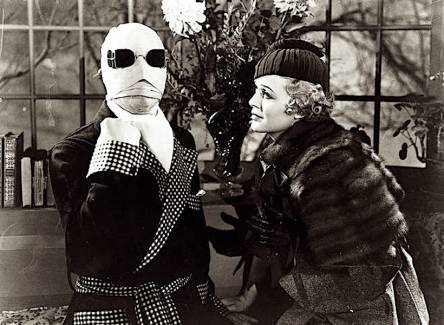
In 1931, James Whale began what is probably the best known part of his career as a producer. He signed a five-year contract with Universal Studios and received his first project, the 1931 drama-war romance film “Waterloo Bridge”, which starred actress Mae Clarke, who is remembered by many for playing Jame Cagney’s girl in “The Public Enemy”. Later in 1931, Carl Laemmie, Jr, the twenty-five year old head of Universal Studios, gave Whale his choice of which studio-owned property he wanted for his next shoot; Whale chose the script for “Frankenstein”. He casted Colin Clive as Henry Frankenstein and Mae Clarke as Elizabeth Frankenstein, Henry’s wife, and chose the little known Boris Karloff for the role of the Monster. Shooting ran from August 24th of 1931 to October 3rd. After premieres on October 29th of 1931, “Frankenstein” had a wide release beginning on November 21st and instantly became a hit with critics and the public.

In 1932, Whale directed two films: the drama “The Impatient Maiden” and a thriller film with Karloff and Charles Laughton entitled “The Old Dark House”, which has been credited with reinventing the “old house” genre of horror films. Whale’s 1933 film, “The Kiss Before the Mirror”, a pre-Code mystery film, received little notice and was a box-office failure. With a script approved by author H. G. Wells, Whale returned to the horror genre and produced the 1933 “The Invisible Man” which the New York Times placed in their list of best films for that year. This adaption of Well’s book, whose special effects were done in utmost secrecy, broke box-office records in cities across America.

James Whale’s next major project was the 1935 “Bride of Frankenstein”, a sequel to the original movie which he was initially reluctant to do for fear of being typecast as a horror director. The film, however, was a critical and commercial success; today it is regarded as the finest of all gothic horror movies and considered Whale’s masterpiece. Whale worked next on a comedy-mystery film entitled “Remember Last Night?” which resulted in divided reviews. After its completion, Whale started immediately on the project that had been in his mind for a long time, a film version of the stage production “Show Boat”. 

For the film version of this long-running romantic musical, Whale gathered as many members of the original show as he could; these included Paul Robeson, Helen Morgan, Sammy White, Irene Dunne, and conductor Victor Baravalle and orchestrator Robert Russell Bennett. Great care was taken by Whale to ensure a feeling of complete authenticity in the set and costume design for this film. Faithfully adapted from the original stage production, the 1936 “Show Boat” is considered the definitive film version of the musical by many critics. This film was the last of Whale’s films produced with the Laemmie family.

Jame Whale eventually retired from the film industry in 1941. Encouraged by his partner David Lewis to resume his artwork, he rediscovered his love of painting and built a studio for himself. In 1942, Whale made training films for the United States Army and created, in collaboration with actress Claire DuBrey, the theater group Brentwood Service Players. He returned to Broadway to direct the 1940 thriller “Hand in Glove” and directed his final film, a short subject entitled “Hello Out There”. Whale’s last professional engagement was the comedy play “Pagan in the Parlour”, which was forced to close early due to contract difficulties that happened during its opening tour in Europe.

While in Europe, Whale met and became infatuated with the twenty-five year old bartender Pierre Foegel. He made the decision to bring Foegel back to the United States as his chauffeur. In November of 1952 when David Lewis heard this, he ended their twenty-three year relationship, separated but still maintained a friendship. Foegel moved in with Whale in early 1953, returned for several months to France, and then in 1954  moved back permanently with Whale. In the spring of 1956, Whale suffered a small stroke, and was hospitalized several months later after suffering a second and more severe stroke. As his mental faculties were diminishing, he began to suffer from mood swings and depression. 

James Whale committed suicide, at the age of sixty-seven, by drowning himself in his Pacific Palisades swimming pool on the 29th of May in 1957. He left a suicide note to David Lewis, who withheld it from the public until his own death. Whale was cremated per his request and his ashes were interred in the Columbarium of Memory at Forest Lawn Memorial Park in Glendale, California. When David Lewis died in 1987, James Curtis, as his executor, had Lewis’s  ashes interred in a niche across from Whale’s internment site. James Curtis would later write the definitive biography of Whale, “James Whale: A New World of Gods and Monsters”, published in 2003.

Note: James Whale lived as an openly gay man throughout his career in the British theater and in Hollywood, which was virtually unheard of in that era. While he did not go out of his way to publicize his homosexuality, he made no effort to conceal it either.

Top Insert Image: Photographer Unknown, “James Whale” (Profile), circa 1930, Cream-Toned Vintage Print, 23.7 x 18 cm, National Portrait Gallery, Washington, DC

Second Insert Image: Arthur Edeson, “Colin Clive and Boris Karloff”, 1931, Film Shot from “Frankenstein”, Director James Whale, Universal Pictures

Third Insert Image; Arthur Edeson, “Claude Rains and Gloria Stuart”, 1933, Film Shot from “The Invisible Man”, Director James Whale, Universal Pictures

Fourth Insert Image: Photographer Unknown, “James Whale”, Date Unknown, Studio Photo Shoot, Universal Pictures

Fifth Insert Image: John J. Mescall, “Paul Robeson, Irene Dunne, Hattie McDaniel, and Helen Morgan”, 1936, Film Shot from “Showboat”, Director James Whale, Universal Pictures

Bottom Insert Image: Photographer Unknown, “James Whale”, circa 1930, Cream-Toned Vintage Print, 23.7 x 18 cm, National Portrait Gallery, Washington, DC

Carl Phillips: “To Sing a Song of Water”


Photographers Unknown, To Sing a Song of Water

Archery

           was still a thing, then. To have timed your arrow
perfectly meant watching the air for a moment
seem stitched throughout with a kind of
timelessness. To have straddled at last, correctly,
the storm of falling in love (and staying there) meant
the smell of apples, victory, tangerines, and smoke
all mixed together on the breath

of a stranger, half asleep still, just beginning to remember a bit,
as he stirs beside you. I dreamed we were young again,
he’s mumbling, as if to someone whose name he’s known
long enough to have called it out more than once in anger
and sex and fear equally. Somewhere happiness too,

right? All those hours spent trying to outstare the distance
of what the days must come to,

and pretending a choice to it: now the shadow-script
that willows and hazel trees mark the barn’s western
face with; now the wind-rippled field, like a lesser version—tamer,
tameable—of the sea, for movement (same infinite
pattern, and variation; randomness and intention; release;
restraint—that kind of movement) …

                                                         Dear saddle
of gentleness. Dear moss, sweet moss that only
the dark and wet and patience make possible. To sing a song
of  water, and not drown in it. And some calling that
a good trick. And some calling it

mastery. That last flickering before nightfall. From beneath
the low branches. I dreamed we were new again. Stars. Just a little
past dusk.

Carl Phillips, Archery, 2020

Born in Everett, Washington, in July of 1959, Carl Phillips is an American poet and writer. The child of a military family which changed residences year to year, he spent his teenage years in Cape Cod, Massachusetts. Phillips earned his Bachelor of Arts from Harvard University, where he studied Latin and Greek. He next earned a Master of Arts in Teaching from the University of Massachusetts, and his Master of Arts in Creative Writing from Boston University. 

Phillips first began to write poetry in his teenage years, a time during which he constructed a world of his own that he could rely on. After entering Harvard University, he did not write any poetry for a long time; however, in 1990 after coming to terms with his identity as a gay man, Phiilips rediscovered his voice as a poet. A classicist by his formal training, he draws allusions to classical art, music and literature in his poems through the use of metaphors and associative words. His poems are often presented in a narrative form which is emphasized through the use of spaced pauses, italics, hyphens, ellipsis, and parentheses. 

Phillips published his first collection of poems, “In the Blood”, in 1992. This collection of love poems and poems based on Greek mythology and Christian iconography won the Samuel French Morse Poetry Prize. His second book, the 1995 “Cortège”, a collection which explores desire and the various points at which spirit and flesh intersect, was nominated tor the National Book Critics Circle Award and the Lambda Gay Men’s Poetry Award.

Carl Phillips’s collections, the 2000 “Pastoral” and the 2001 “The Tether”, winner of the Kingsley Tuft Poetry Award, were both well received by the critics. His seventh book, the 2005 “The Rest of Love”, examined the conflict between belief and disbelief and our ability to face up to hard truths. This collection won the 2005 Thom Gunn Award. Phillips’s recent work includes “Speak Low”, a 2009 work that was a finalist for the National Book Award; the 2011 “Double Shadow” which won the Los Angeles Times Book Prize for Poetry; and the 2013 “Silverchest” which was nominated for the Griffin Prize. His thirteenth collection of poems, the 2015 “Reconnaissance”, was nominated for an NAACP Image Award for Best Poetry and won the Lambda Literary Award and the PEN Center USA Award.

Carl Phillips has also published works of criticism; two collections of essays puvlished by Graywolf Press include the 2004 “Coin of the Realm”Essays on the Life and Art of Poetry” and the 2014 “The Art of Daring: Risk, Restlessness, Imagination”. 

Carl Phillips previously taught Latin in public schools for eight years before becoming Professor of English at St. Louis’s Washington University, where he also teaches creative writing. He was elected a chancellor of the Academy of American Poets in 2006 and has served as the judge for the Yale Series of Younger Poets since 2011. Phillips received an Award in Literature form the American Academy of Arts and Letters, the Academy of American Poets Prize and a Pushcart Prize. 

Note: Carl Phillip’s 1995 poem, “Cortège”, was actually my first choice for the poem to be included with his biography; however, the poem in its full form was too lengthy for this posting. For those interested in reading this poem, I offer this link: https://www.poetryfoundation.org/poems/47856/cortege-56d228a1cf7ae

Richard Blanco: “Burning in the Rain”

Photographers Unknown, Parva Scaena (Brief Scenes): Photo Set Twenty-Six

Someday compassion would demand
I set myself free of my desire to recreate
my father, indulge in my mother’s losses,
strangle lovers with words, forcing them
to confess for me and take the blame.
Today was that day: I tossed them, sheet
by sheet on the patio and gathered them
into a pyre. I wanted to let them go
in a blaze, tiny white dwarfs imploding
beside the azaleas and ficus bushes,
let them crackle, burst like winged seeds,
let them smolder into gossamer embers—
a thousand gray butterflies in the wind.
Today was that day, but it rained, kept
raining. Instead of fire, water—drops
knocking on doors, wetting windows
into mirrors reflecting me in the oaks.
The garden walls and stones swelling
into ghostlier shades of themselves,
the wind chimes giggling in the storm,
a coffee cup left overflowing with rain.
Instead of burning, my pages turned
into water lilies floating over puddles,
then tiny white cliffs as the sun set,
finally drying all night under the moon
into papier-mâché souvenirs. Today
the rain would not let their lives burn.

Richard Blanco, Burning in the Rain, Looking for the Gulf Motel, 2012

Born in February of 1968 in Madrid, Spain, Richard Blanco is an American poet, author, and a public speaker. The son of a Cuban-exile family, he spent his early years in Miami and earned a Bachelor of Science in Civil Engineering and a Master of Fine Arts in Creative Writing from Miami’s Florida International University. In addition to his profession as a practicing civil engineer, Blanco has been a writer and poet since 1991.

As a professor, Blanco has taught at several universities, including American University, Georgetown University, Wesleyan University, Central Connecticut State University, and Colby College in Maine; he is currently a Distinguished Visiting Professor at Florida International University. Blanco also teaches poetry at such diverse institutions as grade schools, nursing homes, writers workshops, correctional institutions, and non-profits such as the Writer’s Center located in Maryland.

Richard Blanco’s first book of poetry, the 1998 “City of a Hundred Fires” received critical acclaim and won the Agnes Lynch Starrett Poetry Prize from the University of Pittsburgh Press. This collection of poems explored his coming of age as a Cuban-American in Miami and the transformation he experienced after his first trip back to his homeland of Cuba. Between 1999 and 2001, Blanco traveled extensively through Europe, South America, and the New England area of the United States. This experience resulted in his second poetry collection, “Directions to the Beach of the Dead” published in 2005, which explored the familiar but unsettling journey for home and connections. This collection of narrative lyric poetry was the winner of the American Beyond Margins Award from PEN International.

Blanco’s third book of poetry, the 2012 “Looking for the Gulf Motel”, explored how his family’s emotional legacy has shaped and continues to shape his perspectives. Divided in three sections, the collection discusses questions of cultural identity, the blurred lines of gender, the father-son relationship, identity as a Cuban-American gay man living in rural Maine, the experience of exile, and one’s impermanence in the world. Poems in this collection include “Burning in the Rain”, seen above, and  “Queer Theory, According to My Grandmother”, a skeptical look at the admonishments made by his conservative generation of elders against being perceived as gay. 

Richard Blanco’s “Looking for the Gulf Motel” won the Thom Gunn Award, the Maine Literary Award, and the Paterson Poetry Prize. He  followed this collection with the poem “Boston Strong”, recited as the opening to the Boston Strong Concert, a benefit concert to assist the families of the victims who were killed and to help the people most affected by the tragic events during the April 2013 Boston Marathon. A commemorative chapbook of Blanco’s poem was published in 2013 with all the proceeds going to the Victim Relief Fund of The One Fund Boston to help those affected.

On January 8, 2013, Richard Blanco was named the Inaugural Poet of the United States for Barack Obama’s second presidential inauguration. Blanco was the first immigrant, first Latino, and first openly-gay person to be an inaugural poet. He performed “One Today”, an original poem he wrote for the occasion; this poem was meant to reconfirm the nation’s collective identity in a time of tragedy. In November of 2015, it was published in book form as “One Day” with drawings by David “Day” Pilkey, an award-winning illustrator of books for children. 

In addition to his poetry collections and performances around the world, Blanco has published two memoirs, the 2013 “For All of Us, One Today” and the 2014 “The Prince of Ios Cocuyos”, which won the Maine Literary Award and the Lambda Literary Award for Gay Memoir. He wrote the forward and poems to accompany a series of vintage photographs of Cuba for the 2014  “Cuba Then: Rare and Classic Images from the Ramiro Fernandez Collection”, a collection of three hundred vintage photos from one of the largest archives of Cuban photography in the world. Blanco also collaborated with landscape photographer Jacob Bond Hessler on his 2017 “Boundaries”. This collection of poems and photographs challenged the physical, imagined and psychological boundaries of race, gender, class,  and ethnicity that divide the American nation.

Richard Blanco was appointed as a founding member of the Obama Foundation Advisory Counsel and has lectured at the U. S. National Archives. He is a member of the prestigious Macondo Writers Workshop, an association of socially-engaged master’s level writers. Richard Blanco and his partner currently live in Maine. 

John Harris: “I Too Found the Inner Chamber”

Photographers Unknown, I Too Found the Inner Chamber

The Government hated
all secret rites and ceremonies,
for they hinted at treason.

And so, in Catholic households,
there would be an innermost room,
behind a hidden door,
where the family knelt for Mass,
hoping they wouldn’t be burned alive
by agents and spies of the King.
Victimae paschali
the countertenors would sing,
their strange, angelic voices weaving through
the settings of William Byrd.

I too
found the inner chamber.
With my high, forbidden voice,
How could I not?

When your ears are opened
you hear the secret music.

And soon you are singing.

John Harris, Listening to William Byrd (d. 1623)

Born in Bolenowe in October of 1820, John Harris was a Cornish poet. The eldest of nine children, he was raised in a two bedroom cottage situated on the slopes of his village located in the historic and ceremonial county of Cornwall, one of the Celtic nations. 

At the age of twelve, Harris followed his father into the Dolooath copper and tin mine where they both worked as miners. This became his occupation for twenty years, during which he endured heavy labor and  began to produce poetry celebrating his native landscape. Not able to afford pen and paper, Harris’s poems describing the villages and peninsular landscapes of southern-most Cornwall were written on grocery wrapping paper with blackberry ink. 

In the 1840s, John Harris married Jane Rule, with whom he had two daughters and two sons. After one of his poems was published in a magazine and received favorable notice, he was able in 1853 to publish his first poetry collection. Following the early death of his second-born daughter Lucretia during Christmas of 1855 and through the assistance of a friend, Harris found an occupation as a traveling Bible-reader and comforter at southern Cornwall’s coastal parish of Falmouth where he would spend the remainder of his life.

While living in Falmouth, Harris produced several volumes of poetry and, in 1863, wrote what is considered his most important work, “A Story of  Carn Brea”. This descriptive poem expressed the special childhood link Harris had with the ancient Celtic site, home to Carn Brea Castle and the Bassett Monument. Through the Earl of Beaconsfield, Harris received a two-hundred Pound grant from the Royal Bounty Fund, which was followed in September of 1881 by a one-hundred Pound grant from the prime minister for service to the state. John Harris died in Falmouth on the 7th of January of 1884, at the age of sixty-three. As to his dying request, he was buried at Treslothan Chapel at the foot of Carn Brea hill. 

Notes: A biography entitled “John Harris, the Cornish Poet: The Story of His Life” was written by his son John Howard Harris and published by Oxford University in 1884; this biography was republished by Franklin Classics in 2018. Harris’s poems can be found in the 1977 collection entitled “ Songs from the Earth: Selected Poems of John Harris, Cornish Miner, 1820-24”, published by Lodenek Press. 

Several poems by John Harris can be found at the John Harris Society’s online site located at:  https://www.johnharrissociety.org.uk/poetry

Many thanks to a great source of LBGTQ literature and biographies,The Gay and Lesbian Review (G&LR), for John Harris’s poem “Listening to William Byrd (d. 1623)”.