Mime Misu: Film History Series

Mime Misu, “In Nacht und Eis (In Night and Ice)”, 1912, Written and Directed by Mime Misu, Film Runtime 42 Minutes, Continental-Kunstfilm, Berlin, Germany,

Remastered with English Subtitles and Score by Swiss Composer Christophe Sturzenegger

Born in January of 1888 at the county seat of Botosani in the northern part of Romania, Misu Rosescu was a pantomime artist, ballet dancer, film actor and director. He was nephew to the prominent writer Rahel Levin Varnhagen whose home became a center for the intellectual and political figures of German culture. Born into a family of musicians, artists and performers, Rosescu made his stage debut as a child performing ballet and pantomime.

Rosescu’s many talented performances were recognized and gained him free entrance into the Bucharest Art Academy. During his studies, he was assigned to the Royal National Theatre in the capital city of Bucharest. After his graduation with honors, Rosescu began a successful career appearing in theatrical performances at the provincial theaters of Romania. After his performance at the 1900 World Fair in Paris, Rosescu established his own theatrical production company and toured Berlin, Budapest, Vienna and London. 

Misu Rosescu, now using the name Mime Misu, entered into the growing film industry. In Paris, he was initially employed by Lux, a film production company located in the 14th arrondissement, and later at Pathé Frères which was becoming the world’s largest film equipment and production company. In 1912, Misu signed with Berlin’s newly established Continental=Kunstfilm which had just begun to release a mix of comedies, melodramas and documentaries. mis

Through Continental-Kunstfilm, Mime Misu wrote and directed three films in his first year. The 1912 silent film “Das Gespenst von Clyde (The Ghost of von Clyde)” was a media story of Count Arthur Hamilton who died in the British Castle of Clyde under mysterious circumstances. Misu’s 1912 “In Nacht und Eis (In Night and Ice)” was a silent adventure-disaster film depicting the recent sinking of RMC Titanic. Having achieved some success with his drama-documentary narrative style, Misu made the 1912 “Das Mirakel (The Miracle)”. Based on the thirteenth-century temptation legend of Sister Beatrice, the film later appeared under the title “Das Marienwunder: Eine alte Legende (The Miracle of Mary: An Old Legend)” due to legal rulings in the United Kingdom and the United States.

Misu made one more film in Germany, the 1913-1914 “Der Excentric Club”, for Projektions-AG Union, a Frankfurt film production company that soon moved to Berlin, the new center of the German film industry. He traveled to the United States where he made one film, the 1914 “Money God”, under his personal production company Misugraph-Film. Lacking support in the United States just as the First Great War began, Misu returned to Europe and settled with his new wife, Bertha, in Berlin’s inner-city district of Wilmersdorf. In 1915, he directed in the Netherlands his last film, a disaster film of a sinking ship entitled “Ontmaskerd (Unmasked)”; the credits list his birth name, Misu Rosecu, as director.

Mime Misu traveled to the United States every year from 1915 to 1917. He maintained office space in Berlin for his production company Misugraph-Film until 1921. There is, however, no record of any artistic activity from 1915 to 1921. In 1921, Misu apparently misrepresented himself as to his involvement with the Famous Players Film Company, a film venture owned by Paramount Pictures’ founder Adolph Zukor. This led to the publishing of their exchanged letters in Berlin’s film journal Fil-Kurier. An accomplished stage performer and director of six films, (Mime) Misu Rosescu died in Antwerp, Belgium in the summer of 1953. 

Among the films in his career, Mime Misu’s best known work is the 1912 “In Nacht und Eis’, the earliest surviving film depiction of the RMS Titanic disaster. Camera work was done by Willy Hameister, Emil Schünemann and Victor Zimmermann. Most of its footage was shot in a glasshouse studio inside the courtyard of Continental-Kunstfilm’s offices at 123 Chausseestrasse. Other footage was shot in Hamburg and, possibly, aboard the Hamburg-docked German ocean liner Kaiserin Auguste Victoria. 

At a running time of thirty-five minutes, “In Nacht und Eis” was shot in black and white with various scenes tinted to increase their impact. The film starred actors Waldemar Hecker as the telegrapher, Otto Rippert as the Captain, and Ernst Rückert as the First Officer. The Berlin Fire Department provided the flood waters necessary for the scenes of the Titanic’s sinking. “In Nacht und Eis” was considered a lost film until February of 1998. At that time, the German film archivist Horst Lange, after reading an article discussing this loss, informed the newspaper that he possessed a print of the film.

Note: The above video of “In Nacht und Eis” is from the Titanic Officers site which contains a multitude of articles on the ship’s officers and other aspects of the Titanic and its sinking. The Titanic Officers website can be found at: https://www.titanicofficers.com/articles.html

For those film buffs who are purists, there is a restored silent version, sans soundtrack, on the Internet Archive. This slightly shorter film with a runtime of thirty-four minutes is located at:  https://archive.org/details/silent-in-nacht-und-eis

Top Insert Image: Mime Misu, “Das Mirakel”, 1912, Publicity Photo on Cardstock

Bottom Insert Image: Mime Misu, “In Nacht und Eis”, 1912, (Otto Rippert and Ernst Rüchert) Film Clip Photo

Corrado Cagli: “The Battle of San Marino”

Corrado Cagli, “The battle of San Marino”, 1936, Encaustic Tempera on Hollow-Core Wood, 545 x 651 cm,  Uffizi Gallery, Florence 

Born in the city of Ancona in February of 1910, Corrado Cagli was an Italian painter of Jewish heritage. Little information on his formative years is available; however, it is known that, at the age of five, his family relocated to Rome. Cagli grew up in a largely assimilated secular family, who had come to terms with its Jewish religion as antisemitism became more aggressive in Fascist Italy. His ties to his Italian heritage were always strong; even in his later years of exile from Italy, it was important for him to maintain a tie with his birth nation. 

Corrado Cagli helped organize the Gallleria La Cometa in Rome and, along with poet Libero De Libero, created an artistic circle of musicians, writers, architects, painters and sculptors. He was involved with New York’s Museum of Modern Art’s 1949 exhibition, “20th Century Italian Art” and facilitated the 1950 opening of the Catherine Viviano Gallery in New York City. Cagli was awarded the Guggenheim Prize in 1946 and, in 1954, the Marzotto Prize, given by the Marzotto fashion company for his contributions to the cultural rebirth of Italy after the war. Corrado Cagli died in Rome in 1976.

Corrado Cagli’s “Battle of San Marino” depicts the final battle of the Second War of Independence in which the Piedmont army, directed by King Vittorio Emanuele and supported by the French troops of Napoleon III, defeated in a fierce battle the Austrian forces commanded by Emperor Franz Joseph I. The battle is considered the founding moment of the Italian Risorgimento, the period leading to unification and the formation of the new state of Italy. 

The battle scene, depicted from a bird’s eye perspective, with the hectic confusion of weapons, horses, infantry and knights crushed together amid the surrounding hillsides, clearly highlights Cagli’s relationship with traditional painting styles, with influences ranging from Paolo Uccello to Piero della Francesca. Owned by Francesco Muzzi, secretary of the Cagli Foundation, and graciously loaned to the Uffizi in 1978, it was finally donated to the Uffizi Gallery in 2003.

Note: An interview between author Raffaele Bedarida and Alessandro Cassin, Director of Centro Primo Levi, entitled “Corrado Cagli, the American Years” can be found online at Printed_Matter located at: http://primolevicenter.org/printed-matter/corrado-cagli-the-american-years/

John Warner Barber: “Death of Capt. Ferrer”

John Warner Barber, “The Death of Capt. Ferrer”, 1840, Etching, Frontpiece from the “A History of the Amistad Captives”, Unfolded 22.9 x 49.3 cm, Partially Hand-Colored, Private Collection 

Born in East Windsor, Connecticut in February of 1798, John Warner Barber was an engraver and historian whose books of local, state, and national history featured his colorful  illustrations. He learned his craft as an apprentice to East Windsor printmaker Abner Reed, who also was a bank note engraver for the United States and Canada. In 1823, Barber opened a business in New Haven, where he printed religious and historical books, illustrated with his own steel and wood engravings. 

Barber traveled throughout Connecticut, creating ink sketches of town greens, churches, hotels and harbors; he also researched local histories on his travels. From his research, Barber produced in 1836 what is considered the first popular local history book published in the United States, the “Connecticut Historical Collections, Containing a General Collection of Interesting Facts, Traditions, Biographical Sketches, Anecdotes, Etc. . .”. His pencil sketches were developed into more detailed wash drawings, which in turn were transferred directly to small blocks of boxwood on which he engraved the designs. The book sold well, seven thousand copies in the first year at a cost of what was then an average week’s pay.

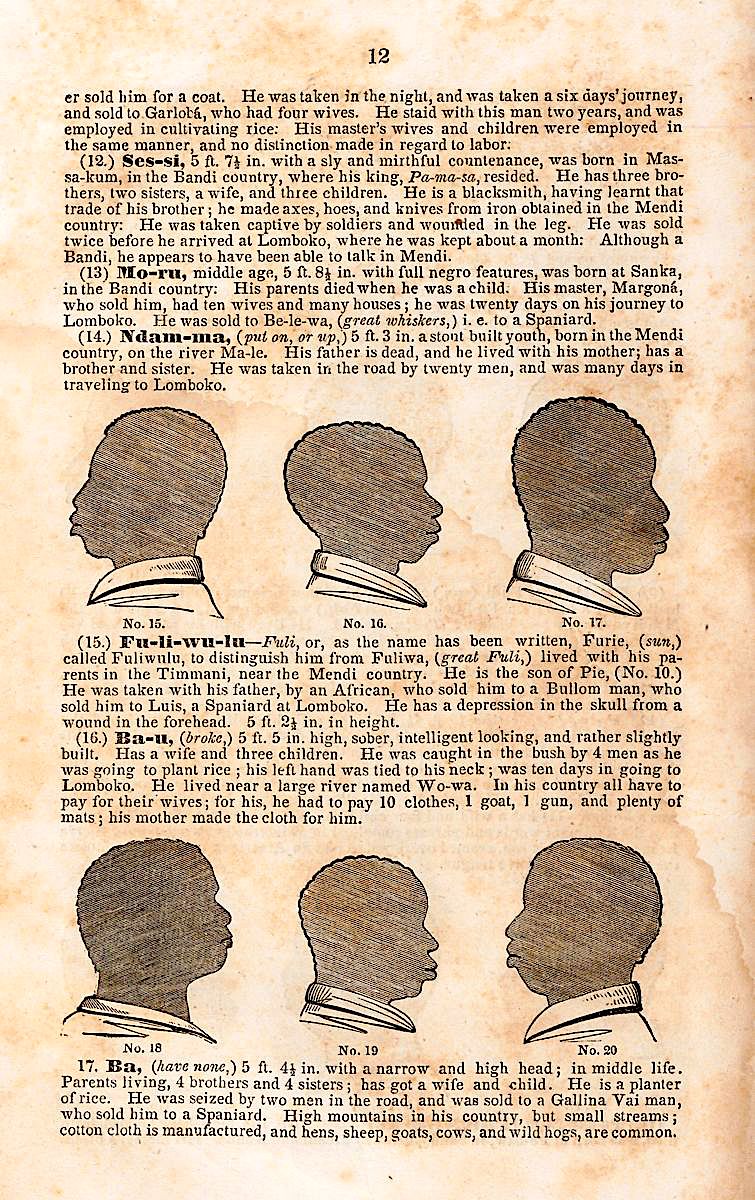
In 1840, John W. Barber produced his thirty-two page “ A History of the Amistad Captives: Being a Circumstantial Account of the Capture of the Spanish Schooner Amistad, by the Africans on Board; Their Voyage, and Capture Near Long Island, New York; with Biographical Sketches of Each of the Surviving Africans, Also, an Account of the Trials , , , Compiled from Authentic Sources”. Documenting one of the most important events of its time, Barber’s  book was published the same year of the Amistad trial and its ruling by the New Haven court.

In February of 1839, Portuguese slave hunters abducted hundreds of Africans from what is now present-day Sierra Leone and transported them to Cuba, then a Spanish colony. Spanish plantation owners Pedro Montes and Jose Ruiz purchased fifty-three of the African captives as slaves, forty-nine adult males and four children. On June 28th, Montes and Ruiz with the African captives set sail from Havana on the Amistad, Spanish for ‘friendship’, for their plantations on Puerto Principe.

Several days into the journey, Sengbe Pieh, one of the Africans also known as Joseph Cinque, managed to unshackle himself and his fellow captives. Armed with knives, they seized control of the Amistad and killed the Spanish captain and the ship’s cook. In need of navigation, the Africans ordered Montes and Ruiz to return to Africa; however, the two men  changed the ship’s course in the middle of the night, sailed through the Caribbean and up the eastern coast of the United States. 

On August 26th of 1839, the U.S. Navy brig Washington found the ship anchored off the coast of Long Island to get provisions. The naval officers seized the Amistad, put the Africans back in chains, and escorted the ship to Conneticut, where they would claim salvage rights to the ship and its human cargo. Originally charged with murder and piracy, Cinque and the other Africans were imprisoned in New Haven. Though the charges were dropped, they remained in prison while the courts decided their legal status, as well as the competing property claims by the Washington’s officers, Montes and Ruiz, and the Spanish government. 

In January of 1840, a judge in U.S. District Court in Hartford ruled that the Africans were not Spanish slaves, but had been illegally captured, and should be returned to Africa. After appealing the decision to the Circuit Court, which upheld the lower court’s decision, the U.S. attorney appealed to the Supreme Court, which heard the case in ealry 1841. 

On March 9, 1841, the Supreme Court ruled seven to one to uphold the lower courts’ decisions in favor of the Africans of the Amistad. However, the court did not require the government to provide funds for the Africans’ return voyage, but did award salvage rights for the Amistad to the officers who apprehended it. In November of 1841 after abolitionists raised money for the return voyage, Cinque and the surviving thirty-four Africans of the Amistad, the others either died at sea or in prison awaiting trial, sailed from New York aboard the ship Gentleman to return to their homeland.

James Warner Barber attended the court hearings between January 7th and 13th in 1840 when Judge Andrew Johnson rule that the Africans were illegally transported to Cuba, and thus would not be returned to Montes and Ruis. On the first of April, Barber began drawing the Amistad Africans in jail and, over the next two months, would create drawings and engravings to illustrate his book. Barber drew portraits, from which he engraved silhouettes of the Africans, and added other illustrations to his book, including a map of the Mendi country, home of the Amistad Africans.

British Pathé, “RMS Titanic”: Film History Series


Artist Unknown, Titanic Moored at Dock, Gifs, British Pathé, 1912

These three colorized gifs were taken from the beginning of a film, jointly owned by British Pathé and Gaumont Newsreels, containing known footage of the R.M.S. Titanic. Slightly different versions of this film are held by British Movietone and the National Film and Television Archive.

The three gifs depict the Titanic moored, probably on April 2nd of 1912, at the Thompson Graving Dock on Queen’s Island in Belfast, where the RMS Titanic was fitted out. In these shots, men can be seen walking beside the ship and smoke is seen issuing from the third funnel of the Titanic.

The British Pathé’s newsreel, just over six minutes in length,  covers several episodes in the story of the RMS Titanic’s final days. The captain of the RMS Titanic, Edward J. Smith, who perished when the ship sank, is shown on board the RMS Olympic, before assuming duty on the Titanic. Newsreel footage of icebergs and ice floes are shown to portray the scene of the disaster. Scenes of the rescue ship, Carpathia, nearing New York City with survivors, and scenes of the departing search and rescue vessel, Mackay Bennet, also are included in this Pathé footage.

At the forefront of cinematic journalism, British Pathé was a producer of newsreels and documentaries from 1910 to 1970 in England. The company blended information with entertainment for movie theater attendees who came to watch the news. Over the course of its sixty years, it documented everything from major armed conflicts and international political crises to the curious hobbies and eccentric lives of ordinary people.

British Pathé’s roots lie in 1896 Paris, France, when Société Pathé Frères  was founded by Charles Pathé and his brothers, who pioneered the development of the moving image. In 1908, the company invented the cinema newsreel with its introduction of the Pathé-Journal and opened a newsreel office on Wardour Street, London, in 1910. These early silent  newsreels, issued every two weeks and running about four minutes in length, were shown in local theaters; sound was introduced beginning in 1928. The Pathé newsreels captured events such as suffragette Emily Danison’s fatal injury by a racehorse at the 1913 Epsom Derby and Franz Reichelt’s fatal descent by parachute from the Eiffel Tower in February of 1912.

Considered now to be the finest newsreel archive in the world, British Pathé is a treasure trove of eighty-five thousand films unmatched in their historical and cultural significance. The company also represents the Reuters historical collection, which includes more than one hundred thirty-six thousand items from the following news agencies: Gaumont Graphic, active from 1910 to 1932; Empire News Bulletin, a film library from 1926 to 1930;  British Paramount,  a collection spanning from 1931 to 1957; and Gaumont British’s collection  from 1934 to 1959. Included in Pathés vast library of film is the collected content from the Visnews service active from 1957 until the end of 1984.

The full footage of British Pathé’s Titanic black and white newsreel can be found at: https://www.youtube.com/watch?v=05o7sOAjtXE

All footage can be viewed on the British Pathé website. https://www.britishpathe.com/

Calendar: December 24

A Year: Day to Day Men: 24th of December

Namor the Sub-Mariner: Homo Mermanus

On December 24, 1851, a fire burns 35,000 volumes at the United States Library of Congress.

As Americans celebrated Christmas Eve, 1851, a fire ripped through the US Library of Congress in Washington, DC, destroying 35,000 volumes. A faulty chimney flue set off the blaze, which took two-thirds of the collection, including most of Thomas Jefferson’s personal library that had been sold to the institution in 1815.

Initially established in 1800 when President John Adams approved legislation that appropriated $5,000 to purchase “such books as may be necessary for the use of Congress” — the first books, ordered from London, arrived in 1801. They were stored in the U.S. Capitol. Twelve years later, the British army invaded the city of Washington and burned the Capitol, including the 3,000-volume Library of Congress. Jefferson responded to that loss by selling his personal library of 6,487 volumes — the largest and finest in the country — to Congress to “recommence” the library.

After the fire of 1851, architect of the Capitol Thomas U. Walter presented a plan to repair and enlarge the Library room using fireproof materials throughout. The elegantly restored Library room was opened on August 23, 1853. Called by the press the “largest iron room in the world,” it was encircled by galleries and filled the west central front of the Capitol. A month before the opening, Pres. Franklin Pierce inspected the new Library in the company of British scientist Sir Charles Lyell, who pronounced it “the most beautiful room in the world.”

The current collection consists of more than 164 million total items: more than 38 million books and other printed materials, 3.6 million recordings, 14 million photographs, 5.5 million maps, 8.1 million pieces of sheet music and 70 million manuscripts. It also has 5,711 incunabula (early printed books before 1501) and 122,810,430 items in the nonclassified (special) collections. Although the Library is open to the public, only high-ranking government officials and Library employees may check out books and materials (except through interlibrary loan, which is available to the public.

Calendar: December 4

A Year: Day to Day Men: 4th of December 

Lost in Thought

On the fourth day of December in 1872, the American-registered merchant brigantine, Mary Celeste, was discovered adrift and deserted in the Atlantic Ocean off the Azores Islands. 

The Mary Celeste was built in Spencer’s Island, Nova Scotia, and launched in 1861 under British registration as the “Amazon”. Seven years later, she was transferred to American ownership and renamed the “Mary Celeste”. She was a brigantine, a two-masted sailing vessel with a fully square-rigged foremast and at least two sails on her main mast: a square topsail and a gaff sail behind the mast. The Mary Celeste had a single deck, tonnage of 198.42 gross tons and a length of 30.3 meters. After her salvage in 1872, the Mary Celeste was rebuilt with a second deck and  additional depth; her tonnage was increased to 282.28 gross tons. 

In October of 1867, the “Amazon” was driven ashore during a storm and was so badly damaged that her owners abandoned her as a wreck. She was eventually acquired by a New York mariner Richard Haines who restored her and registered with the Collector of the Port of New York as an American vessel named “Mary Celeste”. The ship was seized by Haines’s creditors and sold to a consortium headed by James H. Winchester. Early in 1872, the Mary Celeste underwent a major refit which enlarged her considerably. 

In October of 1872, Captain Benjamin Spooner Briggs took command of the Mary Celeste for her first voyage following her extensive refit. As the voyage was to Genoa, Italy, Briggs arranged for his wife and infant daughter to accompany him, but left his school-aged son in the care of his grandmother. Satisfied with his ship and crew, the Mary Celeste was loaded on the twentieth of October with a cargo of seventeen-hundred barrels of alcohol. On November 5th, the ship left the pier with Briggs, his wife and daughter and seven crew members. 

On November 15th in 1872, the Canadian brigantine “Dei Gratia” left New York harbor with a cargo destined for Genoa, Italy. She followed the same general route as the Mary Celeste, only eight days behind. On December 4th at a point midway between the Azores and the coast of Portugal, the helmsman of the Dei Gratia reported a vessel with an odd set to her sails heading erratically towards their ship. Seeing no one on deck and receiving no replies to their signals, Captain Morehouse sent the first and second mates to investigate. The ship was deserted, the sails poorly set with some missing, and much of the rigging was damaged.

While the main hatch was secure, the other hatches of the Mary Celeste were open with the covers on deck. The ship’s single lifeboat was gone and the glass cover of the ship’s compass was shattered. There was a meter of water in the hold but that was not an alarming amount for the size of the vessel. The last entry in the daily log was November 25th, nine days earlier. While personal items in Captain Brigg’s cabin was scattered, gallery equipment was neatly stowed and there were ample provisions in the stores. With no signs of fire or violence, the missing lifeboat indicated an orderly departure from the ship. 

Captain Morehouse divided his crew of eight men to sail the Mary Celeste and the Dei Gratia to Gibraltar. The weather was calm but the progress, being under-crewed, was slow. A series of hearings were held at the Salvage Court in Gibraltar beginning in the middle of December. Various theories, based on testimonies from the Dei Gratia crew, were presented from mutiny and murder to conspiracy of fraud, due to the fact that the Mary Celeste was heavily over-insured. Fact and fiction became entwined over the decades with no determination as to the cause of the missing crew. At Spenser’s Island, the site of Mary Celeste’s original construction, a commemorative monument for her lost crew was erected as well as a memorial outdoor cinema theater. 

Calendar: November 24

A Year: Day to Day Men: 24th of November

One Facet of Life

November 24, 1639 marks the first known observation and recording of a transit of Venus.

By the 17th century, two developments allowed for the transits of planets across the face of the sun to be predicted and observed. One was the telescope of which the actual inventor is unknown; a patent for a refracting telescope was submitted in 1608 in the Netherlands by spectacle maker Hans Lippershey. Galileo heard about it, and in 1609 built his own version for observing celestial objects.

The second development was the new astronomy of Johannes Kepler, which assumed elliptical rather than circular orbits fro the planets. In 1627, Kepler published his “ Rudolphine Tables”, a star catalogue and planetary tables using some observational data collected by Danish astronomer Tycho Brahe. Two years later, Kepler published extracts from his tables concerning the transit of Mercury and of Venus for the year 1631. These occurred as predicted and were observed by several astronomers, vindicating Kepler’s approach to astronomical theory.

The first known observations and recording of the transit of Venus across the sun were made in 1639 by the English astronomers Jeremiah Horrocks and his friend and correspondent William Crabtree. These observations were made on November 24, under the Julian calendar then in use in England. This calendar was refined and gradually replaced by our Gregorian calendar initiated by Pope Gregory XIII, changing the observation date to December 4th of that year. Horrocks observed the event from the village of Much Hoole, Lancashire, and Crabtree, independently, observed the event from his home in Broughton, near Manchester.

Both men, followers of Kepler’s astronomy, were self-taught mathematical astronomers who methodically worked to correct and improve Kepler’s Tables by observation and measurement. In 1639, Horrocks was the only astronomer who realized that the transit of Venus was imminent; others became aware only upon receiving Horrocks’s report. The two men’s observations and later mathematical work were influential in establishing the size of the solar system. For their achievements, they are considered the founders fo British research astronomy.

Insert Image: Ford Madox Brown, “Crabtree Watching the Transit of Venus AD 1639”, 1883, Oil on Canvas, Manchester Town Hall, Manchester, England

Calendar: November 7

A Year: Day to Day Men: 7th of November

Fervor Doubled

On November 7, 1492, the Ensisheim Meteorite strikes a wheat field in Alsace, France.

Shortly before noon on November 7, 1492, a meteorite fell in a field just outside the walled city of Ensisheim in Alsace, France. The fall of the meteorite through the Earth’s atmosphere was observed as a fireball at a distance of up to 150 kilometres from where it eventually landed. The only witness was a young boy who saw the single stone punch itself a meter deep into what is now the rich soil of the eastern French countryside. It is the oldest meteorite impact with a confirmed date on record, and has become famous for its dramatic fall from the heavens, recorded for posterity by the Italian priest Sigismondo Tizio.

In an age when comets, shooting stars, and other celestial phenomenon remained unexplained, the appearance of the meteorite was quickly attributed to divine intervention. When the citizens of Ensisheim learned of the fall, many people wanted their own souvenir of the event in the form a fragment chipped from the main mass. As the crowds descended on the stone, the Chief Magistrate took charge and stopped further destruction. The stone was set at the door of the Ensisheim church where its fame was soon magnified.

On November 26th, the “King of the Romans” King Maximilian arrived in Ensisheim to consult privately with the stone. Several days later, Maximilian declared the meteorite to be a wonder of God, and then chipped off two small pieces of the stone, one for himself and one for his friend Archduke Sigismund of Austria. King Maximilian gave the stone back to the citizens of Ensisheim stating that it should be preserved in the parish church as evidence of God’s miracles. The meteorite was fixed to the church wall with iron crampons “to prevent it from wandering at night or departing in the same violent manner it had arrived” .

Today, the Ensisheim meteorite resides on display at the sixteenth-century Musée de la Régence in Ensisheim. It is now protected in the town; but over centuries,  visitors managed to chip off about 56 kg (123 pounds) of its original 127-kg mass. The Ensisheim meteorite is classified as an ordinary chondrite, the most abundant meteorite class, constituting more than 85 percent of meteorite falls.

Sebastian Brant, satirist and author of “Das Narrenschiff”, described the meteorite and its fall in the poem “Loose Leaves Concerning the Fall of the Meteorite”. Brant created broadsheets in Latin and German with a poem about the meteorite describing it as an omen. On the reverse side of Albrecht Dürer’s 1495 painting “Saint Jerome in the Wilderness” is an image of what appears to be a meteor/meteorite. It has been suggested that this might be the Ensisheim Meteorite.

Calendar: November 2

A Year: Day to Day Men: 2nd of November

He Says “Woof”

November 2, 1947 marks the first and only flight of the Hughes H-4 Hercules, known as the Spruce Goose.

In 1942, the U.S. War Department needed to transport war material and personnel to Britain. A requirement was issued for an aircraft that could cross the Atlantic with a large payload; however, because of wartime priorities, the aircraft could not be made from strategic materials such as aluminum. Henry J. Kaiser, a leading ship builder, teamed with aircraft designer Howard Hughes to create the largest aircraft ever built at that time.

The aircraft was designed to carry 150,000 pounds, 750 fully equipped troops, or two 30-ton M4 Sherman tanks. The final design was to be built mostly of wood to conserve metal, with its elevators and rudder covered with fabric. The construction of the first prototype, the HK-1, took sixteen months. Henry Kaiser, frustrated by the long delays and the restrictions on materials, decided to withdraw from the project.

Howard Hughes continued the program on his own, under a new contract limiting the production to one plane, now the H-4 Hercules. Work proceeded slowly and the H-4 was not completed until the war was over. The plane was built by the Hughes Aircraft Company using composite technology for the laminated wood construction. The finished plane was moved in three sections to Pier E in Long Beach, California, where a hanger was erected around it with a ramp to launch the H-4 into the harbor. In all, development cost for the plane was twenty-three million dollars, or more than ten times that in today dollars.

On November 2, 1947, with Howard Hughes at the controls, and a crew of seven, and fourteen invited guests, the Hercules picked up speed and lifted off. The Hercules remained airborne for 26 seconds at a height of seventy feet above the water and a speed of 135 miles per hour. At this altitude the aircraft still experienced ground effect. This brief flight proved that the now uneeded aircraft was flight worthy. The Hercules H-4 never flew again; its lifting capacity and ceiling height were never tested.

The Smithsonian’s National Air and Space Museum has the Hughes H-1 Racer and a section of theH-4’s wing. The Aero Club of Southern California acquired the Hercules H-4 aircraft in 1980, displaying it in a very large geodesic dome in Long Beach, California. The club later arranged for the aircraft to be given to the Evergreen Aviation Museum in Oregon where it is currently on display. The 315,000 square foot aircraft hanger where the Hercules H-4 was built, located in the Playa Vista neighborhood of Los Angeles,  is on the National Register of Historical Buildings.

Calendar: October 26

A Year: Day to Day Men: 26th of October

Slow Moving Water

October 26, 1825 marks the opening of the Erie Canal.

From the days of the birchbark canoe, the early trade routes of the Northeast utilized New York’s waterways. The Lake Champlain-Hudson River Route and the Lake Ontario-Oswego River-Mohawk River Route were utilized by native Americans, fur traders, missionaries and colonizers. The birchbark canoes used earlier were supplemented by longer heavier boats rowed or pulled by several men, which by 1791 was able to haul a two ton load.

In March of 1792, the Western Inland Lock and Navigation Company came into being and improved navigation on the Mohawk River. Also in that year, this company built small canals 3 feet deep with locks of 12 feet by 74 feet around the falls and rapids of the river. By 1796, Durham boats with capacities of 15-20 tons were able to navigate the route. Although business was brisk, maintenance on the wooden locks and channels depleted revenue and the operation folded a few years later.

In 1817 the Erie Canal was established under the management of a New York State Commission. Federal funds were not legislated; so this canal and all subsequent canals in New York State were built and maintained exclusively with state funds. The canal was dug from Albany to Buffalo, 4 feet deep and 40 feet wide, with stone locks 15 feet by 90 feet. The locks were the limiting factor on boat size and their efficiency of operation dictated the allowable traffic flow.

Additional canals were dug from the Hudson River to Lake Champlain, from Montezuma to Cayuga and Seneca Lakes and from Syracuse to Oswego. This canal system proved to be so successful that almost every community in the state lobbied for a link to the system, resulting in a network of canals. These lateral canals proved to be of marginal value at best:

In 1836, an enlargement program commenced on the main Erie Canal system. The canal was straightened a bit, the channel was increased in size to 7 feet by 70 feet, and the locks were enlarged to 18 feet by 110 feet. This permitted boats of much greater size on the Erie, Champlain, Cayuga-Seneca and Oswego canals, and further diminished the importance of the smaller lateral canals. Most of the lateral canals were closed by 1878 with only the Black River Canal lasting until the eventual close of the entire system in 1917.

The growth of steam power on the canal and steel boat construction eliminated the need for a waterway as protected as the old Erie Canal. A twentieth century canal of grand dimension with cast concrete structures and electronic controls was begun. This Barge Canal system, utilizing canalized rivers and lakes and enlarged sections of the original Erie Canal, opened in 1918. Several of the old routes are still utilized today.

Calendar: October 22

A Year: Day to Day Men: 22nd of October

The Bibliophile

October 22, 1797 marks the first parachute descent from a balloon in Paris.

Early inventors have been designing and testing parachutes since the seventeenth century. Croatian bridge designer Faust Vrancic constructed a device based on Da Vinci’s drawings. To demonstrate it, he jumped rom a Venice tower in 1617 wearing the rigid-framed parachute. He called it the Homo Volans, describing it in his published technical book “Machinae Novae”.

The French inventor Jean Pierre Blanchard was probably the first person to use a  parachute for an emergency. Blanchard claimed in 1793 to have escaped from an exploding hot air balloon by parachute. There were no eye witnesses to the event unfortunately. He did, however, develop the first foldable parachute made from silk.

Andre-Jacques Garnerin was a student of the ballooning pioneer professor Jacques Charles, a French scientist and mathematician. Garnerin was involved with the flight of hot air balloons, working with his older brother in most of his ballooning activities. He began to experiment with early parachutes based on umbrella-shaped devices.

Garnerin became the first person recorded to jump with a parachute without a rigid frame. His frameless parachute descent occurred on October 22 in 1797 at Parc Monceau, a public park in Paris. His parachute was made of silk in an umbrella-shape with a diameter of about ten meters. The umbrella was closed before he ascended, with a pole running down its center and a rope running through a tube in the pole, which was connected to the balloon.

Garnerin rode in a basket attached to the bottom of the parachute to a height of about 1000 meters. At this height, he severed the rope to the balloon. The balloon continued upwards, while Garnerin, in his basket with parachute, fell. The basket swayed violently on its descent, and landed roughly; but Garnerin emerged uninjured. Garnerin made multiple ascents and tests with his parachute at the Parc Monceau.

Andre-Jacques Garnerin was an avid balloonist, making many ascents in a balloon before large numbers of spectators. In 1798 he was the first to ascend with a woman as a passenger. There was much concern from officials regarding the possible ill effects of ascent on a woman and the moral implications of the such close proximity of the sexes. Nevertheless, the balloon trip was successful; and both Garnerin and passenger Citoyenne Henri arrived safely at their destination in Goussaninville about thirty miles north of Paris.

Calendar: October 15


A Year: Day to Day Men: 15th of October

Four Small Portraits

October 15, 1674 was the opening day of the witch trials held in Torsåker, a parish in Sweden.

The great wave of witch hysteria reached the parish of Torsåker, after the sensational trial of the alleged witch Märet Jonsdotter in central Sweden in 1668. Sweden’s Lutheran priests, at this time, were state-employed, causing them to follow the government’s instructions. These priests were ordered to use their sermons to inform their congregations of alleged crimes committed; rumors of witchcraft spread over the country. The priest of Torsåker parish, Laurnetius Christophori Hornæus, who was a man with a terrifying reputation, was ordered by a special commission of the government to perform an investigation.

The witnesses at the trial were mostly children, as the main accusations against the alleged witches was that they had abducted children on the sabbath of Satan. Hornæus had several methods to get the right testimonies from the children. He whipped them, bathed them in the ice cold water of hole in the lake’s winter ice, and put them in an oven, threatening to light the fire below and burn them. These acts were confirmed later in 1735 by Hornæus’ own wife, whose grandson added that these children, sixty years later, were still fearful of the priest, his grandfather.

On October 15, 1674, the witch trial of Torsåker began. About one hundred people of both sexes were accused by the children, making it the biggest witch trial in the country. The prisoners were kept in several different locations in the village, were given almost no food, but were allowed to receive food from their relatives. There is little existing records of the actual trial itself; however, it is known that seventy-one people were found guilty of witchcraft, sixty-five women and six men.

After the last sermon in the church of Torsåker, those found guilty were led to the place of execution, crying and protesting their innocence. Many fainted out of weakness and had to be carried to the middle of the parish, about half a mile from the parish churches, to a mountain area. There the prisoners were decapitated, shed of their clothes, and their bodies lifted on stakes. The stakes and additional wood were set on fire and the bodies burned.

Neither the commission or any local courts had the rights to conduct any execution. They were expected to report their sentences in any case to a higher court for confirmation before sentences could be carried out; the high court normally would confirm only a minority of the death sentences. In this case at Torsåker, no reporting was done and the prisoners were executed without any confirmation. No actions were taken against the commission which was defended by the town’s authorities.  In 1677, all the priests were ordered to tell their congregations that all witches had been expelled from the country forever in order to avoid further witch trials.

Calendar: October 6

A Year: Day to Day Men: 6th of October

The Trail Hiker

October 6, 1914 was the birthdate of Norwegian anthropologist and explorer Thor Heyerdahl.

Thor Heyerdahl began to study biology and geography at the University of Oslo in 1933. At the university he came in contact with Bjarne Kroepelien, who had traveled around Polynesia during the first World War. While living on Tahiti, Kroepelien fell in love with and married Tuimata, one of the daughters of a Tahitian chief, Tereiieroo.

The world-wide 1918 influenza pandemic struck Tahiti, resulting in the deaths of half of Tahiti’s population, including Tuimata. Bjarne Kroepelien subsequently amassed a unique collection of books on Polynesia, which he would years later bequeathed to the University of Oslo. Heyerdahl’s access to these books, as well as Kroepelien’s friendship with Chief Tereiieroo, would have a major impact on Heyerdahl’s life and career.

Thor Heyerdahl married Liv Coucheron Torp in 1936 and visited Tahiti, both sharing a desire to escape from Western civilization. Heyerdahl’s theory that indigenous South American peoples were the first to populate Polynesia took shape after he and Liv made several interesting discoveries on Fatu Hiva and the neighboring island of Hivoa. They stayed on Fatu Hiva for a year, before deciding to return to their native Norway.

Back in Norway, Heyerdahl began writing his scholarly work entitled “American Indians in The South Pacific”, which was published in 1952. His living on Fatu Hiva had instilled in Heyerdahl  an interest in how the remote Polynesian islands of the Pacific Ocean came to be inhabited; this question had been a defining topic in Pacific Ocean research for many years.

Heyerdahl was convinced that the first humans to reach Easter Island – and other islands in the eastern part of Polynesia – came from South America. He believed that only later did people come to Polynesia from the west, and then via the northwest coast of Canada and Hawaii

According to scholars with whom Heyerdahl discussed the subject, the peoples of South America did not have seaworthy rafts or boats that could take them as far as the Polynesian islands. In order to prove that it was possible, Heyerdahl decided to build a raft and make the journey himself. On April 28,1947, he and five other men left the seaport of Callao in Peru on a balsa wood raft called the Kon-Tiki, destined for Polynesia. The raft ran aground on the Raroia atoll in Polynesia after 101 days in open waters, proving that it was indeed possible for South American peoples to have traveled to the islands of the South Pacific.

Calendar: October 4

A Year: Day to Day Men: 4th of October

Resting on White Sheets

October 4, 1363 marked the end of the Battle of Lake Poyang.

The Battle of Lake Poyang was a naval conflict which took place between August 30 and October 4, 1363 between the rebel forces of Zhu Yuanzhang  and Chen Youliang, a rival local warlord, which eventually led to the fall of the Yuan Dynasty.

General Chen Youliang was a Red Turban rebel, who assassinated the existing Red Turban leader and usurped his regime, the Great Han Dynasty. On August 30, 1363, Chen’s forces conducted a major assault on the Ming Dynasty’s city of Nanchang with a hundred naval vessels. After failing to force entry into the city gates, Chen’s forces were repelled by a barrage of canon fire. Chen set up a blockade, with the hope of starving out the defenders; however, a small boat managed to slip out and reached the city of Nanjing in time to warn Zhu Yuanzhang of the Ming Dynasty.

On August 30, Zhu’s fleet, only about a third the size of Chen’s forces, engaged Chen under orders to get close to the enemy’s ships and set off gunpowder weapons, and finally attack with short range weapons. Zhu’s Ming forces succeeded in burning twenty or more enemy vessels and killing or drowning many of the troops. When Zhu’s flagship caught fire and hit a sandbar, he was forced to withdraw.

On August 31, Zhu’s  forces rammed Chen’s enemy fleet with fire ships, vessels deliberately set on fire and sailed into the enemy ships. Many more ships of Chen’s fleet were destroyed. The two fleets engaged in battle again on the 2nd of September; but the tide turned and this time Chen’s forces were forced to withdraw.

Zhu Yuanzhang decided to blockade the enemy ships and forces. This blockade lasted for a month until Zhu’s forces employed fireships again on the 4th of October. The remainder of Chen’s fleet were destroyed. During the battel, Chen Youliang was killed when an arrow struck his head.

The Battle of Lake Poyang was the last major battle of the rebellion prior to the rise of the Ming Dynasty. Chen’s forces were estimated at one hundred vessels and 650,000 men, of which all the vessels were destroyed and most of his army. Zhu’s forces were estimated at 30- 40 vessels and a force of 200,000 men, of which 1,346 died and 11,347 were wounded.

The Ming victory at this battle cemented their position to take command when the Yuan Dynasty fell, which happened five years later in 1368. Zhu Yuanzhang became the first Emperor of the Ming Dynasty under the name of Hongwu. He claimed the Mandate of Heaven and occupied the Yuan capital, Khanbaliq, now present-day Beijing.