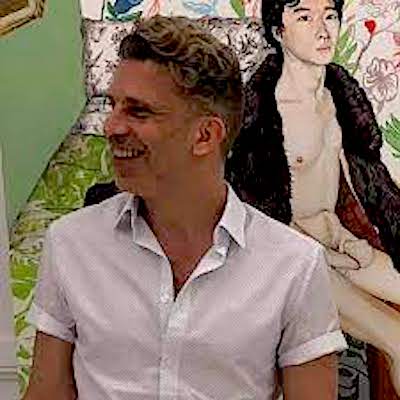
Hernan Bas

Paintings by Hernan Bas

Born in 1978 in Miami, Florida, Hernan Bas is an American painter whose work presents a world composed of personal and historical references. Graduated from the New World School of the Arts in 1996, Bas creates his multilayered, densely textured works of art, by combining the mediums of woodcut, linoleum print, airbrush or gold leaf with painting,.

Hernan Bas takes his inspiration from literature, history and contemporary culture, presenting in his work references to Romanticism and Nihilism, and literary allusion to such writers as Robert Frost and Oscar Wilde. Inspired by the aesthetics of the male androgynous dandy, Bas constructs narratives of adolescent exploration, which often serve as metaphors for a sexual and sensual awakening.

Portrayed usually alone in sprawling natural surroundings, the figures in Bas’s large-format paintings reside in a utopian world of innate sensuality, painted with lush, abundant brushstrokes. The stories of their adventures are woven together with classical poetry, mythology, religious stories, the paranormal, and classical literature.

Hernan Bas’s 2017 exhibition at the gallery Victoria Miro Mayfair was inspired by the lore and romanticism of life at Cambridge, England. Following a period of research while in residence at Jesus College Cambridge in 2016, Bas developed new subject matter including the famed ‘Night Climbers of Cambridge’, a group of students whose nocturnal ascents of the ancient buildings of the university and town, taking photographs while trying to avoid detection, gained them a cult following during the early decades of the twentieth century.

Loosely based on vintage men’s fashion magazine covers, the Bas’s most recent work depicts male magazine-cover celebrities surrounded by a choreographed array of artifacts, accessories and architectural elements that point to the idea of identity. Infused with an aura of eroticism and decadence, and loaded with codes and double-meanings, these recent works of Hernan Bas further point to the intricacies of self-identity, while celebrating moments of transformation from the ordinary to the extraordinary.

Hernan Bas had solo exhibitions at the Brooklyn Museum of Art in 2009, Miami’s Rubell Family Collection in 2008, and the Museum of Contemporary Art North Miami in 2002. He currently, October 17 to December 10 2020, is showing at gallery Ocula in Paris.  Hernan Bas’s work has also been widely exhibited in group exhibitions, including shows at the Venice Biennale, the Busan Biennale, the Aspen Art Museum, and the Whitney Biennial, among many others. 

Hernan Bas has work in the permanent collections of the Art Gallery of Ontario, Toronto; Brooklyn Museum of Art, New York; Detroit Institute of Arts; Museum of Contemporary Art, Los Angeles; Museum of Fine Arts, Boston; Museum of Modern Art, New York; and others.

Second Insert Image: Hernan Bas, “The Palm Tree Enthusiast”, 2021, Acrylic and Gouache on Arches Paper, 76.2 x 57.2 cm, Anat Ebgi Gallery

Bottom Insert Image: Hernan Bas, “A Gathering of Minds (The Agoraphobic), 2021, Acrylic on Linen, 182.9 x 153.4 x 4.45 cm, Anat Ebgi Gallery

Magnus Hirschfeld: Film History Series

Magnus Hirschfeld, “Different from the Others”, 1919,  Directed by Richard Oswald, Cinematography by Max Fassbender, Richard Oswald Film, Berlin

Video Soundtrack: “Meditation de Thais” by Joshua Bell

Born in May of 1868 in Kolberg, Prussia, Magnus Hirschfeld was a German physician and sexologist educated primarily in Germany, earning his doctoral degree in 1892. Observing the suicide rate of his gay patients, he became an outspoken advocate for sexual minorities. In May of 1897 Hirschfeld founded the Scientific-Humanitarian Committee, a campaign for social recognition of gay, bisexual, and transgender men and women, and against their legal persecution. Under Herschfeld’s leadership, the Committee gathered over five thousand signatures on a petition to overturn Paragraph 175, the section of the German penal code that criminalized homosexuality. It received little support in the Reichstag in 1898, made some progress later, until its demise with the Nazi Party took power. 

With the rise of the national socialist party in Germany, Magnus Hirschfeld was badly beaten by a group of võlkisch activists who attacked him on the streeet. In 1933, his Institute for the Research of Sexuality was sacked, the staff beaten, and its contents of books and documents burned on the street. At the time of the book burning, Hirschfeld was on a world speaking tour. He never returned to Germany, eventually near the end of his life, settling in Nice, France. Magnus Hirschfeld died in Nice on May 14, 1935 and is buried in the Caucade Cemetery.  

Enacted in 1871, the German penal code’s Paragraph 175 sentenced thousands of accused German homosexual men to jail terms for “unnatural vice between men.” In 1919, director Richard Oswald and psychologist Dr.Magnus Hirschfeld created a film intended to expose the unjust Paragraph 175 and help liberate the “third sex” from legal persecution and public scorn. It was the first movie to portray homosexual characters beyond the usual innuendo and ridicule.

“Different from the Others” casts Conrad Veidt as Paul Korner, a gay concert pianist blackmailed by a closeted crook named Bollek. When Korner’s budding romance with Kurt Sivers, a handsome young music student, played by Fritz Schulz,  runs afoul of Bollek’s extortion, Korner goes to the German courts for protection. But the draconian Paragraph 175 makes criminals out of both accuser and accused, ultimately costing Korner his career, his freedom, and his life.

One of the first gay-themed films in the history of cinema, “Different from the Others” was banned at the time of its release, later burned by the Nazis and was believed lost for more than forty years. Using recently discovered film segments, still photos and censorship documents from different archives, Filmmuseum Muenchen has resurrected this truly groundbreaking silent film for DVD.

Second Insert Image: Photographer Unknown, “Magnus Hirschfeld with his partner, Li Shiu Tong in Nice, France”. 1934-1935, Gelatin Silver Print

Third Image Insert: Magnus Hirschfeld, on the right, with his partner Tao Li, at the fourth conference of the World League for Sexual Reform in 1932. Tao Li’s father, Li Kam-tong, a wealthy Hong Kong business man, approved of his son’s relationship with Hirschfeld.

Film video reblogged with thanks to:  https://www.kinolorber.com/film/view/id/732

La Culture Physique Magazine

La Culture Physique Magazine

In 1885. French physiologist and physician Professor Edmond Desbonnet developed his Physical Culture theory and practice, which became popular in many European countries. His method was a reaction against the decadence he saw in the Belle Epoque era, and an emphasis on the premise that a healthy body was equally as important as a healthy mind. Before the first World War, fitness rooms were mostly  frequented by the French societal elite; following the war, the working classes gained access to the Physical Culture movement and its facilities. 

At the height of Desbonnet’s popularity, more than two hundred fitness centers espousing his method existed across Europe. Famous body builders, adepts of Desbonnet’s method, were often depicted in the various magazines and books that Desbonnet published. These photographs were offered for sale, often with a hand-held stereo viewer, through advertisements in his magazines. 

Professor Desbonnet published five magazines on the practice of physical culture, in which his theories were explained and illustrated by famous athletes’ photographs, such as Apolion the Mighty, with the form of an ancient Roman gladiator, and Eugene Sandow, who organized the world’s first major body building competition.

Among Desbonnet’s many publications, one of the two most popular magazines was the French “La Culture Physique”. It was an illustrated bimonthly magazine created in Paris by both Desbonnet and author-publisher Albert Surier. Published between 1904 and 1967, except for the war periods between 1914 to 1925 and September of 1943 to December of 1946, the magazine promoted bodybuilding and the benefits of an active lifestyle for all. 

During the rise of the gay consumer culture from 1945 to 1969, physique magazines, paperback novels, and other items became available through gay-oriented mail catalogues. This contributed to the sense of being in a larger community, validating one’s gay identity, and establishing models for what it meant to be gay. The legal struggles of the physique magazine publishers, in their fight against censorship laws, led to the first gay victories on the legal front, establishing the right to market these items, and became a catalyst for the rise of America’s gay movement.

For a more thorough study of the physique magazine and its contribution to the then-emerging gay rights movement, the article “Physique Pioneers: The Politics of 1960s Gay Consumer Culture” by University of Florida Professor David K. Johnson is a must read. The study was published by the Journal of Social History through Oxford University Press.

Available to read and download free through your school or library at:  https://www.jstor.org/stable/40802009?seq=1

A full version of Professor Johnson’s study can also be found at: http://history.usf.edu/faculty/data/johnsonarticle.pdf

Sergei Sovkov

Sergei Sovkov, “Dampfbad (Steambath), Date Unknown, Oil on Canvas

Born in Kyshtym, Russia, in 1972, Sergei Sovkov studied at the art faculty of the Togliatti State University located in Samara Oblast, graduating in 1997. He later attended the Repin Academic Institute of Fine Arts in St. Petersburg. Sovkov took a position as a lecturer and a professor at Togliatti Stat University where he taught for seventeen years before devoting himself full-time to painting in 2014. 

An abstract-realist painter, Sovkov paints colorful and textured images of people, often male nudes, engaged in their daily lives, and has also painted a series of still life images. A member of the Creative Union of Artists of Russia since 2006, he was awarded a gold medal of “Cultural Heritage” for his individual style and skill in painting. In 2011, Sovkov was awarded the title of Laureate of Cultural Heritage.    

Since his first exhibitions in 1995, Sergei Sovkov has exhibited in galleries and multiple international exhibitions, including among others, the 2018 Parallax Art Fair in London, and two solo shows at the Galerie Time in Vienna. Sovkof’s works are held in many private collections.  

In 2015 Sergei Sovkov met his future husband Austrian-born Erwin Sovkov, a photographer and eurythmist who graduated in 2008 from Vienna’s Institute for Eurythmy, which was established in 1912 by philosopher and writer Rudolph Steiner. Sergei and Erwin have together worked on their art project “Crystal House”, a combination of their visions in the fields of painting, photography, and ceramics presenting the inseparable inner and outer worlds of a human being. Married in 2016, they opened their company “Blaue Tauben”, located in Vienna, as a venue for paintings and ceramics by Sergei Sovkov and male nude art photography by Erwin Sovkov. 

Sergei and Erwin Sovkov’s Blaue Tauben Art Studio is located at: https://www.blauetauben.com

Sergei Sovkov’s work can be also be found at: https://sergey-sovkov.pixels.com

Gerardo Vizmanos

Gerardo Vizmanos, “Matthew Gillmore”, Aspen Santa Fe Ballet, Colorado, Date Unknown

Born in a small town in Spain, Gerardo Vizmanos is a photographer based in London and New York. He first studied law and worked, upon graduation, for law firms and companies in Europe and the United States. His interest in photography led him to study in 2010 for his Master’s in the Photography program at Centro Univesitario de Artes TAI in Madrid. Conflicts arose between photography and work, leading to his major decision to pursue photography as a career. Upon winning the International Talent Support contest in Trieste, Italy, he took his awarded scholarship in 2012 to study at New York’s School of Visual Arts. 

An openly gay artist, Vizmanos’s work revolves around the denial of set social constructions, including those of gender, that have become part of our societal existence, and the focusing on the essence of a human being. Born into a world where gay men are typically accepted only when they hide behind socially constructed roles, Vizamonos exposes his own experiences as a gay man through his work, while also presenting an inherent study of gay sexuality through his male subjects. 

Vizamos’s first work after the School of Visual Arts was entitled “No One”, which presented the idea of living without being someone. His first solo exhibition, the “Hidden Subject” series, presented as an installation with large-format images in dialogue with each other, concentrated on the idea of latent sexuality.The “Unidentified” series, shot during a period of personal struggles, dealt with the idea that grieving can be defeated only by going through the pain. He also shot a series called “Subject Matter(s)” which also dealt with body movement, nudity and sexuality, showing that clothes are just an addition to the natural condition of the human body.

Ted Shawn: Dance History

Ted Shawn and His Men Dancers, “Kinetic Molpai”, 1935, Jacob’s Pillow, Music Added to Video in 1985 by Jess Meeker and John Sauer

Born in Kansas City, Missouri, in October of 1891, Ted Shawn was one of the first notable male pioneers of American modern dance. While attending the University of Denver, he contracted diphtheria at the age of nineteen, causing him temporary paralysis form the waist down. During his physical therapy in 1910, Shawn was introduced to the art of dance by Hazel Wallack, a former dancer with the Metropolitan Opera. He relocated to Los Angeles two years later, joining an exhibition ballroom dance troupe with dancer and choreographer Norma Gould as his partner. 

Ted Shawn moved to New York City in 1914 where he met Ruth St. Denis, a teacher and modern dance pioneer. They married in August of 1914, with St. Denis becoming a dance partner and a creative outlet for Shawn. Both artists, believing in dance as an art form integral to everyday life, combined their artistic vision and business knowledge to open the first Denishawn School in Los Angeles in 1915. Renowned for its influence on ballet and experimental dance, this school became the first dance academy in the United States to produce a professional dance company. 

Ted Shawn and Ruth St. Davis established an eclectic mix of dance techniques including a freeing of movement in the upper body and experimental ballet, often done without shoes. With the additions of North African, Spanish, and Amerindian influences to St. Denis’ eastern style, they broke with the established European tradition. Their choreography ushered in a new era of modern dance, drawing from these indigenous, ancient, and international dance traditions. 

In the early 1930s, due to marital problems and finances, Ted Shawn left to form an all-male dance company consisting of athletes he taught at Springfield College in Massachusetts. His mission was to fight for the acceptance of the American male dancer and to present a male perspective on the dance art form. On July 14, 1933, Ted Shawn and His Men Dancers had their premier performance at Shawn’s farm in Lee, Massachusetts. This event, known as Jacob’s Pillow Dance Festival, would transform into the now existing dance school, retreat, and theater at the former farm.

Shawn produced many innovative and controversial choreographies with His Men Dancers, which included performances entitled “Ponca Indian Dance”, “Maori War Haka”, “Hopi Indian Eagle Dance” and “Kinetic Molpai”. Through these creative dance performances, Shawn showcased masculine and athletic movement which gained in popularity. The company toured more than 750 cities in the United States and Canada, and achieved international success in Havana, Cuba, and London. Their final show was a homecoming performance at Jacob’s Pillow on August 31, 1940, ending a seven year tour. 

During the years of the company,, Ted Shawn’s comradeship and interactions with the men in his troupe evolved into a love relationship with Barton Mumaw, one of the leading stars of the company, which lasted from 1931 to 1948. Shawn would later form a partnership with John Christian, the stage manager of the company, with whom he stayed from 1949 until his own death in January of 1972. Ted Shawn’s final appearance on stage was at the Ted Shawn Theater of Jacob’s Pillow in “Siddhas of the Upper Air”, where he reunited with Ruth St. Denis for their fiftieth anniversary. 

Ted Shawn was a Heritage Award recipient of the National Dance Association in 1965 and was inducted into the National Museum of Dance’s Hall of Fame, located in Saratoga Springs, in 1987. His works, including his nine published books providing a foundation for modern dance, are now in the New York Public Library for the Performing Arts and in the archives of Jacob’s Pillow.

Many thanks to the Jacob’s Pillow site: https://danceinteractive.jacobspillow.org

Andrew Salgado

Paintings by Andrew Salgado

Born in 1982, Andrew Salgado is a Canadian artist living and working in London. He received his BFA from the University of British Columbia in Vancouver in 2005; he graduated in 2009 with a MFA form Chelsea College of Art and Design in London. Salgado’s work, striking a balance between abstraction and figuration, deals with questions of masculinity. His paintings are concerned with the political, social, and psychological aspects that effect his subjects. 

In Salgado’s most recent work,  colorful, symbolic, and compositional elements are the driving force of the painted image, but a complex interweaving of figures remain a common thread. His subjects are depicted in a fantastical, often ominous tableaux, with any combination of patterns, abundance, and excess play upon the painted surface. References to the tradition of figurative painting, both historic and contemporary, are recognizable, including those to  Matisse, Gauguin, and Francis Bacon.

Since 2010, Andrew Salgado has had many solo exhibitions in London, New York , Zagreb, Toronto, Cape Town, Basel, and most recently in 2019 at the Untitled Art Fair in Miami. He was the youngest artist to receive a survey-exhibition at The Canadian High Commission in London. An openly gay artist, Salgado frequently donates to charities including Pride London, Stonewall, Diversity Role Models, Pride London, and GLAAD. His donations to the Terrence Higgins Trust are of particular note, having have raised over £100,000 since 2014.

Salgado’s works are in both public and private collections worldwide, including the Government of Canada, The Jordanian Royal Family, London’s prominent legal firm Simmons & Simmons, and the Esquinazi Collection.

The artist’s site : https://andrewsalgado.com

Bottom Insert Image: Andrew Salgado, “Buzzati’s War”, 2023, Oil and Oil Pastel on Linen, 95 x 85 cm

Luke Austin

Luke Austin, “Self-Portrait”, 2018

Australian-born and now living in Los Angeles, Luke Austin started out as a photographer doing photo shoots of bands and musicians, later moving to portraits representing his own gay community. Working with his Instagram app, he has traveled the world and shot many photo shoots of over a hundred men in different cities. Austin has gone from a large Instagram following to becoming a published photographer with his series of “Mini Beau Books” and his latest book “LEWA”, a photographic study of race, masculinity, and sexuality.

Austin has recently shown at a solo 2018 exhibit “LEWA” at PT Gallery in Berlin, the 2018 “Queer Biennial” group show at Navel in Los Angeles, and the 2017 “Home” group show at the Stonewall National Museum and Archives, in Florida.

His work can be seen at his gallery in Los Angeles and at his site: www.lukeaustinphoto.com,

Image reblogged with many thanks to https://doctordee.tumblr.com


Sean Lìonadh

Sean Lìonadh, “Homophobia in 2018: Time for Love”, 2018

“Time for Love” is a short film written, directed and performed by Sean Lìonadh, It is taken from his written poem that explores homophobia in modern society, and also the concept of normality. It questions whether the pressures of convention turn us against one another, at the cost of love. This visually poem won a Royal Television Society Award in 2019, has acieved extensive viewing online, and has been translated into five languages.

Sean Lìonadh is a poet, writer, filmmaker and musician from Glasgow, Scotland. He worked with the Royal Opera House as the libretist on the modern opera”Honest Skin”. His band ‘Lìonadh’ creates dark pop music which explores the themes in his film. Sean Lìonadh is currently working with producers Alfredo Covelli and Ross McKenzie to develop his first feature film “Nostophobia”, exploring the adolescent intimacy and trauma through a gay relationship. His first book, a poetry collection entitled “Not Normal Anymore”, was published in 2019 by Speculative Books.

Sean Lìonadh has written and produced several films dealing with struggles and strengths in one’s life, including the 2017  short film for the BBC The Social series “Social Circles, “The handover” in 2018 dealing with the distance between parents, the 2018 “The Oppression of the Left”, dealing with the stigma of left-handedness, “Us and Them-Rhys’ Story” in 2019, and the 2019 “I Wonder if She Smiles”, the winner in 2020 of a John Byrne Award, Scotland’s online exhibition and competition.

Many thanks to http://irreverentpsychologist.blogspot.com

Jeffrey Smart

Paintings by Jeffrey Smart

Influenced by the Australian modernism of the 1940s, Jeffrey Smart dedicated himself to the representation of the modern city. He executed each painting with classical precision and included repetitious architectural motifs, referencing the Renaissance perspective. Smart painted stark portrayals of contemporary life, choosing as his subject matter the highways, trucks, factories, and even the vacant lots of everyday scenes.

Jeffrey Smart was born in Adelaide, Australia, in 1921. He studied part-time in the late 1930s at the South Australian School of Arts and Crafts under painter Marie Tuck and Rupert Bunny, a master of figure composition. Beginning in 1939, Smart also trained at the Adelaide Teachers College for two years. In this period, Smart visited the studio of Adelaide-based artist Doritt Black, who introduced him to the rules of dynamic symmetry, as seen in the work of the Old Masters and developed by avant-garde artists such as Braque, Cézanne, and Léger. 

The 1940s were a period of artistic growth and raise to fame for Smart, who started to exhibit in group shows alongside other emergent Australian artists, including Jaqueline Hick and Horace Trennery, and was given in his first solo show at Kosminsky Gallery in Melbourne in 1944. In 1945, Smart painted “The Waste Land I” and “The Wasteland II”. These desolate rural views, inspired by T.S. Eliot’s poem of the same name, point to the development of the artist’s distinctive hyper-clear and timeless version of landscape painting.

Between 1948 and 1950, Smart travelled to America and Europe, and then moved in Paris in 1949 to study at the Académie Montmartre under Fernand Léger. His several visits to European museum collections in this period will bring Smart to become particularly fascinated with the art of Giorgione, Giovanni Bellini, and especially Piero della Francesca, whose clarity of forms and rigorous use of perspective would greatly influence Smart’s works. In 1950, he lived on the island of Iachia in the bay of Naples, painting alongside contemporaries Donald Friend, Michael Shannon, and Jacqueline Hick. 

Upon his return to Australia in 1951, the artist settled in Sydney, where he will remain for the next twelve years. In the same year he won the Commonwealth Jubilee Prize for his 1951 painting “Wallalroo”, a scene from the daily life of that copper mining town. During his years in Sydney, Smart also worked as an art teacher and art critic at the Daily Telegraph while continuing to paint landscapes. Works from this period, such as the 1962 “Copper Park” and “The Cahill Expressway”, painted also in 1962, mark the beginning of Smart’s mature style, characterized by an increased hyper-clarity and meticulously crafted compositions.

The year 1963 was crucial in the artistic and personal life of Jeffrey Smart, who resumed his travels around Europe and permanently moved to Rome with Australian artist and partner Ian Bent. Thoughout the 1960s and 1970s, Smart’s artistic career gained momentum thanks to prominent solo shows and exhibitions in his homeland of Australia and around the world, including the 1967 solo exhibition at the Redfern Gallery in London and the American touring group show “The Australian Painters 1964-1966”. 

In 1971, Smart purchase a farmhouse in the countryside of Arezzo, a  small town in Tuscany, where he would remain for the rest of his life. This move marked the start of the most prolific period in the his career. Starting from the 1970s, Smart dedicated himself to interpreting the landscape of modern Italy, mixing his own personal and imaginary relationship with the land with his precision details of climate, life, and landscape. While most of his work includes landscapes, in the 1980s and 1990s, Smart produced a small number of portraits and self-portraits, contrasting the accurate likeness with visionary urban settings. 

Jeffrey Smart’s last work entitled “Labyrinth” was completed in 2011, at which time he officially retired. The artist died in Arezzo in 2013 at the age of ninety-two. Even though he lived as an expatriate for most of his life, the majority of his works is now housed by Australian museums and galleries. 

“My only concern is putting the right shapes in the right colors in the right places. It is always the geometry” —Jeffrey Smart

Top Insert Image: Robert Walker, “Jeffrey Smart in Studio”, 1967, Print from Negative, 2.4 x 3.6 cm, Art Gallery of New South Wales

Second Insert Image: Jeffrey Smart, “The Picnic”, 1980, Oil and Acrylic on Canvas, 106 x 70.7 cm, Private Collection

Third Insert Image: Jeffrey Smart, “Labyrinth, 2011, Oil on Canvas, 100 x 100 cm, National Gallery of Australia, Canberra

Bottom Insert Image: Jeffrey Smart, “The Surfers Bondi”, 1963, Oil on Canvas, Private Collection

Keith Haring

Keith Haring, Unfinished Painting, 1989

The Keith Haring Foundtion

The mission of the Keith Haring Foundation is to sustain, expand, and protect the legacy of Keith Haring, his art, and his ideals. The Foundation supports not-for-profit organizations that assist children, as well as organizations involved in education, prevention, and care related to AIDS.

Keith Haring generously contributed his talents and resources to numerous causes. He conducted art workshops with children, created logos and posters for public service agencies, and produced murals, sculptures, and paintings to benefit health centers and disadvantaged communities. In 1989, Haring established a foundation to ensure that his philanthropic legacy would continue indefinitely.

The Keith Haring Foundation makes grants to not-for-profit groups that engage in charitable activities. In accordance with Haring’s wishes, the Foundation concentrates its giving in two areas: the support of organizations which enrich the lives of underprivileged children and the support of organizations which engage in education, prevention, and care with respect to AIDS and HIV infection.

Keith Haring additionally charged the Foundation with maintaining and protecting his artistic legacy after his death. The Foundation maintains a collection of art along with archives that facilitate historical research about the artist and the times and places in which he lived and worked. The Foundation supports arts and educational institutions by funding exhibitions, programming, and publications that serve to contextualize and illuminate Haring’s work and philosophy.

For more information on the Foundation, current exhibitions, and information on Keith Haring’s life, please visit: https://www.haring.com

Notes: For those interested in Keith Haring’s life and art, I recommend Brian Ferrari’s reprint of the short-lived gay men’s magazine “Heat” article entitled “The Life and Loves of Keith Haring” which can be located at Ferrari’s blog: https://brianferrarinyc.com/2025/06/12/keith-haring-in-heat-magazine-1992/

Vaslav Nijinsky

N. Rimsky-Korsakov, “Vaslav Nijinsky in the Ballet Scheherazade”, 1910, Private Collection

Born Waclaw Niżyński on March 12, 1889, in Kiev to Polish parents, both touring dancers, Vaslav Nijinsky was a ballet dancer and choreographer, considered the greatest male dancer of the early 1900s. Praised for his virtuosity and intensity of the characters he portrayed, Nijinsky possessed the ability to dance ‘en pointe’, on his toes with feet fully extended, a rarity among male dancers at the time. 

In 1909, Nijinsky joined the Ballets Russes, a new ballet company started by ballet impresario Sergei Diaghilev, who concentrated on promoting Russian arts abroad, particularly in Paris. Diaghilev became deeply involved in directing and managing Nijinsky’s career, eventually becoming Nijinsky’s lover for a time. Despite complications in both reworking existing ballets and financial issues, the 1909 Paris season of colorful Russian operas and ballets was a success, with Nijinsky displaying his unique talents and the performances setting new trends in dance, music and fashion.

Breaking against tradition, Nijinsky began choreographing in 1912 original ballets with new trends in music and dance, sometimes causing riotous reactions at the Théâtre de Champs-Élysées. His “Afternoon of the Faun”, set to music by Debussy, is onsidered one of the first modern ballets; though, the ballet’s sexually suggestive final scene caused controversy among its Parisian viewers. His ballet “Rite of Spring”, set to music by Stravinsky, which exceeded the limits of traditional ballet, music scores, and propriety, resulted in violence among the audience at the premier.

In September of 1913, while on tour with the Ballets Russes in South America, Nijinsky married Hungarian aristocrat and actress Romola de Pulszky, despite warnings to both parties by friends. They toured together with the troupe for the season, living in seperate rooms. Nijinsky realized he had made a mistake with the marriage; but the marriage was never legally ended. After the tour was ended, Nijinsky and troupe traveled back to Paris.

Relations, both work and personal, between Diaghilev and Nijinsky had been deteriorating for some time. Upon his return from the South American tour, Nijinsky was notified by an assistant to Diaghilev that he would no longer be employed by the Ballets Russes and also learned that none of his original ballets would be performed by the group. This was particularly devastating as the Ballets Russes was the pre-eminent ballet company and the only innovative modern-thinking one. An attempt was made by Nijinsky to form his own dance company, but he did not succeed.

Classified a Russian citizen and no longer with a military exemption from service, Nijinsky was interned in Budapest during World War I, under house arrest until his release was arranged in 1916. The complex arrangements for this included the agreement that Nijinsky would dance and choreograph for the North and South America tour of the Ballets Russes. The tour proved very stressful to Nijinsky, already in an unsteady position, resulting in anxiety and bouts of rage and frustration. His last performance was in Montevideo, Uruguay, for the Red Cross on September 30, 1917 at age twenty-eight. It was at this time that signs of Nijinsky’s existing schizophrenia became apparent to members of the company. 

In 1919 in Zurich, Nijinsky was diagnosed with schizophrenia and committed to Burghölzli, the leading psychiatric hospital in Switzerland. For the next 30 years, Nijinsky was in and out of hospitals and asylums, maintaining long periods of silence during his years of illness. From 1947 Nijinsky lived in Surrey, England, with his wife Romola who tended to his care. He died from kidney failure at a London clinic on April 8, 1950, and was buried in London, his body later being moved in 1953 to Montmartre Cemetery in Paris.

Nijinsky wrote his “Diary”, reflecting the decline of his household into chaos, during the six weeks in 1919 he spent in Switzerland before being committed to the asylum to Zurich. Discovering years later the three notebooks of the diary plus another with letters to a variety of people, his wife Romola published a bowdlerized version of the diary in 1936, translated into English by Jennifer Mattingly. She deleted about forty per cent of the diary, especially references to bodily functions, sex, and homosexuality, recasting Nijinsky as an “involuntary homosexual.” Romola also removed some of his more unflattering references to her and others close to their household. The first unexpurgated edition of “The Diary of Vaslav Nijinsky” was published in 1995, edited by New Yorker dance critic Joan Acocella and translated by Kyril Fitz Lyon. 

Nijinsky is immortalized in numerous still photographs, many of them by British portrait photogaper E. O. Hoppe, who photographed the Ballets Russes seasons in London extensively between 1909 and 1921. No film exists of Nijinsky dancing; Diaghilev never allowed the Ballets Russes to be filmed because he felt that the quality of film at the time could never capture the artistry of his dancers.

Top Insert Image: Photographer Unknown, “Vaslav Nijinsky in His Practice Outfit, Krasnoya Selo”, 1908

Second and Third Insert Images: Auguste Bert, “Vaslav Nijinsky as the Golden Slave in Scheherazade”, 1911

Bottom Insert Image: Photographer Unknown, Vaslav Nijinsky, circa 1910, Jerome Robbins Dance Division, New York Public Library Collection

Bruno Leydet

Portraitures by Bruno Leydet

Born in 1968, Bruno Leydet is a Canadian painter who graduated from New York University and is currently based in Montreal. He is a portrait painter whose style was influenced mainly by expressionist painter Alice Neel, known for her portraits of family and friends, and the works of experimental filmmaker Kenneth Anger, whose short films merged surrealism and homoeroticism with a documentary style.

Leydet’s work features a tableaux collection centered on acrylic homoerotic portraitures, which narrate the sitters’ gay identities, surrounded by both pattern-oriented and surreal backgrounds. The inspiration for a work comes to Leydet from a pattern he finds, a historic painting, the model himself, or even a film he has seen. His male figures, even those appearing in groups, are often  displayed with contemplative expressions or with a sense of melancholy amid their exotic surroundings . 

“In the case of “Toile de Jouy Dream,” the painting started with Samuel. He had posed for another painting and had told me that he had this suit made with a toile de Jouy pattern. I knew I had to do a painting of him wearing it. Then almost two years passed, and I had this dream – I often have these weird dreams of these strange landscapes and places in crazy Technicolor, or great big old houses filled with objects. In this dream, I saw a prairie with a row of odd-looking houses, with huge storks made of green tiles in front. And then I thought of putting Samuel in that place, and using the greens and blues to give it this unreal night-time feel and add depth to the surroundings.”

– Bruno Leydet, June 2017

Bruno Leydet is represented by Craven Contemporary for Europe and the United States. The artist’s site is :  https://www.instagram.com/brunoleydetmtl/?hl=en

My thanks to https://doctordee.tumblr.com

Danny Ferrell

Paintings by Danny Ferrell

Danny Ferrell is an artist living and working in Pittsburgh, Pennsylvania. In 2014 he received a BFA from Penn State University in drawing and painting, and an MFA in painting from the Rhode Island School of Design in 2016. Ferrell is represented by the Marinaro Gallery in New York City and Galerie Pact in Paris. He is currently an Adjunct Assistant Professor of Art at Carnegie Mellon University, where he teaches drawing and painting. Ferrell has exhibited in New York City, Pittsburgh and the New England area.

Danny Ferrell was born in Flint, Michigan, and spent his formative years in rural Pennsylvania. In this deeply conservative area, most residents placed religion above all other virtues; the result was anyone deviating from religious law was treated as a herald of immorality. Ferrell’s love for other men violated the cultural norms, forcing him to conceal his identity as a gay person from those in the public sphere.

Consequently, his work represents fantasies and fears about the Other in the form of the queer male experience. By creating code homoerotic images of ubiquitous scenes that could appeal to mainstream audiences, the work is both universal and human. Ferrell admires Cadmus and Tooker and follows their lead to bring together the epic and banal in his work.

Alireza Shojaian

Alireza Shojaian, “Hamed Sinno et un de ses Frères (Hamed Sinno and One of His Brothers)”, 2018, Detail, Acrylic and Color Pencil on Wood Board, 150 x 120 cm, Private Collection

Alireza Shojaian is an Iranian gay artist, born in 1988 in Tehran. He studied at Islamic Azad University In the Faculty of Art and Architecture center located in Tehran, and obtained his Masters degree in Fine Arts. He now spends time living and working between his birthplace of Tehran and Beirut, Lebanon, a more tolerant country in the Middle East in terms of protection and acceptance for sexually and gender diverse people..

Shojaian’s artwork tries to highlight subjects which society tries to hide from view. His paintings often deal with the intimacy of his characters, sometimes confronting the viewer with a sense of suffering or embarrassment. Shojaian’s Pentagon and Hexagon series deals deeply with the issue of being a gay man in Iran. The two series depicts the final moments in the life of a gay friend, who was brutally murdered in his own home during the final year at the university.

For further information on the life of Alireza Shojaian and his experience within the Iranian culture as a gay artist, I suggest the following article: https://wearequeerhere.com/queerart

Image reblogged with thanks to a great site: https://bloghqualls.tumblr.com