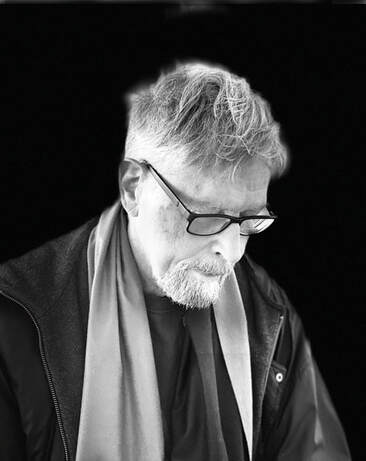
Michael deMeng

The Artwork of Michael deMeng

Michael deMeng is an assemblage artist from Vancouver, Canada who exhibits throughout the United States. As an educator, he has been actively involved with VSA Montana, providing art education and encouraging participation in the arts to people with disabilities. Through these activities, as well as his artwork, deMeng fosters community awareness, and offers creative methods to explore the human experience.

In his art, he addresses issues of transformation. Discarded materials find new and unexpected uses in his work; they are reassembled and conjoined with unlikely components, a form of rebirth from the ashes into new life and new meaning.

These assemblages are metaphors for the evolutions and revolutions of existence: from life to death to rebirth, from new to old to renewed, from construction to destruction to reconstruction. These forms are examinations of the world in perpetual flux, where meaning and function are ever-changing.

Conrad Marca-Relli

Conrad Marca-Relli, “Summer Noon – L – 20”, 1968, Oil , Canvas and Burlap Collage on Canvas, 56 x 72 Inches

Conrad Marca-Relli was an American artist born in Boston who belonged to the early generation of New York School Abstract Expressionism. Along with Jackson Pollock, Willem de Kooning and Robert Motherwell, Marca-Relli was part of the leading art movement of the postwar era.

In 1930 at the age of seventeen, Marca-Relli studied for one year at the Cooper Union, a private arts and science college. He later worked at the Works Progress Administration (WPA) first as a teacher and then painting murals with the Federal Art Project division. After serving in World War II, he taught at Yale University during 1954 and 1955, later teaching at the University of California, Berkeley, during 1959 and 1960.

Marca-Relli’s early still lives, cityscapes and circus paintings are reminiscent of the surrealist work of Giorgio de Chirico. He created many large scale collages throughout his career, combining oil paint with collage, using intense colors, broken surfaces, and splatters of paint in an expressionistic style. His later works showed a simplicity with black or somber colors and more rectangular shapes with neutral backgrounds.

Kurt Schwitters


Kurt Schwitters, “The Spring Door”, 1938

Kurt Schwitters was born Herman Edward Karl Julius Schwitters on June 20, 1887, in Hannover. He attended the Kunstgewerbeschule in Hannover from 1908 to 1909 and from 1909 to 1914 studied at the Kunstakademie Dresden. After serving as a draftsman in the military in 1917, Schwitters experimented with Cubist and Expressionist styles.

In 1918, he made his first collages and in 1919 invented the term “Merz,” which he was to apply to all his creative activities: poetry as well as collage and constructions. Schwitters’s earliest “Merzbilder” date from 1919, the year of his first exhibition at Der Sturm gallery in Berlin, and the first publication of his writings in the ‘Der Sturm’ periodical. Schwitters showed at the Société Anonyme in New York in 1920.

At the Kongress der Konstructivisten in Weimer, Germany, in 1922, Schwitters met Theo van Doesburg, whose ‘De Stijl’ principles influenced his work.  About 1923, the artist started to make his first “Merzbau”, a fantastic structure he built over a number of years; the structure grew to occupy much of his Hannover studio.  In 1932, Schwitters joined the Paris-based Abstraction-Création group and wrote for their publication of the same name. He participated in the Cubism and Abstract Art and Fantastic Art, Dada, Surrealism exhibitions of 1936 at the Museum of Modern Art, New York.

The Nazi regime banned Schwitters’s work as “degenerate art” in 1937. This year, the artist fled to Lysaker, Norway, where he constructed a second “Merzbau”. After the German invasion of Norway in 1940, Schwitters escaped to Great Britain, where he was interned for over a year. He settled in London following his release, but moved to Little Langdale in the Lake District in 1945. There, helped by a stipend from the Museum of Modern Art, he began work on a third “Merzbau” in 1947. The project was left unfinished when Schwitters died on January 8, 1948, in Kendal, England.

Le Corbusier

Le Corbusier, “Bull”, Collage of Colored Paper and Newspaper, Gouache, Indian Ink and Charcoal on Paper, 1963

Le Corbusier was visionary writer, theorist, and architect, and a lesser-known painter. Born Charles-Édouard Jeanneret, he adopted his moniker when he began to author architectural designs and paintings. He had a fascination with proportion, modularity, and geometry, often taking his cue from classical architecture theory. His designs, however, were modernist and industrial. He fondly called houses “machines for living in,” and said that the base principal for design is that “it must be beautiful.”

Le Corbusier was interested in solving what he called the problem of urban co-habitation, and produced a great number of designs for houses and apartment buildings. Le Corbusier worked at the atelier of Peter Behrens, the training grounds of other architectural masters like Mies van der Rohe and Walter Gropius.

John Andro Avendano

Two Paintings by John Andro Avendano

Top Image: “Blue Maze”, Ink, Acrylic, Chalk and Newspaper on Paper, 2007; Bottom Image: “Sex 1″, Oil on Canvas, 2012

John Andro Avendano was born into an artistic family in Arleta, California in 1959. His mother painted and his brothers drew; so from an early age, he has been a focused artist. He did not settle on just one artistic medium but developed many forms of expressing art.

In the late 1970’s, John Avendano gave up ownership in his construction company to become a full-time artist. These were lean times and he would often give away art for food. For several years he worked under Hal Reed who learned his techniques by studying under Nicolai Fechen and by working at Walt Disney Studios in Las Angeles. Avendano was Hal Reed’s assistant for five years at the Art League of Las Angeles while perfecting his skill of color theory, composition, and anatomy. Avendano later taught art at the Art League and at several elementary schools in the Los Angeles area.

Fred Tomaselli

Painting Collages by Fred Tomaselli

Brooklynn-based Fred Tomaselli draws upon decorative traditions from around the world to create richly detailed paintings that pulsate with both abstract and figurative forms. In his signature pieces, natural materials such as leaves and seeds mingle with collaged imagery and painted patterns beneath clear layers of resin. The hybrid nature of Tomaselli’s work speaks to the relationship between humanity and the natural world.

Prescription pills, marijuana leaves, peyote buttons, mushrooms and other psychotropic plant matter are carefully arranged along with brightly colored magazine and picture book clippings of human body parts, flowers and insects. These form beautiful, super-sized collages of kaleidoscopic shapes emanating from the altered states of human forms or floating out of the heads of intricately and accurately patterned birds, all the while suspended in multiple layers of clear resin, blowtorched to a high-gloss sheen, and delicately accented with hand-painted details of swirling, fiery flourishes.

Richard Huntington

Richard Huntington, “Joe E Brown Calls the Lightning Down”, Collage, Archival Pigment Print and Oil on Paper Mounted on Board, 2010

Richard Huntington is a painter, printmaker, writer and art critic. He earned his Bachelor of Fine Arts at Syracuse University and his Master of Art and Humanities at the State University of New York located in Buffalo. Using his technical knowledge, Huntington works in a wide range of fields, including paintings, drawings, collages, print making, and computer generated graphics. 

From 1982 to 1985, Huntington was the Visual Arts Director at Artpark, a public sculpture park in Lexington, New York. Under his directorship, the late video and installation artist Vito Acconci executed his first major public sculpture and the late Chris Burden created his “Bean Drop”, a performance piece in which seventy-one iron beams were dropped, over the course of a day, into a pool of fresh concrete. This kinetic form of abstract expressionism was recreated at Inhotim, Brazil, in 2008, after surviving only as documentation for twenty years.

Richard Huntington has had many residencies over his career, including Visiting Critic at Washington DC’s Kennedy Center for the Arts. He was also a contributing reviewer for publications, including ARTNews, Art New England, and High Performance  Magazine. Huntington served as art critic for The Buffalo News from 2095 to 2007, where he wrote critical articles and reviews on regional and international exhibitions.

Huntington won the 2007Associated Press Award for Criticism for his review which challenged O’Keefe’s status in American art. He is the author of two novels: “An Art Critic Walks into a Bar” and a sequel with the same character, “7 Dead or Otherwise Forgotten Artists”. Huntington also authored a number of essays for art catalogues including “Storyboard: The Sexual Politics of Jackie Felix”, for the 2012 retrospective at Burchfield Penney Art Center; and “Duayne Hatchet: Form, Pattern, and Invention” for a 2009 retrospective at Burchfield Penney.

Bottom Insert Image: Richard Hunting, “Squares of Mine”, 1965, Acrylic on Canvas, Burchfield Penney Art Center, Buffalo, New York

Leslie Pierce

Leslie Pierce, “Sebastian in Stained-Glass Window,, Collage, 2011

Leslie Pierce is a contemporary artist, known for art that focuses on scenes with underlying themes involving coding systems, documentation, fragmentation and technology. She has worked with collages, situating traditional images of Saint Sebastian in absurd contexts, such as a communist street demonstration in Paris, or displaying male nudes against religious backdrops.

“Sebastian in Stained Glass Window” was shown at the “Saint Sebastian: From Martyr to Gay Starlet” exhibition held at Friday Cottage Art Space, a gallery in one of the historic downtown homes in Columbia, South Carolina. . The exhibition was part of a week of events that led up to the South Carolina Pride Festival in early September of 2012.

Pierce has relocated from Austin, Texas, to San Diego, California, and now runs a Studio Gallery in Arts District Liberty Station- an old converted Naval base that is bustling with creative businesses, non profits and eateries. She exhibits and sells her work internationally and teaches Painting and Drawing.

Robert Rauschenberg


Robert Rauschenberg, “Wall Eyed Carp / ROCI JAPAN”, Acrylic and Fabric Collage on Canvas, 1987, National Gallery of Art, Washington DC

“Wall-Eyed Carp” is a fine example of what the artist called a “Combine,” a painting that incorporates everyday objects, in this instance the addition ofa visually striking kite. The painting is more than 20 feet long and is signed below the fish’s tail.

Rauschenberg challenged preconceptions about the boundaries between art and life and profoundly altered the course of art after midcentury.

Kurt Schwitters

Kurt Schwitters, “Santa Klaus”, Cut and Pasted Colored and Printed Papers on Paper with Cardstock Border, 1922, 28 x 28 cm, Museum of Modern Art, New York

Kurt Hermann Schwitters, born in January of 1948, was a German artist. He worked in several genres and media, including dadaism, constructivism, surrealism, poetry, sound, painting, sculpture, graphic design, typography, and what came to be known as installation art. He is most famous for his collages, called “Merz Pictures”.


Emil Holmer

Paintings by Emil Holmer from His Show: Mobilization Table

‘Dead Letters’ is the Swedish painter Emil Holmer’s first solo show in Berlin. His Mobilization Table is a sort of mission statement for his approach to painting: the canvas is a frame into which objects are assembled over and against each other, and techniques are hand-made weapons for dissecting materials. Collages of pornographic material meet total abstraction; media swap roles. The paintings are composed like installations from smaller paintings of sculptures, clusters spaced across the canvas, or piled on top of each other.

Ruth Wall

Ruth Wall, Untitled, Date Unknown, Collage on Paper, 14 x 13 Inches, Private Collection

Ruth Wall, an abstract expressionist painter and lithographer, was born in Wyoming in 1917. After moving to a homestead on an Indian reservation in Utah, Ruth quickly completed school by 16 and left home for California to start her university studies. After working with the Women’s Air Force, Wall enrolled at the California School of Fine Arts where she studied painting. She studied with other prominent Bay Area abstract expressionists such as David Park, Elmer Bischoff, and Hassel Smith until her graduation in 1952. She continued her painting career until her passing in Paris, France.