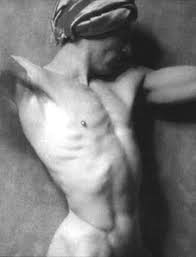
George Platt Lynes: “José Martinez”

George Platt Lynes, “José ‘Pete’ Martinez”, 1937, Photo Shoot at Lynes’s Studio, Vintage Silver Prints, Private Collections

Born in Mexico in March of 1913, José Antonio Martinez-Berlanga was a ballet dancer who in the early 1940s danced with both the American Ballet Caravan and the Ballet Society, precursor ensembles of the New York City Ballet. 

José Martinez at a very young age moved with his family to Houston, Texas. After graduating high school, he relocated to New York City where he studied at the School of American Ballet founded in 1934 by Lincoln Kirstein, Edward Warburg and George Balanchine. Martinez eventually gained a full scholarship and, upon graduation, was invited to join The Ballet Caravan, a touring company founded by Lincoln Kirstein to provide off-season employment to American ballet dancers. Martinez gradually became involved with the group’s creative process and provided ideas and librettos for ballets. 

Martinez eventually began an intimate relationship with Lincoln Kirstein; they lived together in a Greenwich Village townhouse at St. Luke’s Place. After Kirstein married graphic artist Fidelma Cadmus, the younger sister of artist Paul Cadmus, Fidelma moved into the apartment for the first year of the marriage. This triangular romantic relationship was similar to that of their friends, Paul Cadmus, Jared French and his wife Margaret Hoening. 

José Martinez performed with the Ballet Caravan in the 1941 “Pastorela”, a one-act ballet choreographed by Lew Christensen and dancer José Fernandez, that toured Latin America with great reviews. The work included music by Paul Bowles and traditional songs orchestrated by Blas Galindo with words by Rafael Alvarez. Martinez tried in 1942 to enlist in the Army but was denied. He moved to Haverford, Pennsylvania and began work at a Jewish refugee hostel where writer Christopher Isherwood, whom he had met through Kirstein in 1939, was already employed. From Isherwood’s diaries, it is known that their relationship, except for one sexual encounter in August of 1942, was platonic. 

José Martinez and Christopher Isherwood traveled together several times to New York City to visit the Fidelma and Lincoln Kirstein. They both left Haverford in September of 1942 and went their separate ways. Their friendship, however, continued and they met several times in California and New York after the war years. Called up for service during the Second World War, Martinez was trained at Norfolk, Virginia, and served in the United State Army in northern France until 1945.

As a member of the Ballet Society, Martinez toured the United States with visits in both large and smaller cities. The Society’s repertoire was very different from those trained by Sergei Diaghilev, who founded the Ballets Russes. Martinez danced in the original cast of George Balanchine’s “Four Temperaments” in which he performed the first Theme with Beatrice Tompkins in the 1946 performance tour. He also originated and danced the role of the minister in dancer and choreographer William Dollar’s 1947 “Highland Fling”. 

In late 1947, José Martinez suffered a knee injury which forced an end to his performances. Hesitant about the next part of his life, he drifted for a year before beginning life as a dance teacher in Norfolk, Virginia. Over the next two decades, Martinez founded dance studios in Ohio and California where he continued to teach ballet until his retirement in the mid-1960s. José Martinez-Berlanga died at the Huntington Memorial Hospital in Pasadena, California on the twenty-fourth of June in 1997 at the age of eight-four. 

Notes: Paul Cadmus, Jared French and his wife Margaret Hoening would spend the summers from the late 1930s to the early 1950s on Fire Island where they painted and took photographs. This collaborative artistic endeavor became known as the PaJaMa collective, taken from the first two letters of their names. Artist George Tooker would later join the collective during the period of 1944 to 1949 when he was in a relationship with Paul Cadmus.

Many friends would often visit the group on Fire Island, among whom were ballet impresario Lincoln Kirstein, artist Bernard Perlin and photographer George Platt Lynes. Lynes became acquainted with José Martinez through this group of friends and would also photograph him. Although Martinez appeared in many of the pre-war photographs, Lynes’s studio portraits of Martinez wearing the straw hat are the best known. 

The Fire Island Pines Historical Preservation Society has an  article entitled “The Fire Island Muses of George Platt Lynes & the PaJaMa Collective” by Brian Ferrari on its site located at: https://www.pineshistory.org/the-archives/fire-island-muses

Top Insert Image: William Caskey, “José Martinez”, circa 1935-1955, Vintage Print

Second and Bottom Image: Photographers Unknown, “José Martinez”, circa 1935-1955, Vintage Prints, Fire Island Pines Historical Preservation Society

Alina Noir

The Photography of Alina Noir

Born in Romania in 1981, Alina Noir is an visual artist, author and choreographer. Her education in literature and art history was internationally based with studies in Romania, Germany, France, Sweden and New Zealand. Noir studied classical and contemporary dance at Les Grands Ballets Canadiens de Montréal and Lyon’s École Nationale de Musique de Danse et D’art Dramatique. This multi-cultural academic background has had strong influence on her work as a photographer.

Alina Noir maintains an artist studio in the Renaissance city of Lyon, France, where she works with a team of ballet dancers and actors. Her work is influenced by the city’s classical Renaissance and Baroque paintings, in particular the works of Michelangelo Caravaggio. Initially focused on color photography, Noir has incorporated black and white images and re-colored images into her oeuvre. She shoots both theatrical and nude photography with an emphasis on the interaction of bodies in a given space. A variety of emotions and situations, such as fragility, force, solitude, despair and connection, are expressed in Noir’s images. 

For each of her photographic projets, Noir shoots a series of images that often contain an autobiographical dimension. An early project entitled “I Turned My Blood Into a River” was a personal anthology of legends and myths. Noir’s “Cathedrals” was an exploration of her favorite artistic themes presented more mathematically in concept. This project examined the intricate ways , other than sexual or emotional, in which human bodies connect in space. During the winter months of 2018 to 2019, Noir created “Sculptures in the City”, a series of sixty digital photographs of random constructions and urban landscapes in Montreal. Based on the 1930s Surrealist art form of objet trouvé (found objects), the project’s impersonal images evoked sensations of both strangeness and displacement.

In 2019, Alina Noir produced a two-part project “La Bal-Act One” and “La Bal-Act Two”. The first part was a series of photographs taken during May and June of 2019 in which characters were involved in scenes both improvised and choreographed. In the images, references to art history and popular culture were combined with contemporary issues, such as gender, identity and body control. The shooting for “Act Two” took place in Lyon between July and September of 2019. These images were studies of choreographed movements that examined how desire, vulnerability, and intimacy become motivating forces in one’s life. The figural gestures portrayed in the photographs draw upon gestures exhibited in Renaissance paintings.

In January of 2020, Noir created “The Magic Square” series at the Institute for Contemporary Art during Lyon’s fifteenth Biennial for Contemporary Art. Inspired by Albrecht Dürer’s 1514 engraving “Melencolia I”, this series of photographs explored the notion of contemporary masculinity and examined its relationship to the male image in western art. In 2021, Noir created the series “Ships Anchored in Fog”, a set of nine self-portraits visually inspired by statues from classical Antiquity. These photographs translated certain aspects of mathematical set theory into the art of dance. The uniqueness of the dance movements, reinterpreted through the choice of statues, became static choreography which allied the subliminal creative idea with infinite sets. 

Alina Noir created a collection of twenty dance performances from 2018 to 2022 among which were “Keeping This Body Alive”, “Black Bird”, and “No Ghost Just A Bell”. Her “Chrysanthèmes” was a 2021 performance at Lyon’s Maison de la Danse that translated certain aspects of Ferdinand de Saussure’s Semiotics theory into dance movements. The Semiotics theory provides a framework for understanding how humans use signs to make meaning of the world around them; however, an important assumption of this theory is that signs do not convey meaning that is inherent to the object being represented. The performance piece is centered around the symbol of the chrysanthemum as seen in two different cultures, Alina Noir interpreted the chrysanthemum in Romania (a symbol of mourning, death and rebirth) and dancer Mio Fusho interpreted the flower in Japan (a symbol of light, hope and metamorphosis).

Alina Noir’s photography has been featured in many print and online  publications. She has exhibited her work in both collective and solo exhibitions in Lyon, Paris, Berlin, Potsdam, Prague, and Geneva. 

Alina Noir’s portfolio site, which contains contact information and images of her work including installations and performance videos, is located at: https://www.alinanoir.com/index.html

Note: An article describing Albrecht Dürer’s 1514 engraving “Melencolia I” can be found at the online site of New York’s Metropolitan Museum of Art located at: https://www.metmuseum.org/art/collection/search/336228

Top Insert Image: Alina Noir, “Sculptures in the City” Series, 2018-2019, Color Print

Second Insert Image: Alina Noir, “La Bal-Act Two” Series, 2019, Color Print

Bottom Insert Image: Alina Noir, “Sculptures in the City” Series, 2018-2019, Color Print

Féral Benga: Film History Series

Carl van Vechten, “Féral Benga”, 1937, Gelatin Silver Print

Born in Dakar in 1906, François Benga, better known by his stage name Féral, was a Senegalese actor, cabaret dancer, artist’s model, and nightclub owner. Although his principle art form was performance in film and stage, he left an equal legacy in visual arts with his immortalization in the works of such artists as painter James A. Porter, sculptor Richmond Barthé, and photographer George Platt Lynes.

The son of a wealthy French colonial administrator in Dakar, Benga relocated in 1923 at the age of seventeen to Paris where he worked in odd jobs to support himself. For a brief period in May of 1930, Benga danced with American-born Mexican dancer Myrtle Watkins at the Enfants-Terribles Restaurant. After auditioning for the Folies-Bergère, Paris’s famous cabaret club, he quickly became noticed among the public through his dances and close friendship with Josephine Baker, one of the most celebrated performers to headline at the Folies-Bergère. Baker was also the first black woman to star in a major motion picture, the 1927 “Siren of the Tropics”.

In the evenings, Féral Benga and Josephine Baker performed the “Danse Sauvage” to the delight of the French spectators, he wearing a loincloth and she dressed in a skirt of artificial bananas. The pair’s artistry and technical skill in dance was admired but also crudely exoticized  by some of their audiences. Like Josephine Baker, Benga understood the commercialization of black culture and body in the artistic marketplace as well as his own marketability as an object of desire. Due to his skill as well as his popularity in Paris’s artistic and homosexual circles, Benga was able to appear in many cabaret revues throughout the 1930s. 

In 1930, Benga had one of the starring roles in Jean Cocteau’s avant-garde film “La Sang d’un Poète (The Blood of a Poet)”, the first film of Cocteau’s “The Orphic Trilogy”. At this time, images of Benga began to appear as postcards, cabinet cards and other materials for consumption. British photographer Lucien Waléry, who had photographed many prominent people including Josephine Baker and Bessie Smith, took several photos of Benga including a portrait of him hoisting a machete in the air. This photographic pose inspired Harlem Renaissance artist Richmond Barthé to create his iconic 1935 bronze sculpture “Féral Benga”, a new and dramatic representation of the male figure. 

In 1933, Benga and his partner, anthropologist and author Geoffrey Gorer, took a trip to Africa where they studied native dances performed in the remote parts of Africa. Inspired by this trip, Gorer wrote a 1935 book entitled “Africa Dances: A Book About West African Negroes” which, in addition to its vast visual documentation, is one of few existing texts which details Benga’s life. In 1935, artist James A. Porter painted a portrait of Féral Benga, dressed in the khaki uniform of the Senegalese Tirailleur, entitled “Soldado Senegales” which is now housed in the Anacostia Community Museum in Washington, DC. After the publication of “Africa Dances”, Benga and Gorer slowly drifted apart but kept in touch through letters. 

Until the outset of World War II, Féral Benga lived a lavish lifestyle with an apartment near the Champs-Élysées, a custom Delahaye convertible, and his own small cabaret. In 1943, he performed a personally choreographed dance in the ballet “Tam Tam” held at the Olympia Theater. Trapped in France as a result of the German occupation, Benga was aware of the Nazi’s hateful opinions of French-speaking black men and hid for some time in the countryside. Though his hosts treated him well, the hard living conditions took a toll on both Benga’s physical and mental health. 

From 1947, Benga owned, in partnership with bisexual filmmaker Nico Papatakis, a popular and fashionable cabaret-restaurant on Paris’s Left Bank called “La Rose Rouge”. Visited by the wealthy Parisian crowd, it featured over its eight years an African cabaret including drummers and dancers who, during the day, were African students studying at universities in the city. In 1951, Benga met his former partner George Gorer for the last time during Gorer’s trip to Paris. Due to changing times and bad business decisions, Benga was forced to close “La Rose Rouge” in 1956. 

At this time, Féral Benga’s family in Senegal decided to welcome him back into the family circle, from which he had been disinherited at the age of seventeen. Submitting to familial pressure, he traveled back to Senegal and unexpectedly married a cousin. However, Benga soon returned to Paris where he died of a pulmonary embolism on the fourth of June in 1957. He rests in the Saint-Denis cemetery in Châtecauroux, France. Due to cemetary regulations, Benga’s funeral concession will expire in 2028. 

Notes: In Manhattan, New York, Féral Benga was well known in the Harlem Renaissance artistic and social circles and seen by many as a gay icon. In 1938, the openly homosexual surrealist painter Pavel Tchelitchew painted a portrait of Benga entitled “Deposition”, a nude study of the dancer on his back. This portrait later was held by American writer and impresario Lincoln Kirstein, a co-founder of the New York City Ballet.

Jean Cocteau’s 1930 “La Sang d’un Poète” was produced by French nobleman Charles de Noailles; the cinematography was done by Georges Périnal, a renowned artist who also worked with, among others, directors Jean Grémillon, Charlie Chaplin, René Clair, and Otto Preminger. The film, a study of the main character’s obsession with fame and death, was a surrealistic work in which dreamlike states were intercut throughout the film. Its release was delayed a year due to rumors of anti-Christian messages and the threatened excommunication of its producer de Noailles from the Catholic Church. “La Sang d’un Poète” is available for viewing at the Internet Archive located through this link: https://archive.org/details/JeanCocteauLeSangDunPote1930

All Insert Images: Carl van Vechten, “Féral Benga”, Photo Shoot, 1937, Gelatin Silver Prints, Private Collections

Season’s Greetings to All !

My best wishes to all who visit this site during this holiday season and the year to come! I hope that you have enjoyed your stay at this site and will visit often. Have a great winter season, stay well and safe. -Chas  Ultrawolvesunderthefullmoon.blog

The food gifs have been made by the talented cinematographic artist Daria Khoroshavina who is based in Moscow, Russia. Her project Kitchen Ghosts is about food, drinks and other little precious moments of life captured and looped in live photographs.

The Kitchen Ghosts project has been noticed and loved by many brands which led to successful collaborations with Pepsi, Martell, Blue Angel vodka, Schweppes, Amazon, Samsung and others.

Represented by:
glasshouseassignment
Kari Anderson
kari@glasshouseassignment.com

Hubert Julian Stowitts

The Photographs and Artwork of Hubert Julian Stowitts

Born in Rushville, Nebraska, in June of 1892, Hubert Julian (Jay) Stowitts was an American painter and ballet dancer. Raised in the Lakota Souix area of South Dakota, he moved with his family to Los Angeles in 1911. Upon his arrival, Stowitts enrolled at the University of California, Berkeley, where, as a gay student, he became a successful college athlete, captained the university’s track team, and acted in several student theater productions. 

Captivated by a ballet performance seen in San Francisco, Stowitts decided to begin private dance lessons. He became an accomplished dancer and performed both on the public stage and at private parties for  San Francisco’s upper class residents. Stowitts kept his dancing secret from his parents for much of his college years; he graduated from the University of California in 1915 with a degree in Commerce. 

In the summer of 1915, while dancing at the Greek Theatre, a large amphitheater owned by the University of California, Julian Stowitts impressed Russian ballerina Anna Pavlova who was in attendance. He accepted an invitation to join her dance company and dropped plans to attend graduate school at Harvard. Stowitts, the first American to star with a Russian ballet troupe, traveled as a successful dancer for six years throughout Europe and the Americas. Leaving Pavlova’s company, he moved to Paris and started a solo career with performances throughout Europe, including a starring role with the Folies Bèrgere in 1924.

During his solo career, Stowitts executed choreographies for other dance companies, designed sets and costumes, and continued  his painting. In 1925 at the age of thirty-three, he retired from dancing and pursued a new career as a painter and occasional film actor. Stowitts traveled through the Far East in the late 1920s, where he lived and painted  in Java for a year. After a stay in Indonesia, he lived in the southern part of Asia for several years and, during this stay, created a series of one hundred and fifty-five canvases entitled “Vanishing India”. After his return to Europe in 1931, Stowitts’s  painted depictions and scholarly studies of traditional Indonesian and Indian dance and costume enjoyed wide popularity in the 1930s.

For the art exhibition at the 1936 Berlin Olympics, Julian Stowitts presented a series of fifty-five paintings depicting American male athletes in the nude, which caused a sensation among the attendees. While in Berlin, he assisted German film director Leni Reifenstahl on her “Olympia”, released in 1938 as the first feature film documentary of an Olympic Games, later used by the Nazis as a propaganda film. Due to her fame and influence, Riefenstahl was able to protect Stowitts from persecution for being gay; but his exhibition was closed by the Nazi regime because of their objection to the manner in which Stowitts depicted Jewish and African-American athletes. 

Returning to California in 1937, Stowitts struggled financially as his artwork began to lose public interest. He found, with the assistance of friends, some security with employment as a house caretaker in the Los Angeles area. Stowitts continued to lecture on Indian and Javanese culture and to paint privately for the remainder of his life. The last of his painting series, uncompleted due to illness, was “The Labors of Hercules”, in which actor and body builder Steve Reeves served as the model. Hubert Julian Stowitts died in San Marino, California on February 8, 1953.

The papers of American dancer and painter Hubert Julian Stowitts, including biographical materials, correspondence, and exhibition and performance related materials are available for research at the Bancroft Library of the University of California, Berkeley. 

Matthew Bourne: “Swan Lake”

Matthew Bourne, “Swan Lake”

Craig Schwartz, Matthew Bourne’s “Swan Lake” (Dance Troupe), 2019

Johan Persson, Bourne’s “Swan Lake” (Matthew Ball and Liam Mower), 1995

English choreographer and director Matthew Bourne was born in Hackney in 1960. Leaving full time eduction in 1978, he received employment at routine positions in the arts field; in addition to this work, he directed various amateur dance companies. Bourne enrolled, at the age of twenty-two, in London’s  Conservatoire of Music and Dance, formerly the Laban Centre. For his final year, he danced with the center’s Transitions Dance Company, and at end of term in 1985 received a Bachelor of Arts in Dance Theater. After graduation, Bourne spent two more years dancing with the Transition performance company.

In 1987, along with friends and fellow dancers Emma Gladstone and David Massingham, Matthew Bourne established the dance company Adventures in Motion Pictures, where he was AMP’s artistic director from 1987 until 2002. He  also became a charter member of the all-male dance company, The Featherstonehaughs, formed in 1988. Bourne danced professionally for fourteen years, including in his own productions, until his final performance in 1999, when he appeared as The Private Secretary in the Broadway production of “Swan Lake”. 

As a choreographer and director, Matthew Bourne’s work includes “Spitfire”, a highly colored mixture of the 1845 ballet “Pas de Quatre” and men’s underwear advertising, and “The Infernal Galop” which toys with British illusions about lower-class Parisians, both choreographed during the 1980s. In the early 1990s, he produced “Town and Country”, a humorous exploration of life on a small island,  and “Deadly Serious”, a tribute to Alfred Hitchcock films. His revised production of the “Nutcracker!” premiered at Sadler’s Wells in 1992, and returned the following year for a second sold-out season. In 1995, Bourne met and became partners with dancer and choreographer Arthur Pita, who has become a frequent collaborator and is a principle dancer at AMP.

Of Bourne’s work, some of the most acclaimed pieces are those updated from classical ballet’s repertoire, and often infused with contemporary themes. His groundbreaking 1995 “Swan Lake” was a contemporary ballet, based on the Russian romantic work, which became the longest-playing dance production in the history of London’s West End. The ballet took Tchaikovsky’s music and a broad outline of the plot and paired them with an all-male dance company. Bourne’s 1995 “Swan Lake” received over thirty international awards including the Laurence Olivier Award for Best New Dance Production and  Tony Awards for Best Director, Best Choreography, and Best Costume Design.

In the 1995 “Swan Lake”, the roles of the white swan Odette and the black swan Odile, traditionally played by females, were danced by male performers and explored the issue of homoeroticism..Although the traditional story was changed for Bourne’s production, the central theme, the doomed, forbidden love and a protagonist who wishes to transcend conventional boundaries through that love, was still present. That theme had strong ties to the life of the ballet’s composer Pyotr Ilyich Tchaikovsky, whose homosexuality, although kept private, caused a number of complications in his life.

In 2002, Matthew Bourne founded the production company “New Adventures”. The first success of the new company, “Play Without Words”, premiered in 2002 and won the Olivier Awards for Best Entertainment and Choreography. The play was inspired by the 1963 film, “The Servant” in which the class system is chanllenged by the employer;s servant. Bourne’s revised “Nutcracker!”, also in 2002, received critical acclaim and embarked on a world tour. A Tenth Anniversary edition of “Swan Lake” in 2005 reached new audiences and its success led to an extensive international tour. These productions were followed in 2005 with a choreographed production of “Edward Scissorhands”. and revivals of classical musicals including: “My Fair Lady”, “South Paacific”, “Mary Poppins”, and “Olivr!”, among others. 

Matthew Bourne has worked with England’s Royal Shakespeare Company and the London’s National Theatre. He was knighted in the Queen’s  2016 New Year Honors for services to dance, and awarded the Queen Elizabeth II Coronation Award, one of the most coveted honors in the world of dance, in recognition of his outstanding services to the art of ballet. Bourne was presented the Special Award at the 2019 Olivier Awards, in recognition of his extraordinary achievements in dance. This Special Award makes Bourne joint holder of the most ever Olivier Awards, alongside Judi Dench.

Top and Bottom Insert Images:  Johan Persson, Matthew Bourne’s “Swan Lake” (Matthew Ball and Liam Mower) . Middle Insert Image: Johan Persson, “Liam Mower”, Photo Shoot