
Fabienne Verdier, “Cercle – Ascèse VIII”, 2007

A fine art, film, history and literature site oriented to, but not exclusively for, the gay community. Please be aware that there is mature content on this blog. Information on images and links to sources will be provided if known. Enjoy your visit and please subscribe.
Fabienne Verdier, “Cercle – Ascèse VIII”, 2007

Conrad Marca-Relli, “Summer Noon – L – 20”, 1968, Oil , Canvas and Burlap Collage on Canvas, 56 x 72 Inches
Conrad Marca-Relli was an American artist born in Boston who belonged to the early generation of New York School Abstract Expressionism. Along with Jackson Pollock, Willem de Kooning and Robert Motherwell, Marca-Relli was part of the leading art movement of the postwar era.
In 1930 at the age of seventeen, Marca-Relli studied for one year at the Cooper Union, a private arts and science college. He later worked at the Works Progress Administration (WPA) first as a teacher and then painting murals with the Federal Art Project division. After serving in World War II, he taught at Yale University during 1954 and 1955, later teaching at the University of California, Berkeley, during 1959 and 1960.
Marca-Relli’s early still lives, cityscapes and circus paintings are reminiscent of the surrealist work of Giorgio de Chirico. He created many large scale collages throughout his career, combining oil paint with collage, using intense colors, broken surfaces, and splatters of paint in an expressionistic style. His later works showed a simplicity with black or somber colors and more rectangular shapes with neutral backgrounds.

Sandú Darié, Untitled, 1950, Oil on Canvas
Sandú Darié was a Romanian artist who grew up in France and initially trained as a lawyer. He had many contacts with the Romanian avant-garde, Including the poet Stephan Roll and the painter Medi W. Dinu. After spending some time in Paris, he settled in Havana, Cuba, in 1941, taking Cuban nationality.
Darié belonged to the South American Neo-Constructivist movement. He was also a member of the Diez Pintores Concretos group (The Ten Concrete Painters). This group with its development of Cuban abstract geometric art conincided with the radical political and cultural shifts that raged throughout Cuba in the 1950s. In Darié’s compositions, the triangle predominated in combination with vertical and horizontal lines. Interchangeable mobile panels also provided the physical structure for his works.
The basic tenets of Concrete Art was evident in his works with the combinations of planes, primary colors and rigorous geometric form. His use of irregular shaped canvases and structures with moving parts broke the existing tradition of painting and focused on the physicality of the art. Darié drew the viewer into his works with its space, color and light, encouraging the viewer to participate in its perspective and motion.

De Kooning, “Painting”, Oil and Enamel, 1948
For “Painting”, painted in 1948, Willem de Kooning used oil and enamel sign paint to create a densely packed painting in which the paint drips, bleeds, congeals, or dissolves into delicate streaks.

Richard Huntington, “Joe E Brown Calls the Lightning Down”, Collage, Archival Pigment Print and Oil on Paper Mounted on Board, 2010
Richard Huntington is a painter, printmaker, writer and art critic. He earned his Bachelor of Fine Arts at Syracuse University and his Master of Art and Humanities at the State University of New York located in Buffalo. Using his 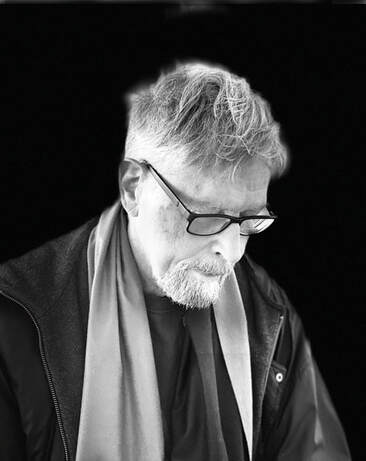 technical knowledge, Huntington works in a wide range of fields, including paintings, drawings, collages, print making, and computer generated graphics.
From 1982 to 1985, Huntington was the Visual Arts Director at Artpark, a public sculpture park in Lexington, New York. Under his directorship, the late video and installation artist Vito Acconci executed his first major public sculpture and the late Chris Burden created his “Bean Drop”, a performance piece in which seventy-one iron beams were dropped, over the course of a day, into a pool of fresh concrete. This kinetic form of abstract expressionism was recreated at Inhotim, Brazil, in 2008, after surviving only as documentation for twenty years.
 Richard Huntington has had many residencies over his career, including Visiting Critic at Washington DC’s Kennedy Center for the Arts. He was also a contributing reviewer for publications, including ARTNews, Art New England, and High Performance Magazine. Huntington served as art critic for The Buffalo News from 2095 to 2007, where he wrote critical articles and reviews on regional and international exhibitions.
Huntington won the 2007Associated Press Award for Criticism for his review which challenged O’Keefe’s status in American art. He is the author of two novels: “An Art Critic Walks into a Bar” and a sequel with the same character, “7 Dead or Otherwise Forgotten Artists”. Huntington also authored a number of essays for art catalogues including “Storyboard: The Sexual Politics of Jackie Felix”, for the 2012 retrospective at Burchfield Penney Art Center; and “Duayne Hatchet: Form, Pattern, and Invention” for a 2009 retrospective at Burchfield Penney.
Bottom Insert Image: Richard Hunting, “Squares of Mine”, 1965, Acrylic on Canvas, Burchfield Penney Art Center, Buffalo, New York


Five Oil Paintigs by David Urban, Corkin Gallery, Toronto
Born in Toronto in 1966, David Urban studied poetry and painting at York University, earning a BFA in 1989. Urban received a Master’s degree in English Literature and Creative writing from the University of Windsor in 1991 (where he studied with Alistair MacLeod) and a second Master’s degree in Painting from the University of Guelph in 1993.
His work is represented in many private and public collections including the National Gallery of Canada. In 2002, Urban curated Painters 15, an exhibition of established Canadian painters which was presented at the Shanghai Museum of Art and the Museum of Contemporary Canadian Art.


Four Paintings by Willem de Kooning
De Kooning strongly opposed the restrictions imposed by naming movements. While generally considered to be an Abstract Expressionist, he never fully abandoned the depiction of the human figure. His paintings of women feature a unique blend of gestural abstraction and figuration. Heavily influenced by the Cubism of Picasso, de Kooning became a master at ambiguously blending figure and ground in his pictures while dismembering, re-assembling and distorting his figures in the process.
Although known for continually reworking his canvases, de Kooning often left them with a sense of dynamic incompletion, as if the forms were still in the process of moving and settling and coming into definition. In this sense his paintings exemplify ‘action painting’ – they are like records of a violent encounter, rather than finished works in the old Beaux Arts tradition of fine painting.
Although de Kooning came to embody the popular image of the macho, hard-drinking artist, – de Kooning approached his art with careful thought and was considered one of the most knowledgeable among the artists associated with the New York School. Willem de Kooning is thought to have possessed the greatest facility and polished techniques of painters in the New York School, one that compares to that of Old Masters, and he looked to the likes of Ingres, Rubens and Rembrandt for inspiration.


Paintings by Alden Mason
Born in the state of Washington, Alden Mason is perhaps best known for his so-called Burpee Garden series, painted in the 1970s, and named for the seed catalogs that enthralled him as a child growing up on a farm in the Skagit Valley.
“They were big, glorious abstractions, with transparent, very thinned-down oil paint,” said Sheila Farr, a Seattle author, arts writer and former art critic for The Seattle Times. The paintings were acclaimed and catapulted his career into the New York art world. But Alden Mason paid a price for the works, as fumes wafting up from the thinners and paint sickened him. “He had invented this really unique style of painting, but he had to give it up,” Farr said.
The influence of nature, native art forms and the free-form artwork of children infused much of his work. “My paintings are a private world of improvisation, spontaneity, humor and pathos, exaggeration and abandon,” Alden Mason wrote in an artist’s statement for Foster/White Gallery, which has represented him since 2002. “Old-fashioned emotional involvement is still my main priority in painting.”

Gunter Damisch, “ Querfeldflimmern (Cross Field Flickering)”, Oil on Canvas, 1996


Paintings by Aquira Kusume, Acrylic on Board, Osaka, Japan


Paintings by Emie Gerzabek
Emie Gerzabek was born in Budapest, Hungary and moved in 1958 to Sydney, Australia. He is an architect, both in Interior Design and Landscape Design, a sculptor, and a mixed media artist and painter.

Robert Motherwell, “Wall Painting III”, 1952, Oil on Fiberboard, 48 x 72 Inches, Smithsonian American Art Museum
Robert Motherwell was an American painter, printmaker, and editor. He was one of the youngest of the New York School (a phrase he coined), which also included Philip Guston, Willem de Kooning, Jackson Pollock, and Mark Rothko.
He described his working process as follows: “I begin painting with a series of mistakes. The painting comes out of the correction of mistakes by feeling. I begin with shapes and colors, which are not related internally nor to the external world; I work without images.”

Jackson Pollock, “The Key”, Oil on Linen, 1946, 150 x 208 cm., Art Institute of Chicago
“The Key” belongs to Jackson Pollock’s ‘Accabonac Creek’ series, named for a stream near the East Hampton property that he and his wife, the painter Lee Krasner, purchased in late 1945. Marking a crucial moment in his evolution as an artist, this quasi-Surrealist painting was created on the floor of an upstairs bedroom and worked on directly from all sides.
Although there is a general suggestion of landscape, here the process of painting became primary, expressing the power of spontaneous action and chance effects. The resulting abstraction, with its expressive, gestural appearance, prefigured the all-over compositions of Pollock’s celebrated drip paintings, which debuted the following year.

Arshile Gorky, “ The Black Monk”, Museo Thyssen-Bomemisza, Madrid, Unfinished on Gorky’s Easel at the Time of his Death in 1948.
Arshile Gorky was an ethnically Armenian painter, who had a seminal influence on Abstract Expressionism. He spent most his life as a national of the United States. Along with Rothko, Jackson Pollock and Willem de Kooning, Arshile Gorky has been hailed as one of the most powerful American painters of the 20th century.

Wassily Kandinsky, One of a Series of Color Studies of Squares and Circles
Wassily Kandinsky produced his early work in Russia, his mature and most revolutionary work in Germany, and his later work in France. He invented a language of abstract forms with which he replaced the forms of nature. His ultimate intention was to mirror the universe in his visionary world. He felt that painting possessed the same power as music and that sign, line, and color ought to correspond to the vibrations of the human soul.