J. Carino

The Artwork of J. Carino

Based in Riverside, California, J. Carino is a figurative artist whose work illustrates the interconnection between man with his sense of self-awareness and the natural world, both literal and symbolic. A  2011 graduate of the Parsons School of Design in New York City, he works in a variety of mixed-media techniques and often uses distortion and abstraction in the construction of his work’s figures.

Carino’s images depict nude, queer figures, often monumental in size, who are set in landscapes both idyllic and suffused with danger. Applying ideas from his study of the decorative arts, he explores the concepts of queerness, self-identity, queer intimacy, sensuality, and man’s relationship with the natural world through images of richly colored and patterned, layered figures and flora. During the evolution of his work’s creation, Carino often adds and removes the layers of landscape and figures to achieve the desired result.

J. Carino’s work has appeared in multiple exhibitions both in the United States and overseas. These include both the Act 1 and Act 2 Summer Stage exhibitions at Auxier/Kline in New York, the 2021 online “Eye Candy” exhibition by the WB Gallery,  the 2020 Art Pride International, and, in the United Kingdom, the 2022 collective “Come Out & Play” at London’s BEERS gallery and the 2019 exhibition at Rye’s McCully & Crane Gallery, among others. 

“Like many queer people, there is a dichotomy of wanting to be seen as a whole person, sexuality included, but also the fear of people seeing too much. My figures, often self portraits, inhabit landscapes of abundance and fertility, lush with ferns and fruit, like an eden where these fears dissipate. Through my work, I explore the complicated influence of intimacy, sexuality, and being seen, especially as it relates to gay relationships and our ability to connect with one another and ourselves.” —J. Carino

J. Carino’s work can be found at the artist’s site located at https://www.jcarinoart.com  and  also at the following gallery locations  https://linktr.ee/j.carino.art

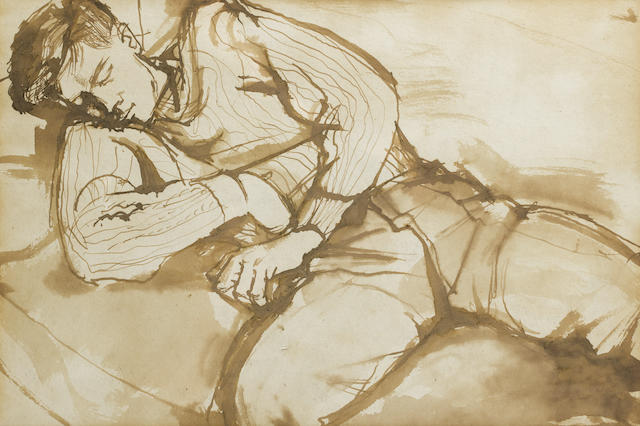
Bottom Insert Image: J. Carino, “Self Portrait”, Date Unknown, Mixed Media on Paper

Richard Hovey: “He Flung Himself at the Eternal Sky”

Photographers Unknown, Parva Scaena (Brief Scenes): Photo Set Twenty-Five

AVID of life and love, insatiate vagabond,
With quest too furious for the graal he would have won,
He flung himself at the eternal sky, as one
Wrenching his chains but impotent to burst the bond.
Yet under the revolt, the revel, the despond,
What pools of innocence, what crystal benison!
As through a riven mist that glowers in the sun,
A stretch of God’s blue calm glassed in a virgin pond.
Prowler of obscene streets that riot reels along,
And aisles with incense numb and gardens mad with rose,
Monastic cells and dreams of dim brocaded lawns,
Death, which has set the calm of Time upon his song,
Surely upon his soul has kissed the same repose
In some fair heaven the Christ has set apart for
Fauns.

Richard Hovey, Verlaine, Songs from Vagabondia, Richard Hovey and Bliss Carman, 1894

Born in Normal, Illinois, in May of 1864, Richard Hovey was a poet, translator, and dramatist. A talented poet at an early age, his first volume of poetry was privately published in 1880, at the age of sixteen. He graduated from Dartmouth college in 1885; he is known for writing its official Alma Mater, “Men of Dartmouth”. He was described by many who knew him as a self-conscious man, an American Oscar Wilde in both mannerisms and clothes.

After graduation, Hovey studied art in Washington, DC, and then theology at the Central Theological Seminary in New York City; he later became a lay assistant at the Church of St. Mary the Virgin. Hovey relocated to Boston where he became a newspaper reporter and, in 1887, met the Canadian poet Bliss Carman, with whom he would begin a lengthy collaboration. After studying acting for a brief period to become a better playwright, Hovey wrote the first collection of his dramatic poems, “Lancelot and Guenevere: A Poem in Dramas”, which was published in 1891. Originally planned as  a collection of nine plays, he only completed four volumes, one of which was the 1895 “The Marriage of Guenevere”. 

Richard Hovey moved to France in the following year and met many members of the French Symbolist movement, including the French poets Paul Verlaine and Stéphane Mallarme, and the Belgian poet Maurice Masterlinck, a future Nobel Prize winner who greatly influenced Hovey’s work. Hovey and Bliss Carman were both members of the “Visionists” group, a Boston-based social group of artists and writers who shared an interest in Aestheticism, Theosophy, and the Decadent movement. Members of this group also included writer and art critic John Ruskin, poet and painter Dante Gabriel Rossetti, and writer Oscar Wilde. 

After becoming one of the first translators of Maurice Masterlinck’s works, completing eight plays into English, Richard Hovey collaborated with Bliss Carman on their first project together, the “Songs of Vagabondia”. Published in 1894, this collective work celebrated the carefree life of a vagabond on the road in the fictitious place called Vagabondia. The Bohemian mood of their poems of masculine comradeship and college fraternity received critical acclaim and became an immediate success; it was followed by a second volume “More Songs from Vagabondia” in 1896 and a third “Last Songs from Vagabondia”, published in 1900 after Hovey’s death. 

Besides his collaborations with Bliss Carman, Hovey had a number of works published under his own name. These include the 1893 “Seaward”, an 1898 elegy on the poet Thomas William Parsons;  the 1898 “Along the Trail: A Book of Lyrics”; and the 1898 “Taliesin, A Masque”, a poetic play in which the bard Taliesin and Percival, a knight of the Round Table, meet the spirit of Merlin, the Three Muses, and Hermes, and other characters. Hovey’s “To the End of the Trail” was published posthumously in 1908. 

Richard Hovey lectured on Aesthetics at the Farmington School of Philosophy and, in 1888, became a lecturer at Columbia University in New York.  He also, in his last years, was a Professor of English at Barnard College in New York City. He died on February 24th of 1900, at the age of thirty-five, after undergoing minor surgery.

The Richard Hovey collection, containing manuscripts, correspondence, scrapbooks, notebooks, and newspaper clippings is housed in theDartmouth Library Archives and Manuscripts.

Notes: After a large fresco painted by Mexican muralist José Clemente Orozco in the Dartmouth College campus library was judged by many alumni to be too critical of the college, alumnus and illustrator Walter Beach Humphrey was allowed to paint a mural more in character with the college. 

This mural was based on a drinking song written by Richard Hovey and portrays the mythical founding of the college by Eleazer Wheelock. In its first panel, he is seen pulling a five-hundred gallon of rum, and being greeted by young Native American men, whom he introduces to drunken revelry. This encounter circles the faculty dining hall and also features half-naked Native American women. In the early 1970s, the “Hovey Murals” became so controversial that they were covered over, and the room itself was closed.

An extensive article for those interested is Ezra Pound scholar Leon Surette’s “Ezra Pound, Bliss Carman and Richard Hovey” which contains the meeting of Carman and Hovey, and Pound’s recollections of them. It can be found at:  https://canadianpoetry.org/volumes/vol43/surette.html

Middle Insert Image: Robert Gryden, “Richard Hovey”, Date Unknown, Engraving

Pier Luigi Nervi

Architectural Designs by Pier Luigi Nervi

Born in the Alpine town of Sondria in June of 1891, Pier Luigi Nervi was an Italian engineer and architect known for his innovative use of concrete and thin-shelled structures. In 1913, he earned his degree in engineering from Bologna’s Civil Engineering School, and upon graduation, joined the Society for Concrete Construction. Nervi considered building construction to be both an art and a science, and as such, dedicated his career to the innovative use of reinforced concrete.

During World War I, Nervi served from 1915 to 1918 as a lieutenant in the Italian Army’s Corps of Engineering. After the war, he worked, beginning in 1923, as a civil engineer in both Bologna and Florence. Nervi’s first significant work was the Augusteo Cinema Theater on the Vomero hill in Naples, which  was completed in 1927. This work was followed by Florence’s Stadio Artemio Franchi, originally named Studio Giovanni Berta. Built between 1930 and 1932, its boldly cantilevered roof and helical staircases won critical acclaim and popular attention throughout Italy. 

In 1932, Pier Luigi Nervi formed a contracting firm, called Società Ingg. Nervi e Bartoli, with his cousin, engineer Giovanni Bartoli, with whom he would work for the remainder of his career. In 1935, Nervi won a competition held by the Italian Air Force for the construction of a series of hangers to be built throughout Italy. His conception of the hangers as concrete vaults with huge spans of reinforced concrete, constructed at low cost, were built between 1935 and 1941. After finishing the first hanger in Orvieto, he improved the design of the hangers in Obertello and Torre del Lago by using precast ribs, a lighter roof, and a modular construction method.

Nervi’s conceptual designs continued to grow through his search for new solutions to structural problems. Through his research, he developed a material of his own invention, a dense concrete called ferrocemento, which was heavily reinforced with evenly distributed steel mesh that gave both lightness and strength. This material played a vital role in Nervi’s design for the Palace of Labor, a collaborative project with his son Antonio Nervi for an exhibition space at the 1951 Turin Exhibition. A prefabricated structure in the form of a corrugated cylindrical arch, the Palace of Labor contained eighty-five thousand feet of exhibition space under a roof divided in sixteen structurally separated squares edged by continuous skylights. Sixty-five foot concrete columns were fixed in the center of each square and held these squares through small arched ribs. The use of arched ribs became a characteristic of Nervi’s oeuvre.

Pier Luigi Nervi’s solutions to construction problems was always direct; he transmitted the stresses developed within his structures to the ground by the shortest path. He used insights from his study of geometry to develop a new form of shell construction, one which generated three-dimensional lattices from concrete ribs. Nervi’s innovative use of pre-made concrete modules was cost-effective and resulted in both functional and ornamentally-geometric structures. Although his primary concern was never aesthetic, his works achieved a forceful expression to a great degree. Nervi introduced a creative three-dimensional quality into architectural design by his use of warping surfaces, folded plates, and intersecting planes. He emphasized functional needs, the technology of construction, knowledge of materials and statistics, and efficiency in building as the mainstays of an architect’s career.

Nervi was awarded Gold Medals by the United Kingdom’s Institution of Structural Engineers, the American Institute of Architects, and the Royal Institute of British Architects. in 1961 Harvard University appointed Nervi  to the Charles Eliot Norton Chair of Poetry. Towards the end of his career, Nervi, assisted by his two sons, the engineer Antonio and the architect Mario, confined his activities to design work in association with other architects. He died in January of 1979, at the age of eighty-seven, in Rome, Italy.

Nervi’s works include the UNESCO headquarters in Paris; Milan’s Pirelli Tower which was the first skyscraper in Italy; the Palazzetto dello Sport in Rome; the Sacro Cuore Bell Tower in Florence; the Cathedral of Saint Mary of the Assumption in San Francisco,;the cylindrical Australian Square tower, at the time the tallest concrete structure in the world; Vatican City’s Paul VI Audience Hall; and the Australian Embassy in Paris. 

Bruno Barbey

Photography by Bruno Barbey

Born into a diplomatic family in February of 1941, Bruno Barbey was a Moroccan-born French photographer whose work covered a span of nearly fifty years. He studied graphic arts and photography at Switzerland’s Ecole des Arts et Métiers in the city of Vevey. During the 1960s, Barbey was commissioned by Editions Rencontre, a publishing house in Lausanne, to photograph in African and European countries.

In 1966, Barbey began a long career with the international Magnum Photos, one of the first photographic cooperatives owned and administered entirely by its members. He later became an Associate member in 1966, and a full member in 1968, at which time he produced a series of work on the student riots in Paris. Barbey continued his career at Magnum Photos as vice-president for Europe in 1978 and 1979, and as President of Magnum International from 1992 to 1995.

Beginning in 1979, Bruno Barbey worked on a two year photographic project in Poland to document the socio-political changes occurring in the country. In a time when the country was divided between Christianity and Communism, he and his family traveled, while living in a camper, over forty thousand miles over an eight month period. In spite of the strict surveillance of visitors to Poland at the time, Barbey was able to take many informal photographs of the local people; seventy-five photographs of this series were published in his 1982 “Portrait of Poland”.

Although he photographed throughout many countries, Barbey became best known for his coverage of world conflicts, including civil wars in Nigeria, Vietnam, Northern Ireland, the Middle East, Cambodia, and the liberation war in Bangladesh. His work has been published in over twenty books, which included photographic projects in Portugal, Bombay, Kenya, Italy, Istanbul, and Naples, among others. Barbey did the cinematography on Éric Rohmer’s 1963 film “The Bakery Girl of Monceau” and had worked on eight films with director Caroline Thiénot, including the 2015 short film “Passages”.

In 1999, Paris’s art museum Petit Palais organized a large exhibition of photographs that Barbey had taken in Morocco during the previous three decades. In 2015, La Maison Européene de la Photographic, based in Paris, presented a retrospective exhibition of Barbey’s work, which traveled internationally in 2016. A retrospective book of his work, “Passages” was also released in the same year.

In 2016, Bruno Barbey was elected as member of the French Academy of Fine Arts. He had received many awards for his work, including the French National Order of Merit. Known for his free and harmonious use of color, Barbey died in November of 2020, at the age of seventy-nine, in Orbais l’Abbaye, France. His photographs have been exhibited internationally and are in numerous museum collections.

All photos credited to Magnum Photos.

Samuel Greenberg: “And This Great Human Rebellion”

Photographers Unknown

And this great human rebellion, has it’s scattered laureates – sparks,
That kindle the flame to repeat my brother will cause the perfumed love more clear
And seek heavenly envy. In spite the selfish heart limits perhaps weave the better birth
We then easily blend a lodge, which can pray upon the universe of charm
And share the impulse of progress, this vital grain must plead thousand-fold
Live in us, as the blowing sea breeze! Through an angel gate,
The ecliptic change found me under a leafless Oak.
The cast shadowings of branches like madusa’s skull
There in on looking leveled my talent to flood the mind in abstract ecstasy,
The gallant spurtive land and heaven with the numberless diamond circle, gives joy hither,
Whether the banner contains power to plenty the soul,
This humble chip in our reverence doth limit it’s whole

end.

Samuel Greenberg, And This Great Human Rebellion

Poet and artist Samuel Greenberg, the sixth of eight children born to Jacob and Hannah Greenberg, was born on December 13, 1893, in a Jewish ghetto in Vienna, Austria. The family emigrated to the United States in October of 1900 and settled on Manhattan’s Lower East Side, where his father worked as an embroiderer. With his mother’s death in  1908, Greenberg, at the age of fourteen, was compelled to leave school to support his family and began work at his older brother Adolf’s leather shop, where he likely contracted tuberculosis in 1912. 

Greenberg began writing poems in his notebooks sometime in 1912. In that year, he also began taking piano lessons, often drawing staff lines with musical notes in his notebooks. Greenberg was also a avid reader of British Romantic classics, as well as the works of John Milton, William Blake, and Oscar Wilde. He painted and was a sketch artist; many of his works, often portraying young men seen in Washington Square Park, were done on scraps of paper or in small sketchbooks. 

Samuel Greenberg was fluent in three languages, Yiddish, German and English. His existing poetry, written in a hard-to decipher English scrawl, was composed between 1913 and 1917. Greenberg’s work was raw in form, contained many spelling errors and unclear grammar; his preferred poetic structure, the sonnet, never extended beyond fourteen lines. Due to his fragile health and early death of both parents, Greenberg was deeply aware of his own mortality, a feeling he relayed in his poems.

After the death of his father in 1913, Samuel Greenberg spent the rest of his life living with one sibling or another. In his final years, he was in and out of charity hospitals in the boroughs of Bronx, Staten Island, and Queens, where he did most of his writing. Samuel Greenberg died of tuberculosis, at the age of twenty-three, in the Manhattan State Hospital on Wards Island on August 16, 1917.

Samuel Greenberg’s work, consisting of over six hundred poems and fifteen notebooks, was never published in his lifetime.His literary immortality is due to the praise and discovery of him by the well-known poet and critic Alan Tate. It was also due, in a large sense, to poet Hart Crane, an admirer of Greenberg’s work who excerpted material from the poems and, either verbatim or slightly modified, included it in his own work. An example of this is Crane’s “Emblems of Conduct”, where he took actual lines of Greenberg’s poem “Conduct”,  slightly altered, and included it in his own published work.

Samuel Greenberg’s work has appeared in several publications, including James Laughlin’s “Poems from the Greenberg Manuscripts”, published in 1939,  and “Self Charm: Selected Sonnets and Other Poems”, published in 2005. His papers are now housed in the Fales Collection at New York University.

Top Insert Image: Samuel Greenberg, Musical Staffs and Hands, Sketchbook Page

Bottom Insert Image: Samuel Greenberg, “Self Portrait”, 1916, Pencil on Paper

Note: A very interesting article by Jacob Silverman, entitled “Rimbaud in Embryo”, on the work and the tragically short life of Samuel Greenberg, including opinions of his poetic peers, can be found at the Poetry Foundation located at:  https://www.poetryfoundation.org/articles/69896/rimbaud-in-embryo

There is also a reading of Samuel Greenberg’s “The Tusks of Blood” and a commentary by former Poet Laureate of New Jersey Gerald Stern at the Library of Congress’s Poetry and Literature Program: https://www.loc.gov/programs/poetry-and-literature/audio-recordings/poetry-of-america/item/poetry-00001018/gerald-stern-samuel-greenberg/

Piero Fornasetti

The Artwork of Piero Fornasetti

Born in Milan, Italy in November of 1913, Piero Fornasetti was an eclectic artist who was an important figure in the Italian design scene. A prolific creator of designs, he was involved in many aesthetic disciplines including painting, drawing, graphic design, and product design. In the course of his career, Fornasetti created over ten thousand works and was responsible for one of the largest outputs of diverse objects and furniture of the twentieth-century. 

The first child of a wealthy family, Fornasetti was already at the age of ten drawing and displaying an innate inclination towards art. In 1932, he enrolled at the Academia di Brera, Milan’s public academy of fine arts; however, two years later he was expelled for insubordination. Although he applied to Milan’s Superior School of Arts Applied to Industry, Fornasetti was unable to adhere to the schools dogma due to his rebellious nature. 

Beginning in the early 1930s, Piero Fornasetti began a individual and comprehensive study of  engraving and printing techniques. With this knowledge and his developed technical skill, he began to print artist books and lithographs for many of the great artists of the time, including composer and playwright Alberto Savinio, painter Fabrizio Clerici, and painter and writer Giorgio de Chirico. The Fornasetti Art Printshop became the source of quality printing for many artists of his generation. Fornasetti, through his constant experimentation, later developed a printing method for graphic effects on silk; this innovation brought him  to the attention of designer and publisher Gio Ponti, with whom Fornasetti would develop a close creative partnership. 

From the early 1940s and onward, Fornasetti produced a vast series of limited edition graphic works, which included calendars, holiday gifts, and images for advertising, theater, posters, and publications. He produced sketches and drawings for the Esino Lario School of Tapestry, whose fine silk tapestries were produced by local village girls. In 1940 Fornasetti began to publish his own work in the architectural design magazine Domus, and for two years designed a series of almanacs for Gio Ponti. Taking refuge in Switzerland in 1943 during the war, he continued his graphic work, expanding into watercolors, oil portraits, drawings in ink, and the creation of theatrical sets for Albert Camus’s 1938 “Caligula”.

Upon his return to Milan, Piero Fornasetti and Gio Ponti began a close creative partnership which centered on architectural concepts in design and decoration. With the beginning of the 1950s, they put their theories into practice developing new simple and functional designs for the interiors of homes, apartments, cinemas and even ship cabins. Their initial project, the “Architettura” trumeau, a furniture design concept seen in an image above, was exhibited at the 1951 Triennale IX in Milan. This piece of furniture became an icon of Italian design in the interwar years of economic growth. 

Fornasetti is best known for his designs using fanciful motifs such as the moon, sun, playing cards, animals, and other surrealist imagery; most of which were executed in black and white. In 1952, he began work on his iconic and best known series, “Tema a Variazioni (Theme and Variations)”, a facial portrait of opera singer Lina Cavalieri, who was renowned at the time as a true archetype of a classical beauty. This image continues to appear today on a series of everyday objects from porcelain and fabrics to furniture and wall coverings. This portrait series entered into the world of theater as set designs in  Fornasetti’s production of Mozart’s two-act opera, “Don Giovanni”. These designs were used in the December 2016 performances at Milan’s Teatro dell’ Arte and in the  January 2017 performances at Florence’s Teatro della Pergola.

In 1970, Piero Fornasetti, along with a group of friends, operated the Galleria dei Bibliofili, where he exhibited his own work and the work of other contemporary artists. His paintings at this time contained both layered abstractions, with interacting colors done in various techniques, and figurative works done in a new pictorial style, where bodies and faces were composed of fruits and bottles. After the death of Gio Ponti in 1979 and the opening of London’s “Themes and Variations” design gallery in 1980, Fornasetti’s work and his idealogical concepts of form/function gained new interest both at home and abroad. 

Piero Fornasetti died in October of 1988 during a minor operation in hospital. In 2013, Silvana Annicchiarico, the director of the Triennale Design Museum, dedicated a first retrospective of Fornasetti’s work at the museum; this exhibition later went on tour to Paris’s Musée des Arts Décoratifs and Seoul’s Dongdaemun Design Plaza. A 1987 collaboration between Fornasetti and fashion writer and publisher Patrick Mauriés, which became a monograph entitled “Fornasetti: Designer of Dreams”, was published posthumously in 2015 with an introduction by Italian architect and designer Ettore Sottsass. Piero Fornasetti’s work can be seen in the collections of New York’s Metropolitan Museum of Art and London’s Victoria and Albert Museum. 

Note” An example of the range of Piero Fornasetti’s oeuvre can be found at the online Fornasetti website located at: https://www.fornasetti.com/bd/en/

George Sylvester Viereck: “Each by Strange Wisps to Strange Abysses Drawn”

Photographers Unknown, The Faces of man: Photo Set Twelve

Sweet is the highroad when the skylarks call,
When we and Love go rambling through the land.
But shall we still walk gayly, hand in hand,
At the road’s turning and the twilight’s fall?
Then darkness shall divide us like a wall,
And uncouth evil nightbirds flap their wings;
The solitude of all created things
Will creep upon us shuddering like a pall.

This is the knowledge I have wrung from pain:
We, yea, all lovers, are not one, but twain,
Each by strange wisps to strange abysses drawn;
But through the black immensity of night
Love’s little lantern, like a glowworm’s, bright,
May lead our steps to some stupendous dawn.

George Sylvester Viereck, The Wanderers

A controversial figure in America in the first-half of the twentieth century, George Sylvester Viereck was a multi-sided figure who gained fame as a journalist and neo-romantic poet; he also earned equal infamy as a publicist for pro-German causes. Born in Munich in December of 1884, he was  the first-born son of Louis Viereck, a member of the Reichstag who was imprisoned in 1886 for attending socialist meetings, and  San Francisco-born Laura Viereck, Louis’s first cousin. The family emigrated to the United States in 1896 and, five years later, Viereck’s father became an American citizen.

George Viereck studied at the City College of New York where he graduated in 1906. While still in college, he published, with the help of literary critic Ludwig Lewisohn, his first collection of poems in 1904. Viereck’s  next collection, “Nineveh and Other Poems” published in 1905, brought him national fame. Several poems in this collection were written in the style of the Uranian movement, a movement of primarily gay male artists and philosophers in the English-speaking world from the 1870s to the 1930s. 

From 1907 to 1912, Viereck developed a profound identification with Germany and became fascinated with all aspects of the German culture and people. In 1907, he published a vampire novel, “The House of the Vampire”, which was not only one of the first psychic-vampire stories but, also,  one of the first known homosexual vampire novels. Viereck, in 1908, published his best-selling “Confessions of a Barbarian”, a collection of personal narratives on subjects such as morals, art, and both German and international culture. Viereck was invited in 1911 to lecture on American poetry at the University of Berlin. Due to his ardent support of Germany and pacifism during the period of estranged Anglo-German relations leading up to World War I,  he was later expelled from several organizations and social clubs. 

Outspoken in his views against America’s involvement in World War I, George Viereck founded and became editor of the German-sponsored magazine “The Fatherland”, which argued the German cause. He was later arrested and served time in a Washington D.C. jail, during which period his son George Jr. died as a  combat casualty of the first world war which Viereck had vigorously opposed.  In August of 1918, a mob stormed Viereck’s  Mount Vernon home: and, in the following year, he was expelled from the Poetry Society of America. In 1919, Viereck wrote the book “Roosevelt”, a psycho-analytical study of Theodore Roosevelt and his attitude on matters of international interest, which was published by New York City’s Jackson Press.

After the end of the war, Viereck traveled throughout Europe and America interviewing many notable personalities, including Sigmund Freud, George Bernard Shaw, Adolf Hitler, Henry Ford, Marshal Ferdinand Foch, Benito Mussolini, and Albert Einstein, among others.  In 1924, he published a collection of poetry, entitled “The Three Sphinxes and Other Poems”; the collection’s poem “Slaves” would be quoted several times in the 1968 psycho-thriller film “Twisted Nerve” and be the inspiration for its title. 

George Viereck became a well-known supporter of National Socialism and a regular apologist for Germany. In 1933, he again met Hitler, who had become Germany’s leader, and gave a speech in 1934 at New York’s Madison Square Garden to an audience of twenty thousand in which he supported National Socialism without its antisemitism. In 1941 George Viereck established his own publishing house, Flanders Hall, in Scotch Plains, New Jersey, but was eventually indicted by the government for a violation of the Foreign Agents Registration Act. Convicted in 1942 for failing to register with the U. S. State Department as a National Socialist agent, he was imprisoned from 1942 to 1947. 

In 1952, Viereck’s “Men Into Beasts”, a general memoir of the loss of dignity, brutality, and the situational homosexuality and rape he witnesse in jail, was published by Fawcett Publications. This book was shortly followed by two more works: the 1952 “Gloria: A Novel” and the 1953 “The Nude in the Mirror”. Between 1906 and 1953, he published twenty-three works in the genres of theater plays, poetry, works of fiction, and works of political discussion and criticism. 

George Viereck’s literary works after his release from prison were not very successful, except for his “Men Into Beasts”, which would become one of the first original titles of 1950s gay novels. In 1955, he suffered a series of mild strokes and ceased his writing. George Sylvester Viereck died in March of 1962 in Holyoke, Massachusetts, of a massive cerebral hemorrhage at the age of seventy-seven. 

Note: An interesting read on the emotional and psychological development of Viereck’s life, and his perception of his own sexuality, is Phyllis Keller’s “George Sylvester Viereck: The Psychology of a German-American Militant” from the MIT Press. It can be found at the JSTOR site: https://www.jstor.org/stable/202443

Soufiane Ababri

Drawings by Soufiane Ababri

Born in Rabat, Morocco in 1985, Soufiane Ababri is a multi-media artist who works in the fields of drawing, sculpture, film, and performance art. He graduated from the École Supérieure des Beaux-Arts in 2010 and earned his Masters of Arts at Paris’s École Supérieure des Arts Décoratifs in 2014. Ababri divides his life and work between the cities of Paris, France, and Tangier, Morocco. 

Although he works in many medias, Soufiane Ababri is best known for his homoerotic drawings of men portrayed in settings which depict a flourishing queer subculture. His scenes, either  humorous or infused with emotion, are drawn from his life as a gay Moroccan immigrant in Europe. Ababri’s most acclaimed series, “Bed Works”, was initiated in 2016 and is still continuing today. These pencil portraits of men, drawn while lying down in bed, are conveyed in bold, energetic colors and explore Ababri’s interest in the nuances of masculinity and male intimacy. 

Having a strong interest in sociology, Ababri’s oeuvre also deals with the idea of visual experience as an exercise in introspection, that is the artist sees the world as the world sees him. Ababri’s work, built from layers of personal and intimate events, also uses literary works, such as Antoine de Saint-Exupéry’s 1943 “Little Prince” and poet Frank O’Hara’s “A True Account of Talking to the Sun”, to examine the tensions, stigmas,  and ambivalences in present day  society. 

Soufiane Ababri’s 2020 “Tanned But Still Angry” series consisted of seventeen colored pencil on paper drawings that Ababri developed over several years in reaction to police violence. These drawings depicted real scenes and situations experienced by Ababri himself and fellow members of the LGBT and POC communities. Fueled by the deaths of Adama Traoré in 2016 and George Floyd in May, the series not only powerfully displays injustice, but also, often poetically, emphasizes the need for equality.

Soufiane Ababri’s most recent solo show, the 2021 “Bunch of Queequeg”, named after the “Moby Dick” character, included all works from the continuing “Bed Work” series and was held at Praz-Delavallade in Los Angeles.The triptych drawing from that exhibition, seen in the above images, shows Ababri as Queequeg in the middle panel, with Ishmael in tight-fitting shorts on the right panel and three skewered severed heads on the left panel. In this work, Ababri considers not only the literature of colonialism and its lasting effects on daily life and culture, but also its presence in our most intimate relationships.

Ababri’s installation / performance pieces include the 2017 “Moving Frontiers: Do and Undo” at the Espace Doual’Art in Doula, CM; the 2018 “Humes l’Ordeur des Fleurs Pendant Qu’il en est Encore Temps” held at the Marathon des Mots in Toulouse, France; the 2018 “Here is a Strange and Bitter Crop” at Space in London; the 2019 “Tropical Concrete Gym Park” at the Glassbox in Paris; the 2019 “Memories of a Solitary Cruise” held at The Pill in Istanbul; and the 2020 “Something New Under the Little Prince’s Body” at the Dittrich & Schlechtriem in Berlin.

Soufiane Ababri has exhibited in Berlin, Brussels, and Istanbul. His work is in the collections of Fonds Régional d’Art Contemporain Pointou-Charente and Musée d’Art Contemporain du Val-de-Marne, and Fonds Régional d’Art Contemporain, Pays de la Loire. In 2021 Ababri’s work was included in the Glasgow International Festival for Contemporary Art. 

Note: Photos of Soufiane Ababri’s performance and artwork, as well as  contact information, can be found at: https://soufianeababri.com

An interesting article, written by Joey Levenson, on Soufiane Ababri’s newest book and his use of intimacy as a means of social construct analysis can be found at: https://www.itsnicethat.com/articles/soufiane-ababri-art-100821

Shirley Everett Johnson: “The End and Aim of Art”

Photographers Unknown, Twelve Portraits of Men

Howard then blurted out this proposition: “I say, fellows, let us form a new club, to be known as “The Cult of the Purple Rose.” What do you say?”

Lucian Denholm, the tall, slender man with a pensive face, who was really brilliant and therefore said little, was now the first to speak, because the name had been suggested by his Purple Tea. He was enthusiastic in favor of the scheme, and said he was complimented by the recognition of his efforts to be original. Then he outlined his plan.

“Oh, it will be simple lovely,” he said, “and so original! We will all wear purple roses, and write on purple linen, —I might say purple and fine linen, —use three cent purple stamps instead of the customary twos, and if any of us should ever write on white paper, he must invariably use purple ink.

“Besides, we would attract so much attention with our purple handkerchiefs and hat bands. It will be so gratifying to hear people remark how hideous they are, and we can be as truly happy as the end and aim of art will allow.

“And to carry it further, we can write purple verses and purple stories and tell purple lies, in lieu of commonplace white lies. And just as it has been shown how lying is a fine art, so much more will purple lying be art.”

—-Shirley Everett Johnson, The Cult of the Purple Rose, Section II, 1902

There is very little information on the life of Shirley Everett Johnson, the author of “The Cult of the Purple Rose”. It is known that he graduated from Harvard University with the class of 1895, which he joined following his sophomore year at the Louisville High School. Johnson was not known to have participated in any of the recognized extracurricular activities available at the college. During his life, he was a journalist and a banker in the state of Kentucky. 

Johnson’s only published books are the 1901 “Conquering a Small Pox Epidemic in Kentucky” and the 1902 novel “The Cult of the Purple Rose: A Phase of Harvard Life”, which was published by Richard G. Badger of Boston’s Gorham Press. 

Considered to be among the genre known as proto-gay novels, “The Cult of the Purple Rose”  is an odd, esoteric example of American college fiction, one which dealt with Harvard University’s student life at the very end of the nineteenth-century. The book’s preface states that the story concerns the lives of a few exceptional people and should not be taken as a full presentation of Harvard undergraduate life. Although a fictional work, some  parts of the book are known to be factual. These include remarks made about publishers Herbert S. Stone and Ingalls Kimball, who as Harvard undergraduates were responsible for the 1894 “The Chap Book” and the 1893 “First Editions of American Authors”. 

In “The College Pump” article, published in the Harvard Alumni Bulletin of April 19, 1958, there was an extract from a doctoral thesis by Maurice F. Brown Jr. which explored the late nineteenth-century, cultural climate of the Yard, the historical campus area of Harvard containing most of the freshman dormitories. This excerpt contained a discussion of “The Cult of the Purple Rose” and also a discussion on the Laodicean Club of 1893. There is speculation that what was known as The Cult of the Purple Rose may have actually been the Laodicean Club.

Whether regarded as fictional or factual-based, “The Cult of the Purple Rose” presented a portrait of Harvard University’s reaction to publications associated with the Aesthetic and Decadent movements of the late-nineteenth century. Both of these movements ran contrary to the established persona of Harvard University. The artists and writers of  the Aesthetic movement tended to believe that the Arts should provide refined sensuous pleasure, rather than convey sentimental or moral messages. The Decadent movement followed an aesthetic ideology of excess and artificiality, and held to the view that human creativity and art were superior to logic and the natural world. Literary examples of these movements include “The Lark” and the literary quarterly “The Yellow Book”, both published in England.

The story within “The Cult of the Purple Rose” also presented the university’s perception and judgement of such prominent figures of the time as essayist Max Beerbohm whose works first appeared in “The Yellow Book”, illustratorAubrey Beardsley who co-founded “The Yellow Book”, and author Oscar Wilde. All three, among others, were members of the Aesthetic movement.

Notes: 

In the Harvard Illustrated Magazine, Volume IV, October of 1902, there is a review of “The Cult of the Purple Rose”. Although the main aspects of the plot was considered to be nonsensical, the book was judged as clever and readable, at times witty, but by no means sincere. The type-work and cover were considered attractive and the book distinctly well made. 

A full edition of “The Cult of the Purple Rose” can be found at the Internet Archive located at: https://archive.org/details/cultpurplerosea00presgoog/mode/2up

Jesús Carrillio

Paintings by Jesús Carrillio

Born in the Andalusian town of Córdoba, Jesús Carrillio is a Spanish multi-media artist who also uses the name Eltío Esse. He works in the fields of painting, photography, computer graphics and film making, Interested in drawing and color from an early age, Jesús Carrillio received his initial lessons in art from his older brother, the painter José Maria Carrillio. 

At the age of sixteen,  Jesús Carrillio attended the Priego Landscape School where he did landscape painting influenced by the school’s impressionistic style. His formal art training began at Granada’s Padre Suárez Institute where he studied art history, art theory, and aesthetics. In 1990, Carrillio attended the Faculty of Fine Arts at the University of Granada, where he majored in painting.

After graduating from the Faculty of Fine Arts, Jesús Carrillio moved in 1995 to the seaside city of Brighton, England, where he painted and worked as a postman. Three years later, he moved to Salamanca, Spain, where he enrolled in its University to study design and both audiovisual and multimedia techniques. Influences on Carrillio’s expressionistic work are the Italian and Flemish paintings of the sixteenth and seventeenth centuries , and his attraction to African culture and art.

Carrillio often uses computer software to enhance his painted images. Both his film and video art, as well as his unique animated and static GIFs,  are designed to be viewed as projections at performances and installation projects. Carrillio’s photographic work and digital paintings are printed on brushed aluminum panels, a process in which, while darker areas of the image appear matte, the lighter areas of the image have a unique shimmer.

More information on Jesús Carrillio’s work, including commissioned pieces and contact information, can be found at his Artfinder site located at: https://www.artfinder.com/artist/eltioesse/

Andreas Georgiadis Kris

Andreas Georgiadis Kris, “Οι δύο φίλοι (The Two Friends)”, 1965, Oil on Canvas

Born in 1892 in Chania, a city on the northwest coast of Crete, Andreas Georgiadis Kris was a Greek painter whose work was influenced by the western art tradition. Due to the rebellion of the Greek Army against the rule of the Ottoman Empire and the subsequent burning of the city of Chania, the family moved to Egypt in 1896, where Andreas Kris spent his childhood in Cairo and Ismailia. As he grew older, he became employed in the workshop of the interior contractor V. Vernardos, and later became an assistant painter and decorator under Orlando in Cairo. Recommended to the architectural firm of the Nistri brothers, Kris remained with this firm for three years.

In 1910, Andreas Kris traveled to Athens and took the entrance exam at its School of Fine Arts, which gave him admittance to the third class under portraiture painter Dimitris Geraniotis. After the start of the Balkan Wars, Kris volunteered for military duty in 1912, joined a unit of Garibaldi volunteers known as the Red Tunics, and later, in the Battle of Drisco, suffered the loss of an eye at the city of Kriftsi in Greece. After leaving military service, Kris resumed his studies at the School of Fine Arts where, from 1914 to 1923, he trained under Ceorgios Roilou, Georgios Jakovibis,  and Spyridon Vikatos, all portraiture and genre painters of the Munich School tradition. 

In 1922, Andreas Kris was awarded first prize in the Panhellenic Arts Competition for his work depicting  the 1826 heroic exit of the Greeks from their city of Missolonghi, which was under siege by the Turkish army during the Greek War of Independence. He later won first prize in an exhibition at Athens’ Polytechnic which secured him a four-year scholarship to study in Europe. Kris studied in Paris at the Ecole des Beaux Arts and at three free academies, including the Julian Academy. During this scholarship period, he frequently traveled throughout Europe to study the masterworks in the museums of Paris, Madrid, Antwerp, Brussels, and Ghent. From these studies, Kris produced a series of twenty-five studies based on the works of Ruben, Van Dyke, Velasquez, and Jusepe de Ribera. 

Returning to Greece in 1929, Andreas Kris had his first solo exhibition at Athens’s  Parnassos Hall; his collection of forty works received critical attention from Zacharias Papantoniou, who was the Director of the National Gallery. In August of 1929, Kris received the Heracles Voltos Scholarship form the University of Athens, which enabled him to study, both in Paris and Rome, the development and techniques of western European art.

Andreas Kris traveled and studied for seven years in Italy, which included a one-year training period at the Regia Seuola per Industrie Artistiche under fresco painter Mario Roversi. In 1930, Andreas Kris’s oil painting “Manna” was accepted for the new work exhibition at the Salon in Paris’s Grand Palais on Champs-Élysées. At the 1934 Venice International Exhibition, Kris entered three works, one of which was his “Portrait of a Friend”. After contributing to the oversight of the 1935 restoration work on Athens’s Old Royal Palace’s murals, he was selected to send one of his works to the 1936 International Exhibition in Sydney, Australia. Later in the same year, Kris exhibited works,  which included portraits, in two  collective shows held at the Atelier Gallery.  

Andreas Kris was appointed as the Chair of Painting at Athens’s School of Fine Arts in 1947, where he taught composition and color studies for fourteen years. Invited to show his work at the 25th Venice International Exhibition held in 1950, he exhibited ten paintings, of which his work of chiaroscuro, entitled “The Fall”, received critical acclaim. Kris participated in the 1957 Mediterranean Exhibition held in Alexandria and, two years later, showed eighty paintings at a retrospective of his work held at Athens’s Parnassos Hall. 

In 1962, the Ioannina Gallery, which holds a collection of over five hundred works, mounted a thirty-two work retrospective of Kris’s oeuvre and awarded him a gold medal in recognitions of his military service and contribution to the arts. From 1965 to 1970, Andreas Kris held the elected post of  President of the Chamber of Arts, a position he used to lobby the government for legislation providing pensions for retired artists. He regularly participated in the annual  Panhellenic Exhibitions and in group exhibitions abroad, including shows in Belgrade, Bucharest and Moscow. 

Andreas Georgiadis Kris died in 1981. In December of 1986, the Director of the National Gallery presented the first complete retrospective of Kris’s oeuvre as a tribute to his career as a painter. Andreas Kris’s work is held in many national museums, public institutions, and private collections in Greece and abroad.

Top Insert Image: Andreas Georgiadis Kris, Still Life, Date Unknown, Oil on Canvas, 46 x 55.5 cm, National Gallery of Greece

Middle Insert Image: Andreas Georgiadis Kris, “The Praying Man, Nude Study”, Date Unknown, Graphite on Paper

Bottom Insert Image: Andreas Georgiadis Kris, “Jeune Homme au Gilet Vert”, 1943, Oil on Canvas, 60.5 x 50 cm, Private Collection

Joseph Hansen: “Wider Than a Man’s Two Stretched Arms”

Photographers Unknown, An Assemblage of Hands

“The waterwheel was twice a man’s height, wider than a man’s two stretched arms. The timbers, braced and bolted with rusty iron, were heavy, hand-hewn, swollen with a century of wet. Moss bearded the paddles, which dripped as they rose. The sounds were good. Wooden stutter like children running down a hall at the end of school. Grudging axle thud like the heartbeat of a strong old man.”

Joseph Hansen, Death Claims, 1973

Born in Aberdeen, South Dakota in July of 1923, Joseph Hansen was a poet and American crime novelist, best know for his series of novels featuring the gay private detective Dave Brandstetter. After his family settled in Altadena, California, Hansen attended the Pasadena Community College, where he focused on literature. Inspired by the ease with which Walt Whitman viewed his own sexual identity and Ralph Waldo Emerson’s call to be true to one’s self, Hansen made the decision to embrace his gay identity at an early age.

Beginning his writing career in the genre of poetry, Hansen’s  first published work was a poem submitted in 1952 to The New Yorker magazine. While employed part-time at bookstores, he continued writing poetry for various magazines, including the Los Angeles-based ONE, the first pro-gay publication in the United States. Hansen’s early fiction efforts, under various pseudonyms,  were also first published by ONE  He also used pseudonyms for his early pulp writings of gay erotica. A total of six early fictional works, including his first novel “Strange Marriage”, published in 1965, were under the names of either James Colton or Rose Brock. 

In 1970, Joseph Hansen published “Fadeout”, the first novel under his own name, which became the introductory novel for his Dave Brandstetter series. Similar in style to a Raymond Chandler character, Hansen’s protagonist was an openly gay insurance investigator, who embodied the tough, stoic, and no-nonsense personality of the classic, private detective. Published two years before the Stonewall riots, a heroic, central literary character, who was a homosexual and not a one-dimensional figure, was revolutionary for that period in history. The importance of the detective’s personal life, his dealing with the death of his partner, his aging and his loneliness, expanded the psychological dimension of the hardboiled genre and, at the same time, offered the genre’s enthusiasts a gay man’s point of view.

Cited now as a groundbreaker in both crime and gay fiction, the gay character of Brandstetter was originally rejected by Ellery Queen’s Mystery Magazine in 1973 because the editor thought that subscribers were not ready for homosexuality in their novels , especially not presented as a part of ordinary social life. Just as the mystery novels of Per Wahloo and Maj Sjowall can be read collectively as a long discussion of Swedish society, the twelve-volume series of “Brandstetter” can be read as a chronicle of gay lives in California during the 1960s and 1970s. Hansen  showed the heterosexual world through this series that being gay is no more homogenizing than any other social category.

Joseph Hansen won the 1992 Lifetime Achievement Award from the Private Eye Writers of America. For his 1991 “A Country of Old Men”, the final novel in the Brandstetter series, he won a Lambda Literary Award for Gay Men’s Mystery. Hansen created a second investigative series, the 1988 “Bohannon’s Book”, which consisted of five novellas, centered on the character of a former deputy sheriff. This was followed in 1993 by the five novella sequel “Bohannon’s Country”. Hansen won a second Lambda Literary Award in 1993 for his novel “Living Upstairs”, the story of a young gay man coming of age.

Jospeh Hansen was active in the Gay Rights Movement and was a co-founder in 1965 of the influential gay publication “Tangents”. He produced a radio program on Los Angeles’s KPFX in 1969 entitled “Homosexuality Today” and helped with the planning for the first Gay Pride Parade in Hollywood, held in 1970. Since his first publications in early gay tabloids, Hansen strove for an inclusive civil society without  divisions in regards to race or sexual orientation. 

Described in the American Hard-Boiled Crime Writers anthology as the father of the gay mystery novel, Joseph Hansen died on November 24th of 2004 of heart failure at his Laguna Beach home in California. He was predeceased by his wife of fifty-one years, artist and educator Jane Bancroft, a lesbian with whom he shared an arrangement to have same-sex lovers, and a daughter who later transitioned and changed her name. According to friends, Hansen also had two long-term male lovers.

”Of all the writers who contributed to the LA poetry renaissance in the second half of the 20th century, Joseph Hansen probably gave the most and got the least in return. Most significantly, Hansen was one of the co-founders of the Beyond Baroque poetry workshop (now the Beyond Baroque Literary Arts Center), a free and open-to-the-public gathering that has met on Wednesday evenings in Venice for 45 years. Along with John Harris, Hansen established an accessible public workshop with serious standards of literary excellence. The fact that Hansen won a National Endowment for the Arts Creative Writing Fellowship for his fiction a couple of years after starting the workshop only reinforced his stature as the workshop’s standard-bearer.”

—Bill Mohr

Eliot Elisofon

Eliot Elisofon,“Marcel Duchamp Descending a Staircase”, 1952, Gelatin Silver Print, Image Size 33.5 x 26.8 cm, Mead Art Museum, Amherst College

Born in New York City in April of 1911 to immigrant parents, Eliot Elisofon, born Meyer Eliot Elicofon, was a photojournalist and a documentary photographer. His humble upbringing and childhood struggles inspired his career as a photographer; the human condition with all its struggles became the central focus of his work. 

Elisofon graduated from Fordham University in 1933 and first produced advertising photographs for Vogue and Mademoiselle magazines. By 1937, he was regularly contributing work to Life magazine on a variety of subjects, including theater, military exercises, coal miners, and elite society events. In 1936, Elisofon became a founding member of the Photo League, a cooperative of New York photographers who covered creative and social causes. One of its more active members, he gave lectures, collaborated with sociologist and photographer Lewis Hine on the “Men at Work” project, and taught courses on flash photography and photojournalism. 

In 1937, Eliot Elisofon became associated with filmmaker Willard Van Dyke, Harper’s Bazaar art director Alexey Brodovitch, Beaumont Newhall, the photography curator at the Museum of Modern Art, and Tom Maloney, the editior of U.S. Camera magazine. His first exhibition of his New York street photography was shown at the Pennsylvania Museum of Art and New York’s avant-garde Julien Levy Gallery, In 1938, Elisofon’s “Playgrounds of Manhattan” was shown at the New School, a progressive arts college in New York City. 

Elisofon was hired in 1939 as a photographer in the Federal Writers’ Project, a WPA New Deal Program, for its series “These Are Our Lives”, which contained thirty-seven life histories of both black and white farm laborers, factory and mill workers, and workers in service occupations or on relief. Beginning in 1942, Elisofon was a war correspondent and a photographer for Life magazine; he was the only photographer to accompany General Patton throughout the North African Campaign. These photographs taken during the campaign became part of the exhibition “The Tunisian Triumph”, which opened in June of 1943 at MOMA and later traveled to twenty cities. Elisofon continued to be associated with Life and other magazines until 1972. 

Over the years, Eliot Elisofon traveled to six continents and nineteen books of his work were published during his lifetime. During his photographic journeys around the African continent, Elisofon assembled a collection of African art and took over eighty thousand images; the art and photographs are now part of the collection of the National Museum of African Art in Washington, DC. 

Eliot Elisofon’s photograph “Marcel Duchamp Descending a Staircase” was shot for a ten-page article written by Winthrop Sargeant on Marcel Duchamp, a key member of the Dada movement, for the April 28, 1952, issue of Life magazine. One of Duchamp’s most significant works was his early 1912 painting “Nude Descending a Staircase”, a cubist image in the manner of the chronophotography work of Eadweard Muybridge, who was a pioneer in the study of movement and measurement through multiple image photography. Elison’s 1952 time-lapse photograph of Duchamp descending a flight of stairs was done as a tribute to Duchamp’s famous painting; the image above is one of the two staged shots that Elisofon produced in the photo shoot.

Top Insert Image: Eliot Elisofon, “Self Portrait with Speed Graphic Camera, New York City”, 1936, Gelatin Silver Print

Bottom Insert Image: Marcel Duchamp, “Nude Descending a Staircase (No. 2)”, 1912, Oil on Canvas, 151.8 x 93.3 cm, Philadelphia Museum of Art

Nebojša Zdravković

Paintings by Nebojša Zdravković

Born in Belgrade in 1959, Nebojša Zdravković is a Serbian artist known for his precise drawing and dynamic color palette. He graduated with a Masters Degree in the Arts and was granted a scholarship by the Spanish government for his post-graduate studies in Madrid. 

Zdravković’s images of male eroticism are executed using a highly expressive color range in a classic impressionistic style. He paints primarily from life, using models for reference, with a particular focus on the effect of light upon his subjects and the posed surroundings.

Nebojša Zdravković, who lives and works in Belgrade, is a member of theAssociation of Fine Artists of Serbia, ULUS. His work has been exhibited at many group shows and at solo exhibitions in Paris, London, Belgrade, Athens, and Cyprus. Zdravković had solo exhibitions at London’s Adonis Art Gallery in 2002 and 2003.  

James Schuyler: “I Remember Very Well the Morning”

Photographers Unknown, I Remember Very Well the Morning

Coming from the deli
a block away today I
saw the UN building
shine and in all the
months and years I’ve
lived in this apartment
I took so you and I
would have a place to
meet I never notice
that it was in my view.

I remember very well
the morning I walked in
and found you in bed
with X. He dressed
and left. You dressed
too. I said, “Stay
five minutes.” You
did. You said, “That’s
the way it is.” It
was not much of a surprise.

Then X got on speed
and ripped off an
antique closet and an
air conditioner, etc.
After he was gone and
you had changed the
Segal lock, I asked
you on the phone, “Can’t
you be content with
your wife and me?” “I’m
not built that way”,
you said. No surprise.

Now, without saying
why, you’ve let me go.
You don’t return my
calls, who used to call
me almost every evening
when I lived in the coun-
try. “Hasn’t he told you
why?” “No, and I doubt he
ever will.” Goodbye. It’s
mysterious and frustrating.

How I wish you would come
back! I could tell
you how, when I lived
on East 49th, first
with Frank and then with John,
we had a lovely view of
the UN building and the
Beekman Towers. They were
not my lovers, though,
You were. You said so.

James Schuyler, This Dark Apartment, The Morning of the Poem, 1980

Born in November of 1923 in Chicago, Illinois, James Marcus Schuyler was a poet who won the 1980 Pulitzer Prize for Poetry for his collection “The Morning of the Poem”. He spent his childhood years in East Aurora, New York, and, after high school graduation, attended Bethany College in West Virginia from 1941 to 1943. During World War Two, Schuyler served on a Navy destroyer in the North Atlantic; he remained in the U.S. Navy until 1947.

After moving to New York City in the late 1940s, Schuyler worked for the National Broadcasting Company and became friends with the English poet and playwright  W. H. Auden. In 1947, he relocated to the Isle of Ischia in Italy, where he shared an apartment and worked for two years as Auden’s secretary. While in Italy, Schuyler attended the University of Florence . 

James Schuyler returned to New York City in 1950; the next year he was introduced to poets Frank O’Hara and John Ashbery at a New York party. The three poets shared an apartment on 49th Street in Manhattan and worked closely together, often contributing to each other’s writing projects. In this early period of Schuyler’s writing, he wrote two play productions: “Presenting Jane”, performed at the Cambridge,  Massachusetts, Poet’s Theatre in 1952 and “Shopping and Waiting: A Dramatic Pause” performed in 1953 at New York’s American Theater for Poets. 

By the middle of the 1950s, Schuyler was a writer and art critic for Art News magazine and was curating for circulating exhibitions at the Museum of Modern Art. Among the artists he befriended were Larry Rivers, William and Elaine de Kooning, Jane Freilicher, and landscape and portrait painter Fairfield Porter. Schuyler would live with Porter and his family at their homes for twelve years from 1961 to 1973; he dedicated his first major collection of poems, the 1969 “Freely Espousing”, to Fairfield Porter and his wife Anne. This collection received the Frank O’Hara Prize for Poetry in 1969. 

The most productive period in James Schuyler’s career occurred in the late 1969s and extended through the 1970s. He coauthored a novel, entitled  “A Nest of Ninnies”, with John Ashbery in 1969 and produced three major collections of poetry: “The Crystal Lithium” in 1972, the 1974 “Hymn to Life”, and the 1980 “The Morning of the Poem”, of which the title poem is considered to be among the best long poems of the postmodern era. Numerous other works have been published throughout the years, including a 1989 recording entitled “Hymn to Life and Other Poems” produced by Watershed Intermedia.

James Schuyler was a central figure in the New York School, an informal group of poets, painters, musicians and dancers active in vanguard of New York City’s 1950-60s avant-garde art scene. He was a Guggenheim Fellow, a fellow of the American Academy of Poets, a recipient of the Longview Foundation Award in 1961, and a 1985 recipient of the Whiting Award given to emerging writers. 

James Marcus Schuyler died in Manhattan following a stroke, in April fo 1991, at the age of sixty-seven. His ashes are interred at the Little Portion Friary, Mount Sinai, Long Island, New York. The major collection of his papers are in the Mandeville Department of Special Collections at San Diego’s University of California. 

Note: Although James Schuyler revealed very little of his personal life, it is known that he was gay and had a relationship  with military man and writer William Eric Aalto, near the end of Aalto’s life. Aalto is featured in Schuyler’s long, prose poem “Dining Out with Doug and Frank”, which describes a meal with Aalto , and  poet and critic Douglas Crase and his partner, professor in plant pathology Frank Polach. Schuyler also had a relationship with American realist, city-scape artist Frank Button, who was also associated with the New York School art movement.

The long conversational poem “Dining Out with Doug and Frank” can be found at: https://www.ronnowpoetry.com/contents/schuyler/DiningOut.html.

For those interested, twelve of James Schuyler’s poems can be found in their entirety at the Poetry Foundation located at: https://www.poetryfoundation.org/poets/james-schuyler#tab-poems