Season’s Greetings 2023

Happy Holidays to Everyone!

I thank you for your comments and really appreciate your visits to my site. Have a great holiday season and a year of health, new friendships and exciting adventures!

The food gifs have been made by the talented cinematographic artist Daria Khoroshavina who is based in Moscow, Russia. Her project Kitchen Ghosts is about food, drinks and other little precious moments of life captured and looped in live photographs.

The Kitchen Ghosts project has been noticed and loved by many brands which led to successful collaborations with Pepsi, Martell, Blue Angel vodka, Schweppes, Amazon, Samsung and others.

The Kitchen Ghosts website is located at: https://kitchenghosts.carbonmade.com

Daria Khoroshavina is represented by:
glasshouseassignment
Kari Anderson
kari@glasshouseassignment.com

Anthony Asquith: Film History Series

Alexander Bassano, “Anthony Asquith”, 1927, Whole Plate Glass Negative, National Portrait Gallery, London

Born in November of 1902 in London, Anthony Asquith was an English film director. He was the son of Margot Asquith and Herbert Henry Asquith, 1st Earl of Oxford and Asquith, who served as Prime Minister of the United Kingdom from 1908 to 1916. Along with Alfred Hitchcock, Carol Reed and David Lean, Anthony Asquith was one of the internationally acclaimed British film directors at the top of the profession in the 1950s and 1960s.

A reluctant aristocrat, Anthony Asquith was educated at the private Eaton House, Winchester College in Hampshire and, from 1921 to 1925, Balliol College, Oxford. Although he was interested in music, he decided to pursue a career in the rapidly growing British film industry. Asquith traveled in 1920 to Hollywood to observe American film production techniques. In England, he made his debut as a silent film director with the 1927 British black comedy “Shooting Stars”. Asquith followed the comedy with the 1928 drama “Underground”, a story of four lives that intersect in London’s underground tube network.

Asquith’s work in silent film was influenced by the German Expressionist film movement and was experimental in nature. This can be seen in his best-known silent film, the 1930 “A Cottage on Dartmoor”, known for its meticulous and emotional frame composition. Asquith’s tense, shocking thriller, which stylistically brings to mind the early work of Alfred Hitchcock, is filled with innovative camera work by Stanley Ridwell and fast editing work to produce an eerie and unpredictable atmosphere. In his role of director, Asquith was a master of atmosphere and extracted the most emotion from dramatic situations. He became known as an actor’s director and was able to get some of the finest performances from Britain’s greatest actors.

The majority of Anthony Asquith’s oeuvre was divided between semi-documentaries and the adaptation of plays and novels. These he staged in a stylistically restrained, tasteful, but nuanced manner. In collaboration with English playwright Terence Rattigan as screenplay writer, Asquith directed film adaptations of ten famous plays written by Rattigan. Among these adaptations were the 1948 “The Winslow Boy”, “The Browning Version” in 1951, and the 1940 “French Without Tears”, Rattigan’s first successful play which premiered in 1936. 

One of Asquith’s best known films is the 1938 “Pygmalion”, an adaptation of George Bernard Shaw’s 1913 stage play, which Asquith co-directed with its star Leslie Howard. A critical success even in the United States, the film received multiple Academy Award nominations; Bernard Shaw won an Academy Award for best adapted screenplay. Asquith’s most successful postwar film was probably his 1952 adaptation of Oscar Wilde’s “The Importance of Being Ernest”; it still remains today, after seventy years, the best adaptation of  Oscar Wilde’s work. 

In the 1960’s, Anthony Asquith was directing lavish all-star productions. He was one of only three British directors who were directing major international motion picture productions in that time period. Asquith directed the 1963 British comedy-drama film “The V,I.P.s” with a large cast that included Richard Burton, Elizabeth Taylor, Maggie Smith, Rod Taylor, Orson Welles and Margaret Rutherford, among others. The film, shot from a screenplay by Terence Rattigan, was distributed by Metro-Goldwyn-Mayer. Margaret Rutherford, cast as the Duchess of Brighton, won the Academy Award and the Golden Globe Award for Best Supporting Actress. 

Asquith’s next project was the 1964 “The Yellow Rolls-Royce” with a screenplay by Rattigan and production by Anatole de Grunwald. The twenty-three member cast of this drama included such stars as Rex Harrison, Ingrid Bergman, Shirley MacLaine, Omar Sharif and George C. Scott. In the early part of 1967, Asquith was signed to direct the 1968 big screen adaptation of Australian author Morris West’s “The Shoes of the Fisherman”. This American political drama of Vatican and Cold War intrigue included a major cast with such stars as Laurence Olivier and Anthony Quinn. Due to ill health in November of 1967, Asquith dropped out of its production. 

The Honorable Anthony Asquith died in February of 1968 of cancer, at the age of sixty-five, in London, England. He was buried at All Saints Churchyard, Sutton Courtenay in Berkshire, England. Over the course of his career, Asquith directed forty-two films and was instrumental in the formation of the London Film Society. In his honor, the British Academy Award for Best Music is named the Anthony Asquith Award. 

“Although I was sparing with the big individual close-ups, I was tempted in the scene where Edith Evan’s voice goes up three octaves on a single syllable when she says the word “hanndb-a-g”. On films, as you know, voices haven’t need to be raised to reach the back of the gallery. We take care of that, and actors and actresses keep their voices right down. In the case of (the character) Lady Bracknell, however, it was different: she is a monster anyway and she is more than life-size, and certainly Edith Evans IS life-size. I didn’t try to modify her performance in any way, because it seemed to me to be splendid.”  —Anthony Asquith on directing “The Importance of Being Ernest”

Notes: It was Asquith’s father, Herbert Henry Asquith, serving as Home Secretary, who ordered Oscar Wilde’s arrest for his homosexual behavior. This arrest for indecent behavior led to Wilde’s incarceration in the Reading Jail and personally destroyed the playwright. The arrest and imprisonment of Wilde affected gay culture in Britain for most of the twentieth-century. The irony of Herbert Henry Asquith’s participation in this event is that Anthony Asquith, his youngest son, was gay.

English theatrical actress Edith Evans is considered the greatest actress on the English stage in the twentieth-century. Over a career of more than fifty years, she appeared in modern and classical roles in the West End of London and on Broadway in New York City. In 1946, Edith Evans was made a Dame Commander of the Most Excellent Order of the British Empire, the equivalent of a knighthood. 

Film historian Peter Cowie, a specialist in Swedish cinema, wrote an excellent article for the Criterion Channel on the Anthony Asquith’s life and his major film adaptations. The article can be found on the Criterion Channel’s website located at: https://www.criterion.com/current/posts/4495-anthony-asquith

Top Insert Image: Howard Coster, “Anthony Asquith”, 1935, Bromide Print, 15.8 x 11.2 cm, National Portrait Gallery, London

Second Insert Image: Anthony Asquith, “A Cottage on Dartmoor”, (Hans Adalbert Schiettow and Norah Baring), 1921, Cinematography Stanley Rodwell

Third Insert Image: Anthony Asquith, “Libel”, 1959, Film Pster, Cinematography Robert Krasker 

Fourth Insert Image: Anthony Asquith, “The Net”, (James Donald and Phyllis Calvert), 1953, Cinematography Desmond Dickinson

Bottom Insert Image: Ernest Cyril Stanborough, “Anthony Asquith”, 1930s, Bromide Print, 22.7 x 17.7 cm, National Portrait Gallery, London

Marylyn Dintenfass

The Artwork of Marylyn Dintenfass

Born in Brooklyn, New York in 1943, Marylyn Dintenfass is an American painter, printmaker and sculptor known for the dynamic color palette of her oil paintings. She graduated from New York’s Queens College in 1965 with a Bachelor of Arts in Fine Arts. During her studies, Dintenfass worked with abstract expressionist painter John Ferren and muralist Barse Miller. She developed her own style of abstract expressionism and acquired an appreciation for the wide range of materials available. 

Though mostly known for her paintings, Marylyn Dintenfass was first recognized for her sculptural mixed-media installations. Her use of ceramics, epoxies, pigments, wax, steel, lead and wood expanded the traditional definitions of ceramic work. The installation sculptures and architectural reliefs Dintenfass created were unique to her organic and structural personal style. For her work, she constructed a pictographic language that consisted of symbols and the fusion of curves and lines. 

After a tour of museums in Paris, Rome and Amsterdam, Dintenfass traveled to Jerusalem in 1966. She studied etching and worked with Swiss painter Ruth Bamberger known for her textile design and fresco work. Through interactions with artists and intellectuals in the city, Dintenfass was given her first architectural commission; the design of Jerusalem’s first disco. She worked with a wide range of materials to fashion shapes, surfaces, textures, colors and light; these components became intrinsic parts of her developing artistic form .

Marylyn Dintenfass received large-scale installation commissions for the State of Connecticut’s Superior Courthouse; the New York Port Authority’s 42nd Street Bus Terminal; IBM’s headquarters in San Jose, Atlanta and Charlotte; and the Ben Gurion University in Israel, among others. In 2010, Dintenfass produced “Parallel Park”, a site-specific work for the exterior walls of the Lee County Justice Center’s parking garage in Ft. Myers, Florida. Each of her twenty-three images were enlarged tenfold to a size  ten by seven meters through the utilization of digital software. These were then  printed with archival ink on Kevlar fabric. Installed on all four facades of the garage, Dintenfass’s patterned images recalled the friezes and frescoes of Medieval as well as Italian Futurist artists. 

Dintenfass’s paintings combine the intense gestural movements of Abstract Expressionism with the repetitive image technique from Pop Art. Central to her work are both the underlying grid reference and the adjustability of the modular sections in their relationships to others. These structural aspects lend stability to Dintenfass’s exuberantly colored and dramatic abstractions. Her abstract images often contain formations of circles or stripes that are formed over alternating layers of high gloss or matte textures.

Marylyn Dintenfass has shown her work in more than sixty national and international exhibitions including solo shows at the Queens Museum of Art, the Greenville County Museum of Art and the Mississippi Museum of Art, among others. Her work was included in the 2008 inaugural exhibition of New York’s Museum of Arts and Design. Works by Dintenfass are housed in the Minneapolis Institute of Arts, the Smithsonian American Art Museum, New York’s Metropolitan Museum of Art and the Museum of Fine Arts Houston.

Dintenfass was awarded the Silver Medal at the First International Exhibition held in Mino, Japan, and the Ravenna Prize at the 45th Concorso Internazionale Della Ceramica D’Arte in Faenza, Italy. She was also a member of the faculty at New York City’s Parsons School of Design  for ten years. Dintenfass was a visiting professor at Norway’s National College of Art and Design, the Brezel Academy of Art and Design in Israel, Canada’s Sheridan College, and New York City’s Hunter College. 

Notes: Due to the large-scale format of work by Marylyn Dintenfass, the best way to view her art is through exhibitions. Her website, which includes exhibitions and publications as well as video interviews, is  located at: https://www.marylyndintenfass.com

Top Insert Image: Photographer Unknown, Marylyn Dintenfass at “Parallel Park”, 2011, Permanent Public Installation, Fort Meyers, Florida

Second Insert Image: Marylyn Dintenfass, “Token Thorn Prick”, “Drop Dead Gorgeous” Series, 2012, Oil on Canvas, 254 x 195.6 cm, Private Collection

Bottom Insert Image: Photographer Unknown, Installation of “Things Are Not What They Seem” Exhibition, Date Unknown

Dunbar Dyson Beck

The Paintings of Dunbar Dyson Beck

Born in Delaware, Ohio in 1903, Dunbar Dyson Beck was an American painter, muralist, educator, and designer of both interiors and exteriors, as well as theatrical sets and costumes. He studied at Northwestern University in Chicago before earning his Bachelor of Fine Arts from Yale University in 1926. Beck was invited to teach at Yale during the following academic year. In 1927, he won the prestigious Prix de Rome for his painting “Adoration”. This scholarship enabled Beck to spend three years studying at Rome’s American Academy and travel extensively  in Europe and Africa to study traditional arts. 

Upon his return to New York in 1930, Beck taught at Columbia University and then at Cooper Union’s School of Art. He began to receive several important commissions for altar paintings, murals and portraits. Beck painted a mural in 1934 for the lobby of New York City’s Radio City Music Hall. He also received a commission from Theodor Steinway to execute a gold-leaf decorative frieze on the side of a custom Steinway piano for President Roosevelt’s White House. Beck’s decoration represented the five musical forms indigenous of America: a New England barn dance, a lone cowboy playing a guitar, the Virginia reel, black field hands singing, and an Indian ceremonial dance.

Dunbar Beck’s commissioned work in New York included both mosaics and murals for the Rockefeller Center on Fifth Avenue, as well as, murals for the 1939-1940 World’s Fair at Flushing Meadows- Corona Park. In the late 1930s, Beck met Eleanor McClatchy, president of the McClatchy publishing company, who recognized his talents and encouraged his relocation to Sacramento, California  where he could live and work. McClatchy became Beck’s most important patron with commissions ranging from stage sets for Sacramento’s Eagle Theater to design work for the Sacramento Bee, the fifth-largest newspaper in California.

In the 1940s, Beck painted a series of eight paintings which focused on the theme of prize-fighting. These works were inspired by an unpublished play of unknown origin entitled “TheNational Ring”. In these works, Beck created the presence of a boxing match with his dramatic placement of compositional elements and his use of theatrical lighting effects. He used architectural elements, diagonal perspectives and concentric circles to create movement; his figures, with their raised fists and muscular arms, are highlighted as it they were spotlit for an unseen audience. Similar to the fight scenes painted by George Bellows, anticipation and emotional tension in Beck’s work are emphasized as details are minimized. 

Settled in Sacramento, Dunbar Beck made many contributions to the local art scene, among which were the Sacramento Art Deco Society and the Sacramento Public Library Program. He also served as set designer for the Sacramento Civic Theater and became an architectural preservationist for the Sacramento area. Beck was a juror for exhibitions held at Sacramento’s Kingsley Art Club and completed murals and mosaics for local churches. He executed fourteen oil paintings depicting the “Stations of the Cross” and a series of stain glass windows for St. Rose’s Chapel in South Sacramento. Beck also executed work for churches in New York, Texas and Pennsylvania. 

Dunbar Dyson Beck died of cancer, at the age of eighty-three, in February of 1986 at a Sacramento convalescent home. In addition to his work in prominent public places, Beck’s work is housed at Smith College and in private collections. His 1934 portrait of American architect William Adams Delano resides in the Smithsonian’s National Portrait Gallery.

Notes: The Sacramento Public Library in collaboration with the Sacramento Art Deco Society has a YouTube video, entitled “Dunbar Dyson Beck: Renaissance Master of Poverty Ridge”, that is narrated by local historian Bruce Marwick.

Top Insert Image: Photographer Unknown, “Dunbar Dyson Beck”, Date Unknown, Vintage Print

Second Insert Image: Dunbar Dyson Beck, “Palais des Papes, Avignon”, 1928, Watercolor on Paper, 31.8 x 23.8 cm, Private Colledtion

Third Insert Image: Dunbar Dyson Beck, “Self Portrait”, Date Unknown, Oil on Canvas, Crocker Art Museum, Sacrament, California

Bottom Insert Image: Dunbar Dyson Beck, “Allegory of Charity”, 1925, Oil on Canvas, 132 x 104.1 cm, Private Collection

Jacques J. Rancourt: “Where to Begin?”

Photographers Unknown, Where to Begin?

First, we’re skinny-dipping,
Sam & I, in a pond in Tennessee,

which is his idea, I should say,
& the tree with the rope swing
looms darker

than the dark night sky.

Second, the harvest moon,
which we came here to see,

is nowhere to be found,
instead the sky burning with stars
I can’t see without my glasses

that Sam describes for me.

Third, I’ve made no promises
to monogamy, but am not sure
about those who have.

I spent my twenties riding
trains through cities leaving
behind hotel rooms

of men who may
or may not have been-

I never asked. The world of men
who have sex with men
is a chrysalis, a paper lantern

the hornets fill
with sound. Underwater, our feet
keep touching. Sorry, Sam says

sorry, sorry, sorry.

I imagine his wife after
a bath, wrapping her hair
in a towel. I imagine

the cluster of small towns
I come from,

each with its own abandoned factory
with its own broken windows-
The world of men

who have sex with men
keeps to itself as the rock
hurled through the last

intact glass. you know? Sam says
about fidelity as we stroke

from one shore
to the next. What we don’t do

doesn’t matter. He towels off,
the moon peers over
the ridge, silvers the pond

at its skirts & the bed
beneath me, which is dark
& crowded with dead leaves.

Jacques J. Rancourt, Where to Begin?, The Baffler, Issue: Mind Cures No. 41, September 2018

Born in 1987 in southern Maine, Jacques J. Rancourt is an American poet, editor and educator who spent his formative years living with his father in an off-the-grid cabin at the Appalachian Trial’s northern terminus. In 2009, he received a Bachelor of Arts in English and Bachelor of Fine Arts in Creative Writing at the University of Maine, Farmington. Rancourt earned his Master of Fine Arts in Poetry in 2011 from the University of Wisconsin, Madison. During his studies at Wisconsin University, he served as the poetry editor for Devil’s Lake, the graduate-run journal of its creative writing program.

As an educator, Rancourt has worked as a middle-school principal, English Curriculum Coordinator and English teacher in Palo Alto, California. He also designed in 2014-2015 a core communications curriculum for an enrichment school program in Singapore. Rancourt has taught creative writing classes at the university level and served as an undergraduate thesis advisor. He has led workshops for prison inmates, underserved youth in the Upward Bound program, and summer high-school students at Stanford, Duke and Northwestern Universities. Rancourt currently lives with his husband in San Francisco, California.

Jacques Rancourt’s first full-length collection “Novena” was published by Pleiades Press in February of 2017. Inspired by the novena, a nine-day Catholic prayer seeking intercession from the Virgin Mary, the poems in this volume explore the complex issues of faith, beauty, desire and justice. The intercession sought by this “Novena” is a prayer for the outcasts and the maligned, LBGTQ people, those in prison and all those who continue to suffer. This collection, a fresh poetic exploration of the Roman Catholic faith interwoven with surreal and supernatural elements, was awarded the Lena-Miles Wever Todd Prize. 

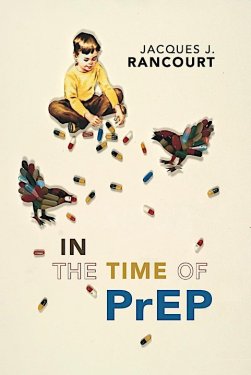
Rancourt’s 2018 chapbook “In the Time of PrEP” is a sequence of interrogative poems that examines how the AIDS crisis had shaped and continues to shape queer identities. Born in the year the anti-retroviral drug AZT was released, Rancourt examines the gap between past and present generations, those who watched loved ones die and the later generation distanced from the crisis. As in his “Novena” collection, he draws on Biblical imagery to illustrate both the risk and joy of desire that is seen in every aspect of nature.

Jacques Rancourt’s second full-length collection, “Broken Spectre” was a 2019 editor’s choice selection for the Alice James Award. This volume is about the voices of those who have passed, our connections to the past, and our navigation of the present aa well as the future. Through the poems in this collection, Rancourt seeks not only to reconcile own his past and future but also those of the LBGTQ community as a whole. The poems in “Broken Spectre”, varying in structure, create a visual art form across the page. Rancourt uses line breaks, overlapping lines, and lines isolated by white spaces as visual elements to sculpt each poem’s final shape.
Fellowships held by Rancourt include:  a five month residency from the Cité Internationale de Arts in Paris, a Halls Emerging Artist Fellowship from the Wisconsin Institute of Creative Writing, and a Wallace Stegner Fellowship from Stanford University. He was awarded scholarships from both the Sewanee Writers’s Conference and Bread Loaf, the oldest writers’ conference in the United States. 

In addition to his published collections, Jacques Rancourt’s individual poems have been published in magazines such as the Boston Review, New England Review, Southern Review, Georgia Review, and Ploughshares, Poetry Daily, and the San Francisco Chronicle, among others. His work has also appeared in such anthologies as Dzanc Book’s “Best of the Net” and Dorianne Laux’s 2014 “Best New Poets” from Samovar Press. 

“Reading, after all, is a practice in empathy. After the AIDS crisis had begun to settle, there seemed to be an “Eisenhower Years” movement where the queer narrative was flattened in order to become more digestible and heteronormative for a straight audience. We were rebranded and made approachable, and as a result, part of the wide and beautifully diverse representation of our queer community was suppressed. My hope for the queer community is that our art, which has never shied away from representing our true selves, can continue to come out and be embraced fully by a more open-minded, non-queer audience.”

—Jacques J. Rancourt, In the Time of PrEP: An Interview with Jacques J. Rancourt, The Georgia Review, Conversations, Fall 2023

Notes: Jacques Rancourt’s website, which includes books and events, can be located at: https://www.jacquesrancourt.com

An extensive and informative conversation occurred between Jacques Rancourt and Interlochen Review editors Genevieve Harding and Darius Atefat-Peckham in October of 2017. Rancourt went into great detail discussing his life, work process, and his passion for poetry. This session can be found at the Interlochen Review site: http://www.interlochenreview.org/jaques-rancourt-2

An interview between writer Divya Mehrish and Rancourt on his 2019 collection “Broken Spectre” can be found at the online literary site The Adroit Journal located at: https://theadroitjournal.org/issue-thirty-nine/a-conversation-with-jacques-j-rancourt/

The BiGLATA Book Club has a video interview and reading with Jacques J. Rancourt on his work process and “Broken Spectre” collection. It is located on YouTube as BiGLATA Book Club: Broken Spectre with Author Jacques J. Rancourt Williams Alumni