Season’s Greetings 2023

Happy Holidays to Everyone!

I thank you for your comments and really appreciate your visits to my site. Have a great holiday season and a year of health, new friendships and exciting adventures!

The food gifs have been made by the talented cinematographic artist Daria Khoroshavina who is based in Moscow, Russia. Her project Kitchen Ghosts is about food, drinks and other little precious moments of life captured and looped in live photographs.

The Kitchen Ghosts project has been noticed and loved by many brands which led to successful collaborations with Pepsi, Martell, Blue Angel vodka, Schweppes, Amazon, Samsung and others.

The Kitchen Ghosts website is located at: https://kitchenghosts.carbonmade.com

Daria Khoroshavina is represented by:
glasshouseassignment
Kari Anderson
kari@glasshouseassignment.com

Anthony Asquith: Film History Series

Alexander Bassano, “Anthony Asquith”, 1927, Whole Plate Glass Negative, National Portrait Gallery, London

Born in November of 1902 in London, Anthony Asquith was an English film director. He was the son of Margot Asquith and Herbert Henry Asquith, 1st Earl of Oxford and Asquith, who served as Prime Minister of the United Kingdom from 1908 to 1916. Along with Alfred Hitchcock, Carol Reed and David Lean, Anthony Asquith was one of the internationally acclaimed British film directors at the top of the profession in the 1950s and 1960s.

A reluctant aristocrat, Anthony Asquith was educated at the private Eaton House, Winchester College in Hampshire and, from 1921 to 1925, Balliol College, Oxford. Although he was interested in music, he decided to pursue a career in the rapidly growing British film industry. Asquith traveled in 1920 to Hollywood to observe American film production techniques. In England, he made his debut as a silent film director with the 1927 British black comedy “Shooting Stars”. Asquith followed the comedy with the 1928 drama “Underground”, a story of four lives that intersect in London’s underground tube network.

Asquith’s work in silent film was influenced by the German Expressionist film movement and was experimental in nature. This can be seen in his best-known silent film, the 1930 “A Cottage on Dartmoor”, known for its meticulous and emotional frame composition. Asquith’s tense, shocking thriller, which stylistically brings to mind the early work of Alfred Hitchcock, is filled with innovative camera work by Stanley Ridwell and fast editing work to produce an eerie and unpredictable atmosphere. In his role of director, Asquith was a master of atmosphere and extracted the most emotion from dramatic situations. He became known as an actor’s director and was able to get some of the finest performances from Britain’s greatest actors.

The majority of Anthony Asquith’s oeuvre was divided between semi-documentaries and the adaptation of plays and novels. These he staged in a stylistically restrained, tasteful, but nuanced manner. In collaboration with English playwright Terence Rattigan as screenplay writer, Asquith directed film adaptations of ten famous plays written by Rattigan. Among these adaptations were the 1948 “The Winslow Boy”, “The Browning Version” in 1951, and the 1940 “French Without Tears”, Rattigan’s first successful play which premiered in 1936. 

One of Asquith’s best known films is the 1938 “Pygmalion”, an adaptation of George Bernard Shaw’s 1913 stage play, which Asquith co-directed with its star Leslie Howard. A critical success even in the United States, the film received multiple Academy Award nominations; Bernard Shaw won an Academy Award for best adapted screenplay. Asquith’s most successful postwar film was probably his 1952 adaptation of Oscar Wilde’s “The Importance of Being Ernest”; it still remains today, after seventy years, the best adaptation of  Oscar Wilde’s work. 

In the 1960’s, Anthony Asquith was directing lavish all-star productions. He was one of only three British directors who were directing major international motion picture productions in that time period. Asquith directed the 1963 British comedy-drama film “The V,I.P.s” with a large cast that included Richard Burton, Elizabeth Taylor, Maggie Smith, Rod Taylor, Orson Welles and Margaret Rutherford, among others. The film, shot from a screenplay by Terence Rattigan, was distributed by Metro-Goldwyn-Mayer. Margaret Rutherford, cast as the Duchess of Brighton, won the Academy Award and the Golden Globe Award for Best Supporting Actress. 

Asquith’s next project was the 1964 “The Yellow Rolls-Royce” with a screenplay by Rattigan and production by Anatole de Grunwald. The twenty-three member cast of this drama included such stars as Rex Harrison, Ingrid Bergman, Shirley MacLaine, Omar Sharif and George C. Scott. In the early part of 1967, Asquith was signed to direct the 1968 big screen adaptation of Australian author Morris West’s “The Shoes of the Fisherman”. This American political drama of Vatican and Cold War intrigue included a major cast with such stars as Laurence Olivier and Anthony Quinn. Due to ill health in November of 1967, Asquith dropped out of its production. 

The Honorable Anthony Asquith died in February of 1968 of cancer, at the age of sixty-five, in London, England. He was buried at All Saints Churchyard, Sutton Courtenay in Berkshire, England. Over the course of his career, Asquith directed forty-two films and was instrumental in the formation of the London Film Society. In his honor, the British Academy Award for Best Music is named the Anthony Asquith Award. 

“Although I was sparing with the big individual close-ups, I was tempted in the scene where Edith Evan’s voice goes up three octaves on a single syllable when she says the word “hanndb-a-g”. On films, as you know, voices haven’t need to be raised to reach the back of the gallery. We take care of that, and actors and actresses keep their voices right down. In the case of (the character) Lady Bracknell, however, it was different: she is a monster anyway and she is more than life-size, and certainly Edith Evans IS life-size. I didn’t try to modify her performance in any way, because it seemed to me to be splendid.”  —Anthony Asquith on directing “The Importance of Being Ernest”

Notes: It was Asquith’s father, Herbert Henry Asquith, serving as Home Secretary, who ordered Oscar Wilde’s arrest for his homosexual behavior. This arrest for indecent behavior led to Wilde’s incarceration in the Reading Jail and personally destroyed the playwright. The arrest and imprisonment of Wilde affected gay culture in Britain for most of the twentieth-century. The irony of Herbert Henry Asquith’s participation in this event is that Anthony Asquith, his youngest son, was gay.

English theatrical actress Edith Evans is considered the greatest actress on the English stage in the twentieth-century. Over a career of more than fifty years, she appeared in modern and classical roles in the West End of London and on Broadway in New York City. In 1946, Edith Evans was made a Dame Commander of the Most Excellent Order of the British Empire, the equivalent of a knighthood. 

Film historian Peter Cowie, a specialist in Swedish cinema, wrote an excellent article for the Criterion Channel on the Anthony Asquith’s life and his major film adaptations. The article can be found on the Criterion Channel’s website located at: https://www.criterion.com/current/posts/4495-anthony-asquith

Top Insert Image: Howard Coster, “Anthony Asquith”, 1935, Bromide Print, 15.8 x 11.2 cm, National Portrait Gallery, London

Second Insert Image: Anthony Asquith, “A Cottage on Dartmoor”, (Hans Adalbert Schiettow and Norah Baring), 1921, Cinematography Stanley Rodwell

Third Insert Image: Anthony Asquith, “Libel”, 1959, Film Pster, Cinematography Robert Krasker 

Fourth Insert Image: Anthony Asquith, “The Net”, (James Donald and Phyllis Calvert), 1953, Cinematography Desmond Dickinson

Bottom Insert Image: Ernest Cyril Stanborough, “Anthony Asquith”, 1930s, Bromide Print, 22.7 x 17.7 cm, National Portrait Gallery, London

Marylyn Dintenfass

The Artwork of Marylyn Dintenfass

Born in Brooklyn, New York in 1943, Marylyn Dintenfass is an American painter, printmaker and sculptor known for the dynamic color palette of her oil paintings. She graduated from New York’s Queens College in 1965 with a Bachelor of Arts in Fine Arts. During her studies, Dintenfass worked with abstract expressionist painter John Ferren and muralist Barse Miller. She developed her own style of abstract expressionism and acquired an appreciation for the wide range of materials available. 

Though mostly known for her paintings, Marylyn Dintenfass was first recognized for her sculptural mixed-media installations. Her use of ceramics, epoxies, pigments, wax, steel, lead and wood expanded the traditional definitions of ceramic work. The installation sculptures and architectural reliefs Dintenfass created were unique to her organic and structural personal style. For her work, she constructed a pictographic language that consisted of symbols and the fusion of curves and lines. 

After a tour of museums in Paris, Rome and Amsterdam, Dintenfass traveled to Jerusalem in 1966. She studied etching and worked with Swiss painter Ruth Bamberger known for her textile design and fresco work. Through interactions with artists and intellectuals in the city, Dintenfass was given her first architectural commission; the design of Jerusalem’s first disco. She worked with a wide range of materials to fashion shapes, surfaces, textures, colors and light; these components became intrinsic parts of her developing artistic form .

Marylyn Dintenfass received large-scale installation commissions for the State of Connecticut’s Superior Courthouse; the New York Port Authority’s 42nd Street Bus Terminal; IBM’s headquarters in San Jose, Atlanta and Charlotte; and the Ben Gurion University in Israel, among others. In 2010, Dintenfass produced “Parallel Park”, a site-specific work for the exterior walls of the Lee County Justice Center’s parking garage in Ft. Myers, Florida. Each of her twenty-three images were enlarged tenfold to a size  ten by seven meters through the utilization of digital software. These were then  printed with archival ink on Kevlar fabric. Installed on all four facades of the garage, Dintenfass’s patterned images recalled the friezes and frescoes of Medieval as well as Italian Futurist artists. 

Dintenfass’s paintings combine the intense gestural movements of Abstract Expressionism with the repetitive image technique from Pop Art. Central to her work are both the underlying grid reference and the adjustability of the modular sections in their relationships to others. These structural aspects lend stability to Dintenfass’s exuberantly colored and dramatic abstractions. Her abstract images often contain formations of circles or stripes that are formed over alternating layers of high gloss or matte textures.

Marylyn Dintenfass has shown her work in more than sixty national and international exhibitions including solo shows at the Queens Museum of Art, the Greenville County Museum of Art and the Mississippi Museum of Art, among others. Her work was included in the 2008 inaugural exhibition of New York’s Museum of Arts and Design. Works by Dintenfass are housed in the Minneapolis Institute of Arts, the Smithsonian American Art Museum, New York’s Metropolitan Museum of Art and the Museum of Fine Arts Houston.

Dintenfass was awarded the Silver Medal at the First International Exhibition held in Mino, Japan, and the Ravenna Prize at the 45th Concorso Internazionale Della Ceramica D’Arte in Faenza, Italy. She was also a member of the faculty at New York City’s Parsons School of Design  for ten years. Dintenfass was a visiting professor at Norway’s National College of Art and Design, the Brezel Academy of Art and Design in Israel, Canada’s Sheridan College, and New York City’s Hunter College. 

Notes: Due to the large-scale format of work by Marylyn Dintenfass, the best way to view her art is through exhibitions. Her website, which includes exhibitions and publications as well as video interviews, is  located at: https://www.marylyndintenfass.com

Top Insert Image: Photographer Unknown, Marylyn Dintenfass at “Parallel Park”, 2011, Permanent Public Installation, Fort Meyers, Florida

Second Insert Image: Marylyn Dintenfass, “Token Thorn Prick”, “Drop Dead Gorgeous” Series, 2012, Oil on Canvas, 254 x 195.6 cm, Private Collection

Bottom Insert Image: Photographer Unknown, Installation of “Things Are Not What They Seem” Exhibition, Date Unknown

Dunbar Dyson Beck

The Paintings of Dunbar Dyson Beck

Born in Delaware, Ohio in 1903, Dunbar Dyson Beck was an American painter, muralist, educator, and designer of both interiors and exteriors, as well as theatrical sets and costumes. He studied at Northwestern University in Chicago before earning his Bachelor of Fine Arts from Yale University in 1926. Beck was invited to teach at Yale during the following academic year. In 1927, he won the prestigious Prix de Rome for his painting “Adoration”. This scholarship enabled Beck to spend three years studying at Rome’s American Academy and travel extensively  in Europe and Africa to study traditional arts. 

Upon his return to New York in 1930, Beck taught at Columbia University and then at Cooper Union’s School of Art. He began to receive several important commissions for altar paintings, murals and portraits. Beck painted a mural in 1934 for the lobby of New York City’s Radio City Music Hall. He also received a commission from Theodor Steinway to execute a gold-leaf decorative frieze on the side of a custom Steinway piano for President Roosevelt’s White House. Beck’s decoration represented the five musical forms indigenous of America: a New England barn dance, a lone cowboy playing a guitar, the Virginia reel, black field hands singing, and an Indian ceremonial dance.

Dunbar Beck’s commissioned work in New York included both mosaics and murals for the Rockefeller Center on Fifth Avenue, as well as, murals for the 1939-1940 World’s Fair at Flushing Meadows- Corona Park. In the late 1930s, Beck met Eleanor McClatchy, president of the McClatchy publishing company, who recognized his talents and encouraged his relocation to Sacramento, California  where he could live and work. McClatchy became Beck’s most important patron with commissions ranging from stage sets for Sacramento’s Eagle Theater to design work for the Sacramento Bee, the fifth-largest newspaper in California.

In the 1940s, Beck painted a series of eight paintings which focused on the theme of prize-fighting. These works were inspired by an unpublished play of unknown origin entitled “TheNational Ring”. In these works, Beck created the presence of a boxing match with his dramatic placement of compositional elements and his use of theatrical lighting effects. He used architectural elements, diagonal perspectives and concentric circles to create movement; his figures, with their raised fists and muscular arms, are highlighted as it they were spotlit for an unseen audience. Similar to the fight scenes painted by George Bellows, anticipation and emotional tension in Beck’s work are emphasized as details are minimized. 

Settled in Sacramento, Dunbar Beck made many contributions to the local art scene, among which were the Sacramento Art Deco Society and the Sacramento Public Library Program. He also served as set designer for the Sacramento Civic Theater and became an architectural preservationist for the Sacramento area. Beck was a juror for exhibitions held at Sacramento’s Kingsley Art Club and completed murals and mosaics for local churches. He executed fourteen oil paintings depicting the “Stations of the Cross” and a series of stain glass windows for St. Rose’s Chapel in South Sacramento. Beck also executed work for churches in New York, Texas and Pennsylvania. 

Dunbar Dyson Beck died of cancer, at the age of eighty-three, in February of 1986 at a Sacramento convalescent home. In addition to his work in prominent public places, Beck’s work is housed at Smith College and in private collections. His 1934 portrait of American architect William Adams Delano resides in the Smithsonian’s National Portrait Gallery.

Notes: The Sacramento Public Library in collaboration with the Sacramento Art Deco Society has a YouTube video, entitled “Dunbar Dyson Beck: Renaissance Master of Poverty Ridge”, that is narrated by local historian Bruce Marwick.

Top Insert Image: Photographer Unknown, “Dunbar Dyson Beck”, Date Unknown, Vintage Print

Second Insert Image: Dunbar Dyson Beck, “Palais des Papes, Avignon”, 1928, Watercolor on Paper, 31.8 x 23.8 cm, Private Colledtion

Third Insert Image: Dunbar Dyson Beck, “Self Portrait”, Date Unknown, Oil on Canvas, Crocker Art Museum, Sacrament, California

Bottom Insert Image: Dunbar Dyson Beck, “Allegory of Charity”, 1925, Oil on Canvas, 132 x 104.1 cm, Private Collection

Jacques J. Rancourt: “Where to Begin?”

Photographers Unknown, Where to Begin?

First, we’re skinny-dipping,
Sam & I, in a pond in Tennessee,

which is his idea, I should say,
& the tree with the rope swing
looms darker

than the dark night sky.

Second, the harvest moon,
which we came here to see,

is nowhere to be found,
instead the sky burning with stars
I can’t see without my glasses

that Sam describes for me.

Third, I’ve made no promises
to monogamy, but am not sure
about those who have.

I spent my twenties riding
trains through cities leaving
behind hotel rooms

of men who may
or may not have been-

I never asked. The world of men
who have sex with men
is a chrysalis, a paper lantern

the hornets fill
with sound. Underwater, our feet
keep touching. Sorry, Sam says

sorry, sorry, sorry.

I imagine his wife after
a bath, wrapping her hair
in a towel. I imagine

the cluster of small towns
I come from,

each with its own abandoned factory
with its own broken windows-
The world of men

who have sex with men
keeps to itself as the rock
hurled through the last

intact glass. you know? Sam says
about fidelity as we stroke

from one shore
to the next. What we don’t do

doesn’t matter. He towels off,
the moon peers over
the ridge, silvers the pond

at its skirts & the bed
beneath me, which is dark
& crowded with dead leaves.

Jacques J. Rancourt, Where to Begin?, The Baffler, Issue: Mind Cures No. 41, September 2018

Born in 1987 in southern Maine, Jacques J. Rancourt is an American poet, editor and educator who spent his formative years living with his father in an off-the-grid cabin at the Appalachian Trial’s northern terminus. In 2009, he received a Bachelor of Arts in English and Bachelor of Fine Arts in Creative Writing at the University of Maine, Farmington. Rancourt earned his Master of Fine Arts in Poetry in 2011 from the University of Wisconsin, Madison. During his studies at Wisconsin University, he served as the poetry editor for Devil’s Lake, the graduate-run journal of its creative writing program.

As an educator, Rancourt has worked as a middle-school principal, English Curriculum Coordinator and English teacher in Palo Alto, California. He also designed in 2014-2015 a core communications curriculum for an enrichment school program in Singapore. Rancourt has taught creative writing classes at the university level and served as an undergraduate thesis advisor. He has led workshops for prison inmates, underserved youth in the Upward Bound program, and summer high-school students at Stanford, Duke and Northwestern Universities. Rancourt currently lives with his husband in San Francisco, California.

Jacques Rancourt’s first full-length collection “Novena” was published by Pleiades Press in February of 2017. Inspired by the novena, a nine-day Catholic prayer seeking intercession from the Virgin Mary, the poems in this volume explore the complex issues of faith, beauty, desire and justice. The intercession sought by this “Novena” is a prayer for the outcasts and the maligned, LBGTQ people, those in prison and all those who continue to suffer. This collection, a fresh poetic exploration of the Roman Catholic faith interwoven with surreal and supernatural elements, was awarded the Lena-Miles Wever Todd Prize. 

Rancourt’s 2018 chapbook “In the Time of PrEP” is a sequence of interrogative poems that examines how the AIDS crisis had shaped and continues to shape queer identities. Born in the year the anti-retroviral drug AZT was released, Rancourt examines the gap between past and present generations, those who watched loved ones die and the later generation distanced from the crisis. As in his “Novena” collection, he draws on Biblical imagery to illustrate both the risk and joy of desire that is seen in every aspect of nature.

Jacques Rancourt’s second full-length collection, “Broken Spectre” was a 2019 editor’s choice selection for the Alice James Award. This volume is about the voices of those who have passed, our connections to the past, and our navigation of the present aa well as the future. Through the poems in this collection, Rancourt seeks not only to reconcile own his past and future but also those of the LBGTQ community as a whole. The poems in “Broken Spectre”, varying in structure, create a visual art form across the page. Rancourt uses line breaks, overlapping lines, and lines isolated by white spaces as visual elements to sculpt each poem’s final shape.
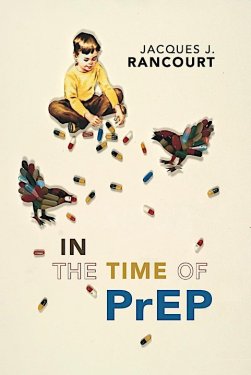
Fellowships held by Rancourt include:  a five month residency from the Cité Internationale de Arts in Paris, a Halls Emerging Artist Fellowship from the Wisconsin Institute of Creative Writing, and a Wallace Stegner Fellowship from Stanford University. He was awarded scholarships from both the Sewanee Writers’s Conference and Bread Loaf, the oldest writers’ conference in the United States. 

In addition to his published collections, Jacques Rancourt’s individual poems have been published in magazines such as the Boston Review, New England Review, Southern Review, Georgia Review, and Ploughshares, Poetry Daily, and the San Francisco Chronicle, among others. His work has also appeared in such anthologies as Dzanc Book’s “Best of the Net” and Dorianne Laux’s 2014 “Best New Poets” from Samovar Press. 

“Reading, after all, is a practice in empathy. After the AIDS crisis had begun to settle, there seemed to be an “Eisenhower Years” movement where the queer narrative was flattened in order to become more digestible and heteronormative for a straight audience. We were rebranded and made approachable, and as a result, part of the wide and beautifully diverse representation of our queer community was suppressed. My hope for the queer community is that our art, which has never shied away from representing our true selves, can continue to come out and be embraced fully by a more open-minded, non-queer audience.”

—Jacques J. Rancourt, In the Time of PrEP: An Interview with Jacques J. Rancourt, The Georgia Review, Conversations, Fall 2023

Notes: Jacques Rancourt’s website, which includes books and events, can be located at: https://www.jacquesrancourt.com

An extensive and informative conversation occurred between Jacques Rancourt and Interlochen Review editors Genevieve Harding and Darius Atefat-Peckham in October of 2017. Rancourt went into great detail discussing his life, work process, and his passion for poetry. This session can be found at the Interlochen Review site: http://www.interlochenreview.org/jaques-rancourt-2

An interview between writer Divya Mehrish and Rancourt on his 2019 collection “Broken Spectre” can be found at the online literary site The Adroit Journal located at: https://theadroitjournal.org/issue-thirty-nine/a-conversation-with-jacques-j-rancourt/

The BiGLATA Book Club has a video interview and reading with Jacques J. Rancourt on his work process and “Broken Spectre” collection. It is located on YouTube as BiGLATA Book Club: Broken Spectre with Author Jacques J. Rancourt Williams Alumni

Owen Rival

The Paintings of Owen Rival

Born in 1999 in Toronto, Owen Rival is a Canadian painter known for his highly contrasted and saturated everyday scenes. After studying both design and painting, he earned his Bachelor of Arts in Illustration at Providence’s Rhode Island School of Design in 2021. Rival is a recipient of the New York Academy of Art Summer Residency and the Dumfries House Artist Residency, a program delivered by Scotland’s Royal Drawing School and the Glasgow School of Art. He is also a member of the Society of Illustrators, a New York City-based professional society that promotes the art and history of illustration through exhibitions and competitions.

Through his work, Rival examines the seemingly mundane episodes of existence which include such monotonous chores as grocery shopping, washing clothes and brushing one’s teeth. Presented through the perspective of an observer, his paintings amplify these daily routines and transforms them into historic events. Married and now living as a couple with his wife and art collaborator Jenny, Rival paints scenes of domestic life that examine both the solitary moments and the interactions that occur in their Houston, Texas apartment.

Owen Rival’s paintings slowly evolve through an extensive work process: creating  thumbnail sketches of a proposed scene, staging the scene, shooting  photographs for foreground and background references, and lastly the gradual layering of color onto each drawn form on the canvas. His work is characterized by its strong lighting effects and visually complex compositions. Rival’s use of different colored LED lighting in the staged settings provides optional color highlights for the proposed work.

Rival pays particular interest in the color combinations for his work and often uses an inversion of traditional color associations to add both depth and complexity to the paintings. Instead of a realistic color palette, he chooses vibrant and contrasting tones to highlight important elements in the work and to amplify its mood, either conveying a sense of calm or injecting tension and stress.

In 2017 and 2018, Rival exhibited his paintings in group exhibitions held at Providence’s Waterman Building, the first permanent home of the Rhode Island School of Design and its first museum location. He exhibited his work in 2019 at the New York Academy of Art and, in the following year, at “The Color of My Land” exhibition at the RISD Museum Gelman Gallery. 

Rival presented five new medium and large scale works at his first solo exhibition, “Chronic Maintenance”, in April and May of 2023 at the Monti8 Gallery in Latina, Italy. He had his first New York solo exhibition entitled “Long View” in May and June of 2023 at the Harkawik, Gallery 2 on Orchard Street in Manhattan. The show consisted of five acrylic paintings and four works on paper depicting domestic scenes at the Houston apartment.

Notes: Images of Owen Rival’s work, contact information, and social media sites can be found on his website located at: https://www.owenrival.com

The creative art site It’s Nice That has an article on Owen Rival’s life and paintings written by Olivia Hingley for its July 2022 posting. It can be found at: https://www.itsnicethat.com/articles/owen-rival-art-180722#:~:text=Gifted%20with%20a%20clear%20perception,relatability%2C%20and%20striking%20visual%20complexity

The Harkawik Gallery is a contemporary art gallery with two locations, Orchard Street in New York and Santa Monica Boulevard in Los Angeles. The gallery’s website can be found at: https://www.harkawik.com

Top Insert Image: Owen Rival, “Groceries”, 2022, Acrylic on Canvas, 91.4 x 61 x 10.2 cm, Private Collection

Bottom Insert Image: Owen Rival, “Toronto”, 2021, Acrylic on Canvas, 60.1 x 76.2 cm, Private Collection

Martin Kosleck: Film History Series

Herbert Irving Leeds, “Martin Kosleck as Heller”, 1942, Film Clip Photo,“Manila Calling”, Cinematography Lucien N. Andriot, 20th Century Fox

Born in March of 1904 in Barkotzen, now Poland’s Barkocin, Martin Kosleck was a German film actor who began his career during the silent film era. He appeared in more than fifty films and numerous episodes of television series, as well as, roles on the Broadway stage. A talented artist, Kosleck supported himself between film roles as an impressionist-styled portrait painter whose work included portraits of Marlene Dietrich, Greta Garbo, and Bette Davis. He had a solo exhibition of his portraits and other works in 1935 at the Los Angeles Museum that received great reviews. 

Born Nicolale Yoshkin to a forester of German-Russian and Jewish lineage, Kosleck studied for six years at the Max Reinhardt Dramatic School located at the Palais Wesendonck in  Berlin Tiergarten. His forte was Shakespearian roles, however, he also appeared in musicals and revues at both German and English theaters. At the age of twenty-three, Kosleck had his film debut in International Film AG’s 1927 “Der Fahnenträger von Sedan”, a silent film by Austrian director Johannes Brandt. Three years later, he appeared in director Carmine Gallone’s musical “Die Singende Stadt (The Singing City)” and Richard Oswald’s sci-fi horror film “Alrune”, both sound films.

In the early 1930s, Kosleck met and began a relationship with the actor Hans Heinrich von Twardowski, already an established artist in Weimar Germany’s film industry and close friend of Marlene Dietrich. This sometimes turbulent relationship would last until Twardowski’s death from a heart attack in 1958. During their early time together, the National Socialist Party under Adolph Hitler was growing in power. Kosleck, an outspoken critic of the Party, soon earned the animosity of the newly established Nazi Propaganda Minister Josef Goebbels. 

Martin Kosleck, after learning he had been tried in absentia and sentenced to death, escaped to Britain in 1931. The following year, he arrived in New York City and performed on Broadway in “The Merchant of Venice”. This play featured the return to acting, after an absence of thirteen years, of Maude Adams who at that time was the most popular stage actress in America. Kosleck’s role in this play was noticed by director Anatole Litvak who signed him with the Warner Brothers Studio; his first role was in directors William Dieterie and Busby Berkeley’s musical comedy “Fashions of 1934”. 

Hans Twardowski also left Germany in 1931 after finishing his role in Viktor Tourjansky’s “Der Herzog von Reichstadt”. He traveled to the west coast of the United States and first appeared in Universal Studio’s 1932 pre-Code drama “Scandal for Sale”. Twardowski appeared in several war films with Kosleck, including “Confessions of a Nazi Spy”, “Espionage Agent” and “The Hitler Gang”. His acting career ended along with the war; however, he continued to write, direct and act in stage plays. A talented singer, he also sang tenor in a number of musicals. 

In 1934, Kosleck was given a small role playing Propaganda Minister Goebbels in the highly controversial Warner Brothers’s drama “Confessions of a Nazi Spy” based on a book by FBI agent Leon Turron who had uncovered Nazi operations in the United States. Kosleck, inspired by his deep hatred of the Nazis, portrayed Goebbels with an icy demeanor and piercing sinister stare, a performance that made Kosleck the directors’ choice for roles depicting both criminals and Nazi villains. Between 1939 and 1944, he appeared as the bad guy in a total of twenty-two war films and crime thrillers that include “Espionage Agent”, “Nick Carter, Master Detective”, “Calling Philo Vance”, “Nazi Agent”, and Paramount Studios’s “The Hitler Gang”, the second of his three roles as Goebbels.

After the end of the Second World War, Martin Kosleck continued his work at Universal Studios with appearances in several horror films. The first of which was the role of Ragheb, the Arkam sect disciple, in the 1944 “The Mummy’s Curse”. This film was Universal’s fifth entry in its “Mummy” franchise as well as Lon Chaney Jr’s final appearance as the mummy Kharis. In 1945, Kosleck again co-starred with Chaney as the disturbed plastic surgeon Dr. Rudi Polden in “The Frozen Ghost”. He was in two Universal films in 1946: a supporting role in “She-Wolf of London” which starred June Lockhart who had just finished filming “Son of Lassie”, and “House of Horrors”, a film which contains one of Kosleck’s best horror film roles, the obsessed sculptor Marcel de Lange who controls the mad killer known as “The Creeper”.

In 1947 Kosleck unexpectedly married the German actress Eleonora van Mendelssohn. Born to an elite banking family in Berlin, she was both a sensitive and vulnerable woman who had married four times and, after an abortion, initially used morphine as a sedative but soon became addicted. With less film roles offered, Kosleck returned with his wife to New York city where he appeared on Broadway in Jean Giraudoux’s “La Folle de Chaillot”, a production starring John Carradine and Tony Award winner Martita Hunt, that was recognized as one of the best plays of 1948-1949. Kosleck also had an extensive career in television with appearances on such shows as “Hallmark Hall of Fame”, “Voyage to the Bottom of the Sea”, “The Outer Limits”, “The F.B.I.”, “Mission Impossible” and “Studio One”, among others. 

Martin Kosleck’s last screen appearance was as Horst Borsht in Robert Day’s 1980 detective comedy “The Man with Bogart’s Face”. This film is also noted for being the last film appearance of George Raft. Martin Kosleck died at the age of eighty-nine following abdominal surgery at a Santa Monica convalescent home in Los Angeles County. His body was cremated; the location of his ashes are unknown.

Notes: Eleonora von Mendelssohn, already a fragile person, had taken the role of caregiver for both her hospitalized gay brother Francesco who had suffered a stroke and Kosleck who had attempted suicide over a love affair dispute. In January of 1951, Eleonora committed suicide with a toxic cocktail of ether, pills and injections. Her body was discovered by Hans Twardowski. To better understand the tragic life of Eleonora von Mendelssohn, I suggest reading the biographical article located at The Mendelssohn Society website: https://www.mendelssohn-gesellschaft.de/en/mendelssohns/biografien/eleonora-von-mendelssohn

A complete list of Martin Kosleck’s films and television appearances can be found at the Swiss film site Cyranos located at: https://www.cyranos.ch/smkosl-e.htm

An article entitled “The Cult of Actor Martin Kosleck in The Flesh Eaters” contains information on Kosleck’s work with Universal Studios. It can be found on the Cult Film Alley website located at: https://cultfilmalley.com.au/2022/05/12/the-cult-of-actor-martin-kosleck-in-the-flesh-eaters-1964/

Top Insert Image: Photographer Unknown, “Martin Kosleck”, Studio Publicity Film Shot, Gelatin Silver Print

Second Insert Image: Eugene Fords, “Berlin Correspondent”, (Virginia Gilmore, Sig Ruman, Martin Kosleck), 1942, Cinematography Virgil Miller, 20th Century Fox

Third Insert Image: Tim Whelan, “The Mad Doctor”, (Martin Kosleck and Basil Rathbone), 1941, Cinematography Ted Tetzlaff, Paramount Pictures

Fourth Insert Image: Leslie Goodwins, “The Mummy’s Curse”, (Peter Coe, Martin Kosleck, Kay Harding), 1944, Cinematography Virgil Miller, Universal Studios

Bottom Insert Image: Jean Yarbrough, “House of Horrors”, (Rondo Hatton and Martin Kosleck), 1946, Cinematography Maury Gertsman, Universal Studios


Martin Stommel

The Paintings of Martin Stommel

Born in 1969, Martin Stommel is a German contemporary painter whose dramatic and suspenseful compositions are a statement on the restlessness of the world. He first studied at Munich’s State Art Academy from 1994 to 1997 under Professor Bernhard Franz Weißhaar (Weisshaar), the academy’s Chair of Christian Art from 1978 to 2000. Stommel entered Berlin’s University of Arts, HdK, in 1998 where he studied under landscape painter and graphic artist Klaus Fußmann (Fussmann). 

During the span of his academic studies, Stommel also trained under Russian painter and dissident Boris Georgievic Birger. Birger widely exhibited in Russia during the 1950s to the 1970s. After he joined the human rights movement, he was expelled in 1962, under the influence of Communist Party leader Nikita Khruschev, from the Moscow Union of Artists. Birger emigrated in 1990 to Bonn, Germany where he taught and exhibited until his death in 2001. Through his association with Birger, Stommel met several international artists, including Russian writer Lev Kopelev, German author and journalist Fritz Pleitgen, and Russian cellist Natalia Gutman.

In 2000, Martin Stommel met Austrian-born art historian and theorist Sir Ernst Gombrich in London. The author of many works of both cultural and art history, Gombrich is noted for his 1950 “The Story of Art” and 1960 “Art and Illusion”, a major work in the psychology of perception which influenced such writers as Umberto Eco and Thomas Kuhn. Gombrich encouraged Stommel towards figurative work and, during his last years of life, engaged in an exchange of supportive letters.

Stommel’s work exhibits the same bold brushwork and use of perspective as that used by sixteenth-century Venetian painter Jacopo (Tintoretto) Robusti, as well as, the intensity found in the figurative paintings of German modernist Max Beckmann who reinvented the religious triptych form. Stommel uses strong lighting techniques, carefully chosen colors, energetic diagonal movement, and elongated gestural bodies to create powerful visual experiences of tension and drama. His figures, rarely static, are full of energy and accentuated by bold black lines of pronounced shading

Between the years 2001 and 2007, Martin Stommel created a series of paintings and drawings of circus scenes as well as portraits of circus performers. His portraits included such famous clowns as the white-faced Francesco Caroli, Oleg Popov of the Moscow Circus, and David Larible known for his performances with Ringling Brothers and Barnum & Bailey Circus as well as Bernhard Paul and André Heller’s Circus Roncalli. Stommel’s circus portraits, along with still lifes and landscapes, were shown in his first solo exhibition in 2003 at the Museum Charlotte Zander in Bönnigheim, Germany. In the next year, he presented his circus paintings in the Principality of Monaco at the invitation of Prince Rainier III and his illustration series for the “Divine Comedy” at the Stadtmuseum in Bonn.

Stommel has regularly exhibited in solo shows throughout the years. In 2013, he exhibited at the Stiftung Wilhelm Lehmbruck Museum in Duisburg which was followed by two shows at Frankfurt’s Galerie Mühlfeld & Stohrer in 2014 and 2015. Stommel’s “Lust and Expectation”, inspired by the world of dance, was held in 2019 at Gallery 70 in Tirana, Albania. In 2020, he had a second solo show at the same Gallery 70 location which showed large-format works, among which was his 2018 “Amazonenkampf (Fight of Amazons)”, a densely painted martial work of warriors and horses. Stommel’s 2022 “On Deliverance” exhibition, a series of works on the turmoil in the world, ran from April to July at Berlin’s Janine Bean Gallery, a dedicated supporter of local contemporary art. 

Martin Stommel’s work has also been exhibited at the Kallmann Museum at Ismaning, Germany; Museum am Dom Trier, Germany; Cologne’s Lew Kopelew Forum; Munich’s Katholische Akademie in Bayern; Monaco’s Théâtre Princesse Grace; the Venice Biennial; as well as many galleries and art fairs in London, Cologne, Berlin, Lübeck and Munich, among others. 

Notes: Martin Stommel’s website with current exhibition and contact information is located at: http://martin-stommel.deadwings.de/de

A short video in which Martin Stommel discusses his work can be found in the videos category at Gallery 70’s YouTube site located at: https://www.youtube.com/@gallery70/videos

Second Insert Image: Martin Stommel, “Jesus Asleep”, 2022, Oil on Linen, 260 x 175 cm, Private Collection

Bottom Insert Image: Martin Stommel, “Girls at the Pool”, 2024, Oil on Canvas, 57 x 52 cm, Gallery 70, Chicago (Available)

Robert Hamberger: “He Bequeths the Gift of Breath”

Photographers Unknown, He Bequeths the Gift of Breath

And they all forsook him and fled. And there followed him a certain young
man, having a linen cloth cast about his naked body; and the young men laid
hold on him: And he left the linen cloth, and fled from them naked.

St Mark, Chapter 14, Verses 50-52

He’s my firmament.
I hang on every word,
lassoed by considering the lilies,
by camels and needle eyes,
bread of life and light of the world.

I studied his mouth, hour by hour,
until I confessed a thirst for his throat
exposed below the beard,
his wrists, slender gazelles
when loose sleeves slip to reveal them.

What could I do
but give up everything
to sip his shadow?
He admits me to his gaze,
permits my passion. He lets me stay.

I could have been the woman
who stroked the edge of his robe,
who wiped his heels with her hair.
His men buzz as if he’s honey
as if we might swallow him whole.

Tonight’s moon notes his cry
among the camellias.
He kneels to call the air father.
Saints snore while I shiver in linen,
keeping my chilly vigil.

My prayer marries his:
Run with me now where no God
can catch us. He walks instead
to swords and spears and glamour,
one man kissing another.

When they prod a blade at my ribs
I leap from their net,
wrestle free from my sheet
as water strips a skin.
My glimmer swims naked through fig trees.

He leaves me to my betrayal
between the olive groves.
He bequeaths the gift of breath
to my body’s temple.

Robert Hamberger, Gethsemane Nude, Torso, 2007, Redbeck Press, Bradford, West Yorkshire, UK

Born in Whitechapel, East London in 1957, Robert Hamberger is an English poet, author and educator. He studied English Literature from 1975 to 1978 at Sussex University, a highly-ranked university in Brighton, United Kingdom. Hamberger was awarded his Master of Arts in Social Work from Leicester University in 1988. 

Following his graduation, Hamberger worked for thirty-eight years in social work for the Leicestershire, Northamptonshire, and West Sussex County Councils. During his residence in the East Midlands, he established the Corby Writers’ Workshop and the Wellingborough Writers’ Workshop. Hamberger also participated in the East Midlands Art’s first New Voices Tour and edited four anthologies by local writers. He currently resides in Brighton with his husband Keith Rainger, who lends his translation skills to Hamberger’s work.

Robert Hamberger prefers writing outside the literary mainstream. He has particular interests in working-class, pro-feminist, radical and queer writings. He uses his own experiences of fatherhood, marriage and separation, loss of friends and queer identity as the foundations for his examinations of love, death and memory. As such, his work remains very personal and true to his self-identity. In addition to publishing his work, Hamberger has taken part in numerous readings online as well as poetry festivals and workshops. Most recent of these was the October 2023 reading and panel on “Genre-Bending and Queering Words” at the Coast is Queer Festival held at Sussex University.  

Hamberger’s first full-length collection of poems “Warpaint Angel” was published by Five Leaves Press in 1997. Its poetry explores the experience of fatherhood and existence as son, the meaning of family and friendship as well as the nature of love. The volume is a mixture of casual, frank narratives and lyrical poems both tough and delicate. Hamberger’s “Rule of Earth”, a winner in the 2000 Poetry Business Competition, is a chapbook that contains a sequence of twenty-one love sonnets. These sonnets describe both the daily routines and ecstasy of a gay relationship, which is unexpectedly impacted by heart disease. 

Robert Hamberger’s 2002 collection of first-person poems, “The Smug Bridegroom”, explores the experiences of fatherhood, love and change which, through shifts in family relationships, lead to both a marriage breakup and renewal of hope. The 2007 “Torso”, Hamberger’s third full-length collection, continues his exploration of existence as father, son, lover and poet. Included among its sequences are a celebration of Federico Garcia Lorca’s love sonnets, elegies for a friend, and queer interpretations of sacred texts. 

Hamberger’s fourth collection entitled “Blue Wallpaper” was published by Waterloo Press several months prior to the Covid-19 pandemic in 2019. Divided into six subtitled sections, this volume of sixty-one personal poems contains sonnets, elegies, free verse, and other poetic forms with the topic of love between men frequently central. Among the poetry in “Blue Wallpaper” are works centered on familial memories from Hamberger’s youth, his mother’s dementia, the poets he admires, mythical and natural creatures, the work of Arthur Rimbaud, and the deaths of close friends during the HIV/AIDS epidemic. “Blue Wallpaper” was shortlisted for the 2020 Polari Prize, an annual United Kingdom literary prize established for LBGTQ+ literature.

Kept in an asylum for four years, the peasant poet John Clare escaped in 1841 and walked over eighty miles to his home in Northamptonshire. Suffering from poor mental health, Clare was attempting to reunite with Mary, his idealized first love, unaware she had died three years prior. In 1995 with his personal life in crisis and mental health fragile, Robert Hamberger retraced poet John Clare’s route over a four-day walk. In June of 2021, he published his finished “A Length of Road”, a work part memoir, part-literary criticism and part travel-log. The volume is a deep, poetic exploration of the issues of class, gender, grief, masculinity and sexuality as seen through Hamberger’s own life as well as the autobiographical writings of poet John Clare.   

Notes: Robert Hamberger”s website, which contains readings on videos, interviews, writings and contact information, can be located at: https://www.roberthamberger.co.uk

Popsublime is an interesting literary, film and pop culture review site that has be publishing online since 2010. It has a review by the site’s author on Robert Hamberger’s 2002 “The Smug Bridegroom”. The article is located at: https://popsublime.blogspot.com/2010/08/robert-hamberger-smug-bridegroom-five.html

Agnes Martin

The Artwork of Agnes Martin

Born in March of 1912 at the town of Macklin located in Saskatchwan, Agnes Bernice Martin was a Canadian-American abstract painter known for her minimalist and abstract expressionist style. Martin’s patterned work, both delicate and awe inspiring, established a connection between the arts of writing and painting. 

One of four children born to Scottish Presbyterian farmers, Agnes Martin spent her formative years in Vancouver before relocating to the state of Washington in 1931 to assist her pregnant sister. She studied at the College of Education of Western Washington University and later received her Bachelor of Arts in 1942 from the Teacher College of New York’s Columbia University. During her studies, Martin was exposed to the artwork of sculptor and painter Joan Miró and abstract expressionist painters Adolph Gottlieb and Arshile Gorky. Inspired by their work, she began to take studio classes and seriously work towards a career as an artist. 

In 1947, Martin attended the Summer Field School of the University of New Mexico in Taos and, through lectures by Zen Buddhist scholar Daisetsu Teltaro Suzuki, became interested in Asian disciplines and ethics as a tool to manage her journey in life. Following her graduation, Martin enrolled at the University of New Mexico in Albuquerque where she taught art classes. She resumed her studies at Columbia University and in 1952 earned her Master of Fine Arts in Modern Art. 

At the invitation of gallery owner Betty Parsons, Agnes Martin settled in New York City for a period of ten years beginning in 1957. She lived in a loft within the Coenties Slip area, a historic section of nineteenth-century buildings surrounded by the city’s financial district. Originally an area with an artificial inlet for loading and unloading cargo ships, Coenties Slip became both home and studio space for ground breaking artists from the late 1950s to the early 1960s. The area also served as a haven for the queer community in the 1960s. Among Martin’s friends and neighbors were Robert Indiana, Ellsworth Kelly, Adolph Reinhardt, and Lenore Tawney, for whom she wrote an essay included in the brochure of Tawney’s first solo exhibition. 

Although not documented until 1962, Martin was known to have schizophrenia, the struggle of which was largely a private and individual affair. She was frequently hospitalized to control its symptoms among which were aural hallucinations and states of catatonia. Martin was aided by her friends from the Coenties Slip who enlisted the support of a respected psychiatrist who was both friend and art collector. The full impact of this illness on her life is unknown. 

In 1967, Agnes Martin abandoned the art world and her life in New York. After a period of travel in Canada and the western United States, she settled in Mesa Portales, New Mexico in 1968 where she rented a fifty-acre property until 1977. On this property, Martin built several adobe brick structures herself. She did not paint any works during the period from 1968 to 1971 and distanced herself from social events and the public eye. In 1973, Martin returned to art with the creation of thirty serigraphs for a portfolio entitled “On a Clear Day”.

An admirer of Mark Rothko’s work, Martin simplified her own work to its basic elements, a process to encourage a perception of perfection and emphasize the painting’s transcendental quality. Her work’s signature style focused on grids, lines and fields of subtle color. In the early 1960s, Martin created square 182cm canvases using only black, white and brown; these were covered with dense, minute and lightly defined graphite grids. Her paintings, while minimalist in form, differed from other minimalist works as her work retained small flaws and noticeable traces of the artist’s hand. Martin’s paintings and her writings both reflected her interest in Eastern philosophy, an aspect which became increasingly more dominant after 1967.

In 1974, Agnes Martin returned to painting with 30cm square and 182cm square canvases that represented a new exploration characterized by vertical and horizontal lines in a palette of yellows, pinks and blues. These were exhibited in 1975 at her first show at New York’s prestigious Pace Gallery. During her time in Taos, Martin continued her use of light pastel washes on the grids and bands of her paintings but reduced the scale of her work to a square of 152cm. She also modified the grid structure she had been using since the late 1950s; the pencil lines were now being drawn intuitively without a ruler. 

In 1976, Martin made her only completed film, “Gabriel”, a seventy-eight minute silent film, except for seven moments at which excerpts from Bach’s “Goldberg Variations” occur for two or three minutes. Unscripted, the film was shot with a handheld camera and presented the story of a young boy who wanders in the natural landscape of rural New Mexico. Martin’s goal was to make a film about happiness and innocence; an angel’s name, representing innocence, was used for the title of the film. 

In 1978, Agnes Martin left her Portales home and moved to Galisteo, near Santa Fe. Her broad-striped paintings became more luminous, a result derived from the application of diluted acrylic color over a ground of multiple layers of white pigment. Martin’s work evolved again in the 1990s; the early symmetric bands of color in her paintings began to be composed of varying widths. In 1991, Amsterdam’s Stedelijk Museum hosted a retrospective of Martin’s work, which was followed in the next year by a retrospective held at New York’s Whitney Museum of American Art.

Following the Whitney show, Martin moved to Taos, New Mexico where she lived and worked for the remainder of her life. She introduced a new palette of color in her work which included a spectrum of greens and saturated orange. In her very last paintings, Martin reintroduced the geometric elements from her 1950s work; she placed dark triangles and rectangles against gray grounds but kept the graphite lines that were a integral part of all her work. Agnes Martin passed away in Taos, New Mexico at the age of ninety-two in December of 2004.

Agnes Martin was awarded the National Medal of Arts by President Clinton in 1998 and was elected to the Royal Canadian Academy of Arts in 2004. In 1994, the Harwood Museum of Art in Taos renovated its Pueblo-Revival building and dedicated a wing to Martin’s work. Since her first solo exhibition in 1958, Martin participated in many international exhibitions including three Venice Biennales, two Whitney Biennials and the 1972 Documenta in Kassel, Germany. In 2016, the same year the Guggenheim Museum held a retrospective of her work, Agnes Martin’s 1965 graphite and oil on canvas “Orange Grove” sold at auction for $13.7 million dollars. 

Notes: Despite sharing several meaningful and long-term relationships in Oregon, New Mexico, and New York City, Agnes Martin never specifically acknowledged her sexuality in interviews or writings during her life. Martin kept her sexuality hidden, often even from close acquaintances. 

An article on Agnes Martin written by William Peterson for the November 2013 “New Mexico Mercury” can be found at: http://newmexicomercury.com/blog/comments/some_late_thoughts_on_the_early_work_of_agnes_martin

An extensive biography of Agnes Martin, written by Christopher Régimbal and entitled “Agnes Martin: Life and Work”, can be found at the Art Canada Institute site located at: https://www.aci-iac.ca/art-books/agnes-martin/

Top Insert Image: Dorothy Alexander, “Agnes Martin”, 1978, Gelatin Silver Print, Art Canada Institute, Toronto

Second Insert Image: Agnes Martin, “Self Portrait”, circa 1947, Encaustic on Canvas, 66 x 49.5 cm, Private Collection

Third Insert Image: Agnes Martin, “With My Back to the World”, 1997, 152.4 x 152.4 cm, Museum of Modern Art, New York

Fourth Insert Image: Agnes Martin, “Portrait of Daphne Vaughn”, 1947, Oil on Canvas, 50.8 x 40.6 cm, Private Collection

Fifth Insert Image: Agnes Martin, “Summer”, 1965, Watercolor, Ink and Gouache on Paper, 22 x 23.5 cm, Private Collection of Patricia Lewy, New York

Bottom Insert Image: Gianfranco Gorgoni, “Agnes Martin in Cuba, New Mexico”, 1974, Detail, Gelatin Silver Print, Art Canada Institute, Toronto

Rockwell Kent

The Wood Engravings of Rockwell Kent

Born in Tarrytown, New York in June of 1882, Rockwell Kent was an American painter, graphic artist, writer and adventurer. A profoundly independent and thoughtful man, he acquired through his personal experience and skills a great respect for the dignity of labor and an appreciation of indigenous societies and cross-cultural encounters.

In his formative years, Rockwell Kent spent much of his life in the area of New York City. He attended the Horace Mann School, a private school and member of the Ivy Preparatory School League. In the fall of 1900, Kent studied composition and design at the Art Students League under painter, printmaker and curator Arthur Wesley Dow. He studied in the summers between 1900 and 1902 at one of the first plein air painting schools in America, Shinnecock Hills Summer School of Art, under Impressionist painter William Merritt Chase. 

In the fall of 1902, Kent entered the New York School of Art, founded by William Chase, where he studied under painter Robert Henri, one of the pioneers of the Ashcan School of American realism. He became an apprentice during the summer of 1903 to painter and naturalist Abbott Handerson Thayer, one of the first to write about disruptive patterning to break up an object’s outlines, now known as Thayer’s Law. Kent earned his Bachelor of Arts in Architecture from New York’s Columbia University which prepared him for occasional work as an architectural renderer and carpenter. While at Columbia, Kent developed a close friendship with Carl Zigrosser who later founded New York’s Weyhe Gallery and became Curator of Prints and Drawings at Philadelphia’s Museum of Art.

Rockwell Kent was a transcendentalist and mystic in the tradition of Ralph Waldo Emerson and Henry David Thoreau. He found his inspiration in the austerity and primordial beauty of the wilderness. After his five-year residence on Monhegan Island in Maine, Kent lived for extended periods in Minnesota, Newfoundland, Alaska, Vermont, Tierra del Fuego, Ireland and Greenland. His landscapes and seascapes from these locales show a Symbolist viewpoint of the natural world. Kent published ten memoirs, complete with illustrations, of his travel years. The first of these volumes was the 1920 “Wilderness: A Journal of Quiet Adventure in Alaska”, an account of his and his eldest son’s 1918 fall and winter exploration of Fox Island in Alaska’s Resurrection Bay. 

Kent spent his early years as a painter in New Hampshire where he painted a series of landscapes and several views of Mount Monadnock, the most prominent mountain peak in southern New Hampshire. These works were first shown at the Society of American Artists in a 1904 New York City exhibition. In 1905, he began his five-year stay on Maine’s Monhegan Island; the series of paintings he produced during this period were shown in 1907 at New York’s Clausen Galleries to critical acclaim. The New Hampshire and the Monhegan paintings are the foundation for Kent’s reputation as an early American Modernist painter. 

In the 1920s, Rockwell Kent began a career in illustration and contributed drawings for the covers of many leading magazines. Acknowledging Kent’s success with his 1920 illustrated “Wilderness”, publisher George Palmer Putnam and others incorporated Kent as ‘Rockwell Kent, Inc” to support him in his Vermont homestead while he completed his Alaskan paintings for a 1920 exhibition at New York’s Knoedler Galleries. Approached by publisher Thorne Donnelley for an illustrated version of “Two Years Before the Mast”, Kent suggested he instead illustrate an edition of Herman Melville’s “Moby Dick; or, The Whale”. After researching whaling lore and visiting whaling museums, Kent created two-hundred and eighty illustrations for the 1930 three-volume set of “Moby Dick”, of which one thousand copies were printed by Donnelley’s Lakeside Press. 

In 1927, Kent purchased Asgaard, an Adirondack farmstead in upstate New York, which became his residence and studio for the remainder of his life. In the summer of 1929, he traveled to Greenland on a painting expedition. Determined to paint and write, Kent spent two years between 1931 and 1935 living in a tiny fishing settlement above the Arctic Circle. His paintings from this period include some of the largest and most lauded of his career. Becoming more politically active as World War II drew near, Kent, on commission from the Treasury Department, painted two murals at the Federal Triangle Post Office in Washington DC that supported, in small letters of a Native Alaskan language, the decolonization of Puerto Rico.  

In spite of his critical views on American foreign policy, Rockwell Kent remained America’s foremost draftsman of the sea. He produced a series of pen and ink maritime drawings for the American Export Lines during World War II. In 1946, Kent completed a second series for the Rahr Malting Company, a worldwide supplier to breweries, wineries and distilleries. These works were published in the 1946 “To Thee!: A Toast in Celebration of a Century of America 1847-1947”, a volume Kent wrote and designed to celebrate American freedom and democracy and the important role immigrants play in forming America’s national identity. 

In 1948, Kent was elected to the National Academy of Design as an Associate member; he became a full Academician in 1966. Kent passed away due to a heart attack at his Adirondacks home in March of 1971 at the age of eighty-eight. He had participated in the 1936 formation of the American Artists’ Congress and later served as an officer of the Artists’ Union of America as well as the Artists’ League of America. In 1948, Kent had sought election as a New York Congressman under the American Labor Party banner. 

New York’s Columbia University houses Rockwell Kent’s personal collection of thirty-three hundred working sketches and drawings, most of which were unpublished. The Archives of American Art of the Smithsonian Institution houses an extensive collection of Kent’s correspondence. His work is contained in many private collections and is both housed and exhibited in major museums throughout the United States. 

Notes: A May 2023 online edition of “Modernism/modernity” has an excellent and extensive article, written by Colgate University Visiting Professor of Writing and Rhetoric Jonathan Najarian, entitled “And Words Were Images to Him; Narrative Remediation in Rockwell Kent” located at: https://modernismmodernity.org/articles/najarian-narrative-remediation-rockwell-kent 

Top Insert Image: Photographer Unknown, “Rockwell Kent”, circa 1920, Vintage Print

Second Insert Image: Rockwell Kent, “Dan Ward’s Stack, Ireland”, 1926-1927, Oil on Canvas, 86 x 112 cm, Hermitage State Museum, St. Petersburg, Russia

Third Insert Image: Rockwell Kent, “Workers of the World, Unite!”, 1937, Wood Engraving on Paper, Cover Illustration for 1937 Issue of the New Masses, 20.3 x 15.2 cm, Plattsburgh State Art Museum, New York

Fourth Insert Image: Rockwell Kent, “Endless Energy for Limitless Living”, 1946, Oil on Canvas on Board, 111.8 x 121.9 cm, Dayton Art Institute, Dayton, Ohio

Bottom Insert Image: Rockwell Kent, “Mountain Climber”, 1933, Wood Engraving on Paper, 20 x 14.9 cm, Smithsonian American Art Museum

Karlheinz Weinberger

The Photography of Karlheinz Weinberger

Born in Zürich in June of 1921, Karlheinz Weinberger was a self-taught Swiss photographer who over his sixty year career documented the outsider culture of rebellious male youths and working-class men. He used the pseudonym “Jim”, taken from a popular 1930 song written by German-Austrian composer Hanns Eisler, for his photographic work from 1948 to 2000.    

From 1936 to 1939, Karlheinz Weinberger attended Zürich’s grammar school and began taking photographs with his first camera. He became a member of the Bund der Nuturfreunde (Association of Nature Enthusiasts) photography club where he developed greater skills in both photographing and processing. In 1942, Weinberger was called for military training after which he served a period of active military service. At the end of the Second World War, he gained temporary employment as a carpet and furniture salesman but also endured periods of unemployment. 

Beginning in 1948, Weinberger became an active member of Zürich’s famous underground gay club “Der Kreis (The Circle)”. He began in the mid-1950s to publish his photos in the underground gay journals “Der Kreis”, printed through the club, and “Club68” Karlheinz Weinberger, Untitled Portrait, Zurich, circa 1970s, Gelatin Silver Print, Karlheinz Weinberger Estatefounded by a small team of former Kreis members. Weinberger  published more than eighty photographs though “Der Kreis” until the journal’s last issue in 1967. It should be noted that “Der Kreis”, besides being the only gay publication to include editorial content in three languages, was the most important European journal promoting the legal and social rights of gay men at that time.

During the 1950s, Karlheinz Weinberger spent his summer holidays in the Mediterranean area where he took portraits on the coasts and islands of Italy and during later excursions into Morocco. Weinberger’s images of sailors, fishermen, beach goers, and dockworkers were later published in “Mediterranean”,  a 2021 posthumous volume, the third of a series through the Swiss publisher Sturm & Drang.

From 1955 to his retirement in 1986, Weinberger was employed in the warehouse department of the Siemens-Albis factory in Zürich; this day-time position provided the finances for his off hours’ photographic work. In 1958, Weinberger met and photographed the young rocker Jimmy Oechslin in the streets of Zürich. Oechslin introduced him to Switzerland’s growing gang culture known by the German term Halbstarker, meaning ‘half-strong’. Groups of Zürich’s young people, influenced by the many aspects of American culture, were looking for an identity of their own. They established an antiauthoritarian subculture based on American film, rock music, customized jean clothing and the riding of motorcycles. 

Intrigued by the teenagers’ edgy look as well as their attitude towards authority, Karlheinz Weinberger began documenting this post-war generation on Zürich’s streets and at local festivals. He later established an improvised portrait studio at the apartment shared with his mother. During this period, Weinberger  became the one of the first photographers granted permission to document the local chapter of the Hells Angels motorcycle club. Between 1964 and 1976, he worked as a freelancer for various sports magazines and specialized in sports reporting in Switzerland and East Germany. 

Karlheinz Weinberger, Untitled, Portrait from 2011 "Jeans", Swiss Institute, New York CitySince 1963, Weinberger presented his work in various group exhibitions in Zürich, Israel, Italy, Canada and the United States. In 1968, he won a prize for his sports photographs at the NIVON Holland competition. Weinberger’s first solo exhibition, entitled “The Hooligans 1955-1960” was held in 1980 at Zürich’s Migros Club School, a recreation and education center. The first institutional exhibition of Weinberger’s work to a wider audience was a major retrospective entitled “Intimate Stranger” held in 2000 at Zürich’s Design Museum. Consisting exclusively of vintage prints mostly developed in Weinberger’s home lab, the show documented his close, but still outsider, view of the Halbstarker gangs. This exhibition later traveled to Vancouver, Canada.

Karlheinz Weinberger passed away in December of 2006 in Zürich at the age of eighty-five. The Galerie Esther Woerdehoff is the owner of the Weinberger Estate which is housed in the Swiss Social Archives in Zürich. In February and March of 2011, the Swiss Institute at St. Marks Place in New York City held an exhibition of Weinberger’s vintage prints curated through the collaboration of the Karlheinz Weinberger Estate and Gianni Jetzer, Curator-at-large at Washington DC’s Hirshhorn Museum. In conjunction with the exhibition, the Swiss Institute published a portfolio of fifty-four images entitled “Karlheinz Weinberger: Jeans”. 

In August of 2017 in conjunction with a large retrospective exhibition at Les Rencontres d’Arles, the German publisher Steidl released French and English editions of “Swiss Rebels”, a collection of Weinberger’s homoerotic images of rockers, bikers, construction workers and athletes. In 2018, publisher Starm & Drang released “Karlheinz Weinberger: Sports” , a collection of work discovered after the artist’s death in 2006. The volume, the second in its series, included one hundred-thirty images taken from thousands of negatives, slides and prints that documented bike races, wrestling matches and weight-lifting events.

Notes: The online magazine on contemporary culture Kvadrat Interwoven has an excellent article on Karlheinz Weinberger’s early career written by Larissa Kasper. This article can be located at: http://kvadratinterwoven.com/foto-jim-zurich

A timeline of Karlheinz Weinberger’s life is available at the Gallery Esther Woerdehoff site, the executor of his estate. This information is located at: https://ewgalerie.com/wp-content/uploads/2018/05/Weinberger_en-2022.pdf

Second Insert Image: Karlheinz Weinberger, Untitled Portrait, Zürich, circa 1970s, Gelatin Silver Print, Karlheinz Weinberger Estate

Fourth Insert Image: Karlheinz Weinberger, Untitled, Portrait from 2011 “Jeans”, Swiss Institute, New York City

John Keene: “Murmurs Linger After the Blue Frost”

Photographers Unknown, Murmurs Linger After the Blue Frost

when night hovers in the square
moon sheets the avenues and glare
from headlights glaze the lone chestnut
murmurs linger after the blue
frost and subdivisions arriving
in crates like tangerines from the ghost
orchards of Chile
beauty is especially dangerous under pressure
to feel your lips on my throat like a wire
or a Beretta slowing firing under water

remember what I cannot bear the leaving
lost hours the embarrassed fragrance of surrender
like a midnight novena on November first
still standing on the naked slopes after dynamite
shears away bedrock and rangers sweep over
brush searching for missed embers and clues
whatever you find there pocket for yourself
keep the lock of my hair sulphur tang of my skin

still burning on your tongue a signal fire
black as your fingers on a compass I turn
on and on never ceasing to ponder the strange
economy of ladders or breakdancers
men’s eyes when they lie writhing
like dolphins through a narrow strait
out into the broad way of a bay the sound
of phosphorous as it catches fire
which is the soul rising into the air without
fear; you, your eyes or dawn, opening

John Keene, The Soul is Always Beautiful, Punks: New and Selected Poems, 2021, The Song Cave Press

Born in St. Louis, Missouri in 1965, John R. Keene Jr. is an American poet, writer, translator, educator and artist. Born into a Catholic family, he attended parochial schools and graduated from the Saint Louis Priory School, ministered by the Benedictine monks of Saint Louis Abbey. 

John Keene earned his Bachelor of Arts from Harvard College where he was a staff member of the art and literary magazine, the “Harvard Advocate”, and member of Harvard’s Black Community and Student Theater. Elected a New York Times Foundation Fellow, Keene received his Master of Fine Arts from New York University. He is both a lifelong member of the Dark Room Collective, an influential African-American poetry collective that promotes greater visibility to emerging writers of color, as well as a Graduate Fellow of Cave Canem, a Brooklyn, New York-based organization that supports MFA programs and writing workshops for African-American poets across the United States.

Keene’s fictional debut was his novel “Annotations” published through New Directions Press in 1995. A fiction work of experimental poetic text, the novel explored those questions that revolve around identity in its forms of race, social class and sexuality, both gay and straight. These issues were examined through a re-creation of Keene’s life as a black youth in St. Louis with references to the historical and cultural events of the 1940s and 1960s. 

In May of 2015, John Keene published “Counternarratives”, a collection of thirteen short fiction stories and novellas. This collection, which ranges over five centuries of history, examined lives marked by the pressures of their time. Its stories, drawn from memoirs, detective stories, newspaper accounts and interrogation transcripts, created new perspectives of our past and present. In one story, Huckleberry Finn meets his former raft-mate Jim after an absence of several decades; in another story, Mexican poet Xavier Villaurrutia meets American poet Langston Hughes in New York during the Depression. In 2016, “Counternarratives” received the Lannan Literary Award for Fiction and the American Book Award from the Before Columbus Foundation, an organization dedicated to the promotion of multicultural literature.

Keene published his first collection of poems “Seismosis” in 2006. Featuring line drawings by Christopher Stackhouse, this sophisticated conversation between writing and visual art is a cohesive study of abstraction in both mediums. In 2016, Keene published a second art-poetry book “Grind” in a collaboration with photographer Nicholas Muellner, best known for his two photo art books “In Most Tides an Island” and “The Amnesia Pavilions”. In the same year Keene published “Playland”, a collection of old and new poems. 

In December of 2021, John Keene published “Punks: New & Selected Poems”, a seven-section collection containing historic narratives of loss, lust and love. Keene’s poems, whose cast of characters include historic Black personalities as well as friends and lovers, addressed the issues of grief, AIDS, desire and oppression. All the stories are told through a wide range of poetic forms, all of which Keene has mastered. “Punks” was the winner in 2022 of the National Book Award for Poetry, the Thom Gunn Award for Gay Poetry, and the Lambda Literary Award for Gay Poetry. 

Keene was formerly associate professor of English and African-American studies at Illinois’s Northwestern University and has taught at Rhode Island’s Brown University, New York University and at Indiana University’s Writer’s Conference. He is currently Distinguished Professor of English and Chair of the African-American and African Studies Department at Rutgers University-Newark, as well as a teacher in its Masters Creative Writing Program. In addition to all his educational positions, Keene served for several years as an editorial board member of the University of Nebraska-Lincoln’s African Poetry Book Fund which promotes and publishes African poetry. 

Among John Keene’s translation work is the 2014 “Letters from a Seducer”, a translation of Brazilian magic-realist author Hilda Hilst’s novel “Cartas de um Sedutor”, one volume of a tetralogy that tells the story of an amoral, wealthy man who seeks an answer to his incomprehension of life through sex. This translation by Keene was selected for the 2015 Best Translated Book Award Fiction long list. He has also translated French, Portuguese and Spanish works by such writers as Jean Wyllys, Alain Mabanckou and Mateo Morrison, among others. 

Among Keene’s many awards are the 2000 AGNI John Cheever Short Fiction Prize, the 2005 Whiting Award for Fiction/Poetry, the 2016 Lannan Literary Award for Fiction, the 2018 Windham-Campbell Literature Prise for Fiction, and the 2019 Harold D. Vursell Award for Distinguished Prose from the American Academy of Arts and Letters.

Notes: An extensive interview with John Keene by American poet Jeffery Renard Allen on Keene’s “Annotations” and “Counternarratives” can be found at the online literary site Big Other located at : https://bigother.com/2022/06/18/from-the-archives-an-interview-with-john-keene-by-jeffery-renard-allen/

The Brooklyn Rail has a conversation between John Keene and his fellow professor from Rutgers University, novelist Akil Kumarasamy, in which they discuss each other’s work. This discussion can be found at:  https://brooklynrail.org/2023/02/books/John-Keene-in-conversation-with-Akil-Kumarasamy

Photograph Eight of the Header Collection: Romy Maxime, “Brothers James and John, Cape Town”., Brothers and Sisters Series, Gelatin Silver Print, OATH Magazine, South Africa

Romy Maxime is a Swiss South African photographer and videographer known for her enigmatic portraits, fine art prints, lifestyle, advertising and fashion work. She is based between Cape Town, South Africa and Zurich, Switzerland. Maxime’s photo “Brothers James and John” was the winner in 2023’s annual Lensculture Portrait Awards. Her website is located at: https://www.romymaxime.com

Stanley Stellar

Photography by Stanley Stellar

Born in Brooklyn, New York in 1945, Stanley Stellar is an American photographer whose five decades of work captured the beauty and vitality of the LBGTQ community of New York City. His work followed its life through the 1969 Stonewall Riots, the first Gay Pride Parades and evolving Gay Liberation Movement, as well as the realities of the HIV/AIDs epidemic. As a participant and a documenter, Stellar produced works that have become historic and cultural references for both the young and old.

Stanley Stellar studied photography and graphic design at New York City’s Parsons School of Design, one of the oldest schools of art and design in New York City. Upon graduation, he began work as art director for the advertising agency Art Direction. Stellar’s career during the 1970s  included countless book designs as well as editorial design and art direction for numerous magazines and publishing houses.

Stellar’s purchase of a Nikon camera in 1976 began his career as a photographer. Among the artists who influenced him were fashion and portrait photographer Richard Avedon, Peter Hujar known for his black and white portraits, and Bruce Davidson, a regular photographer for “Life” and “Look” magazines. Stellar, however, developed his own style and began photographing unequivocally gay images of men that reflected the world he knew. 

Stanley Stellar’s work concentrated on the everyday life of gay men in New York City. He initially began taking street photographs of men with tattoos on their arms, as an inquiry about a tattoo made the request for a photograph easier. Stellar shot many images of gay men walking and gathering on Christopher Street as well as meeting at the abandoned warehouses and piers in Manhattan’s West Village.

One of Stellar’s most iconic street photographs, the first to be mass-produced on postcards, was a 1970 photo of a young man, who after having his arm tattoos photographed, lifted his shirt to show two bright bird tattoos on each chest muscle. Taken at a time when tattooing was illegal in New York City, this single shot by Stellar became a homoerotic image nobody had ever made before.

Stanley Stellar’s early design experiences, essentially photo-journalism, are apparent in all of his work; they all  display a simplicity of composition, recurrence of themes, and honest unembellished depictions of the subject. Throughout most of Stellar’s years of documentation, homosexuality was still illegal in many states; it was not until 2003 that all laws against same-sex activity were invalidated. Stellar’s photographs captured the confidence, intimacy and the energy of the LBGTQ community through all those difficult years.

Stellar’s photography has been shown in many galleries throughout the United States and Europe and has been featured in many international magazines. From May to July in 2011, the Leslie-Lohman Museum of Art featured an exhibition of Stellar’s work entitled “Stanley Stellar: Photographer”. This exhibition coincided with the release of Stellar’s 2011 publication “The Beauty of All Men”, curated by author and publisher Peter Weiermair. In 2018, Stellar published a second collection of photographs entitled “Into the Light: Photographs of the NYC Gay Pride Day from the 70s Till Today”, through the Bruno Gmeunder Press.

Represented by the Kapp Kapp Gallery on Manhattan’s Walker Street, Stanley Stellar had three solo exhibitions in the gallery. The first show was the 2019 “Photographs 1979-1992” which was followed in 2020 by “Night Life”, an exhibition of twenty-four images documenting New York’s queer nightlife between 1981 and 1992. Stellar’ third exhibition with Kapp Kapp was the 2022 “Stanley Stellar: The Piers (1976-1983)” which featured a suite of unseen photographs of the Christopher Street Piers. The Piers exhibition was held at the grand opening of Kapp Kapp’s Tribeca gallery. 

“When I was an editorial art director in the 70s, I used to think I wanted to design other people’s photographs graphically. Possess them in that way. Then in 1976, it became clear to me that I wanted to take my own images of what I had never freely seen, of who and what I was hungry to see, to record my existence through my individual vision of it. 

A combination of masculinity, detail, individuality and human vulnerability catches my eye. Men who are at home within themselves, alive in their ability to share some spark of their humanity with me. Men who have an inner life and an inner light that I recognize within me, within both of us.” —-Stanley Stellar

Notes: Stanley Stellar’s website with archived images and contact information is located at: https://www.stellarnyc.com

Kapp Kapp Gallery’s article on Stanley Stellar’s exhibitions can be found at: https://www.kappkapp.com/artists/stanley-stellar/media

David McGillivray’s 2023 article entitled “Six Pictures by Iconic Photographer Stanley Stellar that Captured Male Beauty in All Its Glory” is located at the Attitude section of Yahoo News: https://uk.news.yahoo.com/6-pictures-iconic-photographer-https://uk.news.yahoo.com/6-pictures-iconic-photographer-stanley-130415741.html?guccounter=1&guce_referrer=aHR0cHM6Ly93d3cuZ29vZ2xlLmNvbS8&guce_referrer_sig=AQAAAIwNAmykxGP71NvJgEczfNbjN6iGpmJ3cDlrIaDDOBhi0Wq4U-

New York-based writer Miss Rosen has written a short article about Stanley Stellar on her photography site Blind located at: https://www.blind-magazine.com/stories/new-york-queer-love-on-the-west-side-piers/

Tony Wilkes’s January 2022 article on Stanley Stellar for the online art magazine AnOther, can be found at: https://www.anothermag.com/art-photography/13813/a-lost-utopia-stanley-stellar-s-portraits-at-new-york-s-gay-piers-kapp-kapp

Top Insert Image: Peter Hujar, “Portrait of Stanley Stellar”, 1981, Gelatin Silver Print

Second Insert Image: Stanley Stellar, “Late Afternoon”, 1980, The Piers Series,  Gelatin Silver Print

Third Insert Image: Stanley Stellar, Untitled, circa 2000s, Color Print

Fourth Insert Image: Stanley Stellar, “Danny, September”, 1982, The Piers Series, Gelatin Silver Print

Bottom Insert Image: Stanley Stellar, “At a Pay Phone on the Corner of Christopher and Bleecker Streets, NYC”, 1981, Gelatin Silver Print