Tim Tadder

The Photography of Tim Tadder

Born in Baltimore in 1972, Tim Tadder is an internationally acclaimed photographic artist known for his highly inventive, conceptual advertising photography. The son of a commercial photographer, his interest in photography developed at an early age through watching his father develop images in his Baltimore studio.

Tadder earned his Bachelor of Science in Mathematics from The College of William and Mary in Williamsburg, Virginia. He was a high school educator in Costa Rica for five years and, on summer breaks, would take photographs during his mountaineering adventures. Deciding to concentrate on a career in photography, Tadder returned to Baltimore where he had connections in the photography world and worked from his father’s studio as a photojournalist for the local newspaper.

After working for two years in Baltimore, Tim Tadder studied  at Ohio University’s School of Visual Communication and graduated with his Masters of Fine Art in Photojournalism. He did freelance work as a photojournalist in Baltimore, Colorado and San Diego. In 2005, Tadder began his career in commercial and editorial photography. The prestigious Luezer Archive Magazine has for eight consecutive years ranked Tadder in the top two-hundred photographers worldwide. Epson, the world leader in photographic printing technology, recognized him in 2015 as one of the top influential photographers.

Skilled in both video and still photography, Tadder’s preference is to make communicative images through still photography. He consumes images from multiple medias, including movies and art, in an effort to seek those concepts which have not yet been visualized. Tadder enters his photo shoots with an already conceived mental image of the finished product; he then works with his team through multiple techniques and experiments to bring the concept to fruition.  

Tim Tadder’s finished work is mainly untouched images captured by his camera; a smaller section of his work is later enhanced by computer graphic imagery. Tadder’s larger shoots , such as the calendar project for the Tecate brand of Mexico’s Cuauhtémoc brewery , required weeks of production work, both before and after the shoot. Inspiration for a shoot comes from many sources. His Bella Umbrella project was a theatrical photogaphic production inspired by images seen on Instagram. The shoot involved models carrying umbrellas to which active smoke bombs had been attached. Multiple approaches to the concept were required before the final product was acceptable.

Intrigued by the Day of the Dead celebrations that occurred in southern California, Tadder created a set of images that paid homage to this cultural event celebrated in many countries. He shot the images both on location and in the studio. Tadder used four female models to represent each of the seasons and set them in the appropriate seasonal backgrounds. The images set in landscapes represent the dead’s return for the day; while the indoor studio shots allow the viewers to examine the skeletal face masks, costumes, and backgrounds.

Tim Tadder currently lives with his family in South California and is the CEO of Tim Tadder Stills + Motion, based in Solana Beach, California. His website is located at: https://www.timtadder.com

Harold Norse: “The Sea Broke Wild Beneath the Cliff”

Photographers Unknown, The Sea Broke Wild Beneath the Cliff

we sailed into the harbor
all the church bells rang
the main street on the crescent shore
hung iridescent silks from windows
stucco house-fronts gleamed
rose, pistachio, peach
and a procession sang
behind a surpliced priest
carrying a burnished Christ
when I set foot on shore
a youth emerged from the crowd
barefoot and olive-skinned
and we climbed up rocky slopes
till dusk fell and close to the moon
at the mouth of a cave we made love
as the sea broke wild beneath the cliff

Harold Norse, Island of Giglio, In the Hub of the Fiery Force: Collected Poems of Harold Norse (1934-2003)

Born in New York City in July of 1916, Harold Norse, born Harold Rosen, was an American poet and writer who broke new ground beginning in the 1950s by his exploration of gay identity and sexuality through plain language and direct imagery. 

The only son of an unmarried Lithuanian Jewish immigrant, Harold Norse earned his Bachelor of Arts degree in English Literature in 1938 from Brooklyn College where he edited its literary magazine and began writing poetry. While at the college, Norse entered into a relationship with fellow student Chester Kallman, who became a poet and opera librettist. He and Kallman became part of poet W. H. Auden’s inner circle of acquaintances after Auden and Christopher Isherwood relocated to New York City in 1939. Chester Kallman later became Auden’s companion until Auden’s death.

By the early 1940s as a member of Auden’s circle, Norse cultivated a number of relationships, both professional and personal. He met Allen Ginsberg on a Manhattan subway and became friends with James Baldwin after meeting him in Greenwich Village. Norse spent a summer with Tennessee Williams while the playwright finished his “The Glass Menagerie”, and in 1950 became friends with Welsh poet Dylan Thomas. After earning his Master’s Degree in English Literature at New York University in 1951, Norse met modernist poet William Carlos William who encouraged him to embrace a more direct, conversational language in his poetry. 

After accepting Williams’s mentorship, Harold Norse found a common cause with the Beat Generation poets in their rejection of academic poetry and traditional metric formats. as well as, his peripheral status in society as a gay man. Norse began publishing his work in The Paris Review, The Saturday Review, and Poetry Magazine. In 1953, he published his first collection of poem, “The Undersea Mountain”. Frustrated with New York’s poetry scene, Norse began a fifteen year period of travel in Europe and North Africa. While in Italy, he translated the sonnets of Giuseppe Gioachino Belli from the Romanesco, the dialect of Rome, with the assistance of street hustlers.

Between 1960 and 1963, Norse lived in Paris , along with William Burroughs, Alan Ginsberg and Gregory Corso, at the hotel known as “The Bear” in the city’s Latin Quarter. He briefly collaborated with painter and performance artist Brion Gysin on Gysin’s cut-up Dada work. After traveling to Greece where he met songwriter and author Leonard Cohen, Norse went to North Africa where he became friends with stage actor Paul Bowles. He returned to the United States and settled in the Mission District of San Francisco in 1972, which became his home for the rest of his life.There he became friends with writer Charles Bukowski and met Arnold Schwarzenegger, at that time a beginning bodybuilder.

It was in San Francisco that Harold Norse’s literary career became very productive. In 1974, Lawrence Ferlinghetti’s publishing house, City Lights, released Norse’s “Hotel Nirvana” Selected Poems 1953-1973” to critical acclaim. With the publication of “Carnivorous Saint: Gay Poems 1941-1975″, he was considered one of America’s leading gay poets. Norse followed these successes with two more collections: “The Love Poems 1940-1985” and his final volume, “In the Hub of the Fiery Force: Collected Poems 1934-2003”. In 1989, his autobiography, “Memoirs of a Bastard Angel: A Fifty Year Literary and Erotic Odyssey”, was published. 

Norse was an outsider of society, Jewish, homosexual and illegitimate, who produced new and technically accomplished work from the fringes of the literary scene in the United States. With the gay liberation movement gathering momentum, his poetry was given a new sense of direction and meaning. Norse wrote new poems about the idea of masculinity, such as his “I Am Not a Man”, and works about unrequited gay love and loneliness. In his latter years, his work reflected on what it meant to be an aged gay man in San Francisco. 

Toward the end of his life, Harold Norse was surrounded by a group of friends who looked after him. He still read his poetry at the age of ninety-one to enthralled audiences. Both a two-time National Endowment of the Arts grant recipient and a National Poetry Association Award winner, Harold Norse died on the 8th of June in 2009. 

Note: For those interested, I highly recommend a visit to the Harold Norse Centennial website. Dedicated to preserving the work and legacy of Norse, it was established by his close.  decades-long friend Todd Swindell. The site contains interviews, readings of Norse’s work, book reviews, videos, photographs, and other articles. The site is located at: https://haroldnorse.com


Anselm Feuerbach

The Paintings of Anselm Feuerbach

Born in September of 1829 in Speyer, one of Germany’s oldest cities, Anselm Feuerbach was a painter and a leading member of the nineteenth-century German classical school. He was the son of archaeologist Joseph Anselm Feuerbach and the grandson of legal scholar Paul Johann Anselm Ritter von Feuerbach, whose reformation of the Bavarian penal code led to the abolition of torture. 

Anselm Feuerbach studied between 1845 and 1848 at the Düsseldorf Academy under the tutelage of romantic painter Wilhelm von Schadow, landscape painter Johann Wilhelm Schirmer, and Carl Sohn, whose poetic and mythical subjects were executed in the idealistic manner of the Düsseldorf school of painting. Feuerbach studied for a year at the Munich Academy of Art; he however left Munich in 1850 to attend the Academy at Antwerp. There he studied under Belgian painter Gustaaf Wappers, an early exponent of the Romanic movement in Belgium.

Anselm Feuerbach relocated to Paris in 1851 and became a student at the atelier of history and genre painter Thomas Couture. Conture is best known for his 1847 masterpiece “Romans During the Decadence” which was  exhibited at Paris’s Salon a year before the revolution toppled the monarchy. In 1854, Feuerbach received funding from Grand Duke Friedrich of Baden which enabled him to visit Venice, accompanied by his friend, the writer Victor Scheffel. There he was influenced by the technique of layering and blending colors to achieve a glowing richness, a method deemed fundamental to the Venetian Colorist school.

 Feuerbach traveled to Florence and then onto Rome where he would remain until 1873, with only brief trips back to Germany. In 1861, he met Anna Risi who became his mistress and sat as his model for four years, a period during which he painted twenty portraits of her. She was succeeded as a model in 1866 by Lucia Brunacci, an innkeeper’s wife who posed for Feuerbach’s depictions of the Greek sorceress Medea. In 1862, literary and art historian Count Adolf Freidrich von Schack commissioned Feuerbach for several copies of Old Master paintings and introduced him to artists Hans von Marées and Arnold Böcklin. 

Interested in the Persian poet Hafia since his youth, Anselm Feuervach in 1866 painted his “Hafia at the Fountain” which was acquired two years later by art collector Joseph Benzino, Upon Benzino’s death, the painting was bequeathed to  the Kaiserslautern Art Museum. In 1873,  Feuerbach relocated to Vienna and took the position of professor of history painting at the Academy of Fine Arts.  Four years later, he resigned his post and moved back to Venice. where he passed away, at the age of fifty, in January of 1880. 

In remembrance of Feuerbach, his friend Johannes Brahms composed “Nänie (A Funeral Song)”,  a composition for full chorus and orchestra, of which the first sentence states “Even the beautiful must die”. Feuerbach was close to his step-mother Henriette Feuerbach. Throughout his lifetime of travels, he wrote roughly six-hundred letters to his step-mother describing his everyday life and problems, as well as his thoughts on art and his methods of painting. Following Feuerbach’s  death, his step-mother wrote a book entitled “Ein Vermächtnis (A Testament)” which included his autobiographical notes and many of his personal letters. Anselm Feuerbach’s works are housed in collections of the leading public German galleries.

Note: An article written by Candida Syndikus entitled “Far from the Modern World: Anselm Feuerbach’s Idea of Modernity” can be found at: https://www.academia.edu/31442931/Far_from_the_modern_world_Anselm_Feuerbach_s_Idea_of_Modernity_pp_63_103

Top Insert Image: Anselm Feuerbach, Selbetbildnis als Knabe (Self Portrait as a Boy)”, 1845-1846, Oil on Canvas, 15.5 x 12.5 cm, Alte Nationalgalerie

Middle Insert Image: Anselm Feuerbach, “Seated Male Nude”, 1860-1869, Black and white Chalk on Brown Paper, 60.4 x 40 cm, Metropolitan Museum of Art, New York

Bottom Insert Image: Anselm Feuerbach, “Self Portrait”, 1852-1853, Oil on Canvas, 42 x 33 cm, Staatliche Kunsthalle, Karlsruhe, Germany

Patrick Mizumoto

The Artwork of Patrick Mizumoto

Born in Los Angeles, California, Patrick Mizumoto is a figurative painter whose work features male figures and landscapes. Self-taught, he also studied painting at the Los Angeles Academy of Figurative Art under the mentorship of Mexican painter, muralist and printmaker Sergio Sanchez. Mizumoto currently resides and maintains a studio in California.

Mizumoto executes his work in oil paints or charcoal with a primary focus on themes of human nature and queer identity. His work, heightened by an understanding of light and shadow, portray figures in energetic and often suggestive poses which are set in backgrounds of swirling colors. In his work, he attempts to capture those moments of discord and harmony we experience in our daily lives.

Patrick Mizumoto has shown his work in multiple exhibitions in California and Hawaii, including the prestigious annual group exhibition, “Commitment to Excellence”, which is presented by the Japanese Chamber of Commerce through the Honolulu Museum of Art. He also presented several works at the Tom of Finland Foundation’s 2014 Emerging Artist Competition. Among these works were the oil on linen “Acceptance and Renewal” and the acrylic on canvas portrait “Sean”, both painted in 2014.

Mizumoto’s work was presented in a 2011 exhibition at Los Angeles’s The Hive Gallery & Studios and, in 2019, at the “My Youth” exhibition held at the Tag Gallery. In 2021, he exhibited work at the “Pow! Wow!” The First Decade: Hawaii to the World” exhibition held by the Thinkspace Gallery in Culver City, California.

Images of Patrick Mizumoto’s work, purchasable prints, and contact information for inquiries can be found at his site: https://patrickmizumoto.com

Bottom Insert Image: Patrick Mizumoto, Title Unknown, 2020, Oil on Panel, 22.9 x 30.5 cm-3

Edward Carpenter: “Clouds and Daemonic Thunder Through the Blue Vault”

Photographers Unknown, Clouds and Daemonic Thunder Through the Blue Vault

O APRIL, month of Nymphs and Fauns and Cupids,
Month of the Sungod’s kisses, Earth’s sweet passion,
Of fanciful winds and showers;
Apollo, glorious over hill and dale
Ethereally striding; grasses springing
Rapt to his feet, buds bursting, flowers out-breathing
Their liberated hearts in love to him.

(The little black-cap garrulous on the willow
Perching so prim, the crested chaffinch warbling,
And primrose and celandine, anemone and daisy,
Starring the tender herb which lambs already nibble.)

Month of all-gathering warmth,
Of breathless moments, hotter and hotter growing-
Smiles turned to fire, kisses to fierce earnest-
Of sultry swoons, pauses, and strange suspense
(Clouds and daemonic thunder through the blue vault
threateningly rolling):
Then the delirious up-break- the great fountains of the
deep, in Sex,
Loosened to pouring failing rushing waters;
Shafts of wild light; and Sky and Earth in one another’s
arms
Melted, and all of Heaven spent in streams of love
Towards the Loved one.

George Carpenter, April, Towards Democracy, 1911

Born in August of 1844 in Hove, a seaside city located next to Brighton, Edward Carpenter was an English poet, utopian socialist, philosopher, and an early activist for both prison reform and gay rights. Among his most notable philosophical publications was his 1889 “Civilization: Its Cause and Cure” which contained Carpenter’s famous essays on civilization and his theory that it is a disease of mankind that must be cured. Papers included in this collection discuss the rampant ill-health suffered by society as well as criticisms of modern science to support this theory. 

One of four siblings, Edward Carpenter was educated at nearby Brighton College where his father served as governor. A late starter academically in life, he was still able to secure a position at Trinity Hall, Cambridge. While at Cambridge, Carpenter was influenced by the teachings of Christian Socialist theologian Frederick Denison Maurice, who had recently founded London’s Working Men’s College. He also began to explore his sexual identity; the most notable example of which was his close relationship with fellow student Edward Anthony Beck, who eventually ended the relationship.

In 1868, Carpenter graduated from Trinity College as tenth Wrangler, having earned first-class honors in mathematics. After graduation, he remained in Cambridge and was ordained, by convention and not conviction, as a curate of the Church of England where he served at St. Edward’s parish under F. D. Maurice. In 1871, at the age of twenty-seven, Carpenter was invited, but declined, to become a tutor to Prince George Frederick, later King George V, and his brother Prince Albert Victor, the Duke of Clarence. This position was accepted by his lifelong friend from college, John Neale Dalton, whom Carpenter continued to visit during Dalton’s fourteen-year tutelage to the princes.

Discouraged with his life in the church and university and weary of the hypocrisy of Victorian society, Edward Carpenter immersed himself in reading, particularly finding solace in the works of Walt Whitman whom he would later meet in 1877. He was released from his duties in the Anglican ministry and left the church in 1874. Moving to Leeds, Carpenter became a lecturer with the University Extension Movement, formed to provide education to deprived communities. His lectures on astronomy and ancient Greek culture and music were, however, not attended by the working classes but by mostly middle-class people who expressed no real interest in the subjects. 

Disillusioned, Carpenter moved to Sheffield, a crucial center of England’s Industrial Revolution, where he came in contact with its manual workers and, inspired, began to write poetry. During this time in Sheffield, Carpenter became increasingly radical and joined the Social Democratic Federation, Britain’s first organized socialist political party. Upon his father’s death in 1882, Carpenter inherited a substantial sum of money, in excess of six-hundred thousand pounds in today’s currency. This inheritance allowed him to cease lecturing and start a simpler life on a farm managed by Albert Ferneyhough and his family. 

Edward Carpenter and Albert Ferneyhough eventually became lovers and moved in 1883, with Albert’s family, to Millthorpe in Derbyshire. In Millthorpe, Carpenter built a large house with outbuildings constructed of local stone with slate roofs; a small business was started with marketable garden produce and handmade leather sandals. As a member of the Social Democratic Federation, Carpenter worked on a number of projects to improve the living conditions of industrial workers. He left the SDF in 1884 and, along with textile designer and author William Morris, joined the Socialist League. 

In 1883, Carpenter published the first part of “Towards Democracy”, a long poem expressing his idea of spiritual democracy and a freer, more just society. This tome, heavily influenced by Walt Whitman’s poetry and passages from the Bhagavad Gita, was later expanded several times with the complete edition published in 1905. In 1887, Carpenter published his “England’s Ideal”, a collection of essays which included his “Simplification of Life”. From 1888 to 1889, he lived with Cecil Reddle, an educational reformer whom he helped found the Abbotsholme School, a progressive alternative to public education.

Drawn increasingly to Hindu philosophy, Edward Carpenter traveled to India and Ceylon where he developed the conviction that socialism would bring about a revolution in both economic conditions and human consciousness. His account of the journey was published as the 1892 “From Adam’s Peak to Elephanta: Sketches in Ceylon and India”. On his return to England in 1891, Carpenter met George Merrill, a Sheffield working-class man twenty-two years his junior. After the Ferneyhough family left Millthorpe in 1893, Merrill became his partner, cohabiting from 1898, and remained with Carpenter for the rest of their lives. 

 Carpenter and Merrill had many friends among activists and artists, including Henry Stephens Salt, founder of the Humanitarian League; author Aldous Huxley; essayist and sexologist Havelock Ellis; actor and producer Ben Iden Payne; Labor activists Bruce and Katharine Glasier; and feminist writer Olive Shreiner. One of his closest friends was the writer E. M. Forster, who often visited the couple at Millthorpe. Carpenter and Merrill’s relationship would inspire Forster during a 1913 visit to write his gay-themed novel “Maurice”. 

In 1902, Edward Carpenter published his anthology of prose and verse “Ioläus: An Anthology of Friendship” and, in 1915, published “The Healing of Nations and the Hidden Sources of Their Strife”, a tome against class-monopoly and social inequality. His 1921 book, “Pagan and Christian Creeds” espoused the story of Christ as mythology. In 1922 after the death of Carpenter’s former lover George Hukin, Carpenter and Merrill relocated to Guildford in Surrey. On Carpenter’s eightieth birthday, he was presented with an album, signed by every member of the Labor Party Government, in recognition of his support for the working classes. 
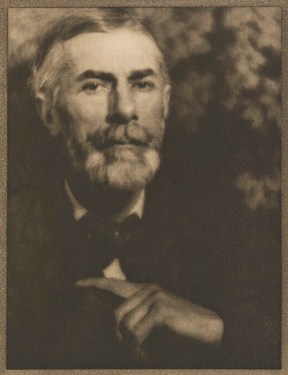
In January of 1928, George Merrill, who had grown dependent on alcohol since moving to Surrey, died suddenly. Carpenter was devastated and sold their house and lodged for a short time with his care giver Ted Inigran. They took a small bungalow in Surrey where, in May of 1928, Carpenter had a stroke. He lived for another thirteen months and died on the 28th of June in 1929, at the age of eighty-four. He was interred in the same grave as Merrill at the Mount Cemetery in Guildford, England.

Note: A collection of Edward Carpenter’s works and papers are housed at the Harry Ransom Center of the University of Texas at Austin. This collection includes letters and the hand-written manuscripts of “Toward Industrial Freedom” and “The Trojan War & Constantinople”, among other items.

A transcript of a discussion, given by poet Allen Ginsberg, on Edward Carpenter’s 1888 “The Secret of Time and Satan” can be found at The Allen Ginsberg Project website. An audio of that discussion is also provided. The discussion is located at: https://allenginsberg.org/2014/03/expansive-poetics-42-edward-carpenter-4/

Top Insert Image: Fred Holland Day, “Edward Carpenter”, 1900, Black and White Photogravure, 9.9 x 7.3 cm, National Portrait Gallery, London

Second Insert Image: Photographer Unknown, “Edward Carpenter and George Merrill”

Third Insert Image: Photographer Unknown, “George Edward Hukin, Edward Carpenter and George Merrill”, Date Unknown, Photogravure

Fourth Insert Image: Henry A Bishop, “Edward Carpenter”, 1907, Oil on Canvas, 47.3 x 43.8 cm, National Portrait Gallery, London

Bottom Insert Image: Alvin Langdon Coburn, “Edward Carpenter”, November 28 1905, Photogravure, 20.8 x 15.7 cm, National Portrait Gallery, London

Keisuke Yamamoto

Stone Lithographs by Keisuke Yamamoto

Born in Osaka in 1961, Keisuke Yamamoto is a Japanese lithographer and painter known for his still lifes and landscape images. He graduated in 1986 from historical Kanazawa’s College of Art and Design with a Master of Fine Arts in Oil Painting and then studied lithographic techniques at a printing studio. Since his graduation, Yamamoto has been an independent painter and lithography artist. He currently lives and works in Kyoto where he maintains his atelier.

Lithography, in essence, requires clear systematic planning in its execution; errors can not be corrected. Yamamoto’s hand-drawn stone lithographs, although appearing simplistic, required great forethought and skill in carving. His work does not contain any narrative but instead focuses on the incredible stillness of a moment in time. The beauty of Yamamoto’s work is created by the interactions between time, silence, light and shadow, the composition of which places the viewer as an observing visitor.

In his “Light, Time, Silence” begun in 1992, Keisuke Yamamoto created a series of lithographs which reconstructed three recurring elements, chairs, stairs and windows, which were arranged in multiple settings with different lighting conditions. The main theme for this series was the conception of the natural flow of time. To achieve this, Yamamoto had to depict the surrounding spaces as well as the gradation of light with great accuracy. He was aware that our ability to see and understand the world visually was based on the light that reflected off various objects. Upon light entering our eyes, our brains process the information and present it to us as a particular object with a particular color and shape. Yamamoto understood the illustration of the visual world depends actually on the depiction of light; and the flow of time must be illustrated through changes in that light.

Keisuke Yamamoto is represented in the United States by the Davidson Galleries, a collection of nearly twenty-thousand works on paper, which is located on Occidental Avenue South in Seattle, Washington. His works can be seen at: https://www.davidsongalleries.com/collections/keisuke-yamamoto

Top Insert Image: Keisuke Yamamoto, “Apple Tree”, 1961/2013, Lithograph, AP, 38.1 x 60.1 cm, Davidson Galleries

Bottom Insert Image: Keisuke Yamamoto, “Sea Breeze B”, 1961, Lithograph, “Light, Time, Silence” Series, Edition of 20, 30.2 x 20 cm, Davidson Galleries

Cecil Beaton

The Photography of Cecil Beaton

Born in January of 1904 in the Hampstead area of London, Sir Cecil Walter Hardy Beaton was a British portrait, fashion and war photographer. He was also a painter, an interior designer and a designer of stage set and costumes, for which he received two Academy Awards.

Cecil Beaton was the eldest of four children born to Ernest Beaton, a prosperous timber merchant and amateur actor, and Esther Sisson, the daughter of a Cumbrian blacksmith. His primary education was at Heath Mount School in rural Hertfordshire, where he was recognized for both his singing and artistic talent. Beaton received his initial instruction in photography and film development from his governess. When he considered his work acceptable, he sent photos to London society magazines under a pseudonym.

Beaton attended the prestigious Harrow School in Greater London and then entered St. John’s College at Cambridge, where he studied history, art and architecture. He continued his photographic work during his college years. Beaton, never having a strong interest in academia, left Cambridge without a degree in 1925. After a short period in the family’s timber business, he left and concentrated on a career in his main interest, photography. After a period of study under one of London’s youngest photographers Paul Tanqueray, Beaton set up his own studio in London. 

Through the patronage of English author and poet Osbert Sitwell, Cecil Beaton had his first photography exhibition at London’s Cooling Gallery at Southampton Row. This successful show in 1927 established him as one of the leading fashion and portrait photographers of his generation. Beaton was soon hired as a staff photographer for Vanity Fair magazine and both the American and British editions of Vogue magazine. He developed a style of portraiture where the sitter was merely one element of an overall decorative pattern, dominated by backgrounds of unusual materials. In addition to his fashion  and society work, Beaton traveledd to the United States and began to photograph many celebrities in Hollywood. 

Beaton’s celebrity portraits had a sparse composition and a sensual directness that in essence freed his subjects from their respective eras. Devoted to the social scenes he lived in and passionate for his individual subjects, Beaton was committed to capturing their charisma on film. Among the celebrities he photographed were the solemn looking, plain dressed Gary Cooper in 1931, Greta Garbo at the Plaza Hotel in 1946, and the boyish-looking Truman Capote in 1948. Beaton also took many portraits of the English and foreign elite, including Lady Diane Cooper, Winston Churchill, Caroline of Monaco, and Charles de Gaulle. He also shot a portrait of the young Queen Elizabeth in 1939 and in 1953, photographed her daughter Elizabeth II on her Coronation Day.

During World War II, Cecil Beaton served in the British Ministry of Information, as a leading war photographer covering the fighting in Africa and East Asia. During this period his style sharpened and the compositional range of his photographs widened. Beaton’s photographs taken during the the siege of Britain were published in 1942 in a collection entitled “Winged Squadrons”. After the war, he continued his portrait photography; his style however had mellowed due to his war experience and became less flamboyant. Beaton broadened his work at this time and began to design costumes and sets for both film and theater productions. 

One of Beaton’s first designs for the Broadway stage was a 1946 revival of Oscar Wilde’s comedy “Lady Windermere’s Fan” for which he designed costumes, sets, and lighting. In 1956, he designed costumes for the stage production of Lerner and Loewe’s “My Fair Lady”. The success of Beaton’s work led to designs for two of Lerner and Loewe film musicals, the 1958 “Gigi” and the 1964 “My Fair Lady”, each of which earned Beaton an Academy Award for Best Costume Design. For his many Broadway design works, he was the recipient of four Tony Awards. Beaton also designed sets and costumes for the New York’s 1961 Metropolitan Opera and London’s 1963 Covent Garden productions of Puccini’s “Turandot”.

In 1947, Cecil Beaton leased the historic Georgian manor Ashcombe House in Wiltshire after a visit accompanied by sculptor Stephen Tomlin and writer Edith Olivier. He employed architect Michael Rosenauer to make substantial renovations and alterations to the manor. At Ashcombe House, Beaton lavishly entertained such guests as Welsh painter and etcher Augustus John, English aristocrat Lady Diane Cooper, actress Tallulah Bankhead, artist Salvador Dali, and fashion illustrator Christian Bérard. In 1948, Beaton designed a fabric, still used among designers today, which he named “Ashcombe Stripe” after the manor. In 1947, Beaton bought Reddish House in Broad Chalke where he remained until his death.

In his personal life, Beaton had relationships with various men, including his two great loves, British arts patron Peter Watson and American art historian Kin Hoitsma, who was also a former Olympic fencer. He also had relationships with women, including Greta Garbo, the dancer Adel Astaire, and socialite Doris Castlerosse. In 1972, Beaton received the state honor of being knighted at the New Years Honors. Two years later, he suffered a stroke that paralyzed his right side. Although he adapted to the condition and continued his photographic work, Beaton became anxious about his financial security. Philippe Garner of Sotheby’s acquired Beaton’s archive, excluding work of the Royal Family and that held by Vogue, and oversaw its preservation and partial dispersal, which allowed Beaton an annual income.

Cecil Beaton’s health faded by the end of the 1970s. He died in January of 1980, four days after his seventy-sixth birthday, at his home in Broad Chalke; he is buried in the nearby churchyard. Beaton’s work has been shown in many exhibitions and retrospectives over the years, including at the National Portrait Gallery in Washington DC and the Imperial War Museum in London, among others.

Note: An interesting article to read would be Sooanne Berner’s “Ten Things You Might Not Know About Cecil Beaton” located at the online magazine “AnOther” : https://www.anothermag.com/art-photography/10296/ten-things-you-might-not-know-about-cecil-beaton

Top Insert Image: Photographer Unknown, “Cecil beaton in Sandwich, England”, circa 1920s, Gelatin Silver Print, Cecil Beaton Studio Photos, Sotheby’s

Second Insert Image: Curtis Moffat, “Cecil beaton”, circa 1930, Gelatin Silver Print, Victoria and Albert Museum, London

Third Insert Image: Photographer Unknown, “Cecil Beaton and Gary Cooper, 1931, Gelatin Silver Print

Fourth Insert Image: Photographer Unknown, “Cecil Beaton and Stephen Tennant”, 1927, National Portrait Gallery, London

Bottom Insert Image: Jack Mitchell, “Cecil Beaton”, 1963, Silver Gelatin Print, Getty Images

Ottilie Roederstein

The Paintings of Ottilie Roederstein

Born in 1859 to German parents in Zurich, Ottilie Wilhelmine  Roederstein was a painter who gained attention mostly in her homeland of Switzerland, but also in France and Germany. Her interest in painting began with the visit to her family home by Swiss painter Eduard Pfyffer who had been commissioned to do the family’s portraits. Beginning in 1876, Roederstein was allowed by her father, against her mother’s wishes and the prevailing social customs, to study painting under the tutelage of Eduard Pfyffer, so she would remain close to home

Three years later, Roederstein moved to the Berlin residence of her married sister Johanna and found a position in a special women’s class at the Grand-Ducal Saxon Art School under the tutelage of portrait painter Carl Gussow. Her first exhibition of paintings at a Zurich gallery in 1882 was well received. That same year, Roederstein followed her colleagues to Paris where she joined the women’s studio of portrait painters Charles Auguste Émile Durand and Jean-Jacques Henner. In addition to these classes, Roederstein also worked with academic painter Luc-Olivier Merson and painted nudes in special private evening classes.

In order to sustain herself as an artist, Ottilie Roederstein had chosen the genres of portraiture and still life, for which she used a dark-toned color palette. She soon departed from that traditional canon and began to paint religious imagery and nudes. By the very end of the 1890s, Roederstein had embraced the tempera medium which was in vogue among both traditional and avant-garde artists. She experimented with Symbolism and Impressionism in the latter part of her career before returning to her signature style in the 1920s.

Initially dependent on financial support from her family, Roederstein was able by 1887 to support herself with sales and commissions for her work. She returned to Zurich but continued to maintain her Paris studio on the Seine where she would work and exhibit several months of the year. Roederstein moved to Frankfurt, Germany, in 1891 to be with her partner, Elizabeth Winterhalter, a physician and one of the first female surgeons in Germany.

In 1891, Elisabeth Winterhalter had just  taken over a practice in Frankfurt am Main’s newly founded hospital, the Vaterländischer Frauenverein. She also set up the first gynecological polyclinic through a branch of the Red Cross organization. Although unable to obtain a German medical license despite her internships and Doctorate, she established a reputation as an obstetrician and gynecologist. In 1895, Winterhalter became the first female surgeon in Germany to perform a surgical procedure involving an incision through the abdominal wall. She also conducted research that led to the discovery of the ganglion cell of the ovary and published a major paper on the subject in 1896. 

Soon after her 1891 move to Berlin, Ottilie Roederstein quickly gained a wide circle of clients and, in 1892, began giving  women artists painting lessons at her  studio in the Städel Art School. She exhibited her paintings in Paris’s Salon and won a Silver Medal at the city’s 1889 Exposition Universelle. Her work was also shown at the Woman’s Building of the 1893 World’s Columbian Exposition held in Chicago, Illinois. In 1902, Ottilie Roederstein’s application for Swiss citizenship was granted; however, Frankfurt remained at the center of her life. Five years later, she and Elisabeth settled in Hofheim am Taurus, a western Frankfurt suburb surrounded by forest. 

Roederstein was a member of the Frankfurt-Cronberg Artists’ Association, a group which was attempting to establish the Impressionist technique of open air painting in Germany. She was also the only female artist to exhibit at Cologne’s 1912 International Art Exhibition. In 1913, Roederstein became a member of Frankfurt’s Women’s Art Association which campaigned for women artists’ rights to equal training and admission to art academies. During the first World War as exhibition opportunities shrank, she gave up her Paris studio and withdrew into the privacy of her Hofheim estate. Beginning in 1920, Roederstein bequeathed her own collection of important French and Swiss paintings to Kunsthaus Zürich, one of the most important art collections in Switzerland. 

In 1929 on the occasion of Ottilie Roederstein’s seventieth birthday, a large anniversary exhibition of her work was held at Frankfurt’s Art Museum and the city declared both Roederstein and Winte halter as honorary citizens. The rise of the National Socialist Party to power in Germany and the persecution of her Jewish friends and colleagues deeply affected Roederstein. She herself, as an artist, became subject to the state and had to contend with the government’s increasing control over the arts. After the war, Roederstein continued her painting and did  a number of portraits of women widowed by the war. 

Ottilie Roederstein continued to exhibit regularly until 1931. She produced a large body of work, of which more than eighty were self-portraits. She usually staged herself in a self-confident pose with a stern gaze, a posture that signified her emancipation. On the 26th of November in 1937, Ottilie W. Roederstein died of a heart condition in Hofheim am Taunus. The first posthumous exhibitions of Roederstein’s work were presented in 1938 in Frankfurt, Zurich and Bern in recognition of her artistic legacy and tireless work as a mediator between Switzerland and Germany. After a long period of obscurity, a retrospective of seventy works by Roederstein was held at Kunsthaus Zürich in December of 2020.

After her partner’s  death, Elisabeth Winterhalter created a joint legacy, the Roederstein-Winterhalter-Stiftung. She died in February of 1952 in Hofheim am Taunus. Winterhalter was buried alongside Roederstein in an honorary grave cared for by the community. For her efforts in opening the medical profession to women, a street in the Niederursel district of Frankfurt is named after her. 

Top Insert Image: Photographer Unknown, Ottilie Roederstein in Her Atelier, Date Unknown

Second Insert Image: Ottilie Foederstein, “Self Portrait with Keys”, 1936, 105.3 x 74.6 cm, Städel Museum

Third Insert Image: Photographer Unknown, ” Ottilie roederstein and Elisabeth Winterhalter, Date Unknown

Fourth Insert Image: Ottilie W. Roederstein, “Self Portrait with Hat”, 1904, Oil on Canvas, 55.3 x 46.1 cm, Stäadel Museum

Bottom Insert Image: Photogapher Unknown, Ottilie Roederstein and Elisabeth Winterhalter, Date Unknown, Studio Portrait Print

William Haines: Film History Series

Photographers Unknown, “William Haines”, Date Unknown, Studio Publicity Shot, Gelatin Silver Print

Born in Staunton, Virginia in January of 1900, Charles William Haines was an American actor and interior designer. He was the third child of seven siblings, two of which died in infancy, born to George Adam Haines, a cigar maker, and Laura Virginia (Matthews) Haines. He became fascinated at an early age with motion pictures and stage performances. 

At the age of fourteen, William Haines ran away from home accompanied by an unidentified young man. They both gained employment at the DuPont factory in Hopewell, Virginia, where they earned fifty dollars a week producing nitrocellulose which in its finished form is used for photography. Tracked by the police, Haines made an arrangement with his parents where he could remain in Hopewell and, with his earnings, send support to his family. The two boys remained in Hopewell until the 1915 fire which destroyed most of the city. 

Haines relocated to New York City until 1917, when a family crisis caused him to move to his family’s new home in Richmond, Virginia, to lend financial and emotional support. With the family’s recovery in 1919, Haines returned to New York City and settled in the growing gay community of Greenwich Village. He worked at various odd jobs and eventually gained employment as a model. Haines entered the Goldwyn Pictures’s contest, “New Faces of 1922”, and was discovered by Bijou Fernandez, a silent film actress and theatrical agent. Signed to a forty dollar per week contract with Goldwyn Pictures, he traveled to Hollywood in March of 1922 along with fellow contestant Eleanor Boardman.

William Haines initially played uncredited roles; his first significant casting was a high-profile role in director King Vidor’s 1923 silent drama “Three Wise Fools”, for which he received positive notices in reviews. This was followed in the same year by another significant role in Fox Studios’s silent western “The Desert Outlaw”. In 1924, MGM lent Haines to Columbia Pictures for a five-picture deal. The first of these films, the 1924 crime film “The Midnight Express” received excellent reviews. 

Haines had his first major personal success with the starring role in MGM’s 1926 silent drama “Brown of Harvard”. The character he played, a young arrogant man later humbled, was a role he would repeat for the next several years. On a publicity trip to New York City in 1926, Haines met James Shields. He convinced Shields to move to Los Angeles and promised to secure him work as an extra in films. Haines and Shields began living together and saw themselves as a committed couple. Although many actors in the film industry knew of their commitment, Haines never publicly affirmed his sexuality and there was no mention of their relationship in the press.

William Haines next appeared in two successful films, the 1925 comedy-drama “Little Annie Rooney”, co-starring with Mary Pickford, and the 1926 comedy “Show People”, co-starring with Marion Davies. He was one of the top five box-office stars from 1928 to 1932. With the advent of sound in film, Haines was able, with elocution lessons, to make the transition and maintain his star status. His first starring role in a full-sound film was the 1929 romance  “Navy Blues” for MGM; this was followed by the 1930 western parody “Way Out West”. At this point in his career, Haines was listed as the top box-office attraction in the country. 

Haines’s films began to drop at the box-office by the late 1930s. MGM canceled his contract in 1931 and, later, brought him back to the studio as a featured player with a reduced salary. Haines next starred in the film, “Just a Gigolo”; but that production failed to turn his slipping ratings. The MGM Studio finally terminated Haines’s contract with the studio in early 1933. 

The termination of Haines was the result of multiple factors.  With the depression, studios were very concerned about their films’ profit margins; Haines was aging and had not successfully completed his transition from his early “Brown of Harvard” persona; and Haines, despite not affirming his sexuality publicly, did not agree to a studio-supported lavender marriage as other gay actors had done. The impending Hays Production Code and the decreasing profits from Haines’s films put pressure on the studio and made it difficult for MGM to continue placing him in starring roles.

William Haines’s final two films were produced in 1934 by Mascot Pictures, a studio known for producing serials and B-movies. The first was the romantic comedy “Young and Beautiful”, which starred Haines opposite actress Judith Allen, and the second was a war-romance film “The Marines Are Coming”, in which Haines played opposite Conrad Nagel and Esther Ralston. Although Haines still received offers from minor studios, he made the decision to retire from acting and commit himself to his and Shield’s interior design business. Over his acting career, Haines had appeared appeared in fifty-four films, the majority of which were in starring roles.

In 1930, William Haines and James Shield had begun a successful dual career as interior designers and antique dealers. Hand-painted wallpaper, ottoman tables, and low to the ground sitting rooms became signature pieces of their work. Their antiques and artwork were loaned for film stage sets, including Haines’s personal paintings for Tara’s interior walls in “Gone With the Wind”. Among their clients were friends such as Gloria Swanson, George Cukor, Carole Lombard, and Joan Crawford.  In 1937, Haines was hired to decorate the estate of studio executive Jack L. Warner.  In the late 1930s through an introduction made by Joan Crawford, Haines and Shield decorated Villa Valentino, a secluded estate owned by Tom Lyle Williams, the founder of Maybelline Cosmetics, and his life-long partner Emery Shaver.

Haines and Shield settled in the Hollywood community of Brentwood and, except for a brief period of Haines’s service during World War II, they remained together and ran their prosperous business. By the time of their retirement in the early 1970s, their clients included socialite and philanthropist Betsy Bloomingdale and Governor Ronald Reagan and Nancy Reagan. Haines was also hired to redecorate London’s Winfield House, the official United States embassy residence, by the U.S. Ambassador Walter Annenberg.

William Haines and James Shield remained together in a relationship for forty-seven years. They enjoyed a high position in Hollywood for decades, supported by many loyal friends. On December 26th of 1973, William Haines died, at the age of seventy-three, from lung cancer in Santa Monica, California. Shortly afterward on March 6th of 1974, James Shield, who was suffering from Alzheimer’s disease, dressed in Haines’s pajamas, wrote a note about his loneliness, and took an overdose of sleeping pills. They are interred side by side in Santa Monica’s Woodlawn Memorial Cemetery. For his contribution to the motion-picture industry, William Haines has a star on the Hollywood Walk of Fame located at number 7012.

Third Insert Image: Nick Grinde, Edward Sedgwick and Malcolm St. Clair, “Remote Contol”, 1930, Promotional Window Card, Cinematographer Merrit B. Gerstad, Metro Goldwyn Mayer

Thanh Vuong

The Photography of Thanh Vuong

Based in Melbourne, Thanh Vuong is a Vietnamese-Australian photographer who specializes in photographing the male body in natural landscapes with natural light. Born in Saigon, Vietnam, he emigrated at a very young age with his family to Australia. In 2017, Vuong earned his Bachelor of Arts in Photography from Melbourne’s Photography Studies College where he studied under the tutelage of photographers Daniel Boetker-Smith, the director of the Asia-Pacific Photobook Archive, and Hoda Afshar, an Iranian photographer known for her black and white documentary work.

Vuong’s projects explore the themes of gender politics and the representation of queer identities, masculinity and the male form. Among the photographers he considers major influences on his work are such artists as German photographer Wilhelm von Gloeden, known for his pastoral nude studies accomplished with photographic filters of Sicilian boys; photojournalist William Eugene Smith, an important figure in the development of editorial photo essays; portraitist George Platt Lynes, best known for his Hollywood portraits and male nudes; and George Dureau, whose career was most  notable for his charcoal sketches and black and white photographs of vulnerable and marginalized individuals.

In 2017, Thanh Vuong shot his series “In My Garden, the Trees Are Changing”, which centered on theme of male beauty and desire. The images presented an imaginary utopia of lush gardens and ethereal light in which gay men are free from prejudice, judgement and injustice. This series was awarded the Leica and Ilford Excellence in Photomedia Award at Melbourne’s 2017 Summer Salon held at the Centre for Contemporary Photography. It also won multiple awards in the same year at both state and national level from the Australian Institute of Professional Photography. The success of Vuong’s series led to another solo exhibition at the end of 2021 held at the Paddington Reservoir Gardens in Paddington, Australia.

Vuong’s 2017 series “(Not) Blue” was shortlisted for the Australian Photographer of the Year held by Capture Magazine. Vuong was a finalist in the British Journal of Photography’s first OpenWalls competition held in Arles, France, in 2019. His photo “A River That Flows From Eden”, depicting a nude couple lying at water’s edge, placed third in the 2021 Monovisions Photography Awards.

Thanh Vuong is currently represented by Boys!Boys!Boys, an initiative of the Little Black Gallery in London. Images of his work can be seen at the Boys!Boys!Boys site located at: https://boysboysboys.org/search?q=vuong

“I see photography as an extension and expression of my sexual identity and a way to start an honest and open conversation. As I developed my technique, the way I approach the body in my work has also evolved. Now it is no longer just an autonomous specimen understood as an exhibition of manhood, but a means through which I can delicately express some of the problems that affect the current queer community.” – Thanh Vuong, Interview with Gustavo Forcada, Editor of the online magazine Belfusto, March 2021

Andreas Martin Andersen

Andreas Martin Andersen, “Hendrik Andersen and John Briggs Potter in Florence”, 1894, Oil on Canvas, Dimensions Unknown, Hendrik Andersen Museum, Rome

Born in August of 1869 in Bergen, the historic site of Norway’s first coronation, painter Andreas Martin Andersen was the first son of parents Anders Andersen and Helene Monsine Monsen. His younger brother, the sculptor Hendrik Christian Andersen, was born in April of 1872, also in Bergen. In 1873, the family emigrated to the United States and settled in Newport, Rhode Island. 

Beginning in 1889, Andreas Andersen studied at Cowles Art School in Boston. Three years later after receiving a scholarship, he studied painting at the Académie Julian in Paris under painter and sculptor Jean-Paul Laurens, a major exponent of the French Academic style, and  Jean-Joseph Benjamin-Constant, painter and etcher known for his Oriental subjects and portraits. During his stay in Paris, Andersen shared the studio with his American friend Howard G. Cushing, the son of an illustrious and wealthy family with residences in Newport and Boston. 

Andersen also became good friends with the painter John Briggs Potter, another student at the Académie Julian. In 1894, Hendrik Andersen joined his brother in Paris. The three Americans traveled together through Europe and explored the many Italian cities, including Florence. “Hendrik Andersen and John Briggs Potter in Florence”, was painted in 1894 by Andreas Andersen during the last year of their grand European tour as a final proof to be sent back to Boston. He portrayed his brother and friend Potter as they woke up in the bohemian interior of the Florentine house in Via San Zanobi near Piazza Indipendenza where the three companions had taken up residence.

Early in his academic stay in Paris, Andreas Andersen began dating Olivia Cushing who was Howard’s sister and, at that time, residing in Paris. By 1892, they had developed a strong loving bond. Upon his return to the United States at the end of 1894, Andersen settled in the Boston area and began painting. A talented painter, his exceptional early success was partly influenced by Olivia Cushing’s friendships with many wealthy citizens of the area. One of Andersen’s most important patrons was Isabella Stewart Gardner. Born to a wealthy family and a collector of rare books. Gardner supported many artists, including John Singer Sargent and dancer Ruth St, Denis. Over his career, Andersen painted over thirty portraits and a dozen landscapes, as well as a series of drawings with academic studies of nudes.

Andreas Andersen married Olivia Cushing in January of 1902. Stricken with tuberculosis, he was ill at the time of their marriage and died a year later in February of 1902. Many of Andersen’s works are housed in private collections and in the Hendrik Andersen Museum in Rome. 

 In 1903, Olivia Cushing Andersen left Boston to join her brother-in-law Hendrik Andersen in Rome. A cultural woman of great sensitivity and author of allegorical dramas with historical and biblical themes, she was Hendrik’s muse and also in part the financier of his grandiose sculptural and urban projects. Until her death in Rome in December of 1917, she was the passionate expounder of Andreas and Hendrik’s work in her unpublished diaries. These diaries are now preserved in the historical archive of the Hendrik Andersen Museum in Rome. 

Top Insert Image: Andreas Martin Andersen, “Dionysus Torso at Fenway Court”, 1902, Oil on Canvas, 57 x 36 cm, Isabella Stewart Gardner Museum

Bottom Insert Image: Andreas Martin Andersen, “Portrait of Olivia Cushing Andersen”, Circa 1895, Oil on Canvas, Dimensions Unknown

Hendrik Christian Andersen

The Sculptural Works of Hendrik Christian Andersen

Born in Bergen in April of 1872, Hendrik Christian Andersen was a Norwegian-American sculptor, painter and urban planner. The younger brother of painter Andreas Martin Andersen, he moved in 1873 as an infant with his family to Newport, Rhode Island. As a young man, Andersen worked as a sculptor and served as an art instructor to prominent social figure Gertrude Vanderbilt Whitney, who was a sculptor and both patron and collector of the arts.

In 1893, Hendrik Andersen traveled to Europe to study art. In Paris, he met his older brother Andreas and student painter John Briggs Potter. The three of them traveled for a year through Europe and resided in Florence for some time at the end of their tour. In 1894 at their Florence residence, Andreas Andersen painted a portrait scene of both Hendrik and John Potter rising from sleep, entitled “Hendrik Andersen and John Briggs Potter in Florence”

Now settled in Rome in 1899, Hendrik Andersen met the American expatriate writer, Henry James, who is regarded as a prominent transitional figure between literary realism and literary modernism. Although James was thirty years older, the two men developed a close relationship and maintained correspondence for fifteen years. James, enamored with the sculptor, become one of his first patrons by buying Andersen’s painted terracotta bust of the twelve-year old Count Alberto Bevilacqua who regularly visited every Saturday at Andersen’s studio.

Henry James’s letters to Andersen, seventy-seven of which are in the University of Virginia’s library, show a high level of affection and sensual love for Anderson. James’s letter of condolence for the death of Andreas Andersen in 1902 expresses his grief as well as his love: “to put my arm round you and make you lean on me as a brother and a lover, and keep you on and on. . .”. However, as Andersen’s replies are not available, their actual relationship can not be definitely determined.

After Andreas Andersen’s death, his widow Olivia Cushing traveled to Rome to stay at Hendrik Andersen’s residence for discussions on the commemoration of Andreas’s life and work. Hendrik’s conception for a sculpted funeral monument grew into an idea for a Palace of Arts, and then further progressed into a plan for a World City full of sculptures, museums, and galleries. In 1813, Andersen published his “A World Centre of Communication”, a tome about social and spiritual renewal through the arts, with an emphasis on sculpture.

This tome alienated James who felt that Andersen was pursuing a megalomaniacal version of society at a time when Italy was under the rise of Fascism. By 1915, they both had ceased correspondence. Before his death, Henry James burned many of his papers, including pieces of correspondence. After James’s death, Andersen approached the James estate in 1930 for permission to publish the letters he had received: however, permission was refused. These letters were not available publicly until 2000.

Olivia Cushing Andersen came from a wealthy family with residences in both Newport, Rhode Island, and Boston, Massachusetts. In her own right, she was cultured and had amassed an extensive collection of art and rare books. Upon her death in Rome in December of 1917, she left a large sum of money to Hendrik Andersen. He used this inheritance to build a villa as part of his World City idea. Between 1922 and 1925, Villa Helene was built to Andersen’s design with an immense carving studio in the nearby Piazza del Popolo. 

Henrik Andersen worked in this studio until his death in December of 1940. Over his lifetime, he executed more than four hundred pieces of both plaster models and stone or bronze sculpture, many of which were monumental figurative works of larger than life size. Upon his death, Andersen bequeathed all of his work to the Italian State, only stipulating that Villa Helene be made available to his model and adopted sister, Lucie, until her death.

Upon Lucia’s death in 1979, the villa became state property and is now the Hendrik Christian Andersen Museum, located on Via Pasquale Stanislao Mancini in Rome. The museum houses all the papers and collected works of Hendrik Christian Andersen, which include sketches, models in plaster and bronze, as well as paintings by his brother Andreas and other contemporary artists of that time.

Notes: A collection of letters from Henry James to Hendrik Andersen can be found in Rosella Mamoli Zorzi’s “Henry James: Beloved Boy: Letters to Hendrik C. Andersen”. The book is available through many vendors.

A collection of six letters from Henry James to Hendrik Andersen, along with a short description of Henry James’s life, can be found at Rictor Norton’s Gay History and Literature site. There is however an error in the description of the Andreas Andersen’s painting; the seated figure is not Andreas Andersen but John Briggs Potter. The letters can be found at: https://rictornorton.co.uk/jameshen.htm

Top Insert Image: Photographer Unknown, “Hendrik Christian Andersen”

Second Insert Image: Photographer Unknown, “James Henry and Hendrik Andersen”, 1907

Third and Fourth Insert Images: Sculptures by Hendrik Christian Andersen, Museo Hendrik Christian Andersen

Saeed Jones: “Their Footprints Burn Holes in the Sand”

Photographers Unknown, Their Footprints Burn Holes in the Sand

Boys begin to gather around the man like seagulls.
He ignores them entirely, but they follow him
from one end of the beach to the other.
Their footprints burn holes in the sand.
It’s quite a sight, a strange parade:
a man with a pair of wings strapped to his arms
followed by a flock of rowdy boys.
Some squawk and flap their bony limbs.
Others try to leap now and then, stumbling
as the sand tugs at their feet. One boy pretends to fly
in a circle around the man, cawing in his face.

We don’t know his name or why he walks
along our beach, talking to the wind.
To say nothing of those wings. A woman yells
to her son, Ask him if he’ll make me a pair.
Maybe I’ll finally leave your father.
He answers our cackles with a sudden stop,
turns, and runs toward the water.
The children jump into the waves after him.
Over the sound of their thrashes and giggles,
we hear a boy say, We don’t want wings.
We want to be fish now.

Saeed Jones, “Daedalus, After Icarus”, Prelude to Bruise, 2014

Saeed Jones, an American poet and author, was born in November of 1985 in Memphis, Tennessee, and raised in a suburb of northern Texas. He studied at Western Kentucky University where he won national speech and debate competitions. After receiving his Bachelor of Arts, Jones earned his Master of Fine Arts in Creative Writing from Rutgers University in Newark. He currently lives and works on his writing in Columbus, Ohio. 

Saeed Jones’s poetry examines the issues of race, power, desire and grief; he incorporates both mythology and the iconography of black culture into his poems and prose. In his work, Jones also discusses the process of personal journey and transformation, which includes those events in life where the issues of sex, race and power collide. 

Jones’s first published work, “Prelude to Bruise”, was a large collection of melodic poems with words in counterpoint. The core theme present throughout the collection is of a queer Afro-American child who navigates through family, gender and desire in the South. The work was named a finalist for the 2014 National Book Critics Circle Award for Poetry, the 2014 Lambda Literary Award for Gay Poetry, and the 2015 Thom Gunn Award for Gay Poetry. It won the 2015 Stonewall Book Award and PEN/ Joyce Osterwell Award for Poetry. 

Saeed Jones’s second work, a memoir entitled “How We Fight for Our Lives”, follows his life as a young, gay, black man living in Lewisville, Texas in the 1990s as he seeks a place for himself within family and country, and within his desires, hopes and fears. The memoir highlights his awareness of the discrimination, homophobia and racism he endured, as well as the struggles he faced to define his own identity. “How We Fight for Our Lives” won the 2019 Kirkus Prize for Non-Fiction, the 2020 Lambda Literary Award for Memoir/Biography, the 2020 Stonewall Book Award-Israel Fishman Non-Fiction Award, and the Randy Shilts Award for Gay Nonfiction presented by Publishing Triangle. 

Saeed Jones previously worked as the LGBTQ editor and Culture editor for BuzzFeed, an internet company focused on all segments of digital media. He has received a Pushcart Prize and fellowships from Cave Canem and Queer Art Mentorship. 

Notes: Saeed Jones’s next poetry collection, entitled “Alive at the End of the World”, will be released in September of 2022. Though his poems, Jones confronts the everyday perils of white supremacy and identifies even routine moments that open channels of hurt. Using first-person narration, he seeks to understand his own feelings through the lives and experiences of such cultural icons as Aretha Franklin, Little Richard, and Diahann Carroll. Pre-order is available through Coffee House Press located at: https://coffeehousepress.org/products/alive-at-the-end-of-the-world/

Larry Stanton

The Portrait Work of Larry Stanton

Born in June of 1947 in Rockville Center on the south shore of Long Island, Larry Stanton was a portrait painter who was lived and worked  in Manhattan, New York. His father, a graduate of Columbia University and the Juilliard School of Music, moved his family in 1948 to a dairy farm in New York’s Catskill Mountains to provide a country environment for the family and a source of income for his work as a freelance music arranger. Due to the foundering of both the farm and his musical aspirations, Stanton’s father often experienced periods of frustration and temper which affected the family. However, despite the familial tensions, both he and Stanton’s mother encouraged and supported Stanton’s early artwork. 

After graduating high school, Larry Stanton studied on an art scholarship at New York City’s Cooper Union for one semester. He worked in the following months at various odd jobs including mailrooms and an ice cream parlor. During this period, Stanton embraced his gay identity and gained some notoriety in New York City’s gay community. He became acquainted with banker Arthur Lambert in the summer of 1967 and the two were immediately drawn to each other. Upon returning from a trip with Lambert to London, Stanton followed him in the fall of that year to Los Angeles, where Stanton took a new financial position. 

In February of 1968, Stanton enrolled in Los Angeles’s Art Center College of Design where he received his first formal training in drawing and painting. After applying himself intensely to his studies, he became convinced it was possible to make a career in art. During his time at the college, Stanton met many people who would become lifelong friends, including Alice Sulit, an art student from the Philippines, and English painter David Hockney. In the fall of 1968, Stanton traveled with Lambert to Hockney’s residence in London where he met another major influence on his life, Henry Geldzahler, the Curator of Contemporary Art at New York’s Metropolitan Museum of Art.  

Upon the return to New York, Larry Stanton moved into a Manhattan rent-controlled apartment owned by his father, who was relocating to retire in Florida; Lambert returned to his financial work in California. With a scholarship from the New School, Stanton began  to study printmaking and drawing; his studies were further supported by a grant for printmaking from the Tiffany Foundation. In January of 1970, Stanton had his first exhibition of drawings at New York City’s Gotham Gallery. This show was followed by a period of travel, accompanied sometimes by Henry Geldzabler, to Italy, Tunisia and sub-Saharan Africa. Upon his return, Stanton found a basement studio space in the Italian section of Greenwich Village where he could continue his painting. 

In early 1972, Arthur Lambert moved back to New York and noticed a change in Stanton. Stanton had begun drinking alcohol more frequently and had become less committed to painting. He began to pursue filmmaking and produced a few films on David Hockney. Stanton also began bringing back to his place young men he met on his travels around the city. By late 1977, he was not socializing as much and complained of lingering feelings of anxiety. Stanton’s mother, with whom he had a close bond, succumbed from cancer in 1979 after a three year struggle. The loss of this bond, intensified by the depressive effects of his developed alcoholism, resulted in Stanton having a psychological collapse for which he needed hospitalization.

From this trauma, Larry Stanton emerged a sober, non-smoking artist with an intense commitment to his art. Stanton moved his studio to a larger location nearer his apartment which enabled him to work on larger canvases. By 1983, his studio was attracting young writers and artists who admired his work and sought his company. In his apartment and studio, Stanton created a series of portraits in charcoal, oil crayon, pencil, and pen, as well as paint, drawing friends, familial relations, and people he met while wandering the streets of New York. Many of the people who posed for him would later die from the AIDS epidemic.

Holly Solomon, a prominent art dealer, commissioned two portraits, one of herself and one of her son. She later placed two of Stanton’s oversized portraits in a group show at her Soho gallery. Following this show, Stanton’s work was given an exhibition at the Aaron Berman Gallery in Brooklyn. In 1984, his work was included in a major group exhibition at the Queens, New York, city-owned exhibition space, PS1, which focused on emerging new artists. Stanton’s work was also presented in a group exhibition at the East Village’s Magic Gallery. With these shows, his work was gaining increased attention as he developed a consistent quality and a mature personal style. 

Beginning in February of 1984, Larry Stanton began to have health problems, initially shingles and later periodic unpleasant skin rashes. After numerous tests, the doctors assured there were no signs of immunity problems; there were no specific AIDS testing at this time. In August, Stanton developed a persistent and sore throat and was diagnosed with pneumocystis carinii pneumonia, a fatal fungal infection of the lungs and major cause of death for people with HIV/AIDS. Larry Stanton died, at the age of thirty-seven, of AIDS-related illness on October 18th of 1984. 

After Larry Stanton’s  death, a collection of his work was shown at New York City’s Charles Cowles Gallery in 1987. From May through July of 2021, the Daniel Cooney Fine Art Gallery in the Chelsea area of New York City held “It Doesn’t Thunder Every Day”, an exhibition of twenty works on paper by Stanton that captured the faces of a generation of people lost in the early stages of the AIDS epidemic. Larry Stanton’s work is housed in the permanent collection of New York City’s  Leslie-Lohman Museum of Gay and Lesbian Art.

Notes: A full collection of Larry Stanton’s paintings and drawings, as well as personal tributes and remembrances by friends such as Arthur Lambert,  Henry Geldzahler and David Hockney, can be found at: http://www.larrystanton.net

A recent collection of poems by gay poet Winthrop Smith entitled “Take Down Portraits: Drawings and Portraits by Larry Stanton” was published by Chiron Review Press. Bringing the portraits back to life, Smith’s poems imagine the encounters between Stanton and his sitters, which reconstruct the experience of New York at the height of the AIDS epidemic.

Top Insert Image: Photographer Unknown, “Larry Stanton”, circa 1968

Second Insert Image: Larry Stanton, “Man in Jockstrap”, circa Early 1970s, Pencil on Paper, Private Collection

Third Insert Image: Photographer Unknown, “Arry Stanton in His Village Basement Studio”, circa 1981

Fourth Insert Image: Larry Stanton, “Joey”, 1975, Pencil on Paper, Private Collection

Bottom Insert Image: Photographer Unknown, “larry Stanton, Fire Island Pines”, circa 1980

Alexandre Denis Abel de Pujol

Alexandre-Denis Abel de Pujal, “Ixion Chained in Tartarus”, 1824, Oil on Canvas, 127 x 157 cm, Louvre Museum, Paris

Alexandre-Denis Abel de Pujol, “Sisyphus Eternally Rolling the Rock”, 1819, Oil on Canvas, 130 x 212 cm, Musée Henri Martin, Cahors, France

Born in January of 1785 in Valenciennes, a northern French city bordering Belgium, Alexandre Denis Abel de Pujol was a French painter. He was the illegitimate son and only child of nobleman Alexander-Denis-Joseph Mortry de Pujol, Baron de la Grave, who served as advisor to King Louis XVI Auguste and was the founder of the Académie de Peinture et Sculpture in Valenciennes. From the age of twelve, Abel de Pujol studied at the Academy and completed his training as a student of Neoclassical artist Jacques-Louis David, regarded in his time as the preeminent painter in France. 

Receiving little support from his father for his studies, Abel de Pujol earned a pension from the city of Valenciennes which allowed him to continue his studies at David’s studio. He also took classes in perspective, anatomy, and architecture at the Ecole des Beaux-Arts in Paris. In 1806 at  the age of twenty-one, de Pujol won a first-class medal at the Académie and a second-class medal at the Salon of 1810 for his painting “Jacob Blessing the Children of Joseph”; this painting placed second at the Prix de Rome competition in 1810. 

In 1811, Abel du Pujol won the Prix de Rome with his painting “Lycurgus Presenting the Heir to the Throne to the Lacedaemonians”. Having achieved this award, he was formally recognized by his father and was able to add the name Pujol to his own. Abel de Pujol suffered a period of poor health and depression during his stay in Italy, which allowed him only eight months of study in 1812. Restored to health, he returned to his career in Paris and successfully exhibited mainly history paintings at the Salons.

In 1814, Abel de Pujol won gold medals from both Louis XVIII and Napoleon Bonaparte for his monumental painting “The Death of Britannicus”. A compositional study for the 3.54 x 5.50 meters painting is currently housed in the collection of New York’s Metropolitan Museum of Art. His grisaille (gray-monochrome) painting “The Preaching and Martyrdom of Saint Stephen”, intended for the church of Saint Etienne du Mont, was entered at the 1817 Paris Salon where it won the prize for history painting. These awards established his reputation as a history painter and muralist.

Abel de Pujol received several important official commissions, He executed three paintings and a ceiling mural for the royal palace at Versailles, as well as a large, allegorical ceiling mural, entitled “The Renaissance of the Arts”, for the Louvre’s grand staircase, later destroyed in 1855 during the joining of the Palais du Louvre to the Palais des Tuileries. Abel de Pujol also painted many mural decorations for public buildings, such as the Galerie de Diane at Fontainbeau and the Palais de Luxembourg. For the ceiling of the Bourse, Paris’s stock exchange, he executed a series of large-scale grisaille tromp-l’oeil decorations of architectural features and draped nudes.

Throughout his career, de Pujol produced altar pieces and designs for stained-glass windows for Parisian churches such as Saint-Roch, Saint Sulpice and Saint Thomas d’Acquin and the Madeleine. He also did work for the cathedral at Arras and the church of Saint-Pierre in Douai. Included among Abel de Pojul’s last major works are the 1846 “Valenciennes Encouraging the Arts”, a monumental canvas for the town hall of Valenciennes, and an 1852 mural for the ceiling of the staircase of the School of Mining at the Hôtel de Vendôme in Paris.

A successful teacher and draftsman, Abel de Pujol was a member of the Institut de France, a learned society composed of all the sciences and fine arts, and an Officer of the National Order of the Legion of Honor. Among his students were sculptor Alphonse Lami, painter Alexandre-Gabriel Decamps, and Julien Hudson, an American painter and free man of color, thought to be the first African American by whom a self portrait is known. Abel de Pujol died in Paris, at the age of seventy-six, in September of 1861. 

Top Insert Image: Alexandre-Denis Abel de Pujol, “Self Portrait”, 1806, Oil on Canvas, 71 x 55 cm, Musée de Beaux-Arts, Paris

Middle Insert Image: Abel de Pujol, “La Colère d’Achille (The Fury of Achilles)”, 1810, Oil on Canvas, 112 x 146 cm, Snite Museum of Art, Campus of Notre Dame, Indiana

Bottom Insert Image: Alexandre_Abel_de_Pujol, “Self Portrait”, 1812, Oil on Canvas, 56.2 x 46 cm, Musée des Beaux-Arts