Alex Folla

The Paintings of Alex Folla

Born in 1980 in Oggiono, a northern town in the Province of Lecco, Alex Folla is a contemporary Italian artist. He graduated with a Bachelor of Arts in Painting at Milan’s Accademia di Brera and a Masters Degree in Visual Arts from the Accademia di Bella Arti in the city of Carrara. He currently lives and works in Milan, Filorera located in the Italian Alps, and Moscow.

Trained in the history and techniques of the Renaissance and Baroque artists from Michelangelo to Caravaggio, Alex Folla uses his classical training to tackle contemporary life though metaphoric images. He creates profoundly technical and pictorial realistic images which incorporate such human issues as the frailty of the body, illness, holiness and strength. In many of his works, Folla takes traditional sacred imagery and, using its classical composition and his stylistic choice, reconstructs it to form symbolic images of a more contemporary nature.

In his 2016 show “BulleTime”, Alex Folla based his work on the idea of martyrdom  and reinterpreted the classical images of the Christian martyrs in a more contemporary way. The figures of the martyrs, often substituted with either a self-portrait or one of  friends, were painted in seventeenth-century techniques with gold leaf backgrounds used in early traditional Byzantine paintings. Folla’s paintings in this series are contemporary in appearance by his use of the “bullet time” cinematic technique, a slow-motion film shot enabling you to see every moment of the scene, typically when the protagonist dodges the incoming bullet. With the use of this technique from movie culture, Folla focuses the attention of the viewer towards each of the paintings’ figures, who are seen moving from their position as if to avoid an object’s trajectory and their inevitable martyrdom.

Alex Folla’s paintings have appeared in multiple group exhibitions throughout the world including the 2010 Castello Dei Pico Exhibition, where he won the Volturno Morani Prize; the 2014 International Alla Prima Exhibition in New Delhi; the 2016 LA Art Show in Los Angeles; the 2014 and 2016 SWAB International Exhibitions in Barcelona; and the 2017 Ostrale 17 Biennale in Dresden, Germany, among others.

Alex Folla’s fist solo exhibition, entitled “Black and White”,  was in 2013 at Milan’s Union Gallery. Since then, he has had multiple solo shows including two at Moscow’s Triumph Gallery: “Miracles” in 2014 and “#unknownmonk” in 2015; the 2014 “Football Players” at the Savina Gallery in St. Petersburg; the 2016 “bulleTime” at Los Angeles’s Building Bridge Gallery; and the 2016 “#unknownmonk 2.0” at Los Angeles’s Italian Institute of Culture in collaboration with the J. Paul Getty Museum.

Additional images, exhibition dates and contact information can be found at the artist’s site located at: http://www.alexfolla.org/saints3.html

Top Insert Image: Alex Folla, “Patrocio”, 2020, Oil and Gold Leaf on Canvas, 145 x 145 cm

Bottom Insert Image: Alex folla, “Aiace”, 2020, Oil and Gold Leaf on Canvas, 145 x 145 cm

John Minton, “Portrait of Kevin Maybury”

John Minton, “Portrait of Kevin Maybury”, 1956, Oil on Canvas, 129.4 x 98.8 cm, Tate Museum, London

In April of 1956,  painter John Minton took a one-year hiatus without pay from his position as head of the Painting Department of London’s Royal College of Art. This was at a period in his career when his figurative style of painting was being overtaken by the new movement of Abstract Expressionism. Minton was having profound doubts about the relevance of painting in the modern world and doubts about his own ability as a teacher and a painter.

Shortly after leaving the Royal College, Minton accepted a commission to design stage sets for two productions at London’s Royal Court Theater, “Don Juan” and “The Death of Satan”. These two plays, to be presented by the English Stage Company, were written by playwright Ronald Duncan and had been previously performed, “Don Juan” in 1953 and “The Death of Satan”, a comedy performed in 1954.

While working at the theater, John Minton met Kevin Maybury, an Australian carpenter working in the scenery department. A relationship developed and by the winter of 1956 Maybury had moved into Minton’s Chelsea house at 9 Apollo Place. Although Minton made several portrait drawings of Maybury, the”Portrait of Kevin Maybury”, shown above, is the only painting of Maybury known to be done by Minton. 

Finding himself out of sync with the new abstract expressionist movement, John Minton found himself left by the wayside in the painting world. He suffered psychological problems and turned to self-medicating with alcohol. In January of 1957, John Minton died, at the age of thirty-nine, from an overdose of sleeping pills in what was ruled a suicide.

After Minton’s death, Kevin Maybury subsequently had a distinguished career as a stage manager in South Africa and was the first person to earn a lifetime achievement award for services to South African theatre. Kevin Maybury died. at the age of eighty-four, in July of 2013 at his home in Johannesburg.

The “Portrait of Kevin Maybury”, most likely painted at the workshop in The Royal Court Theater during the summer of 1956, shows Kevin Maybury, posed and informally dressed,  holding a collapsible ruler and surrounded by the tools of his trade. The surface of the canvas is composed of geometric forms upon which tools lie at angles. The right side of the canvas is dominated by the easel which seems to lie flat on the plane of the canvas surface. This combined with the tilted up floor shortens the depth of the image.

Top Insert Image: Michael Ayrton, “John Minton”, October 1941, Oil on Panel, 41 x 33.5 cm, Private Collection

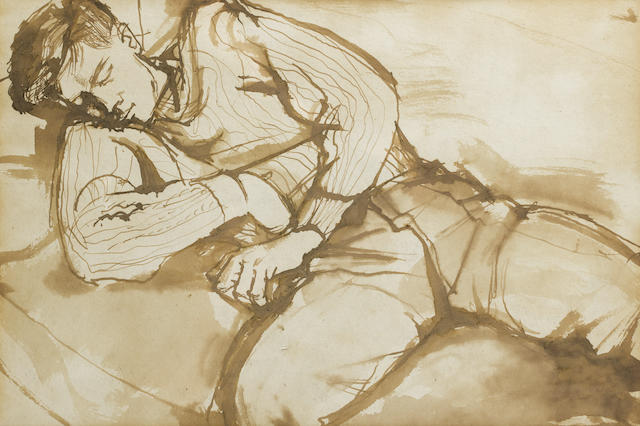
Middle Insert Image: John Minton, “Kevin Maybury Having a Nap”, 1956-1957, Ink and Wash on Paper, 25.2 x 37 cm, Private Collection

Bottom Insert Image: John Minton, “Kevin Maybury and Spanish Boy”, Pen, Ink, Gouache and Crayon on Paper, 37.3 x 27.3 cm, Private Collection


Richard Blanco: “Burning in the Rain”

Photographers Unknown, Parva Scaena (Brief Scenes): Photo Set Twenty-Six

Someday compassion would demand
I set myself free of my desire to recreate
my father, indulge in my mother’s losses,
strangle lovers with words, forcing them
to confess for me and take the blame.
Today was that day: I tossed them, sheet
by sheet on the patio and gathered them
into a pyre. I wanted to let them go
in a blaze, tiny white dwarfs imploding
beside the azaleas and ficus bushes,
let them crackle, burst like winged seeds,
let them smolder into gossamer embers—
a thousand gray butterflies in the wind.
Today was that day, but it rained, kept
raining. Instead of fire, water—drops
knocking on doors, wetting windows
into mirrors reflecting me in the oaks.
The garden walls and stones swelling
into ghostlier shades of themselves,
the wind chimes giggling in the storm,
a coffee cup left overflowing with rain.
Instead of burning, my pages turned
into water lilies floating over puddles,
then tiny white cliffs as the sun set,
finally drying all night under the moon
into papier-mâché souvenirs. Today
the rain would not let their lives burn.

Richard Blanco, Burning in the Rain, Looking for the Gulf Motel, 2012

Born in February of 1968 in Madrid, Spain, Richard Blanco is an American poet, author, and a public speaker. The son of a Cuban-exile family, he spent his early years in Miami and earned a Bachelor of Science in Civil Engineering and a Master of Fine Arts in Creative Writing from Miami’s Florida International University. In addition to his profession as a practicing civil engineer, Blanco has been a writer and poet since 1991.

As a professor, Blanco has taught at several universities, including American University, Georgetown University, Wesleyan University, Central Connecticut State University, and Colby College in Maine; he is currently a Distinguished Visiting Professor at Florida International University. Blanco also teaches poetry at such diverse institutions as grade schools, nursing homes, writers workshops, correctional institutions, and non-profits such as the Writer’s Center located in Maryland.

Richard Blanco’s first book of poetry, the 1998 “City of a Hundred Fires” received critical acclaim and won the Agnes Lynch Starrett Poetry Prize from the University of Pittsburgh Press. This collection of poems explored his coming of age as a Cuban-American in Miami and the transformation he experienced after his first trip back to his homeland of Cuba. Between 1999 and 2001, Blanco traveled extensively through Europe, South America, and the New England area of the United States. This experience resulted in his second poetry collection, “Directions to the Beach of the Dead” published in 2005, which explored the familiar but unsettling journey for home and connections. This collection of narrative lyric poetry was the winner of the American Beyond Margins Award from PEN International.

Blanco’s third book of poetry, the 2012 “Looking for the Gulf Motel”, explored how his family’s emotional legacy has shaped and continues to shape his perspectives. Divided in three sections, the collection discusses questions of cultural identity, the blurred lines of gender, the father-son relationship, identity as a Cuban-American gay man living in rural Maine, the experience of exile, and one’s impermanence in the world. Poems in this collection include “Burning in the Rain”, seen above, and  “Queer Theory, According to My Grandmother”, a skeptical look at the admonishments made by his conservative generation of elders against being perceived as gay. 

Richard Blanco’s “Looking for the Gulf Motel” won the Thom Gunn Award, the Maine Literary Award, and the Paterson Poetry Prize. He  followed this collection with the poem “Boston Strong”, recited as the opening to the Boston Strong Concert, a benefit concert to assist the families of the victims who were killed and to help the people most affected by the tragic events during the April 2013 Boston Marathon. A commemorative chapbook of Blanco’s poem was published in 2013 with all the proceeds going to the Victim Relief Fund of The One Fund Boston to help those affected.

On January 8, 2013, Richard Blanco was named the Inaugural Poet of the United States for Barack Obama’s second presidential inauguration. Blanco was the first immigrant, first Latino, and first openly-gay person to be an inaugural poet. He performed “One Today”, an original poem he wrote for the occasion; this poem was meant to reconfirm the nation’s collective identity in a time of tragedy. In November of 2015, it was published in book form as “One Day” with drawings by David “Day” Pilkey, an award-winning illustrator of books for children. 

In addition to his poetry collections and performances around the world, Blanco has published two memoirs, the 2013 “For All of Us, One Today” and the 2014 “The Prince of Ios Cocuyos”, which won the Maine Literary Award and the Lambda Literary Award for Gay Memoir. He wrote the forward and poems to accompany a series of vintage photographs of Cuba for the 2014  “Cuba Then: Rare and Classic Images from the Ramiro Fernandez Collection”, a collection of three hundred vintage photos from one of the largest archives of Cuban photography in the world. Blanco also collaborated with landscape photographer Jacob Bond Hessler on his 2017 “Boundaries”. This collection of poems and photographs challenged the physical, imagined and psychological boundaries of race, gender, class,  and ethnicity that divide the American nation.

Richard Blanco was appointed as a founding member of the Obama Foundation Advisory Counsel and has lectured at the U. S. National Archives. He is a member of the prestigious Macondo Writers Workshop, an association of socially-engaged master’s level writers. Richard Blanco and his partner currently live in Maine. 

John Minton

The Artwork of John Minton

Born in Great Shelford, Cambridgeshire in December of 1917, Francis John Minton was an English illustrator, painter, stage designer and educator. He studied art at St. John’s Wood School of Art in northern London from 1935 to 1938.  Minton was introduced to the work of the French Neo-Romantic painters by his fellow student Michael Ayrton, who would become renowned for his writings and sculptural work. Between 1938 to 1939, he spent eight months studying art in France, often in the company of Ayrton, until the start of the second World War necessitated his return to England.

In 1941, John Minton joined the Pioneer Corps, a division of the British Army combatant corps used for light engineering tasks. He received a commission in a light infantry regiment in 1943, but was discharged in the same year on medical grounds. While in the army, Minton, collaborating with Michael Ayrton, designed sets and costumes for actor and theater director John Gielgud’s 1942 production of “Macbeth”. In the same year, they presented their paintings in a joint exhibition at London’s Leicester Galleries. Minton’s intense, realistic work was expressed in dark color schemes and included a self-portrait and cityscapes of streets and bombed buildings.

During the war years, Minton met painters Adrian Ryan and Lucian Freud and developed a close friendship which soon became an intimate sexual relationship with both men that lasted until the late 1940s. After he had seen Freud’s portrait of Francis Bacon, Minton commissioned in 1952 his own portrait from Freud. Between 1943 and 1946, Minton taught illustration at London’s Camberwell College of Arts. He often attended late night sessions at The Colony Room Club, a private members’ drinking and social club known for its debauchery, and visited jazz clubs that dotted London’s Soho district. 

After he left Camberwell College, John Minton served as the head of the drawing and illustration department at the Central School of Art and Design from 1946 to 1948. During these years, he  continued his own work and shared a studio, first with painters and theater set designers Robert Colquhoun and Robert MacBryde, and later with painter Keith Vaughan, all of whom were artists of the Neo-Romantic circle in that immediate post-war period. 

Minton began a prolific period of work after 1945; besides entries in group exhibitions, he had seven solo shows at London’s prestigious Lefevre Gallery before 1956. Minton, in addition to creating his paintings and illustrative work, also became a tutor of painting in 1949 at the Royal College of Art, where he taught until the year before his death. By the mid-1950s with the arrival of the newly popular American Abstract Expressionism, Minton’s commitment to figural composition had begun to be seen as out-dated. 

John Minton returned to the world of the theater and accepted a commission to design stage sets for two productions by playwright Ronald Duncan for London’s Royal Court Theater, “Don Juan” and “The Death of Satan”. While working at the theater, he met Kevin Maybury, an Australian carpenter working in the scenery department. A relationship soon developed and, by the winter, Maybury had moved into Minton’s house in Chelsea. Maybury became the model for several drawings by Minton and also posed for a portrait in which he is shown seated in his workshop surrounded by the tools of his trade. 

Finding his work out of fashion and suffering from psychological problems, Minton began to self-medicate with alcohol. In April of 1956, he left the Royal College of Art on a one-year unpaid leave; his departure caused by a lack of confidence in his own ability as both teacher and painter, and by deep-seated doubts about the relevance of painting in the modern world. He started suffering from extreme mood swings and became more dependent on alcohol. John Minto was found dead on the 22nd of January in 1957. The coroner’s verdict was suicide. 

John Minton’s final work, an ambitious large-scale painting, was incomplete at the time of his death and depicted a gravely injured man surrounded by distraught onlookers.  On the day before Minton’s death, the painter Ruskin Spear had visited him at his studio and was told that Minton identified the dying figure with Hollywood actor James Dean, who had died two years previously in a car accident. The painting, known as the 1957 “The Death of James Dean”, is clearly unfinished; there were indications through friends that Minton never intended to finish it as he was worried about not being able to break out of his past style.

Minton’s range of work was wide and included designs for stamps, textiles and wallpapers; posters for the London Transport system and Ealing Studios, a television and film producer; large scale paintings for the Royal Academy and the Dome of Discovery exhibition space at the 1951 Festival of Britain; and numerous landscapes of the British countryside. However, he is best remembered for his illustrative work for books, both interior work and book jackets. Among these are poet Alan Ross’s travel book “Time Was Away-A Notebook in Corsica”, author Herbert Ernest Bates’s “The Country Heart”, and two ground-breaking cook books by food writer Elizabeth David.

Note: A history of the relationship between John Minton, Lucian Freud and Adrian Ryan, interspersed with images of their work, can be found at the online Museum Crush magazine located at: https://museumcrush.org/art-sex-and-death-the-unholy-trinity-of-freud-minton-and-ryan/

Top Insert Image: Rollie McKenna, “John Minton”, 1951, Bromide Print, 24.5 x 19.4 cm, National Portrait Gallery, Washington DC

Second Insert Image: John Minton, “John Minton”, circa 1953, Oil on Canvas, 35.6 x 25.4 cm, National Portrait Gallery, Washington DC

Third Insert Image: John Minton, “The Life Model”, 1948, Oil on Canvas, 63.5 x 76 cm, Private Collection 

Bottom Insert Image: John Deakin, “John Minton, Soho”, 1951, Gelatin Silver Print, Michael Hoppen Gallery

John Harris: “I Too Found the Inner Chamber”

Photographers Unknown, I Too Found the Inner Chamber

The Government hated
all secret rites and ceremonies,
for they hinted at treason.

And so, in Catholic households,
there would be an innermost room,
behind a hidden door,
where the family knelt for Mass,
hoping they wouldn’t be burned alive
by agents and spies of the King.
Victimae paschali
the countertenors would sing,
their strange, angelic voices weaving through
the settings of William Byrd.

I too
found the inner chamber.
With my high, forbidden voice,
How could I not?

When your ears are opened
you hear the secret music.

And soon you are singing.

John Harris, Listening to William Byrd (d. 1623)

Born in Bolenowe in October of 1820, John Harris was a Cornish poet. The eldest of nine children, he was raised in a two bedroom cottage situated on the slopes of his village located in the historic and ceremonial county of Cornwall, one of the Celtic nations. 

At the age of twelve, Harris followed his father into the Dolooath copper and tin mine where they both worked as miners. This became his occupation for twenty years, during which he endured heavy labor and  began to produce poetry celebrating his native landscape. Not able to afford pen and paper, Harris’s poems describing the villages and peninsular landscapes of southern-most Cornwall were written on grocery wrapping paper with blackberry ink. 

In the 1840s, John Harris married Jane Rule, with whom he had two daughters and two sons. After one of his poems was published in a magazine and received favorable notice, he was able in 1853 to publish his first poetry collection. Following the early death of his second-born daughter Lucretia during Christmas of 1855 and through the assistance of a friend, Harris found an occupation as a traveling Bible-reader and comforter at southern Cornwall’s coastal parish of Falmouth where he would spend the remainder of his life.

While living in Falmouth, Harris produced several volumes of poetry and, in 1863, wrote what is considered his most important work, “A Story of  Carn Brea”. This descriptive poem expressed the special childhood link Harris had with the ancient Celtic site, home to Carn Brea Castle and the Bassett Monument. Through the Earl of Beaconsfield, Harris received a two-hundred Pound grant from the Royal Bounty Fund, which was followed in September of 1881 by a one-hundred Pound grant from the prime minister for service to the state. John Harris died in Falmouth on the 7th of January of 1884, at the age of sixty-three. As to his dying request, he was buried at Treslothan Chapel at the foot of Carn Brea hill. 

Notes: A biography entitled “John Harris, the Cornish Poet: The Story of His Life” was written by his son John Howard Harris and published by Oxford University in 1884; this biography was republished by Franklin Classics in 2018. Harris’s poems can be found in the 1977 collection entitled “ Songs from the Earth: Selected Poems of John Harris, Cornish Miner, 1820-24”, published by Lodenek Press. 

Several poems by John Harris can be found at the John Harris Society’s online site located at:  https://www.johnharrissociety.org.uk/poetry

Many thanks to a great source of LBGTQ literature and biographies,The Gay and Lesbian Review (G&LR), for John Harris’s poem “Listening to William Byrd (d. 1623)”.

Wayne Howarth

The Artwork of Wayne Howarth

Based in North West England, Wayne Howarth is a British artist, the son of illustrator Walt Howarth who was known for his interior and cover art of such British serial comics as Doctor Who, The Avengers, and Tarzan .After graduating from Liverpool Polytechnic in 1979, Wayne Howarth became a successful interior designer for many high profile clients throughout Great Britain. In 2009, Howarth changed the focus of his career to drawing, a passion he has had since childhood.

Howarth’s portraiture work is most often done in a combination of mediums. Harris’s figurative images, mainly done in pencil, are combined with surface pattern designs taken from textiles and wall coverings, which are then rendered by Howarth in acrylics and watercolors. Gold and copper leaf are also occasionally applied to the background patterns for embellishment.

Wayne Howarth’s work and contacts, including image purchases and  commissions for portraits, can be found at the artist’s site located at: https://www.waynehowarthillustration.com