Michele Giambono

Michele Giambono, “Man of Sorrows”, ca  1420-1430, Tempera and Gold on Wood Panel,  47 x 31.1 cm, Metropolitan Museum of Art

Born in Venice circa 1400, Michele Taddeo di Giovanni Bono, known as Giambono, was an Italian painter whose work reflected the International Gothic style with a Venetian influence. There are no known portraits of Michele Giambono and very little is known of his personal life, except for knowledge of a marriage in 1420 and his death circa 1462 in Venice.

Giambono was active as an artist between the years 1420 and 1462. He was influenced by the works of Jacobello del Fiore, a Late-Gothic style painter whose mature work displayed a local Venetian style;  Gentile da Fabriano, a painter of altarpieces and frescoes, whose 1423 “Adoration of the Magi” is regarded as one of the masterpieces of the international Gothic style; and Antonio di Puccio Pisanello, one of the most distinguished fresco painters and medalists of the early Italian Renaissance. 

Michele Giambono is known for his mosaic designs in the Mascoli Chapel of San Marco in Venice. In the left vault of the chapel, two elaborately decorated mosaics depict the Birth, the Presentation at the Temple, and the Annunciation. On the right side of the chapel, the life of the Virgin is continued with the Visitation and the Death, or Dormitio Virginis. The architectural elements in the mosaics are triangular in shape, slightly askew with rounded arches of Corinthian and Florentine style.

The paintings attributed to Giambono include “St. Chrysogonus on Horseback”, circa 1450, done in the International Gothic Style with suggested movement and gilded highlights; “Virgin and Child”, located at Galleria Franchetti in Venice and completed circa 1450, a painting by which Giambono became one of the first Italian artists to use iconographic images in a Christian context; “Portrait of a Man”, a tempera and silver on wood panel painting,  which is one of very few surviving early fifteenth-century Venetian portraits; and the five panel “Polyptych of Saint James”, located at Gallerie dell’Accademia in Venice.

Michele Giambono’s small, tempera and gold on wood panel painting, “The Man of Sorrows”, is one of his earliest known works, executed between 1420 and 1430. The central, well-rendered figure of Jesus was conceived as a focus for meditation. He is depicted upright in his tomb, his hands extended to display his wounds, and his  blood and crown of thorns rendered in relief. A diminutive Saint Francis , standing on the left, receives the Stigmata and becomes a surrogate for the viewer. Elaborately framed, with the reverse painted to imitate porphyry, a stone with imperial associations, the painting would have been a precious object of devotion, perhaps for a Franciscan friar. The pattern on the deteriorated background derives from Islamic textiles.

Note: The International Gothic is a period of Gothic art which began in Burgundy, France and northern Italy in the late fourteenth and early fifteenth-century. It then spread rapidly through Western Europe, although, most of the style’s development occurred in Italy. Initially a style of the courts of nobility, it gradually spread, becoming more robust in appearance, to the mercantile classes and lower nobility. Artwork of the period is known by the use of light, bright colors and especially gold in panel paintings, illuminated manuscripts, tapestries, and polychromed sculptures. Stylistic features included a dignified elegance, a more practiced use of perspective in the modeling and setting, and an attention to realistic detail in plants and animals. 

Top Insert Image: Michele Giambono, “Virgin and Child Enthroned”, circa 1440-1450, Tempera and Gold on Linden Wood, 121.5 x 56.5 cm, Museum of Fine Arts, Budapest

Bottom Insert Image: Michele Giambono, ‘San Grisógono a Caballo”, circa 1450, Oil on Panel, 199 x 134 cm, Venice


Gregory Scofield: “Your Mouth Will Be the Web”

Photographers Unknown, The Parts and Pieces Making a Whole: Set Twelve

with the tip of my spring tongue, ayike          frog
your mouth will be the web
catching apihkêsis words,          spider
that cannot be translated.

hâw, pîkiskwê!          Now, speak!

I’ll teach you Cree, nêhiyawêwin          the Cree language
that is the taste
of pima êkwa saskarômina          fat and saskatoon
berries
Your mouth will be the branches
I am picking clean,
a summer heat ceremony
that cannot be translated.

hâw, pîkiskwê!          Now, speak!

I’ll teach you Cree
in the winter, pipon           winter
when the dogs curl against our backs.
Your mouth will be pawâcakinâsis-pîsim          the frost exploding
moon
that cannot be translated.
It will be a ceremony.

hâw, pîkiskwê!          Now, speak!

I’ll teach you Cree
ê-kohk mistake ê-sâkihitan.          because I love you a
lot
It will be in the fall, this ceremony.
You will have the mouth of a beaver,
thick and luminescent.

I will make my camp there
ê-kohk mistake ê-sâkihitan          because I love you a
lot
This cannot be translated.

hâw, pîkiskwê!          Now, speak!

Gregory Scofield, I’ll Teach You Cree, Kipocihkân, Nightwood Editions, 2009

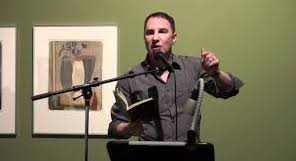
Born in July of 1966 in Maple Ridge, British Columbia, Gregory Scofield is a poet, playwright, and teacher whose work and activism is centered around the indigenous experience. He was born into a Métis family of Cree, Scottish, French and English descent, whose lineage can be traced back to the Hudson Bay fur trade and the Métis community of Kinosota, Manitoba. The Métis are a community of indigenous people in Canada and parts of the United States who are unique in being of mixed indigenous and European, primarily French, ancestry. 

Separated from his mother at age five and placed with strangers, Scofield grew up in northern Manitoba, northern Saskatchewan and the Yukon, where he struggled with poverty, substance abuse, racism, and his gay sexual identity. He has been writing poetry for over thirty years and has published multiple collections of his work, as well as novels and memoirs. Scofield is also a strong  advocate of social and racial justice for the indigenous communities.

Gregory Scofield’s first collection of poetry, “The Gathering: Stones for the Medicine Wheel “, published in 1994, provided insights into the lives of Canada’s Métis and was awarded the Dorothy Livesay Poetry Prize. In 1996, he received the Air Canada Award which is given annually to a promising Canadian writer under age thirty. Scofield published a memoir in 1998, entitled “Thunder Through My Veins”, which told the story of his traumatic, yet hopeful, fight to rediscover his heritage and accept his position as a person molded by completely opposed backgrounds.

From 1999 to 2009, Scofield published several collections of his  poetry. His 1999 “I Knew Two Métis Women” celebrated the lives of his mother Dorothy Scofield and his aunt Georgina Houle Young through the interweaving of poems, tales, and sly humor with verses from country classics by Hank Williams and the Carter Family. Scofield is also the author of the 1996 “Native Canadiana: Songs from the Urban Rez”, a cultural perspective on urban street life, and the 1997 “Love Medicine and One Song”, a work in which Scofield melds ezplicitly erotic imagery with elements of the Canadian bush and the rhythm of Cree words and phrases. For his 2005 collection of poems, “Singing Home the Bones”, he referenced the personal stories from his memoir “Thunder Through My Veins”.

While living in Vancouver, Gregory Scofield worked with street youth and became involved with the Louis Riel Métis Council, an educational and support organization. He taught First Nations and Métis Poetry at Brandon University in Manitoba, and later taught Identity Narratives at the Alberta College of Art and Design. Scofield also served as writer-in-residence at the University of Manitoba, the University of Winnipeg, and the Memorial University of Newfoundland.

In 2016, Scofield became Assistant Professor in English at Laurentian University in Sudbury, Ontario, where he teaches Creative Writing.  He has been  increasingly involved in publicizing Canada’s Missing and Murdered Indigenous Women (MMIW) on social media. Having lost an aunt and a cousin to racism and violence, Scofield honored their lives and the lives of other victims by making this topic the subject of many poems in his 2016 collection “Witness, I Am”. 

“With my poetry, I always begin with the title—the title becomes the sacred lodge of where the poems are going to be. “Witness, I Am” really came about with this idea of where we’re sitting right now, the contemporary reality of Indigenous people. It’s partly my own testimony as an Indigenous individual in this country. It’s the testimony of my auntie, who cannot speak. It’s the testimony of my mother, who cannot speak. It’s the testimony of generations of my family that were left voiceless. It’s also a ceremony of those things, of bringing the names together, of talking about the things that each of us witness.” – Gregory Scofield, CBC Radio Interview

An interesting read for those who want to explore Gregory Scofield’s work is Sara Jamieson’s treatise “Âyahkwêw Songs: AIDS and Mourning in Gregory Scofield’s “Urban Rez” Poems” which is located at: http://canadianpoetry.org/volumes/vol57/jamieson.html

David Kindersley

The Lettering of David Kindersley

Born in Codicote in 1915, David Guy Barnabas Kindersley was a British typeface designer and stone letter-carver, the grandson of the Arts and Crafts potter Sir Edmund Elton. He was educated at St. Cyprian’s School, a preparatory school for boys in Eastbourne, and later, attended Marlborough College for three years, at which time he left due to rheumatoid arthritis. 

Kindersley traveled to Paris and enrolled at the Academie St. Julian where he studied French and sculpture; he continued his sculptural studies under the Induni brothers, Peter Guiseppe and Joseph Vincent, both of whom were marble carvers in London. In December of 1934, Kindersley became an apprentice to Arts and Crafts sculptor and typeface designer Eric Gill at his workshop in the market town of High Wycombe. While at the workshop, he worked on several important commissions, including St. John’s College in Oxford, London’s Dorset House, and Bentalls, a department store designed by architect Maurice Webb and located in Kingston upon Thames. 

David Kindersley left Gill’s workshop in 1936 and opened his own shop on the River Arun, where he continued commission work sent by Gill. On the death of Eric Gill in 1940, he settled Gill’s affairs and continued work at his own shop until 1945, at which time he relocated to the county of Cambridgeshire. Here Kindersley developed his own style and methods, his decorative carving embellishments, his use of heraldic ornamentation, and his taste for carving lettering on slate.

In addition to teaching calligraphy at the Cambridge Art School in the late 1940s, Kindersley received a major commission for carved relief imaps to be placed in the American War Cemetery. He also became a consultant for film titles, through the influence of his cousin Sir Arthur Elton, documentary filmmaker and head of film production at Shell Oil. A major commission under taken by Kindersley 

In 1946, Kindersley established his first completely equipped letter-cutting workshop at Dales Barn in the village of Barton. He was joined by his wife and stone-cutter, Lida Lopes Cardozo, in 1976. A major commission undertaken by Kindersley and his wife was the distinctive large metal gates of the British Library which transformed its artistic “British Library” metal letters into a functional use. This project was followed by the gates at Queens’ College’s porter lodge; inspired by the same principle, the gates are composed of the letters “Queens College” wrought out of metal. 

David Kindersley is known for his accurate letter-spacing system. He designed the “Mo T Serif” typeface in 1952, which was originally submitted for the British Ministry of Transport for road signs. Kindersley created the “Itek Bookface” and, in collaboration with Will Carter, designed the book typeface “Octavian” for the Monotype Corporation in 1961. The Cardozo Kindersley Workshop publishes a number of typefaces based on Kindersley’s work, including the 2005 “Kindersley Street”, also known as “Kindersley Grand Arcade”, which is based on his 1952 “Mo T Serif”. 

David Kindersley authored two major works on typeface, the 1976 “Optical Letter Spacing for New Printing Systems” and the “Computer-Aided Letter Design”. Very interested in Sufism, he also published a book “Graphic Sayings” which contains his typeface plates bearing sayings by the Sufi mystics taken from the writings of Sufi author Idries Shah. 

Note: Kindersley’s workshop, now known as The Cardozo Kindersley Workshop, relocated to Victoria Road, Cambridge, in 1977. Upon Kindersley’s death in 1995, Cardozo, along with Graham Beck and a crew of five, continued the design, carving, printing and gild work.

Second Insert Image: Granville Davies, “David Kindersley”, Gelatin Silver Print, Printed 2005

Bottom Insert Image: Rory Cooron, “David Guy Barnabas Kindersley”, 1989, Bromide Fiber Print, 45.5 x 27.8 cm, National Portrait Gallery, London

Eden Yerushalmy, “Yuval Sliper”

Eden Yerushalmy, “Yuval Sliper”, 2020, Eroticco Magazine

Eden Yerushalmy is a professional hair stylist and photographer of portraits and fashion; he is living and working in Tel Aviv, Israel. Yerushalmy has done work for:  the clothing company Urban Outfitters and the online magazines Graveravens, Maxculine Dosage, Kaltblut Magazine, Yup Magazine, and The Male Fashion..

Yeurshalmy”s exclusive photo shoot of Yuval Sliper, an Israeli model with the BOLD talent agency, was posted in the November 2020  issue of the online Eroticco Magazine, located at:  https://eroticcomagazine.com..

For information on Eden Yerushalmy’s work, a link to the artist’s sites is located at:  https://www.instagram.com/edenyeru/

Hedda Sterne

The Artwork of Hedda Sterne

Born Hedwig Lindenberg in Bucharest, Romania, in 1910, Hedda Sterne received a rich primary education that included the study of multiple languages, German philosophy, and art history. With the encouragement of Modernist painter and professor Max Hermann Maxy, Sterne began her formal art education in 1918. Her first teacher was the Realist sculptor Frederic Stock, a professor at the Bucharest National University of the Arts. 

As early as 1924, Hedda Sterne gravitated to the Constructivist, Dada, and Surrealist artist communities of Bucharest and Paris. She took classes in ceramics atVienna’s Museum of Fine Arts and, in 1929, enrolled at the University of Bucharest, where she studied under literary and art critic Tudor Vianu, and philosophers Nae Ionescu, and Mircea Florian. In addition to her early work with Frederic Stock, Sterne worked in the studio of Surrealist painter Marcel Janco, who was a co-founder of the Dada movement, and became a close friend with Surrealist painters Victor Brauner and his brother Théodore Brauner, realist painter Jules Perahim, classical painter Medi Wexler, and surrealist poet Gheorghe Dinu.

In the late 1930s, Sterne began her work in the mediums of painting and collage. Drawn to the Surrealist practice of automatism, a process which allows the subconscious mind control over the formation of a work, Sterne  developed her own unique style of collage. Sterne’s collage work was first recognized in 1939 at the Fiftieth annual Salon des Indépendants in Paris, where her work was singled out by painter Jean Arp, who recommended her work to art patron and collector Peggy Guggenheim. After the outbreak of World War II and the Bucharest pogrom, Sterne was able to acquire the necessary visas for travel, which enabled her to embark from Lisbon and sail to New York in October of 1941. 

Settling in Manhattan, Hedda Sterne established an apartment and studio on East 50th Street and soon developed a close friendship with Peggy Guggenheim, a close neighbor on Beekman Place. Sterne re-united with many Surrealistic artists she had known in Paris, including Marcel Duchamp, Max Ernst, and André Breton. She also began a close friendship with author Antoine de Saint-Exupéry, whom she encouraged to illustrate his own book “The Little Prince”. Involved with the circle of New York School of artists, Sterne’s work was included in surrealism’s seminal exhibition in the United States, “The First Papers of Surrealism”,  held in October of 1942 at Manhattan’s Whitelaw Reid Mansion.

By 1943 Sterne’s work was regularly show in exhibitions at Peggy Guggenheim’s Art of This Century gallery, including the 1943 “Exhibition by 31 Women”. In November of 1943, Sterne had her first solo show in the United States at the Manhattan’s Wakefield Gallery, organized by art dealer and collector Betty Parsons. This began a nearly forty-year collaboration between Sterne and Parsons, who represented her after the opening of her own gallery, the Betty Parsons Gallery, in 1947.

Throughout her career, Hedda Sterne’s diverse series of artwork were a reflection of the changing world around her.  In the 1940s, she began to draw inspiration from the motion, architecture and scale of her new New York surroundings.  Following a visit to Vermont with her husband and fellow artist Saul Steinberg, Sterne began studying farm machinery, as well as the construction sites and harbors of New York and post-war Paris. By the 1950s, these Machine paintings and drawings had evolved into a series about motion itself.   Often utilizing commercial spray paint to invoke a feeling of speed, Sterne’s large gestural canvases of the mid-1950s were inspired by city bridges and her travels on highways around the United States.

Hedda Sterne began, in the 1960s, to explore new themes in her work, expanding beyond the inspiration of her immediate surrounding to include her interests in science and philosophy.  The qualities of light and space were often a central focus of investigation in Stern’s work.  While on a Fulbright Fellowship in Venice in 1963, she experimented with mosaic and refined a series entitled “Vertical-Horizontals”, paintings that invoked an expansive, horizontal landscape, whose reach, however, was confined within a vertical format. Later in the decade, as drawing took on a more central role in her practice, Sterne developed dense and intricate organic abstractions in series entitled “Lettuces and Baldanders”.

In addition to exploring both physical and conceptual subjects in her work, Sterne also produced both geometric and organic abstractions.  Among her largest series of works on canvas are her 1980s “Patterns of Thought” paintings, in which she, now in her seventies, explored the universality of signs and symbols through prismatic geometric structures.  While doing this series, Sterne also developed various drawings and loose studies of nature, with elaborate organic structures and ghostly apparitions emerging from the page.

Hedda Sterne was a prolific artist who maintained  a daily practice of making art throughout a career that spanned nine decades. Her work intersected with some of the most important movements and figures of twentieth-century art. Even though affected by macular degeneration, she continued to create new work in her eighties and nineties; unable to paint by 1998, she still drew. Her vision and movement affected by two strokes between 2004 and 2008, Sterne passed away in April of 2011 at the age of one hundred.

In 1977 Hedda Sterne was honored with her first retrospective exhibition of her work at the Montclair Art Museum in New Jersey. Her second retrospective entitled “Hedda Sterne: Forty Years” was held at New York’s Queens Museum in 1985. Her third retrospective was held in 2006, entitled “Uninterrupted Flux: Hedda Sterne; A Retrospective:, at the Krannert Art Museum at the University of Illinois.

Top Insert Image: Henri Cartier-Bresson, “Hedda Sterne”, 1961, Silver Gelaton Print.   Second Image: Edith Glogau, “Hedda Sterne, October 1932 Issue of Die Bühne Magazine, Vienna;   Third Image: Lilian Bristol, “Hedda Sterne in Her Studio with Her Portrait of Joan Mitchell”, 1955;   Bottom Image: Nina Leen, Hedda Sterne and New York School of Painters, January 1951 Life Magazine Photo

More information on Hedda Sterne’s life and a complete body of her work cna be found at the Hedda Sterne Foundation located at: https://heddasternefoundation.org

Matthijs Röling

Paintings by Matthijs Röling

Born in Oostkapelle, The Netherlands, in 1943, Matthijs Nicolaas Röling is a figurative painter, lithographer and academy lecturer who has carried on the tradition of realistic painting, enriching its language with artistic techniques derived from surrealism. 

Röling received his training at the Royal Academy of Art in The Hague from 1960 to 1963; he continued his studies at the Rijksacademie in Amsterdam in 1963 to 1964 . He had his first exhibition in 1965 at the Drents Museum in the city of Assen . In 1972, Röling became a lecturer at the Academie Minerva in Groningen where he taught such future artists as realist painters Jan van der Kooi, Douwe Elias, and Peter Pander. Röling has also lectured at the Classical Academy for Fine Art, also in Groningen.

Matthijs Röling first achieved recognition for his work in 1976 with his series of still-lifes, entitled “Cabinets”. In 1983 he began working on large-scale decorative projects, such as monumental canvases and wall and ceiling paintings. In recent years these projects have come to occupy an increasingly important place within Röling’s highly diverse body of work.

Röling’s first large-scale, oil on panel mural, entitled “De Sterrenhemel (The Starry Sky)”, was finished in 1983. The mural is located at the Café De Eenhoorn in the city of Eelde, and consists of four horizontal panels, each panel depicting a section of the night sky with its zodiac symbols and measuring 196 x 173 x 16 centimeters. In a 1987 collaboration with Northern-realist painter Wout Muller, Matthijs Röling produced the mural “Boom van Kennis (Tree of Knowledge)”, which is installed in the auditorium of the Academy Building at the University of Groningen. 

Since 1962, Matthijs Röling has been regularly exhibiting his work in museums and galleries throughout the Netherlands, including Amsterdam’s galleries M.L. de Boer and Galerie Mokum, and Groningen’s Galerie Wiek XX. Röling received the Dr. AH Heineken Prize for Art in 1994 for his short operatic work. The Drents Museum in Assen houses a number of Röling’s paintings and sketchbooks in its collection.

Claude McKay: “The Shadow-Fact with Which I Strove”

Photographers Unknown, The Shadow-Fact with Which I Strove

I
Not once in all our days of poignant love,
Did I a single instant give to thee
My undivided being wholly free.
Not all thy potent passion could remove
The barrier that loomed between to prove
The full supreme surrendering of me.
Oh, I was beaten, helpless utterly
Against the shadow-fact with which I strove.
For when a cruel power forced me to face
The truth which poisoned our illicit wine,
That even I was faithless to my race
Bleeding beneath the iron hand of thine,
Our union seemed a monstrous thing and base!
I was an outcast from thy world and mine.

II
Adventure-seasoned and storm-buffeted,
I shun all signs of anchorage, because
The zest of life exceeds the bound of laws.
New gales of tropic fury round my head
Break lashing me through hours of soulful dread;
But when the terror thins and, spent, withdraws,
Leaving me wondering awhile, I pause–
But soon again the risky ways I tread!
No rigid road for me, no peace, no rest,
While molten elements run through my blood;
And beauty-burning bodies manifest
Their warm, heart-melting motions to be wooed;
And passion boldly rising in my breast,
Like rivers of the Spring, lets loose its flood.

Claude McKay, One Year After, 2003

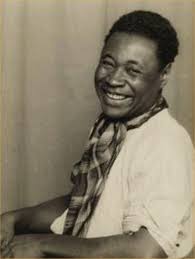
Born in Sunny Ville, Jamaica, in 1889, Festus Claudius McKay was poet and writer, one of the key figures in the literary movement of the 1920s Harlem Renaissance. His work ranged from vernacular verse celebrating peasant life in Jamaica to poems which protested racial and economic inequities. 

Proud of his African heritage, Claude McKay’s early interests were in the study of English poetry. He received his formative education under the tutelage of his brother, schoolteacher Uriah Theophilus McKay, and a local Englishman Walter Jekyll, who advised aspiring poet McKay to write verse in the Jamaican dialect. McKay’s studies were based in the British classic writers, such as Milton and Pope, and the later Romantic authors. McKay also studied the writings of philosopher Arthur Schopenhauer, whose works Jekyll was translating into English.

In 1906, McKay spent a year in Brown’s Town and the Jamaican capital of Kingston; but, after encountering extensive racism, he returned to Sunny Ville. In 1912, McKay published through a London company two collections of verses portraying opposing aspects of Black life inJamaica:“Songs of Jamaica” and “Constab Ballads”. His “Songs of Jamaica” presented a celebration of Jamaican peasant life and the people’s connections to the land. McKay’s “Constab Ballads”, however, portrayed a bleaker outlook on the plight of Black Jamaicans and was explicitly critical of the discrimination in urban Kingston. 

For his “Songs of Jamaica”, Claude McKay received an award and a stipend from the Jamaican Institute of Arts and Sciences, which he used to travel to America in 1912. He studied briefly at Kansas State College, but left in 1914 for New York City where he worked various menial jobs and continued writing poetry. In 1917, McKay published two poems in the short-lived periodical “Seven Arts”; a few years later, he published poems in the “Liberator” magazine. among these was his famous “If We Must Die”, a response to mob attacks by white Americans upon Afro-American communities during the ?Red Summer” from April to November of 1919.

McKay began a two year period of travel and work abroad, which began with a stay in Holland and Belgium, before moving to London and working at the “Workers’ Dreadnought” periodical, published on behalf of the East London Federation of Suffragettes. In 1920 he published his third collection of poetry, “Spring in New Hampshire”, notable for containing  “Harlem Shadows”, a poem of the plight of Black sex workers in the degrading urban city. 

Returning to the United States in 1921 McKay involved himself in various social causes. His 1922 anthology collection of poems, “Harlem Shadows”, assured his stature as a leading member of the Harlem Renaissance. Working on behalf of Blacks and laborers, McKay became involved with the Universal Negro Improvement Association and produced several articles for its publication. His travels took him to Paris, where he was hospitalized for a severe respiratory infection; upon recovery, McKay  traveled for the next eleven years, touring Europe and northern Africa. 

During this travel period, Claude McKay published three novels and a short story collection. His first novel, the 1928 “Home to Harlem”, tells the story of two black men, one who represents the instinctual aspect of an individual and, the other, the intellectual perspective, whose lives in Harlem are affected with either happiness or despair. This social-realist novel detailed a portrait of the hardships of Black urban life and recounted  different ways of rebelling against its ensuing circumstances. 

Mc Kay followed this book with the 1929 “Banjo” A Story without a Plot”, a novel about Banjo, a Black vagabond living in the French port city of Marseilles, who embodies the largely instinctual way of life, and Ray, a struggling, intellectual artist conventionally employed. The two men, always dissatisfied and disturbed by their limited roles in the racist society of Marseilles, cope with their problems in their own way, but both eventually decide to leave the city. 

In his third novel “Banana Bottom”, McKay presented a more incisive exploration of the Black individual’s quest for cultural identity in the face of racism, and explored the underlying racial and cultural tensions. In this story, the protagonist was a Jamaican peasant girl, who with pride and independence, fled the oppressive racist society in which she was forced to live and returned to an idealized peasant Jamaican environment.

During his final years abroad, Claude McKay published his 1932 “Gingertown”, a collection of twelve short stories, six of which were addressed to Harlem life and dealt with Black exploitation, and six stories which were set in Jamaica and North Africa, McKay’s last home before his return to the United States. Upon his return to Harlem in the mid-1930s, he began work on an autobiography, “A Long Way from Home”, a work published in 1937 about his challenges as a Black man in society.

Developing a keen interest in Catholicism after his disillusionment with Communism in the late 1930s, McKay became active in Harlem’s Friendship House, a missionary movement and a leading proponent of interracial justice. His work with the organization inspired his 1940 non-fiction historical treatise “Harlem: Negro Metropolis”, an account of the black community in Harlem during the 1920s and 1930s. McKay later moved to Chicago and worked as a teacher for a Catholic organization. 

In 1943, McKay started “Cycle Manuscript”, a collection of forty-four poems, which were never published; this important document remains as a typescript at the Beinecke Library of Yale University. By the middle of the 1940s, McKay’s health had deteriorated. He endured several illnesses throughout his last years and eventually died of heart failure in May of 1948. Claude McKay was buried at Calvary Cemetery in Queens, New York. 

Notes: An extensive collection of Claude McKay’s poetry can be found at: https://www.poemhunter.com/claude-mckay/poems/

An interesting read is “A Love So Fugitive and So Complete: Recovering the Queer Subtext of Claude McKay’s Harlem Shadows” by Lindsay Tuggle of the University of Sydney (originally printed in the journal “The Space Between; Literature and Culture 1914-1945”) which is located at: https://www.monmouth.edu/department-of-english/documents/a-love-so-fugitive-and-so-completerecovering-the-queer-subtext-of-claude-mckays-harlem-shadows.pdf/

Maurice Grosser

Paintings by Maurice Grosser

Born on October 23, 1903 in Huntsville, Alabama, Maurice Grosser was an American writer, art critic, and painter. He attended Harvard University and graduated with a degree in Mathematics with honors in 1924. While at Harvard, Grosser received painting instruction from painter and professor Denman Ross, a trustee of Boston’s Museum of Fine Art. Grosser also studied both life drawing and painting at Boston’s Architectural School and South Boston’s Art School,

Awarded Harvard’s Sheldon Fellowship for a two year period, Grosser was able to study painting in both France and Italy. In 1925 in Paris, he met for the second time and began a relationship with American composer and critic Virgil Thomson, who became his life partner and frequent collaborator. After meeting Gertrude Stein in Paris in 1926, they returned to the United States and took up residence at New York’s Hotel Chelsea, where they presided over a salon which attracted leading figures in the arts, such as writer and poet Frank O’Hara, composer Leonard Bernstein, author Tennessee Williams, and avant-garde composer John Cage

Maurice Grosser first began his collaborative work with Virgil Thomson around 1928, when he assisted in the production of Thomson’s new opera “Four Saints in Three Acts”. The libretto for the opera was prepared by Gertrude Stein, the music was composed by Thomson, and the scenario was developed by Grosser. This opera was noted for its musical content, its form, and its portrayal of the European saints by a cast of black performers, with singers directed by Eva Jessye, a prominent black choral director. 

Grosser next worked with Thomson on his provocative 1947 opera “The Mother of Us All”, based on the life of social reformer Susan B.  Anthony. The libretto for this opera was written by Gertrude Stein, who sent the finished work to Thomson in March of 1946, just a few months before her death in July. The two-act opera premiered in May of 1947 with soprano Dorothy Dow as Susan B. Anthony. The work was a 1956 Off-Broadway production, part of the Santa Fe Opera’s 1976 season, and staged at the New York City Opera in 2000 and the San Francisco Opera in 2003. 

A third collaboration between Maurice Grosser and Thomson was the 1985 “18 Portraits”. For many years, they had made portraits, some dating from the 1920s, of mutual friends in both music and paint forms. The portraits of each sitter were presented in eighteen separate bi-folios, with a single sheet insert consisting of two pages of music and an original lithograph of a  pencil and charcoal portrait.

A writer as well as a painter, Maurice Grosser lived among a circle of avant-garde authors, artists, and musicians. He spent long periods living and working abroad, first in Paris and later in Morocco, Spain, Turkey, Greece, Israel, Nigeria, Canada, and Brazil. As an artist, Grosser painted in a conservative realist style, in which he depicted structured landscapes in New England, and in the southern and western states. He was also a portraitist whose more famous subjects were  his companion, composer Virgil Thomson, Scottish operatic soprano Mary Garden, writer and playwright Jane Bowles, and British mathematician Alfred North Whitehead.

Between 1956 and 1967, Maurice Grosser served as art critic for “The Nation” magazine. As an author, he wrote four books on painting and art criticism, including “Painting in Public / Painting in Our Time” in 1948 and republished in 1964; “The Painter’s Eye” in 1951; the 1962 “Critic’s Eye”; and “Painter’s Progress” in 1971. Grosser’s memoir entitled “Visiting Gertrude Stein and Alice Toklas” was published posthumously in 2006 by New York Review Books. 

Maurice Grosser died on December 22, 1986, at the age of eighty-three. His ashes are interred at Maple Hill Cemetery in Huntsville, Alabama. Virgil Thomson died on September 30, 1989, in his suite at the Hotel Chelsea in Manhattan at age ninety-two. 

Note: Maurice and Virgil first met in 1920 while both were attending meetings of The Liberal Club at Harvard; but the intimate relationship between the two would not fully evolve until they met by chance in 1925 at the Parisian cafe “Deux Magots”.

Top Insert Image: Maurice Grosser, “Self Portrait”, 1925, Oil on Canvas, Location Unknown

Middle Insert Image: Maurice Grosser, “Self-Portrait”, 1985, Lithograph, Private Collection

Bottom Insert Image: Carl Van Vechten, “Maurice Grosser”, 1935, Silver Gelatin Print, Library of Congress

Candido Pontinari

The Paintings of Candido Portinari

Considered one of the most important Brazilian painters, Candido Portinari was a prominent and influential member of Brazil’s Neo-Realist movement. Producing more than five thousand canvases, Portinari’s  inspiration was rooted in his formative years spent with family on a Brodowski coffee plantation. He developed a social preoccupation throughout his work and was active in both the cultural and political worlds of Brazil.

Candido Portinari was born in December of 1903 in the Brodowski municipality of São Paulo, Brazil. He received formal education at the local school until 1912, when, at the age of nine, his family’s poverty forced his suspension of education. However, even at a young age, Portinari manifested an interest and aptitude in drawing and painting. At the age of fifteen, he assisted a visiting group of Italian painters and sculptors who had come to the area for the purpose of decorating  local small town churches. 

In 1919, Portinari moved to Rio de Janeiro with friends of his parents, the Toledo family, who owned a boarding house in the city. He enrolled in the Lyceum of Arts and Trades and, in the following year, at the National School of Fine Arts, where he regularly attended figure drawing classes. Portinari exhibited his work for the first time in 1922 and received an Honorable Mention for his portrait of classmate Ezequel Fonseca Filho. At this time he became one of the first Brazilian artists to incorporate Modernist elements in his work, which would feature in all future work.

 In 1924 Candido Portinari submitted eight works to the selection panel of the National School of Fine Arts, of which the panel chose his seven portraits for the exhibition. A pivotal point in his career occurred in 1928 with the presentation of twelve works at the 35th General Exhibition of Fine Arts. For his oil portrait of poet and diplomat Olegário Mariano, he won the European Travel Prize and achieved recognition in the press. 

After a solo exhibition of twenty-five portraits at the Palace Hotel in Rio de Janeiro, Portinari traveled to Paris, settling in the artist haven of Montparnasse. He visited museums in Europe and met other artists working in the various trends of Modernism, mostly drawn to the styles of Cubism and Surrealism. In 1930, Portinari participated in a group exhibition of Brazilian art at the Exposition d’Art Brésilien in Paris, where he entered two works, a still life and a portrait. While in Paris, he met Maria Victoria Martinelli, a nineteen year old Uruguayan, who would become his lifelong companion. 

Portinari decided, during this Parisian stay, that the prominent subject of his work would be the colorful people and landscapes in his Brodowski homeland. Returning to Brazil with Martinelli in 1931, he began a prolific period of work as an artist. In a 1932 solo exhibition at the Palace Hotel promoted by the Brazilian Artists Association, Portinari presented over sixty works. For the first time, the artist showed paintings with Brazilian themes, primarily scenes from his childhood, circus themes, and scenes of circle games. 

Portinari painted his first work with a social theme “The Evicted” in 1934; in the same year, his portraiture work “Mestizo” was purchased by the Pinacoteca de São Paulo and became the first of his paintings to be included in a public institution. At the invitation of Celso Kelly whose portrait he had painted in 1926, Portinari was hired in 1935 to teach mural and easel painting at the Art Institute of the Federal District University in Rio de Janeiro. Between 1935 and 1940, Portinari produced several major works, which portrayed the Brazilian spirit with all its hardships, but also its strengths, hard work and independence. 

Candido Portinari’s 1935 “Coffee”, a large painting depicting the hard-working coffee harvesters and baggers, was entered into the Carnegie Institute exhibition and won Second Honorable Mention. Portinari produced four large panels for the Art Deco-designed Monument Via Dutra, which celebrated the construction of the Rio-São Paulo motorway. These interior murals were the first of his works on the themes of socialism and nationalism.He also created exterior mosaic panels and twelve fresco murals for the Modernist-designed Gustavo Capanema Palace.

In the years that followed, Portinari’s work gained greater recognition in the United States. In 1939 he painted three panels, “Northeastern Rafts”, “Gaúcha Scene”, and “Night of Saint John”, for the interior of the Brazilian Pavilion at the New York World’s Fair. Impressed by the paintings, Alfred H. Barr, then director of the New York’s MOMA, showcased Portinari’s work in a solo exhibition at the museum, a first time for a Brazilian artist. This led to a commission by the Library of Congress to create murals to decorate its magnificent Hispanic Reading Room.

In the 1940s, Candido Portinari turned to politics, becoming a full member of the Brazilian Communist Party, and ran for congress and senate twice, but was defeated narrowly. In 1947 he left for exile in Uruguay where he was to stay until 1951 when, benefitting from a thaw in government persecution, he returned to Brazil for the rest of his life. It was in 1952 that Portinari started his best known work, the grandiose double mural “Guerra e Paz (War and Peace)”, commissioned by the Brazilian government as a gift to the United Nations, to be displayed in the United Nations’s newly built headquarters in New York City.

These panels are Portinari’s masterpiece and one of the most recognizable pieces of Brazilian art. Measuring individually an imposing 46 by 32 feet, Portinari sought to encapsulate in this work the hopes and fears that the newly founded organization represented to a world reeling from the horrors of the Second World War. He worked on the project for four years and produced one hundred-eighty sketches to complete his two-paneled mural. The dark-blue, purple and red palette of the “War” tableau contrasts starkly with the lighter yellow tones of its companion “Peace”, offering all its viewers a reminder of the peace mission of the United Nations.

For the completion of this monumental project, Portinari sacrificed his own health. During the long process of creating the two panels, Portinari became increasingly sick due to the toxicity of the paint fumes he inhaled while painting the panels. Dedicated to complete the two murals, he finished his work in 1956; however, he suffered from health issues, showing symptoms of lead poisoning, throughout the last decade of his life. Candido Portinari died on February 6, 1962 due to contact with the paint. His dedication to his work at the expense of his health made him even more of a legend among the people of Brazil, a martyr to art and the cause of equality.

Top Insert Image: Paulo Rossi Osir, “Candido Portinari”, 1935, Oil on Canvas, Museu de Arte Contemporânea da Universidade de São Paulo:  Second Insert Image: Candido Portinari, “Flautista”, 1957, Oil on Canvas,  41 x 50 cm, Private Collection;  Third Insert Image: Candido Pontinari, “Mastiço”, 1934, Oil on Canvas, Pinacoteca de São Paulo:   Bottom Insert Image: Candido Portinari, “Guerra e Paz (War and Peace”, 1952-1956, Dyptch in Oil on Six-Sheet Cedar Plywood, Each Panel: 14.32 x 10.66 meters, United Nations General Assembly, New York City 

R.M. Vaughan: “A Smile Pulled from the Eyes”

Photographers Unknown, But, Once You Start Living, It Never Ends

“Mais, une fois qu’on a commence’ de vivre, ca n’en finit plus.”
-Anne He’bert, La Robe Corail

yes, I could be transparent, have no more than 2 meanings
for every sentence, smother      the small inhalations
in duck-lined beds  (instinctual)
but I am not

tired, only some part of me, the corner of intellect
reserved for newspapers, educated company, family fights
won’t shut up, won’t misread for me, play blind man’s bluff or
any game with kissing and shut eyes      won’t say  –  this means
nothing. I am safe-

from harm, I take baby steps      dangle limbs over balconies
sit on cane back chairs made for light men in linens      even dance
fat-legged, convinced of rhythm      but from love all manner
and logic, knoves if necessary      nothing closes me, nothing

to danger, a smile pulled from the eyes, where smartness lives
or a wrist, the left, folding surrendered air in cross-cuts      language
for events microscopic, just as loud      but to love
no tricks no practiced feints of hip or cape, no tangles of scarves
to swirl over the very idea      because love happened, once, and
like anything charming      love was just another language, another dress,
a sneaky link of party half-grins      spread chair to chair, room to room
sogning the trickster from his mark

–R.M. Vaughan, Untitled, Invisible to Predators, ECW Press, Fall 1999

Born in the city of Saint John in New Brunswick, Canada, in 1965, Richard Murray Vaughan was a poet, novelist, and playwright. He earned both his Bachelor of Arts degree in Creative Writing and his Masters of Arts in English from the University of New Brunswick. Openly gay, he was playwright-in-residence for the years 1994 and 1995 at Buddies in Bad Times, a professional Canadian theater company. Originally focused on staged adaptions of poetry, the company became dedicated to the promotion of queer theatrical expression during the 1980s.

RM Vaughan published many works in his career, including fiction, poetry, anthologies, stage plays, and journalistic articles for such publications as the digital digest Utne Reader, the digital LGBYQ2-focused Xtra magazine, and the print newspaper The Globe and Mail. Vaughan’s memoir about his struggles with insomnia, entitled “Bright Eyed”, was published in 2015. 

Vaughan has written many poetry books and chapbooks. Some of his most successful works include “A Selection of Dazzling Scarves” published in 1996 and “96 Tears (in my Jeans)” published in 1997 by Broken jaw Press. The most recent collections of his poetry include the 2004 “Ruined Stars” and “Troubled: A Memoir in Poems” published in 2008. His single poems have been included in over fifty anthologies. 

As a novelist, RM Vaughan’s work includes “A Quilted Heart” in 1998 and “Spells” in 2003; as a playwright, his work includes the 1998 “Camera, Woman” and the 2003 “The Monster Trilogy”. Vaughan’s short narrative and experimental videos have been exhibited in many Canadian and international galleries and festivals, and are represented by V-Tape and the Canadian Filmmakers’s Distribution Centre.

RM Vaughan’s works often touched on queer stories of coming-of-age and eroticism. He had a taste for the supernatural and macabre, and was captivated by the world of the celebrity. Vaughan published the book of essays “Compared to Hitler” in 2013 which featured  many of his opinions on contemporary culture.

While working as writer-in-residence at the University of New Brunswick, located in Fredericton, RM Vaughan was reported missing on October 13th of 2020. His body was reported discovered ten days later on October 23rd; his death was not considered as foul play. 

Note: A collection of six poems by Richard Murray Vaughan can be found at Canadian Poetry Online, located at: https://canpoetry.library.utoronto.ca/vaughan/poems.htm

Felicia Chiao

Illustrations by Felicia Chiao

Born in Houston, Texas, Felicia Chiao is an industrial designer and illustrator who is currently residing in San Francisco. She attended Providence’s Rhode Island School of Design where she graduated in 2016 with a degree in Industrial Design. Chiao has experience in toy design, machining and shop work, sketching, and digital and physical prototyping. She balances her work at the global design and consulting firm IDEO with her greatest passion, drawing in her free time.

Traveling frequently due to work, Chiao carries an artist’s notebook with her, in which she daily draws illustrations. Her imaginative illustrations are traditionally done with Copic markers and gel-ink pens on brown paper. Much of Chiao’s work, often infused with a surrealistic atmosphere, are populated by a common humanoid protagonist, as well as black spirit-figures reminiscent of the creatures in Japan’s manga artist and animator Hayao Miyazaki. 

Felicia Chiao’s layered illustrations often depict her protagonists in mundane, everyday narratives and exhibiting states of anxiety and other complex emotions. Although the scenes appear whimsical, there is often, particularly in her most recent work, a sense of loneliness, foreboding, or confinement, a common feeling during this time of isolation.   

Chiao exhibited her work at the GR2: 8 x 8- Group Exhibition held by Giant Robot in July of 2020. Most recently she has a solo show at the GR2 Gallery through March 20th of 2021. The online show is at: https://www.giantrobot.com/collections/gr2-daydreams-felicia-chiao

For more information and images of her work, Felicia Chiao’s website is located at https://society6.com/feliciachiao/prints

Francesco Mochi

Francesco Mochi, “Saint Veronica”, 1629, Marble, 500 cm, Basilica di San Pietro, Vatican City

One of the most individual sculptors of his age, Francesco Mochi was born in July of 1580 at Montevarchi, Italy. His initial training was with Santi di Tito, one of the most influential painters of the fundamental Baroque style. Mochi also studied under Mannerist sculptor Giambologna, who exposed him to pictorial clarity and the importance of ability and design in drawing. Mochi moved to Rome circa 1599 and trained in the studio of sculptor Camillo Mariani, whose work in Venice and Rome formed a base for the Baroque style of the seventeenth century.

Francesco Mochi worked in many of the thriving cities of central Italy, including Florence, Rome, Piacenza, and Orvieto. His early career was aided by the powerful Farnese family who brought him many commissions. Mochi worked with sculptor Stefano Maderno on the papal commission for the Cappella Paoline in the Basilica of Santa Maria Maggiore, Rome, where his travertine sculpture “Saint Matthew and the Angel” now resides. 

Mochi’s first major work was the dual-statue composition “Annunciation of the Virgin by the Angel”, which he completed in full by 1608. The polished smoothness of the marble surfaces and the audacity of Mochi’s composition is considered to have signaled the end point of Mannerism and the rise of the Baroque period. In the period between 1612 and 1620, Mochi created two works, commissioned by the Farnese family, consisting of monumental bronze equestrian statues of Ranuccio and Alessandro Farnese, both Dukes of Parma, which were erected in Piazza Cavalli in Piacenza. 

The statue of Ranuccio Farnese, executed first, is linked in style and type to earlier Renaissance models that depicted the rider as peacemaker and statesman, for example Giambologna’s Cosimo de’ Medici. However, in the statue of Alessandro Farnese, Francesco Mochi broke entirelynew ground to create the first dynamic equestrian monument of the Baroque. In an unprecedented manner, he used the device of a billowing cloak to unify the rider with the bulk of the horse and to create the illusion of warlike energy. During the casting, Mochi quarreled with the founder and took over the job himself; other than sculptor Domenico Guidi, he was the only major Roman sculptor with the expertise to cast his own work.

Finished with the equestrian statues, Francesco Mochi returned in 1629 to Rome, which was now dominated by the exuberant Baroque style of Gian Lorenzo Bernini, who was fully in charge of major commissions. Mochi, whose work was no longer fashionable, was becoming increasingly bitter and disappointed as the number of commissions he received decreased. One of the requests he did receive in this period was a commission for Pope Urban VIII, which was given to him by Bernini, to sculpt a statue which would be placed in one of the four niches at the crossing piers in Saint Peter’s Basilica.

One of the four larger-than-life sculptures in the crossing of the Basilica, “Saint Veronica” displaying the lost Veil of Veronica, executed between 1629-1632, is the best known masterpiece of Mochi’s work. Gian Bernini provided models for three of the statues but gave Mochi free-reign with the design for Saint Veronica. Influenced by Hellenistic sculpture, Mochi conceived the figure in strongly emotional terms: In agony, Saint Veronica holds the Veil, a lost relic of the Christ’s passion, in trembling outstretched hands. Spiraling, thin, drapery folds create an illusion of motion, as though the figure is rushing from the niche in an effort to present the viewer with the miraculous imprint of Christ’s countenance upon the veil. 

Compared to the heroic calm of the figures designed by Gian Bernini, especially his design for the statue of Saint Longinus, Francesco Mochi’s work, both original and audacious, received much criticism and, due to its excessive motion, was seen to be unsuitable and overstepping the decorum of the Basilica. More and more frequently after this criticism, Mochi lost commissions to Bernini and high-Baroque sculptor Alessandro Algardi, and even had planned commissions rescinded or his finished work rejected by the patrons. Seen by his contemporaries as being a difficult and bitter man, Francesco Mochi died on the 6th of February in 1654.

Top Insert Image: Francesco Mochi, “Saint Veronica”, 1629, Detail, Marble, Saint Peter’s Basilica, Rome, Italy

Middle Insert Image: Francesco Mochi, “Bust of a Youth”, 1630s, Marble on Variegated Black Marble Socle, 40.5 x 33 x 29 cm, Art Institute of Chicago

Bottom Insert Image: Francesco Mochi, “Angel of Annunciation”, 1603-1609, Marble, Museo dell’Opera del Duomo, Orvieto, Italy

César Moro: “Like a Road That Vanishes”

Photographer Unknown, Like a Road That Vanishes

“The same as your non-existent window
Like a hand’s shadow in a phantom instrument
The same as your veins and your blood’s intense journey
With the same equality with the precious continuity that ideally
reassures me of your existence
At a distance
In the distance
Despite the distance
With your head and your face
And your entire presence without closing my eyes
And the landscape arising from your presence when the city was
only, could only be, the useless reflection of your slaughter
presence

In order to better moisten the birds’ feathers
The rain is falling a great distance
And it encloses me within you all by myself
Within and far from you
Like a road that vanishes on another continent.”
—César Moro, The Illustrated World

Born in Lima in 1903, César Moro, birth name Alfredo Quispez Asin, was a Peruvian poet and painter, whose only fond memory of his Jesuit childhood education was his learning French. He changed his name to César Moro, at the age of twenty, after a character by author Romón Gómez de la Serna. After years of unbearable parochialism and hostility towards any form of poetic expression, which characterized Lima between 1920 and 1930, Moro traveled to Paris in 1925 to pursue dance and art; but later poetry and art became his focus. 

Moro exhibited in group shows in Brussels in 1926, and in Paris the next year. He became a member of the Surrealist movement and exchanged ideas and art with such figures as poet Paul Éluard, writer and poet André Breton, poet Benjamin Péret, and outside the surrealist group, painters Henri and Simone Jannot. Moro promptly adopted French as his second writing language and became the only Latin American poet to contribute to Andre Breton’s surrealistic journals of the 1920s and 1930s.

While living in Paris, César Moro continued to publish his work in Latin America, including the Peruvian periodical “Amauta” whose April 1928 edition printed Moro’s poems “Oráculo”, “Infancia”, and “Following You Around”. He was active in the Parisian political protests through his contribution to the writing of the 1933 manifesto “Mobilization Against the War is Not Peace”. Moro added a note to the manifesto condemning Peru’s dictator Sánchez Cerro’s violent suppression of an uprising of sailors who were protesting against cruel discipline and poor nutrition. 

Moro returned to Lima in 1934 and continued to write against those in power. The police of Peruvian dictator Benavides entered his home and confiscated copies of the clandestine pamphlet, CADRE, which supported the Spanish Republic. As a result of continual police harassment, Moro fled Peru in March of 1938. He traveled to Mexico City, his residence for  the next ten years, and befriended other progressive artists seeking haven, such as  Austrian painter Wolfgang Paalen, photographer Eva Sulzer, surrealist painters Remedios Varo and Gordon Onslow Ford and British painter and novelist Leonora Carrington. 

With assistance from Wolfgang Paalen and André Breton, the modernist avant-garde artists of Mexico City organized the 1940 International Exhibition of Surrealism at the Galeria de Art Mexicano. This large exhibition followed two others exhibitions staged by Moro, the earliest in 1935 with Chilean artists Maria Valencia, Waldo Paaraguez, and Carlos Sotomayor. Moro became more closely associated with Wolfgang Paalen and his international literary and art journal “Dyn”. This journal gave Moro the opportunity to publish his French-language poetry, and allowed him to expand on his exploration of indigenous culture as subject matter. 

César Moro was prolific in his output during his stay in Mexico, where he also published in the periodicals “El Hijo Prodigo (The Prodigal Son)” and “Lettas de México (Letters from Mexico)”. He also translated the surrealist poems in the periodicals and a poem of his, a tribute to Breton, was published in the “Letters to Mexico”. As a result of his association with Paalen, Moro published two collections of his poetry, “Le Chateau de Grisou (Firedamp Castle)” and “Lettre d’Amour (Love Letter)”, and many translations of his surrealist and avant-garde texts.

César Moro, who was gay, led a self-described scandalous life quietly and privately. Many of his fellow surrealists were unaware of his homosexuality, which he embraced for the first time in Mexico. While his love poetry written in France is tortured; the poetry written in Mexico City for his collection “The Equestrian Turtle”, an oblique chronicle of Moro’s relationship with army lieutenant Antonio Acosta, is openly homoerotic. Throughout 1939, Moro wrote a series of letters and poems which expressed the totality of his feelings for Acosta as being the sum total of his life. This totality of love lasted the duration of Moro’s residency in Mexico; even after Acosta married and became a father. Moro appears to have played an almost godfather-like role in the life of Acosta’s son.

The intensity of Moro’s relationship with Antonio coincided with Moro’s rift with Breton and the surrealist movement after the publication of Breton’s 1944 “Arcane 17”, a work combining memoir, poetry and political treatise in which Breton cited that heterosexual love was the only legitimate one. Moro denounced, not without reason,the shortsightedness of Breton who had placed himself as the ultimate champion of freedom. From then on Breton, who could not accept love between members of the same sex, no longer had as great an impact on Moro’s artistic development. Moro turned instead to figures such as Paalen for direction in his work.

In 1948 César Moro returned to Lima, where he wrote poetry for the periodicals “The Magazine of Guatemala” and “Dwellings”, taught French at the Leoncio Prado military college, and met his future partner and lover, the French writer André Coyne. In 1954, he made his last public appearance at a conference on Marcel Proust, where he delivered a paper entitled “Passionately Loved and Admired”. César Moro died of leukemia in Lima on January 15th of 1956. His death went unnoticed by “Bief”, the surrealist main publication at that time. A large part of his prose and poetry was collected and published posthumously through the efforts of his lover and literary executor André Coyné.

Notes: César Moro’s 1939 collection “Le Tortuga Ecustre (The Equestrian Turtle)” contained an editorial and introduction by poet Américo Ferrari as well as  an epilogue by Moro’s lover André Coyné. In his epilogue on page 88, Coyné noted that the title of the collection is an erotic symbol derived from their 1934-35 experience in Lima of seeing two turtles copulating in a park.

On the Asymptote Journal site, there are three poems from “TheEquestrian Turtle” that were translated by Leslie Bary and Esteban Quispe. These poems are located at: https://www.asymptotejournal.com/poetry/cesar-moro-the-equestrian-turtle/

More extensive information on the life of poet César Moro can be found at JSTOR’s online library located at:  https://www.jstor.org/stable/90024968?seq=1

Richard Laeton

Digital Photographic Art by Richard Laeton

Born and raised in Long Beach, New York, Richard Laeton is a graphic designer and illustrator. He attended the Carnegie Mellon University from 1973 to 1975, receiving his BA in Communication Design, and the Parsons School of Design from 1974 to 1975, earning his MFA in Illustration and Design. Laeton currently lives and works in Marin County, California. 

A versatile graphic designer with expertise in all phases of art direction, Laeton was graphic designer and illustrator for the SYDA Foundation from 1995 to 2003. He was art director for the global world music label Real Music from 2005 to 2012. During that period, Laeton founded Laeton Designs, a provider of designs and illustrations for private clients, as well as a source for commissioned portraitures, fine art drawings, and other digital work. 

Richard Laeton creates works of art that blend conventional photography and painting with digital technology. Inspired by the naturally occurring forms, contours, and colors in the environment, his figurative work uses natural colors with a layered and textural approach to the image. Laeton’s works include figurative works, celebrity portraits, floral images, abstracts, and meditative works.

For more information and available images for purchase, Richard Laeton’s website is located at:  https://richard-laeton.pixels.com

Insert Image: Richard Leaton, “Andrea P”, Date Unknown, Digital Art Photography

Matthew Hittinger: “In Strings of Is and Os”

Photographers Unknown, In Strings of Is and Os

I have been here since on other dates but it’s your ghost
still hausts this place. Or should I say duppy?
Can duppies cross the wide Sargasso sea?
or are they bound by the roots of the Banyan tree?

I won’t lie. A Jamaican ache. You seduced me
before you knew me, reading from a blank
sheet or receipt the words scared in that space
behind iris and cornea. And days later

when we met, when my boot heels clicked down those steps,
when
the March air blew me through that door, I gave
a wave to your perched chair. You would later
recount your disbelief to Richard that the man

who wrote you, who you thought a kindly old gentle
man, was an anagram and rhyme. Come now.
Did you really think me other than those
words you surely googled? I do not remember

what we drank, but I remember the direction
the wood grains went–yes I knew Erna’s work,
I studied with Lorna, and Walcott’s knot
was a year of my life. That landscape long dormant

woke again in me that night, your accent a chant,
your eyes brinning with island light, your skin
a song on my lips. Started, we parted
on opposite sides of the tracks, you Brooklyn-bound

me, Queens. I knew you, but not convinced of bamboo
clues I missed the hint, lint trapped in lucite.
The modern courting of email ensued,
the story of your name, our chat-box-poems exchanged

in strings of Is and Os. And that April surprise
to come home to find dew on my bed. Hi.
Hello. Hues conjured. There for me? For you?
for something we both felt and knew needed to bloom?

Matthew Hittinger, “71 Irving Place”, Smite and Spoon Project, 2017

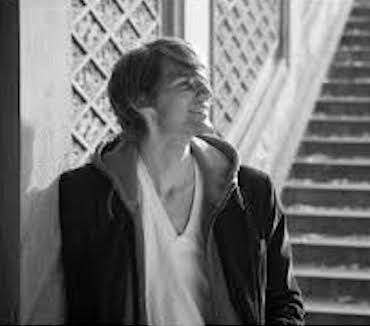
Born in 1978 in Bethlehem, Pennsylvania, Matthew Hittinger is a poet and a printmaker. He earned his BFA in English and Art History at Pennsylvania’s Muhlenberg College in 2000 and his MFA in Creative Writing from the University of Michigan in 2004. Hittinger is married to Michael Ernst Sweet, a Canadian writer, educator, and photographer known for his oddly-framed street photography.

Hittinger is the author of the poetry collections “The Masque of Marilyn, The Erotic Postulate” and “Skin Shift”, which , in 2012, earned him recognition as a Debut Poet from Poets & Writers Magazine. He has also written three chapbooks: the 2007 “Pear Slip”,  winner of the 2006 Spire Press Chapbook Award, and two volumes published in 2009, “Narcissus Resists” and “Platos de Sal”.

Matthew Hittinger received the Helen S. and John Wagner Prize from the University of Michigan, the Kay Deeter Award from the literary journal “Fine Madness”, two Best of the Net nominations from Sundress Publications, and eleven nominations from the literary Pushcart Prize. His work has appeared on the web poetry anthology “Verse Daily” and in over fifty journals including American Letters & Commentary, the Michigan Quarterly Review, and StepAway Magazine, an award-winning online literary magazine. Hittinger’s work has also been featured in The Academy of American Poets.

Matthew Hittinger has also collaborated on projects with artists of other disciplines, such as the Canadian painter Kristy Gordon, American painter Judith Peck, composer Randall West, and New York City-based John Glover. Glover’s art song based on Hittinger’s poem “8:46 AM, Five Years Later” was included in the 2012 Five Borough Songbook, a book celebrating the five New York boroughs’ music festival.

Matthew Hittinger’s website is located at: https://matthewhittinger.com