John Warner Barber: “Death of Capt. Ferrer”

John Warner Barber, “The Death of Capt. Ferrer”, 1840, Etching, Frontpiece from the “A History of the Amistad Captives”, Unfolded 22.9 x 49.3 cm, Partially Hand-Colored, Private Collection 

Born in East Windsor, Connecticut in February of 1798, John Warner Barber was an engraver and historian whose books of local, state, and national history featured his colorful  illustrations. He learned his craft as an apprentice to East Windsor printmaker Abner Reed, who also was a bank note engraver for the United States and Canada. In 1823, Barber opened a business in New Haven, where he printed religious and historical books, illustrated with his own steel and wood engravings. 

Barber traveled throughout Connecticut, creating ink sketches of town greens, churches, hotels and harbors; he also researched local histories on his travels. From his research, Barber produced in 1836 what is considered the first popular local history book published in the United States, the “Connecticut Historical Collections, Containing a General Collection of Interesting Facts, Traditions, Biographical Sketches, Anecdotes, Etc. . .”. His pencil sketches were developed into more detailed wash drawings, which in turn were transferred directly to small blocks of boxwood on which he engraved the designs. The book sold well, seven thousand copies in the first year at a cost of what was then an average week’s pay.

In 1840, John W. Barber produced his thirty-two page “ A History of the Amistad Captives: Being a Circumstantial Account of the Capture of the Spanish Schooner Amistad, by the Africans on Board; Their Voyage, and Capture Near Long Island, New York; with Biographical Sketches of Each of the Surviving Africans, Also, an Account of the Trials , , , Compiled from Authentic Sources”. Documenting one of the most important events of its time, Barber’s  book was published the same year of the Amistad trial and its ruling by the New Haven court.

In February of 1839, Portuguese slave hunters abducted hundreds of Africans from what is now present-day Sierra Leone and transported them to Cuba, then a Spanish colony. Spanish plantation owners Pedro Montes and Jose Ruiz purchased fifty-three of the African captives as slaves, forty-nine adult males and four children. On June 28th, Montes and Ruiz with the African captives set sail from Havana on the Amistad, Spanish for ‘friendship’, for their plantations on Puerto Principe.

Several days into the journey, Sengbe Pieh, one of the Africans also known as Joseph Cinque, managed to unshackle himself and his fellow captives. Armed with knives, they seized control of the Amistad and killed the Spanish captain and the ship’s cook. In need of navigation, the Africans ordered Montes and Ruiz to return to Africa; however, the two men  changed the ship’s course in the middle of the night, sailed through the Caribbean and up the eastern coast of the United States. 

On August 26th of 1839, the U.S. Navy brig Washington found the ship anchored off the coast of Long Island to get provisions. The naval officers seized the Amistad, put the Africans back in chains, and escorted the ship to Conneticut, where they would claim salvage rights to the ship and its human cargo. Originally charged with murder and piracy, Cinque and the other Africans were imprisoned in New Haven. Though the charges were dropped, they remained in prison while the courts decided their legal status, as well as the competing property claims by the Washington’s officers, Montes and Ruiz, and the Spanish government. 
In January of 1840, a judge in U.S. District Court in Hartford ruled that the Africans were not Spanish slaves, but had been illegally captured, and should be returned to Africa. After appealing the decision to the Circuit Court, which upheld the lower court’s decision, the U.S. attorney appealed to the Supreme Court, which heard the case in ealry 1841. 

On March 9, 1841, the Supreme Court ruled seven to one to uphold the lower courts’ decisions in favor of the Africans of the Amistad. However, the court did not require the government to provide funds for the Africans’ return voyage, but did award salvage rights for the Amistad to the officers who apprehended it. In November of 1841 after abolitionists raised money for the return voyage, Cinque and the surviving thirty-four Africans of the Amistad, the others either died at sea or in prison awaiting trial, sailed from New York aboard the ship Gentleman to return to their homeland.

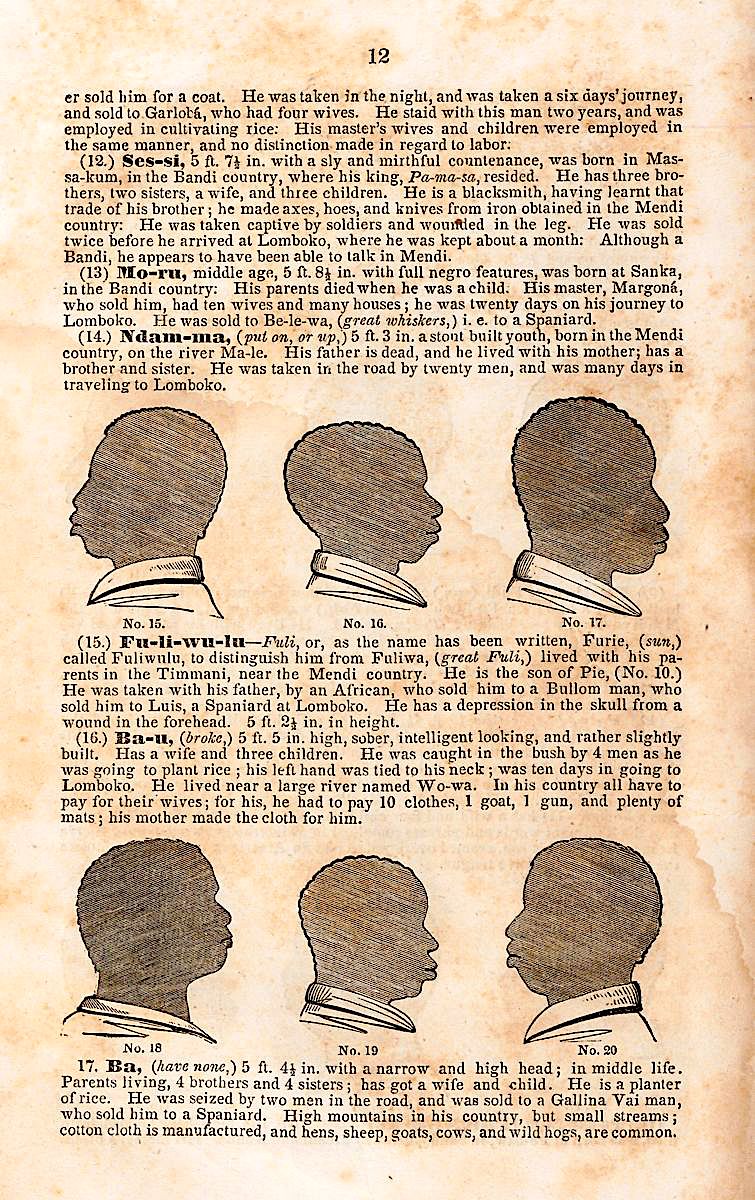
James Warner Barber attended the court hearings between January 7th and 13th in 1840 when Judge Andrew Johnson rule that the Africans were illegally transported to Cuba, and thus would not be returned to Montes and Ruis. On the first of April, Barber began drawing the Amistad Africans in jail and, over the next two months, would create drawings and engravings to illustrate his book. Barber drew portraits, from which he engraved silhouettes of the Africans, and added other illustrations to his book, including a map of the Mendi country, home of the Amistad Africans.

Essex Hemphill: “Our Kisses Are Petals, Our Tongues Caress the Bloom”

Photographers Unknown, Our Kisses Are Petals

Times are lean,
Pretty Baby,
the beans are burnt
to the bottom
of the battered pot.
Let’s make fierce love
on the over-stuffed,
hand-me-down sofa.
We can burn it up, too.
Our hungers
will evaporate like-money.
I smell your lust,
not the pot burnt black
with tonight’s meager meal.
So we can’t buy flowers
for our table
Our kisses are petals,
our tongues caress the bloom.
Who dares to tell us
we are poor and powerless?
We keep treasure
any king would count as dear.
Come on, Pretty Baby.
Our souls can’t be crushed
like cats crossing streets too soon.
Let the beans burn all night long.
Our chipped water glasses are filled
with wine from our loving.
And the burnt black beans-
caviar

Essex Hemphill, Black Beans, Ceremonies: Prose and Poetry, 2000

Born in Chicago in April of 1957, Essex Hemphill was an openly gay American poet and activist known for his contributions to Washington D.C.’s art scene in the 1980s. In his early years, Hemphill moved with his family to Washington D.C. where he attended Ballou High School in Congress Heights. Already having written poetry since the age of fourteen, he enrolled at the University of Maryland to study journalism. Hemphill left the university after his freshman year and enrolled at the University of the District of Columbia, where he graduated with a degree in English. Throughout his college years, he interacted with the local art scene, gave spoken word performances, and began to publish poetry chapbooks. 

Known for the political edge of his performances, Hemphill openly addressed the issues of race, identity, sexuality, HIV and AIDS, and the concept of family in his work, all issues central to the African American gay community. In 1979, he became a co-founder of the Nethula Journal of Contemporary Literature, a publication to showcase modern black artists. Through an arrangement by Nethula co-editor and educator Eugene Ethelbert Miller, Hemphill performed one of his first public readings, along with filmmaker Michella Parkerson, at Howard University’s Founder Library.

In 1982, Essex Hemphill, along with Larry Duckett and Wayson Jones, founded ”Cinque”, a spoken word group which performed in the Washington D. C. area. The following year he received a grant from the non-profit Washington Project for the Arts for “Murder on Glass”, an experimental poetry dramatization which he performed alongside Wayson Jones and Michelle Parkerson. Their work was later featured in two documentaries by filmmaker Marlon Riggs, the  1989 “Tongues Untied” and the 1994 “Black Is. . .Black Ain’t”, which won the Filmmakers’ Trophy at the 1995 Sundance Film Festival. 

Hemphill’s first published poetry collections were two chapbooks, “Earth Life” in 1985 and “Conditions” in 1986. His work received additional attention with its inclusion in the 1986 anthology “In the Life”, a collection of poems from gay, black artists, compiled by Hemphill’s fellow author and lover, the gay rights activist Joseph F. Beam. Hemphill’s  first full-length collection, entitled “Ceremonies: Prose and Poetry”, was published in 1992 and won the National Library Association’s Gay, Lesbian, and Bisexual New Author Award. His editing credits include the 1991 anthology “Brother to Brother: New Writing by Black Gay Men”, which won the Lambda Literary Award.

Many of Essex Hemphill’s poetry and spoken word works were autobiographical and portrayed his experiences as a minority in both the African-American and LGBTQ communities. His pieces conveyed his frustrations about bigotry, the relationships among gay black men and non-gay black men, the effect of HIV/AIDS on the black community, and the meaning of one’s family, community and support. 

In the decade of the 1990s, Hemphill rarely gave information on his health, only talking occasionally about being a person with AIDS. He did not write about his experience with the disease until his 1994 poem “Vital Signs”. Hemphill died the following year on the 4th of November, at the age of fifty-eight, of AIDS related complications. In June of 2019, he was one of the fifty inaugural American pioneers and heroes inducted on the National LBGTQ Wall of Honor within the Stonewall National Monument in New York City’s Stonewall Inn. It is the first United States national monument dedicated to LBGTQ rights and history.

Note: A suggested article is J. T. Roane’s 2017 “The Poetic Theology of Essex Hemphill”, which was published in the African American Intellectual History Society’s online publication “Black Perspectives”. The article is located at:  https://www.aaihs.org/the-poetic-theology-of-essex-hemphill/

John Craxton

Paintings by John Craxton

Born to pianist and composer Harold Craxton and his wife Essie in October of 1922, John Leith Craxton RA, was an English painter. Considered too young to attend nude life drawing at the Chelsea School of Art, he instead studied at Paris’s Academie Julian and later at the Académie de la Grande Chaumière in 1929. With the outbreak of war in Europe, he returned to London and completed his training at Westminster School of Art and the Central School of Arts and Crafts.

Rejected for military service, Craxton attended Goldsmiths College, part of the University of London, and had his first solo exhibition was in London in 1942 at the Swiss Cottage Café. In 1943, Craxton traveled through the Pembrokeshire woodlands with artist and designer Graham Sutherland, who had recently begun painting surreal, organic landscapes in oils. Returning to London, he had his first major solo show in 1944 at the Leicester Galleries, known for its exhibitions of modern international artists.

John Craxton’s work was considered part of the Neo-Romantic revival which sought to provide meaning and content to the modern existence. His early works done before 1945 showed the influences of artists Graham Sutherland and painter and printmaker Samuel Palmer whose visionary Shoreham landscapes had a great effect on both Craxton and Sutherland. Craxton was also heavily influenced by his friend and patron Peter Watson, a wealthy gay English art collector who provided financial assistance to Craxton, as well as Francis Bacon and Lucien Freud among others.

With the end of the Second World War, John Craxton began to travel extensively from 1946 to 1966, during which time he visited Switzerland, Spain, Italy, Istanbul, and Italy. However, his main interest was in Greece, and especially the island of Crete, where he permanently settled in 1970 with return visits to Paris and London. Writing in his memoirs, American painter and food writer Richard Olmey remembered Craxton’s visits to Paris during the summer of 1951: “Most nights, John Craxton, a young English painter, arrived to share my bed; we kept each other warm. He moved in a bucolic dreamworld, peopled with beautiful Greek goat herders. Soon he left for Greece.“

In 1951, Craxton designed the stage sets for the production of French composer Maurice Ravel’s longest work, “Daphnis et Chloé”, a retelling of the romance tale from the second century concerning the love between the goatherd Daphnis and the shepherdess Chloé. Craxton was able to use his experiences in Greece as a basis for his set designs. The Sadler’s Wells Ballet, now The Royal Ballet, performed Ravel’s work at Covent Garden in central London. In 1968, Craxton produced costumes and scenery for one more ballet: the 1968 performance of Igor Stravinsky’s “Apollo” performed at the Royal Opera House.

John Craxton exhibited his works in England and Greece, with a major retrospective of his work shown at the Whitechapel Art Gallery in 1967. He his work has appeared in print magazines; he also illustrated English writer Patrick Leigh Fermor’s series of books, and  produced lithographs for several anthologies edited by poet and critic Geoffrey Grigson. Elected a Royal Academician in 1993, Craxton also became a British Honorary Consul of Crete. In 2006, Craxton and his long-term partner Richard Riley were united in an official Civil Partnership. John Craxton died in 2009 at the age of eighty-seven, survived by his husband Richard. 

Top Insert Image: John Craxton, “Tree Trunk and Ruin”, 1944, Watercolor, Ink and Gouache on Paper, 21 x 14.5 cm, Private Collection

Middle Insert Image: Wolfgang Suschitzky, “John Craxton in Hydra, Greece”, 1969, Gelatin Silver Print

Bottom Insert Image: John Craxton, “Self Portrait”, 1946-1947, Oil on Paper, 32.3 x 23.2 cm, Private Collection

Frank Bidart: “Night Was the Guide Sweeter Than the Sun Raw at Dawn”

Photographers Unknown, Night Was the Guide

In a dark night, when the light
burning was the burning of love (fortuitous
night, fated, free,—)
as I stole from my dark house, dark
house that was silent, grave, sleeping—

by the staircase that was secret, hidden
safe: disguised by darkness (fortuitous
night, fated, free—)
by darkness and by cunning, dark
house that was silent, grave, sleeping—;

in that sweet night, secret, seen by
no one and seeing
nothing, my only light or
guide
the burning in my burning heart,

night was the guide
sweeter than the sun raw at
dawn, for there the burning bridegroom is
bride
and he who chose at last is chosen.

.

As he lay sleeping on my sleepless
breast, kept from the beginning for him
alone, lying on the gift I gave
as the restless
fragrant cedars moved the restless winds,—

winds from the circling parapet circling
us as I lay there touching and lifting his hair,–
with his sovereign hand, he
wounded my neck=
and my senses, when they touched that, touched nothing. . .

In a dark night (there where I
lost myself, —) as I leaned to rest
in his smooth white breast, everything
ceased
and left me, forgotten in the grave of forgotten lilies.

Frank Bidart, Dark Night

Born in Bakersfield, California, in May of 1939, Frank Bidart is an American academic and a poet, and the winner of the 2018 Pulitzer Prize for Poetry. He started his studies in 1957 at the University of California at Riverside where, after reading works by Ezra Pound and T. S. Eliot, he decided on a career in poetry. He continued his studies at Harvard, where he became both a student and friend to Robert Lowell, the sixth Consultant in Poetry to the Library of Congress, and Elizabeth Bishop, the 1956 Pulitzer Prize winner for Poetry and, after Lowell’s departure, the subsequent Consultant in Poetry to the Library of Congress.

Bidart’s work is written in the style of Confessional poetry which emerged in the United States during the late 1950s and early 1960s. In this personal form of poetry, the speaker focuses on extreme moments of individual experience, thoughts, and personal traumas, which may include such experiences as mental illness, sexuality, and self-harm. These issues are often set against the broader themes of society. In the 1950s, confessional poets often wrote about the unhappiness in their lives in opposition to the idealization of domestic life which was propagated at the time.

Frank Bidart’s early work often disregarded the formal conventions of poetry. His narrative works are not seamless dramatic monologues but rather snippets of speech, anecdotes, reminiscences, analogies, and notes and letters which are spliced together in a cinematic progression. In his poetry, Bidart uses unusual typography and takes liberties with capitalization and punctuation; this process allows the reader to visualize, spatially, the urgencies, emphases, pauses and fatigue in the poem’s voice.

Frank Bidart gained critical attention with his first two books, the 1973 “Golden State” and the 1977 “The Book of the Body”. However, it was his 1983 “The Sacrifice” that made his reputation as an original, uncompromising poet. These three early works, focused on the origins and consequences of guilt, were later published together in the 1990 collection “In the Western Night: Collected Poems1965-90”.  Among Bidart’s most notable works are monologues spoken by central characters.Two examples of these are “Herbert White” from the “Golden State”collection, a monologue spoken through the voice of a psychopathic child murderer, and “Ellen West” included in “The Book of the Body”, spoken by a woman with an eating disorder.

Bidart’s 1997 collection “Desire” began with thirteen short poems, one of which was a memorial to artist  and writer Joe Brainard, who was associated with the New York School movement of poets, painters, dancers and musicians active during the 1950s and 1960s. A prodigious artist known for his collages and his memoir “I Remember”, Brainard died from AIDS in May of 1994. The second half of the book, “The Second Hour of the Night” was a long poem that questioned the traditional assumptions about love told through a recounting of Ovid’s tale of Myrrha’s incestuous love for her father.This collection, which also included writings by Dante and Marcus Aurelius, received the Theodore Roethke Memorial Poetry Prize and was a finalist for three awards: the Pulitzer Prize, the National Book Award, and the National Book Critics Circle Award. 

Frank Bidart’s sixth book “Star Dust”, also divided in two parts, was nominated for a National Book Award and employed the familiar Bidart typography, including block capitals, italics and blank spaces, and used the techniques of quotations, paraphrases and monologues. His 2008 “Watching the Spring Festival” was his first book of lyric poems. Bidart’s  2013 collection “Metaphysical Dog” won the National Book Critics Circle Award and “Half-light: Collected Poems 1965-2016” won both the 2017 National Book Award for Poetry and the 2018 Pulitzer Prize for Poetry. 

Frank Bidart has taught at Brandeis University and, since 1972, at Wellesley College, both located in the state of Massachusetts. Bidart’s poem “Herbert White” became the basis for actor and poet James Franco’s  2010 short film of the same name. Bidart became a chancellor of The Academy of American Poets in 2001 and, in 2017, won the Griffin Poetry Prize Lifetime Recognition Award.

Joe Raskin

Urban Photography by Joe Raskin

Born in Queens, New York, Joe Raskin is a photographer, an avid urban explorer, and chronicler of New York City. He has posted on his blog over forty-eight thousand photographs of the greater New York City region, which he shot while wandering its boroughs over a period of seven years. Raskin primarily documents the varying architectural styles of the city’s buildings, but also shoots images of its subways and commuter railway lines. 

Raskin is a graduate of York College, City University of New York, where he majored in political science; he received his Masters Degree in Urban Studies from Queens College in New York. Although he attended a  photography class while at York College, Raskin considers himself self-taught. Originally starting with a Kodak Brownie camera, his primary equipment choices now are the digital Panasonic Lumix and the smaller, digital Casio Exilim. 

Prior to his retirement, Joe Raskin served as assistant director of Government and Community Relations at the Metropolitan Transit Authority of New York. He is the author of a book on the history of New York’s subway system entitled “The Routes Not Taken; A Trip Though New York City’s Unbuilt Subway System”, published in 2013.  Now a resident of the Chelsea neighborhood on the west side of Manhattan, Raskin previously lived  over thirty years in the neighborhoods of Sunnyside, Rochdale Village, and Astoria. 

Influences on Raskin’s work include the works of Arnold Eagle, a photographer and cinematographer known for his socially concerned photographs of the 1930s and 1940s; Todd Webb, whose photographs documented architecture and everyday life in cities; and, in particular, the work of Berenice Abbott, best known for her photographs of New York City architecture and urban design of the 1930s. A portrait photographer of cultural figures from 1920 to 1940, Abbott was a central figure between the photographic circles and cultural hubs of Paris and New York.

A life-long history buff, Raskin’s photographs document how New York City grew in  its expansion from just the downtown areas into each of the boroughs. This expansion was, in a large part, enabled by the rapid growth of its extensive subway and rail systems. Although Raskin documents many historical, architectural styles of buildings, he finds classic city housing, such as Art Deco Bronx apartment houses, Mathews Model Flats row houses, and brownstones and townhouses, the most intriguing to photograph. 

“I’ve always looked at the paintings of Edward Hopper and the photographs of Berenice Abbott as a reference point for my photographs. They seemed to be more intent on showing the environment of an area. When a person was in Abbott’s photographs or many of Hopper’s paintings, they were part of the overall scene, rather than the subject. If someone shows up in one of my photographs, it’s more of an incidental matter more than anything else. They’re part of the background, a component of the overall scene.” 

—Joe Raskin, Art in New York City, July 2012

Joe Raskin’s photographs can be found on his blog located at:  https://wanderingnewyork.tumblr.com

Top Insert Image: Joe Raskin, “North View of 90th Street, Roosevelt Avenue, Jackson Heights”, Queens, New York

Bottom Insert Image: Joe Raskin, “Apartment Building, Highbridge”, Bronx, New York

Marsden Hartley

Paintings by Marsden Hartley

Born in Lewiston, Maine on January 4th of 1877, Marsden Edmund Hartley was an American Modernist painter, poet, essayist and author.  The youngest of eight children, he remained, at the age of fourteen, with his father in Maine after the death of his mother, his siblings having moved to Ohio after the death. A year later in 1892, he joined his family in Cleveland, Ohio, where he began formal art training at Cleveland’s School of Art under a scholarship.

In 1898, Hartley relocated to New York City to study painting under Impressionist William Merritt Chase at the New York School of Art; he also associated with member artists from  the National Academy of Design. Hartley became a close friend and admirer of allegorical and seascape painter Albert Pinkham Ryder, whom he often visited at his Greenwich Village studio. He also read the writings of Walt Whitman and the American  transcendentalists such as Emerson and Thoreau.

Between 1900 and 1910, Marsden Hartley spent his summers in the city of Lewiston, located in southern Maine, and the region of western Maine near the village of Lovell. During these summers, he painted what are considered his first mature works, images of Kezar Lake located near the town of Lovell, and Maine’s hillsides and mountains. In 1909, Hartley exhibited these paintings at his first solo exhibition in art promoter Alfred Stieglitz’s internationally-known Gallery 291, located in Manhattan. Impressed by Hartley’s work, Stieglitz introduced him to the work of the European Modernist artists, such as Picasso, Kandinsky and Matisse.

Hartley traveled to Europe in April of 1912, the first of many visits, and in Paris became acquainted with Gertrude Stein and her circle of  writers and artists. He was encouraged by Stein, along with poet Hart Crane and novelist Sherwood Anderson, to write as well as paint. Disenchanted after living in Paris for a year, Hartley relocated to Berlin in April of 1913 where he became friends with Wassily Kandinsky and Franz Marc, and continued his painting. Of his work done in Berlin, two of his still life paintings, inspired by the work of Cézanne, and six charcoal drawings were included in the historic 1913 Armory Show in New York.

Marsden Hartley’s work during this period in Berlin was a combination of German Expressionism and abstraction; his work was also inspired by the pageantry of the German military, though his view of the military changed with the outbreak of war in 1914. In Berlin, Hartley developed a close relationship with a lieutenant in the Prussian Armed Forces, Karl von Freyburg, who was a cousin of Hartley’s friend Arnold Ronnebeck. Infatuated with Freyburg, Hartley would use him as a recurring motif in his works. Although Freyburg survived the Battle of the Marne, for which he was awarded the Iron Cross, he died on October 7th in 1914, at the age of twenty-four, during the Battle of Arras. Hartley was devastated at the announcement of Freyburg’s death.

The works Hartley produced shortly after Freyburg’s death were variations on his post-war themes. However, along with the regimental plumes in his paintings, there were now numbers and letters which had deep significance to Hartley. They included the “K.v.F.” of Freyburg’s initials, coded references to the Iron Cross, Freyburg’s age and regiment numbers, and black and white checkered patterns which referenced Freyburg’s favorite game, chess. Two examples of these memorial pieces are “Portrait of a German Officer” and “Portrait No. 47”, both painted in Berlin and seen in the images above.

Marsden Hartley returned to the United States in early 1916. He traveled and painted from 1916 to 1921 in Provincetown, New York, New Mexico, and Bermuda. Although his works still contained some German iconography, he also painted other subjects, often with homoerotic undertones. After an auction of one hundred of his works at New York’s Anderson Gallery in 1921, Hartley returned to Europe and created still lifes and landscapes using the drawing medium of silverpoint. 

Throughout the 1930s, Hartley spent summers and autumns in New Hampshire painting scenes of its mountains. Awarded a Guggenheim Fellowship, he spent time painting in Mexico which was followed by a year in the Bavarian Alps. After a few months in Bermuda in 1935, Hartley traveled by ship to Blue Rocks, Nova Scotia, where he lived for two summers with the Mason family, who earned their living as fishermen. The deaths of the two Mason brothers, drowned in a hurricane, greatly affected Hartley and inspired a series of portrait paintings and seascapes. Hartley returned to Maine in 1937 where he remained for the rest of his life. He died in Ellsworth, Maine, at the age of sixty-six, on September 2nd of 1943.

Marsden Hartley was not overt about his homosexuality and often diverted attention to other aspects of his work. Most of his works, such as “Portrait of a German Officer”, a homage to Freyburg, and his 1916 “Handsome Drinks”, one of the first paintings Hartley did after his reluctant 1916 return to the United States, are coded in their reference to his sexuality. When he reached his sixties, he no longer felt unease and his works became more intimate, such as his two 1940 paintings “Flaming American (Swim Champ)” and the  “Madawaska-Acadian Light-Heavy”, seen in one of the above inserts. 

Top Inset Image: Marsden Hartley, “Green Landscape with Rocks, No. 2”, 1935-1936, Oil on Board, 33 x 45.4 cm, Brooklun Museum, New York

Second Insert Image: Richard Tweedy, “Marsden Hartley”, 1898, Oil on Canvas, 66 x 45.7 cm, National Portrait Gallery, Washington DC

Third Insert Image: Marsden Hartley, “Abstraction”, 1912-1913, Oil on Canvas, 118 x 101 cm, Private Collection

Bottom Insert Image: Marsden Hartley, “Madawaska-Acadian Light-Heavy”, 1940, 101.6 x 76.2 cm, Chicago Art Institute

Bill Hollands: “The Paradox of Beauty in the Midst of Suffering”

Photographers Unknown, The Paradox of Beauty in the Midst of Suffering

I sit in the darkened theater and watch
images of naked men on the screen. Is it wrong
to be turned on by a marble sculpture
from the Hellenistic period? Do you know
the story? Laocoön warned the Trojans
about Greeks bearing gifts (see also
Trojan Horse) and the gods sent big snakes
to punish Laocoön and his sons. The professor
drones on but the message is clear: Sons suffer
for the sins of their father. I, on the other hand,
can’t take my eyes off the son on the right.
He looks at his father and his brother and to me
his expression is not Help but I’m out. Meanwhile,
he slyly slips the coiled snake from around
his ankle as if he’s shedding a wet
Speedo. I return to my dorm room
and geek out. Apparently, my guy
wasn’t even connected to the others
when they unearthed the sculpture’s fragments.
Plus, in another version of the story, that son
escapes the snake’s jaws altogether. And,
anyway, the whole thing might just be a fraud.
One theory goes that it’s a forgery by Michelangelo
who passed it off as an antiquity for cash
and you know which son he had his eye on. So,
on the test when the professor asks about the paradox
of beauty in the midst of suffering
I write about the liberated son
and take my B and call it good.

Bill Hollands, Escape

Born and raised in Miami, Bill Hollands is an American poet and educator. He graduated from Williams College in Massachusetts, where he studied under poets Louise Glück and Lawrence Raab. As a Herchel Smith Fellow, Hollands studied at Cambridge University’s Emmanuel College, where he earned a Masters Degree in English. Continuing his studies, he earned a third degree at the University of Michigan. 

Hollands was the first internet librarian for the New York Public Library and had worked for many years on Microsoft’s Encarta Encyclopedia, a multi-media digital information source. He is currently a teacher and poet in Seattle, where he resides with his husband and their child.

Bill Hollands’s work typically consists of narrative poems, a longer form of poetry, typically told by just one narrator, that contains all story elements, including plot, characters, conflict and resolution. A narrative poem’s story is more condensed than one in prose, the exception being epic poems. 

Hollands was recently named a finalist for North American Review’s James Hearst Poetry Prize. He was also a semi-finalist in the 2020 National Poetry Month competition for his submitted works “ICYMI” and “The Crocodile Pit at the Serpentarium, Miami, Florida”. Hollands was a recent contributor to the 3Elements Literary Review; his poem “Parrot Jungle, Polaroid, Miami, May 1981” appeared in the Summer 2020, Issue No. 27.

Bill Hollands’s poems have appeared in both online and print publications including The Summerset Review, PageBoy, Rattle, Hawai’i Pacific Review, The American journal of Poetry, The North American Review, and the online publication DIAGRAM, among others.

Bill Hollands’s poetry site can be located at: https://billhollandspoetry.com

Gaston-Marie Martin

Photography and Sculptural Work by Gaston-Marie Martin

Following a lineage of artistic personalities, Gaston-Marie Martin is a French photographer and sculptor who currently lives and works in Paris. His photographic work of male figures  are either in black and white format or tinted with colors.  

Revisiting classical references in his sculptural work, Martin creates reliquaries which, hidden away in their interiors, contain secret, almost ceremonial photographs of male figures. These instruments of memory blend the history of painting and the epic of photography with an archaeology of erotism. The reliquaries raise, in a very personal way, the art medium of nudity to a fascinating form of symbolism.

Gaston-Marie Martin’s works can be found at the artist’s sites located at: 

https://ofleadandlight.tumblr.com

http://gastonmariemartin.blogspot.com


Simkha Simkhovitch

Simkha Simkhovitch,”Fishermen”, 1948, Pencil, Watercolor and Gouache on Paper on Board, 73.3 x 45.7 cm, Private Collection 

Born in the city of Novozybkov in June of 1885, Simka Faibusovich Simkhovitch was a Russian artist. He began drawing at the age of seven when confined to his room with a severe case of measles. In 1905, Simkhovitch started studying at the Grekov Odessa Art School, one of the oldest art schools in the Ukraine. Upon his graduation in 1911, he received a recommendation for admittance to the Imperial Academy of Arts in Saint Petersburg, which was considered a notable honor at that time. 

Though he began courses in architecture, sculpture and painting, Simkhovitch was dismissed from the Imperial Academy in December of 1911 due to the quota on Jewish students and was drafted into the army. During the first World War, he served as a private until his demobilization in 1912, at which time he reenrolled at the Imperial Academy. Like many others, Simkhovitch was caught in the chaos of the Russian Revolution in 1917; however, he survived and continued his work under the new Soviet government. 

In 1918, Simka Simkhovitch exhibited paintings and sculptures in an exhibition of Russian Jewish artists and, in 1919, placed first in “The Great Russian Revolution” competition with his painting “Russian Revolution”. This painting was added to Saint Petersburg’s historical State Museum of Revolution’s collection. Simkhovitch exhibited his work at the 1922 International Book Fair held in Florence, Italy. Two years later, he traveled to the United States for the purpose of illustrating Soviet textbooks; however, once in the country, he made the decision to immigrate and remain in New York City.

Initially supporting himself by portrait commissions and commercial art, Simkhovitch was hired to paint a theatrical screen for the play “The Command to Love” which was playing at Broadway’s Longacre Theater. This started his career as a screen painter for the theater and brought him to the attention of screenwriter Ernest Pascal, known for his screenplay of “The Hound of the Baskervilles”, who gave him work as an illustrator. Pascal, in turn, introduced Simkhovitch to gallery owner Marie Sterner who purchased two paintings and held solo exhibitions of his work at her gallery in 1927 and 1928. These shows were followed by a solo exhibition of his circus paintings, also at the Marie Sterner Gallery, in 1929.

Simka Simkhovitch moved in the early 1930s with his wife, Elsa, and his three daughters to Conneticutt where he established a studio in his house. There he continued to produce works by commission during the Great Depression years. After a solo exhibition at New York City’s  Helen Hackett Gallery in 1931, Simka Simkhovitch became one of the featured artists at the 1931 exhibition held at San Fransisco’s California Palace of the Legion of Honor located in Lincoln Park. Coordinated by Marie Sterner, the exhibition featured four of Simkhovitch’s watercolors, including his “Nudes”, now in a private collection. 

Beginning in 1936, Simkhovitch began working with the Works Progress Administration, WPA, painting murals for public buildings in the United States. His first work was a 1938 mural for the Jackson, Mississippi, post office and courthouse. Painted on the wall behind the judge’s bench, “Pursuits of Life in Mississippi”, a depiction of black workers engaged in manual labor amid scenes of white professionals and socialites, was eventually covered over in later years during renovations due to its stereotypical imagery. 

In 1936 after winning a competition for the work, Simkhovitch received a commission for four murals at the Beaufort, North Carolina, post office. Upon his return to Conneticutt, he painted the four mural panels depicting the 1886 tragedy of the schooner Crissie Wright, driven onto rocks off the coast of Beaufort, North Carolina, during a winter storm, which resulted in the deaths of all six sailors, four frozen to death. These panels were installed in the Beaufort post office in 1938. The completed mural was  later restored in the 1990s by Elisabeth Speight, the daughter of two muralist who had worked with the WPA.

In February of 1949, Simka Simkhovitch purchased a home in Milford, Conneticutt for his family; the property included a barn which was to be his studio. While in the process of moving, he developed pneumonia and died two weeks later on the 25th of February, at the age of fifty-six. Simkhovitch’s work is in private collections and in numerous museums, including the Polish National Museum in Krakow, the Dallas Museum of Art, the National Museum of American Art in Washington DC,  and the Whitney Museum in New York City. A collection of his papers is housed in the Archives of American Art at the Smithsonian Institution.

Top Insert Image: Simka Simkovitch, Title and Date Unknown, (Picnic), Oil on Canvas, Private Collection

Middle Insert Image: Simkha Simkhovitch, “Self Portrait with Family”, Date Unknown, Private Collection 

Bottom Insert Image: Simka Simkovitch “Boxers”, 1932. Oil on Canvas, Private Collection 

Wilbur Underwood: “Deep as the Void Above Us and Sweet as the Dawn-Star”

Photographers Unknown,  Deep As The Void Above Us

All night long through the starlit air and the stillness,
Through the cool wanness of dawn and the burning of noontide,
Onward we strain with a mighty resounding of hoof-beats.

Heaven and earth are ashake with the terrible trampling;
Wild, straying feet of a vast and hastening army;
Wistful eyes that helplessly seek one another.

Hushed is the dark to hear the plaint of our lowing,
Mournful cry of the dumb-tired hearts within us,
Faint to death with thirst and the gnawing of hunger.

Day by day through the dust and heat have we thirsted;
Day by day through stony ways have we hungered;
Naught but a few bitter herbs that grew by the wayside.

What we flee that is far behind in the darkness,
Where the place of abiding for us, we know not;
Only we hark for the voice of the Master Herdsman.

Many a weary day must pass ere we hear it,
Blown on the winds, now close, now far in the distance,
Deep as the void above us and sweet as the dawn-star.

Wilbur Underwood, The Cattle of His Hand, Excerpt

Born in 1874, Wilbur Underwood was an American poet whose work had strong affiliations with the literary Decadent movement of the late-nineteenth century. This movement was characterized by a rejection of the world’s banal progress and its norms of morality and sexual behavior, a love for extravagant language in literature, and an emphasis on art for its own sake. 

Few prominent writers, however, were connected to the Decadent movement in the United States, one exception being the poet George Sylvester Viereck who wrote the 1907 “Nineveh and Other Poems’, as Americans at that time were reluctant to see value in the movement’s art forms. Although Underwood’s poetry had some affinities with the Romantic and Pre-Raphaelite eras, the vast majority of his work was written in a decadent style.

Wilbur Underwood worked in a clerical-administrative position in the United States State Department until 1933. He was a member of the homosexual underground scene of the period and is best known as the mentor and confidant of poet Hart Crane, whom he met in 1920 in Washington D.C.  Hart Crane’s intimate letters to Underwood have been published, often censored, in several anthologies. 

One of the first poems of Underwood to be published was his “The Cattle of His Hand”, which appeared in poet Edmund Clarence Stedman’s 1900 verse collection, “An American Anthology”.  Underwood published five volumes of poetry in his lifetime; the first of which was the 1907 “A Book of Masks” which was followed two years later by his “Damien of Molokai”. His third collection was the 1927 “The Way: Poems”, which was followed in the following year by “To One In Heaven”. Underwood’s final verse collection was “Fountain of Dark Waters”, published in 1933. 

Wilbur Underwood died in 1935 at the age of sixty-one. A collection of his poems, “Selected Poems”, was published posthumously in 1949. Underwood’s papers, amassed and catalogued by his brother Norman, were given to the Manuscript Division of the Library of Congress. These include journals, sketchbooks and illustrations, poems, photographs, legal records, and other printed material.

Notes: One of the best sources of information on Wilbur Underwood is Olive Fisher’s 2002 biography “Hart Crane: A Life”, published by Yale University. 

The 1980 Spring Issue of The Souther Review magazine contained the article entitled “Wind-Blown Flames: Letters of Hart Crane to Wilbur Underwood”. Unfortunately, it is not archived online.

Wilbur Underwood’s poem “The Cattle of His Hand”, in its entirety, can be found at bartleby.com located at https://www.bartleby.com/248/1676.html

Insert Images: Two hand-written poems from “A Book of Masks”, published 1907.

J. Carino

The Artwork of J. Carino

Based in Riverside, California, J. Carino is a figurative artist whose work illustrates the interconnection between man with his sense of self-awareness and the natural world, both literal and symbolic. A  2011 graduate of the Parsons School of Design in New York City, he works in a variety of mixed-media techniques and often uses distortion and abstraction in the construction of his work’s figures.

Carino’s images depict nude, queer figures, often monumental in size, who are set in landscapes both idyllic and suffused with danger. Applying ideas from his study of the decorative arts, he explores the concepts of queerness, self-identity, queer intimacy, sensuality, and man’s relationship with the natural world through images of richly colored and patterned, layered figures and flora. During the evolution of his work’s creation, Carino often adds and removes the layers of landscape and figures to achieve the desired result.

J. Carino’s work has appeared in multiple exhibitions both in the United States and overseas. These include both the Act 1 and Act 2 Summer Stage exhibitions at Auxier/Kline in New York, the 2021 online “Eye Candy” exhibition by the WB Gallery,  the 2020 Art Pride International, and, in the United Kingdom, the 2022 collective “Come Out & Play” at London’s BEERS gallery and the 2019 exhibition at Rye’s McCully & Crane Gallery, among others. 

“Like many queer people, there is a dichotomy of wanting to be seen as a whole person, sexuality included, but also the fear of people seeing too much. My figures, often self portraits, inhabit landscapes of abundance and fertility, lush with ferns and fruit, like an eden where these fears dissipate. Through my work, I explore the complicated influence of intimacy, sexuality, and being seen, especially as it relates to gay relationships and our ability to connect with one another and ourselves.” —J. Carino

J. Carino’s work can be found at the artist’s site located at https://www.jcarinoart.com  and  also at the following gallery locations  https://linktr.ee/j.carino.art

Bottom Insert Image: J. Carino, “Self Portrait”, Date Unknown, Mixed Media on Paper

Richard Hovey: “He Flung Himself at the Eternal Sky”

Photographers Unknown, Parva Scaena (Brief Scenes): Photo Set Twenty-Five

AVID of life and love, insatiate vagabond,
With quest too furious for the graal he would have won,
He flung himself at the eternal sky, as one
Wrenching his chains but impotent to burst the bond.
Yet under the revolt, the revel, the despond,
What pools of innocence, what crystal benison!
As through a riven mist that glowers in the sun,
A stretch of God’s blue calm glassed in a virgin pond.
Prowler of obscene streets that riot reels along,
And aisles with incense numb and gardens mad with rose,
Monastic cells and dreams of dim brocaded lawns,
Death, which has set the calm of Time upon his song,
Surely upon his soul has kissed the same repose
In some fair heaven the Christ has set apart for
Fauns.

Richard Hovey, Verlaine, Songs from Vagabondia, Richard Hovey and Bliss Carman, 1894

Born in Normal, Illinois, in May of 1864, Richard Hovey was a poet, translator, and dramatist. A talented poet at an early age, his first volume of poetry was privately published in 1880, at the age of sixteen. He graduated from Dartmouth college in 1885; he is known for writing its official Alma Mater, “Men of Dartmouth”. He was described by many who knew him as a self-conscious man, an American Oscar Wilde in both mannerisms and clothes.

After graduation, Hovey studied art in Washington, DC, and then theology at the Central Theological Seminary in New York City; he later became a lay assistant at the Church of St. Mary the Virgin. Hovey relocated to Boston where he became a newspaper reporter and, in 1887, met the Canadian poet Bliss Carman, with whom he would begin a lengthy collaboration. After studying acting for a brief period to become a better playwright, Hovey wrote the first collection of his dramatic poems, “Lancelot and Guenevere: A Poem in Dramas”, which was published in 1891. Originally planned as  a collection of nine plays, he only completed four volumes, one of which was the 1895 “The Marriage of Guenevere”. 

Richard Hovey moved to France in the following year and met many members of the French Symbolist movement, including the French poets Paul Verlaine and Stéphane Mallarme, and the Belgian poet Maurice Masterlinck, a future Nobel Prize winner who greatly influenced Hovey’s work. Hovey and Bliss Carman were both members of the “Visionists” group, a Boston-based social group of artists and writers who shared an interest in Aestheticism, Theosophy, and the Decadent movement. Members of this group also included writer and art critic John Ruskin, poet and painter Dante Gabriel Rossetti, and writer Oscar Wilde. 

After becoming one of the first translators of Maurice Masterlinck’s works, completing eight plays into English, Richard Hovey collaborated with Bliss Carman on their first project together, the “Songs of Vagabondia”. Published in 1894, this collective work celebrated the carefree life of a vagabond on the road in the fictitious place called Vagabondia. The Bohemian mood of their poems of masculine comradeship and college fraternity received critical acclaim and became an immediate success; it was followed by a second volume “More Songs from Vagabondia” in 1896 and a third “Last Songs from Vagabondia”, published in 1900 after Hovey’s death. 

Besides his collaborations with Bliss Carman, Hovey had a number of works published under his own name. These include the 1893 “Seaward”, an 1898 elegy on the poet Thomas William Parsons;  the 1898 “Along the Trail: A Book of Lyrics”; and the 1898 “Taliesin, A Masque”, a poetic play in which the bard Taliesin and Percival, a knight of the Round Table, meet the spirit of Merlin, the Three Muses, and Hermes, and other characters. Hovey’s “To the End of the Trail” was published posthumously in 1908. 

Richard Hovey lectured on Aesthetics at the Farmington School of Philosophy and, in 1888, became a lecturer at Columbia University in New York.  He also, in his last years, was a Professor of English at Barnard College in New York City. He died on February 24th of 1900, at the age of thirty-five, after undergoing minor surgery.

The Richard Hovey collection, containing manuscripts, correspondence, scrapbooks, notebooks, and newspaper clippings is housed in theDartmouth Library Archives and Manuscripts.

Notes: After a large fresco painted by Mexican muralist José Clemente Orozco in the Dartmouth College campus library was judged by many alumni to be too critical of the college, alumnus and illustrator Walter Beach Humphrey was allowed to paint a mural more in character with the college. 

This mural was based on a drinking song written by Richard Hovey and portrays the mythical founding of the college by Eleazer Wheelock. In its first panel, he is seen pulling a five-hundred gallon of rum, and being greeted by young Native American men, whom he introduces to drunken revelry. This encounter circles the faculty dining hall and also features half-naked Native American women. In the early 1970s, the “Hovey Murals” became so controversial that they were covered over, and the room itself was closed.

An extensive article for those interested is Ezra Pound scholar Leon Surette’s “Ezra Pound, Bliss Carman and Richard Hovey” which contains the meeting of Carman and Hovey, and Pound’s recollections of them. It can be found at:  https://canadianpoetry.org/volumes/vol43/surette.html

Middle Insert Image: Robert Gryden, “Richard Hovey”, Date Unknown, Engraving

Pier Luigi Nervi

Architectural Designs by Pier Luigi Nervi

Born in the Alpine town of Sondria in June of 1891, Pier Luigi Nervi was an Italian engineer and architect known for his innovative use of concrete and thin-shelled structures. In 1913, he earned his degree in engineering from Bologna’s Civil Engineering School, and upon graduation, joined the Society for Concrete Construction. Nervi considered building construction to be both an art and a science, and as such, dedicated his career to the innovative use of reinforced concrete.

During World War I, Nervi served from 1915 to 1918 as a lieutenant in the Italian Army’s Corps of Engineering. After the war, he worked, beginning in 1923, as a civil engineer in both Bologna and Florence. Nervi’s first significant work was the Augusteo Cinema Theater on the Vomero hill in Naples, which  was completed in 1927. This work was followed by Florence’s Stadio Artemio Franchi, originally named Studio Giovanni Berta. Built between 1930 and 1932, its boldly cantilevered roof and helical staircases won critical acclaim and popular attention throughout Italy. 

In 1932, Pier Luigi Nervi formed a contracting firm, called Società Ingg. Nervi e Bartoli, with his cousin, engineer Giovanni Bartoli, with whom he would work for the remainder of his career. In 1935, Nervi won a competition held by the Italian Air Force for the construction of a series of hangers to be built throughout Italy. His conception of the hangers as concrete vaults with huge spans of reinforced concrete, constructed at low cost, were built between 1935 and 1941. After finishing the first hanger in Orvieto, he improved the design of the hangers in Obertello and Torre del Lago by using precast ribs, a lighter roof, and a modular construction method.

Nervi’s conceptual designs continued to grow through his search for new solutions to structural problems. Through his research, he developed a material of his own invention, a dense concrete called ferrocemento, which was heavily reinforced with evenly distributed steel mesh that gave both lightness and strength. This material played a vital role in Nervi’s design for the Palace of Labor, a collaborative project with his son Antonio Nervi for an exhibition space at the 1951 Turin Exhibition. A prefabricated structure in the form of a corrugated cylindrical arch, the Palace of Labor contained eighty-five thousand feet of exhibition space under a roof divided in sixteen structurally separated squares edged by continuous skylights. Sixty-five foot concrete columns were fixed in the center of each square and held these squares through small arched ribs. The use of arched ribs became a characteristic of Nervi’s oeuvre.

Pier Luigi Nervi’s solutions to construction problems was always direct; he transmitted the stresses developed within his structures to the ground by the shortest path. He used insights from his study of geometry to develop a new form of shell construction, one which generated three-dimensional lattices from concrete ribs. Nervi’s innovative use of pre-made concrete modules was cost-effective and resulted in both functional and ornamentally-geometric structures. Although his primary concern was never aesthetic, his works achieved a forceful expression to a great degree. Nervi introduced a creative three-dimensional quality into architectural design by his use of warping surfaces, folded plates, and intersecting planes. He emphasized functional needs, the technology of construction, knowledge of materials and statistics, and efficiency in building as the mainstays of an architect’s career.

Nervi was awarded Gold Medals by the United Kingdom’s Institution of Structural Engineers, the American Institute of Architects, and the Royal Institute of British Architects. in 1961 Harvard University appointed Nervi  to the Charles Eliot Norton Chair of Poetry. Towards the end of his career, Nervi, assisted by his two sons, the engineer Antonio and the architect Mario, confined his activities to design work in association with other architects. He died in January of 1979, at the age of eighty-seven, in Rome, Italy.

Nervi’s works include the UNESCO headquarters in Paris; Milan’s Pirelli Tower which was the first skyscraper in Italy; the Palazzetto dello Sport in Rome; the Sacro Cuore Bell Tower in Florence; the Cathedral of Saint Mary of the Assumption in San Francisco,;the cylindrical Australian Square tower, at the time the tallest concrete structure in the world; Vatican City’s Paul VI Audience Hall; and the Australian Embassy in Paris. 

Bruno Barbey

Photography by Bruno Barbey

Born into a diplomatic family in February of 1941, Bruno Barbey was a Moroccan-born French photographer whose work covered a span of nearly fifty years. He studied graphic arts and photography at Switzerland’s Ecole des Arts et Métiers in the city of Vevey. During the 1960s, Barbey was commissioned by Editions Rencontre, a publishing house in Lausanne, to photograph in African and European countries.

In 1966, Barbey began a long career with the international Magnum Photos, one of the first photographic cooperatives owned and administered entirely by its members. He later became an Associate member in 1966, and a full member in 1968, at which time he produced a series of work on the student riots in Paris. Barbey continued his career at Magnum Photos as vice-president for Europe in 1978 and 1979, and as President of Magnum International from 1992 to 1995.

Beginning in 1979, Bruno Barbey worked on a two year photographic project in Poland to document the socio-political changes occurring in the country. In a time when the country was divided between Christianity and Communism, he and his family traveled, while living in a camper, over forty thousand miles over an eight month period. In spite of the strict surveillance of visitors to Poland at the time, Barbey was able to take many informal photographs of the local people; seventy-five photographs of this series were published in his 1982 “Portrait of Poland”.

Although he photographed throughout many countries, Barbey became best known for his coverage of world conflicts, including civil wars in Nigeria, Vietnam, Northern Ireland, the Middle East, Cambodia, and the liberation war in Bangladesh. His work has been published in over twenty books, which included photographic projects in Portugal, Bombay, Kenya, Italy, Istanbul, and Naples, among others. Barbey did the cinematography on Éric Rohmer’s 1963 film “The Bakery Girl of Monceau” and had worked on eight films with director Caroline Thiénot, including the 2015 short film “Passages”.

In 1999, Paris’s art museum Petit Palais organized a large exhibition of photographs that Barbey had taken in Morocco during the previous three decades. In 2015, La Maison Européene de la Photographic, based in Paris, presented a retrospective exhibition of Barbey’s work, which traveled internationally in 2016. A retrospective book of his work, “Passages” was also released in the same year.

In 2016, Bruno Barbey was elected as member of the French Academy of Fine Arts. He had received many awards for his work, including the French National Order of Merit. Known for his free and harmonious use of color, Barbey died in November of 2020, at the age of seventy-nine, in Orbais l’Abbaye, France. His photographs have been exhibited internationally and are in numerous museum collections.

All photos credited to Magnum Photos.

Samuel Greenberg: “And This Great Human Rebellion”

Photographers Unknown

And this great human rebellion, has it’s scattered laureates – sparks,
That kindle the flame to repeat my brother will cause the perfumed love more clear
And seek heavenly envy. In spite the selfish heart limits perhaps weave the better birth
We then easily blend a lodge, which can pray upon the universe of charm
And share the impulse of progress, this vital grain must plead thousand-fold
Live in us, as the blowing sea breeze! Through an angel gate,
The ecliptic change found me under a leafless Oak.
The cast shadowings of branches like madusa’s skull
There in on looking leveled my talent to flood the mind in abstract ecstasy,
The gallant spurtive land and heaven with the numberless diamond circle, gives joy hither,
Whether the banner contains power to plenty the soul,
This humble chip in our reverence doth limit it’s whole

end.

Samuel Greenberg, And This Great Human Rebellion

Poet and artist Samuel Greenberg, the sixth of eight children born to Jacob and Hannah Greenberg, was born on December 13, 1893, in a Jewish ghetto in Vienna, Austria. The family emigrated to the United States in October of 1900 and settled on Manhattan’s Lower East Side, where his father worked as an embroiderer. With his mother’s death in  1908, Greenberg, at the age of fourteen, was compelled to leave school to support his family and began work at his older brother Adolf’s leather shop, where he likely contracted tuberculosis in 1912. 

Greenberg began writing poems in his notebooks sometime in 1912. In that year, he also began taking piano lessons, often drawing staff lines with musical notes in his notebooks. Greenberg was also a avid reader of British Romantic classics, as well as the works of John Milton, William Blake, and Oscar Wilde. He painted and was a sketch artist; many of his works, often portraying young men seen in Washington Square Park, were done on scraps of paper or in small sketchbooks. 

Samuel Greenberg was fluent in three languages, Yiddish, German and English. His existing poetry, written in a hard-to decipher English scrawl, was composed between 1913 and 1917. Greenberg’s work was raw in form, contained many spelling errors and unclear grammar; his preferred poetic structure, the sonnet, never extended beyond fourteen lines. Due to his fragile health and early death of both parents, Greenberg was deeply aware of his own mortality, a feeling he relayed in his poems.

After the death of his father in 1913, Samuel Greenberg spent the rest of his life living with one sibling or another. In his final years, he was in and out of charity hospitals in the boroughs of Bronx, Staten Island, and Queens, where he did most of his writing. Samuel Greenberg died of tuberculosis, at the age of twenty-three, in the Manhattan State Hospital on Wards Island on August 16, 1917.

Samuel Greenberg’s work, consisting of over six hundred poems and fifteen notebooks, was never published in his lifetime.His literary immortality is due to the praise and discovery of him by the well-known poet and critic Alan Tate. It was also due, in a large sense, to poet Hart Crane, an admirer of Greenberg’s work who excerpted material from the poems and, either verbatim or slightly modified, included it in his own work. An example of this is Crane’s “Emblems of Conduct”, where he took actual lines of Greenberg’s poem “Conduct”,  slightly altered, and included it in his own published work.

Samuel Greenberg’s work has appeared in several publications, including James Laughlin’s “Poems from the Greenberg Manuscripts”, published in 1939,  and “Self Charm: Selected Sonnets and Other Poems”, published in 2005. His papers are now housed in the Fales Collection at New York University.

Top Insert Image: Samuel Greenberg, Musical Staffs and Hands, Sketchbook Page

Bottom Insert Image: Samuel Greenberg, “Self Portrait”, 1916, Pencil on Paper

Note: A very interesting article by Jacob Silverman, entitled “Rimbaud in Embryo”, on the work and the tragically short life of Samuel Greenberg, including opinions of his poetic peers, can be found at the Poetry Foundation located at:  https://www.poetryfoundation.org/articles/69896/rimbaud-in-embryo

There is also a reading of Samuel Greenberg’s “The Tusks of Blood” and a commentary by former Poet Laureate of New Jersey Gerald Stern at the Library of Congress’s Poetry and Literature Program: https://www.loc.gov/programs/poetry-and-literature/audio-recordings/poetry-of-america/item/poetry-00001018/gerald-stern-samuel-greenberg/