


Photographers Unknown, The Parts and Pieces Making a Whole: Set Twelve
with the tip of my spring tongue, ayike frog
your mouth will be the web
catching apihkêsis words, spider
that cannot be translated.
hâw, pîkiskwê! Now, speak!
I’ll teach you Cree, nêhiyawêwin the Cree language
that is the taste
of pima êkwa saskarômina fat and saskatoon
berries
Your mouth will be the branches
I am picking clean,
a summer heat ceremony
that cannot be translated.
hâw, pîkiskwê! Now, speak!
I’ll teach you Cree
in the winter, pipon winter
when the dogs curl against our backs.
Your mouth will be pawâcakinâsis-pîsim the frost exploding
moon
that cannot be translated.
It will be a ceremony.
hâw, pîkiskwê! Now, speak!
I’ll teach you Cree
ê-kohk mistake ê-sâkihitan. because I love you a
lot
It will be in the fall, this ceremony.
You will have the mouth of a beaver,
thick and luminescent.
I will make my camp there
ê-kohk mistake ê-sâkihitan because I love you a
lot
This cannot be translated.
hâw, pîkiskwê! Now, speak!
Gregory Scofield, I’ll Teach You Cree, Kipocihkân, Nightwood Editions, 2009
Born in July of 1966 in Maple Ridge, British Columbia, Gregory Scofield is a poet, playwright, and teacher whose work and activism is centered around the indigenous experience. He was born into a Métis family of Cree, Scottish, French and English descent, whose lineage can be traced back to the Hudson Bay fur trade and the Métis community of Kinosota, Manitoba. The Métis are a community of indigenous people in Canada and parts of the United States who are unique in being of mixed indigenous and European, primarily French, ancestry.
Separated from his mother at age five and placed with strangers, Scofield grew up in northern Manitoba, northern Saskatchewan and the Yukon, where he struggled with poverty, substance abuse, racism, and his gay sexual identity. He has been writing poetry for over thirty years and has published multiple collections of his work, as well as novels and memoirs. Scofield is also a strong advocate of social and racial justice for the indigenous communities.
Gregory Scofield’s first collection of poetry, “The Gathering: Stones for the Medicine Wheel “, published in 1994, provided insights into the lives of Canada’s Métis and was awarded the Dorothy Livesay Poetry Prize. In 1996, he received the Air Canada Award which is given annually to a promising Canadian writer under age thirty. Scofield published a memoir in 1998,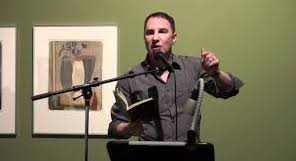 entitled “Thunder Through My Veins”, which told the story of his traumatic, yet hopeful, fight to rediscover his heritage and accept his position as a person molded by completely opposed backgrounds.
From 1999 to 2009, Scofield published several collections of his poetry. His 1999 “I Knew Two Métis Women” celebrated the lives of his mother Dorothy Scofield and his aunt Georgina Houle Young through the interweaving of poems, tales, and sly humor with verses from country classics by Hank Williams and the Carter Family. Scofield is also the author of the 1996 “Native Canadiana: Songs from the Urban Rez”, a cultural perspective on urban street life, and the 1997 “Love Medicine and One Song”, a work in which Scofield melds ezplicitly erotic imagery with elements of the Canadian bush and the rhythm of Cree words and phrases. For his 2005 collection of poems, “Singing Home the Bones”, he referenced the personal stories from his memoir “Thunder Through My Veins”.
While living in Vancouver, Gregory Scofield worked with street youth and became involved with the Louis Riel Métis Council, an educational and support organization. He taught First Nations and Métis Poetry at Brandon University in Manitoba, and later taught Identity Narratives at the Alberta College of Art and Design. Scofield also served as  writer-in-residence at the University of Manitoba, the University of Winnipeg, and the Memorial University of Newfoundland.
In 2016, Scofield became Assistant Professor in English at Laurentian University in Sudbury, Ontario, where he teaches Creative Writing. He has been increasingly involved in publicizing Canada’s Missing and Murdered Indigenous Women (MMIW) on social media. Having lost an aunt and a cousin to racism and violence, Scofield honored their lives and the lives of other victims by making this topic the subject of many poems in his 2016 collection “Witness, I Am”.
“With my poetry, I always begin with the title—the title becomes the sacred lodge of where the poems are going to be. “Witness, I Am” really came about with this idea of where we’re sitting right now, the contemporary reality of Indigenous people. It’s partly my own testimony as an Indigenous individual in this country. It’s the testimony of my auntie, who cannot speak. It’s the testimony of my mother, who cannot speak. It’s the testimony of generations of my family that were left voiceless. It’s also a ceremony of those things, of bringing the names together, of talking about the things that each of us witness.” – Gregory Scofield, CBC Radio Interview
An interesting read for those who want to explore Gregory Scofield’s work is Sara Jamieson’s treatise “Âyahkwêw Songs: AIDS and Mourning in Gregory Scofield’s “Urban Rez” Poems” which is located at: http://canadianpoetry.org/volumes/vol57/jamieson.html