Walt Whitman: “Fulfilling Our Foray”

Photographers Unknown, (Fulfilling Our Foray)

“WE two boys together clinging,

One the other never leaving,

Up and down the roads going, North and South excursions making,

Power enjoying, elbows stretching, fingers clutching,

Arm’d and fearless, eating, drinking, sleeping, loving.

No law less than ourselves owning, sailing, soldiering, thieving,

threatening,

Misers, menials, priests alarming, air breathing, water drinking, on

the turf or the sea-beach dancing,

Cities wrenching, ease scorning, statutes mocking, feebleness

chasing,

Fulfilling our foray.” 

—Walt Whitman, Leaves of Grass, 1900

Brian Andreas: “The Room Filled with the Sound of the Wind”

Photographer Unknown, (The Room Filled with the Sound of the Wind)

“The day he first told me he was starting to disappear I didn’t believe him & so he stopped & held his hand up to the sun & it was like thin paper in the light & finally I said you seem very calm for a man who is disappearing & he said it was a relief after all those years of trying to keep the pieces of his life in one place. Later on, I went to see him again & as I was leaving, he put a package in my hand. This is the last piece of my life, he said, take good care of it & then he smiled & was gone & the room filled with the sound of the wind & when I opened the package there was nothing there & I thought there must be some mistake or maybe I dropped it & I got down on my hands & knees & looked until the light began to fade & then slowly I felt the pieces of my life fall away gently & suddenly I understood what he meant & I lay there for a long time crying & laughing at the same time.
—Disappearing”

Brian Andreas, Still Mostly True

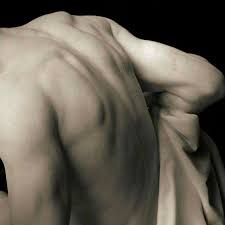
Pierre Julien

Pierre Julien, “Dying Gladiator”, 1779, Marble, 60 x 48x 42 cm, Richelieu Wing, Louvre, Paris

The “Dying Gladiator” was Pierre Julien’s second admission piece for the Académie Royale de Peinture et de Sculpture and a crucial work for him. He had presented another piece for admission in 1776, a statue of Ganymede and had been refused, possibly due to his teacher, Guillaume II Coustou’s, lack of support for his too talented pupil. Humiliated by this unjust failure, Julien had thought of becoming a naval sculptor but, encouraged by friends, persevered and presented “Dying Gladiator” to the Académie in 1778. Acclaim for the sculpture at the 1779 Salon made amends for the affront of 1776. Pierre Julien  was admitted to the Académie on 27th of March, 1779, and appointed an assistant teacher in 1781.

In this scholarly work, Pierre Julien demonstrated his mastery of academic criteria while asserting personal qualities and his knowledge of antique sculpture. He was reinterpreting the “Dying Gladiator” in the Capitoline Museum in Rome, a marble copy of which he had sculpted during his three-year stay at the Académie de France in Rome. Julien’s nude gladiator demonstrates his complete mastery of anatomy,. But it was the sculptor’s personal contribution which imbues the work with its sensitivity: the elegant proportions, unctuous modeling and delicate execution in the finesse of the hands, laurel leaves and strands of hair; the marble’s perfect finish and the rendering of textures, illustrated by the suggestion of metallic brilliance in the sword and shield.

The work is a dazzling testimony to the renaissance of classical sensibility, although in a codified genre. The return to antiquity and nature, begun in the 1740s by the sculptors Edme Bouchardon and Jean-Baptiste Pigalle, asserted itself in the 1770s. Julien was exalting the heroism of a man overcoming his pain and stoically dying in silence. The balanced composition, dignified pose, discreet chest wound and restrained expression are formal echoes of this heroic serenity. Like the “Laocoon”, one of the most admired antique statues at that time, the gladiator is in agony but not crying out in pain; and it is this dignity in suffering which makes the figure more sensitive and inward-looking.

Information reblogged with thanks to Valerie Montalbetti

Vojtěch Kovařík

Paintings by Vojtěch Kovařík

Born in 1993, Vojtěch Kovařík is a Czech artist who lives and works in Rožnov pod Radhoštěm, located in the eastern part of the Czech Republic. He received both his BA and MA at the Faculty of Arts of the Ostrava University in the Czech Republic; he also studied Painting at the Academy of Fine Arts in Warsaw, Poland. 

Kovařík has devoted himself to painting, mixing classical influences with a contemporary style. In his exploration of Greek mythology and European identity, he creates exaggerated figures evocative of the ancient Greek heroes. Kovařík’s large-format works, displaying their strong, muscled characters  with mottled skin tones and textures, are achieved through a technique of spray, acrylic, and oil painting. Set in abstract surroundings, represented by mere symbols, these strong figures are the central focus for the viewer.

Kovařík has participated in several residency projects including The Fores Project for emerging artists in London, Los Angeles’s The Cabin, and the curatorial and residency L21 x Camper Foundation in Palma, Spain. Among his recent solo exhibitions are “Lovers and Fighters” at the Public Gallery in London, “Landscapes of Muscle” at Galerie Dukla in Ostrava, Czech Republic, and “Hidden Garden” at the 2020 Galerie Derouillon in Paris.  

Ray Bradbury: “Something Wicked This Way Comes”

Photographer Unknown, (Leather, Beetle, and Snake), Photo Shoot, Model Unknown

“The stuff of nightmare is their plain bread. They butter it with pain. They set their clocks by deathwatch beetles, and thrive the centuries. They were the men with the leather-ribbon whips who sweated up the Pyramids seasoning it with other people’s salt and other people’s cracked hearts. They coursed Europe on the White Horses of the Plague. They whispered to Caesar that he was mortal, then sold daggers at half-price in the grand March sale. Some must have been lazing clowns, foot props for emperors, princes, and epileptic popes. Then out on the road, Gypsies in time, their populations grew as the world grew, spread, and there was more delicious variety of pain to thrive on. The train put wheels under them and here they run down the log road out of the Gothic and baroque; look at their wagons and coaches, the carving like medieval shrines, all of it stuff once drawn by horses, mules, or, maybe, men.”

—Ray Bradbury, Something Wicked This Way Comes

Gerardo Vizmanos

Gerardo Vizmanos, “Matthew Gillmore”, Aspen Santa Fe Ballet, Colorado, Date Unknown

Born in a small town in Spain, Gerardo Vizmanos is a photographer based in London and New York. He first studied law and worked, upon graduation, for law firms and companies in Europe and the United States. His interest in photography led him to study in 2010 for his Master’s in the Photography program at Centro Univesitario de Artes TAI in Madrid. Conflicts arose between photography and work, leading to his major decision to pursue photography as a career. Upon winning the International Talent Support contest in Trieste, Italy, he took his awarded scholarship in 2012 to study at New York’s School of Visual Arts. 

An openly gay artist, Vizmanos’s work revolves around the denial of set social constructions, including those of gender, that have become part of our societal existence, and the focusing on the essence of a human being. Born into a world where gay men are typically accepted only when they hide behind socially constructed roles, Vizamonos exposes his own experiences as a gay man through his work, while also presenting an inherent study of gay sexuality through his male subjects. 

Vizamos’s first work after the School of Visual Arts was entitled “No One”, which presented the idea of living without being someone. His first solo exhibition, the “Hidden Subject” series, presented as an installation with large-format images in dialogue with each other, concentrated on the idea of latent sexuality.The “Unidentified” series, shot during a period of personal struggles, dealt with the idea that grieving can be defeated only by going through the pain. He also shot a series called “Subject Matter(s)” which also dealt with body movement, nudity and sexuality, showing that clothes are just an addition to the natural condition of the human body.