Dimosthenis Gallis

Dimosthenis Gallis, “To the Lascivious Impulses of My Blood”, Giclée Print on Watercolor Paper, 40 x 27 cm

A self=taught artist Dimosthenis Gallis was born in Athens, Greece, in 1967. He has been studying and exploring the techniques of photography since 1990. Gallis’ love of the Renaissance and the Romantic art movement of the 1800s greatly influences his painterly style of photography. His specialty is staged photography with narrative digital compositions.

Gallis’ photography are in the permanent collections of the Museum of Greek Folk Art, the American College of Greece, the Corfu Heritage Foundation, the Athens Municipal Gallery, as well as in private collections. His work has shown in solo exhibitions at the Eos Gallery and the Aggelon Vima, both in Athens. Gallis has also participated in multiple group exhibitions, including the 2010 “Conversations in Black and White and Color” at Ochrophaio in Athens, and the 2001 International Art Biennale in Mgarr, Malta. 

Note: Dimosthenis Gallis’ photograph “To the Lascivious Impulses of My Blood” was inspired by Egyptian-Greek poet Constantine Cavafy’s 1983 poem “Dangerous Thoughts”:

“Said Myrtias (a Syrian student
in Alexandria during the reign
of the Emperor Konstans and the Emperor Konstantios;
in part a heathen, in part christianized):
‘Strengthened by meditation and study,
I won’t fear my passions like a coward;
I’ll give my body to sensual pleasures,
to enjoyments I’ve dreamed of,
to the most audacious erotic desires,
to the lascivious impulses of my blood,
without being at all afraid, because when I wish-
and I’ll have the will-power, strengthened
as I shall be by meditation and study-
when I wish, at critical moments I’ll recover
my ascetic spirit as it was before.”

The artist’s site:  https://www.dimosthenisgallis.com


Lionel Wendt

Lionel Wendt, Photographs of Ceylon

Lionel George Henricus Wendt was born of  Dutch Burgher background in Colombo, Ceylon, on December 3, 1900. His father was a judge of the Supreme Court and his mother, the daughter of the District Judge of Kandy, the last capital of the ancient kings of Sri Lanka (Ceylon). At the age of five, Lionel was admitted to the Government Training College English School and later entered St. Thomas’ College in Mutuwal. After the death of his father in 1911 and, later, his mother in 1918, Lionel Wendt met George Keyt, who would later become one of  Sri Lanka’s greatest modern painters and a strong influence in Wendt’s life. 

After completing his studies at St. Thomas College, Wendt traveled to London, and joined the Inner Temple, one of the four Inns of Court whose membership is necessary to study law and become a barrister. Music, also being an early enthusiasm in his life, prompted his to join the Royal Academy of Music where he studied  piano under technical pianist Oscar Beringer and Mark Hambourg., the Russian-British concert pianist. Wendt returned to Ceylon as a Barrister with a degree in Law from the Inner Temple.

Although he practiced law for a short time in Colombo, Lionel Wendt’s passion for the arts usurped all other interests, leading him ultimately to pursue a career in photography in the 1930s. Wendt, along with his life-long friend George Keyt, founded the Colombo ’43 Group, This was an association of Ceylon’s artists whose interest in European modernist trends constituted a historical break from Sri Lankan and South Asian traditions,  with its use of Ceylonese subject matter in styles appropriated from the contemporary West.

 Lionel Wendt’s contribution to modern painting in Sri Lanka was very influential. He made prints of contemporary European artists, along with books from England, available to aspiring artists. He bought paintings by young artists, held exhibitions, and defended them publicly in the newspapers against their critics. Over a period of twenty-five years, the Colombo ’43 Group held  many public exhibitions, providing a climate for young painters and atmosphere for an appreciative audience to grow. 

Lionel Wendt experimented with solarized prints in photography as early as 1935, one of the earliest uses anywhere of the solarization effect for pictorial ends. Wendt would often enter international photographic exhibitions with two different styles under two different names. He assisted on the production, lending his advice and  his voice to the narrative, of the 1935 documentary film “Song of Ceylon”, which won first prize at the Brussels International Film Festival of 1935. He also had in 1935 a one-man exhibition in London of his work, arranged by Messers Ernst Leitz, manufacturers of Leica photography equipment. 

Lionel Wendt died unexpectedly of a cardiac asthma heart failure on December 19,  1944, shortly after his birthday. A portrait of Lionel Wendt, wearing a dressing gown seated at a piano, was painted by artist and friend  W J G Beling and hangs in the Lionel Wendt Memorial Theater of  Colombo, Sri Lanka.

Note: An 2000 article written by Manel Fonseka, entitled “Lionel Wendt: Recovery and Dispersal’, discusses Wendt’s legacy and the safeguarding of his work for the cultural heritage of Ceylon. Printed in the June 18th 2017 issue of London’s The Sunday Times, it can be located at: https://www.sundaytimes.lk/170618/plus/lionel-wendt-recovery-and-dispersal-245924.html

Top Insert Image: Lionel Wendt, “Self Portrait”, Date Unknown, Gelatin Silver Print

Second Insert Image: Wendt, “The Waves No. 2”, Date Unknown, Solarized Gelatin Silver Print, Private Collection

Bottom Insert Image: Lionel Wendt, “Kandyan Torso”, circa 1935, Gelatin Silver Print, 38.1 x 28.3 cm, Private Collection

Dr. Suess: “Oh, The Places You’ll Go”

Photographer Unknown, (Oh, The Places You’ll Go)

“Out there things can happen, and frequently do,

To people as brainy and footsy as you.

And when things start to happen, don’t worry, don’t stew.

Just go right along, you’ll start happening too!”

–Dr. Seuss, Oh, the Places You’ll Go

Image reblogged with thanks to : https://joselito28.newtumbl.com

Antonio Lucio Vivaldi

The Divertissement Chamber Orchestra and Ilya Ioff, Antonio Vivaldi’s “The Storm”, From “Summer” of the “Four Seasons”

Antonio Lucio Vivaldi was an Italian Baroque musical composer, virtuoso violinist, teacher and priest. Born in March of 1678 in Venice, he is recognized as one of the greatest Baroque composers, whose influence even during his lifetime was widespread across Europe. He composed many instrumental concertos for the violin and a variety of other instruments, as well as sacred choral works and more than forty operas.

Many of his compositions were written for the all-female music ensemble of the Ospedale della Pietà, a home for abandoned children where Vivaldi, who had been ordained as a Catholic priest, was employed from 1703 to 1715 and from 1723 to 1740. Vivaldi received many commissions and had some success with expensive stagings of his operas in Venice, Mantua and Vienna. His innovative compositions brightened the formal and rhythmic structure of the concerto with their harmonic contrasts and innovative themes. 

Between 1717 and 1718, Vivaldi was offered a prestigious new position as Maestro di Cappella of the court of Prince Philip of Hesse-Darmstadt, governor of Mantua, in the northwest of Italy. He moved there for three years and produced several operas, including the 1719 “Tito Manlio”, a three-act opera to celebrate the upcoming marriage of the governor. Vivaldi was in Milan in 1721, where he presented the pastoral drama “La Silviia”, of which nine arias have survived. He moved to Rome, where he introduced a new style for his operas, performing one of his operas for the new pope Benedict XIII before returning to Venice.

In 1725, Vivaldi composed the “Quattro Stagioni (The Four Seasons)”, a musical conception of four violin concertos with varied textures, each representing its respective season. Though three of the concertos are wholly original, the first, “Spring”, borrows motifs from a Sinfonia in the first act of Vivaldi’s contemporaneous opera “Il Giustino”. All of the concertos are associated with a sonnet, possibly written by Vivaldi, describing the scenes depicted in the music.

Each of Vivaldi’s four concertos is in three movements, with the slow movement positioned between two faster ones, all varying in tempos according to the season portrayed. At the time of “Four Seasons” composition,  the modern solo-form of the concerto, typically a solo instrument with an accompanying orchestra, had not yet been established. Vivaldi’s original arrangement for a solo violin with a string quartet and basso continuo evolved the form of the concerto, The “Four Seasons”, the best known of Vivaldi’s work, was published in 1725 as part of a set of twelve concertos entitled “Il Cimento dell’ Armonia i dell’ Inventione” with a dedication to his patron Count Václav Morzin of Vrchilabí.

Note: The “Storm” is part of the “Summer” concerto of  Vivaldi’s “Four Seasons”, with its final movement evoking a thunderstorm. In the accompanying music video, the arrangement is played by The Divertissement Chamber Orchestra with a solo  by Ilya Ioff, violinist and professor at the St Petersburg State Rimsky-Korsakov Conservatoire.

Gustavo Adolfo Bécquer: “A Mystery to Man”


Artists Unknown, (A Mystery to Man), Computer Graphics, Film Gifs

“Mientras la humanidad siempre avanzando,

No sepa a do camina:

Mientras haya un misterio para el hombre,

!Habrá poesia!”

“While humanity is always advancing,

Do not know where you are going;

As long as there is a mystery to man, 

There will be poetry!”

—Gustavo Adolfo Bécquer, Rimas, 1871

Born in Selvill in 1836, the Spanish lyric poet Gustavo Adolfo Dominguez Bécquer is noted for his “Rimes, a collection of short lyric poems. This work had such a profound influence that it is considered the starting point of Spanish contemporary poetry.

Unlike the inflated style of his contemporaries, Bécquer’s diction was spare and simple, his verses delicate and light. Yet he achieved in each poem a maximum resonance by attending to the phonetic structure of words and by using images which affected the reader’s sensibility and demanded his active collaboration. Bécquer’s ability to make words express much more than their conventional meanings anticipated the techniques of modern symbolic poetry.

Bécquer wrote most of his prose works from 1860 to 1865. These include 22 legends, which are based upon regional folklore and exploit the supernatural. While at the monastery of Veruela in 1864, he wrote a collection of nine letters entitled “Desde Mi Celda, Cartas Literarias (From My Cell, Literary Letters)”. That same year Becquer directed an important journal and was appointed official censor of novels.

In 1868 Bécquer separated from his wife and, in the wake of the revolution that ended the rule of Isabella II, went to Paris. He returned to Madrid in 1869, rewrote from memory the lost manuscript of “Rimas”, and resumed newspaper writing. The sudden death of his brother Valeriano in September of 1870 severely depressed Bécquer, and he died only 3 months later, on December 22nd, exhausted by tuberculosis. Gustavo Adolfo Bécquer’s collected works were published posthumously in 1871.


James Joyce: “If He Had Smiled”

Photographer Unknown, (If He Had Smiled)

“If he had smiled why would he have smiled? To reflect that each one who enters imagines himself to be the first to enter whereas he is always the last term of a preceding series even if the first term of a succeeding one, each imagining himself to be first, last, only and alone whereas he is neither first nor last nor only nor alone in a series originating in and repeated to infinity.” 

—James Joyce, Ulysses

HardCiderNY, “Luis Coppini”

HardCiderNY, “Luis Coppini”, Photo Shoot for Yup Magazine

HardCiderNY is a fashion and fine art photography studio located in New York City. It is dedicated to natural-light male physique work. The studio works regularly with Wilhelmina, Ford, DNA, Soul Artist and the Red Modeling Agency. The site is located at: :https://www.facebook.com/hardciderny/

Luis Coppini is a Brazilian model working with the agency Q Management located in New York and Los Angeles. He has previously done photo shoots with photographers Ronaldo Gutierrez, Karl Simone, Thiago Martini, and Glauber Bassi.

Yup Magazine is a men’s fashion digital magazine based in NYC : https://yup-mag.com

Sergei Parajanov: Film History Series

Sergei Parajanov, “The Color of Pomegranates”, 1969, Computer Graphics, Film Gifs

The 1969 Soviet art film “The Color of Pomegranates”, written and directed by Sergei Parajanov, is a visual, poetic treatment of the life of the eighteenth-century Armenian musician and poet Sayat-Nova. The film is presented in a series of chapters depicting the poet’s life in active tableaux, presented with little dialogue. Each chapter, framed through Sayat-Nova’s poems, is indicated by a title card: Childhood, Youth, Prince’s Court, The Monastery, The Dream, Old Age, The Angel of Death, and Death. Narration on the film was done by Armenian-born renowned actor Armen Dzhigarkhanyan, known for his role in the 1979 “The Meeting Place Can Not Be Changed”. 

Four actors took the role of Sayat-Nova at different stages in his life, with Soviet Georgian actress Sofiko Chiaureli, notably playing six roles in the film, both female and male. The film was shot at numerous historical sites in northern Armenia, many being medieval churches in the Lori Provence, including the Sarahin Monastery and the St. John church at Ardvi. Filming was also done at the Old City of Baku, Azerbaijani, and in the countryside near the David Gareja Monastary in Eastern Georgia. 

Objections were made by the Communist Party and the Soviet censors  to Parajanov’s poetic, stylized treatment of the poet’s life, citing that it failed to educate the public. As a result, the original title “Sayat-Nova” was changed to “The Color of Pomegranates” and any references to Sayat-Nova’s name was removed from the credits. The Soviet officials also objected to the amount of religious imagery in the film and removed a substantial portion of it. Although the State Committee for Cinematography initially refused to allow the film to be shown outside Armenia, it did allow the film, now with a seventy-seven minute running time, to premiere inside Armenia in October of 1969.

Filmmaker Sergei Yutkevich,  the 1962 People’s Artist of the USSR and a script-reader on the State Committee, recut the film by a few minutes to appease the authorities and created Russian-language chapter titles for easier understanding by the public at large. He also changed the order of some of the sequences in the film. This seventy-three minute version ultimately received only limited distribution in the rest of the Soviet Union. 

The digital restoration of “The Color of Pomegranates” was completed in 2014 by Martin Scorsese’s Film Foundation with the help of Cineteca di Bologna. It was re-edited as close as possible to the Sergei Parajanov’s original version, with its premier held at the 67th Cannes Film Festival. Parajanov’s film premiered in the US at the Los Angeles County Museum of Art in September of 2014 and the 52nd New York Film Festival in October of 2014.

Takato Yamamoto

Takato Yamamoto, “Saint Sebastian (聖セバスチャン)”, 2005, Woodblock Print

Takao Yamamoto is a japanese artist born in 1960 and who experimented with the Ukiyo-e Pop style and further refined and developed that style in order to create what he calls the  Heisei estheticism style.

Ukiyo-e is a genre of Japanese woodblock prints and paintings produced between the 17th and the 20th centuries, featuring motifs and landscapes, tales from history, the theatre and pleasure quarters. It is the main artistic genre of woodblock printing in Japan.

Yamamoto usually portrays famous occidental myths, such as Salome or Saint Sebastian. His graphic depictions of sex and death remind the work of the most controversial artist of the Art Nouveau era and of Symbolist painters such as Gustave Moreau or Aubrey Beardsley.

Vaslav Nijinsky

N. Rimsky-Korsakov, “Vaslav Nijinsky in the Ballet Scheherazade”, 1910, Private Collection

Born Waclaw Niżyński on March 12, 1889, in Kiev to Polish parents, both touring dancers, Vaslav Nijinsky was a ballet dancer and choreographer, considered the greatest male dancer of the early 1900s. Praised for his virtuosity and intensity of the characters he portrayed, Nijinsky possessed the ability to dance ‘en pointe’, on his toes with feet fully extended, a rarity among male dancers at the time. 

In 1909, Nijinsky joined the Ballets Russes, a new ballet company started by ballet impresario Sergei Diaghilev, who concentrated on promoting Russian arts abroad, particularly in Paris. Diaghilev became deeply involved in directing and managing Nijinsky’s career, eventually becoming Nijinsky’s lover for a time. Despite complications in both reworking existing ballets and financial issues, the 1909 Paris season of colorful Russian operas and ballets was a success, with Nijinsky displaying his unique talents and the performances setting new trends in dance, music and fashion.

Breaking against tradition, Nijinsky began choreographing in 1912 original ballets with new trends in music and dance, sometimes causing riotous reactions at the Théâtre de Champs-Élysées. His “Afternoon of the Faun”, set to music by Debussy, is onsidered one of the first modern ballets; though, the ballet’s sexually suggestive final scene caused controversy among its Parisian viewers. His ballet “Rite of Spring”, set to music by Stravinsky, which exceeded the limits of traditional ballet, music scores, and propriety, resulted in violence among the audience at the premier.

In September of 1913, while on tour with the Ballets Russes in South America, Nijinsky married Hungarian aristocrat and actress Romola de Pulszky, despite warnings to both parties by friends. They toured together with the troupe for the season, living in seperate rooms. Nijinsky realized he had made a mistake with the marriage; but the marriage was never legally ended. After the tour was ended, Nijinsky and troupe traveled back to Paris.

Relations, both work and personal, between Diaghilev and Nijinsky had been deteriorating for some time. Upon his return from the South American tour, Nijinsky was notified by an assistant to Diaghilev that he would no longer be employed by the Ballets Russes and also learned that none of his original ballets would be performed by the group. This was particularly devastating as the Ballets Russes was the pre-eminent ballet company and the only innovative modern-thinking one. An attempt was made by Nijinsky to form his own dance company, but he did not succeed.

Classified a Russian citizen and no longer with a military exemption from service, Nijinsky was interned in Budapest during World War I, under house arrest until his release was arranged in 1916. The complex arrangements for this included the agreement that Nijinsky would dance and choreograph for the North and South America tour of the Ballets Russes. The tour proved very stressful to Nijinsky, already in an unsteady position, resulting in anxiety and bouts of rage and frustration. His last performance was in Montevideo, Uruguay, for the Red Cross on September 30, 1917 at age twenty-eight. It was at this time that signs of Nijinsky’s existing schizophrenia became apparent to members of the company. 

In 1919 in Zurich, Nijinsky was diagnosed with schizophrenia and committed to Burghölzli, the leading psychiatric hospital in Switzerland. For the next 30 years, Nijinsky was in and out of hospitals and asylums, maintaining long periods of silence during his years of illness. From 1947 Nijinsky lived in Surrey, England, with his wife Romola who tended to his care. He died from kidney failure at a London clinic on April 8, 1950, and was buried in London, his body later being moved in 1953 to Montmartre Cemetery in Paris.

Nijinsky wrote his “Diary”, reflecting the decline of his household into chaos, during the six weeks in 1919 he spent in Switzerland before being committed to the asylum to Zurich. Discovering years later the three notebooks of the diary plus another with letters to a variety of people, his wife Romola published a bowdlerized version of the diary in 1936, translated into English by Jennifer Mattingly. She deleted about forty per cent of the diary, especially references to bodily functions, sex, and homosexuality, recasting Nijinsky as an “involuntary homosexual.” Romola also removed some of his more unflattering references to her and others close to their household. The first unexpurgated edition of “The Diary of Vaslav Nijinsky” was published in 1995, edited by New Yorker dance critic Joan Acocella and translated by Kyril Fitz Lyon. 

Nijinsky is immortalized in numerous still photographs, many of them by British portrait photogaper E. O. Hoppe, who photographed the Ballets Russes seasons in London extensively between 1909 and 1921. No film exists of Nijinsky dancing; Diaghilev never allowed the Ballets Russes to be filmed because he felt that the quality of film at the time could never capture the artistry of his dancers.

Top Insert Image: Photographer Unknown, “Vaslav Nijinsky in His Practice Outfit, Krasnoya Selo”, 1908

Second and Third Insert Images: Auguste Bert, “Vaslav Nijinsky as the Golden Slave in Scheherazade”, 1911

Bottom Insert Image: Photographer Unknown, Vaslav Nijinsky, circa 1910, Jerome Robbins Dance Division, New York Public Library Collection

Sinclair Lewis: “We Might Make Life More Fun”

Photographers Unknown, (We Might Make Life More Fun)

“But I do know that about ten times as many people find their lives dull, and unnecessarily dull, as ever admit it; and I do believe that if we busted out and admitted it sometimes, instead of being nice and patient and loyal for sixty years, and then nice and patient and dead for the rest of eternity, why, maybe, possibly, we might make life more fun.” 

—Sinclair Lewis, Babbitt

Richard Rosenfeld

Richard Rosenfeld, Untitled, 1982, Color Pencil on Paper, 46 x 61 cm.

A veteran of the fashion education industry, Richard Rosenfeld has taught fashion model-drawing classes at Manhattan’s Parsons School of Design since 1978 and at the Fashion Institute of Technology since 1989. He has taught numerous famous designers, including Chris Benz, Isaac Mizrahi and Jason Wu, as well as New York illustrator Steven Broadway, who is currently teaching at the University of Fashion in New York.

Rosenfeld attended Providence’s Rhode Island School of Design and graduated from Parsons School of Design with a degree in Illustration. He has worked as a fashion illustrator for high profile publications such as Vogue, WWD, Glamour, The New York Times, and for various department stores and other fashion design clientele.

Richard Rosenfeld’s philosophy for teaching fashion drawing focuses on developing good observational skills, the accurate depiction of textiles and various types of garments in silhouette, all with a personal point of view. His preferred medium of choice is a combination of pencil & watercolors.

Rosenfeld continued his passion for drawing from live models during the Covid-19 pandemic via ZOOM. He currently mentors young design professionals.

Insert Image: Richard Rosenfeld, “New Kid in Town”, Date Unknown, Sketch with Mixed Media on Paper

Marlene Dietrich: Film History Series

Marlene Dietrich, “Lili Marleen”, 1945, Decca Records

Marlene Dietrich was born on December 27th of 1901 in Berlin, Germany, with the given name Maria Magdalene Dietrich. Growing up, she studied French, English, and the violin at a private school, with the aspiration of becoming a professional violinist. Later in her teen years, Dietrich decided to explore acting, enrolling in Austrian-born theater director Max Reinhardt’s drama school, eventually acting in small parts on stage and in films. Because of her family’s disapproval of theater as a profession, she changed her name to Marlene Dietrich.

Dietrich married Rudolf Sieber in 1923 and, with his help, was able to get the small role of ‘Lucy’ in director Joe May’s 1923 “Tragedy of Love”. After the birth of their only child Maria in 1924, the marriage began to fail, leading to a separation but not a divorce. During this time, Paramount Studios signed to a contract director and filmmaker Josef von Sternberg, who already had produced a number of notable films. In 1929, Sternberg was sent to UFA, Paramount’s studio in Berlin, to direct the sound production of “The Blue Angel” based on Heinrich Mann’s book “Professor Unrat”.

Sternberg cast the little-known Marlene Dietrich in the female lead role of Lola Lola, the cabaret singer and dancer whose allure would attract and lead to the decline of Professor Unrat. With her sophisticated manner and sultry looks, Dietrich naturally fit into the role and became a star. The 1930 “Der Blaue Engel (The Blue Angel)”, the first talking picture in Germany, became a big hit, eventually making Dietrich an international star with its English language version in the United States.

In April of 1930, Marlene Dietrich moved to America. Working once again with Sternberg, she starred in the 1930 romantic-drama “Morocco” with actor Gary Cooper. The film received four Academy Award nominations; Dietrich was nominated for Best Actress in a Leading Role, her one and only Academy Award nomination.She continued in her next films to play the femme-fatale roles, creating new more-masculine fashion trends for women and challenging accepted views of the female image.

Dietrich made several more films working with director Sternberg: the 1931 successful spy film “Dishonored”, “Shanghai Express” in 1932, “The Scarlet Empress” in 1934, and her personal favorite film “The Devil is a Woman”, a 1935 romance film set in Spain in which she played a cold-hearted temptress. A strong opponent of the Nazi government in Germany, she disassociated herself from the German film companies and became a US citizen in 1939, resulting in the banning of her films in Germany. During the war, Dietrich traveled extensively, entertaining the troops, selling war bonds, and recording anti-Nazi messages to broadcast in Germany. 

Following the war, Marlene Dietrich worked with director Billy Wilder on his 1948 film “A Foreign Affair” and the 1957 film “Witness for the Prosecution” with actor Tyrone Power, based on the book by Agatha Christie. She also played strong supporting roles in director Orson Welles’ famous 1958 film-noir “Touch of Evil” and in Stanley Kramer’s 1941 courtroom drama “Judgement at Nuremberg”. As her acting career faded, Dietrich began a successful singing career in the mid-1950s performing from Las Vegas to Paris, and finally singing in Germany in 1960, her first visit since the war.

Marlene Dietrich gave up performing in the middle of the 1970s, moving to Paris and living in near-seclusion. She did agree to provide some audio commentary for the documentary “Marlene”, filmed by Maximillian Schell in 1984; however, she would not appear on camera for the film. Marlene Dietrich, one of the most glamorous leading ladies of the 1930s and 1940s, died in her Paris home on May 6th of 1992 and was buried next to her mother in Berlin.

The song “LiLi Marleen” is a German love song that became popular during WWII throughout Europe and the Mediterranean among both Axis and Allied troops. Written in 1915 as a poem of three verses by Hans Leip, a school theacher, it was set to music by Norbert Schultze in 1938 and recorded for the first time by Lale Andersen in 1939.  In 1944 the Morale Operations Branch of the US Office of Strategic Services initiated the Muzak Project. Marlene Dietrich recorded a number of songs in German for the project, including “Lili Marleen”, which became a massive success. This version of the song with Dietrich singing eventually became recorded as a single by Decca Records in 1944 and released in 1945.

Top Insert Image: Photographer Unknown, “Marlene Dietrich”, 1948, Gelatin Silver Print, Encyclopedia Britannica

Second Insert Image: Eugene Robert Richee, “Marlene Dietrich”, Publicity Photo for 1931 “Disnonored”, Gelatin Siver Print, Paramount Pictures

Third Insert Image: Photographer Unknown, “Marlene Dietrich in Uniform for USO Camp Shows, London”, September 25, 1944, Gelatin Silver Print, Associated Press

Bottom Insert Image: Clarence Sinclair Bull, “Marlene Dietrich”, 1944, Publicity Shoot for “Kismet”, Gelatin Silver Print, Metro Goldwyn Mayer

James A. Owen, “Here, There Be Dragons”

Photographer Unknown, (Here, There Be Dragons)

“Power, true power, comes from the belief in true things, and the willingness to stand behind that belief, even if the universe itself conspires to thwart your plans. Chaos may settle; flames may die; worlds may rise and fall. But true things will remain so, and will never fail to guide you to your goals.”
James A. Owen, Here, There Be Dragons

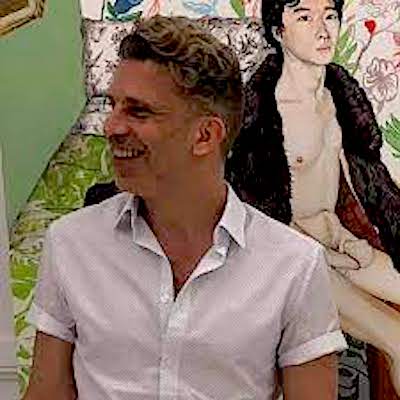
Bruno Leydet

Portraitures by Bruno Leydet

Born in 1968, Bruno Leydet is a Canadian painter who graduated from New York University and is currently based in Montreal. He is a portrait painter whose style was influenced mainly by expressionist painter Alice Neel, known for her portraits of family and friends, and the works of experimental filmmaker Kenneth Anger, whose short films merged surrealism and homoeroticism with a documentary style.

Leydet’s work features a tableaux collection centered on acrylic homoerotic portraitures, which narrate the sitters’ gay identities, surrounded by both pattern-oriented and surreal backgrounds. The inspiration for a work comes to Leydet from a pattern he finds, a historic painting, the model himself, or even a film he has seen. His male figures, even those appearing in groups, are often  displayed with contemplative expressions or with a sense of melancholy amid their exotic surroundings . 

“In the case of “Toile de Jouy Dream,” the painting started with Samuel. He had posed for another painting and had told me that he had this suit made with a toile de Jouy pattern. I knew I had to do a painting of him wearing it. Then almost two years passed, and I had this dream – I often have these weird dreams of these strange landscapes and places in crazy Technicolor, or great big old houses filled with objects. In this dream, I saw a prairie with a row of odd-looking houses, with huge storks made of green tiles in front. And then I thought of putting Samuel in that place, and using the greens and blues to give it this unreal night-time feel and add depth to the surroundings.”

– Bruno Leydet, June 2017

Bruno Leydet is represented by Craven Contemporary for Europe and the United States. The artist’s site is :  https://www.instagram.com/brunoleydetmtl/?hl=en

My thanks to https://doctordee.tumblr.com