
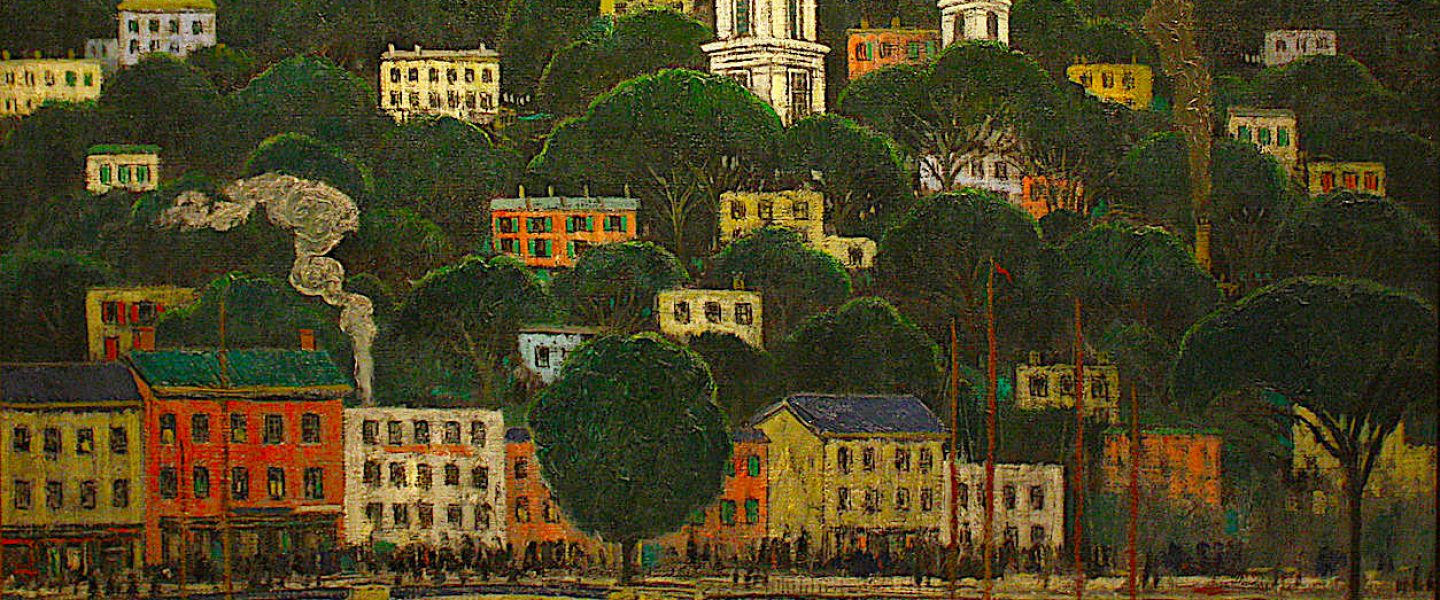
Boris Volck, (Rain in the City)
A fine art, film, history and literature site oriented to, but not exclusively for, the gay community. Please be aware that there is mature content on this blog. Information on images and links to sources will be provided if known. Enjoy your visit and please subscribe.
Boris Volck, (Rain in the City)
Vicente Politeo and Max Cordero, Short Film, 2015, Starring Matias Amunategui
Special effects by Enzo Grimaldos
A man goes trough the physical and psychological pains involved with growing wings. A mystical yet human metamorphosis that depicts an inner confrontation of what makes us the happiest and scares us the most.

Giorgio de Chirico, “The Red Tower”, 1913, Oil on Canvas, Guggenheim Collection, Venice
De Chirico is best known for the paintings he produced between 1909 and 1919, his metaphysical period, which are characterized by haunted, brooding moods evoked by their images. At the start of this period, his subjects were still cityscapes inspired by the bright daylight of Mediterranean cities, but gradually he turned his attention to studies of cluttered storerooms, sometimes inhabited by mannequin-like hybrid figures.
In the paintings of his metaphysical period, de Chirico developed a repertoire of motifs—empty arcades, towers, elongated shadows, mannequins, and trains among others—that he arranged to create “images of forlornness and emptiness” that paradoxically also convey a feeling of “power and freedom”.
According to author Sanford Schwartz, de Chirico—whose father was a railroad engineer—painted images that suggest “the way you take in buildings and vistas from the perspective of a train window. His towers, walls, and plazas seem to flash by, and you are made to feel the power that comes from seeing things that way: you feel you know them more intimately than the people do who live with them day by day.”
Michelangelo Antonioni, the Italian film director, claimed to be influenced by de Chirico. Some comparison can be made to the long takes in Antonioni’s films from the 1960s, in which the camera continues to linger on desolate cityscapes populated by a few distant figures, or none at all, in the absence of the film’s protagonists.


Photographers Unknown, Quinn Christopher Jackson, Photo Shoots

Photographer Unknown, (Teal Pants and the Money Tree)

Photographer Unknown, (The Heat: Holding the Blizzard at Bay)


Photographer Unknown, (Two Pairs of Jeans), Computer Graphics, Gay Film Gifs
“When iron and carbon come together, there emerges steel! To be something stronger and better, you must mostly unite with something else and melt in something else!”
― Mehmet Murat Ildan

A Year: Day to Day Men: 12th of January
Climbing Walls
Author and storyteller Charles Perrault was born in Paris, France on January 12, 1628. He was one of the first writers in European literature who turned his eyes to folklore, laying the foundation for the literary genre of fairy tales .
In 1695, when he was 67, Perrault decided to dedicate himself to his children. In 1697 he published “Tales and Stories from the Past with Morals”, subtitled “Tales of Mother Goose”. These tales, based on French popular tradition, were very popular in sophisticated court circles. Its publication made him suddenly very widely known and he is credited as the founder of the modern fairy tale genre. Naturally, his work reflects awareness of earlier fairy tales written in the salons, most notably by Marie Catherine Le Jumel de Barneville, the Baroness d’Aulnoy, who coined the phrase “fairy tale” and wrote tales as early as 1690.
Some of his popular stories, particularly “Cinderella” and “The Sleeping Beauty”, are still commonly told similar to the way Perrault had written them, while others have been revised over the years. For example, some versions of “Sleeping Beauty” published today are based partially on a Brothers Grimm tale, “Little Briar Rose”, a modified version of the Perrault story. However, the version done by Disney is quite true to the original Perrault tale.
Perrault had written “Little Red Riding Hood” as a warning to readers about men who were trying to prey on young girls who were walking through the forest. He provided the following comment about the lesson provided by the story: “I say Wolf, for all wolves are not of the same sort; there is one kind with an amenable disposition – neither noisy, nor hateful, nor angry, but tame, obliging and gentle, following the young maids in the streets, even into their homes. Alas! Who does not know that these gentle wolves are of all such creatures the most dangerous!” In his story, the girl gets into bed with the wolf and is devoured. There is no happy ending.
He published his collection under the name of his last son, Pierre (Perrault) Darmancourt, probably fearful of criticism from those who favored the classical style of writing as opposed to the new modern writing style common under Louis XIV . In the tales, he used images from around him, such as the Chateau Usse for “The Sleeping Beauty”, and the Marquis of the Chateau de’Oiron as the model for the Marquis de Carabas in “Puss in Boots”. He ornamented his folktale subject matter with details, asides and subtext drawn from the world of fashion.

Artist Unknown, (Sentinels of Zarzura, the Oasis of Little Birds), Computer Graphics, Animation Gifs


Photographer Unknown, (Study with White), Photo Shoot


“Rebel Without a Cause” Screen-test, March 1955


Ho Thuy Tien Water Park, Huong Thuy, Vietnam
Ho Thuy Tien is an abandoned water park in central Vietnam. Opened in 2004 at a price tag of three million US dollars provided by Company Hue Tourism, the water park was only partially completed. Within a few years, the business experienced problems and shortages of funds. As recently as 2013, plans were made to turn it into an eco-park; but these plans never reached fruition. Located eight kilometers outside of the town of Huong Thuy, it now exists as a overgrown jungle purgatory between worlds- with a sometimes quasi-guard at the gate collecting “admission” to the site.

Year: Day to Day Men: January 11
The Stucco Effect
The eleventh day of January in 1494 marks the death of Italian Renaissance painter Domenico Ghirlandaio from pestilential fever at the age of forty-five.
Born in June of 1448 in Florence, Domenico di Tommaso Curradi di Doffo Bigodi was part of the third generation of Florence Renaissance painters among whom were Sandro Botticelli, Andrea de Verracchio, and the Pollaiolo brothers, Antonio, Piero and Simone. Bigodi was known professionally by the name Domenico Ghirlandaio.
Domenico Ghirlandaio received his initial training as an apprentice in his goldsmith father’s workshop where he often made portraits of the shop’s visitors. Ghirlandaio was later apprenticed to painter Alesso Baldovinetti for training in painting and mosaic work. In Florence, he was apprenticed at the workshop of sculptor and painter Andrea de Verracchio and maintained close associations with both Boticelli and the Umbrian school painter Pietro Perugino, who became the teacher of painter and architect Raffaello Sanzio da Urbino, known as Raphael.
Ghirlandaio is predominantly known for his fresco work in which he excelled and a number of important works executed in tempera. Among his fresco works are two depicting the miraculous events at the death of Saint Fina for the city of San Gimignano’s Chapel of Santa Fina; “St. Jerome in His Study”, a companion piece to Botticelli’s “Saint Augustine in His Study” in Florence’s Church of Ognissanti; and several frescoes depicting popes and Biblical scenes at the Palazzo Vecchio.
In 1481, Domenico Ghirlandaio was summoned to Rome by Pope Sixtus IV as part of a team of Umbrian and Florentine painters to create a series of frescoes on the walls of the Sistine Chapel. The foremost of his work there was “The Vocation of the Apostles” that depicts the Gospel narrative of Jesus calling Peter and Andrew to become his disciples. Between 1482 and 1485, Ghirlandaio painted a fresco cycle for the Sassetti Chapel of Santa Trinita that was commissioned by Medici banker Francesco Sassetti and Giovanni Tornabuoni, who later became Ghirlandaio’s patron.
In 1485, Ghirlandaio painted “Adoration of the Shepherds” for the Sassetti Chapel’s altarpiece. Ghirlandaio worked on the Santa Maria Novella, the family chapel of the Ricci family, from 1485 to 1490. For the family, he produced frescoes depicting the lives of the Virgin Mary and St. John the Baptist. In addition to this fresco cycle, he painted no fewer than twenty-one portraits of the Tornabuoni and Tornaquinci families, who provided the finances for the chapel’s restoration.
Domenico Ghirlandaio had a large workshop which included his two brothers, Davide and Benedetto, his brother-in-law Bastiano Mainardi, and later his son Ridolfo, who also became a painter. He had many apprentices over the years, among whom was Michelangelo. Although Ghirlandaio had a long line of descendants, the family name died out in the seventeenth century, when its last members entered monasteries.

Photographer Unknown, (Running Water)

Artist Unknown, SCAD Tarot Cards: Seven of Wands